


_1750326878398.png)

LED Area Flood Lights: What Wattage Is Right for Your Site?
One of the most important choices you will make in any large-scale lighting installation is choosing the proper wattage for LED area flood lights. If you run a busy shipyard, manage a port terminal, or plan fixtures for an offshore platform, the improper wattage translates into lost energy or poor coverage – and both cost you money. Roughly: “rooms” less than 500 m2 need 100W-300W, mid-size industrial spaces need 300W-600W, and large areas such as port aprons or steel mill floors need 800W-1200W. This post will discuss the main elements that determine the optimum wattage for your individual location.
Understanding LED Area Flood Lights and Wattage Basics
Before selecting a fixture, it helps to understand what wattage actually controls and why it matters beyond a simple number on a spec sheet.
What Are LED Area Flood Lights?
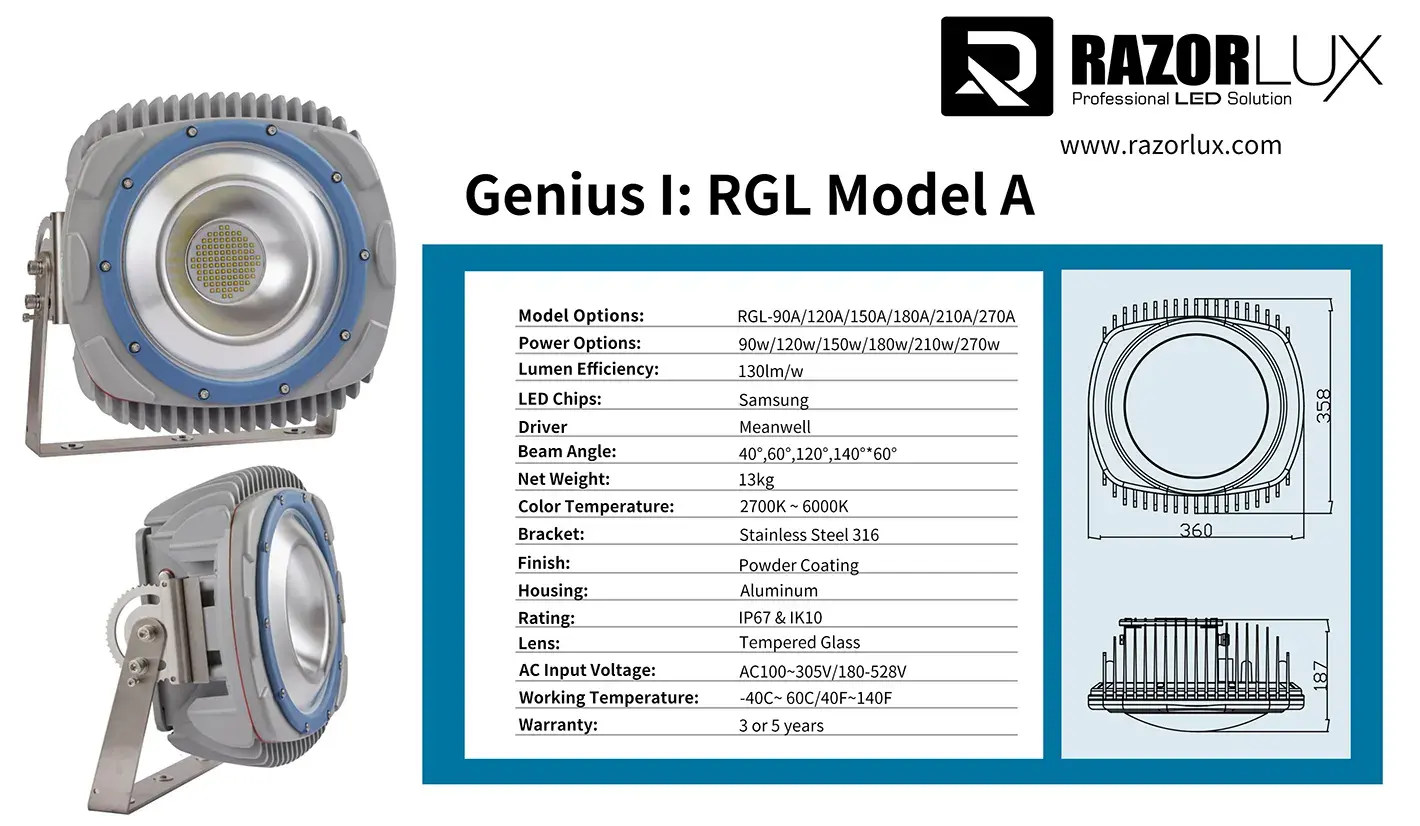
LED area flood lights are high-intensity solid-state lights intended to project wide, homogeneous beams across vast outdoor or industrial areas. Unlike directional spotlights, they diffuse light across a broad range of angles, from a narrow 15° beam to a large 140°×60° area, making them the go-to replacement for legacy high-intensity discharge (HID) lamps like Metal Halide and High-Pressure Sodium. They are the default option for shipyards, port infrastructure, offshore platforms, large industrial floors, and sports venues.
How Wattage Relates to Brightness
Wattage is a measure of electrical power use, not how brilliant the light will be. Measured in lumens. Brightness. For procurement purposes, light effectiveness, or lumens per watt (lm/W), is what's important. A 1000W fixture rated at 130 lm/W delivers 130,000 lumens. You'd need a 1000W Metal Halide lamp to provide the same lumen output, and it would use the same amount of electricity, but you'd get far fewer usable lumens owing to omnidirectional light loss. More efficient means you reach the needed level of lux at a cheaper operational cost.
Why Getting Wattage Wrong Is Expensive
Over-specifying wattage raises energy expenditures and thermal load on the fixture. Under-specification creates dark zones that pose a safety risk, especially in locations where cranes operate, ship loading docks, and refinery platforms where visibility is an issue of people safety. According to the US Department of Energy’s 2023 Solid-State Lighting Report, up to 18% of energy use in the first year of operation is wasteful due to incorrect lumen targeting for industrial LED retrofits.
Factors to Consider When Choosing Wattage for Different Sites
Wattage selection is never a one-size-fits-all decision. Several site-specific variables feed into the calculation before any fixture is specified.
Site Area, Mounting Height, and Target Lux Level
Wattage is driven by three variables: floor area (m2), height of mounting (meters), and the lux level necessary as prescribed by relevant standards. The Illuminating Engineering Society (IES) recommends minimum illumination levels of 20–50 lux for ordinary outdoor industrial locations, and 100–300 lux for busy working zones such as cargo handling areas or machine operating floors. Simplified lumen estimate formula: Required Lumens = (Lux level x Area) / Coefficient of Utilization. This formula immediately tells you how many fixtures, at what wattage, you need.
Environmental Conditions and Protection Ratings
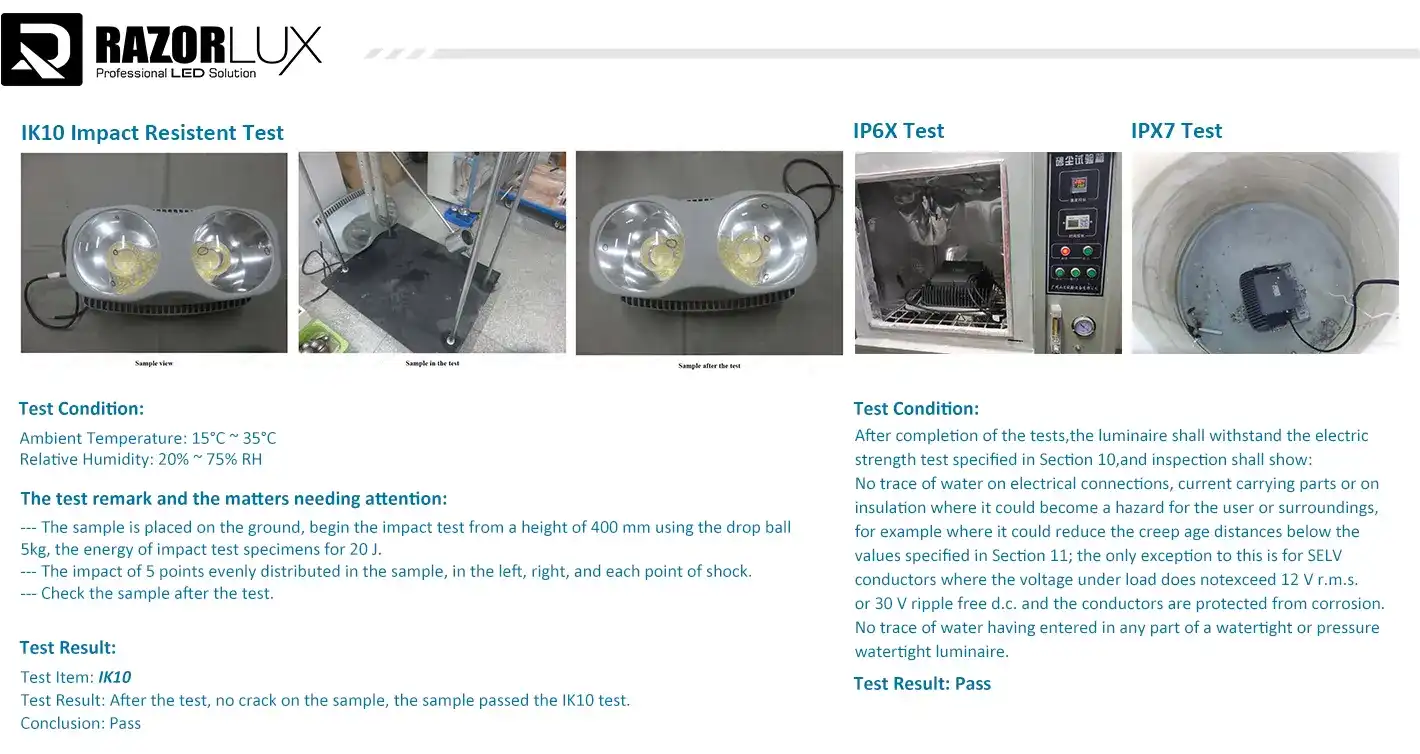
Salt spray, humidity, vibration, and severe temperatures can impact fixture performance and longevity. Locations such as Nordic seas, the Middle East, or Southeast Asian port settings necessitate at least an IP67 classification – complete dust exclusion and immersion protection. In shipyards and heavy industrial environments, where mechanical shock is an everyday occurrence, impact resistance certified at IK10 is required. Fixtures should also be reliable throughout a wide variety of ambient temperatures. The Razorlux RGL-1000A, for example, works from −40°C to +60°C, and is suited for use on Norwegian offshore rigs and Gulf port terminals alike.
Regulatory Compliance and Certification Requirements
Oil and gas and marine and port industries have high certification requirements for their procurement teams. International standards such as CE, RoHS, DNV/GL, ABS, and UL are not optional; they are contractual requirements. In the US, DLC (Design LED area flood lights Consortium) listing is typically a prerequisite to qualify for utility rebate programs that may cut overall procurement cost by 10-30%. Make sure a fixture has the right certifications for your regional market before choosing wattage to avoid expensive project delays.
Comparison: LED Area Flood Lights Wattage vs. Traditional Flood Lights
The efficiency gap between LED and legacy flood lighting technology is substantial, and understanding it helps justify specification decisions to management and finance teams.
| Parameter | 1000W LED (Razorlux RGL-1000A) | 1000W Metal Halide | 1000W High-Pressure Sodium |
|---|---|---|---|
| Lumen Output | 130,000 lm | ~90,000 lm | ~105,000 lm |
| Luminous Efficacy | 130 lm/W | ~90 lm/W | ~105 lm/W |
| Rated Lifespan | 50,000+ hrs | ~15,000 hrs | ~24,000 hrs |
| Re-strike Time | Instant | 5–15 minutes | 3–5 minutes |
| Maintenance Interval | Low | High | Moderate |
| CRI | Ra >75 | Ra ~65 | Ra ~25 |
Energy Savings Over a 5-Year Period
At the U.S. average industrial power rate of $0.12/kWh, running one 1000W Metal Halide fixture for 4,000 hours per year costs about $480 per year. And an LED fixture that provides the same or higher light output at the same wattage still comes out ahead in overall cost due to drastically reduced frequency of maintenance. Swap 10 Metal Halide lights with LED counterparts, and you’ll save between 30-50 bulb and ballast repairs over five years – a huge labor and parts savings for port maintenance staff.
Color Rendering and Operational Safety
High-pressure sodium lights have a CRI of around 25; thus, colors seem distorted beneath them. This is a major safety hazard in sorting goods, identifying vehicles, and inspecting equipment. The high CRI Ra >75 LED flood lights provide a far more accurate visual image, and this is important in locations where misreading a valve, cable color, or danger marking might lead to an incident. This is not a cosmetic argument but an operational safety argument that can be documented and supported by the technical departments.
Total Cost of Ownership
Procurement teams that focus primarily on the upfront price of a fixture often overlook the total cost of ownership (TCO). LED fixtures also boast a longer L70 lifetime, often 50,000 hours compared to 15,000 hours for Metal Halide. A shipyard operating 50 lights will have to replace Metal Halide bulbs around three times in a 10-year period, but an LED array will not need replacement. Add crane access labor for high mast maintenance at $ 200- $ 400 per fixture per event, and the TCO case for LED is quite obvious.
Best Practices for Installing LED Area Flood Lights Based on Wattage
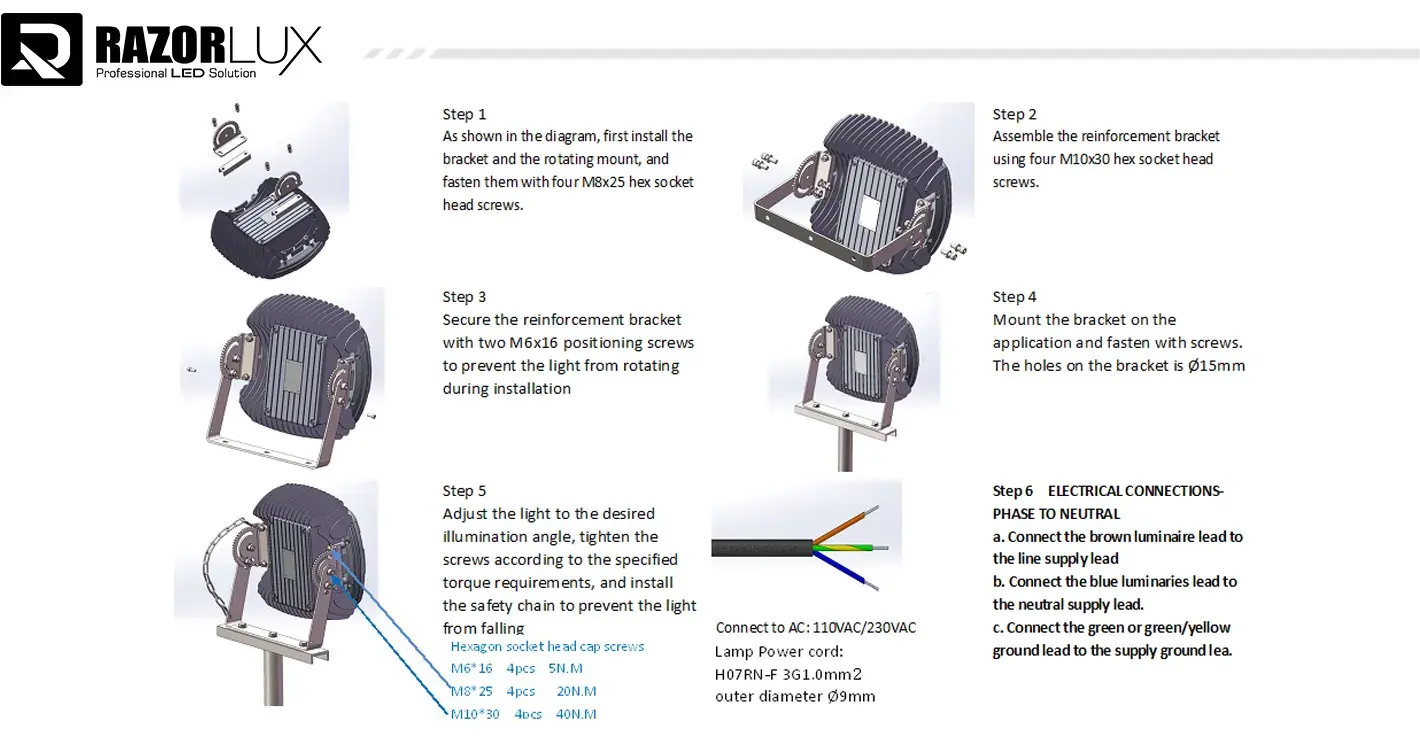
Correct wattage selection is only half the equation. Installation practice determines whether the specification performs as calculated.
Pre-Installation Lux Calculation
Do a photometric calculation using software such as DIALux or Relux before ordering fixtures. Input site dimensions, mounting points, target lux levels, and fixture photometric data (IES files). The output will indicate if the wattage you choose meets the needed uniformity ratio (usually a minimum of 0.4:1 for industrial spaces) and any dark zones that need more fixtures or repositioning.
Mounting Position and Beam Angle Selection
Coverage footprint is directly affected by beam angle. Razorlux RGL-series LED area flood lights are available in seven beam angle options: 15, 20, 30, 40, 60, 120, and 140 ° x 60 °. A 15° or 20° beam is good for high-mast pole installation over 20 meters, focusing the lumens where you need them. A 120° or 140°×60° beam is useful for perimeter wall attachment when extensive wash coverage is desired. An incorrect beam angle at the installation point results in wasted lumens and unwanted glare to ground people.
| Site Type | Recommended Wattage | Beam Angle | Mounting Height |
|---|---|---|---|
| Ship deck / working platform | 200W–400W | 60°–120° | 6–10 m |
| Port cargo terminal | 400W–800W | 40°–60° | 15–25 m |
| Offshore platform work deck | 500W–1000W | 30°–60° | 10–20 m |
| Steel mill / heavy industrial floor | 600W–1000W | 60°–120° | 12–20 m |
| Airport apron / runway perimeter | 800W–1200W | 15°–40° | 20–30 m |
Integrating Smart Controls
High-wattage LED floodlights with motion sensors or photocell dimmers may be used to provide meaningful energy savings without sacrificing safety. For example, if a 1000W fixture is dimmed to 50% during low-use times, it will use 500W. The Meanwell drivers in Razorlux fixtures natively accept 0-10V dimming, making integration uncomplicated. According to the Lawrence Berkeley National Laboratory’s 2022 research on industrial lighting controls, port facilities that operate 24/7 may cut their yearly lighting energy cost by 20-35% by using a sensor-controlled dimming schedule.
How to Procure LED Area Flood Lights: Choosing the Right Supplier and Product
Procurement for large-scale industrial and maritime projects is not only a comparison of unit pricing. Project success depends on supplier technical depth, certification portfolio, and supply chain stability.
Evaluating Supplier Credentials
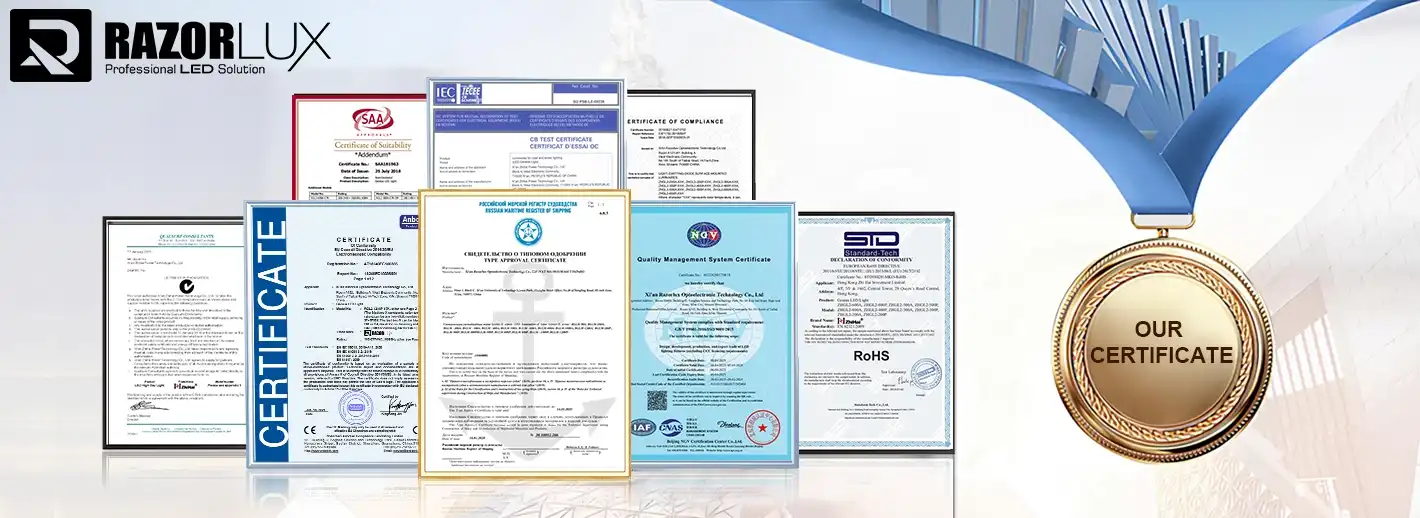
You may audit a reputable LED area flood light manufacturer for certifications for your market. Look for UL listing and DLC certification in North America. “CE and RMRS are standard for European marine projects.” “Compliance with SAA and C-Tick is required for Australian ports. Razorlux products are certified with CE, RoHS, SAA, C-Tick, UL, DLC, CB, RMRS and ISO 9001 for the primary procurement markets in the Americas, Europe, Oceania and Southeast Asia.
Reading Specifications Critically
A 1000W fixture may not behave like another 1000W fixture. So what to check for? Total lumen output (not just watts); effectiveness (lm/W); driver brand and model number; LED chip brand; IP and IK ratings; and operating temperature range. Razorlux RGL-1000A with Samsung or Philips LED chips and a Meanwell driver delivers 130,000 lm @ 130 lm/W and includes independently confirmed performance data sheets for components. These are the details that matter when your technical team is verifying the specification, or when the project is put out to public tender.
Assessing After-Sales and Supply Chain Support
The worst situation for shipyards and offshore operators is a fixture failure in the midst of a project with no parts to repair it or expert support to help. When choosing suppliers, ask about: minimum lead times, spare parts availability, technical documentation packages (IES files, wiring diagrams, installation instructions), warranty duration. Razorlux provides a standard 5 year warranty with technical advice, installation support, and fast troubleshooting. DHL express (3-7 days) or sea freight (15-50 days) delivery options are available to assist procurement teams in meeting delivery dates with project timelines.
Conclusion
If you’re picking outdoor or industrial LED area flood lights, wattage is the start, not the finish line. The right amount depends on site size, mounting height, targeted lux levels, ambient conditions, and the efficacy of the light you choose. LED technology, properly set, has a longer lifespan and lower maintenance burden than any earlier technology, and also produces more lumens per watt. Procurement teams may specify defensively to suit the demands of both technical reviewers and financial departments using 130 lm/W rated fixtures, verifiable certificates, quality drivers, and proven chip sources. Do the math from the get-go, and the lighting system will function for decades without any problems.
FAQ
1. Does higher wattage always mean more brightness?
No. Brightness depends on lumens, not watts. A 400W LED fixture at 130 lm/W produces 52,000 lumens—more than a 600W fixture running at 80 lm/W. Always specify by lumen output and luminous efficacy, not wattage alone.
2. What IP rating do I need for a marine or port environment?
IP67 is the practical minimum for ship decks, dock infrastructure, and coastal industrial sites. It confirms full dust exclusion and protection against temporary immersion. For areas subject to direct wave wash or pressure cleaning, IP68 testing provides additional assurance.
3. Can I use the same fixture wattage for both indoor and outdoor industrial areas?
Wattage requirements differ based on ceiling height, reflectance, and target lux levels. Outdoor areas typically need higher wattage due to zero reflectance contribution from surfaces. Always run a site-specific photometric calculation rather than applying indoor specifications to outdoor zones.
4. What beam angle should I specify for high-mast port lighting?
For mast heights above 20 meters, a 15°–30° beam angle concentrates the lumen output where it is needed and avoids excessive light spill. For lower mounting at 8–12 meters, a 60°–120° beam provides broader, more even coverage across the work area.
5. How do I verify that a supplier's certifications are genuine?
Request the certificate document, including the issuing body's reference number, and verify directly with the certification body's online registry. For UL, use the UL Product iQ database. For DLC, use the DesignLights Consortium's QPL database. Both are publicly searchable.
Request a Wattage Consultation from Razorlux — Your LED Area Flood Lights Supplier
Razorlux has supplied high-performance LED area flood lights to shipyards, port terminals, offshore platforms, and heavy industrial facilities across North America, Europe, Southeast Asia, and beyond. Our engineering team provides photometric calculations, product selection guidance, and complete documentation packages at no charge. Whether you need a single sample for technical evaluation or a bulk order with framework contract terms, we respond promptly with full specifications and competitive pricing. contact us at sam@razorlux.com to request a quote or download product data sheets today.
References
1. U.S. Department of Energy — 2023 Solid-State Lighting R&D Opportunities Report, Office of Energy Efficiency & Renewable Energy, 2023.
2. Illuminating Engineering Society — IES Lighting Handbook, 10th Edition, Illuminating Engineering Society of North America, 2011.
3. Lawrence Berkeley National Laboratory — Energy Savings Potential of Solid-State Lighting in Niche Applications, LBNL, 2022.
4. DesignLights Consortium — Commercial LED Lighting Technical Requirements, DLC Technical Requirements Document v5.1, 2022.
5. Navigant Research (Wood Mackenzie) — LED Lighting for Industrial and Outdoor Applications: Market and Technology Assessment, 2021.
6. International Electrotechnical Commission — IEC 60598-2-3: Luminaires — Part 2-3: Particular Requirements for Luminaires for Road and Street Lighting, IEC, 2022.