


_1750326878398.png)

400W Equivalent LED Flood Light vs HID: Which Is Better?
Chances are, if you are the procurement manager of a shipyard, port facility, or major industrial complex, you have been asked this question. The quick answer is that a 400W-equivalent LED floodlight wins on almost every quantifiable criterion – energy draw, service life, maintenance load, and certification compliance. Razorlux’s RGL2-400P model, for instance, uses a 400W equivalent LED flood light overall and outputs 48,000 lumens at 130 lm/W, replacing HID sources from 400W to 600W. That one data point conveys much of the tale. The whole narrative is worth reading before your next procurement cycle.
Understanding LED Flood Light and HID Technology
Before comparing the two technologies side by side, it helps to understand exactly what each one is and how it works at a technical level.
What Is a 400W Equivalent LED Flood Light?
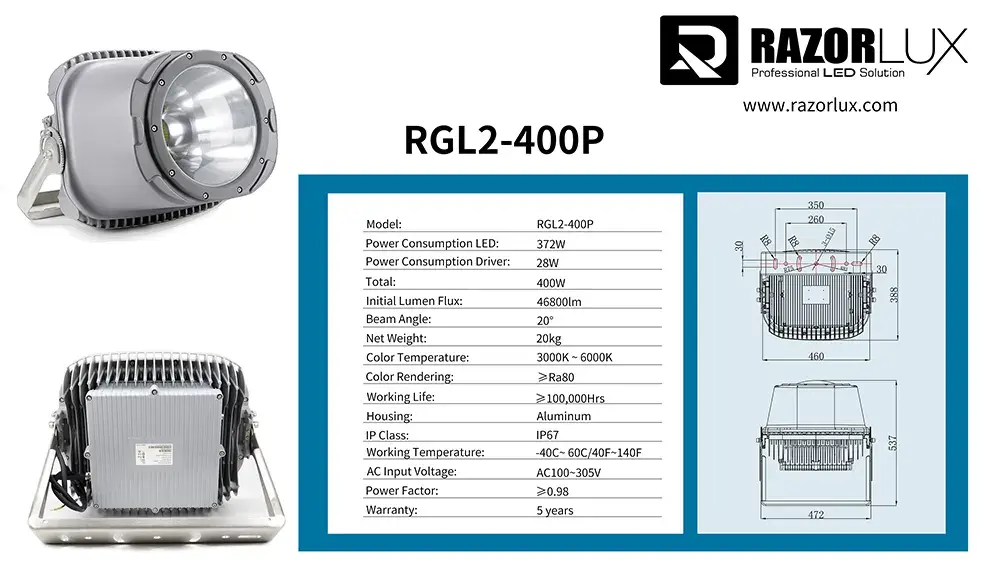
LED Flood Light 400W Equivalent: A solid-state light fixture that provides the same or better light output than a 400W metal halide or high-pressure sodium (HPS) bulb, but with a fraction of the power consumption. LED Flood Light: The Razorlux RGL2-400P consumes 400W overall, 360W for the LED array and 40W for the Meanwell driver. It delivers a consistent 48,000 lumens after one hour at 5700K. The fixture handles AC 110-480V and DC 100-800V; therefore, it is compatible with almost all grid standards throughout the globe without an extra adapter.
What Are HID Technologies?
HID is a blanket term for metal halide (MH), high-pressure sodium (HPS), and mercury vapor lamps. Both types produce light by running an electric arc through a pressurized gas. Metal halide lamps are the most frequent HID option for flood applications and emit a white light with a CRI usually between 65 and 80. HPS lamps have a higher raw lumen-per-watt efficiency but create an orange-yellow light with a CRI of less than 25, making it difficult to distinguish colors in an industrial setting.
Key Differences at a Glance
The table below summarizes the core technical differences between a modern LED flood light and a standard 400W metal halide HID fixture.
| Parameter | Razorlux RGL2-400P LED | 400W Metal Halide HID |
|---|---|---|
| Actual Power Draw | 400W | 400–460W (ballast included) |
| Lumen Output | 48,000 lm | ~32,000 lm (initial) |
| Luminous Efficacy | 130 lm/W | ~80 lm/W |
| Rated Service Life | ≥50,000 hours | 15,000–20,000 hours |
| Warm-Up Time | Instant | 3–15 minutes |
| CRI | ≥Ra75 (Ra80/Ra90 available) | 65–80 |
| IP Rating | IP67 | IP54–IP65 (typical) |
| IK Rating | IK10 | IK06–IK08 (typical) |
| Operating Temperature | −40°C to +60°C | −20°C to +50°C |
These numbers alone justify a closer look at each performance category.
Performance and Efficiency: LED vs HID Flood Lights
Raw specifications only tell part of the story. How each technology performs in the field — especially in harsh marine and industrial conditions — is what procurement engineers really need to know.
Brightness and Light Quality
Metal halide lamps suffer from lumen degradation and lose 20% of their original brightness in the first six months of operation. When the rated life ends, the output may be less than 50% of the original value. The RGL2-400P maintains its power for the whole 50,000-hour rating (L70 designation signifies that 400W Equivalent Led Flood Light output remains over 70% of the original). The 50,000 hours is about 8.5 years of continuous operation for a dock facility running 16 hours per day before any maintenance is needed.
The practical benefit of the CRI also counts. A CRI of Ra75 or more allows workers to reliably recognize color-coded electrical wiring, pipe markings, and safety signs. That is almost impossible with HPS lamps at CRI <25 and is a real safety hazard in OSHA-regulated areas.
Beam Angle and Light Distribution
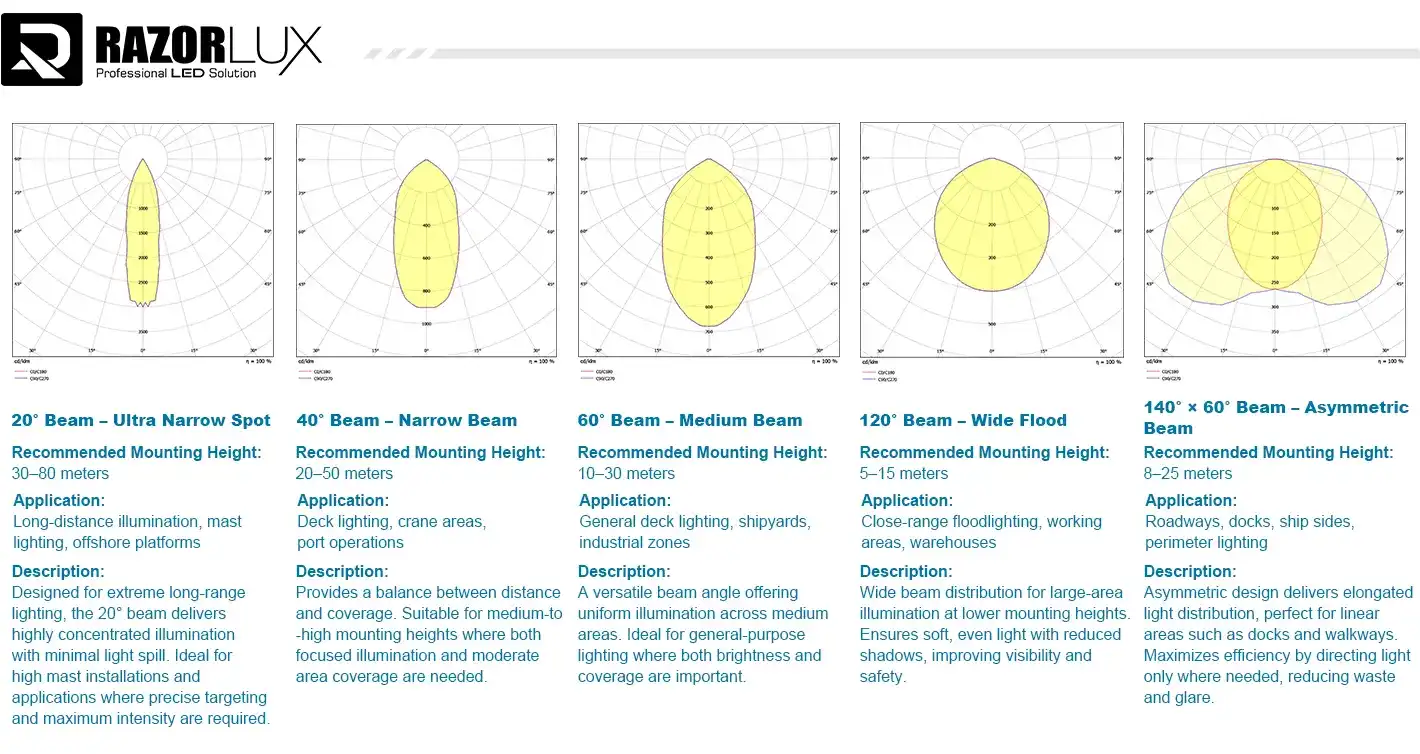
The RGL2-400P is offered with 3 beam angles: 15°, 20°, and 30°. This kind of optical control is not possible from HID sources, as they are omnidirectional and need a reflector to divert the light. In HID lights, reflector efficiency is often 60% to 75%. This means up to 40% of the light produced is lost before it ever reaches the work surface. LED optics help to focus the light exactly where it’s required, allowing for improvements in uniformity ratios and reducing glare for people working underneath the fixture.
Weather Resistance and Durability
The RGL2-400P is IP67 rated, meaning it is entirely protected against dust intrusion and can resist brief immersion in water up to 1 meter. It has an IK10 impact rating, meaning it can withstand a 20-joule mechanical impact (about similar to the force of a 5 kg weight dropped from 40 cm) without harm. The stainless steel bracket is resistant to salt spray corrosion, and the aluminum housing with powder coating is resistant to humidity and temperature cycling, which are frequent on ship decks and offshore platforms. IP67 or IK10 is seldom achieved with standard HID flood fixtures in the same package.
Cost, Energy Savings, and Environmental Impact
Purchasing managers who focus only on unit price often underestimate the true cost of HID lighting over a project's lifetime. Total cost of ownership (TCO) tells a very different story.
Initial Cost vs Total Cost of Ownership
A 400W metal halide fixture could be cheaper to buy. MH lights generally last between 15,000 and 20,000 hours before they need to be replaced. That’s a new one every 2.5 to 3.5 years at 16 hours of operation every day. Each bulb replacement entails the expense of the lamp, the ballast (which frequently fails independently), technician work, and any temporary illumination during the downtime window. Those expenditures amount to tens of thousands of dollars every maintenance cycle for a port facility operating 200 fixtures.
The RGL2-400P comes with a 5-year guarantee on the LED module and Meanwell driver, and a 10-year warranty on the housing, thereby eliminating that maintenance cycle throughout the warranty term. Across every independent lifetime cost study issued by the U.S. Department of Energy’s Better Buildings Program, LED’s TCO is consistently cheaper than HID’s across the 10-year operating window.
Energy and Carbon Savings
Here are the core energy figures worth carrying into your next procurement comparison:
- Efficacy gap: At 130 lm/W versus roughly 80 lm/W for metal halide, the RGL2-400P produces 63% more light per watt consumed.
- Annual energy savings (single fixture, 16 hrs/day): Replacing a 460W MH system (lamp + ballast) with the 400W LED saves approximately 350 kWh per year per fixture.
- Fleet savings (200 fixtures): 70,000 kWh per year, which, at the U.S. commercial average of $0.12/kWh, equals $8,400 in annual electricity costs avoided.
- Carbon reduction: 70,000 kWh saved equals approximately 49 metric tons of CO₂ avoided annually, based on the EPA's national average emissions factor.
These savings also support DLC and ENERGY STAR compliance reporting, which matters for facilities pursuing sustainability certifications or government incentive programs.
Environmental Compliance Advantages
HID lamps, particularly mercury vapor types, contain hazardous materials that require regulated disposal. Metal halide lamps also contain mercury. 400W Equivalent LED Flood Lights contain no mercury, and the RGL2-400P holds RoHS certification confirming it meets European Union restrictions on hazardous substances. CE, UL, DLC, SAA, C-Tick, and CB certifications cover the product for use in the U.S., European, and Australian markets. For procurement teams assembling documentation packages for government tenders or DNV/ABS vessel inspections, this certification portfolio reduces compliance preparation time considerably.
Practical Use Cases and Installation Considerations
Knowing that LED outperforms HID on paper is useful. Seeing where it has been deployed successfully builds the confidence that purchasing teams need before committing to a bulk order.
Industrial and Marine Applications
The table below maps the RGL2-400P to common application scenarios alongside the key specification that makes it suitable for each environment.
| Application | Key Requirement Met | Relevant Spec |
|---|---|---|
| Ship deck lighting | Salt spray and vibration resistance | IP67, IK10, stainless steel bracket |
| Offshore platform perimeter | Extreme temperature operation | −40°C to +60°C working range |
| Shipyard work area | High-uniformity task lighting | 48,000 lm, 15°/20°/30° beam options |
| Port container terminal | 24/7 reliability, instant restart | Meanwell driver, ≥50,000-hour life |
| Steel mill production floor | Dust and heat resistance | IP67, aluminum housing, wide voltage input |
| Warehouse security perimeter | Motion sensor compatibility | Dimmable driver, instant-on capability |
Each of these scenarios represents a real deployment context where HID technology has been phased out in favor of LED over the past decade, driven primarily by maintenance cost reduction and improved safety compliance.
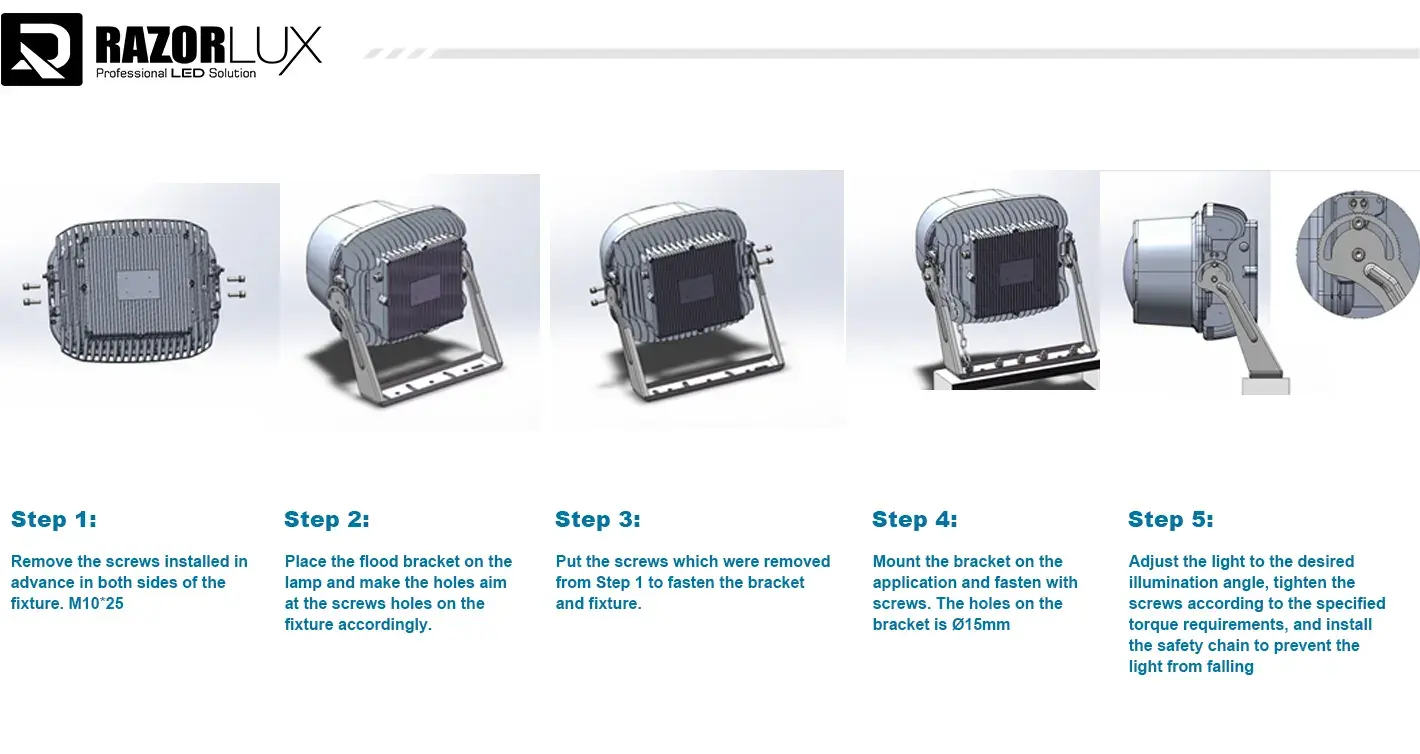
Installation and Wiring Compatibility
The RGL2-400P accepts AC input from 110V to 480V without any additional adapter, and DC input from 100V to 800V. This range covers U.S. 120V and 277V commercial circuits, European 230V systems, 480V industrial three-phase feeds, and DC shipboard power systems — all from a single SKU. Installation teams do not need to stock multiple fixture variants for mixed-voltage projects.
The power factor of ≥0.98 and THD below 10% mean the fixture imposes minimal harmonic distortion on the supply circuit, which matters in marine electrical systems where clean power is essential for sensitive navigation and communication equipment sharing the same bus.
Integration with Smart Controls
The Meanwell driver in the RGL2-400P supports dimming and integration with 0–10V control systems. This allows the fixture to work with motion sensors, daylight harvesting controllers, and building management systems (BMS). In a warehouse application, pairing these fixtures with occupancy sensors typically reduces runtime by 30% to 40%, adding another layer of energy savings beyond the base efficacy improvement over HID. HID sources cannot be dimmed effectively and require a full restart cycle after being switched off, making them incompatible with motion-sensor control strategies.
Choosing the Right Flood Light: Decision-Making Criteria for B2B Buyers
With the performance and cost data established, the question shifts to how procurement professionals should structure their evaluation and selection process.
Essential Technical Metrics to Evaluate
When specifying a flood light for industrial or marine procurement, the following parameters should appear on every technical review checklist. Each one directly affects long-term performance and total cost:
- Luminous efficacy (lm/W): A minimum of 130 lm/W is the current performance benchmark for premium industrial LED flood lights. The RGL2-400P meets this threshold exactly.
- IP and IK ratings: IP67 and IK10 are the appropriate ratings for outdoor industrial and marine environments. Products rated only IP65 or IK08 carry a higher risk of ingress failure in salt spray or high-vibration settings.
- CRI: Ra75 is the minimum for general industrial work. Ra80 or Ra90 is available from Razorlux on request for color-critical inspection areas.
- Operating temperature range: −40°C to +60°C covers Arctic shipyard environments through Middle Eastern port conditions.
- Input voltage flexibility: Wide-range AC/DC input eliminates the need for multiple product variants across different geographic markets.
- Certification portfolio: CE, UL, DLC, RoHS, SAA, and CB certifications are essential for cross-market procurement. DNV/GL or ABS marine certification should be confirmed for vessel applications.
These criteria should form the technical scoring criteria in your supplier evaluation matrix.
Comparing Major Suppliers
“Philips, GE, Cree and Osram all make great LED flood fixtures, and each has strengths in different market segments,” says Davidson. Both Philips and Osram have a strong presence in the European commercial and municipal sectors. Cree has a strong DLC Premium listing for North American energy incentive schemes. GE’s current industrial LED range is mostly focused on the North American market.
Razorlux provides a new set of benefits that are of special interest to customers in the maritime and heavy industrial sectors. The firm was founded in 1998 as Xi'an Zhihai Power Technology Co., Ltd. and has been in business for more than 25 years. It has over 200 patents in LED Packaging, power management, and structural design. Its products have UL, CE, SAA, RoHS, RMRS, and TUV certificates. The firm provides OEM and ODM services, bespoke beam angles, color temperatures ranging from 2700K to 6500K, and custom voltage combinations – a level of project-specific flexibility seldom seen with catalog-driven global brands at reasonable cost.
Procurement and Supplier Reliability Considerations
For B2B customers that purchase in bulk, supplier dependability is as vital as product specification. A delay in delivery of a lighting order might delay the commissioning of a ship or the accreditation of a building. Razorlux can accommodate tight project schedules with substantial inventory stocks available for fast delivery and flexible transportation by air, rail, and sea. It is also possible to place sample orders for technical assessment prior to the bulk commitment. This is the usual procurement process used by most engineering departments.
For big customers, T/T wire transfer and Letter of Credit are popular payment options. Framework purchase agreements are used for regular procurement connections, and the company’s ISO 9001 quality management accreditation ensures inbound quality paperwork is standardized and can be audited.
Conclusion
The competition between 400W Equivalent LED Flood Light isn’t even a contest anymore. LED wins outright in effectiveness, maintenance cost, service life, environmental compliance, and installation flexibility. This is what the Razorlux RGL2-400P model does, offering 48,000 lumens at 130 lm/W, IP67/IK10 protection, a Meanwell driver, and a certification portfolio for all the key markets. For procurement teams in shipyards, ports, offshore platforms and heavy industries, the move from HID to LED is not a matter of if, but which product and provider to trust with a long-term commitment. That response has been supplied by Razorlux since 1998.
FAQ
1. How long does an LED flood light last compared to an HID lamp?
The RGL2-400P is rated for ≥50,000 hours at L70, meaning it maintains at least 70% of initial output for that duration. A standard 400W metal halide lamp is typically rated for 15,000 to 20,000 hours, and its output degrades significantly before that point. LED service life is two to three times longer than comparable HID sources under normal operating conditions.
2. Can 400W equivalent LED flood lights work with dimming systems?
Yes. The Meanwell driver in the RGL2-400P supports 0–10V dimming and is compatible with standard occupancy and daylight sensors. HID sources cannot be effectively dimmed — they require a full arc restart cycle after shutdown, which takes 3 to 15 minutes and stresses the lamp and ballast.
3. What certifications should I look for when buying industrial LED flood lights?
For general international procurement, look for CE, RoHS, UL, and DLC. For marine applications, confirm RMRS, DNV/GL, or ABS certification depending on the flag state. For Australian projects, SAA and C-Tick are required. Razorlux's RGL2-400P holds CE, RoHS, UL, DLC, SAA, C-Tick, and CB certifications.
4. What maintenance does an LED flood light require in a marine environment?
Under normal operating conditions, the RGL2-400P requires no lamp or ballast replacement during its rated 50,000-hour service life. Periodic cleaning of the lens surface is recommended in salt spray environments. The IP67 housing prevents internal corrosion, and the stainless steel bracket resists surface oxidation.
Request a Quote for Razorlux 400W LED Flood Lights
Razorlux has supplied industrial and marine LED lighting solutions to shipyards, offshore platforms, and port facilities across four continents since 1998. The RGL2-400P 400W Equivalent Led Flood Light is available for sample evaluation before bulk ordering. As a trusted 400W equivalent LED flood light manufacturer, Razorlux offers full certification documentation, OEM/ODM customization, and dedicated technical support. Contact our team directly at sam@razorlux.com to request a quote, download the product datasheet, or discuss project-specific requirements with a lighting engineer.
References
1. U.S. Department of Energy, Office of Energy Efficiency & Renewable Energy — Energy Savings Forecast of Solid-State Lighting in General Illumination Applications, 2022.
2. Illuminating Engineering Society (IES) — IES LM-80: Measuring Lumen Maintenance of LED Light Sources, 2020.
3. U.S. Environmental Protection Agency (EPA) — Emissions & Generation Resource Integrated Database (eGRID), 2023.
4. DesignLights Consortium (DLC) — Technical Requirements for Solid-State Lighting Products (QPL v5.1), 2022.
5. International Electrotechnical Commission (IEC) — IEC 60598-1: Luminaires — General Requirements and Tests, 2020.
6. U.S. Department of Energy, Better Buildings Program — Solid-State Lighting Technology Assessment: LED Flood and Area Lighting, 2021.