


_1750326878398.png)

Why Choose LED Marine Flood Lights for Marine Applications?
LED maritime flood lights are purpose-built fixtures that provide steady, high-intensity marine flood lighting over ship decks, offshore platforms and port facilities – under circumstances that would send traditional fixtures packing in a matter of months. Saltwater corrosion, mechanical vibration and high temperature changes are everyday elements of marine work conditions. Switching from halogen or high-pressure sodium (HPS) to LED technology may cut energy usage by up to 80%, while increasing operational life to more than 50,000 hours. Every great buying choice starts with B2B procurement teams knowing what makes purpose-built marine flood lights different from a generic outdoor fixture.
Understanding LED Marine Flood Lights and Their Advantages
Before comparing products or requesting quotes, procurement managers need a clear picture of what makes marine-grade LED flood lights technically distinct from ordinary commercial lighting. The differences are not cosmetic—they are structural, material, and electrical.
What Makes Marine Flood Lights Different from Standard Fixtures
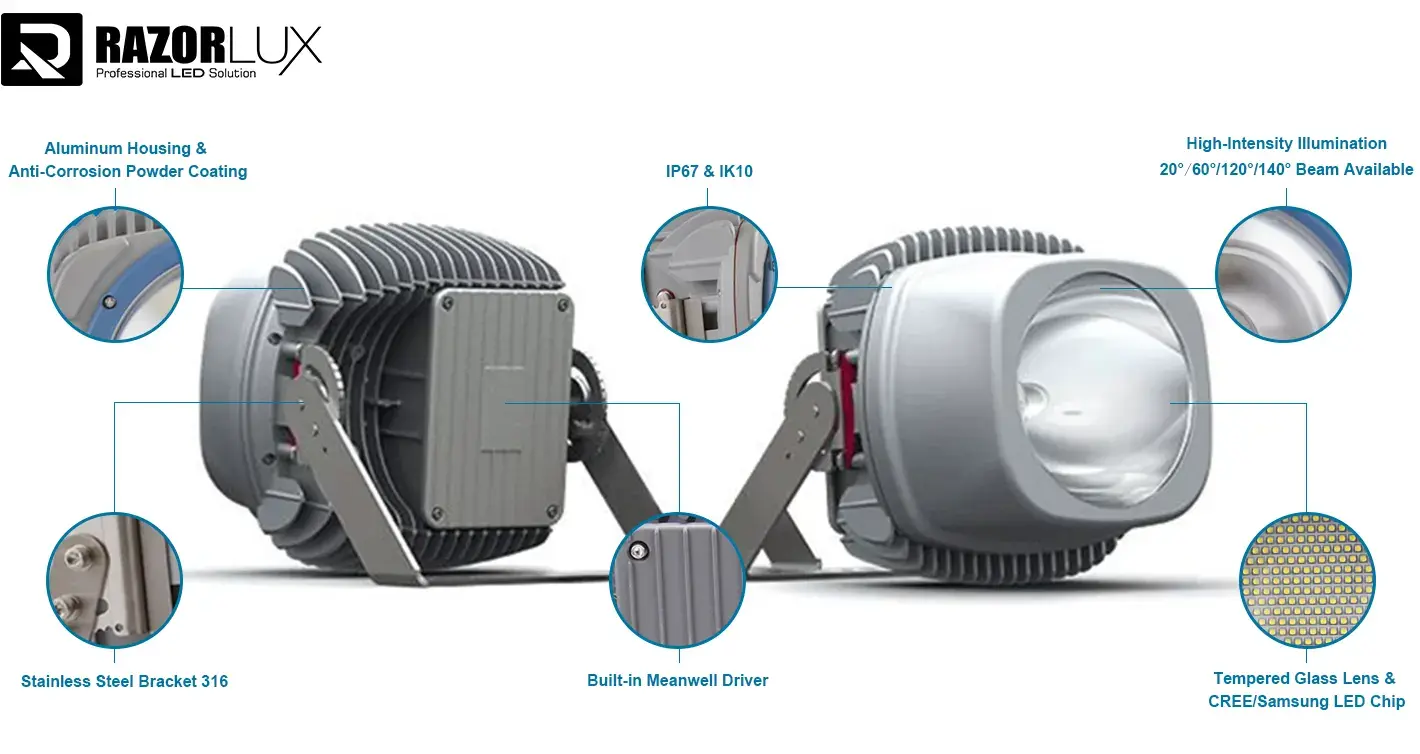
Standard outdoor floodlights are meant for protected land use. Marine fixtures must stand up to salt spray, the pressure of being underwater, high-frequency engine vibration, and large changes in ambient temperature, frequently all at once. Housings are made of low-copper die-cast aluminum or 316L stainless steel, lenses are made of UV-stabilized polycarbonate or tempered glass, and internal seals must preserve integrity during prolonged temperature cycling. These technical criteria are not optional on the water: They are what decide whether a fixture survives its first winter at sea or fails prematurely and drives up maintenance expenses.
Key Performance Metrics That Matter to Engineering Teams
When a technical department evaluates the LED deck lighting specs, there are usually three statistics that are the basis of the evaluation: luminous efficacy (lm/W), ingress protection rating (IP class), and the working temperature range. 130 lm/W signifies that the fixture generates 130 lumens of visible light per watt of electricity consumed — substantially higher usable output than a 70-90 lm/W halogen counterpart. The minimum for open deck installation is IP67 certification, which guarantees that the device will resist brief immersion in water up to one meter for 30 minutes. The operational range of -40°C to +60°C encompasses both Arctic maritime channels and Middle Eastern offshore sites.
LED Technology vs. Legacy Halogen and HPS Lamps
Halogen lights produce a lot of infrared heat, requiring frequent bulb replacements (usually every 1,000–2,000 hours) and use much more electricity for the same lumen output. HPS lamps are more efficient than halogen but need warm-up time, contain mercury, and do not meet RoHS compliance criteria. LED technology has no warm-up time, no hazardous ingredients, and a 50,000-hour rated life decreases replacement frequency by a factor of 25 compared with halogen. For vessels that operate 24/7, such a decrease in maintenance frequency translates directly to reduced lifespan costs and fewer disruptions to planned operations.
Critical Factors to Consider When Choosing Marine Flood Lights
Procurement professionals sourcing vessel deck lights or port area marine flood light fixtures face a structured evaluation process. Several technical and logistical factors determine whether a product passes the engineering review stage and advances to supplier negotiation.
IP Rating and Impact Resistance Classification
IP67 is the standard for open-deck maritime applications, meaning the structure is dust-tight and protected against temporary water immersion for marine flood lights. The IK10 impact resistance grade – equivalent to protection from 20 joules of impact energy – is critical on working decks where tools, equipment, and cargo movement generate continual mechanical risks. Products with IP67 and IK10 classifications are independently tested against these criteria, not only asserted by the maker. Procurement teams should seek IEC 60529 and IEC 62262 test certifications rather than relying just on specification sheet assertions.
Lumen Output, Beam Angle, and Coverage Area
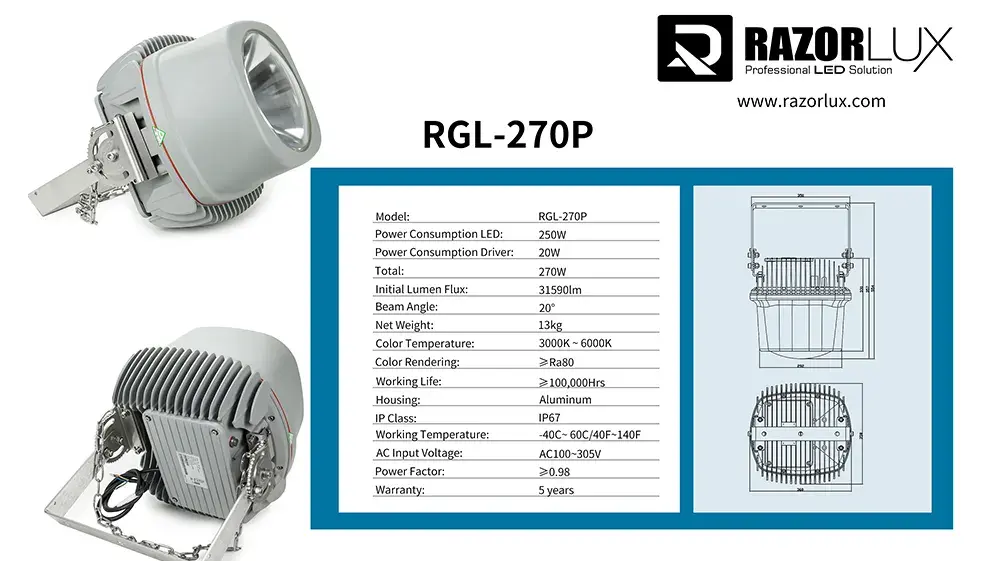
Matching the lumen output and beam angle to the application minimizes under-illumination (a safety hazard) and over-specification (an unnecessary expenditure). A 270W LED fixture with a 20° beam and 29,700 lm rating spreads the light across a greater throw distance, which is ideal for crane work areas and cargo loading zones. Larger beam angles like 60°, 120° or 140°×60° diffuse light across larger deck areas or port aprons. The following table shows the effect of beam angle choice on the coverage geometry for a fixture situated at 10 meters:
| Beam Angle | Coverage Diameter at 10m Height | Typical Application |
|---|---|---|
| 20° | ~3.6 m | Crane arm, mast spotlight |
| 60° | ~11.5 m | Deck work zone, cargo bay |
| 120° | ~34.6 m | Port apron, open deck area |
| 140°×60° | Asymmetric wide area | Loading dock wall-mount |
Power Supply Compatibility and Electrical Specifications
Marine electrical systems are diverse in vessel classes and national grid requirements. The fixture operates directly in both shore-power and onboard generator setups and has built-in AC 90–305V and DC 127–431V input without an extra adaptor. A power factor greater than 0.98 and a total harmonic distortion less than 10% equal clean electrical behavior that does not put a strain on the vessel generator sets. If you are a procurement team that evaluates big orders in batches, make sure that the driver maker has its own certifications – Meanwell is an internationally recognized standard – and that replacement drivers can be obtained via regular supply channels.
Installation, Maintenance, and Safety Guidelines for LED Marine Flood Lights
A well-designed fixture that is improperly installed or seldom maintained may also function badly. B2B customers typically find hidden variations between providers in areas of installation and maintenance.
Mounting Structure and Bracket Material
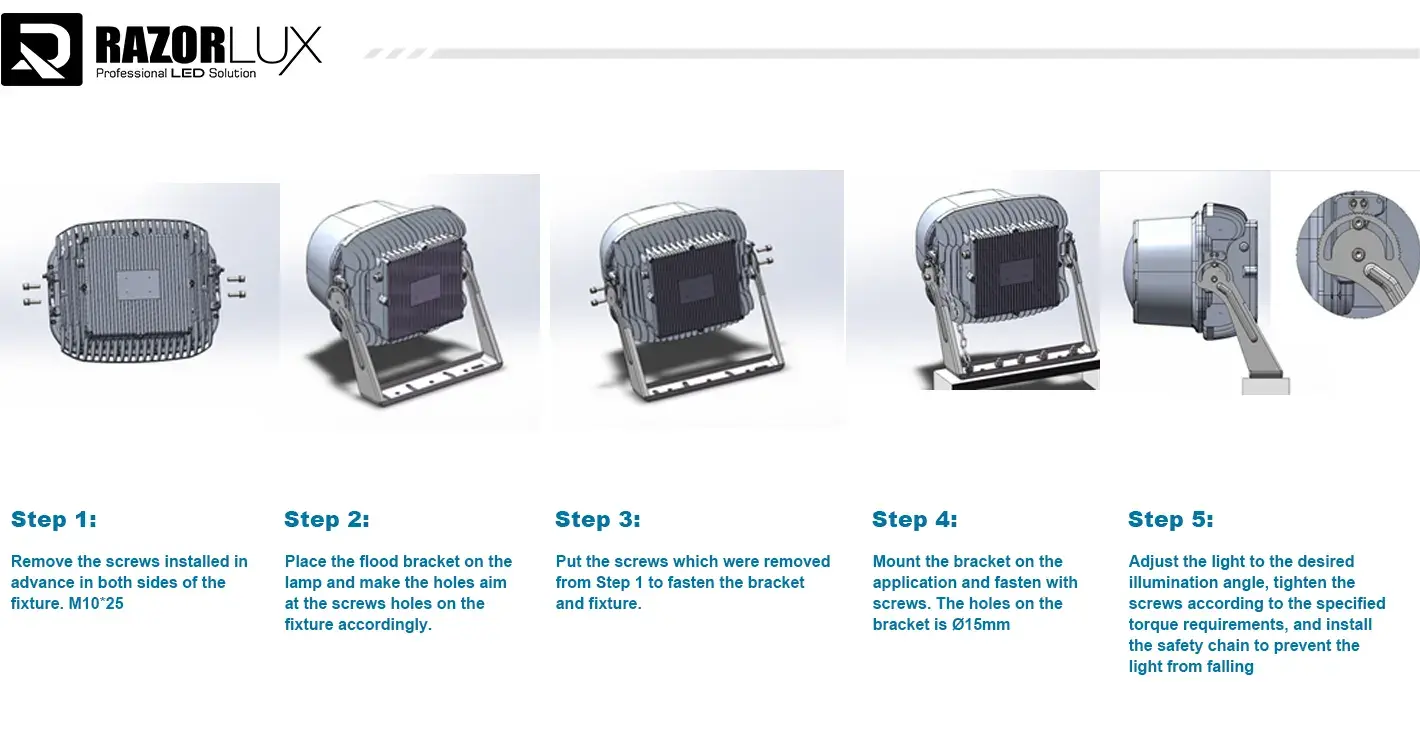
The stainless steel bracket that comes with professional maritime fixtures is not a minor element. Grade 316 stainless steel resists chloride-induced pitting corrosion that grade 304 cannot withstand under persistent salt-spray exposure. If feasible, the mounting points should be pre-drilled to conventional deck plate hole patterns, and the bracket shape should allow for angular adjustment after installation, so that the beam direction may be tweaked without removing the fixture. The mounting surface must be rated for at least twice the load of the net fixture weight, which is 15 kg, to accommodate the dynamic forces from vessel motion.
Wiring, Sealing, and Conduit Entry
Statistically speaking, water penetration in maritime fittings most often occurs via cable entrance points. Each conduit entrance should be provided with a double compression cable gland with the same IP rating as the fixture body. Wiring Must Be Completed Before Fixture Reaches Operating Temperature. Thermal Expansion of the fixture may affect seal compression if connections are made while the fixture is warm. A megohm insulation resistance test at 500VDC is performed after installation to ensure there is no wiring issue prior to energizing the circuit.
Inspection Schedule and Cleaning Protocol
A feasible inspection time for fixtures used continuously offshore is every 90 days. Inspection should include lens clarity (salt crust will lower lumen output), integrity of the seal at cable entry, torque of fasteners on brackets, and signs of corrosion on the housing. Use fresh water and a soft cloth to wipe the lenses, which will remove salt deposits without harming the polycarbonate surface. Abrasive cleansers promote micro-cracking, allowing UV light in and causing yellowing. Recording inspection findings per fixture helps warranty claims and meets classification society maintenance record standards.
Razorlux RGL-270P: A Purpose-Built Marine Flood Light Worth Evaluating
Razorlux has manufactured LED lighting solutions since 1998 and holds over 200 patents covering LED Packaging, power management, and structural design. The RGL-270P represents the company's application of that development history to demanding marine flood lights and industrial environments.
Product Specifications at a Glance
The RGL-270P carries a patented multi-function design that suits permanent installation across a wide range of working environments. Here are the primary specifications relevant to procurement evaluation:
- Rated Power: 270W (243W LED + 27W driver)
- Stable Flux: 29,700 lm at 5700K after one hour of operation
- Input Voltage: AC 90–305V / DC 127–431V (no additional adapter required)
- Color Temperature: 2700K–6500K (adjustable)
- Lamp Efficiency: 130 lm/W
- Beam Angle Options: 15°, 20°, 30°, 40°, 60°, 120°, 140°×60°
- CRI: Ra ≥75 (Ra 80 and Ra 90 available on request)
- IP Rating: IP67 | IK Rating: IK10
- Operating Temperature: −40°C to +60°C
- Working Life: ≥50,000 hours
- Power Supply: Meanwell driver
- Net Weight: 15 kg | Bracket: Stainless steel
- Warranty: 5 years (LED module and driver); 10 years (housing)
These specifications position the RGL-270P as a direct replacement for 600–1,000W HID lamps, with verified electrical and photometric performance.
Certifications That Support Procurement Approval
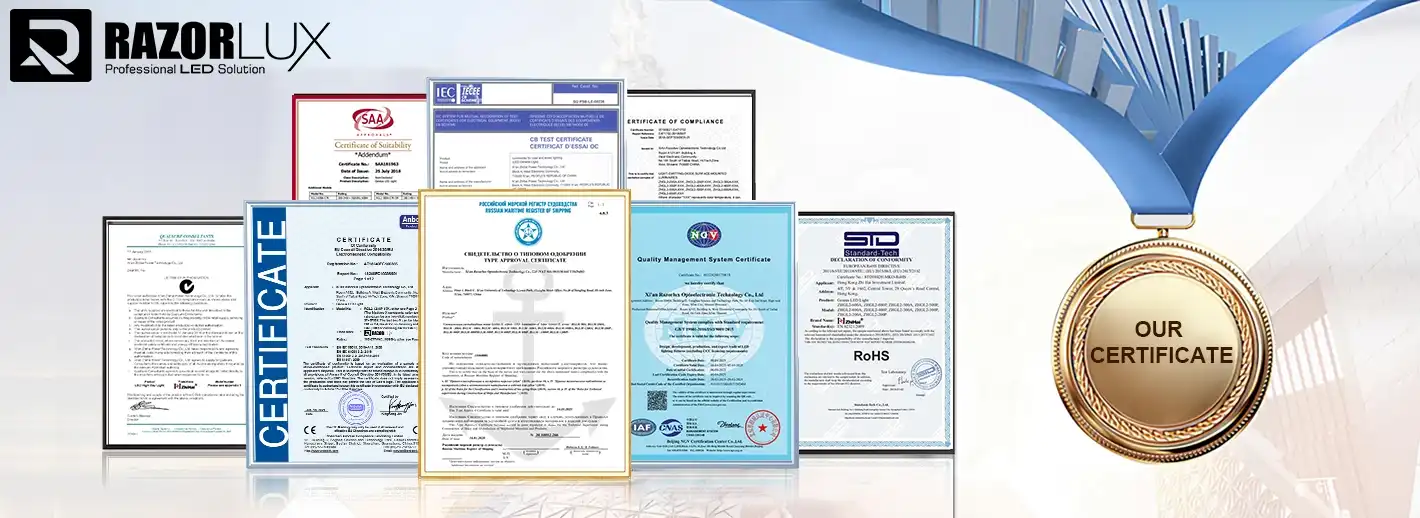
The RGL-270P carries RMRS, CE, RoHS, SAA, C-Tick, UL, DLC, CB, and ISO 9001 certifications. For procurement teams working through classification society approval processes or tendering for government-linked port projects, this breadth of certification reduces administrative friction at the technical review stage. RMRS approval specifically addresses Russian Maritime Register of Shipping requirements—relevant for vessels operating in Baltic and Northern sea routes.
Real-World Application Scenarios
The following table shows how the RGL-270P maps to common maritime and industrial deployment contexts:
| Application Environment | Recommended Beam Angle | Key Specification Benefit |
|---|---|---|
| Ship deck work zone | 60° or 120° | IP67 + IK10, vibration resistance |
| Offshore platform drilling area | 20° or 40° | 29,700 lm output, −40°C operation |
| Port loading dock (wall mount) | 140°×60° asymmetric | Wide area coverage, low glare |
| Shipyard repair bay | 60° or 120° | 130 lm/W efficiency, long life |
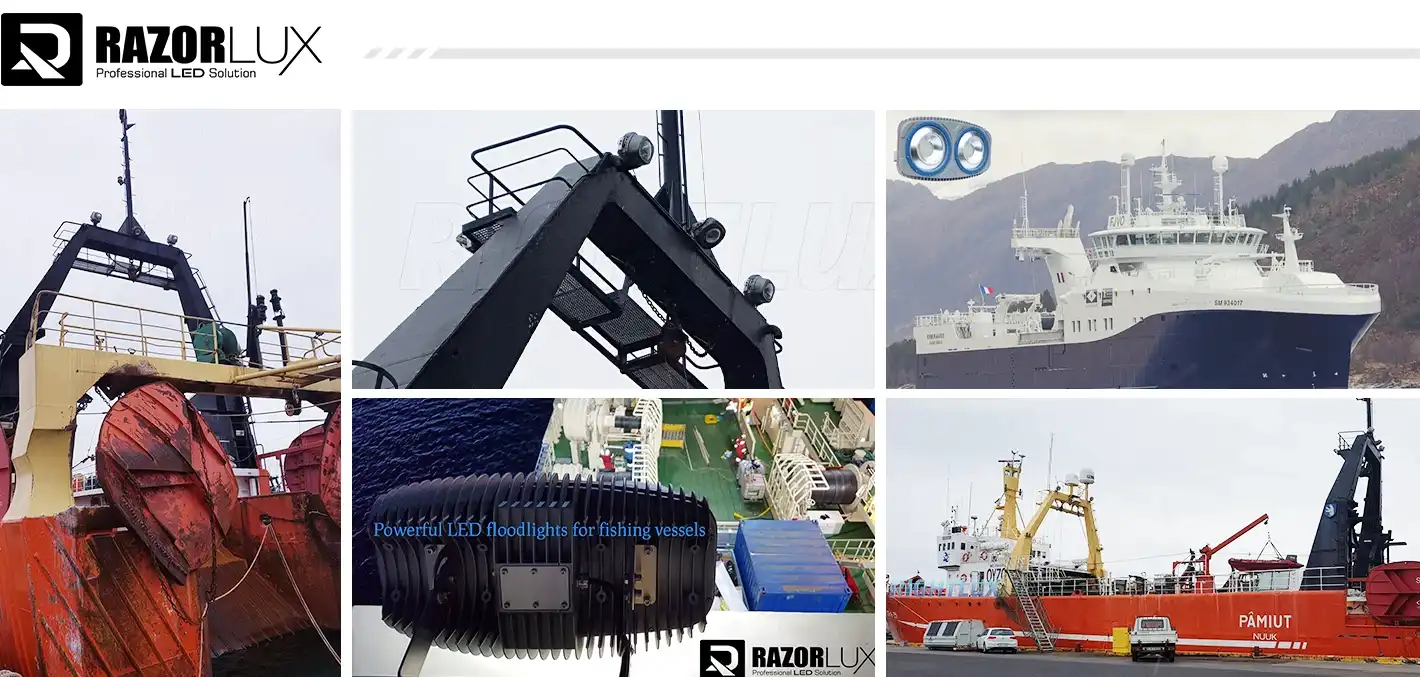
| Commercial fishing vessel deck | 120° | Salt spray resistance, Meanwell driver |
| Heavy industrial (steel mill) | 40° or 60° | IK10 impact rating, wide voltage range |
These are not hypothetical pairings. They reflect the engineering logic of matching fixture output geometry to the physical dimensions and hazard profile of each work area.
Making the Smart Procurement Decision for Marine Flood Lights
After the technical review stage passes, procurement decisions shift toward supplier evaluation, commercial terms, and supply chain reliability. These factors carry equal weight in determining whether a project stays on schedule.
Evaluating Suppliers Beyond the Specification Sheet
The function of a fixture is described by a product specification. What it doesn’t tell you is if the manufacturer can reliably deliver 200 units on time, offer entire documentation packages for submission to a classification society, or answer a technical issue within 24 hours. Procurement teams should obtain references for similar projects, look for quality management certifications (ISO 9001 being the typical baseline), and especially inquire about lead times for bespoke beam angle configurations. Razorlux has a vast inventory of in-house items and provides OEM and ODM services with established modification methods.
Total Cost of Ownership vs. Unit Purchase Price
With current commercial power rates, the energy savings alone will pay for the difference in price between a 270W LED light and an equivalent 400W halogen bulb in the first year of operation. The rated life of 50,000 hours compared to 2,000 hours for halogen makes the life-cycle analysis strongly in favor of LED when considering the cost of replacement parts and labor during a 10-year service life on a vessel. This estimate may be created by procurement teams who submit investment cases to management, based on public IES LM-80 lumen maintenance data and their vessel’s actual operating hour logs.
After-Sales Support and Warranty Terms
Razorlux offers a 5-year guarantee on the LED module and Meanwell driver, and a 10-year warranty on the housing. After-sales assistance includes technical documentation, installation instructions, and prompt communication for warranty claims. For procurement teams who have to manage many vessels or continuous port facility modifications, a supplier with this warranty structure minimizes the administrative effort of juggling different component warranty deadlines. Engineering review sample units are provided prior to bulk purchase commitment.
Conclusion
Choosing the best LED flood lighting for maritime use is a choice that should not be based on price alone. IP67 ingress protection, IK10 impact resistance, 130 lm/W effectiveness, a wide variety of input voltage and multi-angle beam choices ensure that a fixture will really work in the complete spectrum of maritime circumstances it may experience. Since 1998, Razorlux has established a proven track record in industrial marine flood lights supported by over 200 patents and a certification portfolio that provides procurement clearance in most major maritime markets. If performance of deck lighting and long-term running cost are important in your next procurement cycle, the RGL-270P should be part of your supplier assessment.
FAQ
1. Can LED marine flood lights handle continuous saltwater spray without housing degradation?
Yes, provided the fixture carries IP67 certification and uses low-copper die-cast aluminum or 316L stainless steel hardware. IP67 confirms the housing and lens assembly prevents water and dust ingress under standardized IEC 60529 test conditions. The RGL-270P uses a marine-grade aluminum housing with powder coating and stainless steel mounting brackets, which together resist chloride-induced corrosion over extended service periods.
2. How much energy does switching from HPS to LED save in a port lighting installation?
LED fixtures at 130 lm/W produce equivalent illumination to HPS lamps rated at 70–95 lm/W, at roughly 60–70% less power consumption. A port installation replacing 1,000W HPS lamps with 270W LED fixtures reduces per-fixture power draw by 73%, which translates to substantial annual energy cost savings at commercial electricity rates.
3. Are custom beam angles available for specialized vessel configurations?
Yes. The RGL-270P is available in seven beam angle configurations: 15°, 20°, 30°, 40°, 60°, 120°, and 140°×60°. Razorlux also supports OEM and ODM customization for projects requiring non-standard configurations, different housing colors, or specific mounting interface dimensions. Sample units can be provided for engineering review before bulk order commitment.
4. What certifications should procurement teams require for offshore platform applications?
At minimum: IP67, IK10, CE, and RoHS for general use. For vessels under classification society oversight, RMRS, DNV, ABS, or Lloyd's Register approval certificates are typically required. The RGL-270P carries RMRS, CE, RoHS, SAA, C-Tick, UL, DLC, CB, and ISO 9001 certifications, covering most major market approval requirements.
Ready to Source LED Marine Flood Lights from a Verified Manufacturer?
Razorlux engineers have been supplying marine flood lights and industrial LED flood lights to shipyards, port operators, and offshore facility managers since 1998. The RGL-270P marine flood light manufacturer lineup is backed by 200+ patents, a 5-year product warranty, and ISO 9001-certified production quality. Whether you need standard stock configurations or a custom-spec marine flood light supplier arrangement for a new vessel build, our technical team can respond with complete documentation, certifications, and sample availability. contact us at sam@razorlux.com to request product specifications, project-specific pricing, or a sample unit for your engineering team's evaluation.
References
1. International Electrotechnical Commission. IEC 60529: Degrees of Protection Provided by Enclosures (IP Code). IEC, 2013.
2. Illuminating Engineering Society. IES LM-80: Measuring Lumen Maintenance of LED Light Sources. IES, 2015.
3. International Electrotechnical Commission. IEC 62262: Degrees of Protection Provided by Enclosures for Electrical Equipment Against External Mechanical Impacts (IK Code). IEC, 2002.
4. U.S. Department of Energy. Solid-State Lighting Technology Fact Sheet: Energy Savings Potential of Solid-State Lighting in General Illumination Applications. DOE Office of Energy Efficiency and Renewable Energy, 2016.
5. American Bureau of Shipping. ABS Rules for Building and Classing Marine Vessels: Electrical Installations. ABS, 2022.
6. Russian Maritime Register of Shipping. RMRS Rules for the Classification and Construction of Sea-Going Ships: Electrical Equipment. RMRS, 2021.