


_1750326878398.png)

Crane Boom Lights: Which Features Matter Most?
When procurement teams and engineering managers evaluate Crane Boom Lights, the decision goes far beyond simply picking the brightest fixture on the market. These specialized high-intensity lighting systems are mounted directly on crane booms, jibs, and trolleys — often at heights exceeding 50 to 100 meters — and they must perform without failure in conditions that would destroy standard work lights. Getting the specification wrong means costly replacements, dangerous shadow zones on the work floor, and project delays. This article walks through every feature that genuinely matters, backed by real product data from Razorlux's RGL-150P model and practical field knowledge.
Understanding Crane Boom Lights: Functionality and Key Benefits
What Exactly Are Crane Boom Lights?
Crane boom lights are designed to shine a focused beam from high mounting points directly onto the hook block and load zone below. A jib-mounted light, unlike a regular floodlight on a tripod, moves with the crane. This means it has to handle constant mechanical vibration, sudden dynamic loads, and rain, salt spray, or industrial dust all at the same time.
Why Standard Work Lights Fail in This Role
A normal halogen or metal halide work light has a thin glass cover that breaks when the high-amplitude oscillations caused by moving trolleys or quick stops on cranes happen. Filament-based sources also give off too much heat and need to have their bulbs changed often, which is a very dangerous job to do at a height. Both issues can be solved with solid-state LED technology and strengthened interior construction. This is why custom-made LED fixtures are now standard on modern tower cranes and ship-to-shore (STS) equipment.
Key Operational Benefits
If you switch to a well-specified LED light on a crane, you'll see three clear benefits that buying managers can show their finance teams:
These three main operational gains are the most important for project budgets and safety records:
- Elimination of shadow zones: A light that travels with the load guarantees that the rigger and operator maintain constant visual contact, even in dense urban construction sites where ambient site lighting creates misleading reflections.
- Reduced operator eye fatigue: Consistent, high-CRI illumination (Ra ≥ 75 as a minimum; Ra ≥ 80 or Ra ≥ 90 available on request from Razorlux) allows operators to accurately judge depth and distance over long night shifts, reducing the probability of load swing accidents.
- Lower total maintenance cost: An LED module rated for 50,000+ hours running 10 hours per night lasts over 13 years before requiring replacement — virtually eliminating the cost and risk of bulb changes at height.
When companies look at what they should buy, these three improvements for crane boom lights directly address the problems that come up most often: safety risk, maintenance labor, and lifetime cost.
Essential Features to Consider When Choosing Crane Boom Lights
Brightness, Beam Angle, and Lux at Ground Level
Flux of light doesn't tell the whole story by itself. At a height of 60 meters, a wide-angle flood spreads light over a big area, and the brightness level that reaches the load zone might not be enough for safe operation. The Razorlux RGL-150P has a 20° beam angle and puts out 13,200 lm. This is concentrated into a tight column that keeps the light intensity useful at long working distances. Narrow curves between 10° and 20° are the right standard for tower cranes that are taller than 80 meters.
Protection Ratings and Structural Durability
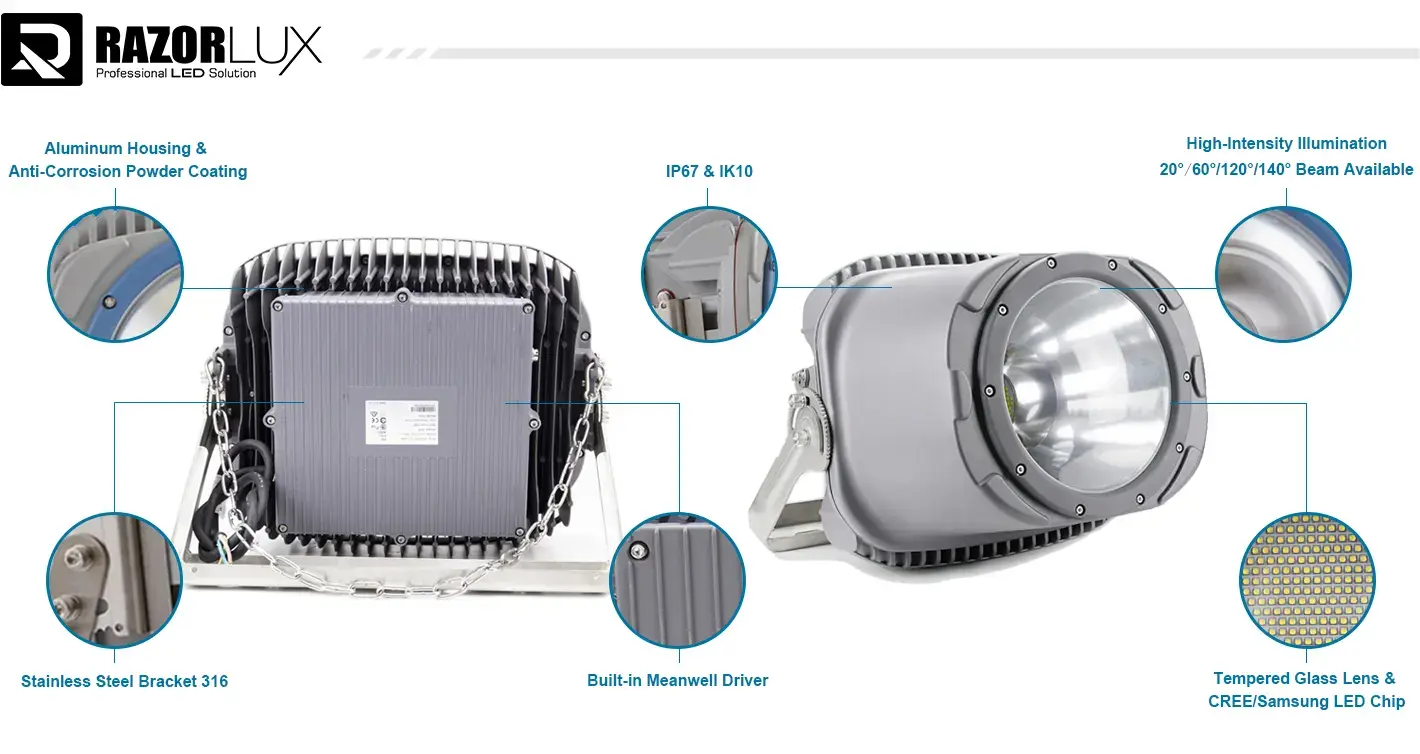
The IP and IK grades are not marketing terms; they are widely agreed upon performance standards set by IEC 60529 and IEC 62262. An IP67 rating means that the fixture can be completely submerged for a short time. This is important on offshore platforms and when it rains a lot. IK10 proves that it can withstand a 20-joule mechanical impact without the housing breaking. This is important in case riggers or maintenance workers accidentally bump into the device while working at heights. The RGL-150P has an IP67 rating and an IK10 rating. Its die-cast aluminum body and stainless steel bracket can withstand temperatures from -40°C to +60°C.
Energy Efficiency and Driver Quality
At 130 lm/W, the RGL-150P can replace 300–400W HID lamps with a 150W draw. This saves about 50–60% of energy without lowering the amount of light produced. Through its Meanwell driver, the fixture can take both AC 80–315V and DC 80–400V for crane boom lights applications. The driver has a power factor of ≥0.98 and THD below 10%. When the generator output changes, like on offshore platforms and in shipyards, the wide voltage input range is very useful.
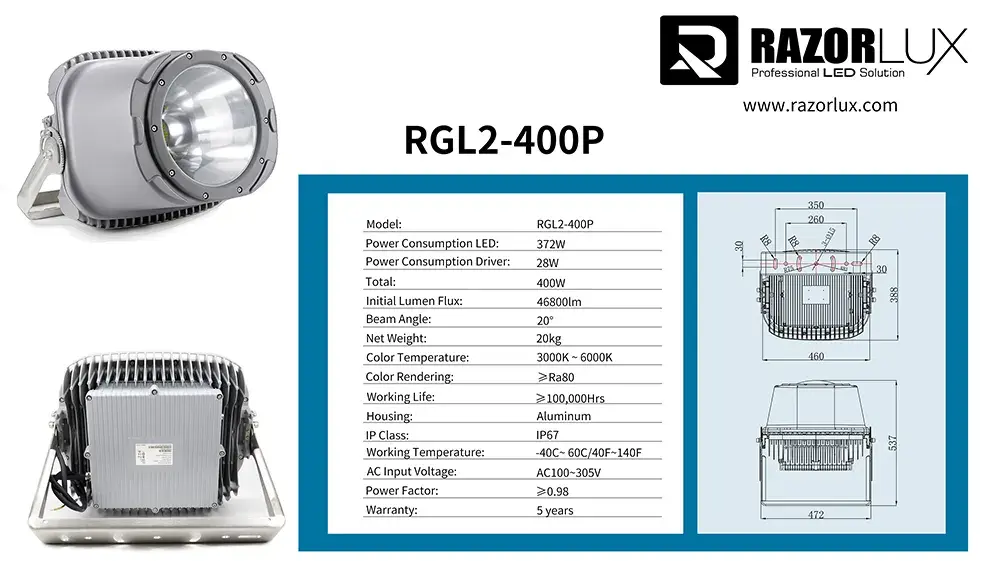
The Razorlux RGL-150P's most important electrical and optical specs are shown in the table below:
| Specification | Value |
|---|---|
| Rated Power | 150W (LED 135W + Driver 15W) |
| Input Voltage (AC) | 80–315Vac |
| Input Voltage (DC) | 80–400Vdc |
| Luminous Flux | 13,200 lm (at 5700K, 1 hour) |
| Lamp Efficacy | 130 lm/W |
| Beam Angle | 20° |
| Color Temperature Range | 2000–6000K |
| CRI | ≥Ra75 (Ra80, Ra90 available) |
| Power Factor | ≥0.98 |
| THD | <10% |
| Working Temperature | -40°C to +60°C |
| IP Rating | IP67 |
| IK Rating | IK10 |
| Working Life | ≥50,000 hours |
| Net Weight | 10 kg (22 lbs) |
| Warranty | LED & Driver: 5 years; Housing: 10 years |
Comparing Crane Boom Lights: Making the Right Choice for Your Business
LED vs. Halogen vs. Metal Halide
Over the past ten years, the performance difference between LEDs and other types of light sources has grown significantly. Metal halide lights, which used to be the standard for high-mast uses, need 3–5 minutes to warm up before they can produce their full output, and they are especially prone to arc instability caused by vibrations. Because they use much more power per light, halogen lamps are easier to use, but their surfaces get very hot when they work. Modern LED fixtures made specifically for mounting on cranes don't have any of these problems, and their solid-state construction directly addresses the mechanical fatigue failure mode that has historically been a problem with lighting on cranes.
Crane Boom Lights vs. General Industrial Floodlights
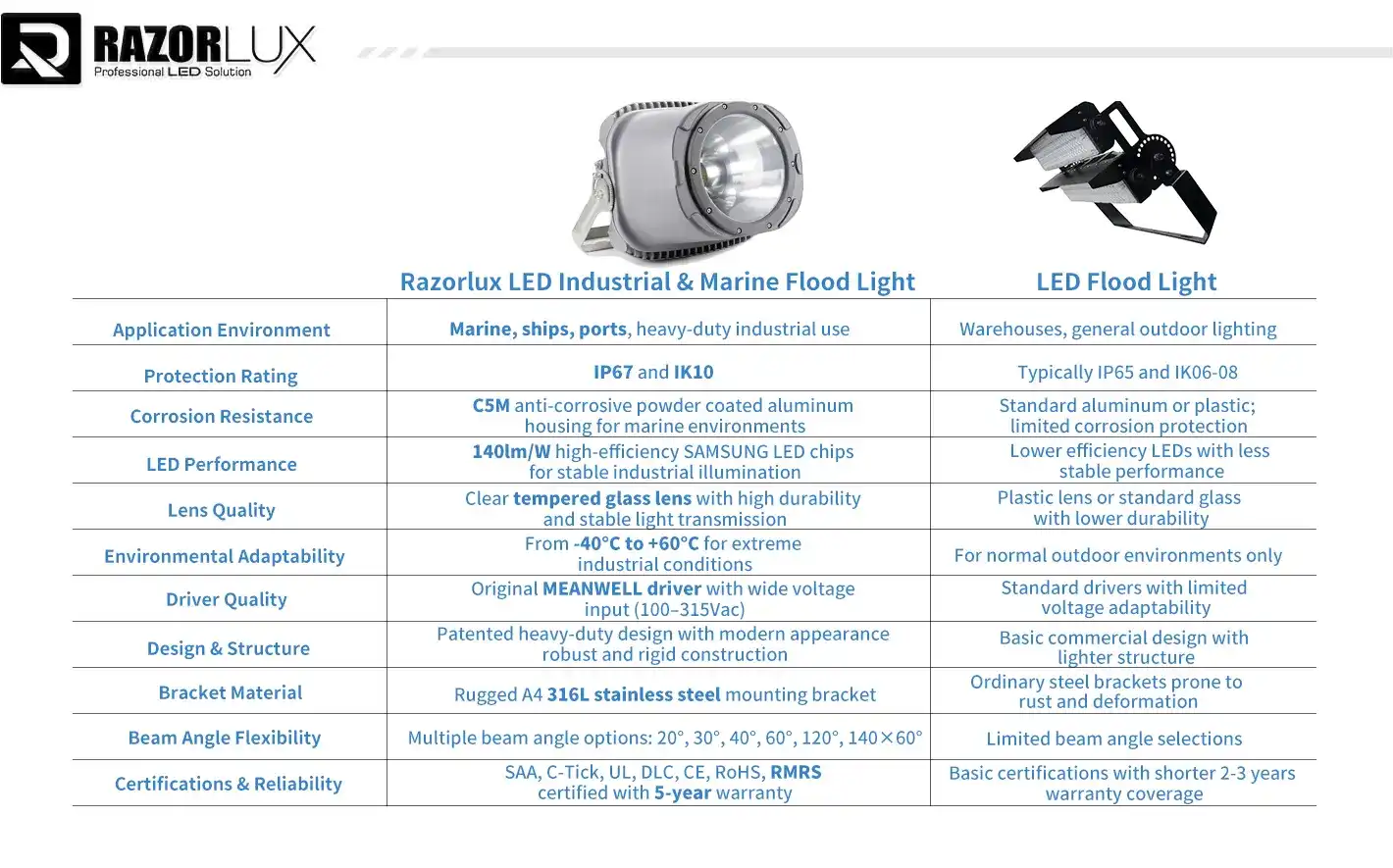
It would be reasonable for a buying manager to wonder if a normal industrial floodlight, which is cheaper, could do the same job. The truth is that it's only used in low-risk, low-altitude situations. General floodlights aren't made to handle the changing loads, vibrations, or mounting shapes that come with crane jibs. When linked to generator-fed power systems like those on building sites and offshore platforms, they usually don't have conformal-coated PCBs, anti-vibration internal damping, or the surge protection (the RGL-150P's Meanwell driver handles industrial surge events) that is needed.
Certification as a Procurement Filter
International certifications are not just extra steps; they are the main way that technical departments narrow down the list of suppliers they consider. The RGL-150P has ISO 9001, CE, RoHS, SAA, C-Tick, UL, DLC, and CB certifications. Buyers should also check DNV/GL or ABS documentation from their supplier for marine and offshore uses. Razorlux's goods meet the standards set by UL, RMRS, TUV, CE, SAA, and RoHS. This gives procurement teams the paperwork they need to pass technical review in most major market areas.
Procurement Considerations for Crane Boom Lights
Sourcing Channels: Direct Manufacturer vs. Distributor
When you buy directly from a manufacturer like Razorlux, you can get better prices on large orders and talk to engineering support directly about your specific needs. Distributors and approved partners are better when you need to stock items locally, get them delivered faster in your area, or get help in a language other than English. Working with a manufacturer that has globally recognized certifications makes import compliance a lot easier for projects in the UAE, Qatar, Norway, Singapore, or Australia, all of which are busy markets for heavy-lift operations.
The following table compares procurement channel options for heavy-duty crane lighting:
| Procurement Channel | Key Advantage | Best Suited For |
|---|---|---|
| Direct Manufacturer | Competitive pricing, customization, full documentation | Volume orders, OEM projects, long-term supply agreements |
| Authorized Distributor | Regional stock, local support, faster spot delivery | Urgent replacements, smaller quantities |
| Online B2B Platform (Alibaba, etc.) | Price comparison, multiple suppliers | Initial vendor screening, sample sourcing |
| Engineering Contractor / MRO | Project bundling, on-site support | Turnkey project installations |
Bulk Orders, Customization, and OEM Options
A lot of the time, big factories and port building projects need hundreds of fixtures that are the same size and shape for all the ships or berths. As an OEM or ODM service, Razorlux lets buyers choose the wattage, color temperature (2700K–6500K), housing finish, attaching bracket setup, and control interface (0-10V or DALI dimming) for crane boom lights all in one order. Framework purchase contracts are available for buyers who need to be sure they will have a steady supply of goods for projects that last more than one year.
Warranty, Delivery, and After-Sales Support
Any lighting specification's total cost of ownership must take into account service response time and guarantee support. Razorlux backs up the LED module and driver with a 5-year warranty and the housing with a 10-year guarantee. This is one of the longer coverage terms in this product category. You can order samples to check the quality before you commit to buying a lot, and the team at sam@razorlux.com can answer your technical questions and quote requests right away.
Maintenance, Safety, and Best Practices for Crane Boom Lights
Routine Inspection and Cleaning Schedules
Any outdoor fixture's lens transmission gets worse over time when it is exposed to salt spray, industrial particle matter, and UV light. Every three months, the lens surface should be cleaned with a non-abrasive solution, the stainless steel bracket and mounting hardware should be checked for corrosion, and the cable entry gland should be checked to make sure the seal is still good. Due to the faster corrosion environment, floating sites should have checks once a month. The powder-coated aluminum housing of the RGL-150P is made to resist salt spray, but it's still a good idea to check it out physically.
Electrical Safety During Servicing
Lighting on cranes is mounted at heights that make routine maintenance very dangerous. Before any work is done on the device, it needs to be disconnected from its power source at the panel level, not just turned off at the local control point. There is surge protection in the RGL-150P's wide-voltage driver that protects against transients in the generator switching. However, planned maintenance should always follow a formal lockout/tagout procedure in line with OSHA 29 CFR 1910.147 or the relevant regional standard.
Troubleshooting Common Field Issues
Most complaints about crane-mounted lights in the field are about them dimming too soon instead of not working at all. This usually happens when the driver gets too hot because airflow around the housing is stopped, or when a loose cable connection at the waterproof gland causes power to go out every once in a while. Both problems are easy to find and fix without having to replace the whole fitting. Razorlux's technical support team provides installation instructions and answers questions from users in the field about how to fix problems. This significantly cuts down on the time that maintenance crews need to spend fixing lighting problems during key project stages.
Conclusion
To choose the right lighting fixture for a crane boom, you need to make sure that the technical specs match the real-world conditions, such as the mounting height, temperature range, power supply characteristics, and certification needs for the area where the crane will be used. The Razorlux RGL-150P has a 150W output, 13,200 lm output, 20° beam angle, IP67/IK10 security, a Meanwell driver, and a full certification package that includes CE, RoHS, UL, SAA, and more. It can handle all of these factors for crane boom lights. The product has an estimated lifespan of 50,000 hours and a 5-year warranty, which makes it a good choice for buying teams looking at jib-mounted lighting for new builds or retrofit projects.
FAQ
What beam angle should I specify for a tower crane at 60 meters height?
For mounting heights over 40 meters, the beam angle needs to be narrow, between 15° and 30°. The lumen output is spread out over too large an area when the angle is wider, and the lux level at ground level drops below what is needed for safe load handling. The 20° slope of the RGL-150P works well for heights between 50 and 80 meters.
How does the RGL-150P handle voltage fluctuations from site generators?
The Meanwell driver can work with both AC 80–315V and DC 80–400V power without the need for an extra adapter or transformer. The unstable generator output that is common on building sites, ships, and offshore platforms is immediately fixed by this wide input range.
Can the fixture be used in salt spray and marine environments?
Yes. The IP67 rating of the RGL-150P comes from its powder-coated aluminum body and stainless steel bracket, which were both chosen for their ability to fight corrosion in high-salinity environments. It has been used in shipyards and on platforms in the ocean.
What certifications are included with the RGL-150P?
It has CE, RoHS, SAA, C-Tick, UL, DLC, CB, and ISO 9001 certifications.
Is customization available for OEM or large volume orders?
Custom color temperature, wattage, housing finish, mounting setup, and dimmer interface can all be made by Razorlux for OEM and ODM projects. Framework supply agreements can be used for procurement programs that last more than one year.
Get Crane Boom Lights Direct From Razorlux — Request a Quote Today
Since 1998, Razorlux has provided industrial and naval lighting solutions to projects in shipyards, on offshore sites, and at ports around the world. The company that makes and sells the RGL-150P crane boom light offers performance that has been certified and tested in the field. They also offer over 200 patents and a full documentation package for technical review. Send your project details, the number of items you need, and any regional approval needs to sam@razorlux.com. You can also go to razorlux.com to find product datasheets, installation plans, and sample request forms. Within one business day, our engineering team will get back to you with a quote and a detailed suggestion.
References
1. Illuminating Engineering Society. IES Handbook, 10th Edition. Illuminating Engineering Society, 2011.
2. International Electrotechnical Commission. IEC 60529: Degrees of Protection Provided by Enclosures (IP Code). IEC, 2013.
3. International Electrotechnical Commission. IEC 62262: Degrees of Protection Provided by Enclosures for Electrical Equipment Against External Mechanical Impacts (IK Code). IEC, 2002.
4. U.S. Department of Labor, Occupational Safety and Health Administration. OSHA 29 CFR 1910.147: The Control of Hazardous Energy (Lockout/Tagout). OSHA, 2019.
5. Det Norske Veritas. DNV-ST-0145: Offshore Substations. DNV GL, 2021.
6. U.S. Department of Energy, Office of Energy Efficiency and Renewable Energy. Solid-State Lighting R&D Plan. DOE, 2022.