


_1750326878398.png)

How to Choose the Right Marine LED Flood Light for Safety?
Choosing the right Marine LED Flood Light comes down to matching technical specs with your actual operating environment. If you operate a shipyard, offshore platform or dock infrastructure, the lighting you select impacts worker safety, the need for compliance and long-term running costs. A maritime LED flood light that is purpose-built must be able to take salt spray, persistent vibration, temperature variations and moisture, all at the same time. This tutorial will focus on what’s important: protection ratings, lumen output, certifications, installation standards and how to vet providers before ordering in bulk.
Understanding Marine LED Flood Lights: What They Are and How They Work
First, it's helpful to know what the difference is between a real maritime-grade fixture and a regular outdoor floodlight that's sold as "waterproof."
What Makes a Flood Light "Marine Grade"
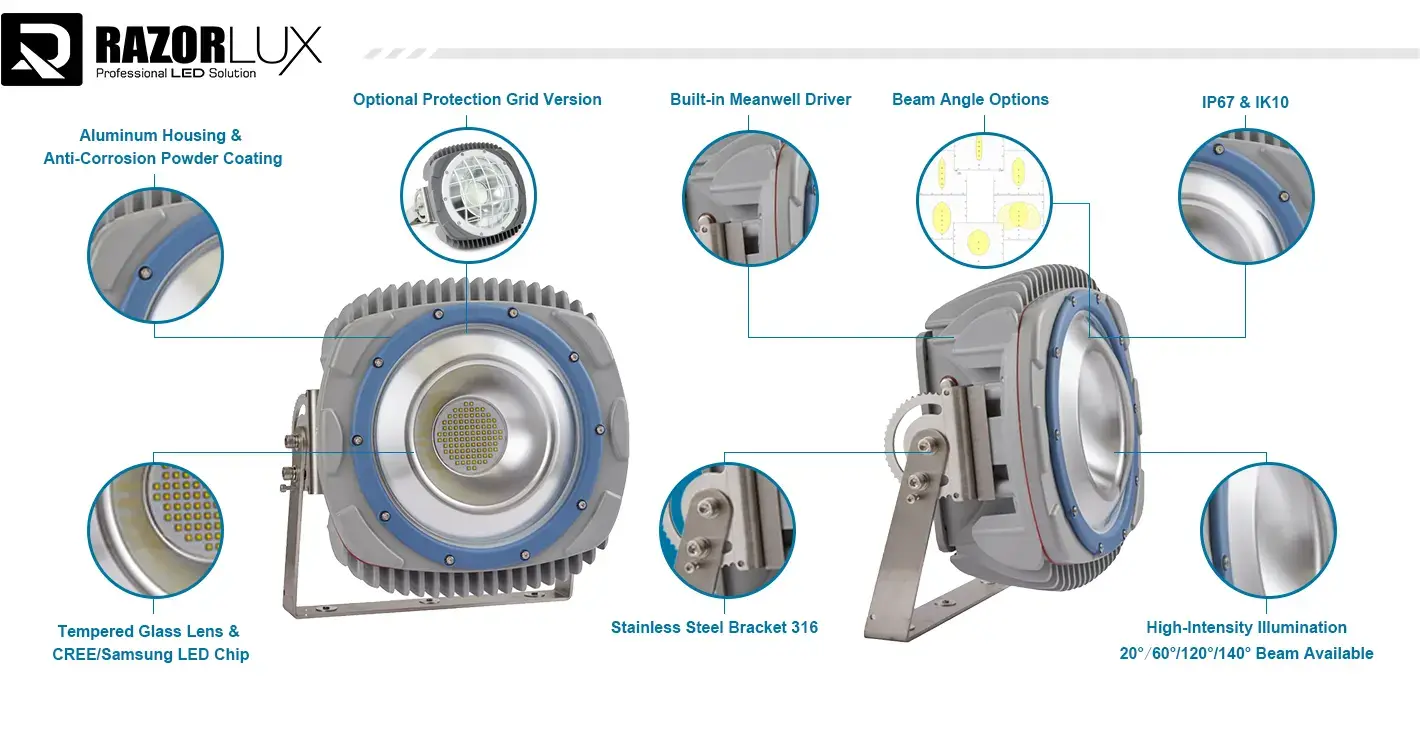
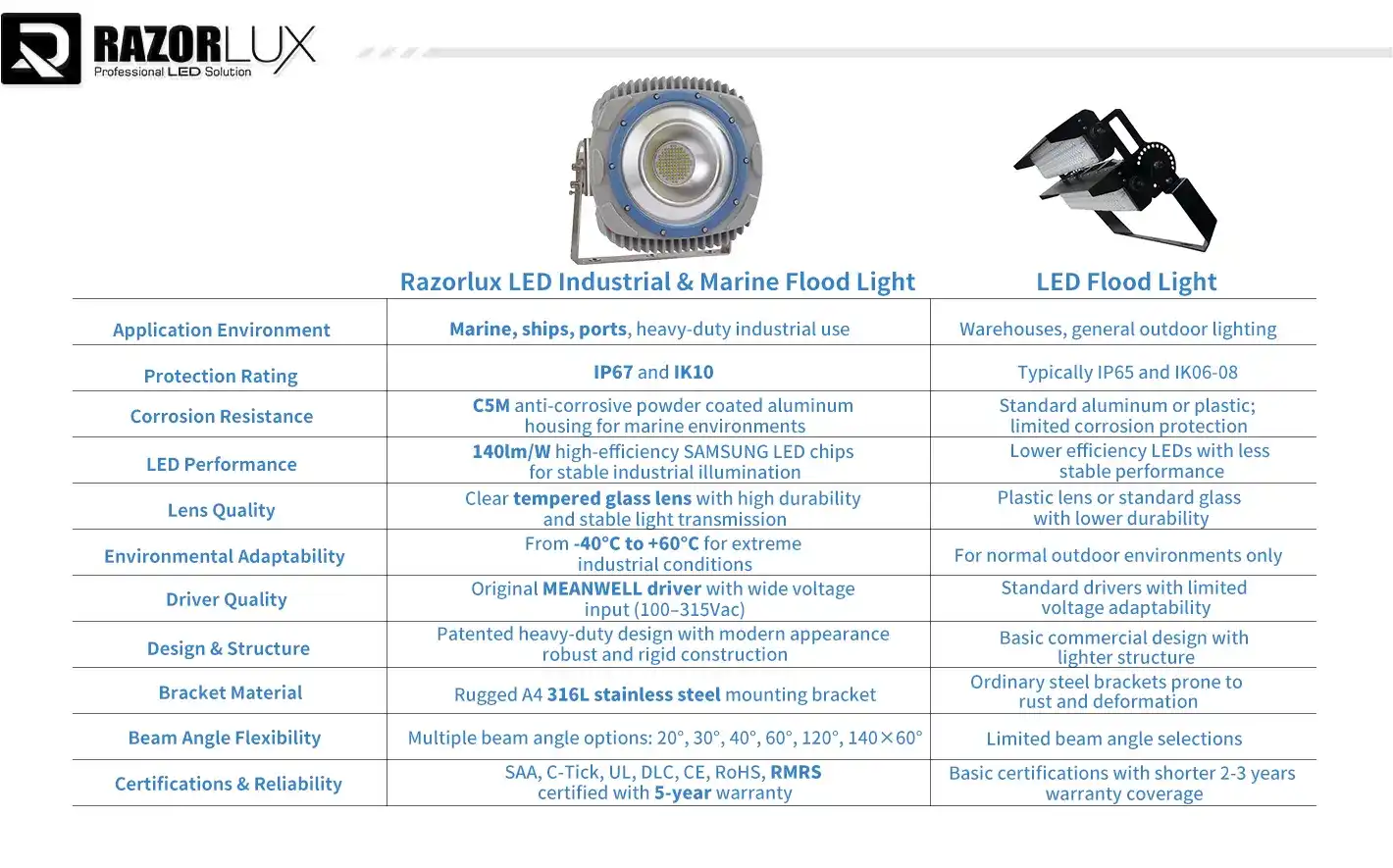
A deck-rated flood light is more than just a fixture that can handle the weather. It is designed to be resistant to galvanic rust, mechanical shock from wave-induced shaking, and UV damage from being in the sun for a long time. The material of the housing is important. Marine-grade aluminum alloy (low copper content) with a special anti-corrosion coating is much better at stopping salt-fog attack than regular die-cast housings. Hardware like fixing clamps must be made of 316L stainless steel and not zinc-plated steel so that it doesn't rust quickly in air that is high in salt.
How LED Technology Works in Maritime Conditions
LED chips directly turn electricity into light, and they do this with a lot less heat than halogen or metal halide sources. That heat economy makes parts last longer. A fixture that is approved for use at sea has LED chips that sit on an aluminum heat sink that pulls heat away from the joint. A well-designed thermal path keeps the temperature at the LED junction low, which is the most important thing for maintaining lumens over time. Razorlux's RGL-180A has LED chips from Samsung or Philips and a Meanwell driver. This is a combo that is well known in commercial marine buying for being reliable when the load changes.
Waterproofing and Sealing Standards Explained
IP (Ingress Protection) ratings show how well a fixture keeps solids and liquids out. The fixture is fully dust-tight and can withstand being submerged in water for up to 30 minutes. IP67 is the minimum standard for outdoor uses that will be washed by waves and high-pressure water hoses. You may need IP68 or IP69K for some services that run abroad. IK ratings show how resistant something is to being hit. For example, an IK10 rating means that the lens and case can withstand a 20-joule impact without breaking. This is important in places like a busy dock or cargo deck.
Key Criteria for Choosing the Right Marine LED Flood Light for Your Needs
With dozens of products on the market, a structured evaluation process saves procurement time and reduces the risk of specifying the wrong fixture.
Lumen Output and Color Temperature
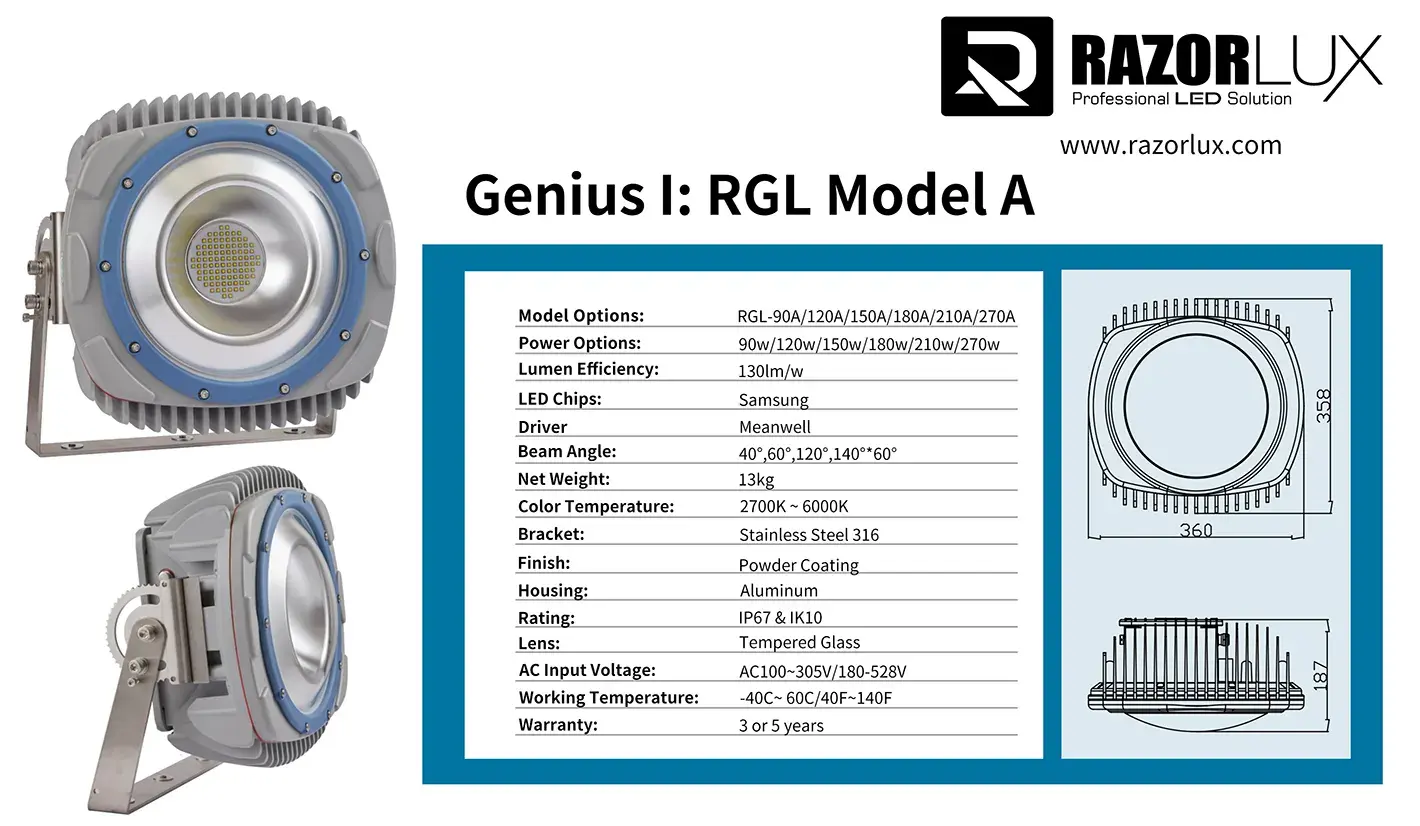
Lumen output determines how much usable light reaches the work surface. A 180W LED fixture delivering 23,400 lumens at 130 lm/W gives you strong coverage for large deck or dock areas without oversizing the circuit load for marine led flood light applications. Color temperature affects visibility and fatigue. For general deck work and loading operations, 5000K–5700K (cool white) provides high contrast and clear color rendering. For environments where fog penetration matters, 4000K is a practical alternative. CRI (Color Rendering Index) above Ra 75 ensures crews can accurately distinguish equipment, markings, and hazards.
Waterproof Ratings, Impact Resistance, and Operating Range
Not all IP67 fixtures are equal. Check whether the rating was tested to IEC 60529 standards with third-party verification, not just self-declared. IK10 impact resistance is equally important on working vessels. Operating temperature range matters too — Razorlux's RGL-180A is rated from -40°C to +60°C (-40°F to +140°F), covering Arctic vessel operations through tropical offshore platforms without thermal de-rating.
The table below summarizes the minimum technical benchmarks I recommend evaluating for any marine deck lighting procurement:
| Parameter | Minimum Recommended | RGL-180A Specification |
|---|---|---|
| IP Rating | IP67 | IP67 |
| IK Rating | IK10 | IK10 |
| Luminous Efficacy | ≥ 120 lm/W | 130 lm/W |
| Operating Temp. | -30°C to +55°C | -40°C to +60°C |
| Input Voltage Range | AC 100–277V | AC 90–305V / DC 127–431V |
| Bracket Material | 316 Stainless Steel | 316 Stainless Steel |
| Warranty | ≥ 3 Years | 5 Years |
Certifications That Matter for Marine Applications
Certifications are not marketing badges — they are contractual requirements for most commercial vessel projects, port tenders, and offshore platform specifications. The certifications to confirm before finalizing a supplier include:
- RMRS (Russian Maritime Register of Shipping): Required for vessels operating under Russian flag or in Russian waters.
- DNV / ABS / BV: Bureau classification society approvals for commercial shipping.
- CE and RoHS: Mandatory for European market compliance.
- UL: Required for U.S. market and U.S.-flagged vessels.
- SAA and C-Tick: Required for Australian market deployments.
Razorlux's RGL-180A carries RMRS, CE, RoHS, SAA, C-Tick, UL, DLC, CB, and ISO 9001 certification — a certification portfolio that satisfies procurement requirements across North America, Europe, Russia, Southeast Asia, and Oceania.
Comparing Marine LED Flood Light Solutions: Making an Informed Decision
A lot of the time, procurement teams ask me how LED lights are different from the halogen or metal halide systems that are still used on older ships and docks.
LED vs. Halogen and Metal Halide: The Numbers
A 400W metal halide lamp with the same output can be replaced with a 180W LED fixture that gives off 23,400 lumens. That means 55% less power is being used for marine led flood light applications. With a service life of 50,000 hours, or 16 hours per day, the LED fixture will last for about 8.5 years before it needs to be replaced. Metal halide lights need to be replaced every 6,000 to 10,000 hours, which adds to the cost of work and materials. This difference directly means less money for support on an offshore base that is up and running 24 hours a day, seven days a week.
Evaluating Beam Angle Options for Different Applications
The choice of beam angle has a bigger effect on the quality of coverage than the output lumens. A narrow 15° or 20° beam focuses light for long-range projection, which can be useful for security lighting or keeping an eye on the exterior from a mast. Mid-range angles (40°–60°) work well for lighting the storage area and the dock apron. Wide-angle options (120° or 140°×60°) spread light evenly over warehouse bays or open decks. The RGL-180A has seven different beam angles: 15°, 20°, 30°, 40°, 60°, 120°, and 140°×60°. This means that project engineers can use the same fixture in different areas of the same installation.
Bulk Procurement and Customization Options
Large projects like shipyards and ports rarely need just one device. When you buy in bulk, you have to think about things like wait time, consistent packing, and custom labeling. Razorlux provides OEM and ODM services with wattage choices running from 90W to 1200W. These services can be used for a wide range of projects, from retrofitting small ships to building large offshore platforms. Because it can handle both AC 90–305V and DC 127–431V, you don't have to keep a lot of different SKUs on hand for different electrical systems on boats. One part number can be used for both AC and DC setups.
Procurement Best Practices: How to Buy Marine LED Flood Lights Efficiently
Sourcing maritime lighting from an unverified supplier creates project risk — late delivery, missing certifications, or fixture failure shortly after installation. Here is how I approach supplier qualification.
Questions to Ask Any Supplier Before Ordering
Before requesting a quote, get clear answers on these points:
- Can you provide the original test reports for the IP67 and IK10 ratings, not just the certificate number?
- What LED chip and driver brands are used, and can you confirm with component datasheets?
- What is your standard lead time for orders above 500 units, and do you hold buffer stock?
- What does your 5-year warranty cover, and what is the RMA process for defective units?
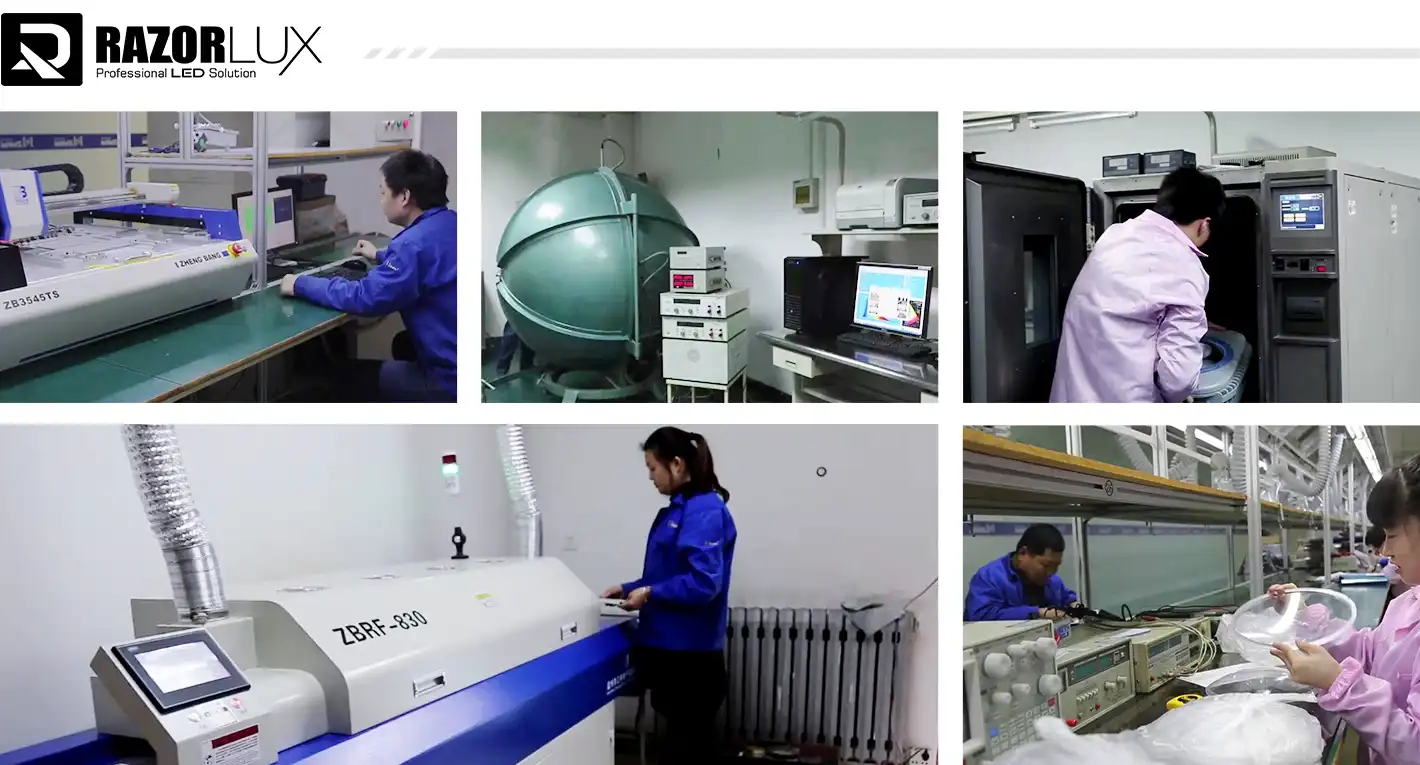
Razorlux has maintained ISO 9001 quality management certification for 22 consecutive years. Every fixture undergoes salt spray resistance testing, vibration testing, and thermal cycling before shipment — and the company provides full technical documentation packages including DFMEA failure mode analysis reports on request.
Sampling Before Bulk Orders
I always recommend requesting physical samples before committing to a bulk order, especially for new supplier relationships. A sample evaluation of marine LED flood light lets your technical team verify lumen output with a photometer, inspect the housing finish, and check the waterproof seal under real conditions. Razorlux provides sample orders with full technical documentation, installation guides, and performance test reports included.
Logistics and Delivery Planning
Project delays caused by late light deliveries are a common pain point in shipyard procurement. The table below outlines the shipping options available from Razorlux to help project managers plan realistically:
| Shipping Method | Transit Time | Best For |
|---|---|---|
| International Express (DHL/FedEx/UPS) | 3–7 days | Samples, urgent replacements |
| Air Freight | 5–10 days | Medium volume, time-sensitive projects |
| Rail (China–Europe Express) | 18–22 days | Large shipments to Europe |
| Sea Freight (FCL/LCL) | 15–50 days | High-volume, non-urgent bulk orders |
Practical Tips to Ensure Safety and Longevity of Your Marine LED Flood Lights
Even the best-specified fixture fails early if installed or maintained incorrectly.
Proper Mounting and Orientation
Mount fixtures with cable entry points facing downward or sideways — never upward — to prevent water pooling at the gland. Use anti-vibration mounts on engine room or hull-mounted positions to reduce mechanical stress on driver components. Stainless steel fasteners must be isolated from dissimilar metals using nylon or PTFE washers to prevent galvanic corrosion at the mounting interface. Confirm that the mounting surface can bear the fixture weight — at 15 kg, the RGL-180A requires a properly rated structural bracket.
Routine Maintenance Procedures
Marine fixtures do not require frequent servicing, but periodic inspection prevents small issues from becoming expensive failures. Check the following at each vessel dry dock or scheduled maintenance interval:
- Inspect the lens for crazing, yellowing, or physical impact damage — tempered glass lenses are replaceable.
- Verify that cable glands remain tight and show no signs of seal deterioration.
- Clean the housing fins of salt deposits using fresh water — salt buildup reduces heat dissipation over time.
- Confirm that mounting hardware torque is maintained, particularly on high-vibration installations.
Common Installation Mistakes to Avoid
Selecting the wrong beam angle for the application is the most frequent error I see in dock and vessel retrofit projects. Specifying a 120° wide-angle fixture for a long-throw mast position wastes light and under-illuminates the target area. Equally, placing a 15° narrow beam in a cargo hold leaves large shadow zones that create safety hazards. Take time to run a photometric layout before finalizing fixture positions. Most reputable suppliers, including Razorlux, can provide lighting simulation files (IES/LDT) for use in standard layout software.
Conclusion
Picking the correct lighting device for an ocean or ship is a technical choice that has real safety implications. Protection grade (at least IP67 and IK10 is recommended), luminous efficacy above 130 lm/W, confirmed certifications that meet the needs of your market, and a source with recorded quality processes are the most important things to look for in a marine LED flood light. Razorlux's RGL-180A meets all of these requirements thanks to its patented multi-function design, Samsung/Philips chips, Meanwell driver, and a range of certifications such as UL, DLC, RMRS, and more. Getting the specifications right before buying something saves a lot of money on maintenance costs and project schedule risks in the long run.
FAQ
What IP rating is required for marine flood lights?
The standard for deck-mounted and outside marine lights is IP67. It proves that it is dust-tight and won't leak if it gets wet for a short time. For places that will be washed down with high-pressure water, IP68 or IP69K gives you more room to spare. You should always ask for the original IEC 60529 test report, not just the label's grade.
How much energy does an LED flood light save compared to halogen?
A 180W LED fixture that puts out 23,400 lumens can be used instead of a 400W halogen or metal halide lamp that gives off the same amount of light. That means that each bulb will use about 55% less energy. Depending on the electricity rates in your area, a 30-fixture dock installation that runs 16 hours a day could save more than a few thousand dollars a year in energy costs.
Should installation be handled by a professional or in-house crew?
I suggest licensed marine electricians for installations on commercial ships' decks and masts, especially when RMRS, ABS, or DNV classification calls for written records of the installations. Replacement of broken units can be done by in-house repair teams using the original mounting tools. However, the manufacturer's wiring plan and the requirements of the appropriate classification society should be followed for the first installation in classified areas.
Can one fixture model work across AC and DC vessel electrical systems?
Yes, if the driver can handle inputs from both power sources. The RGL-180A can handle both AC 90–305V and DC 127–431V, so it can be used with most business ships and offshore platforms without needing different SKUs for AC and DC installations.
What certifications should I verify before approving a supplier?
For projects in North America and Europe, at the very least, check for CE, RoHS, and UL. RMRS is needed for ships that are classified as Russian. Aussie projects need C-Tick and SAA. Razorlux has RMRS, UL, CE, RoHS, SAA, C-Tick, DLC, CB, and ISO 9001 certifications for the RGL-180A variant.
Get a Quote from Razorlux — Trusted Marine LED Flood Light Supplier
Since 1998, Razorlux has been making marine and heavy-duty LED lights. The company has over 200 patents and works with clients in shipyards, offshore platforms, and port sites all over the world. There are wattages of the RGL-180A marine led flood light ranging from 90W to 1200W, and it can be fully customized. Ask for a sample, detailed information, or price on a large order today. To begin your evaluation, please email our team at sam@razorlux.com or go to razorlux.com.
References
1. International Electrotechnical Commission. IEC 60529: Degrees of Protection Provided by Enclosures (IP Code). IEC, 2013.
2. Illuminating Engineering Society. IES RP-12: Recommended Practice for Marine Lighting. IES, 2021.
3. U.S. Department of Energy, Office of Energy Efficiency and Renewable Energy. Solid-State Lighting R&D Plan. DOE, 2022.
4. Russian Maritime Register of Shipping. Rules for the Classification and Construction of Sea-Going Ships. RMRS, 2023.
5. International Association of Classification Societies. IACS Recommendation No. 10: Guidance for Lighting on Ships. IACS, 2020.
6. Det Norske Veritas. DNV-ST-0373: Maritime Equipment and Systems — Electrical Installations. DNV, 2022.