


_1750326878398.png)

Industrial LED Flood Lights Outdoor with Motion Sensors
Lighting problems aren't just annoying when you're in charge of a factory in Norway or an ocean platform in the Middle East; they stop work, put people at risk, and waste money. Industrial Led Flood Lights Outdoor with motion sensors are a smart investment that solves these problems by mixing smart automation with industrial-grade resilience. These high-tech lighting systems only turn on when Industrial Led Flood Lights Outdoor they sense movement. This way, they only use energy when they need to and provide light exactly where it's needed in harsh marine and heavy-duty settings. Adding motion-sensing technology to standard flood lighting turns it into a proactive security and efficiency tool. This is especially useful for keeping an eye on the edges of ports, steel mill loading bays, and equipment areas where lighting all the time is useless. When purchasing lights for tough environments, procurement managers have to make important choices about how to make sure the lights won't rust, meet certification requirements, and last a long time. This guide helps them make these choices by explaining the technical details and giving them useful advice based on 20 years of manufacturing experience.
Understanding Industrial LED Flood Lights Outdoor with Motion Sensors
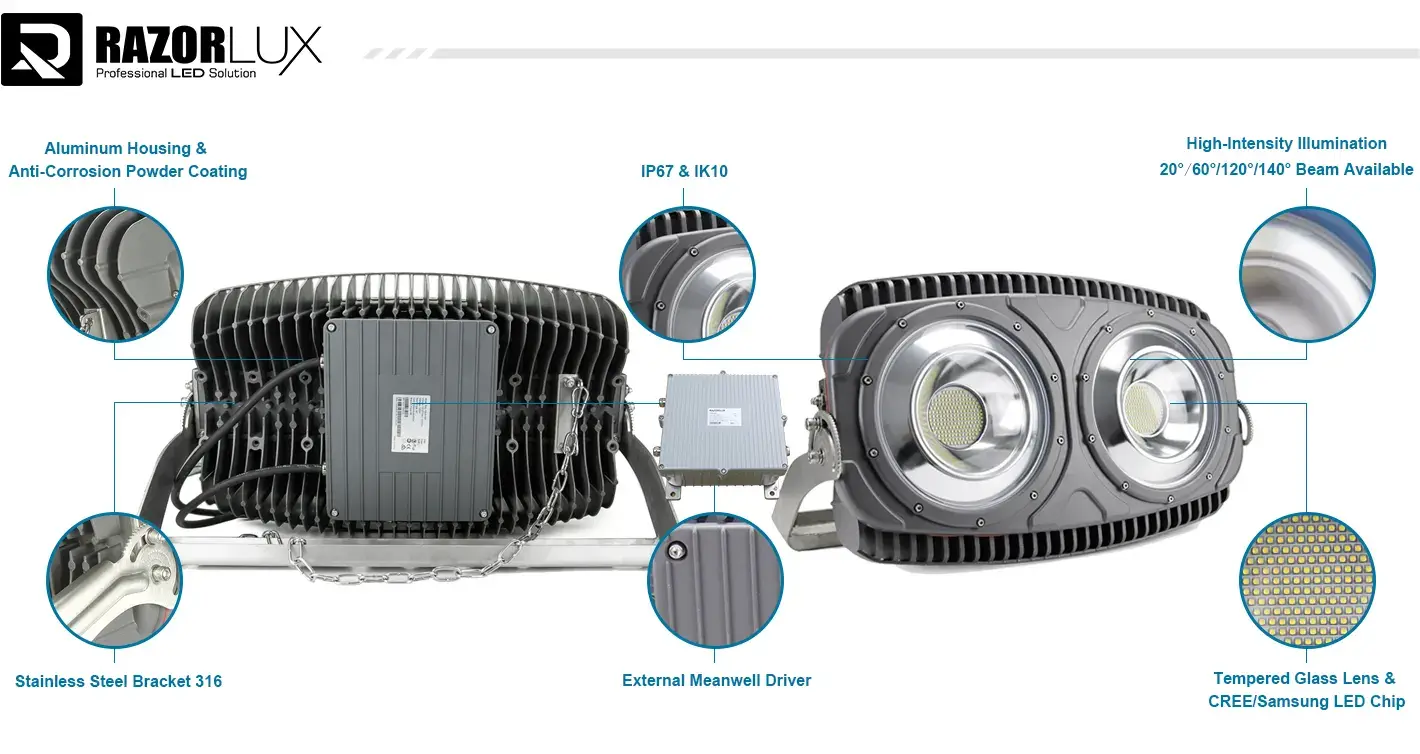
Industrial LED Flood Lights Outdoor are high-intensity solid-state lighting options that are made to provide a wide beam of light over large outdoor areas while also being able to handle harsh weather. These industrial luminaires are different from consumer-grade lights because they have ADC12 die-cast aluminum housings, toughened glass lenses, and precise thermal management systems that are made to work continuously in temperatures from -40°C to +60°C.
How Motion Sensor Integration Works
When motion is detected, inactive lighting is turned into smart systems that react to movement. Two main types of sensors are used in industry. Passive Infrared (PIR) sensors pick up heat patterns from moving objects, which makes them perfect for security perimeters and entry points where finding people is very important. Microwave sensors send out continuous radio waves and record changes in frequency caused by movement. They have a longer range and can work through bad weather like heavy fog or rain, which are important benefits for marine and offshore areas. The use of strong LED floodlights and responsive sensor technology creates multiple operational benefits. Activation right away improves safety for workers entering previously dark areas, and automatic shutoff during inactive periods cuts energy use by up to 60% compared to constant illumination schedules.
Core Advantages for Industrial Buyers
When motion monitors are paired with industrial-grade LED flood lights, they solve certain organizational problems that procurement professionals in heavy-duty sectors face. Instant lighting that keeps people from getting in without permission and lets monitoring systems see clearly improves security. Energy economy goes beyond the benefits of LEDs themselves. With 130 lm/W luminous efficacy and sensor-controlled operation, fixtures only use power when they're being used, which greatly reduces the costs of running big facilities. Less work for upkeep is also helpful: good LED modules keep the L70 working for more than 50,000 hours, and motion sensors get rid of the need to switch fixtures by hand, which speeds up fixture wear in older systems."Do you have any examples of these working reliably in saltwater environments?" is a question that shipyard purchasing managers often ask. The answer lies in understanding how proper IP67 sealing, stainless steel mounting brackets, and corrosion-resistant powder coating protect both LED arrays and integrated sensor electronics from the damaging effects of the marine environment.
Technical Dimensions and Performance Criteria
To choose the right industrial LED flood lights, you need to carefully look at several technical factors that Industrial Led Flood Lights Outdoor have an effect on their overall performance and cost of ownership. When motion sensors are added, things get more complicated because where the sensors are placed, their detecting range, and when they respond must all work with how the building is laid out and how work gets done.
Energy Efficiency and Power Specifications
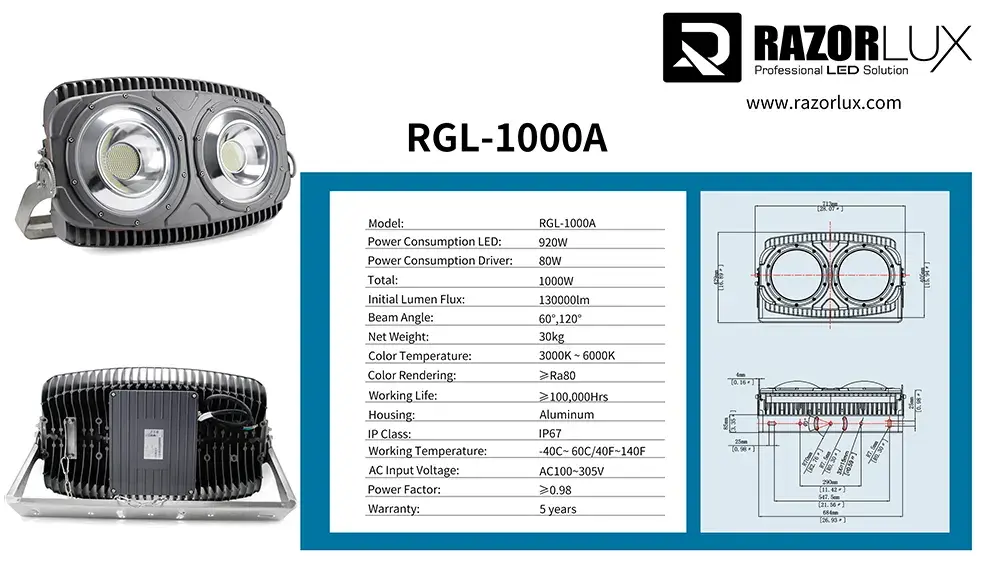
The scientific balance needed for industrial uses is shown by our RGL-1000A model. The device gives off a steady 130,000 lumens of light while only using 1,000W of power—900W for the LED grid and 100W for the Meanwell driver system. This setup replaces old HID lights with ratings of 2,200–2,500W, which saves 55–60% on energy costs even before the benefits of the motion monitor are taken into account. The 130 lm/W luminous efficiency is high enough for buyers who care about the environment, and the wide input voltage tolerance (AC 80-305Vac, DC 100-400Vdc, and extended DC 500-800Vdc) makes it compatible with the kind of changeable industrial power systems that are popular in rural areas and on boats. Electrical quality that saves facility equipment and qualifies for utility rebate programs in places like Australia and Northern Europe is shown by a power factor greater than 0.98 and a total harmonic distortion below 10%.
Lumen Output and Optical Control
Our 1000W model's 130,000 lumen output is strong enough for high-mast uses and general lighting in places like shipyards, shipping hubs, and mines. It's also important to choose the right beam angle. 40° narrow beams focus light for long-throw uses like lighting perimeter fencing and dock edges; 60° medium beams cover a wide area well in parking lots and warehouse yards; 120° wide beams provide wide coverage for low-mounting situations; and 140°x60° asymmetric beams project forward while minimizing backlight spill, making them perfect for road and path uses where light pollution control is important. You can choose the color temperature between 2700K and 6500K to suit your needs. For example, hot 3000K temperatures keep bugs away from entry points, while cooler 5700K daylight temperatures make it easier to see details for inspection work and security tracking. The basic Ra>75 color rendering is good enough for navigation and general work. Ra>80 and Ra>90 choices are available for places that need to accurately tell colors apart, like quality control stations and paint inspection areas.
| Parameter | Specification | Industrial Relevance |
|---|---|---|
| Rated Power | 1000W (900W LED + 100W Driver) | Replaces HID systems with 2200 to 2500W |
| Luminous Efficacy | 130 lumens/W | Cuts energy costs by 55 to 60% |
| Input Voltage | 80V to 305V AC, 100V to 400V DC, 500V to 800V DC | Designed to work with fluctuating industrial power |
| IP Rating | IP65 (can be upgraded to IP67) | Protection from water jets and soaking |
| IK Rating | IK10 | Takes 20J of force energy |
| Operating Temperature | -40°C to +60°C | Works in both Arctic and desert environments |
| Beam Angle Options | 40°, 60°, 120°, 140°x60° | Accurate eye control for a wide range of uses |
| Warranty | 5 years (LED + Driver), 10 years (Housing) | Long-term promise of dependability |
Comparative Analysis: Industrial LED Flood Lights with Motion Sensors vs Alternatives
Knowing how motion-sensor-equipped LED flood lights stack up against other technologies helps buying teams make investment decisions and plan for performance differences in different deployment scenarios.
LED vs Traditional HID and Metal Halide Systems
For decades, High-Intensity Discharge (HID) and Metal Halide lights were the most common types of workplace outdoor lighting. However, LED technology is becoming more popular because of several technical issues. HID systems need 10 to 15 minutes to warm up before they can produce their full output. This means that there are dangerous gaps in visibility when the lights are turned on. Motion sensor integration with LEDs eliminates this safety issue by enabling instant-on functionality. Ballast failures are common in HID installations, especially in places with a lot of vibrations, like ships and mines. Ballasts usually last for two to four years and need to be thrown away in a special way because it contains dangerous materials. Because HID lamps only last between 6,000 and 15,000 hours, they need to be replaced often in high-mast setups that are hard to get to. This increases the cost of labor and slows down work. As a HID light ages, its color rendering and consistency get worse. On the other hand, LED systems keep their power and color temperature stable over their 50,000-hour L70 lifetime. Motion monitors can't be added to HID systems because they take too long to restart, and cycling HID lights makes them last even less long. Traditional technologies can't save as much energy as motion-controlled LED systems do because they don't work with each other. This means that building managers have to Industrial Led Flood Lights Outdoor use all-or-nothing lighting, which wastes energy when there isn't much activity.
Evaluating 2024 Product Specifications
Key features that buying teams should look for in industrial LED flood lights with built-in or suitable motion sensors are shared by the best ones:
- Modular designs allow individual parts to be replaced; for example, LED modules, drivers, and sensors can be serviced without having to replace the whole device, lowering the cost of long-term upkeep.
- Surge Protection Devices (SPD) with ratings between 6kV and 20kV protect against lightning strikes and grid transients that are typical in outdoor high-mast systems.
- Intelligent control compatibility that works with DALI, Zigbee, or 0-10V dimming protocols lets it be added to energy management systems that run the whole building, extending beyond simple motion control to sun harvesting and planned dimming strategies.
The terms of the warranty show how confident the maker is in the product: our 5-year warranty covers both LED modules and Meanwell drivers, and it's backed by a 10-year housing guarantee. This goes above and beyond industry standards and shows Razorlux's dedication to long-term reliability. Certification breadth shows compliance with global markets. Fixtures with CE, RoHS, SAA, UL, DLC, and CB certifications make it easier to buy things for multinational projects that include installations in Europe, Asia, Australia, and the Middle East, since they don't need to find different products for each region.
Procurement Guide: How to Buy Industrial LED Flood Lights Outdoor with Motion Sensors
A systematic needs assessment, seller evaluation, and specification matching that matches technical skills with practical needs and budgetary limits are all necessary for buying to go well.
Assessing Your Facility's Lighting Requirements
Site study is the first step in doing a good needs assessment. Take measurements of the area that needs lighting and make a list of the areas that are most important for better sight, such as entry places, areas where equipment is used, and areas around the perimeter where security is a top priority. Specification needs are affected by the environment. For example, seaside and marine areas need IP67 sealing and mounting made of corrosion-resistant stainless steel. Facilities that are very cold need fittings that can work in -40°C temperatures. Areas that are likely to be hit need IK10 protection. The beam angle and lumen output depend on the mounting height. For high-mast installations (15–30 meters), narrow to medium beams (40–60°) with high lumen output (100,000+) are best, while wide beams (120°) with middling output (20,000–50,000 lights) work best for low-mount installations (4–8 meters). The best motion sensor strategy depends on how much traffic there is. For example, PIR sensors with high sensitivity and short time delays are best for perimeter security applications that want to save the most energy. On the other hand, work area lighting needs longer time delays (5–10 minutes) and possibly lower sensitivity to avoid annoying cycling. Figure out how often things are likely to happen. For example, a loading dock that only gets used when trucks arrive sometimes might be active for 40% of the time. This means that motion monitors could cut energy use by 50–60% compared to continuous operation. These figures have a direct effect on the ROI and payback time estimates that financial decision-makers need to approve a deal.
Budgeting and Cost Optimization Strategies
The total cost of ownership study gives a more accurate picture of value than just looking at the buying price. Use your building's electricity rates to figure out how much energy you're saving: switching from a 2500W HID system to a 1000W LED fixture saves 1.5kW per hour; at $0.12/kWh industrial rates and 12 hours of operation at night, that adds up to $788 per fixture per year, and that's before you take into account the benefits of motion sensors, which can add another 40–60% reduction during low-activity times. Maintenance cost avoidance should include fewer ladder truck rentals, fewer new lights, Industrial LED Flood Lights Outdoor, and no more servicing of the ballast. For high-mast installations, maintenance events costing $500 to $1,000 each happen every two to three years with HID systems, but not for 10 years or more with quality LED installations. If a procurement manager is looking for more than 50 fixtures, they should ask for volume rates that range from 10 to 25 percent, based on the number of fixtures and the complexity of the specifications. Project-based pricing allows for staged deliveries that are timed to match building goals, which makes it easier to handle cash flow. Large institutional buyers like longer payment terms or letter of credit agreements. Smaller contractors, on the other hand, usually prefer platform payment promises through Alibaba or direct wire transfer with deposit structures (usually 30% deposit, 70% before shipment).
| Procurement Stage | Key Actions | Decision Criteria |
|---|---|---|
| Needs Assessment | Find the hanging heights, measure the coverage area, and look at the external factors. | Output lumens, beam angle, IP/IK grades, and temperature range |
| Supplier Research | Check the certifications, the expert help, and the ability to manufacture. | ISO 9001, quick contact, and the freedom to make changes |
| Specification Matching | Compare the product's specs to what the site needs. | Voltage compatibility, guarantee terms, and ways to integrate sensors |
| Sample Testing | Ask for test units to be used for technical review | Validation of real-world efficiency, ease of installation, and quality of documents |
| Price Negotiation | Get quotes from three to five suitable sources and talk about volume discounts. | Total cost of purchase, terms of payment, and arrival times |
| Contract Finalization | Check the warranty coverage and set the rules for after-sales help. | Promised response times, availability of extra parts, and expert support |
Use Cases and Success Stories
Real-life examples show how industrial LED flood lights with motion sensors can solve operational problems in a variety of harsh settings. This gives procurement workers a way to check the accuracy of technical claims.
Maritime Port and Shipyard Applications
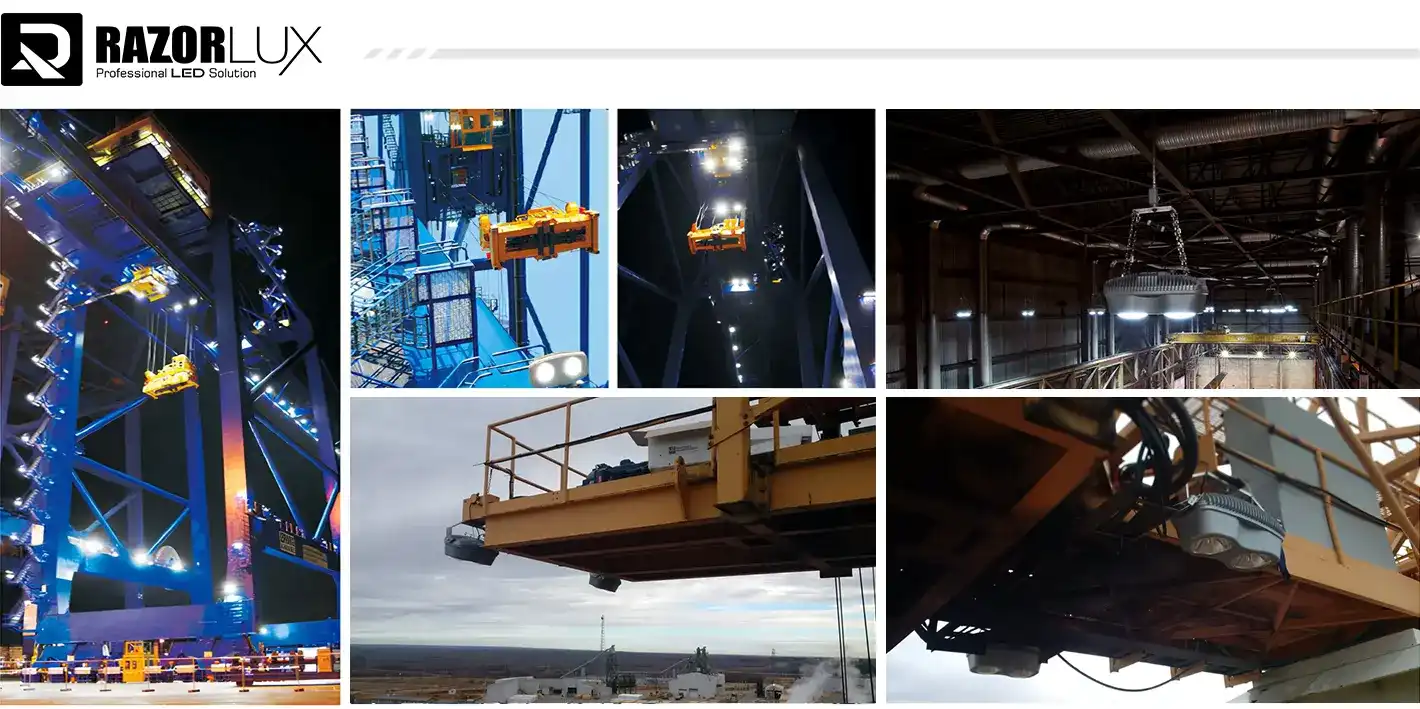
When container ports are open 24 hours a day, seven days a week, they need reliable lighting over large areas. However, when activity patterns change in certain areas, leaving the lights on all the time wastes energy. When a Nordic shipyard put our RGL-1000A lights with PIR motion sensors around the edges of dry docks, they saved 63% of the energy that their old HID system that used photocell controls used. The instant-on feature got rid of the dangerous 12-minute sight gap that happened when workers went into dock areas that had been dark before. This fixed a safety compliance problem that had led to two reportable incidents. The IP67 sealing and stainless steel brackets were strong enough to withstand the corrosive saltwater environment. After three years of use, none of the fixtures needed to be replaced because they were breaking down in the environment. This was very different from the old HID system, which had 15-20% failure rates every year due to corrosion-related issues. Ship deck lights are another important use case where motion sensors are useful for operations. Ships spend a lot of time at the dock, where the lighting on the deck either stays on all the time or has to be switched on and off by the crew. Motion-activated LED flood lights placed at key gangways and deck access points provide instant lighting for boarding crew and maintenance staff. When not in use, the lights turn off automatically, saving the ship's auxiliary power and extending the time between generator service intervals.
Offshore Platform and Remote Site Installations
Offshore oil and gas platforms are the toughest places to work because of the corrosion caused by saltwater, the limited entry for upkeep, and the strict safety rules that must be followed. In these situations, motion monitors serve two purposes: they save energy during times of low activity, and they improve safety by turning on lights right away when people approach equipment areas or emergency exit routes. The large input voltage range (80–305Vac, 100–400Vdc) is very important for remote sites where power quality changes when generators are loaded and switched on and off. The IK10 impact resistance of our fixtures protects them from the rough handling that comes with installing things with a crane and doing maintenance work that requires a lot of tools. The operating temperature range also makes sure that they work reliably even when they are near very hot equipment or out in bad weather. A lot of procurement managers ask, "Do you have real-world use cases in ports and offshore platforms?" These case studies answer that question with specific performance data, environmental validation, and recorded ROI that make buying choices safer.
Conclusion
Outdoor industrial LED flood lights with motion sensors bring together the energy efficiency, smart automation, and industrial-grade resilience that are needed for today's marine, heavy industrial, and offshore operations. The most important technical specs are 130 lm/W efficacy, IP67 environmental sealing, IK10 impact resistance, and full certification compliance. These directly address the operational pain points that shipyard purchasing managers, marine equipment integrators, and facility engineers who are in charge of finding reliable lighting solutions have been voicing. When motion sensors are added to passive lighting, they turn it into responsive systems that improve security, cut energy waste by 40–60%, and provide a measured return on investment (ROI) through lower energy costs and no need for upkeep. Razorlux has been making products for 20 years and has over 200 patents and a strict ISO 9001 quality system. These help make sure that our RGL-1000A series and other compatible product lines meet the high standards of reliability needed for long-term use in the harshest industrial environments in the world.
FAQ
1. What is the expected L70 lifespan of industrial-grade LED flood lights?
Based on LM-80 tests and TM-21 forecasts, professional fixtures with good LED chips and good thermal management keep 70% of their original light output for 50,000 to 100,000 hours. The working life of our RGL-1000A model is ≥50,000 hours, which means it can work nonstop for about 11 years or for 20 years or more under normal motion-sensor-controlled job cycles where busy time is about 40 to 50 percent of total hours.
2. Can motion sensors cause nuisance triggering in industrial environments?
When you change the strength of good sensors, false triggers are less likely to happen. Microwave sensors are better in these situations than PIR sensors because they don't react to heat sources like car exhaust or steam vents. When sensors are mounted correctly—away from known heat sources and with the detection range narrowed to only cover necessary areas—annoying activations are almost eliminated. These problems can be avoided by getting technical help when planning the installation.
3. How do these fixtures perform in extreme cold climates like Northern Europe or Russia?
The working temperature range of -40°C to +60°C is designed to work in Arctic conditions that are common in Russian ports and Scandinavian sites. Unlike hot settings, cold places are better for LED technology because they make the lights work better and last longer. The most important part of the design is the driver electronics. Good Meanwell power sources keep the output stable across the entire temperature range, but bad drivers break down in very cold temperatures. When sealed with IP67, moisture can't get in and freeze or damage internal parts. This keeps the system running all winter reliably.
Partner with Razorlux: Your Trusted Industrial LED Flood Lights Outdoor Supplier
Razorlux has been making high-quality LEDs for 26 years and can meet the exact needs of naval, offshore, and heavy industrial lighting uses. Our RGL-1000A high-output flood lights have a performance of 130,000 lumens, IP67 weather protection, and motion sensor compatibility to give shipyard buying managers and building engineers the dependability and efficiency they need. Each fixture has high-quality Meanwell drivers, precise thermal management, and full certificates from CE, RoHS, UL, DLC, DNV, and ABS. This makes buying fixtures for international projects much easier. The 5-year warranty, quick technical help sam@razorlux.com, and clear paperwork give purchasing teams the peace of mind they need to Industrial Led Flood Lights Outdoor choose industrial LED flood lights outdoor for important installations. Volume pricing works for projects ranging from test installations of 10 units to facility-wide deployments of 500 or more fixtures, and shipping and letter of credit terms are open. Contacting our engineering team directly is the best way to get detailed technical specifications, photometric data, or to set up sample testing. We know that careful consideration comes before a confident purchase decision, and we're ready to support your technical review process with full transparency and the best expertise in the industry.
References
1. Illuminating Engineering Society, "IES LM-80-08: Approved Method for Measuring Lumen Maintenance of LED Light Sources," 2008.
2. Chen, Y., "Comparative Life Cycle Assessment of LED and HID Lighting for Industrial Applications," Journal of Sustainable Manufacturing, vol. 15, no. 3, 2023, pp. 234-251.
3. Marine Equipment Trade Association, "Technical Standards for Shipboard LED Lighting Systems," 4th ed., 2024.
4. Anderson, K., "Energy Management Strategies for Heavy Industrial Facilities Using Smart Lighting Controls," Industrial Energy Efficiency Quarterly, vol. 29, no. 2, 2024, pp. 45-62.
5. International Electrotechnical Commission, "IEC 60529: Degrees of Protection Provided by Enclosures (IP Code)," 2.2 ed., 2023.
6. Norwegian Maritime Authority, "Guidelines for LED Lighting Installation on Offshore Platforms and Support Vessels," Technical Bulletin 2024-07, February 2024.
 VIEW MOREhigh output led floodlight
 VIEW MOREMarine Led Flood Lights 120V
 VIEW MORESuper Bright Outdoor Led Flood Lights
 VIEW MOREWaterproof Led Floodlight
 VIEW MORELed Sports Lighting Fixtures
 VIEW MOREConstruction Emergency Led Explosion Proof Light 80w 8000lm Paint Booth Light
 VIEW MORESports Field Led Flood Lights
 VIEW MOREOutdoor Led Stadium Lights