


_1750326878398.png)

Top Marine Flood Lights 1000W Manufacturers for Harbors
Harbor managers and shipyard procurement teams seeking reliable high-intensity illumination still often find Marine Flood Lights 1000W high on their specification sheets. They provide 100,000 to 150,000 lumens per fixture from a single unit and are the norm for big port lighting, offshore platform work areas, and dry-dock operations. This book addresses the major manufacturers, critical technical standards, buying methods, and what makes a fixture endure ten years or fail in 18 months of saltwater use.
Understanding 1000W Marine Flood Lights: Key Specifications and Benefits
Before comparing suppliers, your technical team needs a firm grasp of what separates a genuine marine-grade floodlight from a standard industrial fixture repainted gray.
How These Fixtures Actually Work
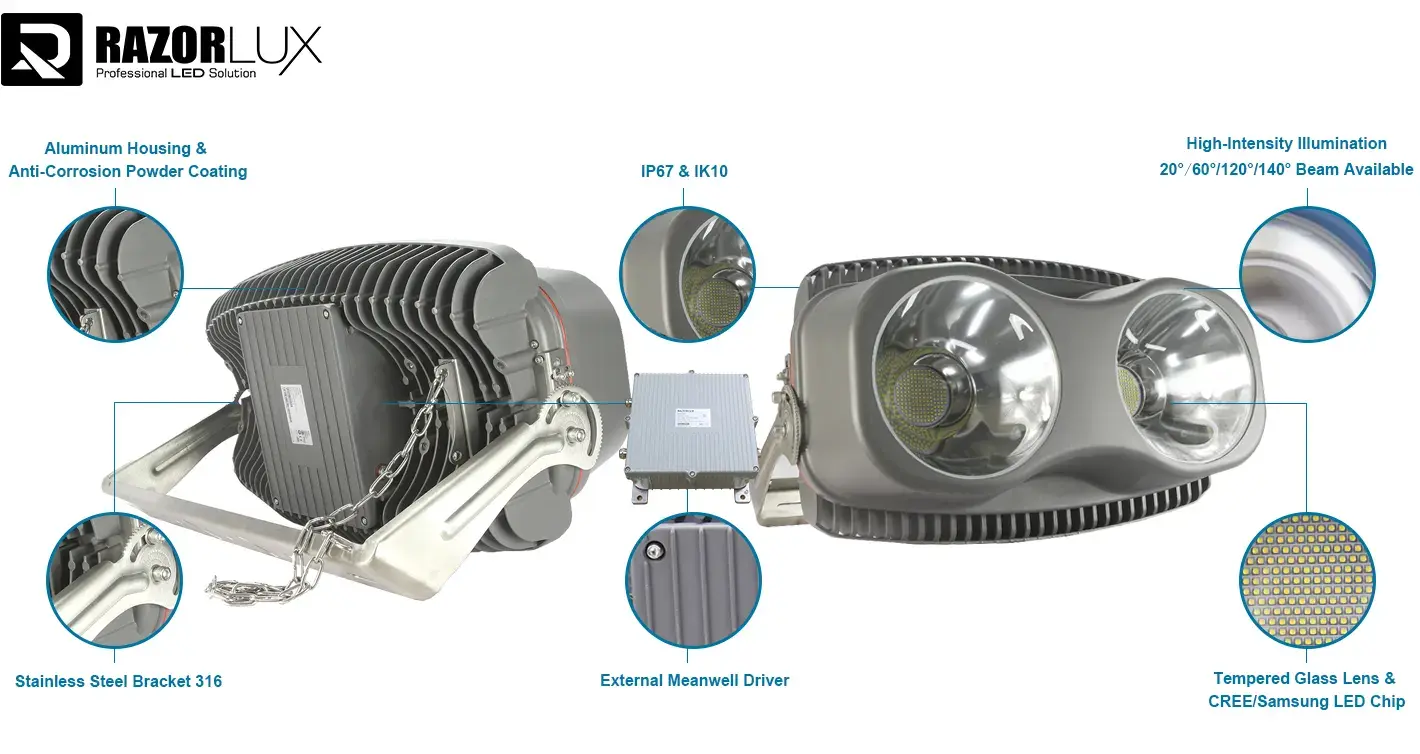
A 1000W LED marine floodlight drives current through high-output LED arrays — typically Samsung or Cree chips — mounted on a thermally managed aluminum housing. The driver converts shore power or vessel generator supply (which can fluctuate significantly) into stable DC current. Mean Well drivers, for example, support wide AC input ranges of 80–360V, protecting the LEDs during generator load swings that would destroy a budget unit.
Critical Specifications You Should Verify
Every specification on a datasheet carries operational consequences. The table below summarizes the parameters your engineering department should confirm before approving any supplier sample.
| Parameter | Recommended Standard | Why It Matters |
|---|---|---|
| Luminous Efficacy | ≥130 lm/W | Direct impact on energy bills and generator load |
| IP Rating | IP67 minimum | Protects against full water immersion and salt spray |
| IK Rating | IK10 | Resists mechanical impact from equipment and debris |
| Color Temperature | 4000K–6500K | Improves worker visibility on night shifts |
| CRI | ≥Ra75 (Ra80+ preferred) | Accurate color rendering reduces errors during inspection |
| Working Temperature | −40°C to +60°C | Covers Arctic and Gulf environments |
| Beam Angle Options | 15° to 140°×60° | Flexibility between focused and wide-area illumination |
| Power Factor | ≥0.98 | Reduces reactive load on vessel electrical systems |
Harbor-Specific Benefits That Justify the Investment
Switching from a 2,200W-3,000W metal halide lamp to a 1000W LED equivalent is more than just a watt savings; it affects the economics of the whole lighting circuit. A port installation that runs 50 floodlights at 2,500W each uses 125 kW for every hour it runs. Replacing them with 1000W LED bulbs at 130 lm/W output reduces consumption to 50 kW, reducing energy cost by almost 60%. That difference over the life of a five year contract finances subsequent procurement cycles. In addition to energy, LED floodlights react immediately in emergency docking circumstances or security issues since there is no warm-up time – metal halide lamps take 3-5 minutes to achieve maximum brightness.
Top Manufacturers of 1000W Marine Flood Lights for Harbors
The market includes both global electrical brands and specialized Marine Flood Lights 1000W lighting manufacturers. Each category serves different procurement contexts.
Global Electrical Brands
Philips (now Signify) and Osram hold significant catalog depth in industrial lighting. Their marine product lines carry CE and RoHS documentation that procurement departments recognize immediately. Eaton's Crouse-Hinds division produces Ex-rated fixtures suitable for hazardous areas on offshore platforms, which is relevant when a single procurement order covers both general harbor areas and classified zones. These brands typically distribute through regional electrical wholesalers, which simplifies local stock availability but often limits customization.
North American Specialists
Cree Lighting and Hubbell Lighting both address the North American market with UL-listed fixtures and DLC-qualified products eligible for utility rebate programs. DLC qualification is particularly relevant for port facilities in the United States operating under energy efficiency incentive schemes. Hubbell's marine division specifically engineers fixtures for shipboard and dock environments, with corrosion-resistant housing treatments suited to coastal installations.
Razorlux: Specialized High-Output Marine Manufacturer
Razorlux (Xi'an Razorlux Optoelectronic Technology Co., Ltd.) is in a distinct position in this market. Since moving to LED manufacture in 2006, the firm has concentrated on maritime and severe demanding conditions rather than taking ordinary industrial items and customizing them for marine usage. The RGL-1000P variant produces a constant output of 100,000-105,000 lumens (measured at 5700K after one hour of operation) while using precisely 1000W of power in total (900W LEDs + 100W driver). Housing: Die-cast aluminum with powder coating. Bracket: 316 stainless steel. Driver: Mean Well, AC input (80-360V / 400-600V without adaptor) and DC input (100-400V / 500-800V). This large voltage tolerance is unusual and of practical importance on older ships with irregular generator output.
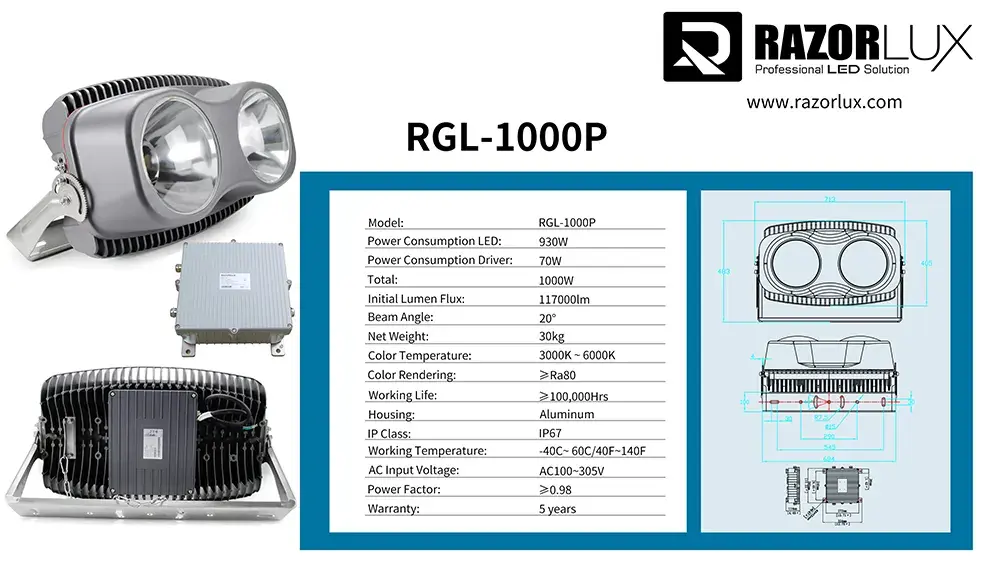
Razorlux is RMRS, CE, RoHS, SAA, C-Tick, UL, DLC, CB, and ISO 9001 Certified. In particular, the RMRS certification, Russian Maritime Register of Shipping, speaks to real compliance with maritime classification regulations, not just some basic electrical safety markings.
How to Choose the Right 1000W Marine Flood Light Manufacturer for Your Harbor Needs
Procurement decisions at this scale involve multiple departments and extend beyond price per unit.
Evaluate Certifications Against Your Project Requirements
Not every certification is equivalent for every application. A port in Norway will need CE and perhaps DNV paperwork for insurance compliance. In Australia, a terminal requires SAA and C-Tick markings to get an electrical safety clearance. A platform located offshore in the Gulf of Mexico may be required to comply with UL 1598A. Before releasing an RFQ, your engineering team should determine the certifications required for the project. Suppliers with extensive certification portfolios – not just a single regional mark – minimize the possibility of paperwork gaps during inspection.
Compare LED Technology and Component Sourcing
The LED chip and driver are the two factors that decide whether a fixture will meet its rated 50,000-hour life or die young. You can really see performance statistics for fixtures that use Samsung or Cree LED arrays and Mean Well or Inventronics drivers. Your technical team can look at it themselves. Ask any provider to confirm the exact type of chip and driver they are using and then compare it to the published LM-80 lumen maintenance data from the chip manufacturer.
Assess After-Sales Infrastructure
A manufacturer’s warranty is only worth as much as their capacity to stand by it. Before you approve a provider, check that they can deliver spares, react to technical questions within 24-48 hours, and give installation manuals in your working language. Take Razorlux, for example, which gives a 5-year guarantee on the LED module and driver, and a 10-year warranty on the housing – something procurement managers need to consider when modeling total cost of ownership throughout the lifetime of a project.
Razorlux RGL-1000P: Technical Specifications in Detail
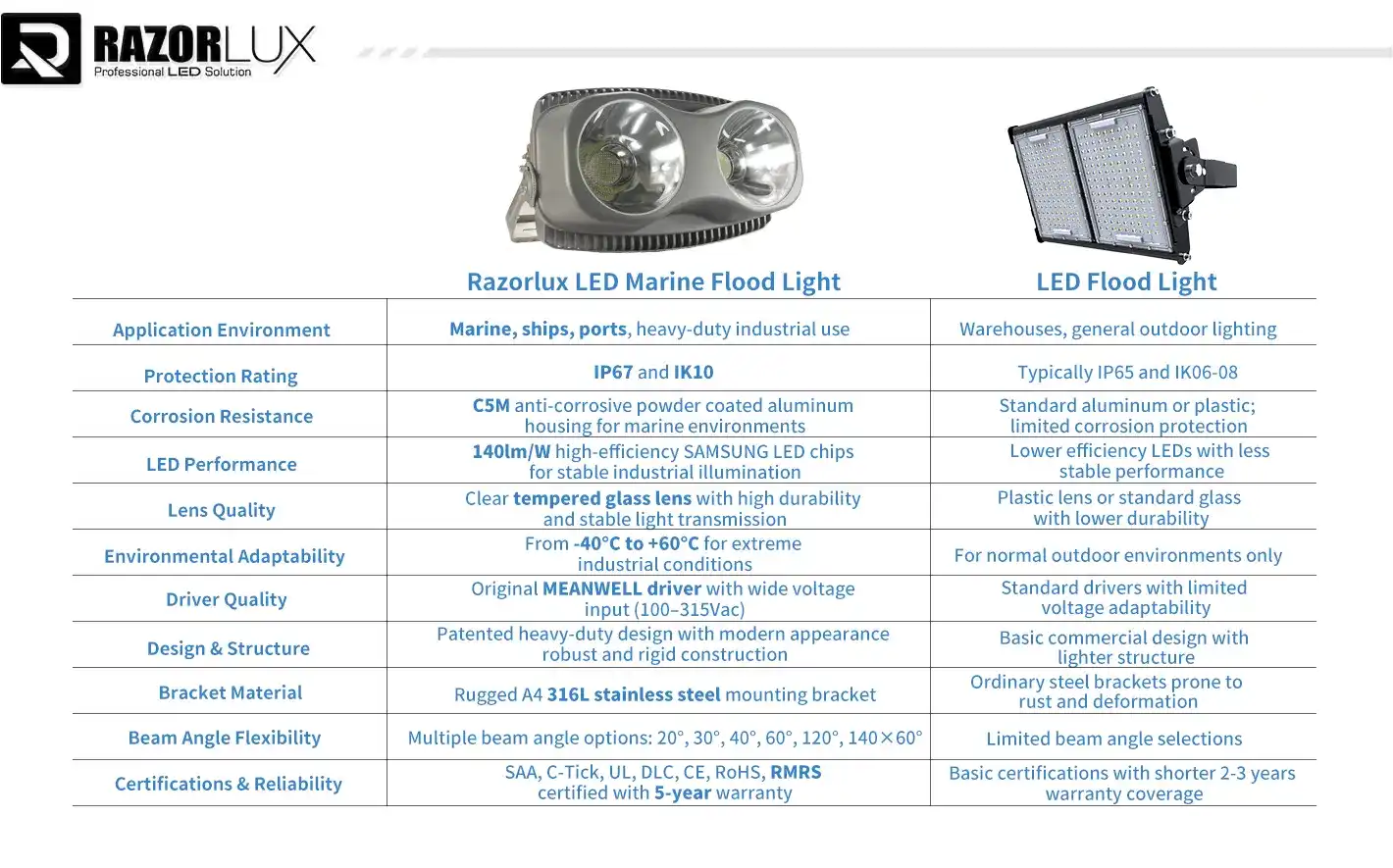
The RGL-1000P represents Razorlux's patented multi-function design, engineered for all working environments from Arctic shipyards to tropical offshore platforms.
Core Electrical and Optical Performance
The fixture achieves 130 lm/W efficacy, producing stable output across a color temperature range of 2700K to 6500K — allowing specification of warm or cool white depending on application. Beam angle options span 15°, 20°, 30°, 40°, 60°, 120°, and 140°×60°, covering both long-range searchlight configurations and wide-area deck illumination from the same product family. CRI is Ra>75 as standard, with Ra80 and Ra90 available on request for inspection or repair yard applications where color accuracy affects work quality.
Environmental and Mechanical Protection
The table below summarizes the RGL-1000P's environmental ratings against common Marine Flood Lights 1000W deployment conditions.
| Environmental Factor | RGL-1000P Rating | Typical Marine Condition |
|---|---|---|
| Water Ingress Protection | IP67 | Salt spray, deck wash-down, heavy rain |
| Impact Resistance | IK10 | Equipment movement, hatch operations |
| Operating Temperature | −40°C to +60°C | Arctic winter to Middle East summer |
| Operating Humidity | 10%–95% | Tropical and coastal environments |
| Vibration | Tested per marine standards | Ship engine resonance (3G–5G) |
| THD | <10% | Reduces harmonics on vessel electrical systems |
Weight, Mounting, and Installation
At 29 kg (64 lbs) including the stainless steel bracket, the RGL-1000P is a substantial fixture designed for permanent installation rather than portable use. The stainless steel U-bracket is adjustable, and Razorlux can supply customized adaptor plates to match existing bolt patterns from legacy HID installations, reducing installation labor and downtime. The housing dimensions are 671×405×374mm (or 671×405×322mm depending on beam angle configuration).
Procurement Strategies: Buying 1000W Marine Flood Lights for Harbors
Effective procurement at this scale requires more than finding the lowest unit price.
Establish Your Total Cost of Ownership Baseline
Before you negotiate, consider the costs for each choice over five years: purchase price, installation labor, energy consumption, projected maintenance visits, and how often the lamps will need to be replaced. If a fixture costs 20% less than a competitor’s, but requires a yearly driver change with high labor costs, it is not really cheaper. LED fixtures using Mean Well drivers and Samsung arrays normally do not need planned maintenance for the first 50,000 hours (around 5–6 years of continuous operation).
Key procurement parameters to model in your cost comparison include:
- Energy consumption: The RGL-1000P consumes 1000W at 130 lm/W and replaces 2200-3000W HID bulbs. Each 2500W HID fixture replaced saves roughly $1,752 annually in energy alone, over 8,760 yearly hours at $0.12/kWh.
- Maintenance frequency: Good LED maritime flood lights should last 50,000+ hours without having to replace the bulb — compared with 8,000- 12,000 hours for metal halide sources. Fewer maintenance cycles imply less scaffolding, fewer contractor hours, and less operational disturbance.
- Certification value: The right certifications (RMRS, UL, DLC, CE) may make the difference between qualifying in a project bid or port authority permission and getting cut from the supplier list.
Together, these three things decide whether a purchase choice will provide long-term value or just push expense down the road to maintenance budgets.
Negotiation and Sample Testing Protocol
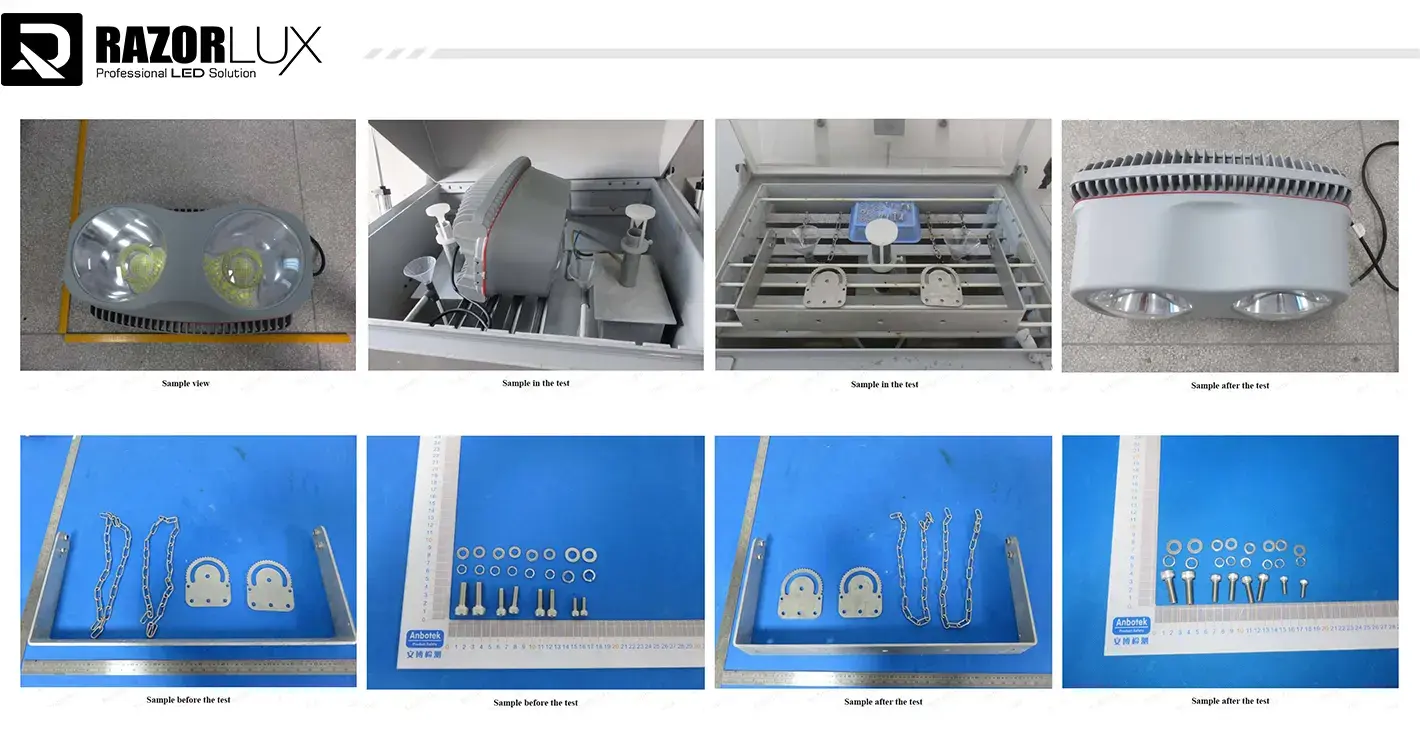
Most reputable manufacturers will provide test samples prior to a big purchase. When ordering samples, ask for a unit in the exact beam angle you will be deploying, and ask for the driver data sheet with fixture. Your technicians should run the sample at load for a minimum of 72 hours and measure lumen output before and after. Check to see if the IP rating is retained under direct water spray.
Supplier Qualification and Long-Term Partnership
For port authorities and shipyards with ongoing projects, a framework agreement with a certified supplier greatly minimizes the administrative overhead for every order. Razorlux allows OEM and customisation, which is important for integrators who want branded or application-specific variations. The firm sells to North America, Western Europe, Eastern Europe, Southeast Asia, the Middle East, and Oceania, covering the main geographical markets for harbor lighting procurement.
Conclusion
The key to selecting the correct manufacturer for high-output harbor flood lighting is finding the proper balance between technical specification, certification integrity, supply chain reliability and whole lifetime economics. The worldwide market comprises major electrical names and experts with a maritime specialty. Razorlux stands out by providing comprehensive deep Marine Flood Lights 1000W certification coverage, including RMRS alongside UL, CE, DLC, and SAA, and boasting 130 lm/W efficacy, IP67/IK10 protection, and a broad selection of beam angles to cater for all harbor applications from broad-area terminal lighting to targeted work-zone illumination. If you’re in procurement and you’re thinking about your next purchase, the RGL-1000P is something to include in your technical evaluation.
FAQ
1. What IP rating is required for harbor flood lights?
IP67 is the practical minimum for exposed harbor and deck applications, as it confirms protection against temporary submersion and continuous salt spray. Some offshore platform applications specify IP68 for permanently submerged or wave-impact zones. The Razorlux RGL-1000P carries IP67 certification, which covers the vast majority of harbor and shipyard environments.
2. Can a 1000W LED floodlight actually replace a 2500W metal halide?
Yes. At 130 lm/W, a 1000W LED unit delivers approximately 130,000 lumens with directional optics. A 2500W metal halide lamp produces around 200,000 lumens but distributes light in all directions, losing roughly 30–40% to internal absorption. The effective delivered lux on a work surface is comparable to or better than with the LED fixture.
3. Which certifications matter most for international procurement?
This depends on the destination market. CE and RoHS cover European Union requirements. UL and DLC address North American standards. SAA and C-Tick apply in Australia. RMRS is required for Russian maritime classification. Procurement managers sourcing for multiple regions should prioritize suppliers holding multi-region certification portfolios.
4. What beam angle should I specify for general dock lighting?
For general area illumination across a dock or terminal, 60°–120° beam angles provide even coverage across wide horizontal surfaces. For elevated mast installations (25m+) covering a large apron area, a narrower 30°–40° angle concentrates flux at ground level. Razorlux offers seven beam angle options on the RGL-1000P, allowing specification without compromising on fixture quantity.
5. How do I verify a manufacturer's component claims?
Request the driver model number and chip model number in writing, then cross-reference with the published datasheets from Mean Well and Samsung directly. Legitimate manufacturers will provide this information without hesitation. If a supplier declines to identify components specifically, treat that as a red flag during evaluation.
Get Your Harbor Lighting Specification Right — Contact Razorlux Today
Razorlux has supplied marine and heavy-duty LED lighting to shipyards, port terminals, and offshore platforms across North America, Europe, the Middle East, and Southeast Asia since 1998. The RGL-1000P Marine Flood Lights 1000W supplier program includes sample evaluation units, full technical documentation, OEM customization, and framework pricing for bulk orders. With certifications covering RMRS, UL, DLC, CE, SAA, and more, Razorlux provides the documentation your procurement and technical teams need to move from evaluation to order without delays. Send your specifications or project requirements to sam@razorlux.com to access the product catalog and request a quote.
References
1. International Electrotechnical Commission. IEC 60598-1: Luminaires — General Requirements and Tests. IEC, 2020.
2. Illuminating Engineering Society. IES TM-21: Projecting Long-Term Lumen Maintenance of LED Light Sources. IES, 2019.
3. Det Norske Veritas (DNV GL). Rules for Classification: Ships — Electrical Installations. DNV GL, 2021.
4. U.S. Department of Energy. LED Lighting Technology and Market Assessment. Office of Energy Efficiency and Renewable Energy, 2022.
5. International Maritime Organization. SOLAS Chapter II-1: Construction — Structure, Subdivision and Stability, Machinery and Electrical Installations. IMO, 2020.
6. DesignLights Consortium. Technical Requirements for Solid-State Lighting Products, Version 5.1. DLC, 2022.