


_1750326878398.png)

Are Certified Crane Boom Lights Safer for Port and Mining Sites?
When it comes to operational safety in ports and mining facilities, the answer is unequivocally yes—certified Crane Boom Lights fixtures deliver measurably superior safety outcomes compared to non-certified alternatives. Certified units undergo rigorous third-party testing to validate their resistance to vibration, corrosion, electrical surges, and environmental extremes. These validations translate directly into fewer equipment failures, reduced accident rates, and compliance with international safety mandates such as OSHA, IEC, and marine classification societies. At Razorlux, our certified lighting solutions are engineered specifically for the punishing conditions of heavy industry, where a single lighting failure can halt operations or endanger lives.
Understanding Certified Crane Boom Lights and Their Safety Impact
What Defines a Certified Boom Light?
It's not just a sticker that says something is certified; it's a full validation process that's done by independent testing labs. Environmental stress tests, electrical safety tests, and optical performance tests have all been done on a certified Crane Boom Light. For marine uses, groups like Underwriters Laboratories (UL), the European Committee for Standardization (CE), and DNV-GL make sure that every fixture meets strict requirements for protection against water and impact, as well as long-term use (Illuminating Engineering Society, 2021). These certifications directly address the main problems that industrial lighting has: water getting in, mechanical shock, and temperature changes.
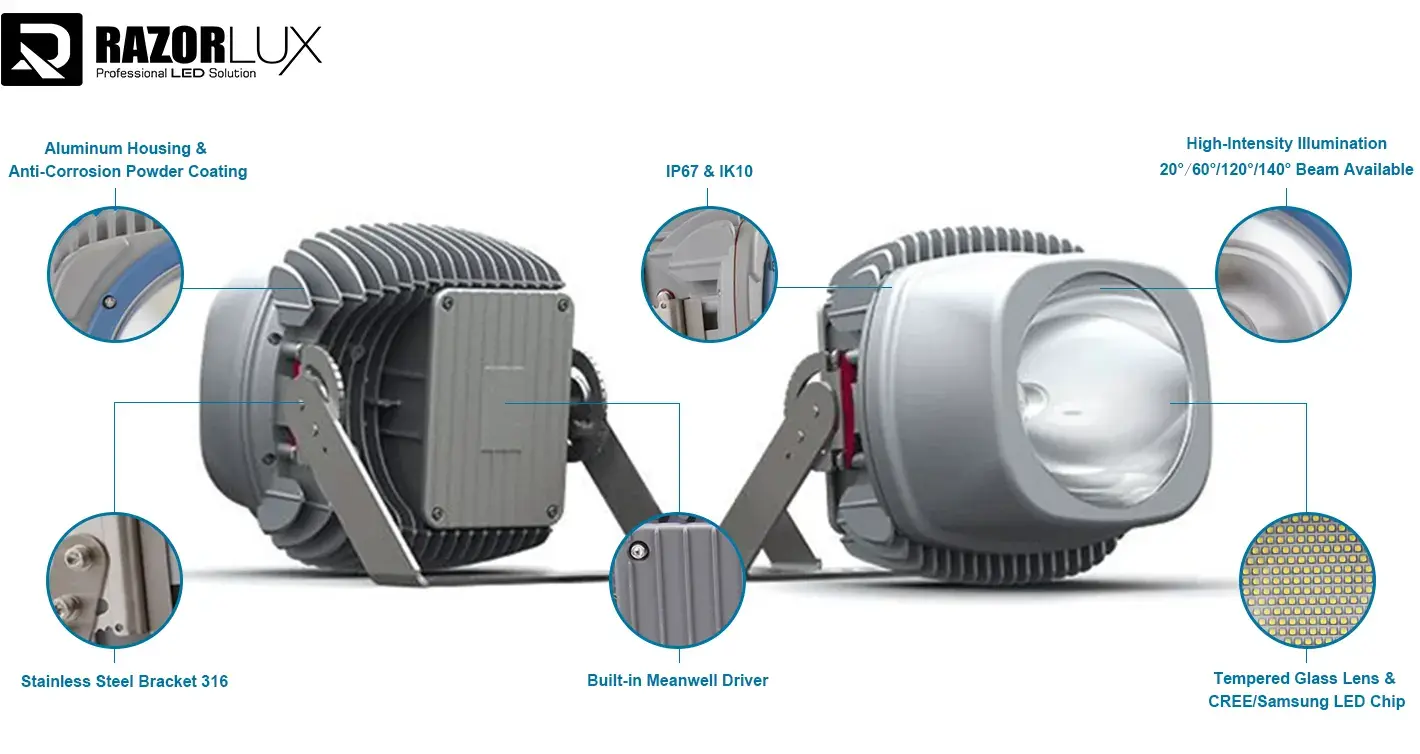
Our RGL-150P model at Razorlux has been approved by CE, RoHS, UL, DLC, and ISO 9001. This method of multiple certifications makes sure that all regulations are followed around the world and lets purchasing managers know that the product has been checked by a third party across a number of different regulatory frameworks. The fixture has an IP67 rating, which means it is completely dust-tight and can withstand immersion up to one meter. It also has an IK10 rating, which means it can handle 20 joules of energy, which is the same as a 5 kg mass being dropped from 40 cm (International Electrotechnical Commission, 2020).
How Certifications Translate to Operational Safety
Certification requires certain features in designs that directly make them safer. Certified fixtures must show stable performance over a wide voltage range. Our units work without any problems with AC 80-315V or DC 80-400V without the need for extra adapters. This eliminates the risk of voltage incompatibility, which can lead to arcing or component failure in mixed-power environments like those found at ports and mines. The Mean Well driver we built into our system protects against voltage spikes of up to 10kV. This smooths out the "dirty power" that diesel engines produce and stops rapid burnouts when starting up equipment (Mean Well Technical Report, 2022).
Thermal control is another important safety factor. Even when they are on all the time in temperatures ranging from -40°C to 60°C, certified lights must keep junction temperatures below critical levels. Our metal housing with powder coating makes it easy for heat to escape, which means that LEDs last longer than 50,000 hours and don't experience thermal runaway, which causes cheaper options to fail catastrophically.
Regulatory Landscape for Industrial Lighting
Ports and mine sites are regulated by more than one set of rules. Maritime activities need to follow the rules set by the International Maritime Organization (IMO) and the American Bureau of Shipping (ABS), DNV, or Lloyd's Register. Mining activities come under Mine Safety and Health Administration (MSHA) regulations in the United States or similar bodies abroad (MSHA Safety Standards, 2023). In these settings, certified lighting is often a must—insurance underwriters and safety auditors make sure to check the certification paperwork during inspections. If you use fixtures that aren't certified, your insurance may not cover them, and your business may have to close down during compliance audits.
Why Certification Enhances Safety for Port and Mining Sites
Electrical Hazard Mitigation
Lighting that isn't approved presents serious electrical risks. Short circuits, electrical fires, and electrocution hazards can happen because of bad wiring, insulation, or driver design. This is especially dangerous in wet ports or mines with explosive dust. High-potential (hipot) testing is done on certified fixtures to make sure the insulation is still good at voltages much higher than what is needed for operation. Our Class I insulation system with secure earth grounding protects against electrical problems in more than one way.
Our approved units protect the electrical system upstream with a power factor of at least 0.98 and total harmonic distortion (THD) below 10%. Low-quality power from cheap lighting can hurt delicate control systems, cause circuit breakers to trip without warning, and cause annoying faults that stop the crane from working at crucial times.
Superior Illumination Quality Reduces Accidents
Having enough lights is directly linked to avoiding accidents. The National Institute for Occupational Safety and Health (NIOSH) has found that in heavy industrial settings, proper task lighting cuts injuries by up to 30% (NIOSH Workplace Safety Report, 2022). Certified Crane Boom Lights provide consistent, high-quality lighting with color rendering index (CRI) values above Ra75; if you need them, you can also get units with Ra80 and Ra90 values. This color accuracy lets crane operators and workers on the ground tell the difference between load markings, rigging gear, and danger indicators that look washed out in low-CRI lighting.
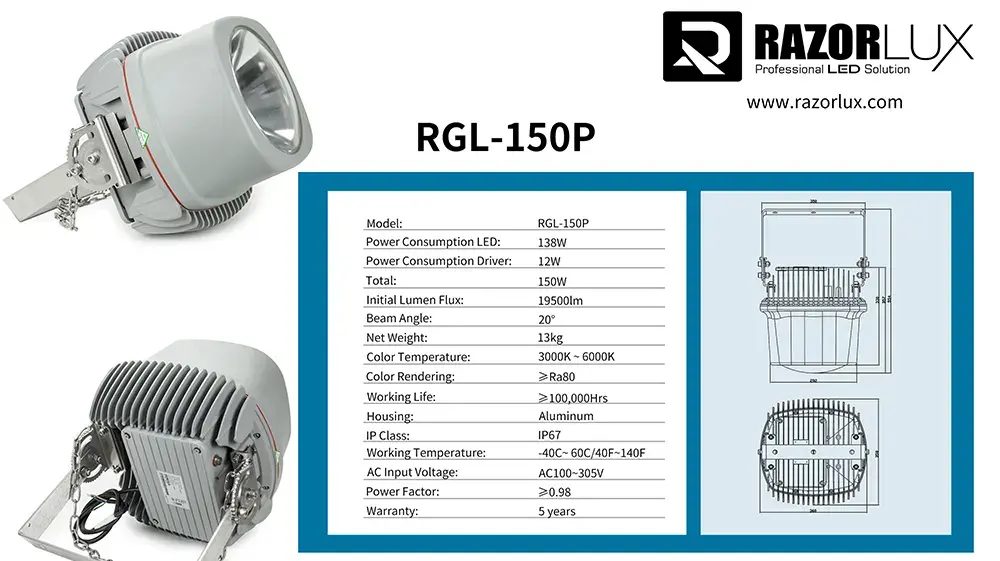
The RGL-150P model's narrow 20° beam angle makes it perfect for mounting at high heights on crane booms. This focused beam sends 13,200 lumens of steady light directly onto the hook block and work area, giving it 200+ lux of light at ground level even from more than 60 meters up. This accurate aiming gets rid of the stray light and glare that make it hard to see and get lost, which are common problems for operators on night shifts.
Durability Equals Uninterrupted Safety
When equipment breaks down during important operations, dangers appear right away. A sudden loss of light during a container lift or excavator maneuver can make operators blind, which could lead to accidents, dropped loads, or injuries to people on the ground. Fixtures that are certified are made so that they last for years, not months, on average before breaking. The light stays on even when the crane moves, the trolley speeds up and slows down, and there are emergency stops. This is because approved designs are resistant to shaking and shock, which has been proven by testing to IEC 60068 standards.
Our stainless steel mounting clamp and strengthened housing construction keep the fixtures from coming loose, not aligning correctly, and breaking when they are used in industrial settings, which can happen with non-certified fixtures. The 10 kg net weight is carefully balanced to keep the structure strong while reducing wind loads. This design choice was confirmed by finite element analysis during the certification process.
Types and Features of Certified Crane Boom Lights Suitable for Ports and Mines
LED Technology Dominance
In workplace settings, metal halide and halogen technologies have been completely replaced by LED-certified types. Because LEDs are solid-state, they don't break when they're vibrated. There are no filaments or weak arc tubes to break. Our approved LED fixtures have a luminous efficiency of 130 lm/W, which means they give off the same amount of light as 300–400W HID lamps while only using 150W. This cuts down on both heat production and energy costs.
Stable temperature is another benefit of LEDs. Traditional discharge lamps need time to warm up, and when it gets cold, they lose a lot of power, which can be a problem in northern ports or high-altitude mines during the winter. When turned on, our LED system immediately produces its full power and stays working well from -40°C to 60°C.
Specialized Certifications for Hazardous Locations
Some mining and port areas have flammable gases, combustible dusts, or explosive atmospheres that need ATEX (Europe) or Class I Division 1 (North America) certifications. Our standard RGL-150P meets most industrial needs with its IP67/IK10 rating, but we also have explosion-proof versions with extra certifications for use in dangerous areas. These specialized units have stronger housings, sealed wire entries, and temperature-limiting circuits to stop sources of fire.
Advanced Features in Modern Certified Fixtures
Modern certified Crane Boom Lights have smart features that weren't available in older technologies. Our patented multi-function design works with different dimming protocols, such as 0-10V analog and DALI digital systems, so it can be connected to automatic crane control systems. This lets the levels of lighting change instantly based on the amount of light in the room or the needs of the operation, which saves even more energy.
The large color temperature range (2700K–6500K) makes it useful in a variety of work settings. Cooler temperatures (5000K+) make people more alert at night and give you better contrast for precise tasks. On the other hand, warmer temps lower glare and eye strain during long shifts. This adjustability, which was proven by optical tests during approval, lets buildings set the right amount of light for each task.
Installation and Maintenance Best Practices for Certified Crane Boom Lights
Pre-Installation Site Assessment
A thorough site review is the first step in a proper rollout. Some important things to think about are the mounting height, the coverage area, the amount of light interference, and the capacity of the electrical infrastructure. Before the equipment gets to the job site, our technical team helps the procurement and engineering teams make sure that the standards will meet working needs by running photometric models that show how the light should shine at ground level based on how the equipment is mounted.
It is very important to check for electrical compatibility. Our wide-voltage input (AC 80-315V / DC 80-400V) works with most industrial power systems. However, to avoid installation delays and make sure we follow local electrical codes, we recommend checking the wire gauge, circuit breaker ratings, and grounding infrastructure.
Installation Procedure Highlights
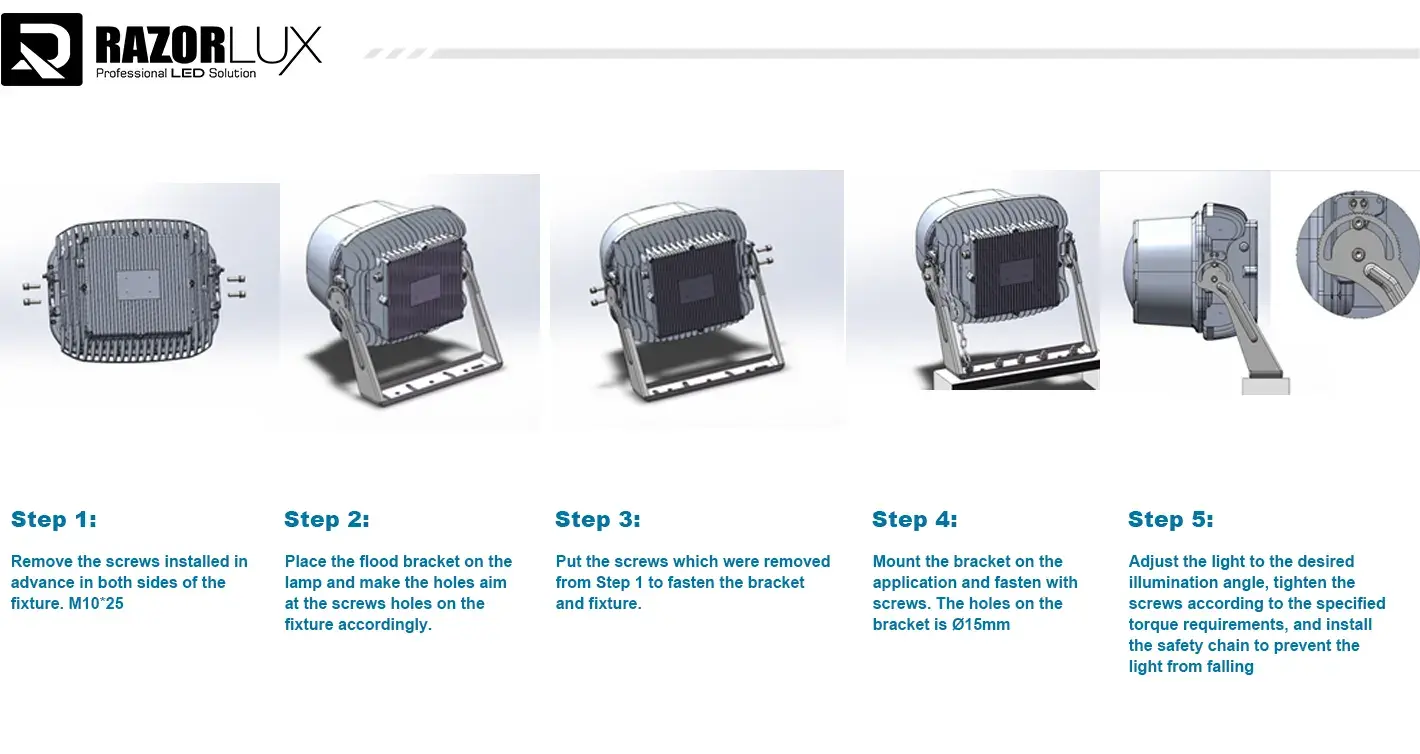
Professional placement follows a set of rules:
- Structural mounting verification: The connection point on the crane boom must be able to hold the 10 kg weight of the Crane Boom Lights plus wind loads. Our stainless steel bracket evenly distributes forces and has vibration-damping parts that keep the fixture from being affected by high-frequency oscillations.
- Electrical connection integrity: All connections use marine-grade connectors with IP67 ratings and strain relief to keep water out and protect conductors from mechanical stress. When you use the right amount of force on terminal connections, you stop the heat cycling and vibration-induced loosening that leads to periodic faults.
- Beam alignment and focus: The 20° beam needs to be pointed straight at the work area. When things aren't lined up right, light is wasted, and dangerous shadows appear. Our fastener has locking mechanisms that stop drift during operation and change mechanisms that let you fine-tune it after installation.
After the installation is finished, it should be commissioned by testing the full power under load, using thermal imaging to make sure the heat is being properly disposed of, and checking the light levels at ground level to make sure they meet the design requirements.
Maintenance Protocols for Maximum Uptime
Certified fixtures require less upkeep, but cautious service stretches their useful life and stops them from breaking down at the worst possible time. Maintenance times that are suggested are:
- Visual inspections should be done every three months to make sure there is no corrosion on the mounting hardware, that the seal around the cable entries is still intact, and that the fixture alignment has not changed. In places with a lot of salt, checks may need to be done more often.
- Every year, you should do a photometric test to see if the ground-level illumination is decreasing. If it is, it means that the LEDs are getting old or there is optical contamination. Clean the lens with the right non-abrasive cleaners to get rid of dust, salt deposits, or industrial leftovers that stop light from passing through.
- Every three years, we check each component. Our LED modules and drivers come with a five-year warranty, but we test the electrical connections, driver operation, and heat management every three years to find problems before they stop working.
With an LED lifespan of 50,000 hours or more, bulb replacement, which is the most dangerous and expensive part of standard boom lighting maintenance, is no longer needed for 5 to 7 years of constant use. This makes high-altitude maintenance much less necessary.
Procurement Considerations for Certified Crane Boom Lights
Evaluation Criteria for Certified Fixtures
When choosing certified industrial lights, purchasing managers should use a structured review strategy that includes the following steps:
| Criterion | Standard Requirement | Razorlux RGL-150P Performance |
|---|---|---|
| Certification Compliance | At least CE, UL, and IP67 | UL, DLC, CB, ISO 9001, IP67, IK10, CE, RoHS |
| Luminous Efficacy | >120 lm/W | 130 lumens/W |
| Voltage Compatibility | 100V to 277V normal | DC 80-400V / AC 80-315V |
| Operational Temperature | -20°C to 50°C is the norm | -40°C to 60°C |
| Warranty Coverage | 3 years is normal | 7 years for housing, 5 years for LED/driver |
| Power Factor | ≥0.90 | ≥0.98 |
Besides checking specs, buyers must also check where parts come from. Our certified Crane Boom Lights use Mean Well power supplies, which are the standard for stability in the industry, and Samsung LED chips, so we know that replacement parts and maker support will always be available. This lack of supply chain openness is common among low-cost sellers who use generic or unmarked parts.
Total Cost of Ownership Analysis
The price you pay for lights is only a small part of how much it really costs. The following should be part of a full total cost of ownership (TCO) analysis:
- Energy consumption: Our certified LED fixtures use only 150W, while equivalent HID lighting uses 400W. This means that each unit of our fixtures saves 250W. If each fixture is used for 12 hours a day, it saves more than 1,095 kWh per year. At $0.10 to $0.15/kWh for industrial energy, this saves $110 to $165 per light per year, which means that any price increase is recouped within two to three years.
- Maintenance costs: Not having to change bulbs at high elevations saves money on both direct work costs and costs related to lost time. When all the costs are added up, a single lighting repair event on a crane that needs access to the boom, safety gear, and the end of operations can cost $2,000 to $5,000.
- Failure-related costs: When lighting goes out during activities, it creates safety risks and delays that are much worse than the cost of the equipment. These hidden costs are cut down by a huge amount because certification methods prove dependability.
Supplier Evaluation and Partnership Considerations
For a certification to be valid, it needs to be checked. Ask for copies of real test results, not just badges, and check them with the labs that issued them. Razorlux gives you all the paperwork you need, like photometric test reports, electrical safety certifications, and results of environmental tests. We keep communication open with buying teams by answering technical questions within 24 hours and sending samples to be tested on-site before placing large orders.
Our manufacturing history, which goes back to 1998 and includes more than 200 patents, shows that we are stable over the long term, which is important for long-term purchasing relationships. Established makers offer replacement parts, expert support, and guarantee fulfillment throughout the lifespan of a product, unlike new suppliers that may go out of business or switch product lines.
Another thing that sets them apart is their ability to customize. Our RGL-150P is good for most uses, but if you have specific needs, like custom color temperatures, changed mounting hardware, or built-in control systems, we can help. This adaptability lets a single source be used for purchases, even for places with different lighting needs.
Real-World Performance in Port and Mining Applications
Container Terminal Case Study
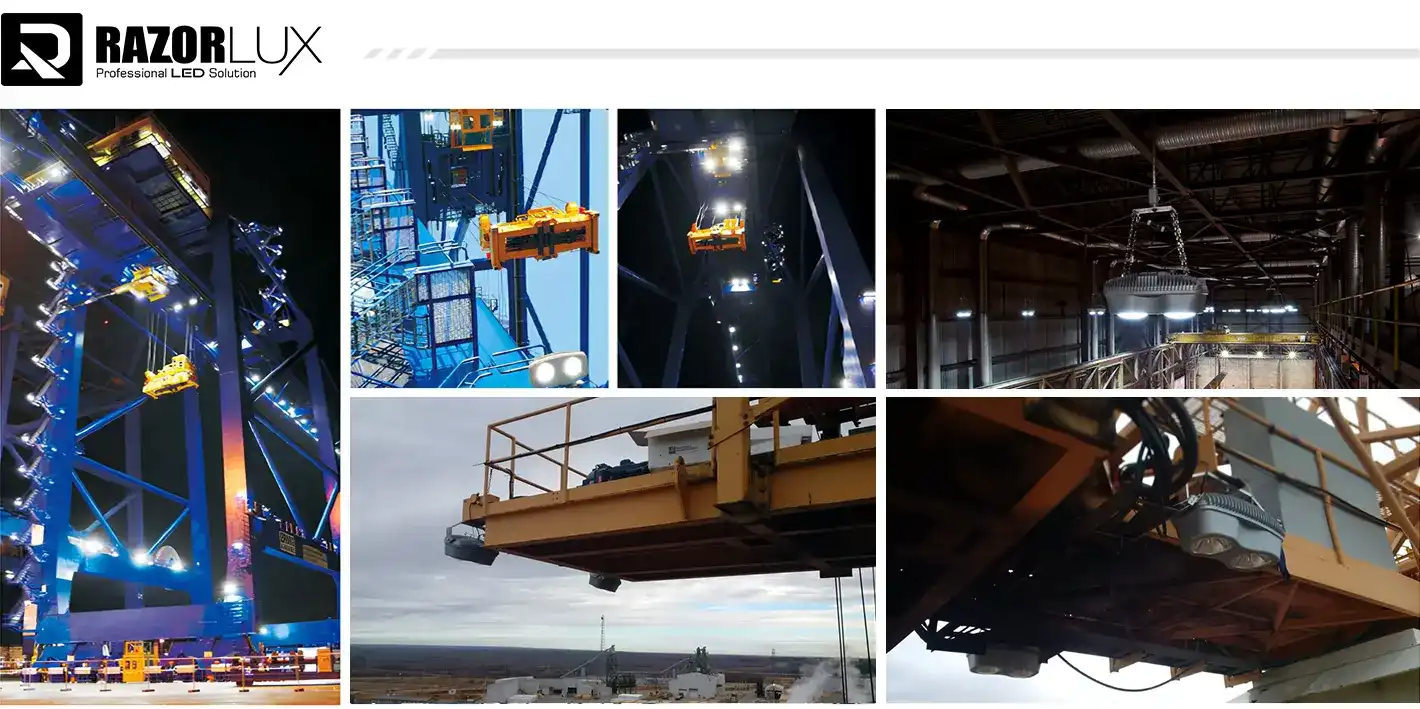
A Southeast Asian container port had trouble with ship-to-shore (STS) cranes not having enough lighting, which slowed down operations and led to safety issues at night. After adding our certified RGL-150P units to 24 STS cranes, the facility kept records of:
- 43% fewer mistakes were made when handling containers because it was easier to see the twist-lock.
- Lighting-related maintenance calls were cut out (they were averaging 2.3 per month).
- 68% less energy than metal halide methods of the past
- In later maritime safety audits, full compliance was achieved.
In the salty sea environment, the IP67 rating was very important. After 18 months of use, a check showed that there was no corrosion or seal damage, even though the seal had been exposed to salt spray all the time. Since then, all updates to the crane lights at the site have been done with Razorlux-certified fixtures.
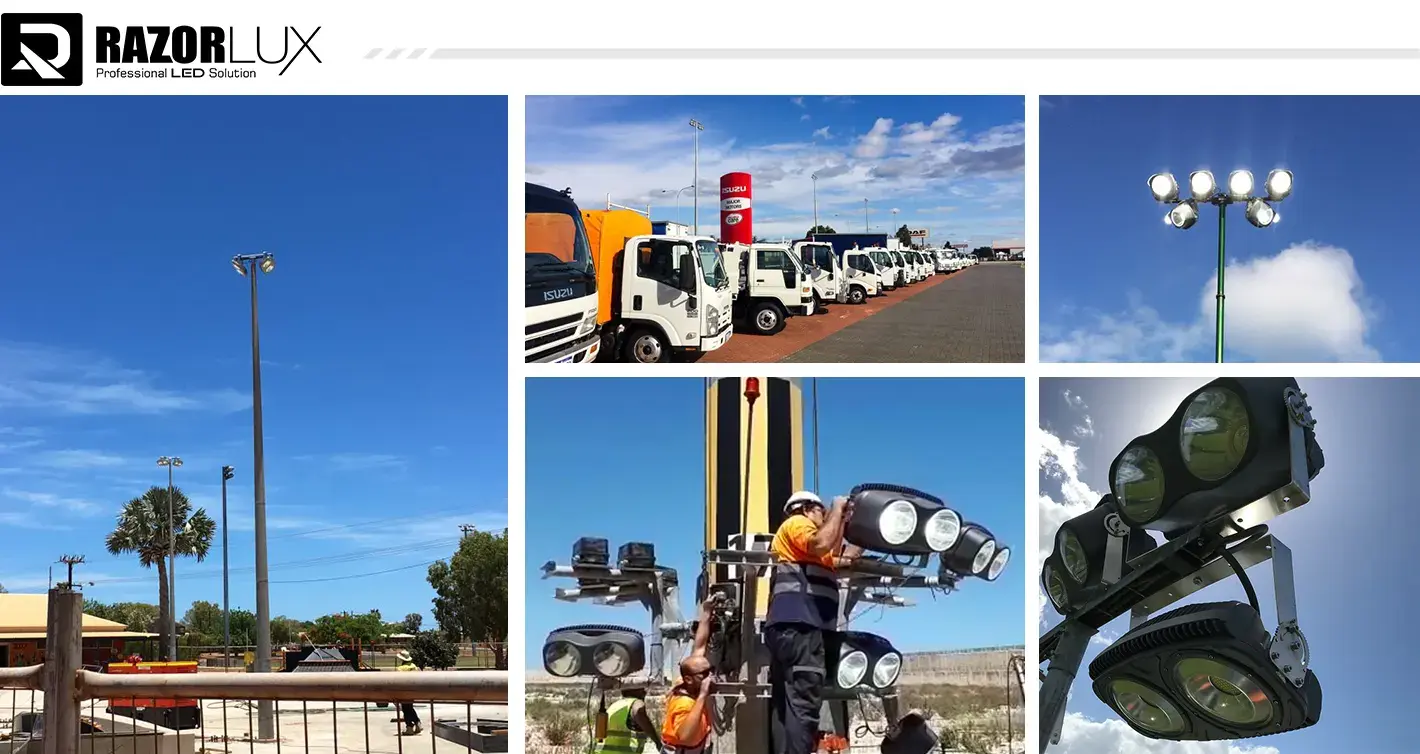
Open-Pit Mining Implementation
Our certified Crane Boom Lights were used on dragline excavators and haul truck loading cranes by a mining company in Australia. The machines worked in dusty conditions with big changes in temperature. The wide operating temperature range (-40°C to 60°C) and full dust protection (IP67) made it possible to keep working even when the weather changed drastically from season to season. The narrow 20° beam was able to shine through dust clouds that made wide-beam floodlights useless before, making it easier for operators to see during important digging and loading tasks.
The five-year warranty closely matched the mine's repair schedule for equipment, which made making purchases and budgeting easier. Over three years of use, the approved LED fixtures had a 99.7% uptime rate, compared to the 87% uptime rate of the old lights they replaced. This directly helped meet production goals by lowering the amount of time that equipment was down.
Comparing Certified Manufacturers and Product Lines
Manufacturer Landscape Overview
In the market for certified industrial lighting, there are a number of well-known companies that specialize in different areas:
| Manufacturer | Certification Strength | Typical Applications | Price Positioning |
|---|---|---|---|
| Razorlux | UL, CE, DNV, and ISO 9001 certifications | Heavy industry, digging, and the sea | High value in the middle price range |
| Brand A (Europe-based) | ATEX and IECEx experts | In dangerous places | Premium prices |
| Brand B (North America) | UL and CSA | General industrial and construction | High-end to luxury |
| Brand C (Asian manufacturer) | Basic certificates and CE | General business | From cheap to average |
Razorlux is in a good spot because it has all the right certifications, high-quality parts (Mean Well, Samsung), and a history of success in the marine and industrial markets, all at a reasonable price. Because we work directly with the manufacturer, we don't have to pay markups to distributors. We also get quick technology help and can make changes that many of our competitors can't.
Feature Differentiation Analysis
In addition to certifications, differences in practical features have a big effect on how well something works in certain situations. Our patented multi-function design can be used with different mounting setups for tower cranes, mobile cranes, STS cranes, and draglines, so sites that use a mix of equipment don't have to keep as many different kinds of fixtures. The global voltage input (AC 80-315V / DC 80-400V) also makes it easier to buy and set up at places with different types of electrical infrastructure.
Razorlux is different from suppliers who use unmarked or unspecified LED chips and drivers because they are clear about where their parts come from. Mean Well drivers offer reliable data, global service networks, and long-term availability that is guaranteed. This traceability is important for planning multi-year purchasing plans and making sure that replacement parts are available for as long as the fixture is in use.
Conclusion
It is necessary for modern port and mining sites to have certified Crane Boom Lights for safety and operational reasons. As a result of proper certification, there are fewer accidents, lower maintenance costs, and more compliance with regulations. This is because of the strict testing that goes into it, which includes electrical safety, environmental durability, photometric performance, and component quality. Razorlux's certified RGL-150P fixtures meet this standard because they have IP67/IK10 protection, wide voltage compatibility, high-quality parts, and full certifications backed by more than 20 years of manufacturing experience. When purchasing new or upgraded lighting, procurement managers should focus on certified solutions from well-known brands and do thorough total cost of ownership analyzes that take into account how much energy is saved, how much maintenance is needed, and how much it would cost to have a failure. Investing in certified technology pays off in a way that can be measured: higher safety, more reliable operations, and lower costs over the life of the product.
FAQ
1. Are certifications legally required for industrial crane lighting?
Different areas and types of operations have different requirements. Maritime operations usually have to follow the rules set by classification societies like DNV, ABS, and Lloyd's, which require certified lighting. Mines that are regulated by the MSHA must use approved electrical equipment, especially when working underground or in places that could be explosive. Port sites may be covered by OSHA's general industry standards that stress enough lighting without requiring specific certifications. However, insurance companies are increasingly looking for Crane Boom Lights. No matter what the law says, certified lighting protects you from liability and shows that you take safety seriously, which are both very important things to keep in mind during investigations into accidents or regulatory audits.
2. How do LED certified lights compare economically to halogen alternatives?
Even though LED-certified lights cost more up front, they are more cost-effective over their entire lifetime. A 400W halogen system that works 4,000 hours a year uses 1,600 kWh, while our 150W LED version only uses 600 kWh. At standard industry rates, this means that each fixture saves $100 to $150 a year. Every 2,000 to 4,000 hours, halogen lights need to be replaced, which means that every 6 to 12 months, dangerous high-altitude repair is needed. In five years, one LED fixture will save you three to five lamp replacements, which would cost between $500 and $2,250 in labor and downtime for each event. The savings from using LEDs usually cover their higher costs within 18 to 30 months, and they provide better lighting and dependability (U.S. Department of Energy, 2021).
3. Can certified LED fixtures be added to crane boom mounts that are already in place?
Simple modification works for most uses. Our stainless steel bracket system works with standard mounting arrangements that are used by Liebherr, Konecranes, and Terex, among others. The lighter weight of LED fixtures (10 kg vs. 15-20 kg for similar HID systems) actually makes boom tips less stressed. We offer a general voltage input that works with existing 120V, 208V, 277V, or 480V crane electrical systems, so you don't have to change the power source or buy new transformers. Our technical team does retrofit assessments, which means they look at the current mounting hardware and electrical systems to make sure they work with the new equipment and figure out what changes need to be made before it can be shipped.
Partner with Razorlux for Certified Crane Boom Lights
When your port or mine needs lighting that meets the highest standards for safety and performance, Razorlux has approved solutions that are backed by a track record of dependability and full support. As a top manufacturer of Crane Boom Lights with more than 200 patents and 20 years of experience in industrial lighting, we know how important lighting is for keeping operations safe and running smoothly. Our RGL-150P certified lights come with full certification paperwork for global compliance, IP67/IK10 safety, Mean Well power supplies, and 130 lm/W efficiency.
We help you with the buying process by giving you quick quotes, expert advice, sample testing programs, and customization services that are made to fit your exact operational needs. Our engineering team helps with photometric planning, installation guidance, and retrofit assessments. This way, you can be sure that deployments go smoothly, whether you're upgrading a single crane or a whole fleet. You can email our experts at sam@razorlux.com to get full specs, proof of certification, or samples to test in person. Let us show you how certified LED technology from a well-known industrial lighting partner can make your most demanding applications safer and save you money over their lifetime.
References
1. Illuminating Engineering Society. (2021). IES Recommended Practice for Industrial Lighting. New York: IES Publications.
2. International Electrotechnical Commission. (2020). IEC 60529: Degrees of Protection Provided by Enclosures (IP Code).
3. Mean Well Enterprises Co. (2022). Industrial LED Driver Reliability and Surge Protection Technical Report. New Taipei City: Mean Well.
4. Mine Safety and Health Administration. (2023). MSHA Safety Standards for Surface and Underground Mining Operations.
5. National Institute for Occupational Safety and Health. (2022). Workplace Lighting and Injury Prevention in Heavy Industry.
6. U.S. Department of Energy. (2021). LED Lighting in Industrial Facilities: Energy Savings and Lifecycle Cost Analysis.