


_1750326878398.png)

Crane Boom Lights for Safer Nighttime Operations
When a crane lifts a 20-ton load at midnight on a shipyard dock, the difference between a safe operation and a serious accident often comes down to one thing: visibility. Crane Boom Lights are high-intensity, purpose-built lighting fixtures mounted directly on crane jibs or booms to project focused illumination onto the hook block and work zone below. Unlike general site floodlights, these fixtures are engineered to operate at heights exceeding 50 to 100 meters, resist mechanical vibration, and survive salt spray, rain, and extreme temperatures — making them a non-negotiable safety investment for any operation running nighttime shifts.
Understanding Crane Boom Lights and Their Importance
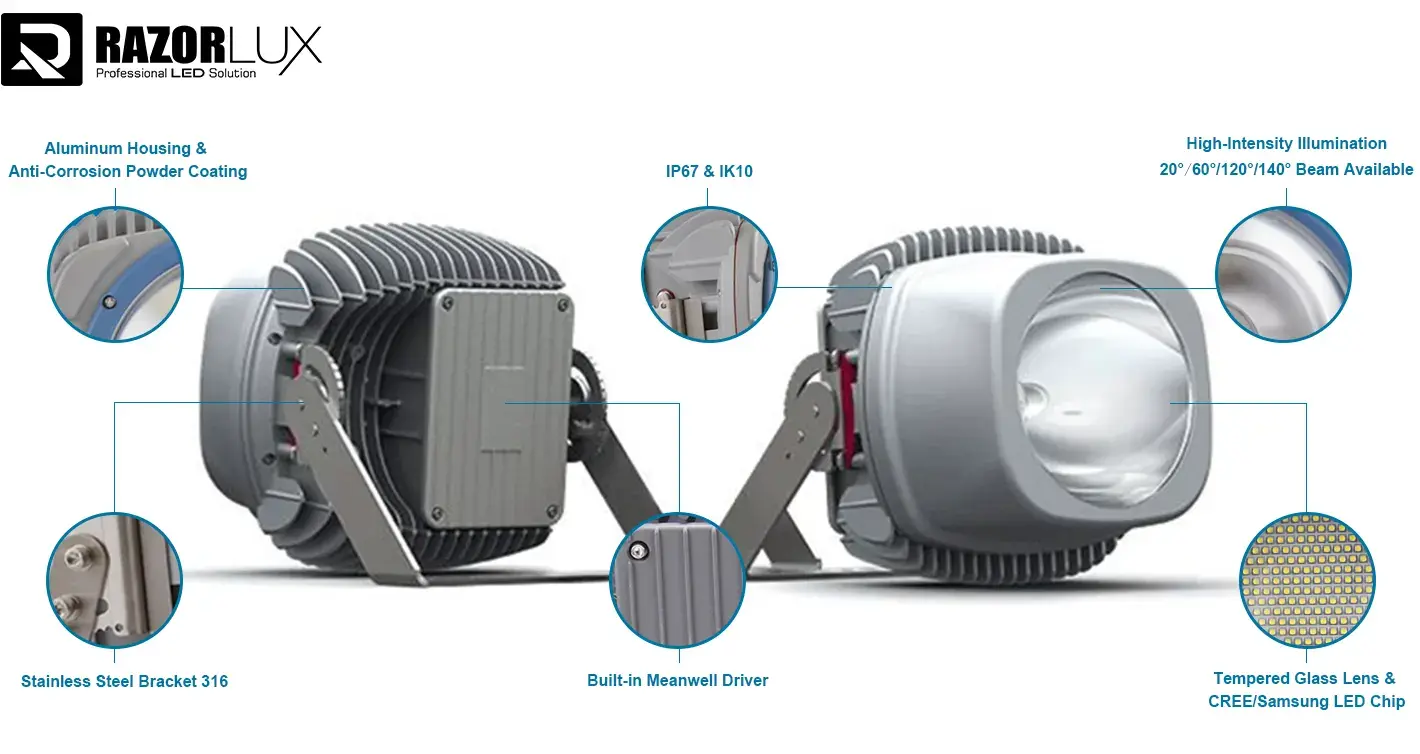
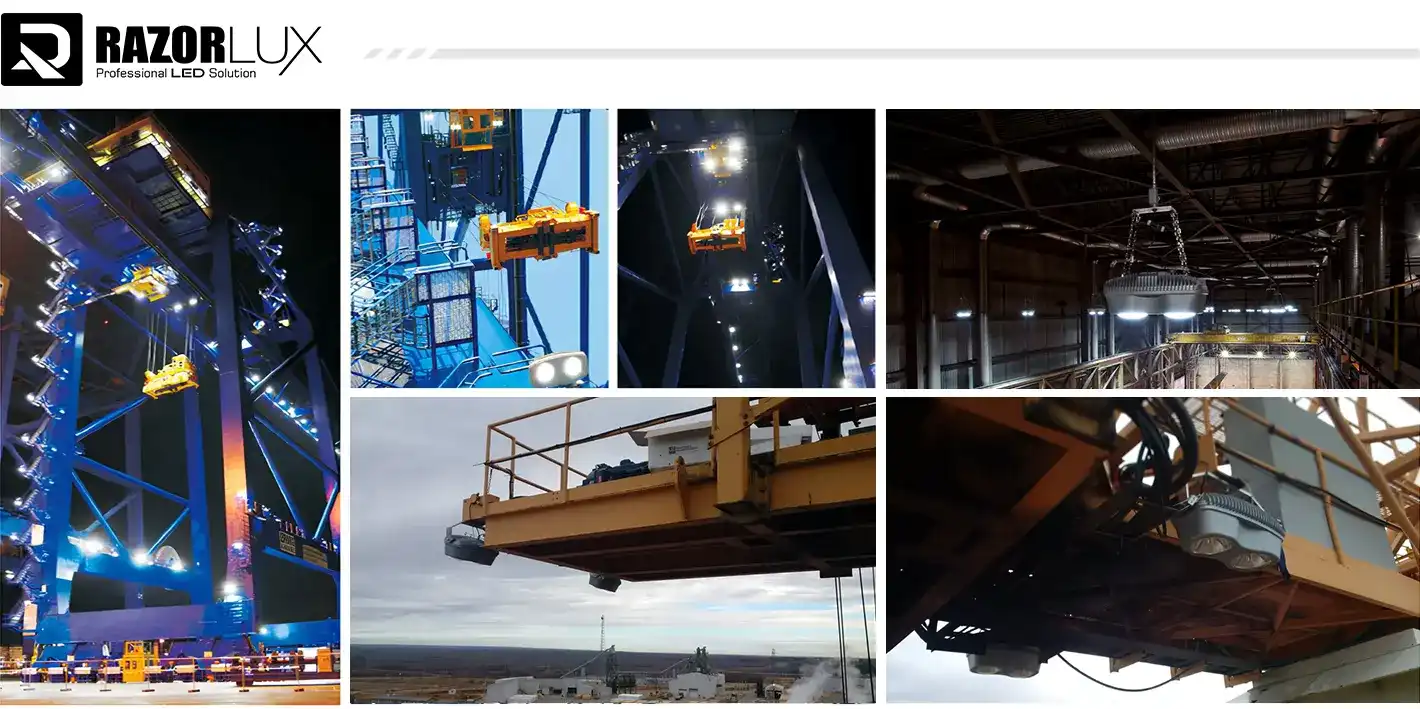
Crane jib lights are used for a special task that regular work lights just can't do. They send focused, high-lumen beams straight down from the boom to the load zone. This helps ground riggers and cabin workers see clearly when there isn't enough light in the room.
Why Visibility Gaps Create Risk
It says that, according to the Bureau of Labor Statistics, crane and derrick workers are more likely to get hurt than people who work with other heavy equipment. This is because it is harder to see at night, which is a major cause of many of these accidents. When a crane boom forms a wide shadow or when the only light comes from tower lamps far away, workers lose their ability to accurately judge where they are in space. That's when bad things happen.
The Role of Dedicated Boom-Mounted Lighting
By putting lights directly on the jib, the "shadow zone" that the crane structure creates is taken away. The load moves the beam along with it, following the hook block around every turn and circle. This is very different from stationary site lighting, which makes areas that are always bright and areas that are always dark when equipment moves.
Regulatory and Compliance Drivers
OSHA's 1926 Subpart CC crane safety standards say that all lifting operations at night must have enough light. On top of the federal minimums, many port officials and offshore platform owners have their own rules that include IP ratings, certification marks, and minimum lux levels at the load zone. If you choose parts that meet CE, UL, and RoHS standards from the start, you won't have to pay a lot of money to fix them after compliance checks.
Types and Features of Crane Boom Lights: Making the Right Choice
Not every crane jib lighting product is the same. Depending on the type of device, the technology used for the light source, and the safety requirements, a product may only last three months or fifteen years on a busy crane.
LED vs. Halogen vs. Metal Halide
For many years, halogen and metal halide lights were the norm. Even though they put out a lot of lumens, they use two to four times as much power as similar LED systems, make a lot of heat, and have fragile filaments or arc tubes that break when crane jibs shake. In new installs, LED technology has mostly taken their place for crane boom lights. A 150W LED crane work light can be used instead of a 300–400W HID lamp and is said to last more than 50,000 hours and display colors more accurately.
Key Technical Specifications to Evaluate
Before choosing a product, purchasing managers and procurement engineers should look at the following factors:
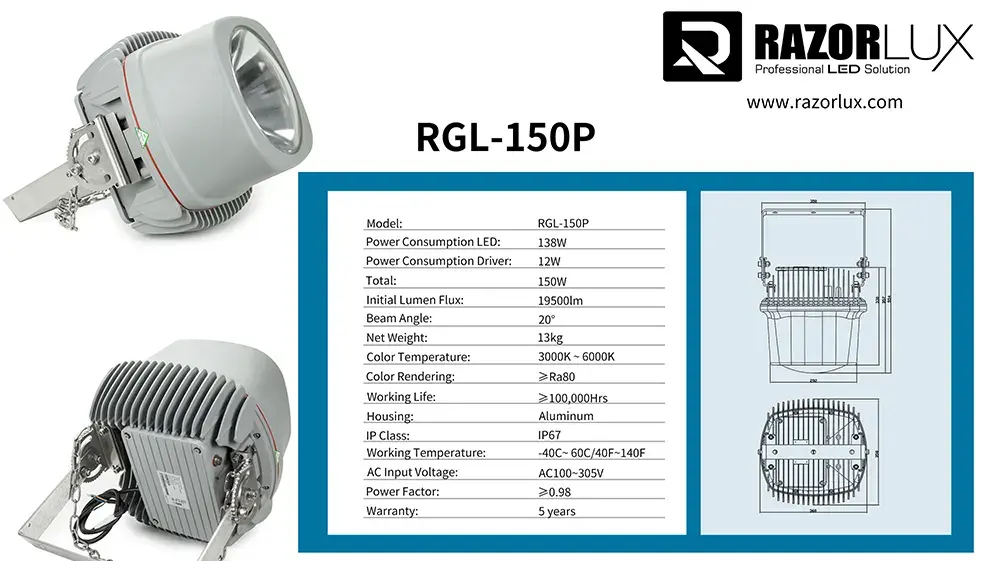
- Beam angle: Narrow angles between 15° and 30° are required for high-altitude mounting. A 20° beam angle concentrates lumens on the load zone rather than dispersing them across the sky.
- Luminous efficacy: Look for fixtures achieving 130 lm/W or above. This determines how much usable light you get per watt consumed.
- Impact resistance: IK10 rating means the fixture withstands 20 joules of impact — essential for environments where tools or rigging hardware occasionally make contact with mounted equipment.
- Ingress protection: IP67 ensures full dust exclusion and protection against temporary water immersion, appropriate for both maritime and open-pit mining environments.
- Operating temperature range: A working range of -40°C to +60°C covers Arctic shipyard winters and Middle Eastern summer heat alike.
| Standard | High | High | High | Vibration Resistance
Standard | Corrosion Protection | Rated for salt spray | Rated for salt spray
| Needs Certification | CE, UL | CE, DNV/GL, ABS | CE, DNV/GL, ABS |
| Specification | Construction Site | Shipyard / Port | Offshore Platform |
|---|---|---|---|
| Minimum IP Rating | IP65 | IP67 | IP67 |
| Beam Angle | 20°–30° | 15°–20° | 15°–20° |
| Vibration Resistance | Standard | High | High |
| Corrosion Protection | Standard | Salt-spray rated | Salt-spray rated |
| Certification Required | CE, UL | CE, DNV/GL, ABS | CE, DNV/GL, ABS |
Certifications That Matter in Procurement
Large shipyards and port authorities will not accept a fixture that does not have the proper certification paperwork. European conformity is confirmed by the CE mark. UL listing meets the needs of North American projects. RoHS compliance sets limits on dangerous materials. In the U.S. market, DLC certification can help with energy refund forms. When it comes to naval projects, buying offices need classification society approval from DNV/GL or ABS before a product can be put on a list of approved vendors.

Installation and Maintenance Guide for Crane Boom Lights
Even the best crane flood light won't work well if it's not set up right or isn't taken care of after it's been put in place. A structured approach to installation and maintenance keeps the investment safe and the people working on it safe.
Pre-Installation Assessment
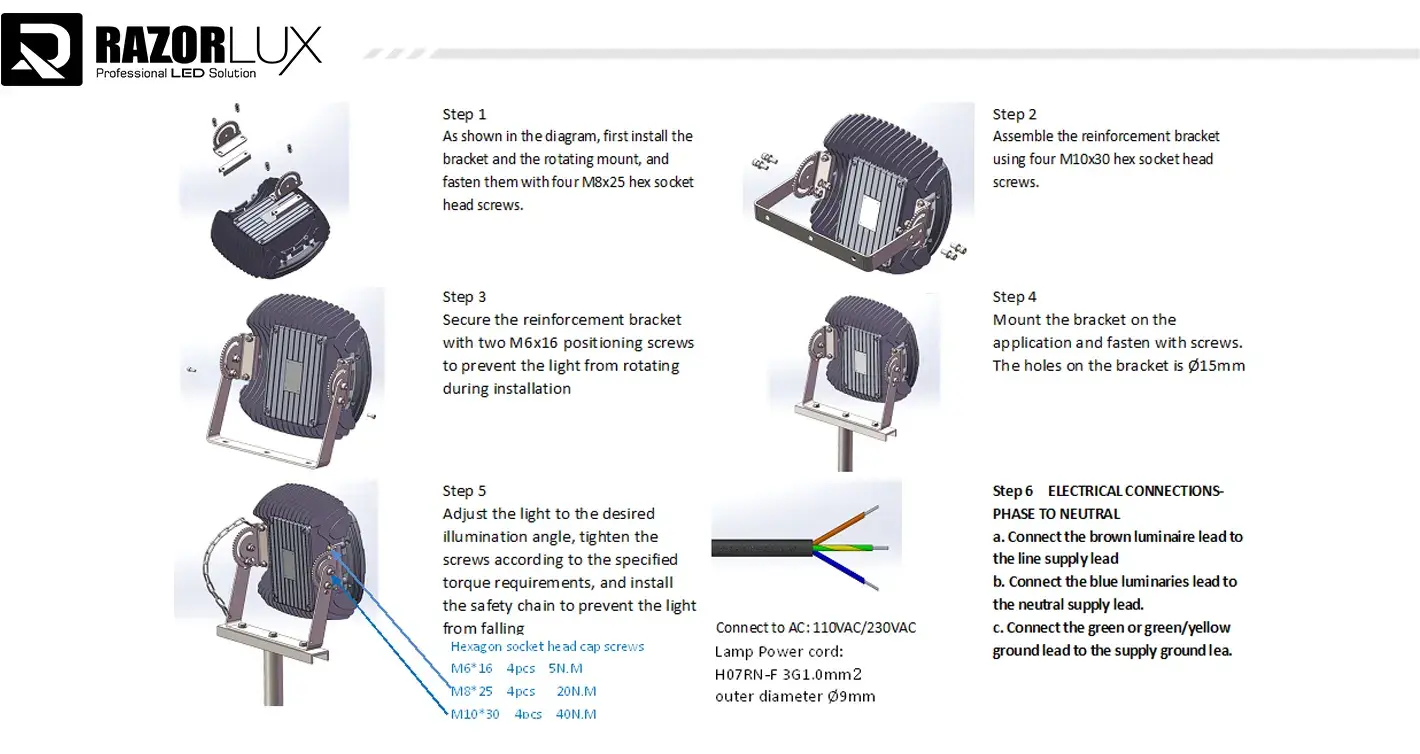
A full load estimate should be done by the repair or construction team before any fixture is put on a crane boom. This includes making sure that the mounting bracket material (stainless steel is best for this because it doesn't rust) is compatible with the boom material, figuring out how much extra wind load the fixture housing adds, and making sure that the crane's electrical system can provide the right voltage range. Razorlux's RGL-150P type can take both AC 80–315V and DC 80–400V input without the need for an extra adapter. This means it can work with most crane generator systems without needing special wiring.
Mounting and Weatherproofing Best Practices
The stainless steel plate that comes with the Razorlux RGL-150P is a safe way to connect things that won't rust for crane boom lights. All openings in the conduit should be sealed with marine-grade gland fittings, and the cable runs along the boom should be made of UV-stabilized conduit that can withstand being outside all the time. Putting rubber vibration isolators between the fixture and the mounting surface stops high-frequency oscillations caused by the trolley moving
Routine Maintenance Schedule
A regular inspection schedule keeps fixtures working longer and stops them from breaking down in the middle of an operation. When taking care of LED crane jib lights, do the following:
- Monthly: Inspect external housing for impact damage, corrosion initiation points, or loose fasteners. Clean the lens face with a damp cloth to remove dust and salt deposits that reduce light output.
- Quarterly: Check all cable connections and gland seals for signs of moisture ingress or insulation wear. Verify that mounting bolts remain torqued to specification.
- Annually: Review driver performance data if the system logs are available. Test lumen output against the original commissioning measurement to identify any degradation trend.
If you follow this plan, a good LED fixture with a 50,000-hour rating can work nonstop for over eleven years before it needs to be replaced. This makes changing lights at height much less dangerous and expensive.
How to Choose the Best Crane Boom Lights for Your Business
Buying decisions for crane jib lighting involve a lot of different people. The buying team compares the qualifications and prices of suppliers, the engineering team looks at the technical specs, and management looks at the warranty terms and long-term supply continuity. Knowing the criteria that each partner uses helps sellers make sure that at each stage they offer the right information.
Matching Fixture Specifications to Your Operating Environment
Where will these lights work? That's the first thing any procurement team should know. Things that stress out a container port in Singapore are different from things that stress out a shipyard in Norway or an oil rig in the North Sea. Places with a lot of salt need housings that have been fully treated to prevent corrosion and have passed a salt-spray test. For operations in cold climates, parts that are set to -40°C are needed to keep drivers from breaking down during cold starts. Mining sites that are prone to dust need full IP67 dust exclusion, which IP65 alone can't provide.
Total Cost of Ownership vs. Purchase Price
A lot of buyers look at the unit cost up front, but the total cost of ownership over five years tells a more complete story. Think about this comparison:
| Cost Factor | 300W HID Lamp | 150W LED (Razorlux RGL-150P) |
|---|---|---|
| Power Consumption (annual, 2,000 hrs) | 600 kWh | 300 kWh |
| Lamp Replacement Frequency | Every 6,000 hrs | None within 50,000 hrs |
| Maintenance Labor (height access) | High | Minimal |
| 5-Year Warranty | Typically not included | Included |
| Certifications Included | Variable | CE, UL, RoHS, DLC, SAA |
At normal industrial power rates in the U.S., the energy savings alone pay for the difference in price within the first two years of operation.
Evaluating Supplier Reliability
Aside from the product itself, procurement managers need to trust that the seller will deliver on time, provide all necessary documentation, and answer quickly to technical questions for crane boom lights. Some important things to look for in a supplier are how long they've been in business, how many patents they have, what certifications they have, whether they offer samples, and how quickly they respond to your first questions. Razorlux has been in business since 1998 and has more than 200 patents in the areas of LED Packaging and structure design. Before placing large orders, the company sends samples for the engineering team to look over.
Future Trends and Innovations in Crane Boom Lighting
The market for crane lights is always changing. Port and dock managers who are looking to the future are becoming more interested in a number of different areas of technology.
Smart Controls and IoT Integration
More and more, new crane work lights come with dimming protocols, such as 0–10V and DALI interfaces, that let operators change the output based on the environment. When connected to IoT controllers, these systems can keep track of operating hours, alert you to maintenance needs, and change the intensity automatically as the crane moves from open areas to loading bays with walls. This cuts down on wasted energy during slow times and increases the life of fixtures by lowering temperature stress during routine tasks.
Advances in LED Chip Technology
In the lab, Samsung's newest commercial LED chips are making light output go above 200 lm/W. Right now, commercial product lines are consistently making light output above 130 lm/W. Fixture power can go down for the same light output as chip efficiency goes up. This lowers the crane's electrical load and cooling needs even more. Ra90 choices are now available on request for uses that need precise color separation, like checking the quality of welds or the markings on goods. Better chip uniformity also raises color rendering indices.
Sustainability and Regulatory Alignment
The commercial and industrial lighting programs of the U.S. Department of Energy are still pushing for stricter rules on how well lights work and less harmful materials in them. Products that are DLC-listed can get utility rebates, which can help pay for big purchases like new lights. RoHS compliance gets rid of lead, mercury, and cadmium from the supply chain. This is something that is becoming more and more of a requirement for buying things in ESG-conscious companies and government-backed port development projects.
Conclusion
When there isn't enough light, using a crane at night is very dangerous. Fixed site lights can't get rid of shadow zones, but dedicated jib-mounted lighting systems such as crane boom lights can. LED technology has made these systems much more useful in terms of cost, lifespan, and maintenance. To choose the right fixture, you need to make sure that the beam angle, IP rating, vibration resistance, and certification credentials all meet the needs of the operating environment. Buying from suppliers who offer full documentation, samples, and expert help after the sale greatly lowers the risk of buying something.
FAQ
What beam angle is correct for high-altitude crane mounting?
For crane booms that are 40 to 80 meters high, a 20° beam angle gives the load zone a high level of light without a lot of light scatter. When you use wider angles, the lights are spread out, and the hook area underfill is lit up, which defeats the purpose of special boom lighting.
How do these fixtures survive constant crane vibration?
Good LED Crane Lights have rubber mounts that stop vibrations between the fixture and the bracket. They also have conformal coating on the PCB to keep the parts in place when the frequency goes up and down. As part of its normal quality control process, the Razorlux RGL-150P is tested for vibration and shock resistance and given an IK10 rating for impact resistance.
What certifications should I require from a supplier?
For projects in the U.S. market, you should at least require CE, UL, and RoHS. For naval or offshore uses, you should ask for type approval documents from DNV/GL or ABS. Applications for energy rebates might gain from being listed in the DLC. So that your expert team can check the scope of each certification, ask providers to send you real test reports instead of just images of certificates.
Can these lights operate on crane generator power?
Yes. The Razorlux RGL-150P can work with both AC 80–315V and DC 80–400V power sources without the need for an extra adapter or voltage converter. This wide input range works with the variable output that is common in crane generator systems.
What is the realistic maintenance interval for LED crane jib lights?
With an estimated lifespan of 50,000 hours or more and a 5-year warranty on both the LED module and the driver, LED crane jib lights don't need much planned care other than cleaning and checking the fasteners every so often. In sharp contrast, HID options need to be relamped every 6,000 to 10,000 hours, which is a dangerous job to do from a crane.
Get Your Crane Boom Lights Quote from Razorlux Today
Razorlux makes tested crane boom lights that are made for the conditions your business faces, not for perfect lab conditions. Our RGL-150P model delivers 13,200 lm at 150W and has a 20° beam. It is protected by IP67 and comes with a 5-year warranty. It is also certified by CE, UL, RoHS, DLC, SAA, and ISO 9001. As a reliable company that makes crane boom lights with more than 200 patents and more than 20 years of field-proven performance, we offer examples, full technical papers, and quick responses to all inquiries. Visit razorlux.com or email our team at sam@razorlux.com right now to get a quote and begin evaluating suppliers.
References
1. U.S. Bureau of Labor Statistics. Census of Fatal Occupational Injuries Summary. 2022.
2. Occupational Safety and Health Administration (OSHA). Cranes and Derricks in Construction: 29 CFR 1926 Subpart CC. U.S. Department of Labor, 2010.
3. U.S. Department of Energy. Solid-State Lighting R&D Annual Update. Office of Energy Efficiency & Renewable Energy, 2023.
4. DesignLights Consortium (DLC). Technical Requirements for Solid-State Lighting Products. Version 5.1, 2022.
5. International Electrotechnical Commission. IEC 60598-1: Luminaires — General Requirements and Tests. IEC, 2020.
6. CIGRE Working Group C4.31. Power Quality Aspects of LED Lighting in Industrial Applications. CIGRE Technical Brochure, 2021.