


_1750326878398.png)

Where Can a 1000 Watt LED Sports Light Improve Visibility?
A 1000 Watt Led Sports Light delivers approximately 130,000 lumens of high-intensity output, making it one of the most efficient instruments for big-area lighting in challenging conditions. If your operation involves a professional stadium, a functioning shipyard, or an offshore platform, this type of fixture replaces old 2000W-3000W metal halide systems, saving up to 60% on energy use. From sporting fields to port infrastructure and heavy industrial yards, a correctly configured 1000-watt LED sports light addresses visibility gaps that cost operations time, money, and safety compliance.
Understanding the Capabilities of 1000 Watt LED Sports Lights
Before making a purchase choice, your expert team needs to know what makes a high-performance LED flood fixture different from a standard one. The details spell out what will happen on the ground.
Core Output and Efficiency
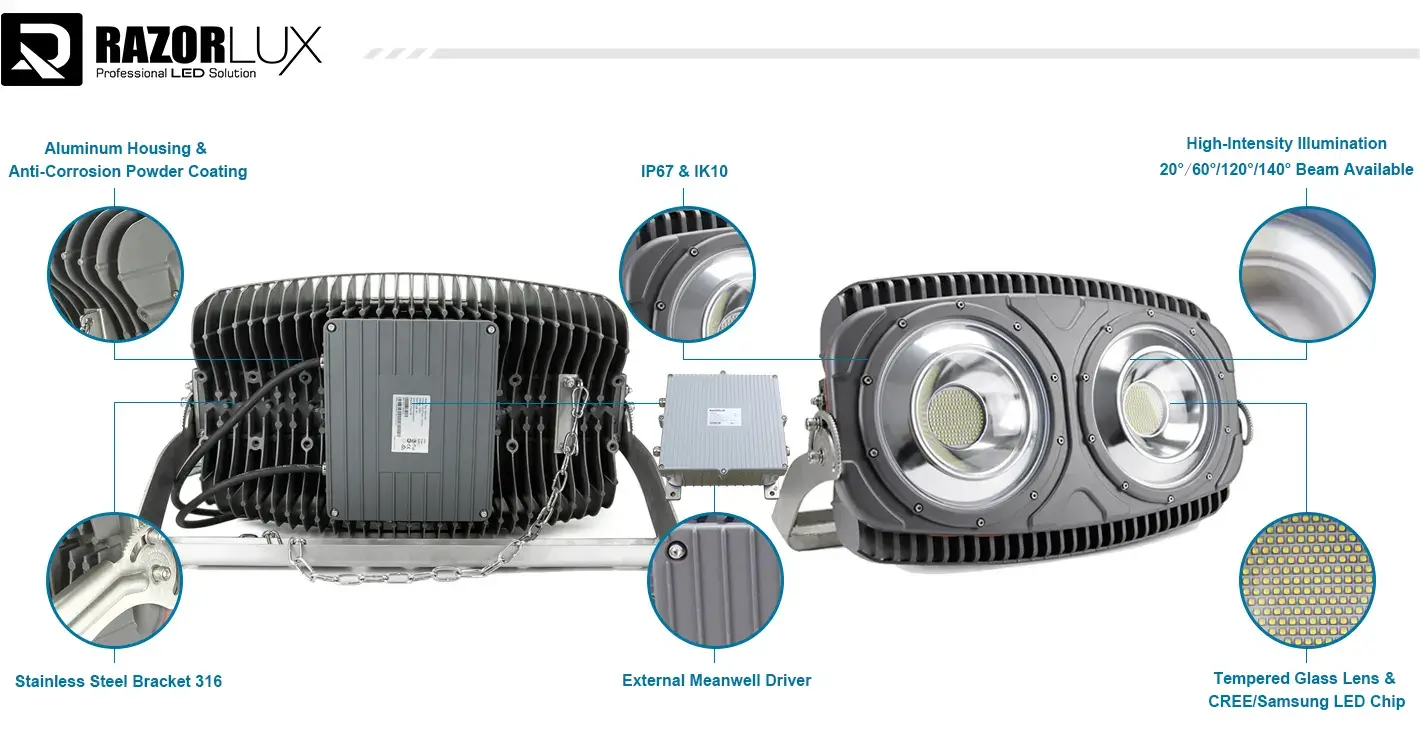
After an hour of usage, the Razorlux RGL-1000A continues to produce 130,000 lumens at 5700K, which is 130 lumens per watt. That figure is essential because it informs you how much light you can get out of every watt you put in. A standard high-pressure sodium lamp of 2500 W provides roughly 100 lm/W and is quicker to degrade. The RGL-1000A emits 130 lm/W of light to 130 lm/W with a total power consumption of 1000W (900W LED array + 100W driver).
Electrical Compatibility and Driver Quality
Grid compatibility is usually a worry procurement managers will raise.' The RGL-1000A can accept AC input from 80 to 305 Vac. It can also accept DC input from 100 to 400 Vdc and 500 to 800 Vdc. It is versatile enough to be utilised in North America, Europe, the Middle East, and Southeast Asia locales without the requirement for additional transformer gear. The power supply is a MeanWell (a famous brand of drivers) with power factor ≥0.98 and THD less than 10%.
Structural Durability and Protection
The fixture has an IP65 rating (which can be upgraded to IP67), an IK10 rating for impact, and can work in temperatures ranging from -40°C to +60°C for 1000 watt led sports light applications. The mounting bracket is made of stainless steel, and the body is made of die-cast metal that has been powder-coated. These traits must be present in places with salt spray, mechanical shaking, or high humidity; they are not options. The working humidity tolerance runs from 10% to 95%, covering tropical coastal climates.
| Specification | RGL-1000A |
|---|---|
| Rated Power | 1000W (LED 900W + Driver 100W) |
| Stable Flux | 130,000 lm (5700K, 1hr) |
| Lamp Efficacy | 130 lm/W |
| Color Temperature | 2700K – 6500K |
| CRI | ≥ Ra75 (Ra80/Ra90 available) |
| Beam Angles | 40°, 60°, 120°, 140°×60° |
| IP Rating | IP65 / IP67 |
| IK Rating | IK10 |
| Working Temperature | −40°C to +60°C |
| Working Life | ≥ 50,000 hrs |
| Power Factor | ≥ 0.98 |
| Driver Brand | MeanWell |
| Warranty | 5 years (LED + Driver), 10 years (Housing) |
| Certifications | CE, RoHS, SAA, C-Tick, UL, DLC, CB, ISO 9001 |
Top Venues and Scenarios Where 1000 Watt LED Sports Lights Improve Visibility
When you set up a high-output LED sports fixture to work in certain conditions, its true worth becomes clear. Here are the three main situations where this type of light regularly makes things better.
Professional Stadiums and Athletic Facilities
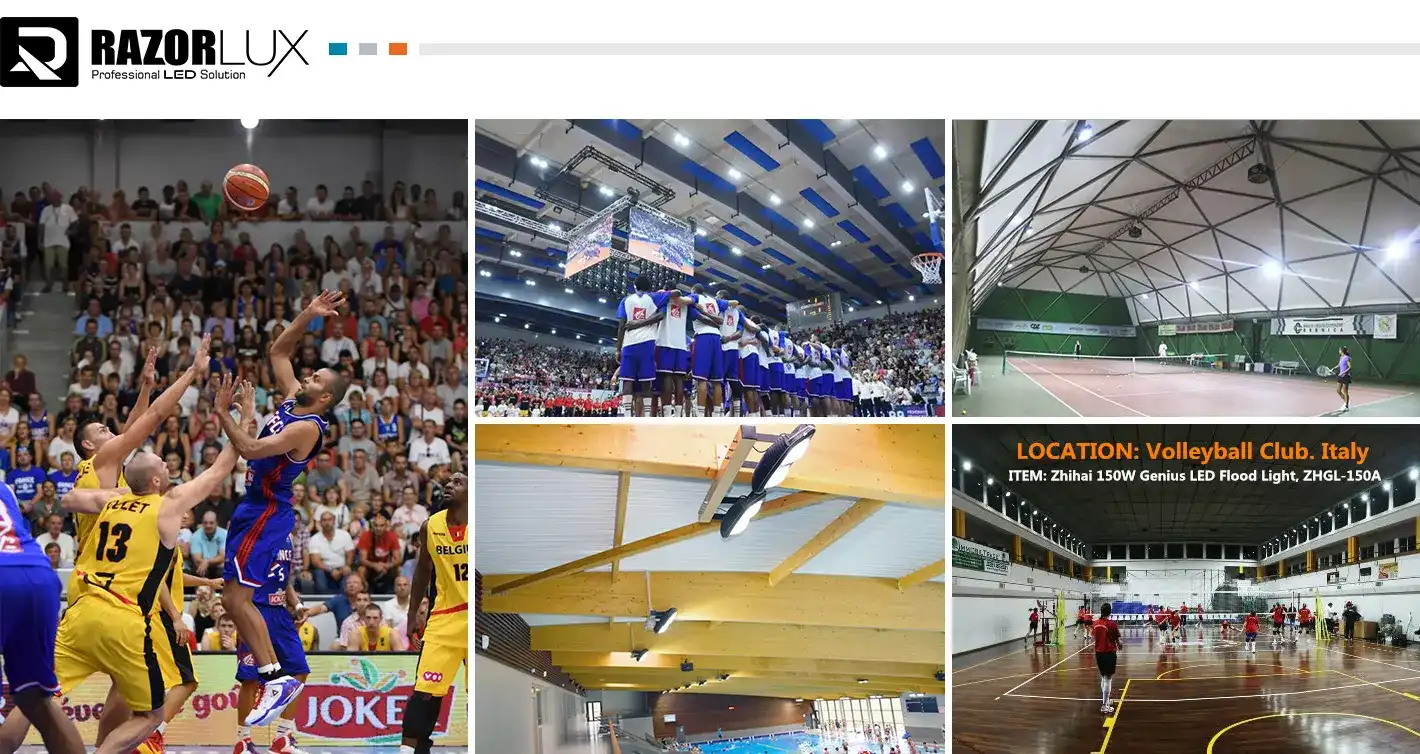
For football fields, baseball parks, and multi-purpose sports facilities supported by masts of height 18 to 40 m, fittings are needed that illuminate the complete playing area uniformly horizontally and vertically. For locations that shoot slow-motion video at 500 frames per second or greater, flicker-free performance is a prerequisite. The RGL-1000A has 4 beam angles to choose from: 40°, 60°, 120°, and 140°×60°. These angles allow lighting designers to create accurate targeting patterns that fulfil Class II or Class III illuminance requirements and are free of shadow striations and over-spill. The 50,000-hour rated life means changing the lights is a far less frequent chore, which may be a huge assistance to college athletic offices and public sports complexes attempting to stay on tight maintenance budgets.
Shipyards, Seaports, and Dock Infrastructure
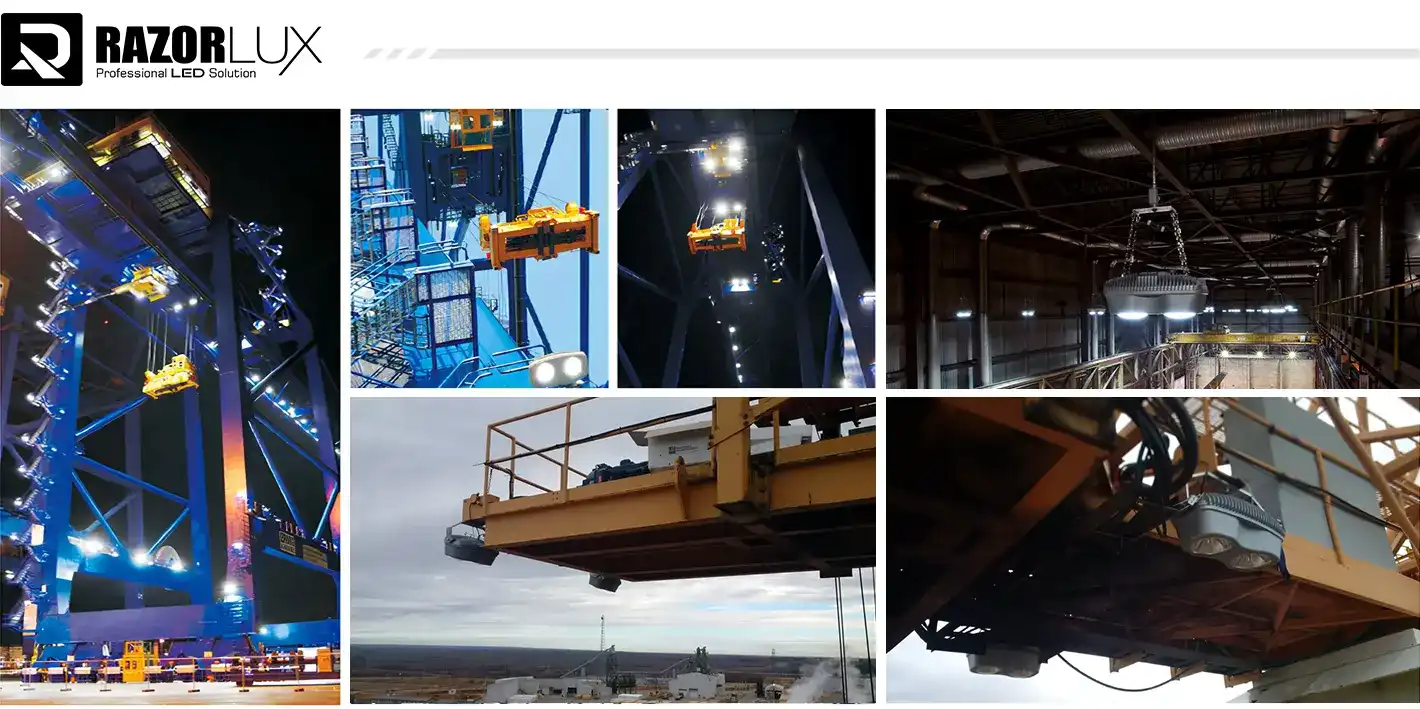
Most typical fixtures in port environments fail in 18 to 24 months because of the salty air, the rapid temperature fluctuations and the fact that they are in use 24 hours a day, seven days a week. Container yards require more than footcandle readings at the ground level. And they require adequate vertical lighting at the stack level. The RGL-1000A is designed for this amount of exposure. It has an IP67 certification, a stainless steel base, and a powder-coated body that will not rust. Shipyards that undertake shipbuilding, pipe fitting, or structural steel work at night need wide-area coverage with no shadows. A less uniform 140°×60° beam works effectively across lengthy dock bays with fewer pole points.
Heavy Industrial Outdoor Areas and Offshore Platforms
Steel mills, paper mills, mine aprons, and remote production platforms all have one thing in common: they all have huge open spaces where accidents can happen because there isn't enough lighting. Certain levels of light must be present in places where people walk, where equipment is kept, and where people lay down according to OSHA and similar foreign standards. With 130,000 lumens per light, the RGL-1000A can be used in a small pole grid to get 50–100 lux in places that used to need twice as many metal halide fixtures for 1000 watt led sports light applications. Offshore sites also have to follow rules for being in a dangerous area. The RGL-1000A's certifications, which include CE, UL, and DLC, give facility engineers the proof they need when they send lighting plans for approval.
Choosing the Right 1000 Watt LED Sports Light for Your Needs
Not every 1000W LED fixture on the market performs the same way. Procurement teams that skip the specification comparison stage often pay more in replacements and downtime than they saved on the initial purchase.
Comparing Wattages and Technologies
A 500W Led Sports Light usually gives 60,000-70,000 lm, which is perfect for tennis courts or smaller training grounds. A 1500W fixture might be suitable if pole placements are few for extremely large stadium main lighting. The 1000W class is a sweet spot for output density and tolerable infrastructure burden. The RGL-1000A is identical to a 2000W metal halide, but consumes around 50% less energy, has no warm-up time, and no re-strike delay after a power loss -- this is an important consideration for any facility that cannot tolerate a long dark-out period.
Weatherproofing and Installation Considerations
Proper installation is the key to the fixture performing as specified, or failing prematurely. Here are the top installation and weatherproofing considerations your engineering team should check before deployment:
- IP rating: Standard IP65 is good for most outdoor sports and industrial applications. Upgrade for direct water jet exposure, wash-down zones, or maritime settings when mounting is near a submerged environment to IP67.
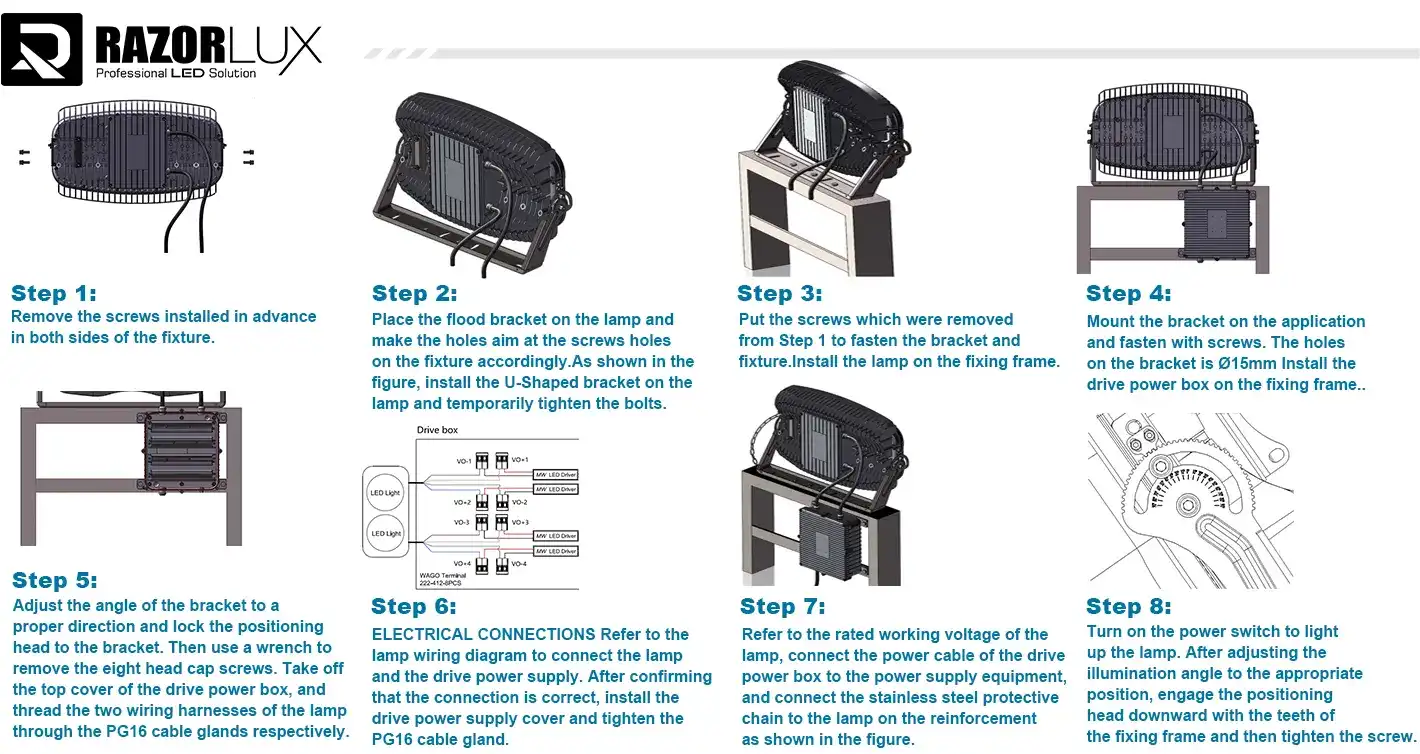
- Bracket and Mounting Hardware: The RGL-1000A stainless steel bracket is resistant to oxidation in coastal and high-humidity locations. During design review, verify that the pole threads and torque specs are compatible.
- Cable entrance sealing: Proper sealing of the conduit at the fixture entry point minimises moisture penetration that may deteriorate the driver over time, even on IP67-certified bodies.
- Beam angle pre-selection: Beam angle should be chosen before installation since optical lens replacement in the field at elevation is difficult. 40° narrow beam for long-throw high-mast applications. 120° or 140°×60° for low-mounting area flood applications.
These problems need to be addressed throughout the design process to avoid expensive rework after fixtures are in place.
Evaluating Suppliers and Certification Documentation
When sourcing a high-wattage LED sports fixture for a commercial or industrial project, certification documentation is not a formality — it is a requirement for commissioning approvals and insurance compliance for 1000 watt led sports light. Razorlux RGL-1000A is CE, RoHS, SAA, C-Tick, UL, DLC, CB, and ISO 9001 certified. The DLC listing is especially important to U.S. projects, since it allows the fixture to qualify for utility rebate programs that may lower the effective cost of purchase by 10–30%. Always ask any supplier for comprehensive test results, not just photos of certificates, so you can be sure the data matches the product you’re quoting.
Maximizing ROI: Procurement and Cost-Effectiveness of 1000 Watt LED Sports Lights
Buying lights in this wattage range is a capital expense that will have an effect on operating budgets for ten years. Getting the business format right from the start saves money over the course of the whole job.
Energy and Maintenance Cost Reduction
The figures are straightforward. Running a 2500W metal halide lamp for 4,000 hours a year at $0.12/kWh is going to cost you around $1,200 a year for the electricity alone. A 1000W LED bulb will cost about $480 on the same plan, saving $720 per fixture each year. That’s a savings of $36,000 a year in energy expenditures for a field with 50 lights. Metal halide bulbs must be changed every 6,000 to 10,000 hours. The RGL-1000A is rated for >50,000 hours. This implies one LED fixture will last longer than five or more HID light cycles. This saves you money on lamps and the labour to re-lamp the high mast.
Wholesale Procurement and Custom Configurations
Here are the top perks that business-to-business customers consistently notice when considering Razorlux as a 1000-watt LED sports light seller:
- Volume Pricing: Meaningful per-unit cost reductions via tiered pricing for bulk purchases improve project-level ROI for mid-to-large installations.
- Custom colour temperature: 2700K to 6500K, enabling identical fixture type for warm-tone architectural applications and cool-tone industrial or sports contexts.
- CRI upgrade options: Standard Ra75 is suitable for most industrial and sporting applications, with Ra80 and Ra90 versions available on request for broadcast-standard venues or inspection conditions.
- Dimming and control integration: Supports 0-10V dimming and motion-triggered or schedule-based control systems that decrease energy usage during low-occupancy times.
- Volume pricing: bulk orders are priced in tiers, with a significant reduction in the price per item. This enhances the ROI at the project level for medium to big installs.
| Procurement Factor | RGL-1000A Advantage |
|---|---|
| Annual energy cost vs. 2500W MHI | ~60% reduction |
| Lamp replacement cycle | ≥50,000 hrs vs. ~8,000 hrs (MH) |
| DLC listing | Qualifies for U.S. utility rebates |
| Certifications available | CE, UL, DLC, SAA, RoHS, CB, ISO 9001 |
| Warranty coverage | 5 yrs LED + Driver / 10 yrs Housing |
| Custom beam angles | 4 standard options |
| Custom CRI | Ra75 / Ra80 / Ra90 |
| OEM/ODM | Available |
It's possible for procurement managers to choose the RGL-1000A platform for multiple project types without having to source different product families. The annual energy cost is about 60% less than the 2500W MHI model, and the lamp replacement cycle is over 50,000 hours compared to about 8,000 hours (MH). The product is also listed with DLC, which means it can qualify for U.S. utility rebates. It has a warranty covering 5 years for the LED and driver and 10 years for the housing. There are 4 standard beam angles, and custom CRI options of Ra75, 80, and 90. OEM/ODM is also an option.
Conclusion
Professional stadiums, working shipyards, container ports, offshore platforms, and heavy industrial yards are just a few of the high-demand environments where a 1000 watt led sports light can improve visibility. The Razorlux RGL-1000A model has a MeanWell driver, IP65/IP67 protection, IK10 impact resistance, and a certification package that covers the U.S., European, and Oceanian markets. It gives off 130,000 lm at 130 lm/W. The LED module and driver come with a 5-year warranty, and the housing has a 10-year warranty. This means that the total cost of ownership over the life of the fixture is much lower than with older high-intensity discharge systems.
FAQ
How long does a 1000 watt LED sports light last compared to metal halide?
The RGL-1000A is designed to work for 50,000 hours. A normal metal halide lamp usually dies after 6,000 to 12,000 hours of use. This means that one LED light can last as long as four to eight HID lamp cycles, which saves a lot of money and time on replacement costs and maintenance.
Is the RGL-1000A suitable for saltwater and coastal environments?
Yes. The body of the fixture is made of die-cast metal that has been powder-coated. It has a stainless steel mounting bracket and an IP67-rated choice for direct water contact. Because of how it was built, it can be used for infrastructure at seaports, lighting in shipyards, and on offshore platforms where salt spray and humidity are common.
How much energy can I expect to save after switching from metal halide?
When you replace a 2500W metal halide fixture with a 1000W RGL-1000A, the power draw of each fixture drops by about 60%. At average business energy rates in the U.S., each fixture saves about $700 to $750 per year over a 4,000-hour working schedule. If you have a big system, this can add up quickly and give you a payback time of two to four years.
Does the RGL-1000A qualify for utility rebate programs in the United States?
The light fixture has a DLC (DesignLights Consortium) listing, which means that most major U.S. energy providers will offer rebate programs for it. Depending on the program and service, rebates can cut the net cost of buying something by 10 to 30%.
Request a Quote from Razorlux — Trusted 1000 Watt LED Sports Light Manufacturer
Since 1998, Razorlux has been making high-performance LED lighting. The company has over 200 patents and is fully certified by CE, UL, DLC, SAA, RoHS, and ISO 9001. You can test a sample of the RGL-1000A before ordering a lot of them. Our expert team can help with beam angle estimates, lux simulations, and full paperwork packages for any project, whether it's a stadium retrofit, a port infrastructure upgrade, or an industrial yard installation. You can email us at sam@razorlux.com or go to razorlux.com to make a request. Within one business day, you will receive a full quote.
References
1. DiLaura, D. L., Houser, K. W., Mistrick, R. G., & Steffy, G. R. — The Lighting Handbook, 10th Edition. Illuminating Engineering Society (IES), 2011.
2. U.S. Department of Energy — Solid-State Lighting R&D Plan. Office of Energy Efficiency and Renewable Energy, 2022.
3. DesignLights Consortium — Technical Requirements for Solid-State Lighting Products: Outdoor Area and Roadway Luminaires. DLC, 2023.
4. Illuminating Engineering Society — IES RP-6-15: Recommended Practice for Sports and Recreational Area Lighting. IES, 2015.
5. International Electrotechnical Commission — IEC 60598-2-3: Luminaires — Part 2-3: Particular Requirements for Luminaires for Road and Street Lighting. IEC, 2011.
6. American Society of Civil Engineers — ASCE 7-22: Minimum Design Loads and Associated Criteria for Buildings and Other Structures (wind and environmental load standards applicable to high-mast lighting structures). ASCE, 2022.