


_1750326878398.png)

Which Construction Site Flood Lights Work Best for Night Jobs?
But choosing the correct floodlights for a construction site isn’t simply about working at night on busy project sites; they’re a safety essential. Bad eyesight slows things down and causes more accidents, whether you’re in a massive shipyard, an offshore platform, or a vast industrial complex. OSHA regulation 1926.56 requires a minimum of 5 foot-candles of light for routine construction sites. Today's LED flood lights consume up to 70% less energy than metal halide or halogen systems, making Construction Site Flood Lights a practical choice, so you can go much further than that. For tonight's work, they are the most practical choice.
Understanding Construction Site Flood Lights: Types and Uses
Before buying any lighting equipment for a project site, it’s helpful to understand what the different types are, in fact, and what difficulties each one addresses. Each site is different in layout, power source, and weather exposure.
Temporary vs. Permanent Lighting Solutions
Temporary lights are usually on tripods and can be moved around. They are used for short-term projects or emergency response situations. Permanent systems, on the other hand, are put on buildings or mast poles and are meant to be used in places that are used for a long time, like ports, ships, or industrial sites. The choice between the two is based on the site, the length of the project, and the budget.
LED vs. Halogen vs. Metal Halide
It's no surprise that LED work lights have pretty much taken the place of both gas and metal halide lights.LEDs are said to be as efficient as 130 lm/W. Halogen is typically 15 to 20 lm/W. Metal halide lights last roughly 10,000 hours and need some time to warm up before they perform at their optimum. LEDs get to full brightness fast and may last more than 50,000 hours, so they won’t need to be changed as frequently on huge operations.
Rechargeable vs. Wired Units
It's no surprise that LED work lights have pretty much taken the place of both gas and metal halide lights. LEDs may provide up to 130 lumens per watt. Halogen typically provides 15 to 20 lumens per watt. Metal halide lights endure for around 10,000 hours and need a warm-up period to work optimally. LEDs reach maximum brightness quickly and may last more than 50,000 hours, so they will not need to be replaced as often in large operations.
Lumens, Lux, and What They Mean for Your Site
Lumens measure how much light a bulb gives off. Lux is the measure of how much light hits a surface per square metre. For job-specific areas that need precise work, 100+ lux is recommended. The Razorlux RGL-1000A makes 130,000 lumens at 5700K and is designed for industrial lighting jobs that cover a large area, like several thousand square meters.
How to Choose the Best Construction Site Flood Lights for Night Jobs
It’s not only a matter of comparing wattages to get the right lighting for a site. A systematic evaluation technique helps procurement teams avoid expensive errors and guarantee that the equipment is suited for the working environment.
Assess Site Size, Layout, and Task Type
First, figure out what areas need more light than the general lighting plan. This includes deciding what spaces need to be lit and which work areas need more light than the general lighting plan with construction site flood lights. A foundation pour area needs different lighting than a normal path. Before deciding on a light setup, use photometric modelling tools like DIALux to make a model of the area.
Key Evaluation Metrics to Compare
These are the most crucial factors each purchasing team needs to consider before they place an order:
- Luminous Efficiency: Aim for 130 lm/W or above to maximise energy savings. Here’s what you get as standard with the Razorlux RGL-1000A.
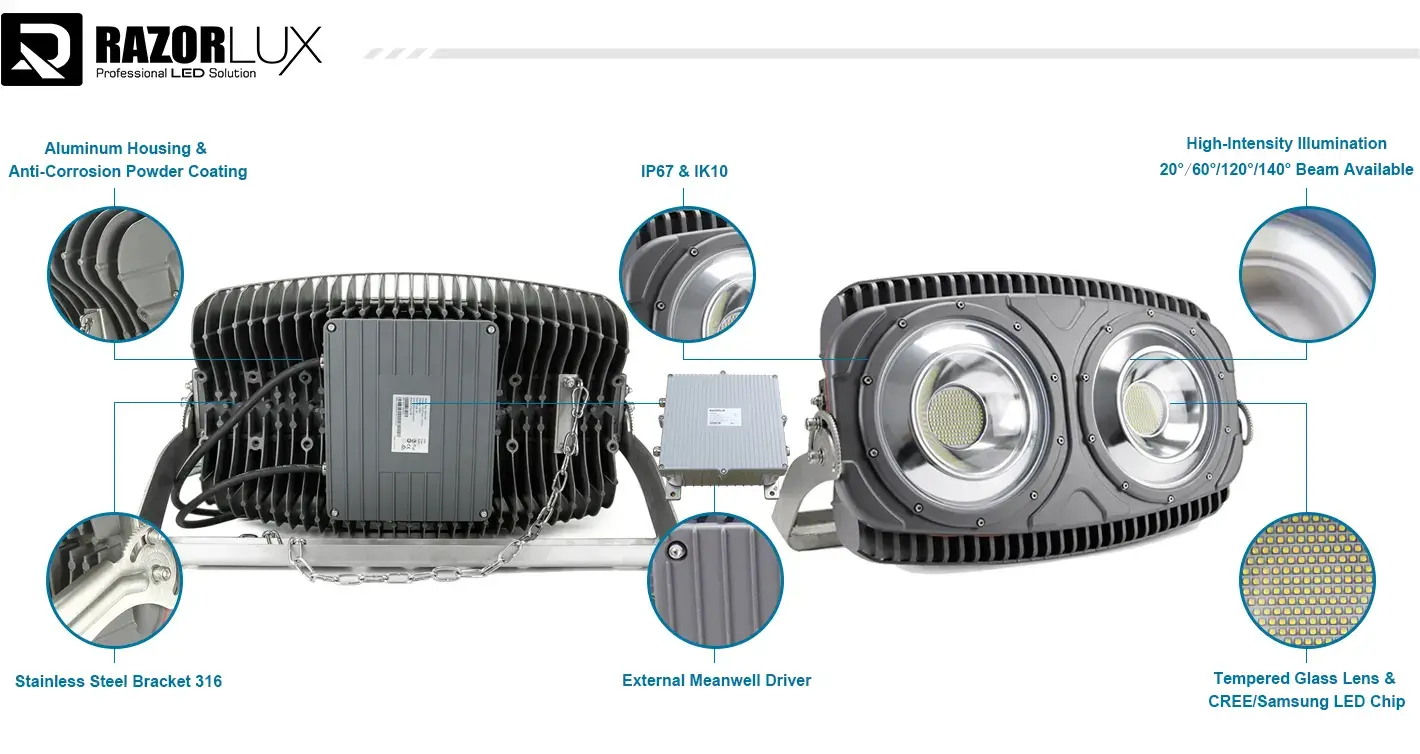
- IP Rating: IP65 is the minimum for marine and outdoor usage; however, IP67 is advised for situations where water might get in. Both ratings are for the RGL-1000A.
- The IK Rating IK10 protects against impact of up to 20 Joules. This is extremely significant on construction sites with plenty of debris.
- The RGL-1000A can be utilised at temperatures between -40°C and 60°C (-40°F to 140°F), therefore, it can be used in everything from the cold to the desert.
- Power Supply Quality: RGL-1000A is powered by a famous Meanwell driver, with a long life, excellent voltage stability, and surge protection.
These are the qualities to be utilised in comparing all actual procurement possibilities. Without any of these items may break down early which will cost more to repair and take longer to complete.
LED vs. Halogen: A Direct Comparison
| Feature | LED (RGL-1000A) | Halogen/HID Equivalent |
|---|---|---|
| Power Consumption | 1000W | 2200–2500W |
| Lumen Output | 130,000 lm | ~120,000 lm |
| Lifespan | 50,000+ hours | 8,000–12,000 hours |
| Warm-Up Time | Instant | 3–5 minutes |
| IP Rating | IP65/IP67 | Typically IP44–IP54 |
| Energy Savings | Up to 60% | Baseline |
| Maintenance Frequency | Low | High |
The data shows clearly that LED technology delivers equivalent or superior light output at less than half the energy cost, with significantly longer service intervals.
Balancing Cost, Performance, and Warranty
The general cost of ownership, not the buying price, shows how much something is worth in the long run. One that costs more up front but comes with a 5-year warranty, a Meanwell power supply, and a 50,000-hour lifespan will last longer than one that costs less but breaks after 18 months. The RGL-1000A comes with a 10-year warranty for the housing and a 5-year warranty for the LED module and driver. This is one of the best warranties on the market.
Installation and Safety Tips for Construction Site Flood Lights
Even the best fixture will underperform if it is installed incorrectly. Proper setup protects both the equipment and the workers on site.
Site Preparation and Mounting Options
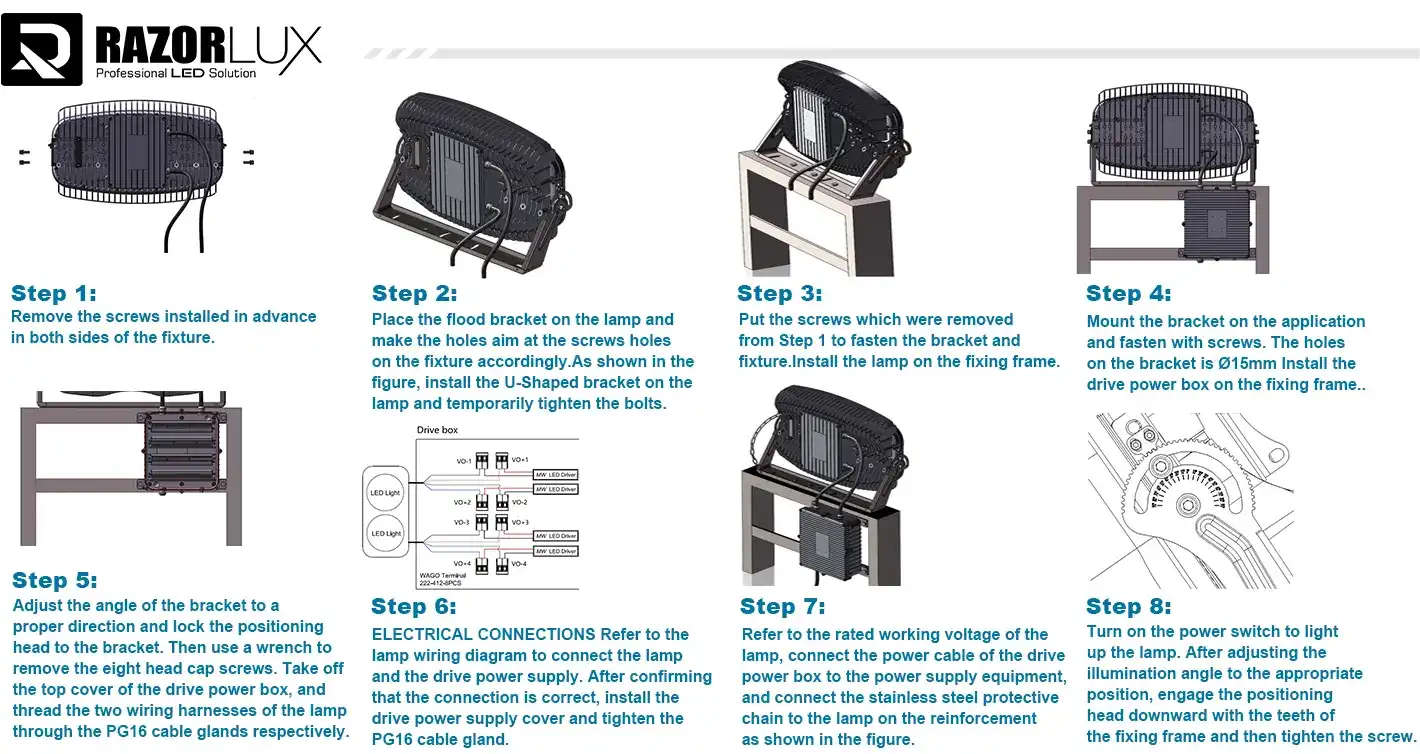
Before installation, confirm that mounting surfaces can support the fixture weight. The RGL-1000A weighs 30 kg (66 lbs) and uses a stainless steel bracket for corrosion resistance. Mast mounting, wall brackets, and crane arm installation are all viable options depending on site geometry.
Electrical Safety and Wiring Protocols
The RGL-1000A can take AC input voltages ranging from 80-305V, and DC input voltages ranging from 100-800V. This allows it to be used with either grid or generator power sources. Always observe NFPA 70E requirements while working on energised circuits. Use weatherproof conduit for outside runs. Make sure the circuit breaker rating is appropriate for the overall draw of the fixture before connecting.
Optimal Positioning to Minimize Shadows and Glare
Mounting height and angle directly affect shadow formation. For wide-area coverage, a 120° or 140°×60° beam angle suits open yards with construction site flood lights. For task zones, a 40° or 60° beam delivers focused light without dispersion. To avoid glare and the weariness it causes, which is a known cause of accidents in the workplace, do not place fixtures directly in the line of sight of a worker.
Maintenance Practices That Extend Equipment Life
With regular maintenance, the performance will not degrade over time. Dust and salt accumulation lowers output and may be removed by cleaning the lens surface every 90 days. For example, if you are in a coastal or marine location, check bracket fasteners for corrosion every six months. The RGL-1000A’s modular design allows individual components to be replaced without removing the complete fixture, minimising downtime.
Top-Rated Construction Site Flood Lights: Comparison and Reviews
The industrial lighting industry is full of good possibilities for B2B purchasers in 2024. Most of the brands reviewed include Philips, DeWalt, Milwaukee, Razorlux, etc. Here’s an unbiased comparison of how they stack up on the parameters that matter most to procurement teams.
Market Leaders and Where They Excel
Philips is a well-known brand in the mid-range LED work light market and is used for broad commercial purposes. DeWalt and Milwaukee are more focused on the portable, battery-powered side of things and are aimed toward trade contractors rather than large-scale industrial applications. The maximum output of each is usually approximately 10,000-20,000 lumens, not enough for broad-area industrial lighting.
Where Razorlux RGL-1000A Stands Out
| Specification | Razorlux RGL-1000A | Typical Competitor (Industrial Range) |
|---|---|---|
| Rated Power | 1000W | 400–600W |
| Lumen Output | 130,000 lm | 50,000–80,000 lm |
| CRI | Ra≥75 (Ra90 available) | Ra≥70 |
| Certifications | CE, RoHS, UL, DLC, SAA, CB | CE, RoHS |
| IP Rating | IP65/IP67 | IP65 |
| Power Supply Brand | Meanwell | Generic or unspecified |
| Warranty | 5 years (LED + Driver) | 1–3 years |
| Operating Temp | -40°C to 60°C | -20°C to 50°C |
For bulk procurement at ports, shipyards, or offshore platforms, the RGL-1000A offers measurably better output, broader certification coverage, and longer warranty terms than most competitors in its class.
Certifications That Matter for B2B Buyers
Certifications are a must in regulated businesses. The RGL-1000A is CE, RoHS, UL, DLC, SAA, C-Tick, CB, and ISO 9001 certified. UL and DLC designations are especially crucial for utility rebate eligibility and local electrical code compliance for U.S. purchasers.
Procurement Guide: Where and How to Buy Construction Site Flood Lights
Understanding how to procure efficiently matters as much as choosing the right fixture. Procurement professionals working under tight project schedules need suppliers who respond quickly, provide complete documentation, and deliver on time.
Procurement Channels and What to Expect
Construction Site Flood Lights Direct manufacturer partnerships are the way to go for the most cost flexibility and access to OEM or bespoke configurations. Online wholesale options like Alibaba and Made-in-China provide a wider choice of vendors to compare but need more due diligence on certifications and factory checks. Buyers who employ authorised distributors benefit from local inventories and quicker delivery times.
Bulk Purchasing and Negotiation Strategies
Most manufacturers, such as Razorlux, will provide a discount for bulk purchases of more than 50 units, and will also offer flexible payment options such as T/T wire transfer or Letter of Credit, as well as bespoke Packaging. Frame agreements may fix prices for recurring project cycles, which is especially valuable for port management businesses or shipyards with continuing building schedules.
What to Ask Before Signing a Supply Agreement
Before you sign up with any provider, ensure that:
- Do you have ready access to comprehensive technical data sheets, photometric files, and test reports?
- Are sample units available for site inspection prior to bulk purchase?
- Standard orders: 3-5 weeks. Lead time for special orders: 6-8 weeks
- Do you have an allocated after-sales contact for your account?
Razorlux has all of the above. We have the sample units ready for on-site examination and can provide complete documentation assistance for any technical or commercial inquiry. For product drawings, certification files, and application case studies, visit razorlux.com.
Conclusion
Night jobs demand lighting that performs without failure under pressure. The data consistently points to high-efficiency LED systems with certified IP and IK ratings as the only practical solution for industrial and marine environments, including construction site flood lights. The Razorlux RGL-1000A — with 130,000 lumens, a 1000W Meanwell-driven system, IP65/IP67 protection, and a 5-year warranty — represents a well-documented solution for procurement teams who need performance they can justify to both their technical and management stakeholders. Matching the right fixture to your site conditions from the start will reduce maintenance costs and protect your crew.
FAQ
Why are LED flood lights better than metal halide for construction sites?
LEDs offer instant-on operation, while metal halide lamps require a 3–5 minute warm-up. LEDs also last over 50,000 hours compared to roughly 10,000 hours for metal halide, which translates directly into fewer replacements and lower labor costs on large sites.
What IP rating is required for outdoor construction lighting?
IP65 is the accepted industry standard for outdoor work lighting. It protects against water jets and heavy dust ingress. For environments with standing water risk or marine exposure, IP67 provides additional protection against temporary submersion.
How do I calculate how many fixtures my site needs?
Use a DIALux photometric simulation based on your site dimensions and target lux levels. OSHA requires a minimum of 5 foot-candles for general construction areas. Task zones require 20–100 lux depending on precision requirements.
Can the Razorlux RGL-1000A run on generator power?
Yes. The RGL-1000A accepts AC input from 80–305V and DC input from 100–800V, which covers the output range of most portable and industrial generators. The Meanwell driver includes surge protection to handle voltage fluctuations common with site generators.
What does the L70 rating mean?
L70 refers to the point at which a fixture's light output drops to 70% of its original value. The RGL-1000A is rated for 50,000+ hours at L70, meaning it maintains acceptable brightness for the full warranty period under normal operating conditions.
Get a Quote from Razorlux — Trusted Construction Site Flood Lights Supplier
Razorlux has supplied industrial-grade LED lighting to shipyards, offshore platforms, and heavy manufacturing facilities across North America, Europe, and the Middle East since 1998. The RGL-1000A is available for sample testing before bulk orders, and the team provides full technical documentation, photometric files, and certification packages on request. If you are evaluating construction site flood lights for your next project, contact the Razorlux team directly at sam@razorlux.com or visit razorlux.com to request a quote. Custom wattage, beam angle, and IP configurations are available to match your specific site requirements.
References
1. Illuminating Engineering Society. The Lighting Handbook, 10th Edition. IES, 2011.
2. Occupational Safety and Health Administration. OSHA Construction Industry Standards: 29 CFR 1926.56 – Illumination. U.S. Department of Labor, 2023.
3. U.S. Department of Energy. Solid-State Lighting Technology Fact Sheet: Lifetime of White LEDs. Office of Energy Efficiency and Renewable Energy, 2009.
4. European Committee for Standardization. EN 12464-2: Light and Lighting – Lighting of Work Places – Part 2: Outdoor Work Places. CEN, 2014.
5. Lawrence Berkeley National Laboratory. Energy Efficiency of LED Lighting in Commercial Buildings. LBNL Report, 2020.
6. National Fire Protection Association. NFPA 70E: Standard for Electrical Safety in the Workplace. NFPA, 2021.