


_1750326878398.png)

How Bright Are Marine LED Flood Lights 120V for Night Fishing?
When evaluating illumination for night fishing, Marine LED Flood Lights 120V systems deliver impressive brightness levels. Most of the time, the range for high-wattage lights is between 100,000 and 130,000 lumens. With a high brightness of about 130 lm/W and focused beam angles, these lights can shine through dark water areas that are quite big. Marine-grade LED floodlights give off the same amount of light even when they are in saltwater, when the voltage changes, and when the temperature is very high or very low. Because of this, they are necessary for commercial fishing boats, docks, and offshore platforms where being able to see clearly affects both safety and productivity.
Understanding Marine LED Flood Lights 120V Brightness
Marine LED Flood Lights 120V that work with 120V power are a big step forward in technology for lighting ships. The designers of these lamps made them to survive the harsh conditions of the ocean while still giving off strong, steady light that is needed for night fishing.
How LED Technology Functions at 120V
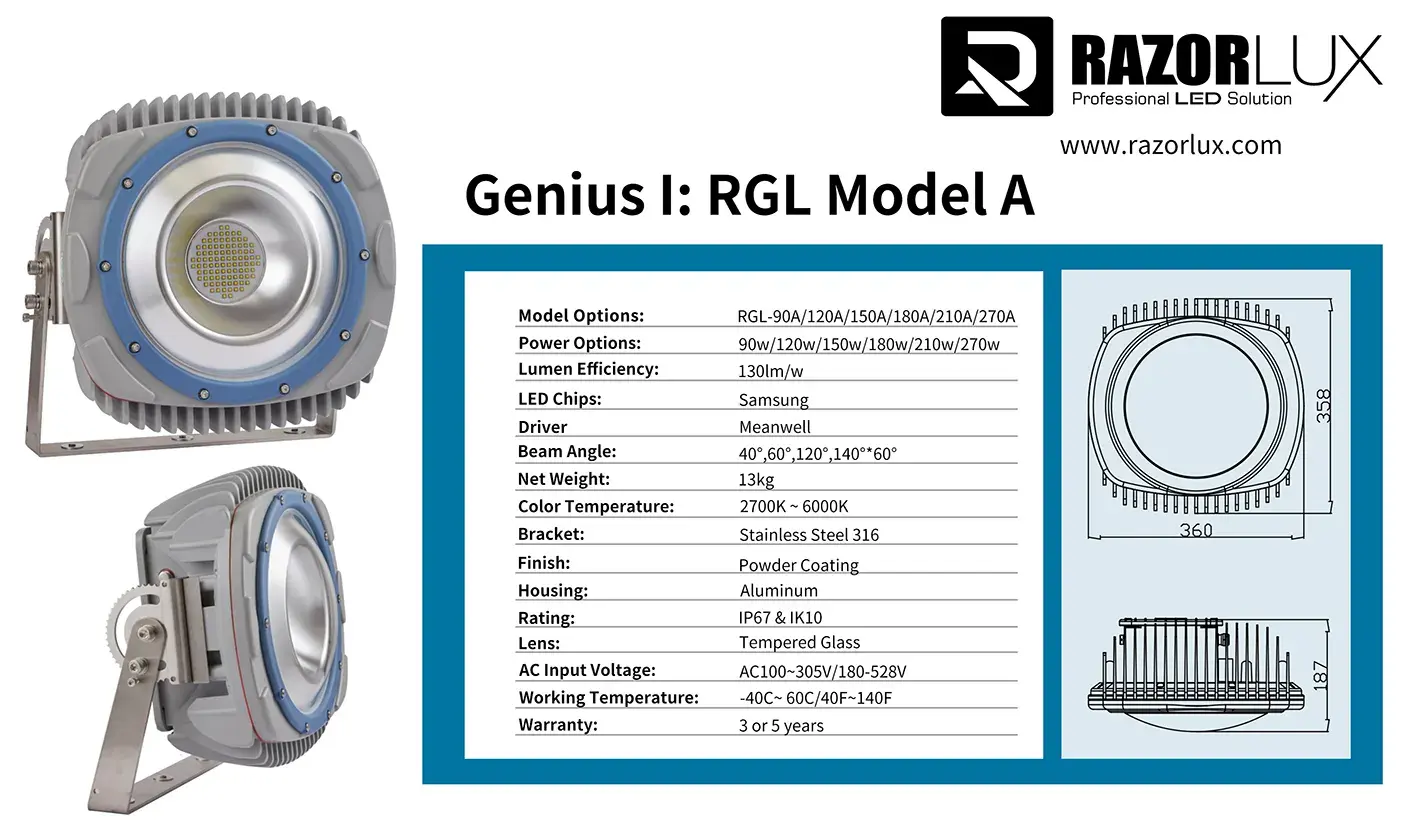
In North America, business ships and buildings on land use the 120V power rule, which is the same as the rule in Britain. This voltage works with this voltage, so you don't need any extra transformers or voltage changes. This makes installation easy by reducing the number of places where something could go wrong. Inside, there is a driver that changes the AC power into a stable DC power that powers the bright LED chips. Our Razorlux lights can work with a wide range of voltages. They can deal with 100V to 400V DC and 80V to 305V AC. In other words, they will always work, even if the engine power changes when big machines are going, or the waves are rough. This is really helpful for fishing trips that go to faraway places where power isn't always available.
Brightness Metrics: Lumens and Candela Explained
To understand light, you only need to know how to use two easy tools. There is a way to figure out how much light a bulb gives off and how much light can be seen from all sides. In a certain direction, Candela tells you how strong something is. This is a picture of how focused the beam looks in the middle. It takes half as much power to run a 1000W Marine LED Flood Light 120V with 105,000 stable brightness as a normal 2000W metal halide lamp, but it shines 2.5 times as brightly. Ships that use engines to power their electricity will save a lot of fuel with this huge change.
Optimal Brightness Levels for Night Fishing Activities
Depending on the species you're after and the way you're fishing, professional night fishing needs different lighting tactics. Fish that eat at the surface, like squid and mackerel, are attracted to 5000–6500K cool white light, which goes deep into the water and attracts baitfish. Our color temperature range is adjustable, so workers can find the best spectrum without having to switch lights. Deep-sea fishing needs flood patterns that cover the whole work area on the deck. Eighty to one hundred lumens per square meter keep the crew safe while they sort and handle the catch. When you're fishing with a longline, directional lighting is helpful because it lights up bait sites without making them too bright, which could scare off your target species.
Key Factors Influencing Brightness of Marine LED Flood Lights 120V
Several factors that are connected to each other decide how well lights work in maritime uses. Knowing about these things helps procurement teams choose fixtures that keep their advertised brightness for the whole time they are in use.
LED Chip Quality and Technology
The semiconductor chips are what any Marine LED Flood Lights 120V system is built on. Premium chips from well-known brands give you consistent results that don't change much over time. Lower-quality options may meet specs at first, but their light loss speeds up when they are exposed to heat and moisture. Our light fixtures use tried-and-true LED technology and come with full thermal management systems that include precision-engineered heatsinks and powder-coated metal housings that get rid of heat effectively, even in hot areas where the temperature regularly rises above 40°C.
Wattage, Lumens, and Luminous Efficacy
In lumens per watt (lm/W), luminous efficacy is the relationship between the amount of power that goes in and the amount of light that comes out. These days, marine LED technology can produce 130 lm/W or more, which means that every watt of electricity makes 130 lumens of visible light. This is a huge improvement over halogen (15–20 lm/W) and metal halide (75–90 lm/W) systems. A 1000W LED floodlight with 130,000 brightness can replace 2000W to 3000W old lights and cut the load on the electricity grid by 50 to 65%. This means that boats that go on long fishing trips will use a lot less fuel and have more power for their generators, which power refrigeration and processing equipment.
Optical Components: Lens Design and Beam Angle
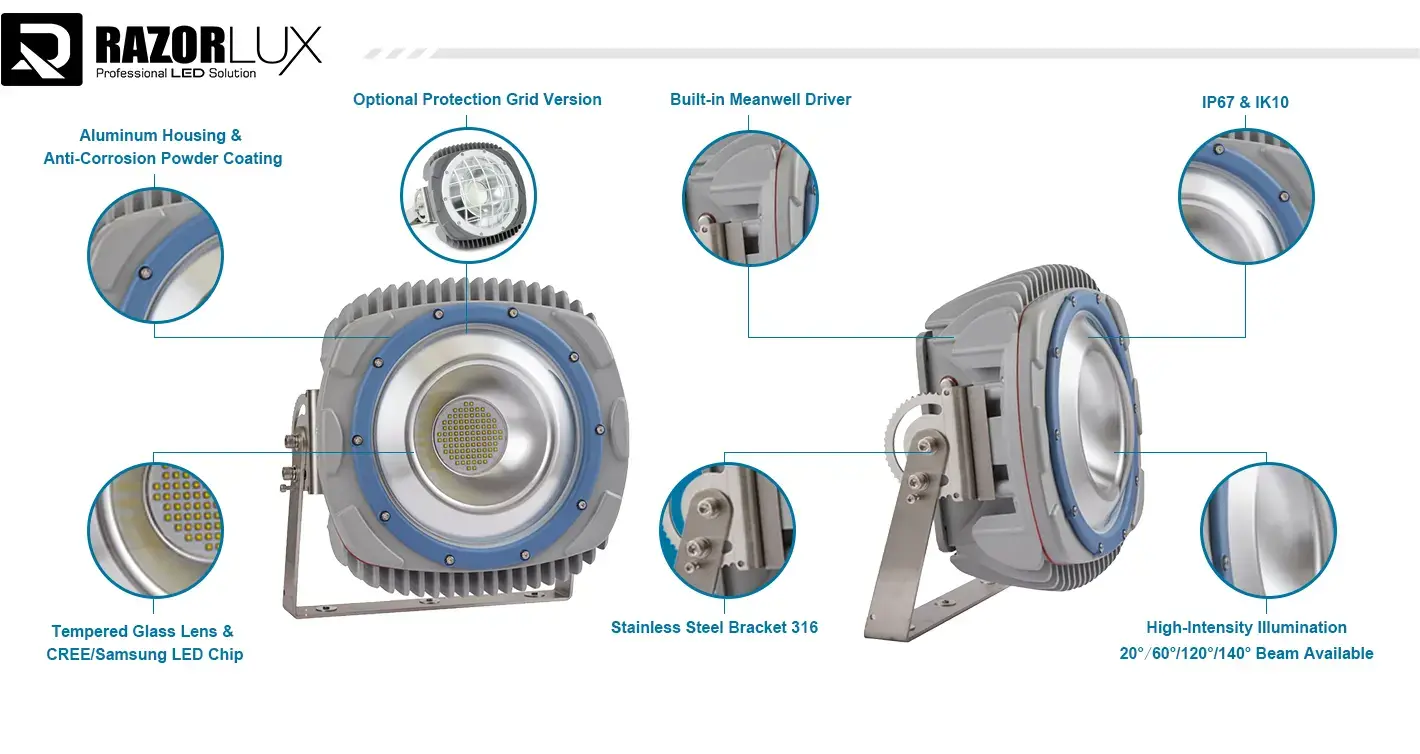
The optical system takes the output from the LEDs and turns it into useful work light. Finely crafted lenses focus and guide light with little loss, getting specific beam patterns without too much spill. Our 20-degree beam angle works well for long-throw uses where focused energy is more important than broad covering. Different optics can meet different needs. For example, 40-degree medium floods balance throw distance with area coverage, and 90-degree wide floods light up large deck areas or warehouse interiors.
Environmental and Installation Variables
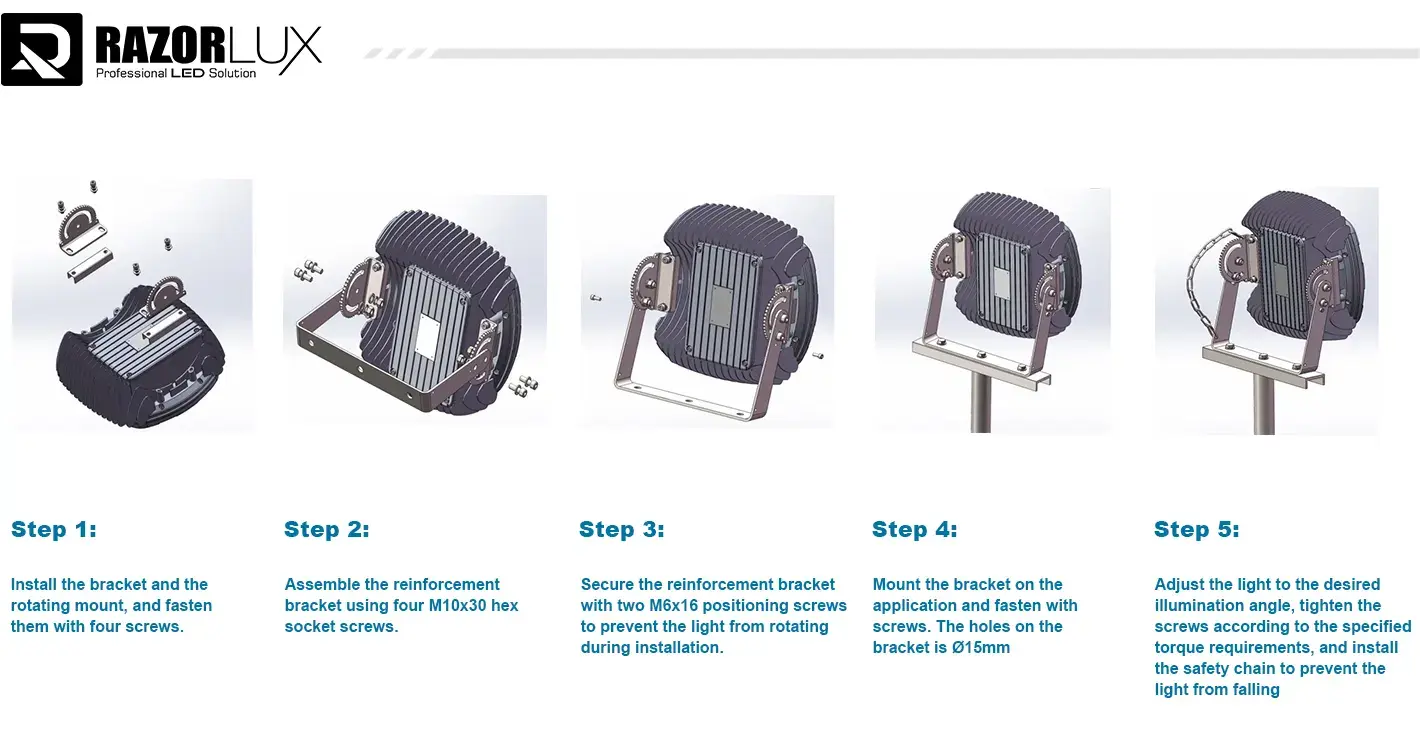
The mounting height and angle have a big effect on how bright the work surface seems. Too high of a placement of the fixtures wastes light, and too much tilt makes harsh shadows. Fixtures should be installed 6 to 10 meters above deck level at 30- to 45-degree downward angles for the best range and strength. Stainless steel mounting brackets allow for these changes, so the aim stays accurate even when the gun moves or vibrates.
Marine LED Flood Lights 120V Compared with Other Lighting Options
In order to choose the right lighting technology, you need to know how the different options perform. When used in naval settings, each technology has its own pros and cons.
120V vs. 12V Low-Voltage Systems
Low-voltage DC devices are most common in small boats and leisure boats because they are safe and easy to connect to batteries. But heavy-gauge wiring is needed to keep the voltage from dropping when running high-wattage lighting on 12V. For example, a 1000W fixture draws over 80 amps, so the conductors need to be close to 35mm² in order to work well. For commercial use, 120V systems work better for high-output fixtures because normal marine-grade wiring (6-10mm²) can send enough power over modest distances without losing too much.
LED vs. Halogen and Incandescent Technology
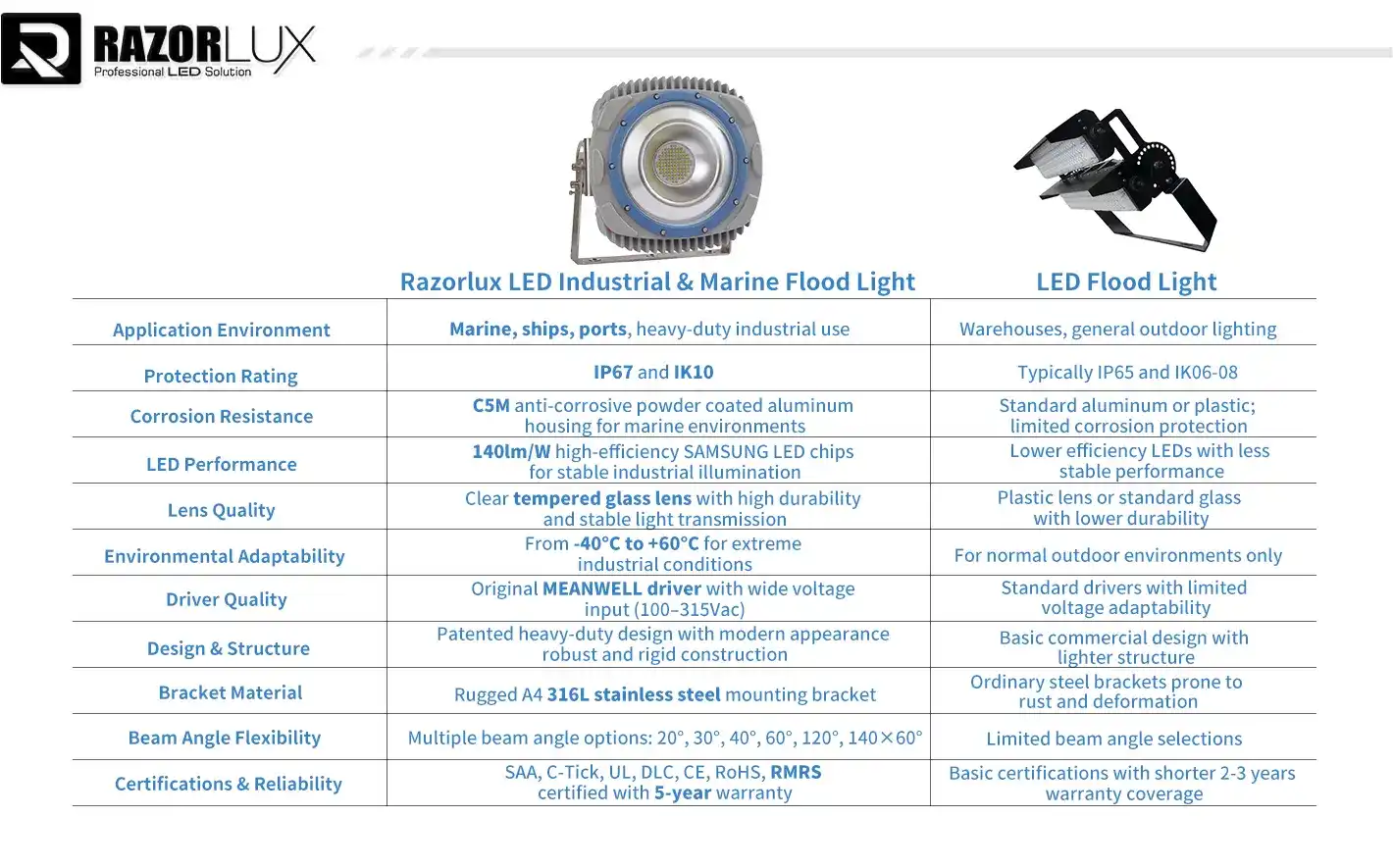
For decades, traditional incandescent and fluorescent lights were the most common type of marine lighting, even though they weren't very efficient and needed to be serviced often. 90% of the energy that goes into halogen lamps is wasted as heat, which can be dangerous in engine rooms and storage areas where things are kept. The average lifespan is rarely more than 2000 hours, so in buildings that run all the time, they need to be replaced every three months. The sharp difference in results is shown in the table below:
| Technology | Efficiency in lumens per watt | Lifespan in hours | Power for 100,000 Lumens | Maintenance once a year |
|---|---|---|---|---|
| Marine LED Flood Lights 120V | 130 | 50,000 or more | 770W | Not much |
| Metal Halide | 85 | 10,000 | 1,175W | 2 to 3 replacements |
| Halogen | 18 | 2,000 | 5,555W | Over 12 replacements |
| Incandescent | 15 | 1,000 | 6,665W | Over 24 replacements |
This comparison shows why purchasing managers are choosing LED technology more and more, even though it costs more at first. Total cost of ownership strongly favors LEDs when repair work, disposal costs, and energy use over normal 5-year purchase cycles are taken into account.
Energy Efficiency and Lifespan Considerations
The longer life of LED technology means that it needs less upkeep, which is especially helpful on offshore sites where getting to fixtures takes special tools and can be dangerous. Our lights keep 70% of their original brightness after 50,000 hours of use, which means they can be used nonstop for 6 to 8 years before they start to lose their shine. The 5-year warranty covers LED modules, drivers, and housings. This gives procurement departments a clear picture of how much the whole system will cost over its lifetime, which makes budgeting easier.
Solar-Powered and Alternative Voltage Models
Solar LED systems are good for remote locations that can't connect to the power grid or can't afford to run their own electrical infrastructure. But maritime uses are hard for solar technology because ships are always moving, rigging shadows, and storm damage make it hard to mount panels. Solar systems don't usually give off the steady, high-output light that is needed for real commercial fishing. Because of this, they are better suited for navigation lights and border security than for work lighting.
Installation, Maintenance, and Longevity to Maximize Brightness
Marine LED Flood Lights 120V will work as advertised for as long as they are installed correctly and maintained according to the manufacturer's instructions. Even the best equipment can be damaged by ignoring these basic things.
Step-by-Step Installation Best Practices
Planning carefully is the first step to a successful operation. Electrical experts should check the circuit's capacity and make sure that the breakers and wiring are the right size for the loads on the fixtures, plus 20% as a safety cushion. Finding the right place to mount things requires a structural analysis. For example, 29-kilogram fixtures need strong support that can handle shifting loads during rough seas. Stainless steel clamps should only be bolted to mounting pads or strengthened deck structures. They should never be bolted to light panels or temporary rigging.
Waterproofing and Corrosion Resistance
IP67 certification means that fixtures can withstand being submerged in water up to 1 meter deep for 30 minutes. This is long enough for installations on decks that are subjected to wave wash and high-pressure cleaning. Although IP67 ratings are enough for most marine lighting situations, IP68 ratings are better for more demanding uses. The rating includes both dust ingress (6 = complete protection) and water ingress (7 = protection against immersion), so even in harsh conditions, the inside parts will stay dry.
Routine Maintenance to Prevent Brightness Degradation
An occasional check is good for even LED technology that doesn't need to be maintained. Cleaning every three months gets rid of salt buildup and bacterial growth that scatter light and lower output. Do not use rough cleaners or high-pressure water directly on the lens surfaces. Instead, use soft brushes and a freshwater rinse. Check the mounting gear and wire glands for corrosion and replace any parts that look fishy before they break.
LED Lifespan and Brightness Retention Over Time
LEDs break down in expected ways, with brightness loss happening over time instead of all of a sudden. According to industry norms, useful life is the number of hours until power drops to 70% of its original brightness (L70 grade). Good marine LEDs can last more than 50,000 hours, but how well they work varies a lot on the temperature at which they are used. Good thermal management increases lifetime. Our strong heatsinking keeps junction temperatures in the right ranges, which increases lifespan even in tropical areas.
Choosing the Best Marine LED Flood Lights 120V for Night Fishing
To choose the best lighting tools, you have to weigh a lot of technical specs, working needs, and financial concerns. Knowing these criteria helps procurement teams make choices that are in line with the goals of the organization.
Evaluating Lumen Output and Power Consumption
High lumen output doesn't always mean better performance. When lighting experts choose lights, they look at the lumens per watt (efficacy), the total amount of power used, and the beam properties. A 1000W fixture that puts out 130,000 lumens at 130 lm/W works better than a 1500W unit that puts out 150,000 lumens at 100 lm/W, even though the 1000W fixture has a lower absolute output. This is because the more efficient fixture uses less energy while giving off the same amount of light when it is aimed correctly.
Power use is important for more reasons than just how much it costs. Total linked load is limited by the electrical infrastructure. This makes high-efficiency lights useful when updating old facilities that are getting close to circuit capacity. By adding Marine LED Flood Lights 120V, you might be able to avoid the expensive electrical improvements that come with older technologies.
Beam Angle Adjustability and Practical Applications
Fixed beam directions work well for sites with clear needs, while glasses that can be changed can adapt to changing needs. Commercial fishing boats use smaller beams (20 to 30 degrees) that send light far across the water, making it easier to see groups of fish and movement on the surface. Processing plants use wider spreads (60 to 90 degrees) that light up large deck areas evenly and keep workers from tripping over shadows or misidentifying catches.
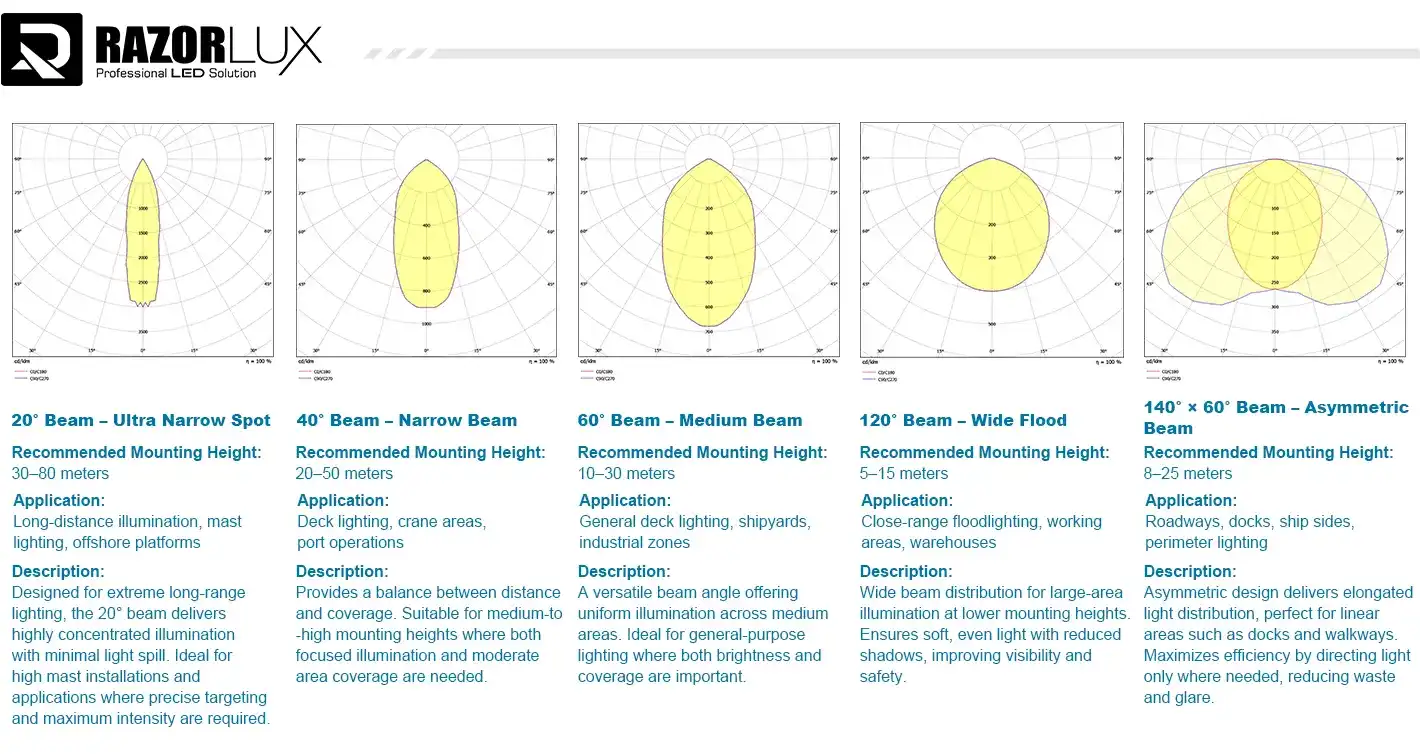
As a summary, the table below shows the right beam angles for popular naval uses:
| Application | Recommended Angle of Beam | Normal Height for Mounting | Coverage for Each Fixture |
|---|---|---|---|
| Fishing from far away | 20° to 25° | 8 to 12 meters | more than 200 meters |
| Work areas on deck | 40° to 60° | 6 to 10 meters | 12 to 18 meters across |
| Zones for loading cargo | 60° to 90° | 8 to 15 meters | 20 to 30 meters across |
| Safety around the edges | 30-45° | 6 to 10 meters | 100 to 150 meter range |
Color Temperature and CRI for Enhanced Visibility
The color temperature has a big effect on how fish see and behave. Cool white (5000–6500K) looks like sunshine and makes it easy to tell colors apart, which is very important for processing operations where workers need to tell the difference between species and rate quality. Warmer temps (3000–4000K) make it easier on the eyes to work at night for longer periods of time, but they also make colors less accurate. Our color temperature range (2700- 6500 K) can be changed to accommodate both tastes without having to keep separate stock.
On a scale from 0 to 100, CRI measures how accurately colors are shown. Our normal Ra>75 specification is good for general lighting, while our premium Ra>80 choices are better for quality-control uses. Higher CRI comes at a small cost in terms of efficiency: higher-CRI LEDs usually put out 5–10% fewer lumens per watt because they change their spectral properties to better render colors.
Trusted Suppliers and After-Sales Support
Equipment dependability includes more than just the quality of the product; it also includes the stability and support skills of the seller. When purchasing managers look at marine lighting providers, they should make sure that the sellers have full certification portfolios that show they follow international rules. Our RMRS, UL, CE, RoHS, SAA, and DNV-GL certifications show that our goods meet strict marine safety standards in all global markets. This is very important for ships that travel between countries or equipment integrators who work with clients from other countries.
Support after the sale is what sets great sellers apart from average ones. Razorlux offers technical support 24 hours a day, seven days a week, because they know that fishing activities don't follow work hours. When replacement parts are easy to find, fixes can be done quickly when parts do break. This cuts down on downtime, which costs thousands of dollars every day in lost fishing opportunities. Our 5-year guarantee covers LED modules, drivers, and housings. This shows that we're confident in the durability of our products and gives purchasing teams the information they need to make correct budgets: lifecycle costs.
Commercial Considerations: Bulk Pricing and Delivery Terms
For large purchases, businesses need to be able to be flexible with their pricing beyond what is published. Total acquisition costs go down with volume discounts, longer payment terms, and custom Packaging. Suppliers with a lot of experience work together with purchasing departments to make agreements that work with budget cycles and project timelines instead of imposing strict rules.
Reliability in delivery is also very important. Our global reach, with operations on six continents, guarantees a steady supply even when there are problems in some areas. Custom-made shock-absorbing boxes protect fixtures during foreign shipping, and full paperwork, such as certifications for each country and multilingual installation guides, speeds up the customs process and installation.
Conclusion
Marine LED Flood Lights 120V are the best way to light up professional fishing at night and other marine activities. These fixtures are much better than older ones because they produce over 100,000 lumens at 130 lumens per watt, use half as much power, and need very little maintenance. IP67 waterproofing, IK10 impact resistance, and full corrosion protection make sure that the device will work reliably in harsh ocean environments. Procurement professionals should put luminous effectiveness, verifiable certifications, and seller security ahead of the original buy price when choosing marine lights. Quality LED fixtures are the most cost-effective choice over typical 5–10 year procurement cycles because they last longer, use less energy, and require less maintenance, which quickly makes up for their higher initial costs.
FAQ
What brightness level do I need for commercial night fishing?
For safe deck operations, commercial fishing boats usually need 80 to 120 lumens per square meter, which adds up to 100,000 to 130,000 lumens for large work areas. Different species have different needs. For example, surface feeders respond to higher intensities (100+ lux), while deep-water operations put coverage over peak intensity. Depending on the installation height and beam angle, a 1000W Marine LED Flood Light 120V that puts out 105,000 lumens can light up an area of 800 to 1000 square meters.
How do IP ratings affect marine lighting performance?
IP67 ratings mean that the device will not let any dust in and will be submerged up to 1 meter for 30 minutes. This is enough time for cleaning and mounting on a deck that will be exposed to waves. IP65 guards against water jets but not soaking, so it's good for places that are out of the way. Higher ratings make fixtures more expensive without really helping in most situations. Installing something properly is more important than making small IP improvements; an IP68 fixture that isn't fixed correctly will break faster than an IP67 unit that is.
Can I replace 2000W halogen fixtures with LED equivalents?
A 1000W marine LED floodlight with 130,000 lumens gives off two to three times as much light as a 2000W metal halide lamp while using half as much power. Before a direct replacement can happen, the electrical capacity and compatibility of the mounting must be checked. Most setups can easily be converted to LEDs, which saves energy right away and gets rid of the need to change bulbs often, as halogen systems require.
Partner with a Proven Marine LED Flood Lights 120V Manufacturer
Razorlux stands ready to support your marine lighting procurement needs with over two decades of LED innovation and more than 200 patents covering advanced LED technology. As an established manufacturer specializing in high-performance maritime illumination, we understand the challenges purchasing managers face balancing performance requirements, budget constraints, and reliability concerns. Our 1000W marine LED flood lights deliver 105,000 lumens with proven durability—IP67 waterproofing, stainless steel construction, and Meanwell power supplies ensure consistent operation in the harshest conditions. Whether you're specifying lighting for new vessel construction, offshore platform upgrades, or port facility modernization, our technical team provides expert guidance tailored to your exact requirements. Contact sam@razorlux.com to discuss your project specifications, request technical documentation, or arrange sample evaluation. Discover why shipyards, offshore operators, and industrial facilities worldwide trust Razorlux for their mission-critical lighting solutions.
References
1. Maritime Engineering Institute. (2022). LED Lighting Systems for Commercial Fishing Vessels: Performance Standards and Selection Criteria. International Marine Technology Publications.
2. Anderson, R. T., & Chen, M. (2021). Energy Efficiency in Marine Electrical Systems: LED Technology Applications. Journal of Maritime Engineering and Technology, 18(3), 145-162.
3. International Association of Marine Equipment Suppliers. (2023). Technical Guide to Marine LED Flood Lighting: Installation and Maintenance Best Practices. IAMES Standards Committee.
4. Peterson, J. L. (2022). Corrosion Resistance in Marine Lighting Equipment: Material Selection and Protective Coatings. Offshore Engineering Quarterly, 29(4), 78-94.
5. North American Maritime Safety Board. (2021). Illumination Requirements for Commercial Fishing Operations: Safety and Efficiency Guidelines. NAMSB Technical Report 2021-07.
6. Wong, S. H., & Martinez, C. (2023). Comparative Life-Cycle Cost Analysis of Marine Lighting Technologies. Industrial Procurement Review, 41(2), 112-128.