


_1750326878398.png)

Which 120 Volt Led Outdoor Flood Lights Offer Dusk-to-Dawn Sensors?
When evaluating outdoor lighting options like 120 Volt LED Outdoor Flood Lights for demanding industrial and commercial projects, purchasing managers often ask which fixtures combine automation with reliability. Several manufacturers produce automated outdoor LED flood lighting with photocell sensors, including Razorlux, Lithonia Lighting, and Hyperikon. At Razorlux, our high-performance fixtures integrate dusk-to-dawn photocells with rugged LED technology rated at 130 lumens per watt, delivering hands-free operation paired with industrial-grade durability suitable for marine environments, shipyards, and offshore platforms where manual switching proves impractical.
Key Technical Specifications for Procurement Evaluation
Lumens, Efficacy, and Coverage Requirements
Lumen output and efficacy are the first things that are used to judge the performance of lighting. Razorlux flood lights get 130 lm/W, and the 1000W RGL-1000A model makes 130,000 lumens. This output can be used instead of 2200W to 2500W HID fixtures, which saves more than 50% of energy and gives better color rendering and uniformity (CRI ≥75, upgradable to ≥90).
The covering patterns and mounting heights are affected by the beam angle choice. You can choose from 40°, 60°, 120°, and uneven 140°×60° ranges. Narrow beams (40°) work well for high-mast applications that need to target specific areas, while wide angles (120°) flood large areas like loading docks and parking lots. Teams in charge of buying things should match beam patterns to the photometric needs that are written down in lighting plans and site studies.
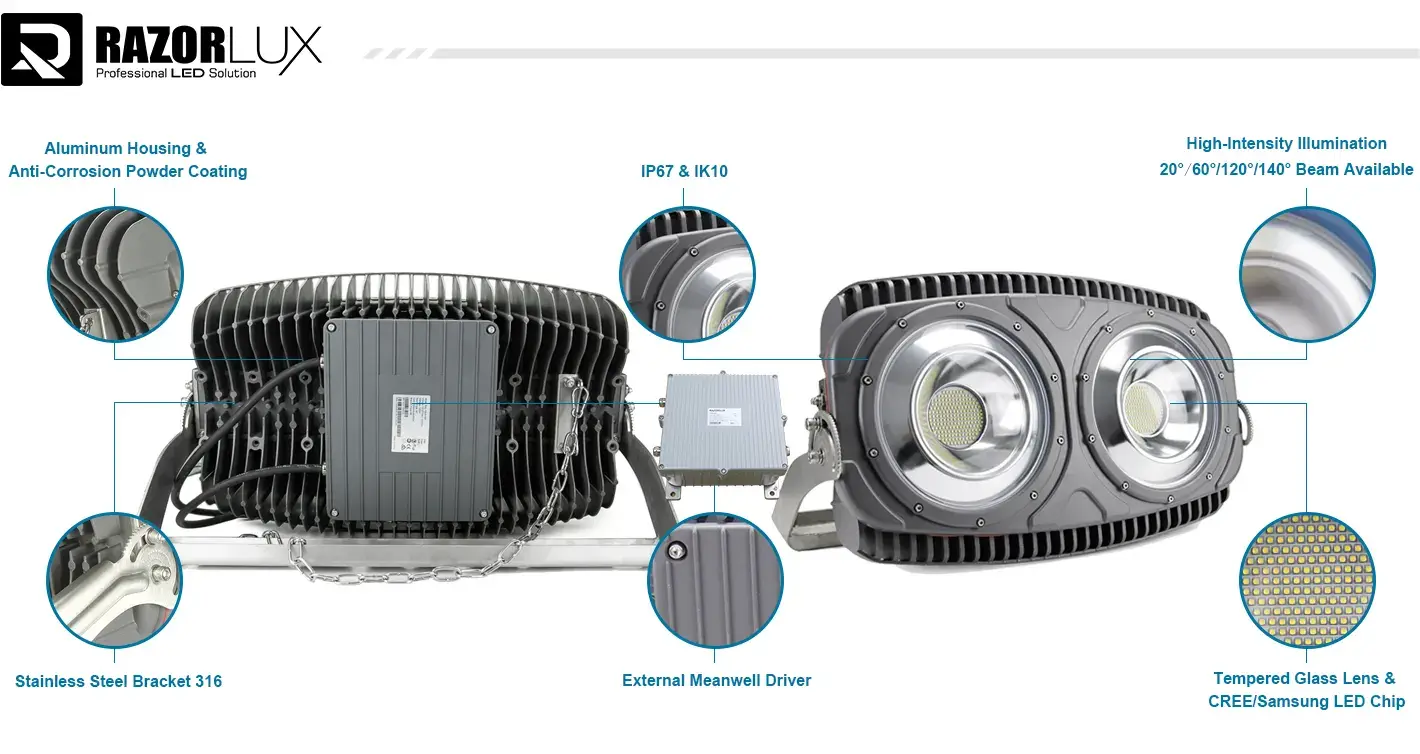
Ingress Protection and Impact Resistance
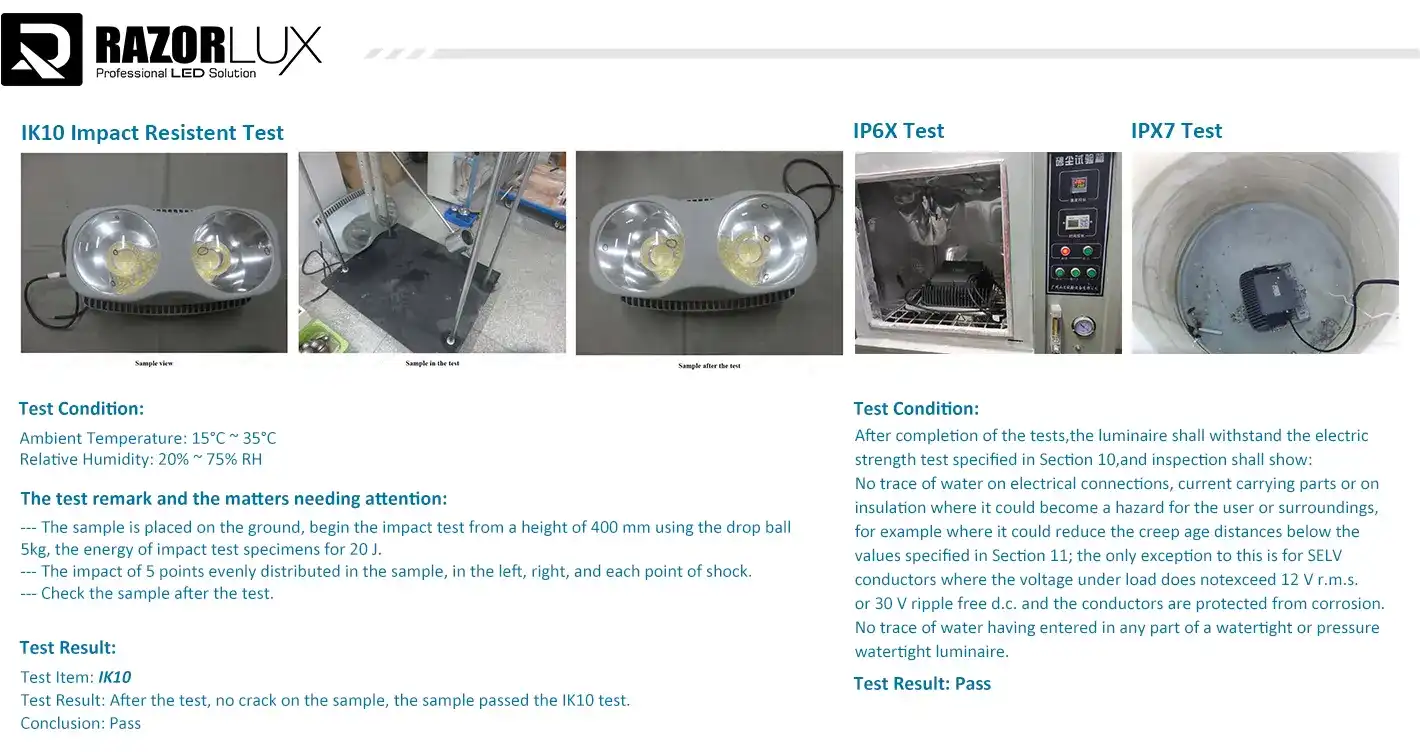
Ratings for the environment for 120 Volt LED Outdoor Flood Lights show how long a fixture will last in harsh conditions. IP65 ratings protect against low-pressure water jets and are good for places that are out of the way. For fixtures on decks that are open to wave spray and washdowns, IP67 grades make sure they can handle being submerged for a short time up to one meter. Razorlux devices come with IP67 standard housings that can be upgraded to meet marine classification societies (DNV, ABS) and offshore legal standards.
IK10 impact resistance means that the safety is good against 20-joule strikes, which is the same as dropping 5 kg from 40 cm. This rating is very important in shipyards and other industrial sites where moving equipment, using cranes, and debris can cause accidents. Stainless steel clamps and shock-absorbing mounts make the mechanical sturdiness even better, which cuts down on repairs and replacement costs.
Lifespan, Warranty, and Total Cost of Ownership
LED lifespan rates (L70 at ≥50,000 hours) show how long the light will work before it loses 70% of its original brightness. With good heat control and quality drivers, the useful service life can be extended to over 60,000 hours in well-ventilated environments. Razorlux backs LED modules with five-year warranties and drivers with the same amount of coverage. Housings are covered by ten-year structural warranties.
The price of buying something, the labor needed to set it up, the amount of energy it uses, and the cost of repairs over a ten-year period are all parts of the total cost of ownership (TCO). Automated fixtures save money on labor costs by getting rid of the need for manual switching and fewer service calls. Dusk-to-dawn operation and high efficacy save more energy every year, and based on power rates and duty cycles, the initial investment is usually recouped within 18 to 36 months.
| Performance Metric | Razorlux RGL-1000A | Typical HID Equivalent | Advantage |
|---|---|---|---|
| Power Consumption | 1000W | 2200W to 2500W | 55–60% less energy used |
| Luminous Output | 130,000 lm | ~110,000 lm | Better uniformity and more brightness |
| Efficacy | 130 lm/W | 45 to 50 lm/W | 2.5 Made things work better |
| Rated Lifespan | ≥50,000 hrs | 10,000 to 15,000 hours | 3–5 times longer service life |
| Maintenance Frequency | Minimal | Frequent relamping | Less disruption to operations |
Comparing Automation Options and Leading Manufacturers
Dusk-to-Dawn Sensors vs. Motion Detection and Timer Controls
Motion monitors and customizable timers are not at all the same as photocell sensors. Motion monitors turn on lights when they sense movement. This saves energy but could mean that there are dark periods between sensing events. This method works well for areas with little foot traffic but not so well for places that need constant security lighting, like offshore platforms and port perimeters.
Timers set times for lights to turn on and off, so schedules are reliable, but they don't take into account changes in the seasons or the weather. On cloudy days, the lights may need to be turned on earlier than planned, and during the summer, longer dusk loses energy if the lights are turned on too early. The automation of photocells changes on the fly, making the best use of runtime no matter where you are or what the weather is like.
Combined systems use photocells and motion sensors together to create dim "standby" lighting that turns on all the way when movement is detected. This hybrid strategy strikes a good balance between saving energy and keeping everyone safe. It's appealing to procurement managers who want to have as much operational flexibility as possible.
Evaluating Established Brands and Specialty Manufacturers
Acuity Brands' Lithonia Lighting makes commercial-grade floodlights that can come with photocell sensors. Their fixtures stress how easy they are to install and how widely they are sold, which makes them appealing to builders who value quick sourcing and standard parts. But there aren't many marine-rated types yet, and the voltage tolerance might not work with generator-fed systems that are popular on boats.
Hyperikon makes LED flood lights with built-in photocells that are affordable and are aimed at the retail and hospitality markets. Even though they are cheap, these units usually don't have the IP67 rating, IK10 impact resistance, or wide voltage input that are needed for marine and industrial uses. Standard warranty terms of three years are also not up to standards in the industry.
Razorlux stands out because it specializes in naval and heavy-duty settings. Our fixtures are tested for performance in shipyards, offshore rigs, and coastal infrastructure by thermal cycling, vibration analysis, and salt spray testing (ASTM B117). Products that are certified by classification groups (DNV/GL, ABS) and meet UL 1598A marine standards are sure to meet strict government standards. Tier-one components like Mean Well drivers and Samsung LED chips lower the number of failures and make global service logistics easier.
Certification and Compliance for International Projects
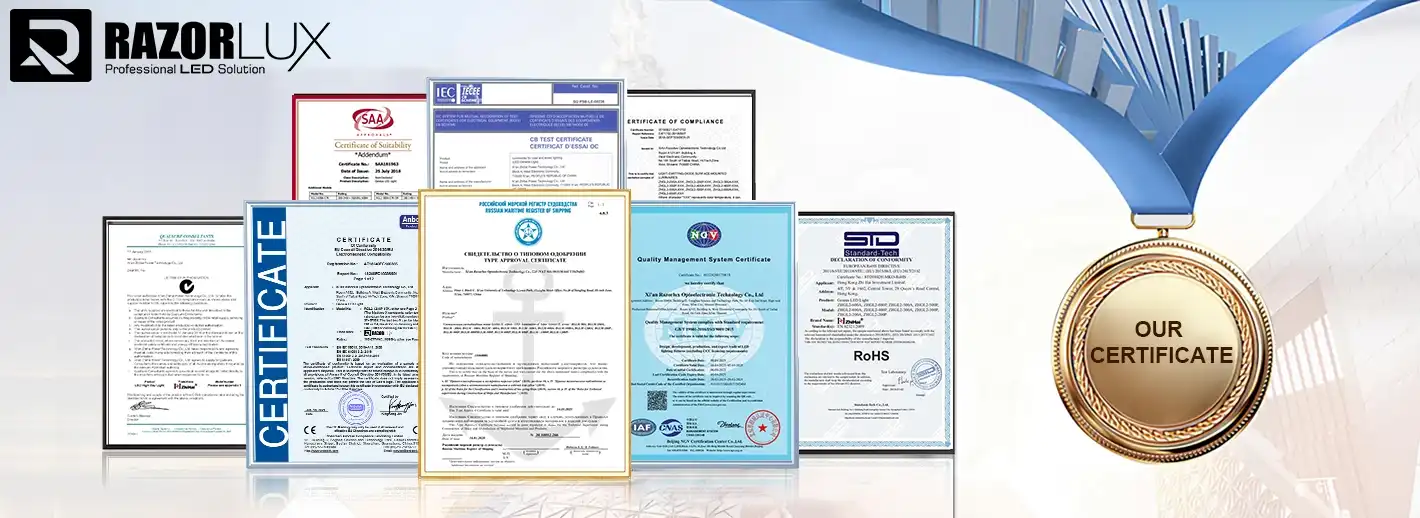
When buying 120 Volt LED Outdoor Flood Lights for international projects, procurement managers have to make sure that they follow local electrical codes and industry standards. CE marking meets the rules of the European Union, and UL and DLC listings prove safety and efficiency in North America. RoHS approval makes sure that rules about dangerous substances are in line with environmental laws.
Marine applications need more attention. Fixtures that meet the earthquake, EMC, and ingress safety standards for seagoing boats are certified by DNV/GL Type Approval and ABS Product Design Assessment. These approvals are given to Razorlux goods, which makes it easier for shipbuilders and offshore companies to get approvals in areas with a lot of rules.
| Certification | Standard Covered | Relevance to Marine/Industrial Buyers |
|---|---|---|
| CE | EU EMC and Low Voltage Directives | Needed to get into the European market |
| UL 1598A | Marine Luminaires | Important for U.S. Coast Guard compliance |
| DNV/GL | Type Approval | Validates seagoing vessel suitability |
| ABS | Product Design Assessment | Offshore platform and drilling rig approval |
| RoHS | Hazardous substance restriction | Environmental compliance, buying a fleet |
| DLC | Energy efficiency verification | Eligibility for utility rebates (North America) |
Procurement Strategies for Automated High-Performance Flood Lights
Criteria Framework for Technical Evaluation
Standardized evaluation grids that compare luminous output, IP/IK grades, sensor reliability, voltage compatibility, and certification accuracy are helpful for procurement teams. Ask for thorough photometric records (IES files), documents on thermal management, and test data from a third party that backs up promises of ingress protection and impact resistance.
Before placing a big order, it is important to try samples first. Razorlux gives technical teams pre-production samples so they can make sure the lights will work with the installation, check the real lumen output, and see how well the photocells work in the conditions at the site. This hands-on validation cuts down on shocks after the installation and makes sure that what the seller says matches up with how things work in the real world.
The terms of the warranty should be carefully read. Five-year warranties on LED modules and drivers show that the manufacturer trusts them and keeps them from breaking down too soon. Find out if warranties cover the costs of labor, shipping, and reinstallation. This is especially important for offshore sites that are hard to reach and where service logistics are expensive and time-sensitive.
Negotiating Volume Pricing and Long-Term Partnerships
Buying in bulk takes advantage of economies of scale to lower prices per unit and get better payment terms. Set up framework agreements that spell out commitments to volume, delivery dates, and price changes that are linked to changes in commodities like LEDs and aluminum. Spread out deliveries over a number of years in multi-year contracts to keep supply lines stable and make budgeting for phased infrastructure changes easier.
Use competitive buying methods, but put quality ahead of the lowest price. Poor fixtures cause hidden costs by needing to be replaced more often, requiring more maintenance work, and stopping operations. Reliability, effectiveness, and warranty assistance should be taken into account along with the purchase price when figuring out the total cost of ownership.
Razorlux has flexible minimum order amounts and project-based prices to help engineering contractors and MRO providers. Our OEM and ODM services allow for custom branding, customized beam patterns, and changes that are made to fit specific applications. This lets partners make their products stand out while taking advantage of our manufacturing expertise.
Logistics, Installation Support, and After-Sales Commitments
Delivery on time keeps building plans on track and prevents costly delays in the project. Make sure you understand the wait times during the quotation process, taking into account production processes, quality checks, and shipping between countries. Razorlux offers freight options by air, sea, and rail, adjusting transit time and cost to meet the needs of the project as quickly as possible.
Installation guidance speeds up commissioning and cuts down on mistakes. For workers who aren't familiar with marine-rated tools, detailed instructions, wiring diagrams, and mounting templates make setup easier. Video lessons and live technical help make it even easier for people to install something for the first time.
Long-term happiness depends on service after the sale. Quick technical teams fix problems with sensor calibration, figure out why LEDs aren't working right, and quickly replace parts. Razorlux keeps regional service networks and parts inventories stocked so that they can respond quickly to installations even in remote places like Arctic ports and offshore platforms.
Installation Best Practices and Maintenance Protocols
Electrical Setup and Sensor Calibration for Industrial Sites
Making sure the voltage is compatible for 120 Volt Led Outdoor Flood Lights is the first step in a proper installation. Razorlux fixtures can work with a lot of different input ranges, but site studies should be done to make sure that the real source characteristics, such as harmonic distortion and transient voltages, are correct. When working in areas prone to lightning or near large inductive loads, put surge protection devices (SPDs) ahead of the lights.
Place photocells where they can see the sky clearly, and make sure they are not in the shadows of buildings, masts, or other fixtures nearby. When sensors are placed incorrectly, they turn on or off too soon or too late, which defeats the purpose of automation. During commissioning, change the sensitivity levels and test the system's performance at dusk and dawn to make sure that the responsive switching meets practical needs.
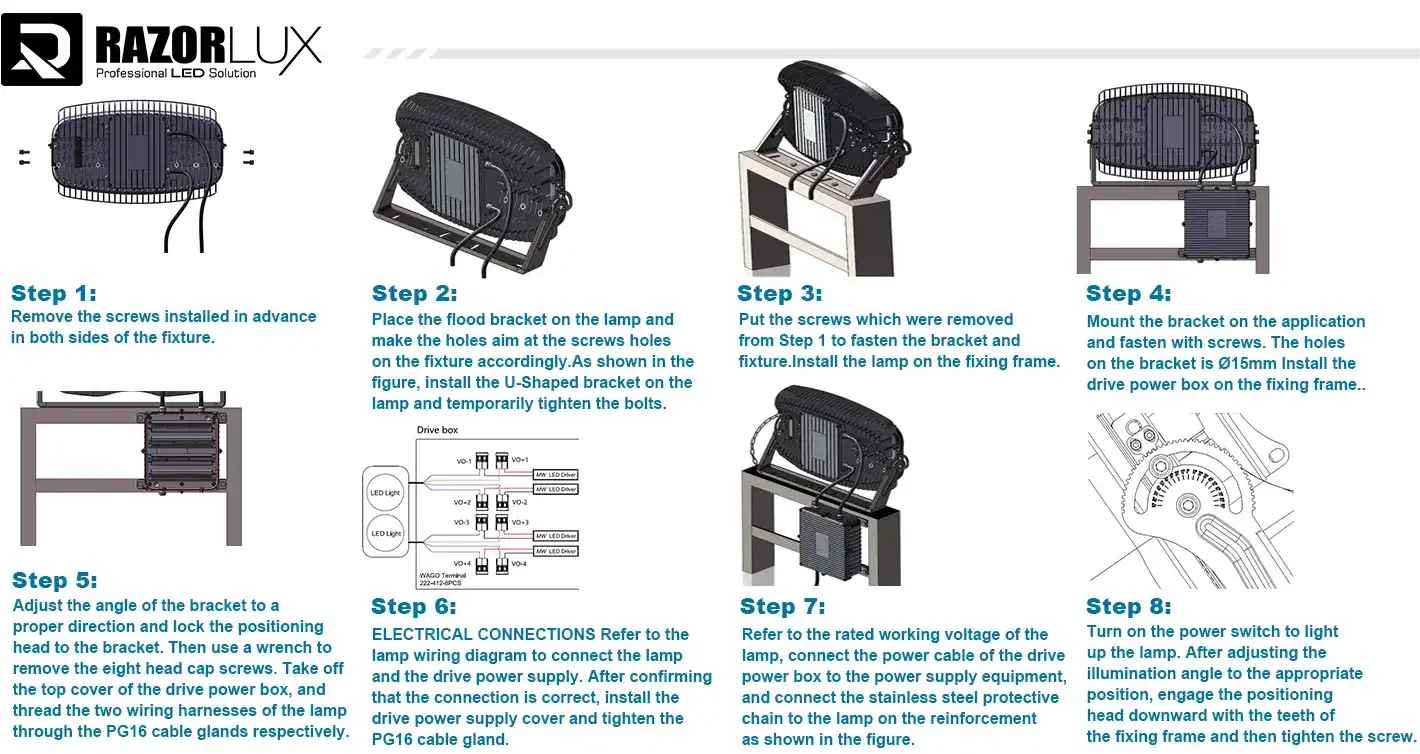
Marine-grade cable glands and terminals that don't rust are needed for electrical connections. Galvanic rusting can't happen in saltwater if you put dielectric grease on threaded parts. According to local codes, ground fixtures set up low-impedance paths that safely get rid of fault currents and surge energy.
Preventive Maintenance Schedules and Troubleshooting Procedures
Cleaning the optics and sensors on a regular basis keeps them working well. Lenses and photocell windows are cleaned every three months to get rid of salt deposits, dust, and biological growth. To keep polycarbonate or toughened glass plates from getting scratched, use cleaners that don't scratch and soft cloths.
Check the sensor's function once a year by covering the photocell for a short time during the day and making sure the fixture turns on when the ambient light level drops. Responses that are slow or inconsistent are signs that the sensor is getting old or dirty. Replacing photocells is much cheaper than replacing the whole fixture, and Razorlux makes it easy to do fixes in the field by making units that can be switched out.
Use calibrated light meters to keep an eye on the output of the LEDs and compare the readings to the standard starting data. Lumen loss that is greater than L70 forecasts is a sign of heat problems, driver problems, or LEDs that are getting old too quickly. Keep track of performance trends to get the most out of warranty claims and replacement cycles, and make sure that bulbs provide the right amount of light for the full length of their rated life.
Reducing Total Cost of Ownership Through Proactive Care
Preventative maintenance makes fixtures last longer and cuts down on unexpected breakdowns. Thermal image scans find drivers that are getting too hot or housings that don't have enough airflow before they break. Tighten the mounting hardware every so often, especially on platforms that are prone to vibration, to keep it from coming loose and compromising the water seals and structure.
Keeping important spare parts like photocells, drivers, and gaskets on hand cuts down on downtime when repairs need to be made. Razorlux makes extra part kits for specific models, which makes sure that they work with each other and makes managing supplies easier. By teaching maintenance staff basic troubleshooting skills, teams can fix common problems without having to wait for outside help, which improves operational continuity.
Energy tracking systems keep track of how much energy is used, making sure that the expected runtime from dusk to dawn is met and finding outliers that could mean a sensor isn't working right or someone is overriding the system manually. Adding lighting data to platforms for managing buildings will help with planning preventative maintenance and comparing performance across multiple locations.
Conclusion
Automated LED flood lighting like 120 Volt LED Outdoor Flood Lights with dusk-to-dawn sensors is a smart investment for procurement managers who care about security, operational reliability, and saving energy. The technical review should focus on how well the light works, how well it protects against water and other damage, how well it works with different voltages, and how complete the certification is. When you compare manufacturers, you can see that there are trade-offs between wide market access and marine-grade engineering that is very specific. Razorlux fixtures have tier-one components, a wide voltage tolerance, and are built to last in industrial settings. They also come with full warranties and quick technical support. If you put something correctly and do regular upkeep, it will last longer and give you a better return on your investment. It will also work the same way in even the harshest conditions.
FAQ
Can Existing Fixtures Be Retrofitted with Dusk-to-Dawn Sensors?
A lot of devices can use external photocell units that work with NEMA-style plugs or straight-wired connections. Make sure the voltage ratings and switching capacity match the amount of power the fixture needs. Razorlux has sensors that can be retrofitted and are rated for marine settings. This makes updates easier without having to replace the whole fixture.
What Weatherproofing Certifications Should Procurement Managers Require?
Set a minimum of IP67 for outdoor installations that will be exposed to dust and water. Marine uses need to meet UL 1598A, DNV/GL, or ABS standards in addition to the minimum requirements. Make sure that test results show that the product is resistant to salt spray (ASTM B117) and works well at different temperatures.
How Do Warranty Terms Differ for Bulk Purchases?
When you place a lot of orders, you can often get better service terms and longer warranty coverage. Razorlux offers standard five-year warranties on LEDs and drivers, and longer warranties can be negotiated for large orders. Before finalizing agreements, make sure you understand what is covered (parts, labor, shipping, etc.) and that local service is available.
Partner with Razorlux for Reliable Automated LED Flood Lighting
Purchasing managers and engineering contractors who need reliable outdoor lighting options should get in touch with Razorlux to set up a personalized meeting. As a specialized 120 Volt LED Outdoor Flood Lights maker, we make lights that are built to last in harsh marine, offshore, and heavy-industrial settings. Our RGL-1000A series has 130 lm/W efficacy, IP67 protection, and Mean Well drivers with five-year warranties. It can automatically turn on at dusk and off at dawn. Email sam@razorlux.com to get examples, technical information, and bulk prices. Over 200 patents, 20 years of LED innovation, and global certifications will help you make sure that your projects meet their performance, safety, and cost goals. You can look through our whole catalog at razorlux.com and learn more about how we support long-term relationships based on trust and quality.
References
1. Illuminating Engineering Society. "IES RP-33-14: Lighting for Exterior Environments," 2014.
2. National Electrical Manufacturers Association. "NEMA Standards Publication: Photocontrols for Outdoor Lighting Applications," 2018.
3. DNV GL. "Rules for Classification of Ships: Part 4, Chapter 9 – Electrical Installations," 2020 Edition.
4. American Bureau of Shipping. "Guide for Light Emitting Diode (LED) Devices and Systems," 2019.
5. U.S. Department of Energy. "LED Lighting for Marine Applications: Energy Efficiency and Operational Benefits," 2021.
6. International Maritime Organization. "SOLAS Consolidated Edition: Safety of Life at Sea - Regulation on Lighting Systems," 2020.