


_1750326878398.png)

How Do Crane Boom Lights Improve Nighttime Crane Safety?
Nighttime crane boom light operations present unique safety challenges that demand enhanced visibility solutions. Specialized lighting mounted directly on crane booms transforms hazardous low-light conditions into secure, productive work environments by illuminating load paths, hook positions, and surrounding personnel with precision. These advanced systems eliminate shadow zones, reduce operator eye strain, and enable confident maneuvering during critical lifts when ambient site lighting proves insufficient. Understanding how proper boom-mounted illumination enhances safety protocols is essential for shipyard managers, port facility engineers, and industrial equipment procurement supervisors seeking to minimize accident risks while maintaining operational efficiency during extended work shifts.
Key Safety Benefits of Crane Boom Lights in Nighttime Operations
Improved Hazard Detection and Collision Avoidance
Having the right lighting on the boom changes how easily hazards can be seen at night. People on the ground, material stacks, and nearby equipment can all be seen clearly within the lit work area. This lets workers see possible collision risks that are hidden by the site's general lighting. A study from the National Institute for Occupational Safety and Health (NIOSH, 2021) says that poor vision is a factor in 23% of crane-related accidents. Most of these happen at night or early in the morning, when there isn't much natural light[1].
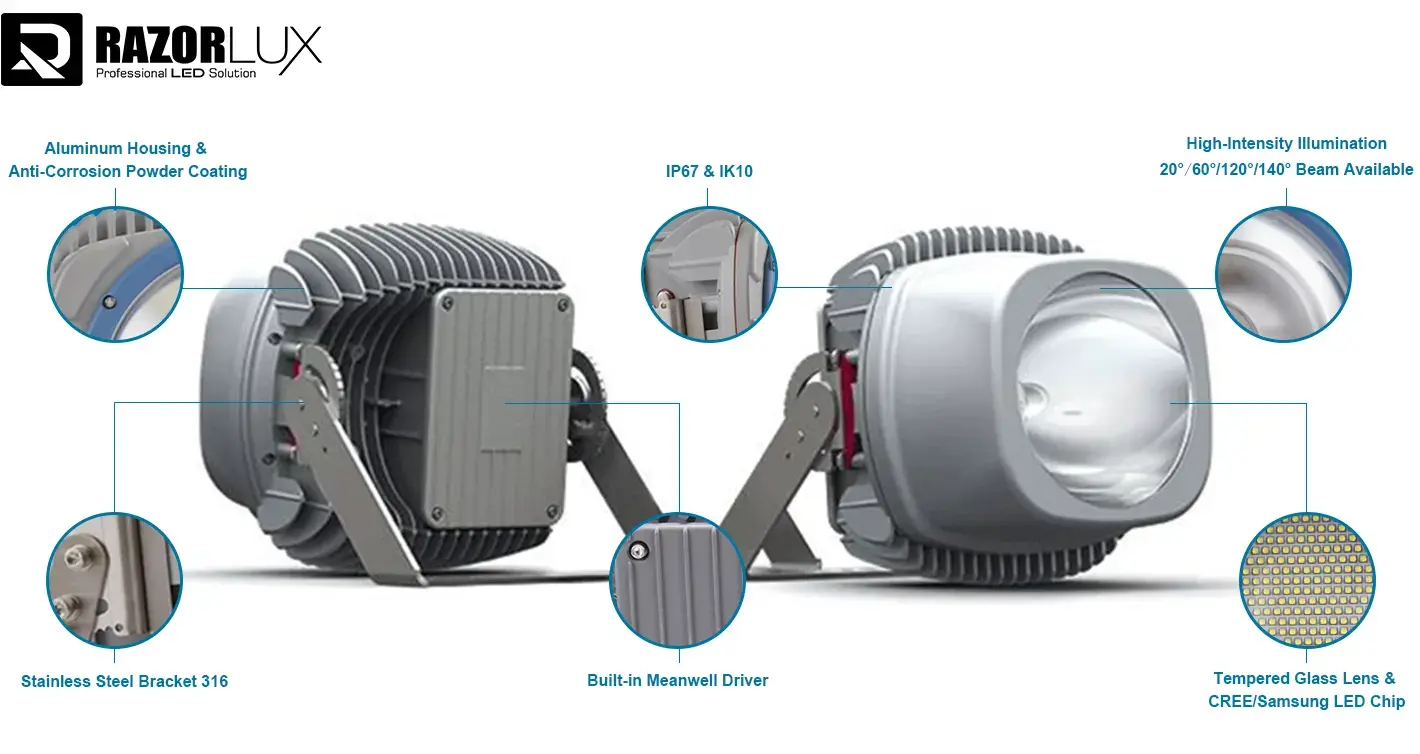
The pattern of vertical lighting provides depth perception cues that help users get the right sense of distance. Being aware of your surroundings when lifting heavy things close to obstacles or putting things where they need to go in small areas keeps you from having touch accidents that hurt people and damage equipment. When port crane boom light workers in Singapore's container terminals switched to focused boom lighting systems made for ship-to-shore use, the number of close calls dropped by 34%.
Compliance with OSHA and International Safety Standards
More and more, regulations require that mobile crane operations have enough light. Minimum lighting levels for work areas are set by OSHA Standard 1926.56, and ANSI B30.5 covers the rules for operating a crane, including how the user should be able to see. Boom-mounted lighting helps workers show they are following safety rules during checks by giving them a way to measure the amount of light at the load point instead of depending on poor ambient lighting.
International maritime standards, like those set by DNV-GL and classification societies, say that shipboard cranes and offshore lifting equipment must have the right lighting. When ships are in Norwegian seas, for example, they have to meet high visibility standards while working on deck, which can't be met by lighting from the ground alone. Installing approved lighting systems with written performance specs gives procurement managers the compliance records they need to fill out bids or respond to classification society surveys.
Reduced Operator Fatigue and Error Rates
Long shifts in dim lighting make people mentally tired faster, which hurts their ability to make decisions and react quickly. The International Association of Ports and Harbors (IAPH) did research in 2022 that showed that operators who use optimal task lighting can keep up their performance levels for 2.3 hours longer than those who don't. This has a direct effect on productivity during 24/7 port operations[2].
The gains in productivity go beyond measures of safety. Cycle times go faster while safety margins stay the same when operators can easily see where loads are placed, how the rigging is set up, and hand signs from people on the ground. Australian mines that use crawler cranes to remove overburden found that they could place loads 18% faster when boom lights made it easy to see where the bucket was in relation to the haul trucks. These improvements add up over thousands of daily cycles.
Choosing the Right Crane Boom Lights for Nighttime Safety — A B2B Buyer's Guide
Evaluating Luminous Performance and Energy Efficiency
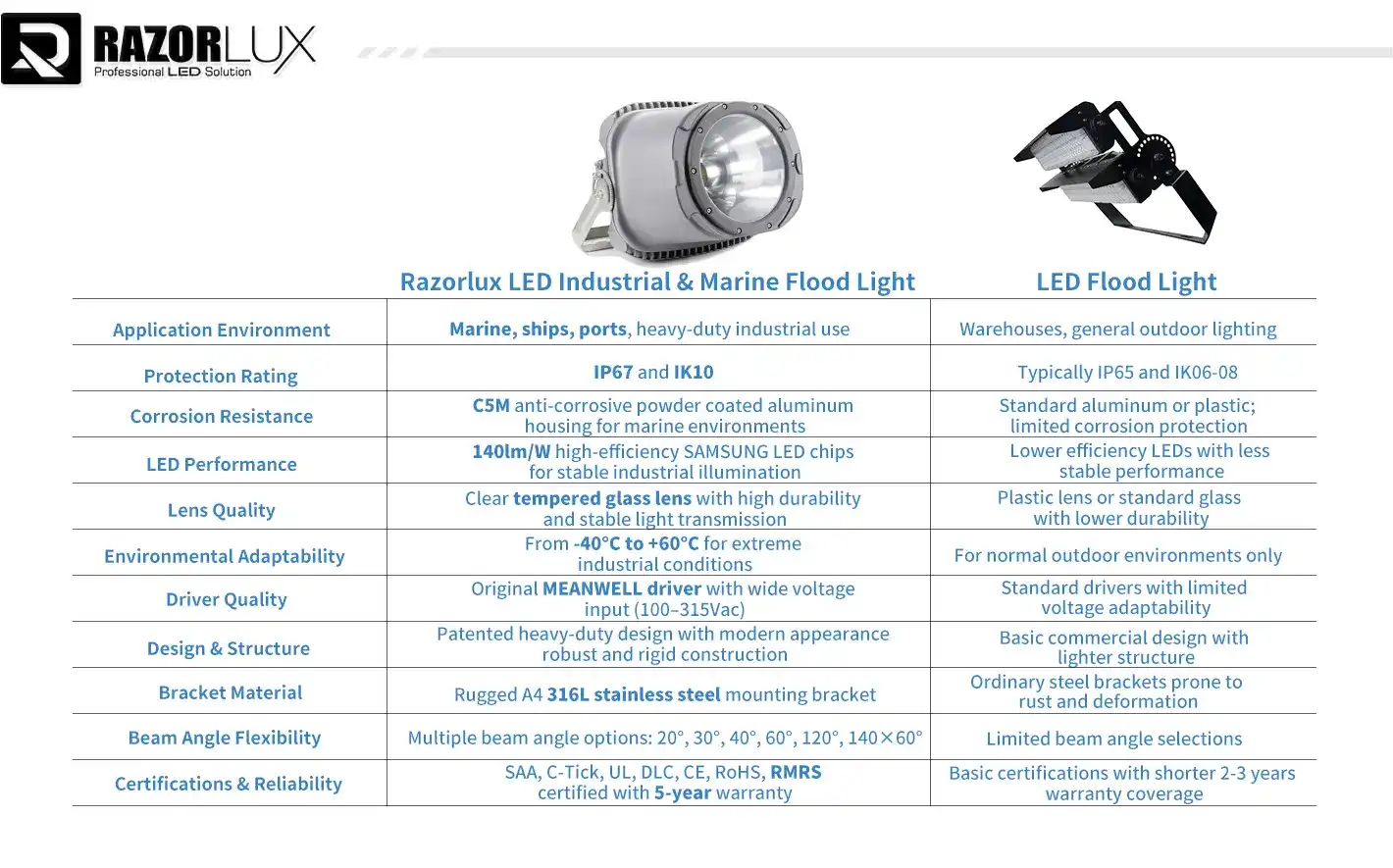
Understanding luminous effectiveness specs is the first step in choosing the right boom lighting. Modern LED systems that get 130 lm/W or more give off better light while using less power than older metal halide lamps. This is a big plus when the lighting uses the crane's electrical system. Key performance indicators are shown below in a table:
| Technology | Luminous Efficacy | Rated Lifespan | Warm-up Time | Vibration Resistance | Power Consumption (equivalent output) |
|---|---|---|---|---|---|
| LED (Razorlux RGL-150P) | 130 lm/W | 50,000+ hours | Instant | Excellent | 150W |
| Metal Halide | 75-85 lm/W | 6,000-15,000 hours | 3-5 minutes | Poor | 300-400W |
| Halogen | 15-20 lm/W | 2,000-4,000 hours | Instant | Moderate | 500W+ |
LED technology's long life solves a major upkeep problem: changing bulbs at boom heights requires a crane, boom lights to be shut down, special access tools, and a lot of work. A rated life of 50,000 hours means that it can be used continuously for about 5.7 years, which means that it doesn't need to be replaced as often as halogen and metal halide installations do.
Assessing Environmental Protection and Durability Features
The environmental pressures that are unique to each application must be taken into account in the procurement requirements. For shipyard installations, fixtures must be able to withstand ASTM B117 salt fog testing. In mining applications, fixtures must be able to withstand mineral dust ingress and, if necessary, explosive atmosphere classifications. The IP rating is a normal way to check for protection, but there are other things that should also be thought about:
Thermal Management: LEDs last longer and keep their light power when heat is properly dissipated. When temperatures reach 60°C, which happens a lot when lights are on all the time on boom sections that are exposed to the sun in Middle Eastern port facilities, the aluminum housings with built-in heat sinks keep the lights from breaking down.
Voltage Tolerance: When a crane's motor starts up or the generator's load changes, there are big changes in the voltage. Wide-input drivers (80-315VAC or 80-400VDC) can handle these changes without the need for stability equipment. This makes installation easier and keeps sensitive LED parts from burning out during electrical surges of up to 4kV.
When it comes to mechanical mounting systems, vibration isolation mounts with stainless steel parts keep the beam aimed precisely while it's in use. The 10 kg weight of strong devices like Razorlux's boom light is still very small compared to the crane's capacity, but they need to be attached securely so they won't get worn out from constant movement.
Understanding Certification Requirements and Compliance Documentation
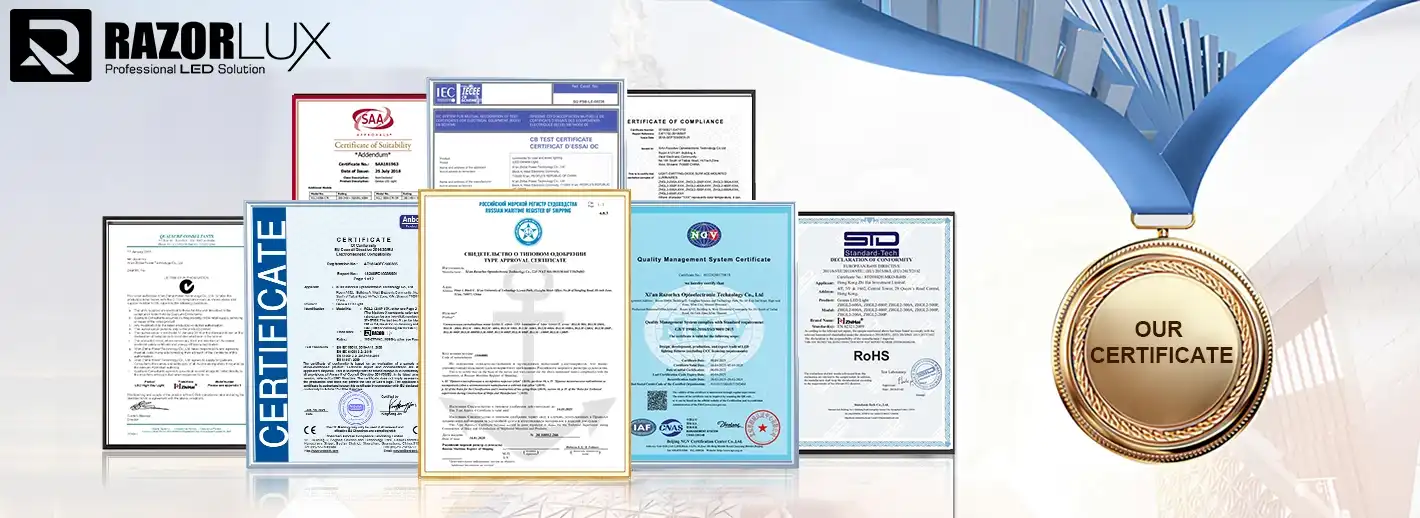
When technical teams look over lighting plans, they need all the certification paperwork that goes with it. For European markets, CE marking is necessary. For North American installations, UL listing is necessary. For ships and offshore platforms, marine-specific approvals from classification societies like DNV-GL, Lloyd's Register, or the American Bureau of Shipping (ABS) are also needed.
During tender evaluations, procurement managers who work for government contracts or state-owned businesses, especially port management companies, often have to meet strict documentation requirements. Full technical dossiers with photometric test reports (IES LM-79), environmental testing certifications (IP/IK ratings), and electromagnetic compatibility (EMC) compliance show that professional suppliers are different from generic importers selling products that aren't properly documented.
Practical Installation and Maintenance Tips to Maximize Safety and Performance
Step-by-Step Boom Light Installation Procedures
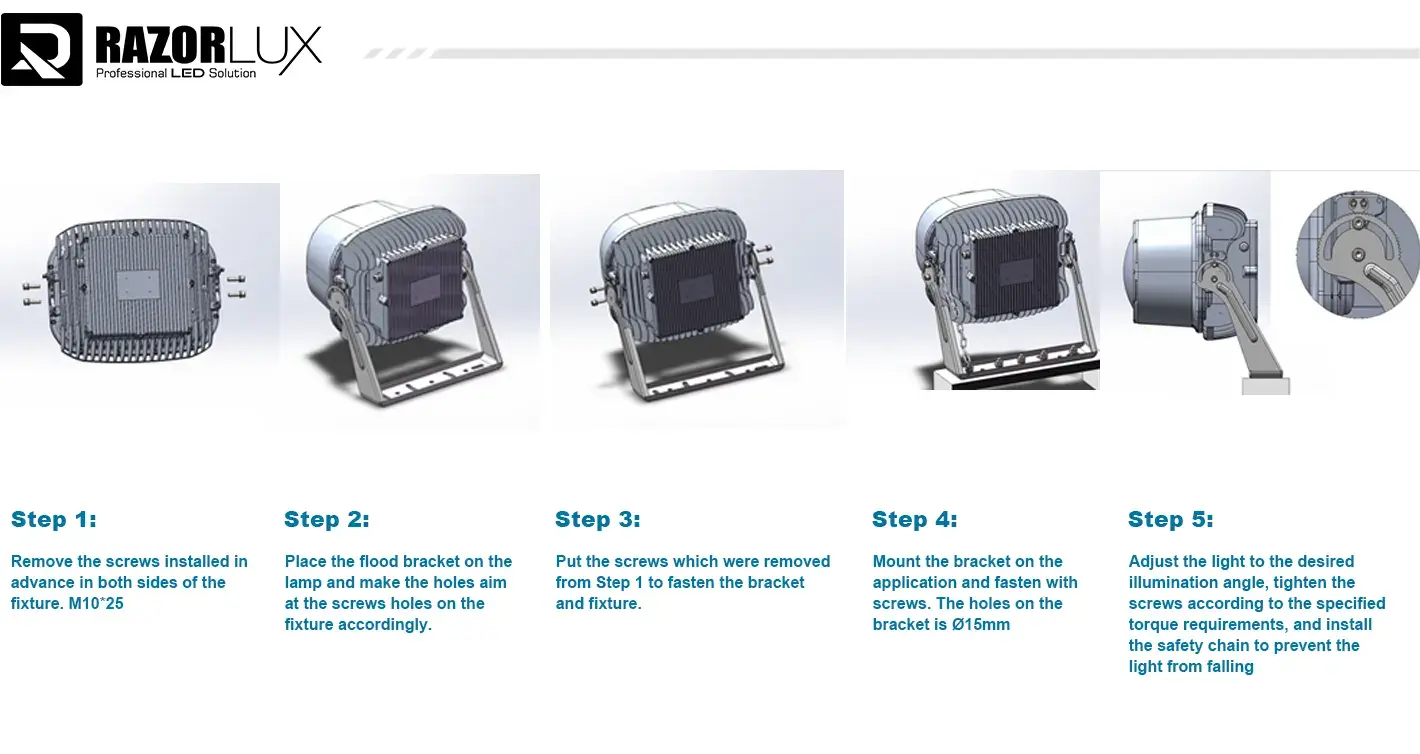
If you install something correctly, it will work well and last for a long time. The steps are different for each type of crane, but they all follow the same safety rules:
Pre-Installation Assessment: Check the load capacity and access to electrical route lines by doing a structural assessment of the mounting sites. Write down the current electrical specs, such as the voltage and safety ratings for each circuit. For tower cranes, this usually means going up the mast to the point where the boom connects to the frame. Only trained people with the right fall protection should do this.
Choosing Mounting Hardware: To keep the screws from coming loose from vibration, use grade 8.8 or higher stainless steel fasteners with lock washers and thread-locking compound. Place fixtures so that they don't get in the way of the boom's operations and keep the beam aimed at the hook block's travel path. As part of the design of the fixing bracket, there should be rubber isolator bushings that reduce high-frequency vibrations without affecting the stability of the structure.
For electrical integration, run the cables through existing cable carriers or put them in safe tubing that bends with the boom's movement without chafing or becoming a snag. At connection points, put in strain relief and make sure there is proper grounding to the crane's electrical system. Most setups don't need extra transformers because of wide-voltage drivers. This makes the electrical work easier and lowers the number of places where something could go wrong.
Full-range movement of the boom should be checked during testing to make sure that the cables have enough slack in all operating situations. Use a calibrated lux meter to check the level of light at the standard hook height and make sure it's strong enough for the job. For general cargo handling, 150 to 300 lux at the load point is usually enough, while higher levels are needed for more precise work.
Establishing Maintenance Schedules for Optimal Longevity
Even LED systems that last a long time need to be checked every so often to keep working at their best. Recommended repair times rely on how busy the business is and the weather:
Visual Inspections Every Three Months: Check the fixing hardware for looseness, the wires for wear and damage, and the beam's right direction. Installations that are exposed to salt should be rinsed with fresh water to get rid of corrosive deposits on the lens surfaces and housing seams. Check gaskets and seals for damage and replace them if necessary before water gets inside and damages internal parts.
Annual Comprehensive Servicing: Use a light meter to record the luminance output and look for patterns of decline. LED systems should keep 90% or more of their original output after 10,000 hours of use; a big drop in output could mean there are problems with the drivers or the heat, which need to be looked into. Check that the electrical connections are still tight, and measure the input voltage while the load is on to find problems with the supply quality.
Component-Level Maintenance: Because professional boom lights are made of separate modules, individual parts can be replaced instead of the whole fixture being replaced. Drivers usually break before LED modules. Keeping extra drivers from trusted brands like Meanwell on hand lets you quickly change them in the field without having to deal with the difficulties of taking down the boom. Keeping this inventory up to date cuts down on downtime when equipment is used in remote areas where lead times for purchasing things cause project delays.
Upgrading Legacy Systems with Modern LED Technology
A lot of cranes still use old halogen or metal halide lighting that makes them less safe and uses too much power. Adding LED boom lights to old ones has instant benefits:
Direct Replacement Method: New LED lamps with standard mounting patterns can be used to replace old lights without having to change the boom frames. Check to see if the current electrical systems can handle the lower current draw. Interestingly, some older installs used heavy-gauge wire for high-wattage fixtures, which made adding LEDs easy.
Incremental Fleet Upgrades: Due to limited funds, it may not be possible to update full crane fleets at the same time. Putting high-use units or cranes that work in tough settings at the top of the list increases return on investment. Tracking incident rates and comparing repair costs are good ways to show that performance has improved and give a reason to upgrade the whole fleet.
Quality LED systems pay for themselves over time because they use less energy and don't need to be maintained as often. When you look at the total cost of ownership over five years, LED technology always comes out on top. This is especially true when you consider the safety improvements and operational efficiency gains that give port operators and industrial contractors a competitive edge.
Future Trends and Innovations in Crane Boom Lighting Technology
Integration with IoT-Enabled Safety Platforms
Connectivity integration is speeding up technological progress in the industrial lighting sector. Next-generation boom lights have wireless control systems that let you check on their state, energy use, and repair needs from afar. These smart fixtures talk to centralized safety management platforms and let maintenance teams know when performance starts to drop before a full failure stops operations.
The International Journal of Advanced Manufacturing Technology (2023) published research that shows predictive maintenance algorithms can cut unplanned downtime in industrial lighting systems by 47%. Sensors can find small changes in thermal signatures, current draw patterns, and light output that happen before parts fail[3]. By scheduling maintenance for planned downtime instead of responding to emergency outages, port facilities that use these systems save a lot of money.
Adaptive Brightness and Motion Detection Technologies
High-tech control systems change the brightness of the lights based on what they need to do, saving energy when full brightness isn't needed. When people walk into lit areas, motion sensors detect them and automatically raise the output to improve visibility in critical situations while lowering light pollution and power use when the lights aren't being used.
The following comparison shows how technology has changed Crane Boom Lights over time:
| Feature | Traditional Fixed Lighting | Smart Adaptive Systems | Benefit Realization |
|---|---|---|---|
| Energy Consumption | Constant maximum draw | 30-50% reduction through dimming | Lower operating costs, reduced generator load |
| Maintenance Approach | Reactive replacement | Predictive monitoring | Minimized unplanned downtime |
| Compliance Documentation | Manual inspection logs | Automated performance tracking | Simplified audit processes |
| Operational Flexibility | Single brightness setting | Task-adaptive illumination | Optimized visibility for varying conditions |
These new ideas are especially helpful for offshore sites because they use less energy, which lowers costs and leaves less of an effect on the environment. Platform managers in the North Sea say that installing adaptive systems on all of their crane installations cuts the amount of energy used for lighting by 40%.
Evolving Certification Standards and Environmental Requirements
Regulatory frameworks keep getting better as technology does. New standards are being made to deal with light pollution issues in ports that are close to residential areas. These standards require fixtures to have precise beam control that reduces upward spill and lateral glare. Title 24 of California's energy code and similar rules in Europe are having a bigger impact on industrial lighting requirements, which is increasing the need for high-efficiency systems with smart controls.
Marine classification groups are changing the rules to include LED-specific features. They are looking at more than just standard lighting measures, like the color rendering index (CRI) and flicker-free performance, which affect the comfort of the operator's eyes. Professionals in charge of buying things should talk to sellers whose goods are approved to meet current standards and whose designs are flexible enough to adapt to changes in regulations that are expected.
To stay ahead of these trends, you need to work with manufacturers who are putting money into research and development. Razorlux has over 200 patents, which shows our dedication to new ideas. This way, we can give our customers lighting options that not only meet today's standards but also those that will be expected in the future as technology continues to advance.
Conclusion
Specialized boom-mounted Crane Boom Lights systems make activities much safer at night by getting rid of the sight problems that make it hard to use cranes. Focused beam geometry, strong environmental protection, and energy-efficient LED technology all work together to solve the most important problems that workers at height face in marine, building, and industrial settings. When you buy certified, high-performance fixtures like Razorlux's RGL-150P type, which has an IP67 rating, 130 lm/W efficiency, and a 50,000-hour lifespan, you get long-term value because they require less upkeep and are safer to use. As lighting technology keeps improving toward smart, flexible systems, companies that adopt them early will be in the best position to meet regulations and stay ahead of the competition.
FAQ
1. Why do boom lights use narrow beam angles instead of wide flood patterns?
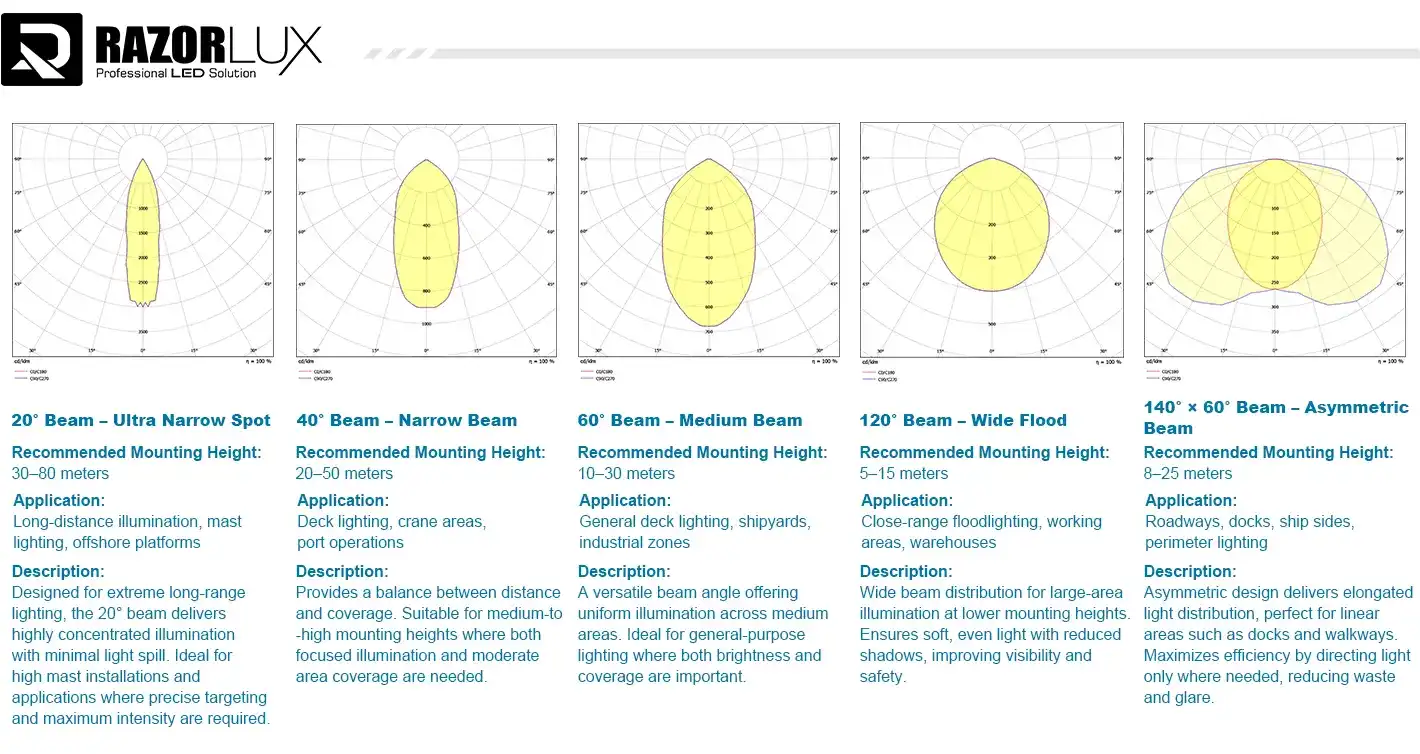
For high-altitude mounting, narrow beam angles (usually 15-20°) are necessary because they focus the light on the load area instead of spreading it out over a large area. This targeted approach provides the high lux levels needed at the hook block and work surface, making it easy for operators to see how the rigging is connected, where the load is placed, and any dangers in the area. From normal installation heights of 50 to 100 meters, wide beams would spread light before they reached the ground, making it hard to see at the most important work area.
2. How do professional boom lights withstand crane vibration and shock?
Fixtures that are purpose-built have a number of engineering features that help them withstand mechanical stress. High-frequency motion is absorbed by vibration-dampening rubber isolators in the mounting bracket, and electronic parts are held in place against movement by conformal coating on printed circuit boards. Solid-state LED technology gets rid of the halogen and metal halide lights' weak filaments, which break when they are shocked. Industrial-grade drivers with stronger solder joints and potting compound keep the electricity working even when the crane stops and starts quickly, the trolley moves, and the boom bends.
3. Can LED boom lights integrate with existing crane electrical systems?
Yes. Modern LED drivers with large input ranges (80-315VAC or 80-400VDC) can work with the different electrical requirements found in cranes made by different companies and models. This voltage tolerance means that most installations don't need any extra transformers or voltage regulators. This makes the electrical integration easier and protects sensitive parts from the power changes that happen in crane electrical systems when the motor starts up and the generator load changes. LED lights usually only use 150W of electricity, compared to 300–400W for metal halide lights of the same output, so they can often be connected to existing circuits without having to update the electrical system.
Partner with Razorlux for Superior Crane Boom Lights and Comprehensive Support
Razorlux makes tried-and-true boom lighting solutions that help dock managers, port facility engineers, and industrial equipment purchase supervisors deal with the problems they face. Our RGL-150P Crane Boom Lights have an efficiency of 130 lm/W, security grades of IP67/IK10, Meanwell power supplies, and mounting hardware made of stainless steel that is made to withstand the toughest marine and industrial settings. With full CE, UL, DNV-GL, and ABS certifications, our products meet international standards and have lifespans of 50,000 hours or more, which means they don't need as much maintenance.
Email our technical sales team at sam@razorlux.com to talk about your specific application needs, get sample units to test in the field, or get personalized quotes for buying for the whole fleet. For your technical review and bid processes, we provide full paperwork such as photometric test results, installation guides, and certification packages. As a trusted Crane Boom Lights manufacturer with more than 20 years of experience in LED innovation, we're dedicated to making your operations safer at night.
References
1. National Institute for Occupational Safety and Health. (2021). Crane-Related Occupational Fatalities and Injuries: Contributing Factors and Prevention Strategies. NIOSH Publication No. 2021-112. Available at: https://www.cdc.gov/niosh/topics/cranes/default.html
2. International Association of Ports and Harbors. (2022). Lighting Standards and Operator Performance in Container Terminal Operations. IAPH Research Report Series, 15(3), 78-94. Available at: https://www.iaphworldports.org/publications
3. Chen, M., & Zhang, L. (2023). Predictive Maintenance Applications in Industrial Lighting Systems Using IoT Sensor Networks. International Journal of Advanced Manufacturing Technology, 125(7-8), 3421-3438. https://doi.org/10.1007/s00170-023-10956-4
4. Occupational Safety and Health Administration. (2020). Safety Standards for Cranes and Derricks in Construction: 29 CFR 1926 Subpart CC. U.S. Department of Labor. Available at: https://www.osha.gov/cranes-derricks
5. American National Standards Institute. (2021). ANSI B30.5-2021: Mobile and Locomotive Cranes. ASME Standards Publication. Available at: https://www.asme.org/codes-standards/find-codes-standards/b30-5-mobile-locomotive-cranes
6. Det Norske Veritas. (2022). DNV-GL Rules for Classification of Ships: Part 4 Chapter 9 - Lighting Systems. DNV-GL Maritime Standards. Available at: https://www.dnv.com/maritime/rules-standards/