


_1750326878398.png)

What Are LED Overhead Crane Lights Used for in Factories?
Industrial crane lighting has evolved dramatically over the past decade. Led Overhead Crane Lights deliver targeted, durable illumination directly where material handling operations occur, mounted onto bridge cranes, gantry systems, and jib cranes throughout manufacturing facilities. These specialized fixtures address unique challenges in heavy-duty environments—constant vibration, extreme temperatures, dusty or humid conditions, and the need for reliable visibility during precision lifting tasks. Unlike static high-bay lights, crane-mounted LED systems move with the load, ensuring operators maintain clear sight lines while reducing shadows and blind spots that compromise safety and efficiency.
Why LED Lighting is the Optimal Choice for Overhead Cranes — A Comparative Analysis
Performance Metrics That Matter in Heavy Industry
When buying, workers look at crane lighting options; they need to consider more than just the initial purchase price. They also need to think about the total cost of ownership. Key performance indicators for different technologies are shown below in a table:
| Technology | Power Draw | Lifespan | Warm-up Time | Vibration Tolerance | 5-Year Energy Cost |
|---|---|---|---|---|---|
| Metal Halide | 250-300W | 10,000 hrs | 15 minutes | Poor | $13,140 |
| Fluorescent | 150-200W | 15,000 hrs | 2-3 minutes | Fair | $9,855 |
| LED (Razorlux RGL-120A) | 120W | 50,000 hrs | Instant | Excellent | $5,256 |
Based on running for 16 hours a day, the $0.12/kWh power rate
These numbers show that LED systems pay for themselves in 18 to 24 months, even though they cost more up front, because they save money on running costs. They also last three times longer than other technologies. The instant-on feature is especially useful in places where the crane is only used sometimes, because repeated warm-up processes waste energy and slow down operations.
Reliability Under Extreme Conditions
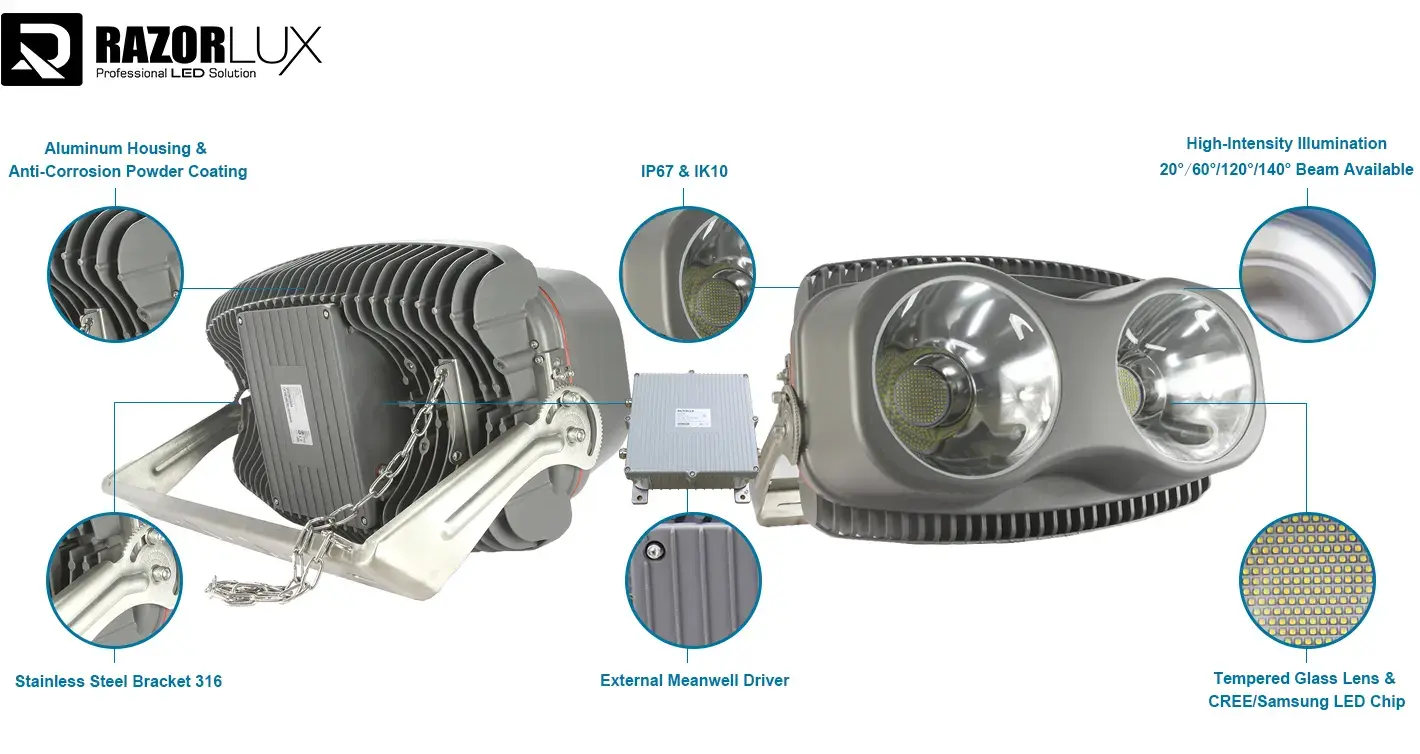
Heavy industrial settings are always testing how long tools will last. Razorlux designs are thoroughly checked to make sure they work. They are tested for vibrations according to IEC 60068-2-6 standards, for temperature changes from -40°C to +60°C, and for exposure to salt spray. The IK10 impact rating confirms resistance to 20 joules of kinetic energy, which is the same as dropping a 5 kg mass from 40 cm. This rating keeps things safe from dropping tools or loads by accident.
Many industrial sites have problems with voltage instability because heavy motor loads cause changes and short-lived spikes. Our wide-range input acceptance (AC 80-315V, DC 80-400V) and built-in surge safety make sure that our LED Overhead Crane Lights can keep working even when the power quality is bad, which would normally stop them from working. The high power factor (≥0.98) and low total harmonic distortion (10%) keep sensitive industrial controls from being harmed and make the electrical system work more efficiently.
Compliance and Certification for Global Markets
International projects have to follow a lot of different rules and regulations. The RGL-120A has a lot of different certifications, including CE and RoHS for European markets, UL and DLC for installations in North America, SAA and C-Tick for Australia and New Zealand, and CB scheme acceptance, which lets it be used in more than 50 countries (International Electrotechnical Commission, 2022). Optional DNV/GL and ABS approvals make marine applications better by allowing fixtures to be used in vessel-class installations where certification requirements are higher than normal industrial standards.
When purchasing managers have to go through reviews of products to make sure they meet specifications, they like getting full paperwork packages that include photometric test results, thermal management analyzes, ingress protection validations, and material composition statements. We keep technical data sheets in many languages up to date and offer CAD models that can be added to project plans. This makes it easier for engineering teams to get approvals.
Installation, Maintenance, and Longevity of LED Overhead Crane Lights
Proper Mounting Techniques Ensure Performance and Safety
Placing the lights in the right places is the first step to installing crane lighting that works. When choosing where to mount something, you need to think about the load paths, hoist rope clearance, and operator sight lines. You also don't want to get in the way of the crane controls or festoon systems. Our RGL-120A's small 360x358x187mm size makes it easy to install, even on older crane bridges that don't have a lot of room.
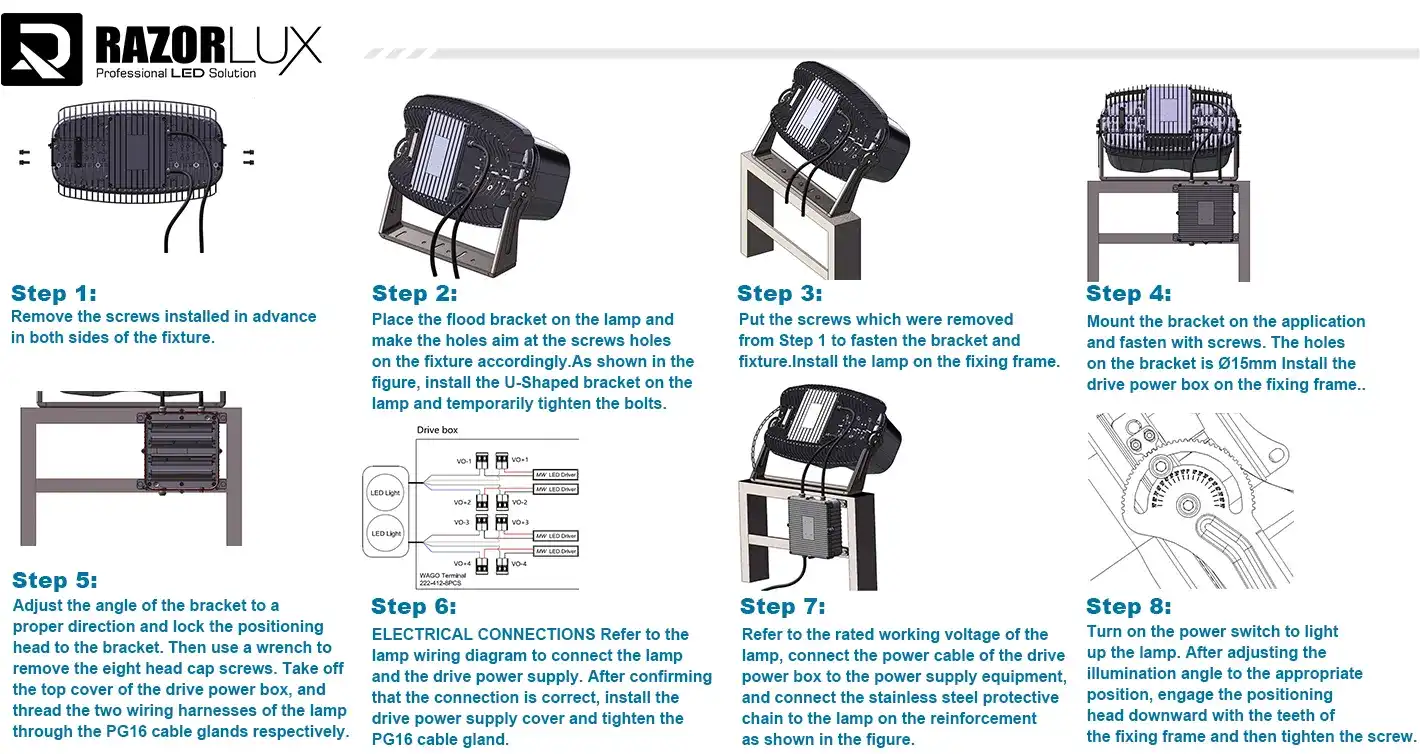
Stainless steel mounting clamps can hold different types of beams and have extra safety features like redundant fasteners and safety wires that keep the fixture from coming loose if the main mounts fail. The American Society of Mechanical Engineers (ASME) B30.2 safety standards for overhead crane devices are met by this two-retention method (2019). Electrical connections use industrial-grade connectors that are rated for environments with vibration, and strain relief keeps cable entry points from breaking from overuse.
Wiring Considerations and Power Integration
Festoon systems, conductor bars, or cable reels are common ways that cranes get power to the hoist and trolley drives. They send three-phase current to these drives. Separate wires should be used in lighting systems to keep fixtures from being affected by electrical noise from motors. Built-in electromagnetic compatibility filters in the Razorlux RGL-120A stop both incoming and outgoing interference. This stops LED flickering that is caused by variable frequency drives.
Adding specialized surge protection devices (SPDs) to the crane disconnect adds another layer of safety against power spikes. Our fixtures have internal surge suppression that can handle 6kV hits, and external SPDs protect the whole system, which is good for all the electrical parts. Layered protection strategies work especially well for places where lightning strikes often or where utility feeds aren't stable.
Maintenance Schedules and Inspection Protocols
For best performance, the table below shows the recommended service intervals:
| Interval | Inspection Items | Actions Required |
|---|---|---|
| Monthly | Visual inspection | Check for physical damage, loose mounting hardware, or discoloration |
| Quarterly | Connection integrity | Verify electrical connections remain tight; inspect for corrosion |
| Semi-annually | Cleaning | Remove accumulated dust/debris from lenses and heat sinks |
| Annually | Performance testing | Measure light output, verify beam patterns, test emergency circuits if equipped |
| 5 Years | Comprehensive evaluation | Assess continued fitness for service, plan replacement if output degrades below requirements |
Traditional lamps need to be replaced completely, but LED fixtures can be maintained at the component level. If a driver fails too soon, trained techs can change just the Mean Well power supply module, instead of throwing away the whole fixture. This serviceability lowers lifecycle costs and helps with sustainability efforts by cutting down on electronic waste.
Troubleshooting Common Issues
Industrial equipment needs to be checked out every once in a while. Flickering usually means that the connections between the wires are loose or that the voltage isn't being regulated properly. Check that the source voltage stays within the 80–315VAC range when the load is on it. Too much thermal stress can cause the output to dim. Make sure the temperature outside stays below 60°C and the heat sink fins don't get blocked. Upstream power problems are often the cause of complete failure. Check the fuses, disconnects, and upstream circuit safety before thinking the device is broken.
Our technical support team can help you with online diagnostics by emailing sam@razorlux.com. Often, problems can be fixed by following a set of steps for testing, so you don't have to call for service. When new parts are needed, we keep a global inventory of them so that we can ship them quickly and reduce the effects of downtime as much as possible.
How to Choose the Right LED Overhead Crane Lights for Your Factory
Assessing Illumination Requirements
Understanding what needs to be done is the first step in designing the right lights. At floor level, general material handling tasks need about 200 to 300 lux, while precise assembly or inspection tasks need about 500 to 750 lux (Illuminating Engineering Society, 2020). The number of fixtures and beam angles used are directly related to the mounting height. For example, setups that are higher need smaller beams to keep the intensity level right.
Use the formula Lux = (Lumens × Utilization Factor × Maintenance Factor) / Area to get a rough idea of the lux levels. A single RGL-120A (14,400 lumens) with a 0.5 utilization factor and a 0.8 maintenance factor gives off about 58 lux for a 100 m² crane that is mounted at a height of 10 m and has a 140° beam angle. Multiple LED overhead crane lights placed in a smart way cover an area by merging, so there are no dark spots where the crane works.
Environmental Considerations Drive Specification Decisions
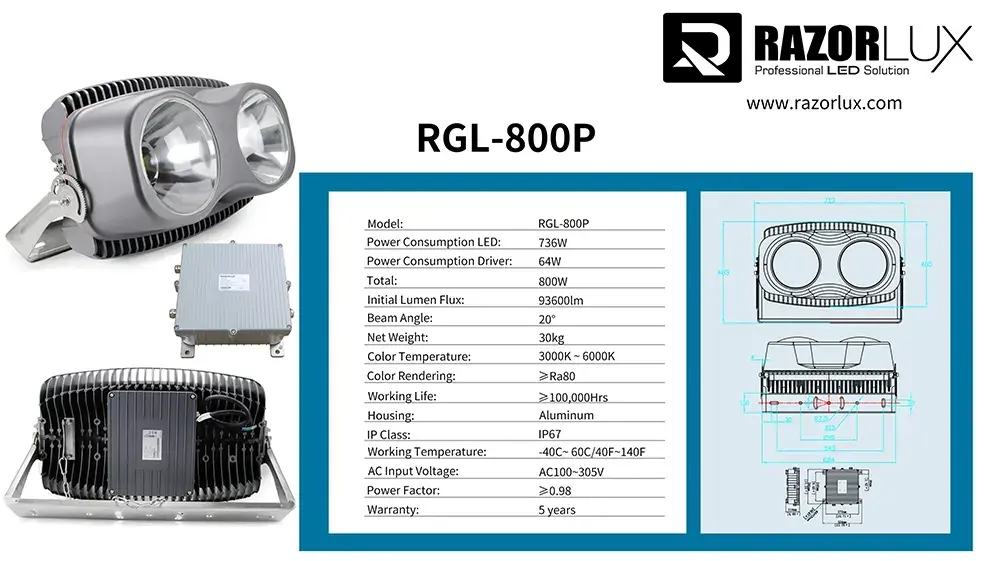
Conditions of operation that are harsh require the right amount of security. IP65 is enough for dry, dust-free areas, but IP67 airtight sealing is needed for places that use chemicals, are exposed to the elements, or are pressure-washed. The temperature extremes in your building affect the choice of components. Standard electronics can work in temperatures ranging from -20°C to +40°C, but our extended-range models can work in temperatures ranging from -40°C to +60°C, which is important for warehouses that aren't heated in cold areas or that are close to processes that produce heat.
Corrosive atmospheres speed up the breakdown of fixtures. Marine-grade powder coating and stainless steel hardware are good for facilities near the coast, chemical plants, and marine uses. We've sent RGL-120A units to ports in Singapore and to offshore sites in Norway, where the salty air would destroy fixtures in just a few months if they weren't properly protected. Galvanic corrosion can't happen in these harsh settings because the metal body has been treated on the outside in a special way.
Color Temperature Selection for Optimal Visibility
The RGL-120A's color temperature can be changed from 2700K to 6500K, so it can be tailored to different uses. Warm white (2700–3000K) lighting is good for general work areas and keeps your eyes from getting tired after long jobs. Neutral white (4000–4500K) gives off a neutral range of colors and is good for buildings that are used for different things. Cool white (5000–6500K) makes things look brighter and is great for tasks like quality control where color accuracy is important.
Many sites use 5000K as their standard throughout their business. This makes inventory easier and makes sure that all work areas look the same. But places that get a lot of natural light should have cooler temperatures that match the characteristics of daylight. On the other hand, rooms that are closed off and don't have windows usually feel better with warmer tones.
Evaluating Supplier Capabilities and Support
To find a trusted LED Crane Light manufacturer, you need to look at more than just the product specs. Razorlux has been very good at industrial lighting applications since 1998. This is shown by our over 200 patents that cover things like LED Packaging, thermal management, and structural design. This new idea directly leads to better products—our unique heat sink designs keep junction temps 15-20°C lower than competing fixtures, which directly increases their useful life.
For project-based procurement, supply chain reliability is very important. Our well-established manufacturing infrastructure keeps our inventory levels high so that we can quickly turn around even large orders. Sample units are sent out within three to five business days so that they can be tested. Depending on the level of customization needed, production orders are usually filled within two to three weeks. Shipping options that are flexible, such as air freight, ocean cargo, and rail transport to European destinations, can work with a range of budgets and time frames.
Customization is what sets manufacturers who work with demanding industrial markets apart from suppliers who only sell products from catalogs. For projects with specific needs, we often change the mounting arrangements, add plugs that the customer specifies, change the beam patterns, and make custom color temperatures. OEM relationships let wholesalers and integrators build complete crane systems with their own labels.
Future Trends and Innovations in LED Overhead Crane Lighting
Smart Controls Transform Industrial Lighting Management
When lighting is connected, it changes from an inactive infrastructure to an intelligent system that gives operating insights. Modern crane lights have wireless settings that let you dim, schedule, and keep an eye on lights across whole sites from afar. Building management systems sync lighting plans with production schedules. Fixtures turn down automatically when no one is working, and they turn back on when the cranes start moving. This saves energy without compromising safety.
Individual part tracking finds performance loss before it happens completely. This allows predictive maintenance to plan replacements for planned breaks instead of having to deal with emergencies. Networked systems keep track of how much energy is used, when it's used, and if there are any problems. This gives facility managers useful information for ongoing efforts to make things better.
Sensor Integration Enhances Safety and Efficiency
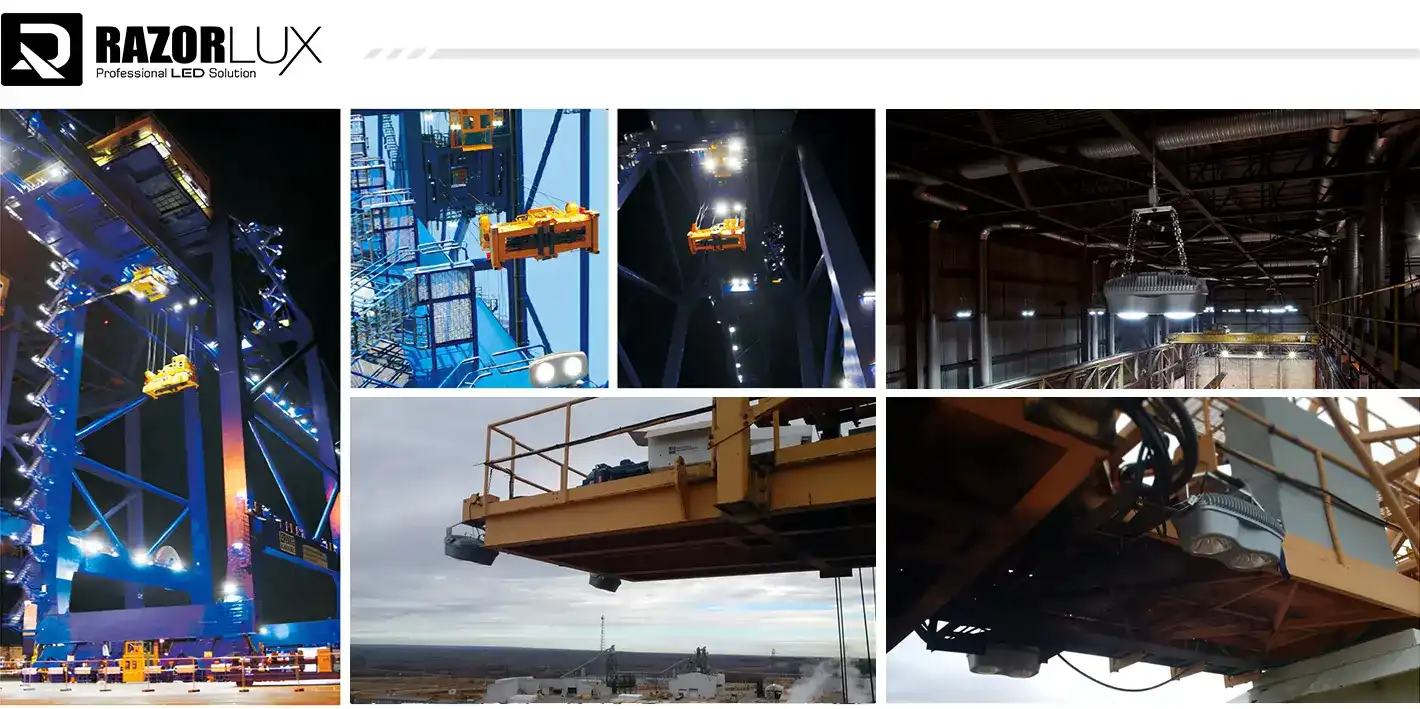
Motion sensors that turn on lights only when cranes move within certain areas save even more energy in places where many cranes cover a lot of ground. Presence detection stops lights from turning on when cranes are not in use, and immediate activation when movement is detected makes sure that operators always have enough light.
Some more advanced setups have collision warning systems that cast colored lines onto the floor around loads that are suspended. Blue or red spotlights move with the crane to create moving safety zones that let people below know about potential dangers. The RGL-120A is mainly for primary lighting, but when it is combined with extra safety projection systems, it offers complete solutions for vision and warning.
Sustainable Materials and Circular Economy Principles
Environmental awareness is becoming more and more important in purchasing choices. LED technology naturally supports sustainability because it uses less energy and lasts longer, but it is still the task of manufacturers to reduce the environmental impact of their products throughout their entire lifecycles. We choose materials that can be recycled whenever possible, get rid of dangerous materials that go beyond RoHS standards, and plan for disassembly so that parts can be recovered at the end of their useful life.
Carbon impact concerns go beyond how a product works and include how it is made and how it is shipped. Our factories use energy-saving systems to cut down on pollution, and regional distribution networks keep transportation impacts to a minimum. Giving customers detailed environmental product declarations (EPD) helps them accurately measure Scope 3 emissions when they are trying to reach carbon neutrality goals.
Emerging Applications in Automated Facilities
Industry 4.0 projects that use self-driving trucks and robots to move materials create new lighting needs. Machine vision systems that guide automated equipment need light that is consistent, doesn't flicker, and has certain spectral properties. High-frequency LED drivers (> 20 kHz) get rid of the stroboscopic effects that make cameras with standard frame rates confused. This makes sure that objects can be reliably identified and placed.
Facilities that use augmented reality systems for training and maintenance can benefit from lights that can be changed to make AR displays easier to see. In the future, crane lighting might use LiFi technology to send positioning data, load information, or safety alerts to workers wearing sensors that are suitable. This would create communication networks that use the lighting infrastructure that is already there.
Conclusion
LED Overhead Crane Lights for industrial cranes is an important investment for keeping the building safe, running efficiently, and keeping costs low over time. LED technology has moved past the early stages of adoption and is now a mature answer that offers clear benefits over older lighting systems. The Razorlux RGL-120A is a great example of this change because it has a strong build, smart engineering, and all the necessary approvals to meet the strict needs of heavy-industry markets around the world. When purchasing managers, facility engineers, and maintenance workers choose fixtures that have been tested thoroughly, have a lot of experience in the field, and have quick technical support, they can do so with confidence. As factories move toward automatic, connected systems, the lighting infrastructure needs to change too. By choosing partners who have a history of innovation and a long-term commitment to the industrial sector, lighting investments will stay useful and effective for a longer time.
FAQ
1. How much energy can facilities save by switching to LED crane lights?
52% less energy is used when 250W metal halide lights are swapped out for 120W LED versions. At $0.12/kWh rates, a building that uses 15 crane lights for 4,000 hours a year saves about 7,800 kWh, which is about $936 a year in energy costs. Over five years, the higher initial investment in LEDs is paid for by the savings in energy costs alone. Not having to replace the bulbs also gives extra returns. Even faster payback times are seen in facilities that use more power or are open longer.
2. Can these fixtures withstand outdoor marine environments?
The RGL-120A can work reliably in coastal and ocean settings thanks to its IP67 rating and marine-grade construction. We've successfully put units to work on Norwegian oil rigs, Singaporean port hubs, and Australian shipyards, all places where normal equipment would fail because of the salt spray, humidity, and extreme temperatures. Marine approvals (DNV/GL, ABS) are available that make fixtures suitable for placement on ships that must meet strict maritime standards. Regular care, such as rinsing with fresh water every so often, improves the life of equipment in even the harshest coastal environments.
3. What maintenance intervals do LED crane lights require?
When compared to older technologies, LED fixtures require a lot less maintenance. Metal halides need to be replaced every 12 to 18 months, but LED systems can work for 50,000 hours, which is about five years of nonstop use, before their power drops to 70% of what it was at first. Visual inspections every three months, cleaning every six months to get rid of built-up dirt and grime, and full evaluations every year are all part of the recommended maintenance. This lessens the need for repair workers, which saves money and keeps output from being interrupted by work like configuring cameras with standard frame rates. Overhead Crane Lights Supplier for Your Industrial Lighting Needs
Razorlux makes LED Overhead Crane Lights solutions that are made to work in the harshest environments in the world. To meet the needs of purchasing managers in the manufacturing, maritime, and heavy industrial sectors, our RGL-120A crane lights are reliable, use very little energy, and have been certified all over the world. We help with projects from the beginning, when they are just ideas, all the way through to when they are running for a long time. We have over 200 patents, 25 years of specialized experience, and production excellence certified to ISO 9001 standards.
Our team can give you expert advice and help you choose the best options for your needs, whether you're setting up a new steel mill in Eastern Europe, updating the infrastructure of an old shipyard, or giving automated stores the latest lighting technology. Contact sam@razorlux.com to get detailed technical documentation, set up a sample evaluation, or talk about volume pricing for deployments across multiple sites. We ship all over the world with a variety of logistics choices, keep in touch with you quickly even when you're in a different time zone, and back up every installation with a full five-year guarantee.
References
1. American Society of Mechanical Engineers. (2019). ASME B30.2 Safety Standard for Overhead and Gantry Cranes. New York: ASME International. Retrieved from https://www.asme.org/codes-standards/find-codes-standards/b30-2-overhead-gantry-cranes-top-running-bridge-single-multiple-girder-top-running-trolley-hoist
2. Illuminating Engineering Society. (2020). IES Lighting Handbook, 10th Edition: Reference and Application. New York: IES. Retrieved from https://www.ies.org/publications/ies-lighting-handbook-10th-edition/
3. International Electrotechnical Commission. (2022). IEC 60598 Luminaires Testing and Certification Requirements. Geneva: IEC. Retrieved from https://www.iec.ch/homepage
4. Lighting Research Center. (2021). LED Systems Reliability in Industrial Applications. Troy, NY: Rensselaer Polytechnic Institute. Retrieved from https://www.lrc.rpi.edu/programs/solidstate/
5. Occupational Safety and Health Administration. (2020). OSHA Technical Manual Section III: Chapter 4 – Industrial Lighting. Washington, DC: U.S. Department of Labor. Retrieved from https://www.osha.gov/otm/section-3-health-hazards/chapter-4
6. U.S. Department of Energy. (2021). Solid-State Lighting Program: Life-Cycle Assessment of Energy and Environmental Impacts. Washington, DC: DOE Office of Energy Efficiency & Renewable Energy. Retrieved from https://www.energy.gov/eere/ssl/solid-state-lighting