


_1750326878398.png)

How to Choose Cost-Effective LED Sports Lighting Fixtures?
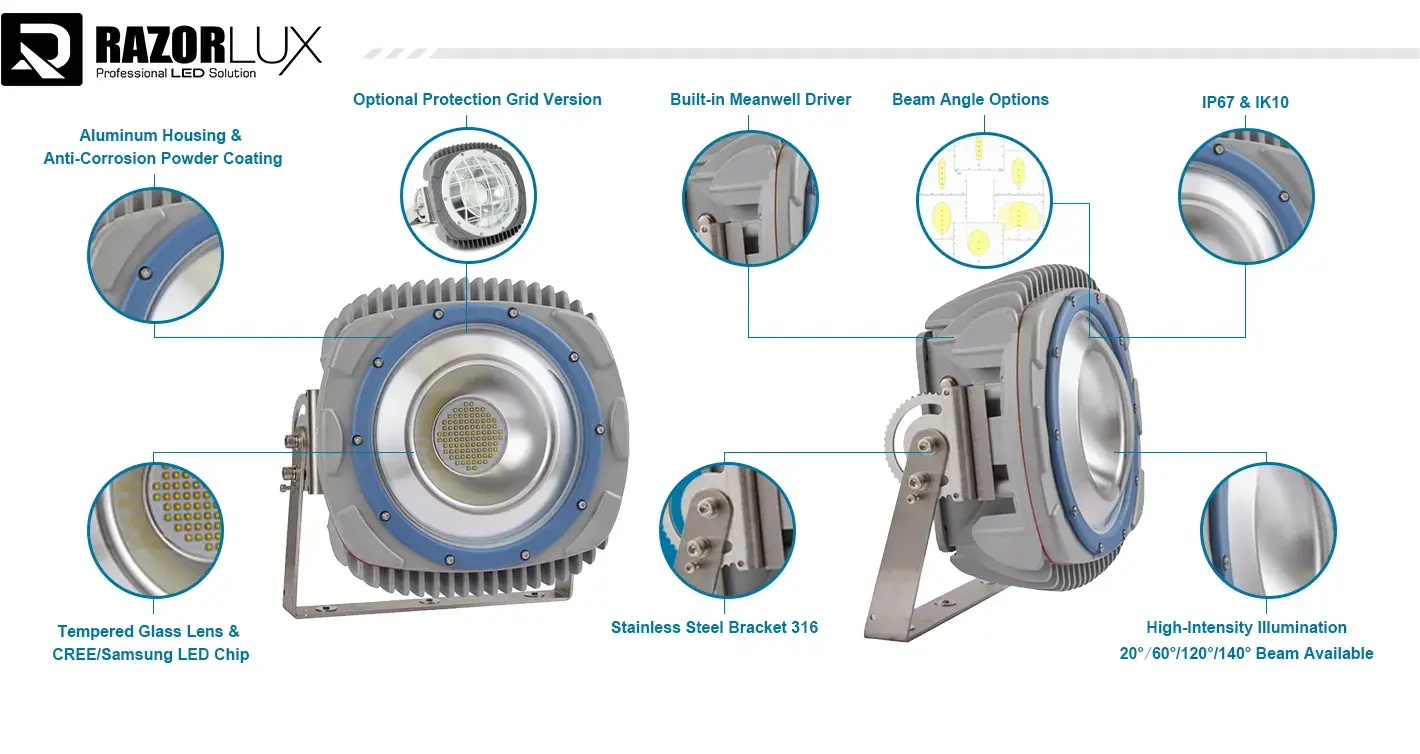
When choosing cost-effective Led Sports Lighting Fixtures, you need to weigh the initial investment against the savings you will see in the long run. Compared to older systems, current LED solutions provide better light output (usually 130 lm/W or more) while using a lot less energy and needing much less upkeep. To make the right choice, you need to look at technical factors like IP ratings, beam angles, and driver quality, as well as standards like CE, RoHS, and UL that make sure the product is safe and compliant. Understanding these factors will directly lead to lower total cost of ownership and better performance across a wide range of sporting uses for procurement managers in charge of stadiums, arenas, or multipurpose sports centers.
Understanding the Need for Cost-Effective LED Sports Lighting Fixtures
Sports centers all over the world are still having trouble with old lighting systems that cost a lot of money. Traditional metal halide and high-pressure sodium lamps use too much energy, need bulbs to be replaced often, and take too long to warm up—often 15 to 20 minutes—which can mess up event plans and emergency plans. These inefficiencies raise operating costs and lower the level of play and the experience for fans.
The Hidden Costs of Legacy Lighting Systems
There are hidden costs that go far beyond the initial buying price that come with older lighting systems. Metal halide lights break down quickly. In their first year of use, they can lose up to 30% of their lumen power. This loss of lumens causes building managers to over-design systems and put in more fixtures than are ideally needed just to keep the amounts of light acceptable over time. Labor costs a lot when lamps need to be replaced often, especially in places where poles are higher than 20 meters, where special lifts and safety rules add a lot of cost.
Addressing Performance Requirements in Modern Sports
Modern sports need accurate lighting that is hard to get with older technologies. For correct color reproduction, high-definition streaming needs lighting that doesn't flicker and has a Color Rendering Index (CRI) above 80. For the slow-motion repeat to work, the strobe effect that comes with discharge lights must be removed. Solid-state design in LED systems makes them meet these needs. They provide stable output without flickering and work with advanced control systems that let you dim, zone, and manage them from afar. These features make both watching sports and watching them on TV better, so they add real value beyond just saving money.
Key Criteria to Evaluate When Selecting LED Sports Lighting Fixtures
To choose the best LED sports lighting fixtures, you need to carefully LED sports lighting fixtures look at a lot of different technical and financial factors. Professionals in procurement have to look at performance specs, durability features, energy economy measures, and lifetime costs to find fixtures that offer the best value for their particular use. The following factors give this assessment process a useful structure.
Luminous Performance and Uniformity Standards
If you want your sports lighting to work, it needs to provide the right amount of light evenly across the playing area. Different sports have different lighting needs. For example, professional football games that are shown on TV usually need 500 to 1,500 lux, while leisure areas may be fine with 200 to 300 lux. In addition to normal illumination, uniformity rates are very important. At least a 0.6 regularity ratio (minimum to average illuminance) keeps dark spots from appearing, that make it hard to play and puts people in danger. To meet these standards, high-quality LED lamps have precise optics—often with asymmetric beam patterns—that spread light equally while limiting spill beyond the playing area.
Energy Efficiency and Power Quality Metrics
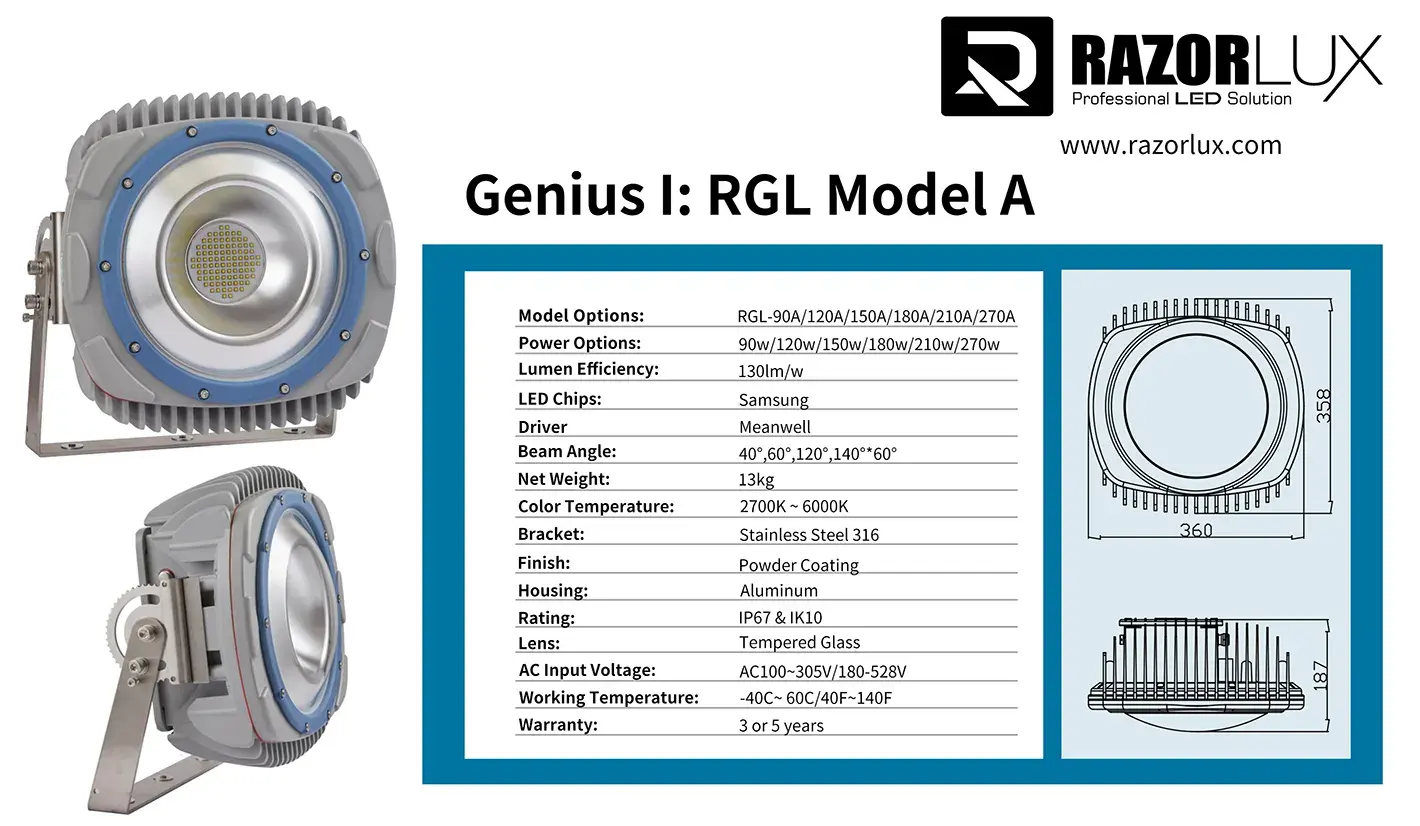
The energy economy has a direct effect on how much it costs to run a device over its lifetime. The main parameter is luminance effectiveness, which is given in lumens per watt (lm/W). High-performance lights can now produce 130 to 170 lm/W, which is a lot more than the 80 to 100 lm/W that metal halide systems usually produce. Another important thing to think about is the power factor. Light bulbs with power factors above 0.95 use electricity more efficiently and have lower reactive power charges. Total Harmonic Distortion (THD) should stay below 10% so that it doesn't mess up other electrical systems and to meet utility standards. The Razorlux RGL-120A model meets these standards with its 130 lm/W effectiveness, >0.98 power factor, and <10% THD, which saves energy in difficult situations.
Certification Compliance and Quality Assurance
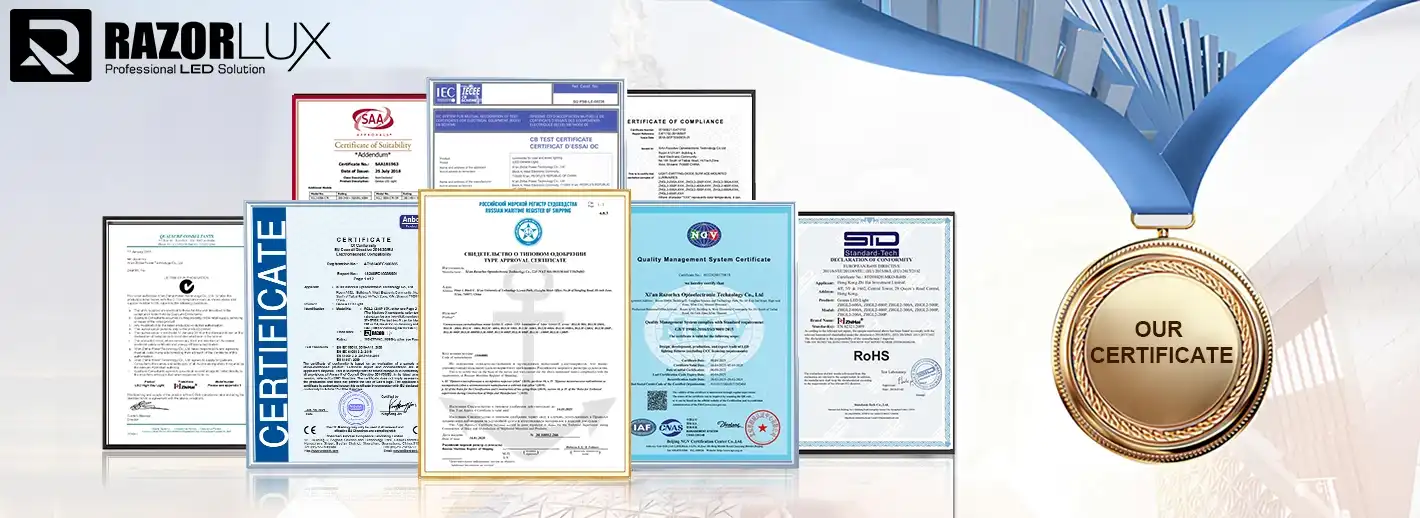
International approvals are a neutral way to make sure that safety, efficiency, and environmental standards are being met. If something has a CE mark on it, it means that it meets European standards for health, safety, and the environment. If it has a UL or ETL listing, it means that it meets North American electricity safety standards. RoHS approval proves that dangerous chemicals are limited, which is important for companies that want to be environmentally friendly and follow the rules. For marine and industrial uses, you might need extra certificates from classification groups like DNV/GL or ABS. These approvals lower the risk of buying things by making sure they meet strict third-party testing standards instead of just believing what the maker says.
Comparing Leading LED Sports Lighting Fixture Types and Brands
There are many types of LED sports lighting fixtures on the market, and each one is best for a certain use or hanging arrangement. Knowledge of the pros and cons of various styles helps procurement teams properly match goods to the needs of venues. Both the name of the brand and the quality of the parts have a big effect on long-term happiness and the total cost of ownership.
Floodlight Fixtures for Large-Area Illumination
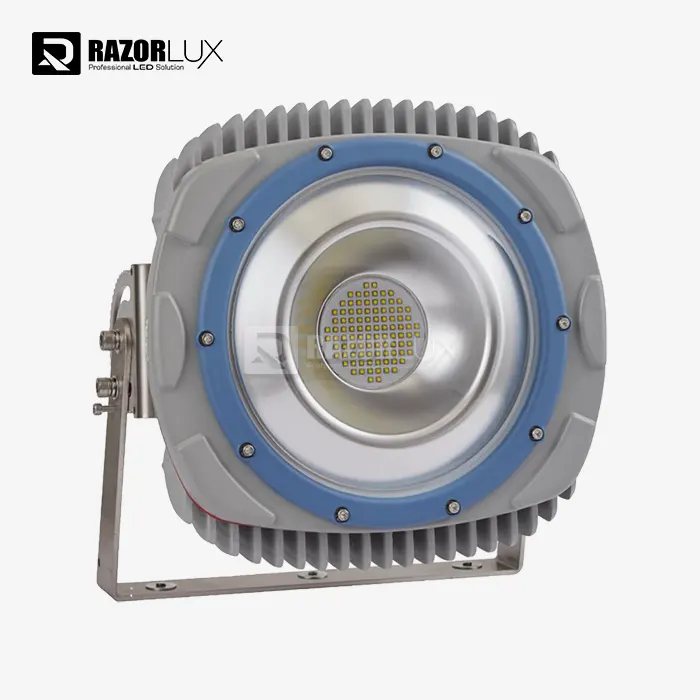
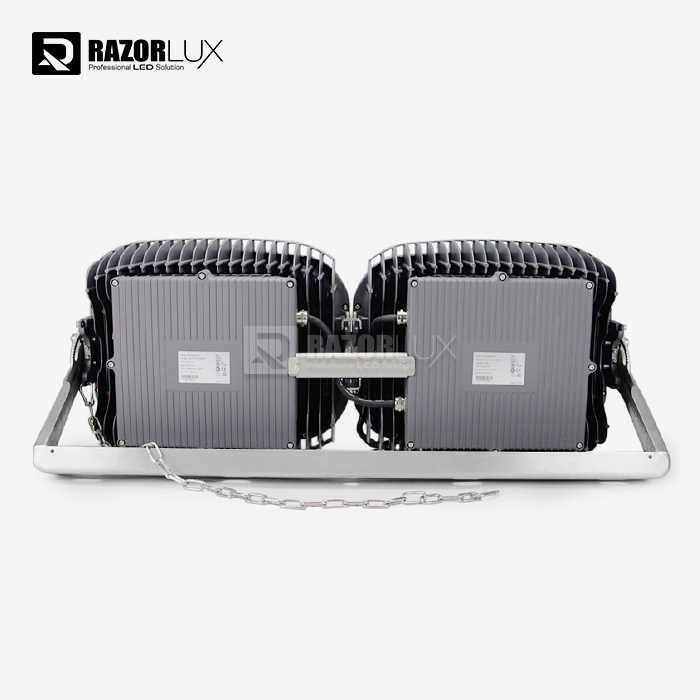
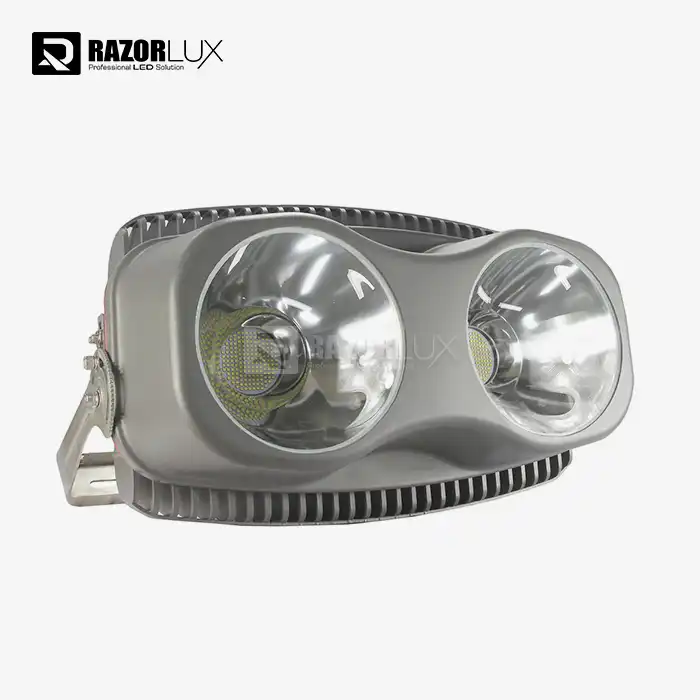
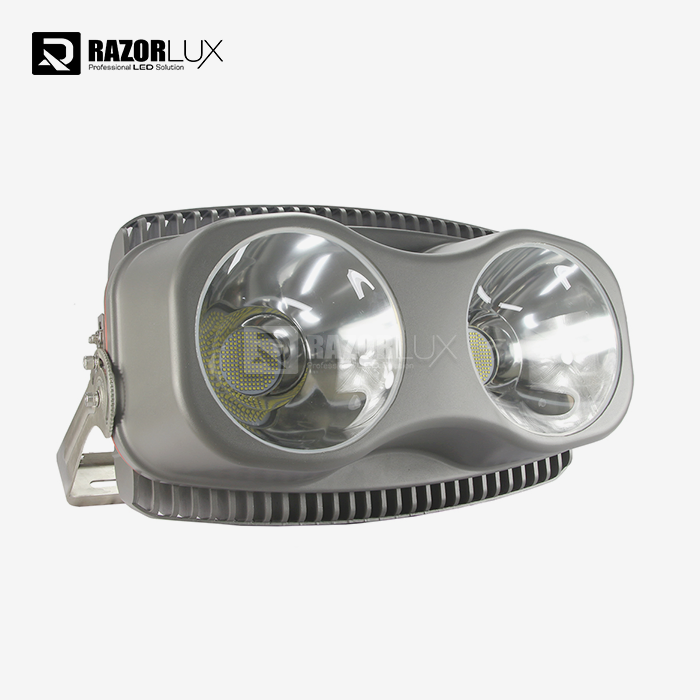
Floodlights are the workhorses of sports lighting because they can send strong beams of light over long distances with LED sports lighting fixtures. Most of the time, these lights are mounted on tall poles or buildings so they can light up sports areas, tracks, and outdoor courts from above. High-power LED arrays (often 500W to 1,500W total consumption) and precise mirrors or lens systems that shape beam patterns to match field layout are used in modern LED floodlights. The Razorlux RGL-1000A is the best in this class. It has a 1,000W power rating, 130,000 lumens of output, and four different beam directions (40°, 60°, 120°, and 140°) that can be changed to fit different sports and mounting heights. Because of this, a single fastener design can be used for more than one purpose, which makes managing supplies easier and makes buying things simpler.
Performance Comparison with Legacy Technologies
By directly comparing the two, it's easy to see how LED lighting is better for business. For a normal outdoor sports field, the table below shows key success metrics for different lighting technologies:
| Technology | Fixture Wattage | System Lumens | Efficacy (lm/W) | Lifespan (Hours) | Warm-Up Time | Annual Energy Cost |
|---|---|---|---|---|---|---|
| Metal Halide | 1,000W | 85,000 lm | 85 lm/W | 12,000 | 15-20 min | $1,314 |
| HPS | 1,000W | 95,000 lm | 95 lm/W | 24,000 | 10-15 min | $1,314 |
| LED (Standard) | 600W | 90,000 lm | 150 lm/W | 50,000 | Instant | $788 |
| LED (Premium) | 500W | 85,000 lm | 170 lm/W | 60,000 | Instant | $657 |
*Based on an energy rate of $0.15/kWh and 3,000 hours of use per year
With these numbers, you can see that LED systems give off the same amount of light or more while using 40% to 60% less energy. Getting rid of delays for warm-up and maintenance gives you extra operational benefits that don't show up in simple energy estimates but make building management a lot more efficient.
Tailoring Your Procurement Strategy for Bulk Purchases and Custom Orders
Effective procurement includes more than just choosing the right LED sports lighting fixtures. It also includes smart buying methods that get the most value out of buying in bulk, customizing items, and managing relationships with suppliers. Structured buying strategies that balance standardization with freedom are very helpful for people who run sports facilities and hire contractors.
Segmenting Requirements by Venue Characteristics
Different types of venues have different lighting needs that affect the choices that are made about what to buy. For stadium main fields, you need high-intensity lights with narrow to medium beam angles (15° to 60°) that are placed at high levels and stress long-throw capability and precise beam control. Cost-effectiveness and ease of upkeep are important to practice sites and community sports complexes. They will often settle for slightly lower performance standards in exchange for less investment. To protect viewers' watching pleasure, indoor venues need fixtures with bigger beam distributions and better glare control. By dividing requirements into these groups, buying teams can make more specific requirements that keep costs down by not including features that aren't needed in certain situations.
Evaluating Total Cost of Ownership Beyond Purchase Price
The initial buying price is only one part of the total cost of owning. The cost of replacing lamps, the amount of energy used, and the dependability of the system are all factors that affect lifetime economics. For a full review, you should figure out the net present value over the projected life of the system, which for sports lighting is usually 10 to 15 years. This study usually shows that high-end lights that cost more up front are worth it because they use less energy and don't need to be fixed as often. For instance, a device that costs 20% more at first but works 10% better and needs twice as much upkeep will usually pay for itself in three years while giving better performance for the whole time it's used. Procurement teams should ask potential providers for thorough TCO models that include estimates of energy use, repair schedules, and warranty terms that make it possible to compare the models objectively.
Case Studies & Practical Tips for Maximizing Cost-Effectiveness
Real-world implementation examples provide valuable LED sports lighting fixtures insights into LED sports lighting performance and procurement best practices. These cases illustrate both the benefits achievable through thoughtful specification and the pitfalls that undermine cost-effectiveness when key considerations are overlooked.
Stadium Lighting Upgrade Delivers 65% Energy Reduction
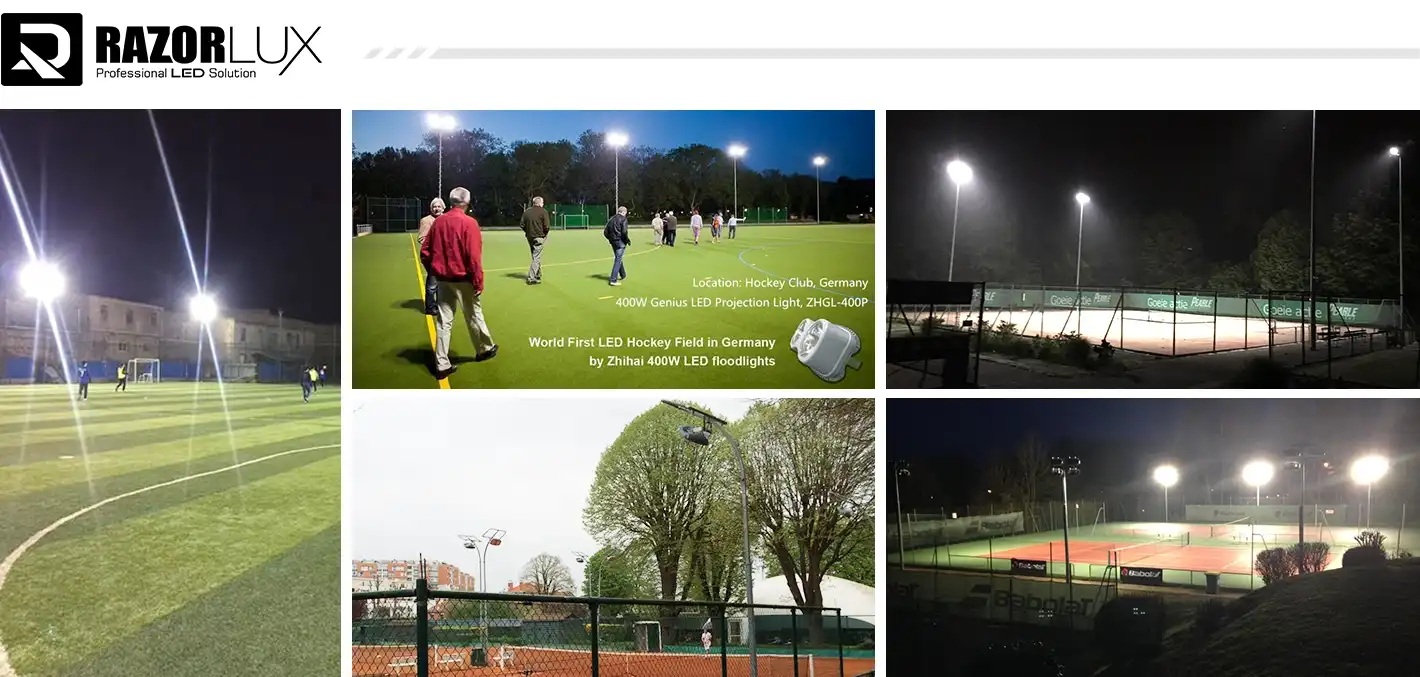
A football field in Northern Europe had to deal with rising energy costs and frequent repair problems because its metal halide system was getting old. Every year, the building was used for about 1,200 hours of games, practices, and community events. The old method used 96 kW of power all the time, which cost more than €17,000 a year at the local utility rates. Because of problems with reliability, three emergency lamps had to be replaced every year. Each one needed special lift tools and contractor work that cost a total of €2,800. The building management team chose LED replacement fixtures that use less energy, can turn on instantly, and need less upkeep. After looking at different options, they chose a system that gave them 150 lm/W of output, IP67 protection, and Mean Well drivers with five-year guarantees. Power use dropped by 65% to 34 kW thanks to the LED system, which also increased consistency from 0.54 to 0.71 and decreased field illuminance by 12%. The price of energy dropped to €6,100 a year, which saved €10,900 a year. The LED system didn't need any service for the first three years it was running, so maintenance costs pretty much went away. The project earned back its €52,000 cost in 4.2 years, with an internal rate of return of more than 18% over the system's projected 15-year life.
Common Pitfalls That Undermine Cost-Effectiveness
Even when buying processes are done with good intentions, they can fall into mistakes that make it harder to get value. The most common mistake is focusing too much on the original price and not paying enough attention to energy economy and maintenance costs. Over the course of its useful life, a fastener that costs 15% less at first but works 20% less well will cost a lot more. Mismatching beam angles to mounting geometry is another common mistake that leads to uneven lighting that needs more lights to fix, which raises both the capital and running costs. If you don't pay enough attention to the quality of the drivers and the terms of the guarantee, you run the risk of reliability issues that lead to unexpected repair costs in the first few years. Instead of automatically choosing the cheapest option that works properly, procurement teams should make detailed evaluation scorecards that give each factor the right amount of weight.
Practical Procurement Checklist for LED Sports Lighting
Before putting together final specs and asking for bids, buying teams should make sure of the following:
- Technical Requirements: Make sure that the mounting heights, illuminance levels, and regularity ratios meet the standards for the sports and competition levels that the venue will hold. Use photometric models instead of guesswork to make sure that the suggested beam angles and fixture numbers will help you reach your goals.
- Environmental Specifications: Choose IP and IK grades that are right for the construction site, taking into account weather, temperature changes, and the chance of physical damage. Include standards for corrosion protection if the building will be near the coast or an industrial area with a corrosive environment.
- Component Quality: You need to name the companies that make the LED chips and drivers, and it's best to choose well-known brands that can provide independent reliability data. Instead of taking broad claims, set base goals for efficacy, power factor, and THD.
- Certification Needs: List all the licenses that are needed for the installation site and the purpose for which it will be used. Check that suppliers can actually give you full test records and declarations of conformity instead of just showing the certifications they say they have.
- Warranty and Support: Set separate minimum insurance terms for LED modules, drivers, and housings, since these parts can fail in different ways. Make sure you understand the terms of the guarantee, such as whether work and shipping costs are covered. Check to see if technical help is available and what the reaction time promises are.
- Total Cost Modeling: Ask for full TCO analyses that include how much energy is used, how often upkeep needs to be done, and how often planned replacements are needed. To find the true lifecycle value, compare these estimates across different options.
Conclusion
To find the most cost-effective LED sports lighting fixtures, you have to weigh the technical performance, environmental stability, energy efficiency, and overall costs over the life of the device. Modern LED technology is much better than older systems. It cuts energy use by 60% to 80% and makes upkeep less frequent, every year instead of every few months. To do a good job of procuring things, you need to use organized methods that look at the total cost of ownership instead of just the purchase price to check things like luminous effectiveness, IP and IK ratings, component quality, and certification compliance. There is a consistent payback time of three to five years in the real world for better lighting that improves both sports success and the fan experience. By using the evaluation models and useful tips presented here, buying professionals can be sure to choose LED solutions that provide the best value over the course of their useful life.
FAQ
1. What lifespan can I realistically expect from LED sports lighting fixtures?
Good LED sports lighting fixtures usually work for 50,000 to 70,000 hours before they hit L70, which is when their power drops to 70% of what it was at first. At the average use rate of 1,000 to 2,000 hours per year, this means that the building will last 25 to 70 years. But in real life, the useful life rests more on how long the driver lasts than on how quickly the LED chips break down. Premium drives from companies like Mean Well usually have 50,000-hour rates and five-year contracts, which means that they should work without any problems for a long time. The Razorlux RGL series is a great example of this reliability because it comes with full five-year warranties that cover both the LED modules and the drivers, and ten-year warranties that cover the case.
2. How do customization options affect cost and lead time?
Standard items can be shipped right away from stock, but special fixtures need to be reviewed by engineers, have their tools adjusted, and be made in limited quantities, which adds to the wait time and makes it 4–8 weeks. Customization costs vary a lot depending on how complicated the change is. For example, changing the beam angle usually adds 5 to 10 percent to the unit cost, but making complex mechanical changes or adding specialized controls could add 20 to 30 percent. However, these extra costs often save more money in the long run by preventing changes in the field, cutting down on building work, and improving performance for specific uses. Early on in the specification process, procurement teams should talk to sellers to find out which changes add real value and which ones add cost without a corresponding benefit.
3. What factors most significantly influence the total cost of ownership?
The main cost of running a business is energy use, which usually makes up 70% to 85% of all lifetime costs in places with modest to high usage rates. If the luminous efficiency goes up by 10%, the yearly energy costs go down by 10%, and these savings add up over the system's lifetime. Maintenance costs come in second, mostly because of how often lamps need to be replaced and how much work is needed to get to them. LED lights don't need to change lamps for at least ten years, so this cost is taken care of completely. The initial purchase price is important to consider when making a choice, but it only makes up 15% to 25% of the total cost of ownership over 15 years. This is why decisions about optimization should focus on efficiency and dependability rather than the lowest possible capital spending.
Transform Your Sports Facility with Razorlux LED Sports Lighting Solutions
For every LED sports lighting fixture Razorlux makes, we use our more than 20 years of experience and more than 200 patents to make it better. As a trusted provider of LED sports lighting devices, we've created solutions that offer unbeatable value by carefully choosing the best parts, maintaining strict quality standards, and offering full support throughout the entire project lifecycle. Our RGL-120A and RGL-1000A models show this dedication by offering 130 lm/W of brightness, IP67 weatherproofing, IK10 impact resistance, and Mean Well drivers with five-year warranties. These models are approved to CE, RoHS, UL, DLC, and ISO 9001 standards. For example, if you're upgrading a public sports center or choosing lights for a new stadium, our technical team can help you choose the best fixtures, beam configurations, and control systems for your needs. We help with big purchases by offering low prices, easy payment options, and dependable global services that make sure projects are delivered on time. Visit razorlux.com or email sam@razorlux.com to talk about how our LED sports lighting systems can cut your energy costs by 60% or more, improve the quality of the light, and almost completely eliminate the need for upkeep for the next ten years.
References
1. Illuminating Engineering Society (2020). IES RP-6-20: Sports and Recreational Area Lighting. New York: IES Publications.
2. Chen, M., & Roberts, P. (2019). Life-cycle cost analysis of LED sports lighting systems: A comparative study. Journal of Sports Facility Management, 14(3), 287-304.
3. European Committee for Standardization (2018). EN 12193:2018 - Light and lighting: Sports facility lighting. Brussels: CEN Publications.
4. Davidson, R., Thompson, K., & Liu, S. (2021). Energy efficiency and performance metrics in modern stadium lighting upgrades. International Journal of Sustainable Building Technology, 12(2), 156-173.
5. U.S. Department of Energy (2022). LED Lighting for Sports and Recreation Facilities: Best Practices and Case Studies. Washington, DC: Office of Energy Efficiency and Renewable Energy.
6. Williams, J., Anderson, T., & Martinez, L. (2020). Total cost of ownership modeling for large-scale sports lighting retrofits. Facilities Management Quarterly, 38(4), 412-429.
 VIEW MOREoutdoor stadium flood lights
 VIEW MOREindoor badminton court lighting
 VIEW MOREindoor stadium lights
 VIEW MOREhigh power outdoor led flood lights
 VIEW MORE1000 Watt Led Stadium Lights
 VIEW MOREAluminum IP65 Led High Mast Light 1000W RoHS Led Baseball Field Lights
 VIEW MOREHigh Mast Sports Arena Lighting 130lm/W 600 Watt Outdoor Stadium Lighting
 VIEW MOREHigh Bay Led Ufo Lights