


_1750326878398.png)

Is the Most Powerful Flood Light Always the Best for Your Project?
When specifying industrial-grade illumination for shipyards, offshore platforms, or port facilities, procurement managers often gravitate toward high-wattage fixtures under the assumption that more power equals superior performance. However, selecting the Most Powerful Flood Light isn't always the optimal decision. Some of the things that affect the success of a project are not just how many lumens it has, but also how accurate the beam is, how well it works with the environment, how much energy it uses, and how much it costs to own the whole thing. If you give the wrong power, you could lose money, use too much energy, and make installation harder. This is especially true for projects that need focused lighting instead of general lighting. The right way to do something is to match the light to the task at hand. For this reason, you can be sure that your investment is useful and doesn't cost too much.
Understanding Flood Light Power and Performance
Wattage vs. Lumens: Clarifying the Difference
A lot of procurement professionals think that wattage means brightness when it doesn't. Wattage only measures how much electricity something uses, not how much light it puts out. A standard metal halide light with 2000W might put out 120,000 lumens, but an advanced LED system with 1200W can put out 156,000 lumens because the lamps are more efficient. This difference is very important when comparing bids from industrial builders or marine lighting companies. Lumens per watt (lm/W), which measure luminance effectiveness, show how well something really works. Our Razorlux lamps get 130 lm/W, which means that for every watt used, they give off more useful light than older technologies.
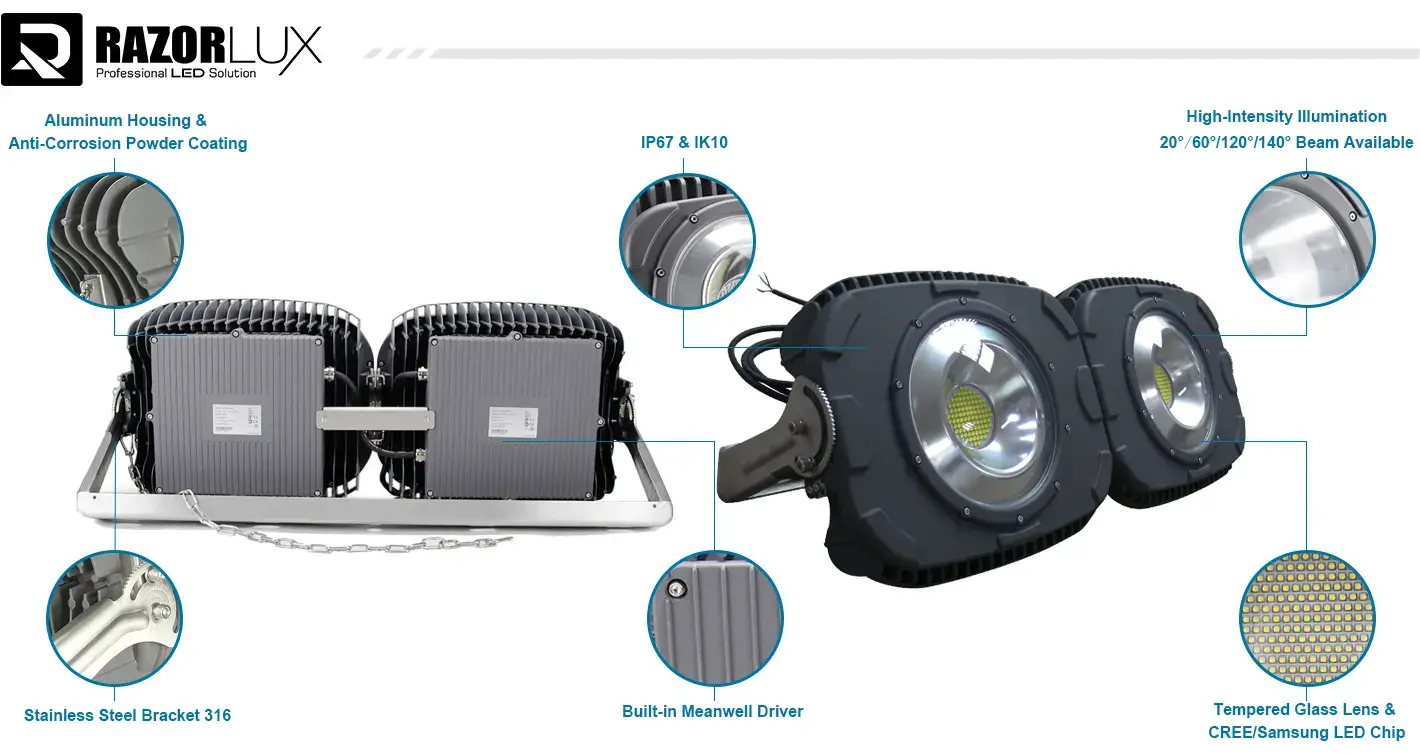
Understanding this metric will keep shipyard managers from buying too powerful lights for the deck or facility engineers from buying too bright lights for the warehouse. When sellers give you specs, always ask for total light output along with watts. Then, check these claims with IES LM-79 test reports, which are independent confirmations of photometric performance.
Key Performance Metrics Beyond Raw Power
Lighting design that works goes beyond just counting lumens. Light is spread out based on the angle of the beam. Narrow beams (15°-30°) work best for high-mast tasks at ports, while wide beams (120°–140°) are best for close-quarters work on ships' decks. Color Rendering Index (CRI) affects safety; a Ra>75 number makes sure that workers can tell the difference between wire colors and equipment marks when the lighting is artificial. Choosing the right color temperature is also important. For precise tasks, 5000K gives you daylight-like visibility, while 3000K cuts down on glare in foggy maritime environments.
When things are bad, environmental scores are very important. IP67-rated enclosures can be temporarily submerged in water during deck cleaning, and IK10 impact resistance keeps them from hitting crane equipment by accident. Also, procurement teams should check the working temperature ranges. Units rated for -40°C to 60°C work successfully in both cold Nordic winters and hot Middle Eastern summers. These specs directly address the worries about dependability that keep site managers up at night.
Energy Efficiency and Long-Term Operating Costs
When comparing standard floodlights to Most Powerful Flood Light high-power LED floodlights, you should figure out how much they will cost you in total over five years. A 12-hour-a-day, 1200W LED fixture uses about 5,256 kWh of electricity in a year. In the U.S., industrial energy rates average $0.12/kWh, which means that each bulb costs $631 a year. When you do this for 50 units of upgraded port lights, the yearly energy costs get close to $32,000, so the starting costs are well worth the savings in efficiency.
When compared to metal halide alternatives, LED technology cuts these costs by 40–60% and gets rid of the need for frequent relamping. When paired with Samsung chips, Mean Well drivers usually last more than 50,000 hours, which is almost 11 years of daily use for 12 hours. Maintenance teams that usually replace broken HID ballasts every three months can move workers to more important jobs. Before finalizing specifications, procurement managers should ask for detailed information on how much energy is used and use lighting calculation software to see how much money can be saved in the real world.
When Is a High-Power Flood Light the Right Choice?
Large-Scale Applications Requiring Maximum Coverage
There are real situations that need very bright lighting. For loading operations at container terminals, 200-meter-wide berths need even lighting, and multiple 1200W fixtures mounted on 40-meter masts get rid of shadows that could hide safety hazards. For offshore oil rigs that are digging 24 hours a day, seven days a week, they need strong LED arrays that can see through salt spray and bad weather. When sports stadiums host televised events, they need lighting that is broadcast-quality and has precise color temperature control. In these situations, lowering the power output could cause the system to fail.
Security and Safety-Critical Perimeter Lighting
Chemical processing plants, military bases, and international borders are all high-security areas that need strong perimeter lighting to make it impossible for people who aren't supposed to be there to hide. Here, carefully placed high-output lights create overlapping coverage that makes lighting zones that are always on, which helps security cameras work and guard patrols do their jobs well. In risk management systems, it's impossible to say enough about how well-lit limits can keep people from crossing them.
Temporary Applications and Mobile Lighting Solutions
Portable high-output lighting is often needed on construction sites, in mines, and during disaster recovery. A 1200W LED flood light that can work with a wide range of voltages (AC 90–305V, DC 127–431V) can handle power changes that happen often in the field. The flexible design lets it be mounted on portable towers, excavation equipment, or temporary scaffolding, which isn't possible with fixed installations.
Potential Drawbacks of Choosing the Most Powerful Flood Light
Higher Initial Investment and Infrastructure Requirements
High-end fixtures with a lot of output cost two to three times as much as mid-range options. Before installation, a fully certified 1200W marine-grade LED floodlight that has been approved by DNV-GL usually costs between $1,800 and $2,500 per unit. That's a $180,000 to $250,000 budget for lighting equipment for 100 fixtures for a port modernization project. That's before you add in the costs of upgrading the electrical infrastructure, strengthening the mounting structures, and commissioning the lights.
| Type of Cost | Mid-Range Light (400W) | Fixture with a lot of power (1200W) | The Best Multiplier |
|---|---|---|---|
| Price per unit bought | $650 to $850 | $1,800 to $2,500 | 2.5 to 3.0x |
| Installation Work | $150 to $200 | $300 to $400 | 1.8 to 2.0x |
| Adding more electricity | Not much | From $500 to $1,500 per circuit | Very Important |
| Cost of energy a year (12 hours a day) | $210 | $631 | 3.0x |
| TCO for Five Years (Single Fixture) | $2,200 to $2,950 | $4,755 to $6,055 | 2.1 to 2.2x |
Excessive Brightness and Light Pollution Concerns
Glare can make the workplace less safe with the Most Powerful Flood Light. Crane operators who move containers in port yards say it's hard to read load indicators when bright floodlights shine directly into the cabin windows. When sailors come from dark open water to brightly lit berths, they temporarily lose their ability to see as they approach illuminated docks. These problems aren't caused by not enough light; they're caused by badly designed, over-powered lights that don't have enough shielding or beam control. When used in these situations, a 600W LED with carefully designed optics usually works better than a 1200W unit with standard mirrors.
Installation Complexity and Structural Challenges
Even though LEDs are very efficient, high-power fixtures produce a lot of heat, and thermal control methods make them heavier and bigger. Our 1200W model has a cold-forged aluminum body and a phase-change cooling system. It weighs 50 kg. Putting this equipment on top of a 30-meter pole needs structural studies to make sure it can handle wind loads and is stable during earthquakes. Older infrastructure might not be able to handle enough weight, which would require expensive repairs.
How to Choose the Best Flood Light for Your Specific Project
Conducting a Proper Lighting Needs Assessment
Instead of starting with device specs, write down the lighting needs. Maritime classification groups set minimum light levels for different parts of a ship. For example, machinery rooms need 50 lux, working decks need 100 lux, and precision assembly areas need 200 lux. Similar rules are set for industrial sites by OSHA and its foreign counterparts. Get a photometric study done using software like DIALux or AGi32 to create a model of your environment that takes into account things like fixture spacing, surface reflectance, and mounting heights.
This study often shows that spread-out groups of moderate-output fixtures work better than centered groups of high-power installs. Take a look at a shipyard paint bay that needs 300-lux lighting that is even across 2,000 square meters. Photometric modeling could show that sixteen 600W fixtures with 60° beam spreads give better even lighting and fewer shadows than eight 1200W units with wider beams. The spread method also offers redundancy, so even if some lights break, some lighting will still work.
Comparing LED Technology Options and Component Quality
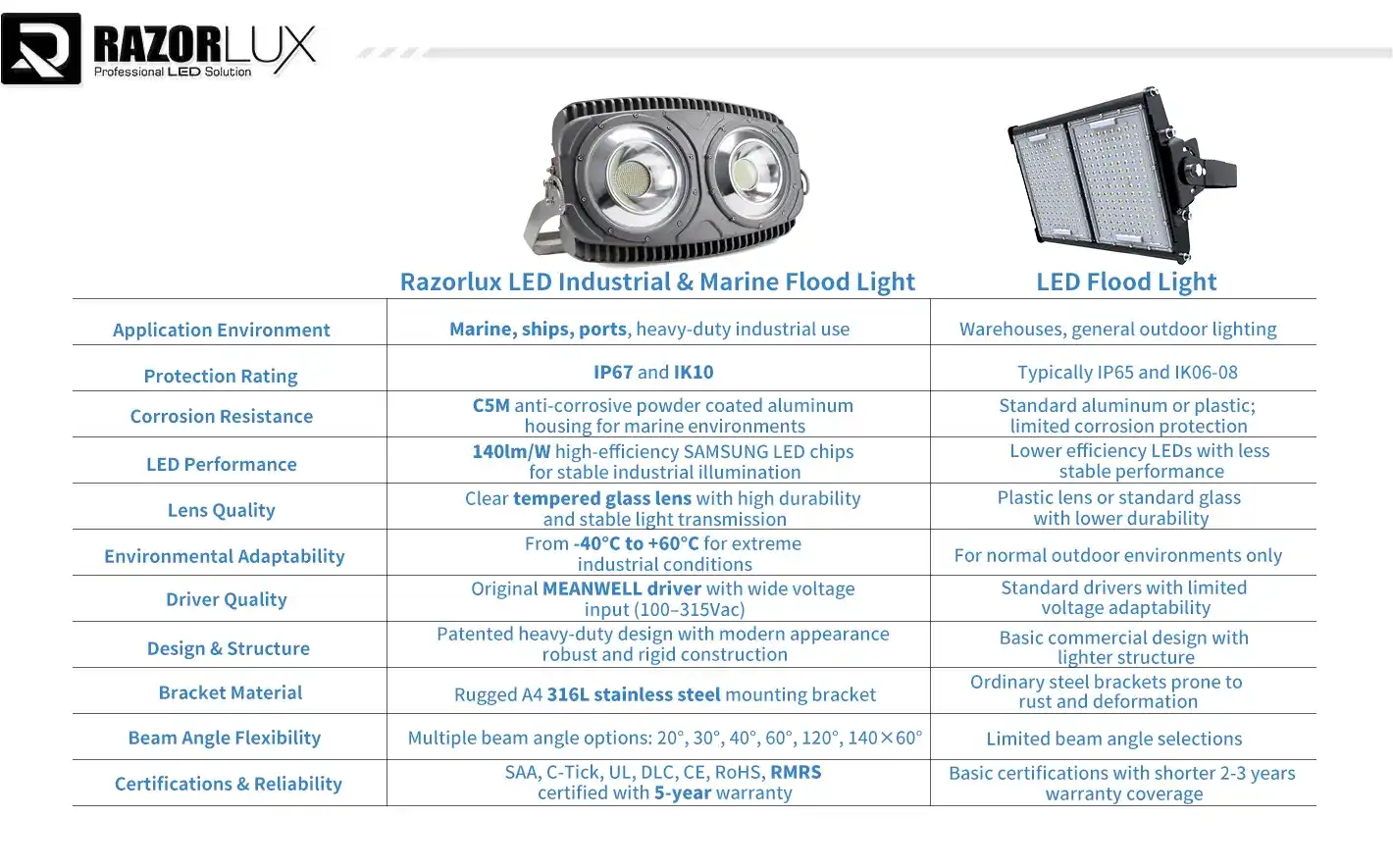
Even though they all have the same wattage number, not all LED floodlights work the same. The choice of chip has a big effect on how well and how long a light works. At the component level, Samsung LM301B chips get 220 lm/W, but generic chips only get 140–160 lm/W. When drivers and optics lose 20–30% of the system's efficiency, starting with premium chips is what makes the difference between meeting 130 lm/W system efficiency goals and failing at 110 lm/W.
In harsh environments, reliability depends on the quality of the driver. Mean Well ELG series drivers have active power factor correction, a wide input voltage tolerance (AC 90–305V to account for generator changes), and a conformal coating that keeps moisture out. These features make the higher price worth it—a Mean Well driver costs $80 to $120, while options without the brand name cost $25 to $40. However, failure rates drop from 15% to less than 2% after 50,000 hours of use, according to data from port owners in the field.
Evaluating Supplier Capabilities and Support Infrastructure
Specifications are only one part of the story of buying the Most Powerful Flood Light. When choosing tools that will last 10 years or more, supplier stability is very important. Razorlux has been in the business for more than 25 years, which shows that the company is stable. If you need replacement parts five years after installation, the company will still be around to honor its warranty promises. Startups that offer slightly lower prices might not be around long enough to see their goods through their entire lives.
Some certifications show how well a product is made and how easy it is to get it on the market. Our fixtures have been certified by third parties to be safe, work well, and be in line with environmental standards. These certifications include CE, RoHS, UL, DLC, and marine-specific RMRS. When inspecting equipment that is mounted on a ship, DNV-GL and ABS approvals are very important because classification societies don't accept parts that aren't certified. Procurement managers should ask for proof of certification and check its validity through databases of granting authorities, since fake certificates are sometimes included in low-ball bids.
Procurement Tips for Industrial Flood Lights
Supplier Evaluation and Vendor Selection Criteria
Before asking for quotes, make fair assessment matrices. Cost might be worth 30%, technical specs 25%, certifications 20%, delivery dependability 15%, and after-sales support 10%, depending on the project's priorities. This organized method keeps people from making hasty choices and gives proof to back up buying choices during internal checks.
Request client references for applications that are similar. If a seller says they are an expert in naval lighting, they should give you the contact information of port authorities or shipyard managers who have used their equipment in similar settings. Talking to current customers directly can reveal useful information about how well a product works, how responsive a supplier is, and hidden problems that aren't mentioned in marketing materials. Ask especially about experiences with warranty claims. How quickly did the maker respond? Were the problems fixed in a satisfactory way?
Negotiating Volume Pricing and Commercial Terms
With bulk buy deals, you can save a lot of money. When you order more than 50 fixtures, unit prices usually go down by 15 to 25 percent. They go down even more at the 100 and 500-fixture volume levels. But extreme discounting might mean that quality is being lowered—if prices fall below what can be justified as production costs for high-quality parts, you should wonder what corners are being cut. For supplier relationships to last, makers need to be able to keep decent profit margins so they can keep quality control and keep their warranty promises.
Payment terms have a big effect on the cash flow of a project. Standard terms for foreign deals are a 30% deposit and the remaining 70% against the bill of lading. These terms favor sellers but make it hard for buyers to get cash on hand. Better terms are possible when you have a history of working together, like 60–90 day payment windows for creditworthy customers or plans based on project progress milestones. Letters of credit through major banks protect both parties in larger transactions, but they add 1% to 2% to the cost of the transaction.
| Volume of Purchases | Discount for Most Units | Terms of Payment | Lead Time | Options for extending the warranty |
|---|---|---|---|---|
| 1 to 10 Units | Price List | 30% down payment, 70% upon receipt of bill | 4 to 6 weeks | Normal 5 years |
| 11 to 50 Units | 10% to 15% off | Possible terms | 6 to 8 weeks | Added another 7 years |
| 51 to 100 Units | 18 to 25 percent off | Net 60 to 90 days | 8 to 10 weeks | Added another 10 years |
| 100 or more units | 25 to 35 percent off | Agreements made just for you | 10 to 14 weeks | Terms specific to the project |
Warranty Provisions and Long-Term Service Agreements
Standard five-year warranties cover problems with the way the product was made, but not problems caused by bad installation, electrical surges, or physical damage. Carefully read the small print of your guarantee. For example, some makers need professional installation certification to keep the warranty valid, while others will not cover repairs that use third-party parts. Make it clear if the warranty covers only parts or both parts and labor, and who pays for shipping broken units that need factory service.
For important uses, extended warranty plans make financial sense. Usually, going from five to ten years of coverage costs 8 to 12% of the purchase price, which is a small amount compared to the cost of replacing fixtures quickly if they break down during a crucial operational period. Some suppliers promise minimum lumen maintenance levels (L70 at 50,000 hours) and will give you a prorated refund if the equipment doesn't work as promised. Because buyers and manufacturers don't have the same amount of knowledge about how well technical components work, these rules move the risk from the customer to the manufacturer.
Conclusion
To choose the best industrial lighting, like the Most Powerful Flood Light, you need to think about more than just "bigger is better." Strong LED floodlights are important in large facilities and tough environments, but many projects turn out better with moderate-output fixtures that are properly specified and strike a balance between performance, efficiency, and cost-effectiveness. A thorough needs assessment, a thorough supplier evaluation, and a total-cost-of-ownership analysis that looks at the whole life of the equipment are all necessary for successful procurement. When professionals make these kinds of smart choices—matching specific project needs to the right technology instead of just going with the most basic options—their companies always get more in the long run. When based on careful engineering rather than oversimplification, strategic investments in lighting improve operational safety, lower energy costs, and ease the burden of maintenance.
FAQ
Does higher wattage always mean better illumination?
Not at all. Wattage measures how much electricity is used, not how much light is produced. A 1200W LED fixture that puts out 156,000 lumens is better than a 2000W metal halide bulb that puts out only 120,000 lumens. Actual light is based on luminous effectiveness (lumens per watt); new LEDs get 130–170 lm/W, while older technologies only got 60–80 lm/W. Instead of thinking that wattage is related to performance, you should always look at overall lumen output and beam spread.
What environmental ratings should I require for marine applications?
Marine sites need water ingress protection of at least IP67 to make sure that devices can handle being submerged temporarily during deck cleaning and bad weather. IK10 impact resistance keeps workers safe in busy workplaces by preventing accidents. In addition, ships that work in both the Arctic and tropical regions must pass salt spray tests according to ISO 9227 standards and be able to operate in temperatures ranging from -40°C to 60°C.
How do LED flood lights reduce maintenance compared to traditional options?
Quality LED systems with Samsung chips and Mean Well drivers last more than 50,000 hours, which is about 11 years of use at 12 hours a day. Metal halide lights need to be replaced every 8,000 to 15,000 hours, which means that the costs of work and materials keep going up. In contrast to HID systems, LED technology doesn't have ballast failures and keeps the output at 70% lumens for the full rated lifetime. This means that performance doesn't drop as much between maintenance cycles.
Partner with Razorlux for Your Next Heavy-Duty Lighting Project
To find the best lighting solution, you need more than just the product specs. You also need a manufacturing partner with a lot of experience in the field and a track record of dependability. Razorlux has more than 25 years of experience in specialized LED lighting tech for use in infrastructure, industry, and ships all over the world. Our high-output 1200W floodlight has 156,000 lumens and an efficiency of 130 lm/W. It comes with Samsung chips, Mean Well drivers, and a number of certifications, such as RMRS, DNV-GL, UL, and DLC approvals. As both a manufacturer and a provider, we can help with every part of a project, from photometric design to after-sales service. We also offer a range of shipping choices to meet the needs of projects around the world. Please email our technical team at sam@razorlux.com for custom lighting estimates, sample test programs, and bulk prices that are made to fit your needs. You can look at our whole line of products at razorlux.com and learn how the right lights can help businesses do their best in the toughest settings in the world.
References
1. Illuminating Engineering Society. (2020). IES LM-79-19: Approved Method for the Electrical and Photometric Measurements of Solid-State Lighting Products. New York: IES.
2. Det Norske Veritas. (2019). Rules for Classification of Ships, Part 4 Chapter 9: Electrical Installations – Lighting Systems. Høvik, Norway: DNV-GL.
3. U.S. Department of Energy. (2021). LED Lighting for Marine and Offshore Applications: Energy Savings and Performance Considerations. Washington, DC: DOE Office of Energy Efficiency.
4. International Maritime Organization. (2018). SOLAS Consolidated Edition 2020: Chapter II-1 Construction – Structure, Subdivision and Stability, Machinery and Electrical Installations. London: IMO Publishing.
5. Chen, H., & Kumar, S. (2021). Thermal management strategies for high-power LED systems in harsh environments. Journal of Industrial Photonics, 15(3), 412-429.
6. Maritime Safety Committee. (2022). Guidance on Energy-Efficient Lighting Systems for Commercial Vessels and Port Infrastructure. Report MSC-103, International Association of Classification Societies.