


_1750326878398.png)

LED Stadium Flood Lights: How to Achieve Uniform Light Distribution?
Achieving uniform light distribution with LED stadium flood lights requires careful attention to beam angle selection, strategic fixture placement, precise mounting heights, and advanced optical engineering. Modern stadium lighting systems utilize multiple beam angles—ranging from narrow 15° spots to wide 140°x60° asymmetric distributions—combined with high-quality reflectors and lenses to eliminate dark zones and hotspots across playing surfaces. Proper photometric planning ensures consistent horizontal and vertical illuminance levels that meet international sports lighting standards while minimizing glare for athletes and spectators. When these technical elements align with durable construction and intelligent controls, facilities achieve broadcast-quality illumination that enhances performance visibility and operational efficiency.
Understanding the Challenge of Uniform Light Distribution in Stadiums
Led stadium flood lights present unique challenges that extend far beyond simply illuminating a large area. Modern sports venues can be over 10,000 square meters, and the playing areas need to be lit up all the time by fixtures that are 20 to 50 meters above the ground. This adds to the complexity. At this distance, it's naturally hard to keep the field bright all the way across while also avoiding clouds that could hurt player safety and performance.
Physical Obstacles and Environmental Factors
The design of a stadium adds many factors that affect how light is distributed. Structures like roof overhangs, support beams, and scoreboard assemblies can cast shadows that need to be taken into account during the planning process. Weather conditions make things even more complicated. For example, rain, fog, and tiny particles in the air can scatter and absorb light, making it 15–30% less bright than when it's clear. Our engineering team has written about these effects in installations near the coast, where salt spray and high humidity make the conditions very tough.
Athletic Performance and Broadcast Requirements
For athletes to correctly follow moving things, the lighting must be just right. According to research from sports science schools, lighting that isn't even or isn't bright enough slows people down and makes them more likely to get hurt. When it comes to professional sports coverage, there are stronger rules. For example, high-speed cameras that record slow-motion video at 1000 frames per second need lighting that doesn't flicker and accurate color rendering so that team colors and skin tones can be shown correctly. In this case, the Color Rendering Index (CRI) is very important. Our fixtures keep Ra>75 as standard, and Ra>80 and Ra>90 are available for high-end broadcast uses.
Regulatory Standards and Compliance
International sports federations put out thorough lighting rules that are different for each sport and level of play. For example, FIFA requires that different types of football venues meet certain GR ratings for glare, U1 and U2 uniformity ratios, and horizontal and vertical illuminance values. These standards aren't made up on the spot; they come from decades of study into what eyesight is best for athletic success. When dealing with these standards, procurement managers need lighting partners who understand both the technical details and the problems that come up when putting them into practice.
Key Factors to Achieve Uniform Light Distribution
A successful LED stadium flood lights strategy relies on combining a lot of different technical parts into a single plan. Each part is responsible for a different part of getting rid of uneven lighting and making sure that everyone in the venue can see clearly.
Strategic Beam Angle Selection
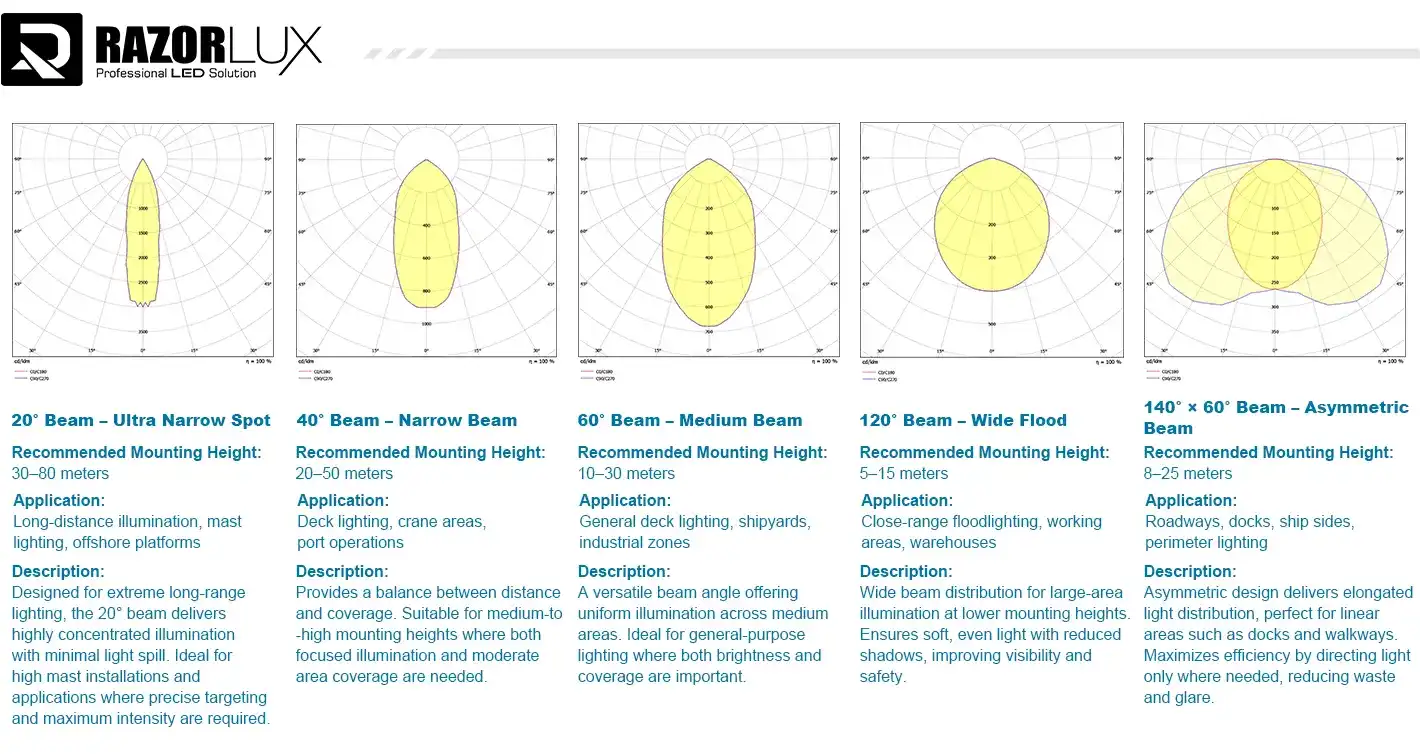
One of the most important choices in arena lighting design is choosing the beam angle. There are seven different beam configurations for our 800W stadium fixtures: 15°, 20°, 30°, 40°, 60°, 120°, and 140°x60°. Each one is designed for a specific use and mounting situation. When placed on high masts outside the playing area, 15° and 20° narrow beams send focused light over long distances. This makes them perfect for decorations. These narrow beam patterns keep light from spilling into nearby homes while precisely lighting up areas far away.
Optimal Mounting Heights and Positioning
Both uniformity and efficiency are directly affected by the height of the mount. Higher mounting positions—usually 35 to 50 meters for big stadiums—allow fixtures to be farther apart and make the glare less noticeable from an athlete's point of view. Increasing the height, on the other hand, needs more lumen output to keep the goal level of illumination at ground level. This is because of the inverse square law, which says that twice the distance needs four times as much light output to keep the same level of brightness.
Advanced Optical Engineering
The optical system inside each bulb controls how well the light that is made gets to where it needs to go. Our patented multi-function optical design blends high-transmission lenses made from impact-resistant materials with precision-engineered mirrors. The shape of the reflector determines how the light is shaped at first, and the secondary lenses adjust the beam patterns and get rid of any extra light that could cause glare or light pollution.
Intelligent Control Integration
These days, running a stadium requires more than just static lighting levels. Smart control systems let venues change the amount of light and how it's spread out based on the needs of the event. During training, the brightness might need to be lowered to 50%, but during a live tournament, the output needs to be fully turned up and evenly distributed. Our fixtures work perfectly with DMX512 and RDM control protocols. This means that you can program dynamic scenes and turn them on and off instantly, without having to wait for the metal halide systems to warm up.
Comparing LED Stadium Flood Lights with Traditional Lighting Solutions
Switching from regular high-intensity discharge (HID) lamps to LED stadium flood lights technology isn't just a small step forward; it completely changes how much stadium lighting costs and how well it works.
Energy Efficiency and Operational Cost Analysis
Metal halide systems, which use 2000 to 2500W per bulb, can be changed with 800W LED units that give off the same amount of light or more. Based on our 130 lm/W grade, each 800W bulb produces 104,000 lumens of useful light. This is the same amount of light as much higher wattage HID systems when optical losses and lumen degradation are taken into account. A typical stadium with 100 fixtures saves about 150,000W of continuous load, which equals 525,000 kWh of annual energy savings for buildings that are used 3,500 hours a year. At average business power rates, this will save $52,500 a year in energy costs, which is enough to cover the cost of the initial investment in three to four years.
In addition to saving energy directly, LED systems don't need the extra power that HID ballasts and cooling systems do. For traditional systems to work, the balance usually needs an extra 15 to 20 percent of power, and there are also big HVAC loads to control the heat production. Our lamps turn 90% of the power they receive into light instead of waste heat. This greatly reduces the need for thermal management and the costs of cooling that come with it.
Lifespan and Maintenance Considerations
LED technology has a very long lifespan, which changes how maintenance is planned and how much it costs over its entire life. After 50,000 hours of normal use, our lights keep working at L70 levels, which means they keep 70% of their original brightness. Metal halide lights, on the other hand, need to be replaced every 6,000 to 10,000 hours, which means that facilities have to deal with lamp replacement processes 5-8 times more often with older technology.
The benefits of lower maintenance costs go beyond how often lamps need to be replaced. To get to fixtures 30 to 50 meters above ground, you need special tools like boom lifts, certified technicians, and the building to be closed during maintenance windows. When you add up the costs of renting equipment, hiring workers, and stopping operations, each maintenance event costs between $500 and $1,500 per fixture. Cutting down on upkeep from every two years to once every five to seven years can save a lot of money over the course of a building's 20-year span.
| Performance Metric | Traditional Metal Halide | Razorlux LED (800W) |
|---|---|---|
| Power Consumption | 2000–2500W | 800W |
| Luminous Efficacy | 70–90 lm/W | 130 lumens/W |
| Rated Lifespan | 6,000 to 10,000 hours | 50,000 hours or more |
| Warm-up Time | 15 to 20 minutes | Right away |
| Color Temperature Stability | Does a lot of changing over life | Stable over a lifetime |
| Operating Temperature Range | Not many (-10°C to 40°C) | Extra (-40°C to 60°C) |
Environmental Impact and Sustainability
LED arena lighting has real environmental benefits that are in line with government rules and business sustainability goals. The huge drop in energy use directly leads to lower carbon emissions. Based on the average U.S. grid carbon intensity, a facility that saves 525,000 kWh per year stops about 370 metric tons of CO2 emissions. In terms of impact, this is the same as taking 80 passenger cars off the road for a year.
Another big benefit is that the material is sustainable. Metal halide lights have mercury and other dangerous chemicals in them that need special disposal methods and create long-term environmental risks. Our LED lights don't have any harmful materials in them, they follow all RoHS rules, and they have recyclable aluminum housing that can be used again after it's been used up. Compared to traditional lighting technologies that need lamp refills often, the longer operating lifespan cuts down on material use and waste by 80%.
Installation and Maintenance Best Practices for Uniform Lighting
The right way to install led stadium flood lights determines whether a lighting design that works well in theory actually does what it's supposed to do in real life. If mounting, aiming, and starting processes don't follow best practices, even high-end fixtures won't work as well as they should.
Comprehensive Site Assessment and Planning
For installations to go well, the site must first be carefully inspected by lighting professionals with a lot of experience. Our technical team uses special software to do a thorough photometric analysis. The software models how light is distributed based on the shape of the venue, where the fixtures are mounted, and the beam directions that were chosen. This simulation finds possible trouble spots—like shadows made by building parts, not enough covering in transition zones, or too many glare angles—before the installation of the equipment starts.
A site assessment also looks at the electrical infrastructure and the strength of the structure. Fixture weight needs to be thought about—our 45-kilogram units need strong fixing gear and support poles that are strong enough to handle both standing and wind loads. Electrical systems need to be checked to make sure they have enough circuit capacity, the right voltage supply (our fixtures can handle AC 90–305V or DC 127–431V), and the right overcurrent protection. Planning carefully during this phase keeps changes that cost a lot of money and project delays from happening during installation.
Precision Mounting and Aiming Techniques
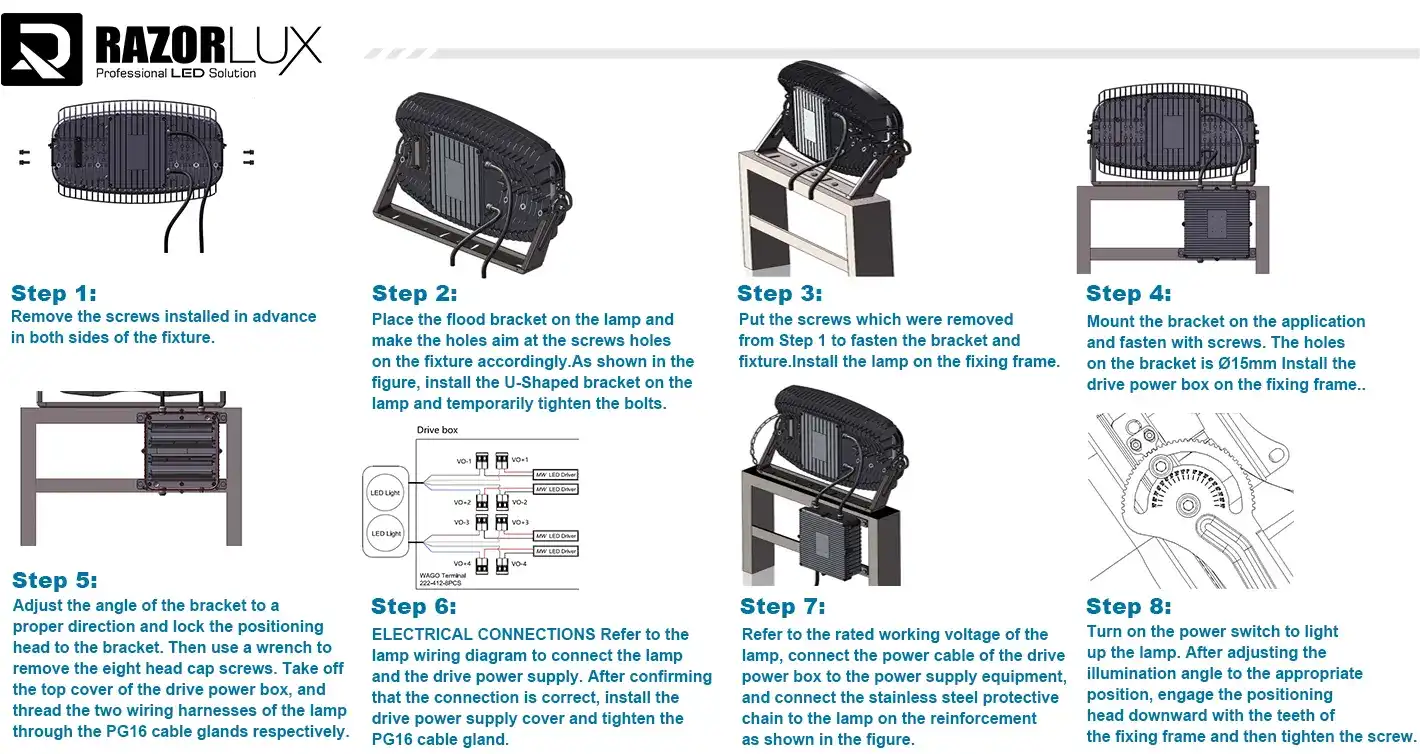
Lighting consistency is directly affected by how accurately fixtures are placed. To keep the beam from getting out of line by accident, mounting brackets must be put in place straight and level, with angular limits of no more than ±1°. Our clamps made of stainless steel offer strong support and exact adjustment along both the horizontal and vertical axes. Before final tightening, installation teams use digital inclinometers and laser alignment tools to make sure that the shooting angles are correct and meet the design requirements.
When beam angles are small for LED stadium flood lights, accuracy in aiming is even more important. For example, a 20° beam fixture mounted 40 meters above the ground will miss its goal covering area by more than 3 meters. As part of professional commissioning, technicians check the lighting at night by measuring the actual light levels across a grid pattern and comparing them to the goals set by the designers. When there are differences, the fixture needs to be re-aimed right away until the measured uniformity ratios meet the requirements.
Systematic Commissioning and Testing
Commissioning systems correctly makes sure they work the way they were supposed to and meet the performance standards set by the contract. As part of the completion process we suggest, photometric testing should be done after the initial placement but before the final acceptance. Using calibrated lux meters, testing teams measure the amount of light hitting the playing surface at set grid points. They write down the values for horizontal and vertical illumination, uniformity ratios, and glare ratings.
Documentation of performance gives maintenance workers a starting point for future work. When devices are turned on and their optics are clean, measurements taken during approval show how much light they should produce. After that, testing once a year shows how performance is getting worse, which lets maintenance teams plan to clean or replace parts before the lighting quality drops below acceptable levels.
Proactive Maintenance Strategies
Regular maintenance protects the performance of a lighting system and the money that was spent on it. Our suggested maintenance plan includes visual checks every three months to look for physical damage, water getting in, or mounting hardware that isn't tight. Cleaning optical surfaces every six months gets rid of the dirt and debris that builds up over time. In industrial or coastal areas, environmental contamination can cut light output by 20 to 30 percent.
Every year, thorough inspections include trying the system's performance in great detail, making sure all the electrical connections are correct, and checking the state of each part. Thermal imaging finds drivers or LED modules that are hot, which is a sign that they are about to break. This way, the parts can be replaced during regular maintenance instead of having to be called for in an emergency. Our 5-year warranty on LED modules and drivers gives you extra peace of mind, and our 10-year warranty on the housing shows that we trust the quality of our marine-grade construction.
| Maintenance Task | Frequency | Key Activities | Performance Impact |
|---|---|---|---|
| Visual Inspection | Quarterly | Check physical condition, mounting security | Prevents catastrophic failures |
| Optical Cleaning | Semi-annual | Clean lenses and reflectors | Maintains 95%+ light output |
| Performance Testing | Annual | Measure illuminance, verify uniformity | Documents degradation trends |
| Component Inspection | Annual | Thermal imaging, connection checks | Identifies new problems |
| Predictive Replacement | As indicated | Replace components showing degradation | Prevents unscheduled downtime |
Procurement Considerations for LED Stadium Flood Lights
When choosing led stadium flood lights systems, you have to think about how well they work technically, how much they cost up front, how much they cost to run, and how reliable the supplier is. When planning a project, the choices you make about purchases will affect how the facility works for decades, so it's important to do a thorough evaluation.
Technical Specification Evaluation
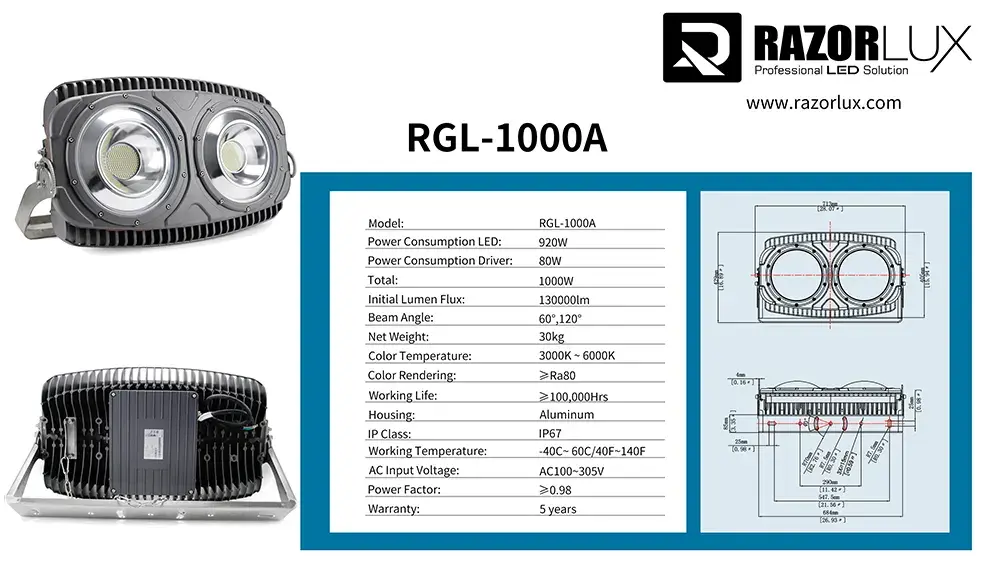
The performance requirements must match the needs of the venue and the lighting standards for sports. Lumen output is the starting point. Our 800W fixtures that put out 104,000 lumens work well in medium to big settings when set up correctly. Effective illumination at the target surface, on the other hand, depends on the beam angle, mounting height, and optical efficiency, and is more important than total light output.
Durability and Environmental Protection
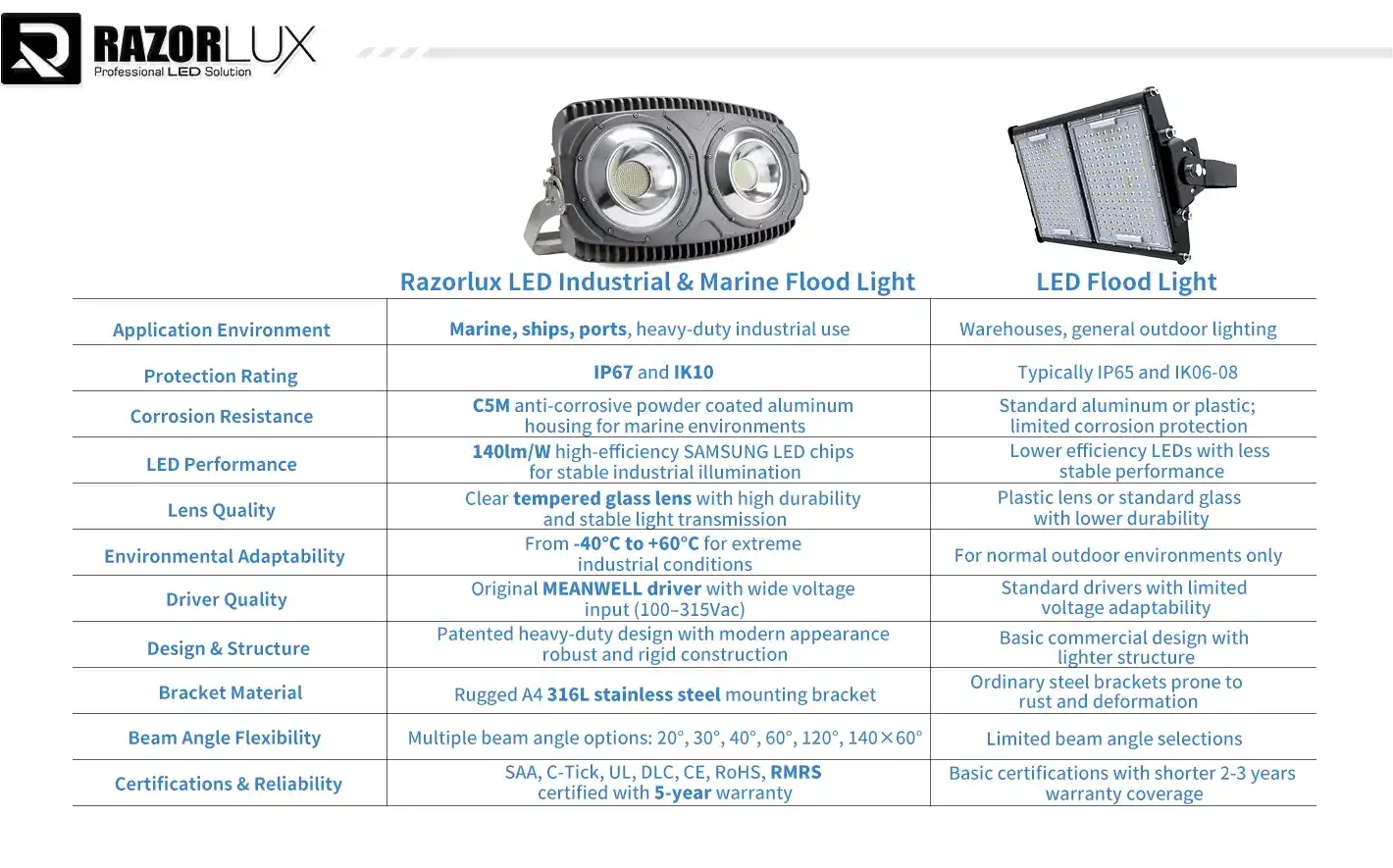
The conditions in a stadium are very harsh, and equipment made for controlled indoor environments would break down very quickly. IP67 ingress protection grade makes sure that dust can't get in and water can't get in for a short time. This is very important for sites near the coast or places that get bad weather. Our IK10 impact rating gives you the best mechanical protection against theft, falling objects, and accidental contact while you're doing maintenance.
Supplier Evaluation and Partnership Quality
Technical specifications are only useful if providers produce good items on time and offer enough support. It's better to buy from well-known companies with a track record than from new companies that offer good prices but aren't sure about their stability. Razorlux has been in business for 22 years and has been given 436 patents. This shows that the company is dedicated to lighting innovation and high-quality manufacturing.
Total Cost of Ownership Analysis
The purchase price is only one part of the total cost of the system over its lifetime. Over the course of a typical 15-20 year facility lifecycle, the costs of energy use, repairs, and replacements often outweigh the initial cost of the equipment. A full economic study takes these running costs into account and shows that high-quality lights that work better and last longer have lower total costs, even though they cost more at first.
Conclusion
LED stadium flood lights require combined optical design, fixture placement, installation, and ongoing upkeep to achieve uniform light spread. Modern LED technology gives you more control over how light spreads than ever before. It does this through advanced beam shaping, multiple configuration options, and smart controls that can change based on operational needs. Going from traditional HID systems to LED ones saves money on energy, cuts down on maintenance, and is better for the environment. It also improves lighting quality for athletes, fans, and broadcasting. To be successful at procurement, you need to look at more than just technical specs. You also need to look at total lifecycle costs, provider reliability, and the quality of the relationship that guarantees long-term performance.
FAQ
Why does flicker-free operation matter for stadium applications?
What does flicker-free performance have to do with led stadium flood lights stadium uses? If lighting systems run at the same frequency as camera shutter speeds, high-speed broadcast cameras that record slow-motion video at 500 to 1000 frames per second will record dark bands or flicker. Our lights use high-quality Meanwell drivers that have a power factor of more than 0.98 and overall harmonic distortion of less than 10%. This keeps the ripple current below 3%. This engineering gets rid of flickering that can be seen at all camera speeds. This means that our systems can be used in the toughest broadcast settings, like professional sports and international events.
How does the height of the fixing affect the choice of fixture?
The inverse square law says that for longer distances, higher mounting heights need smaller beam angles to cast enough light. Fixtures set up 40 to 50 meters above the playing surface usually use beam angles of 15 to 20 degrees, while installations 25 to 35 meters above work well with beam angles of 30 to 40 degrees. Our technical team does photometric modeling that takes into account the heights of your mountings to make sure that the recommended configurations deliver the right amount of light with the best uniformity ratios. This analysis stops common mistakes where bad beam control leads to hotspots or coverage gaps.
What protection features prevent premature failure in harsh environments?
Our complete environmental protection starts with IP67-rated enclosures that keep out all dust and protect against short-term immersion in water. IK10 impact resistance can handle 20 joules of kinetic energy, which is the same as dropping a 5 kg mass from 40 cm. This means that it can protect against damage from falling objects, theft, and maintenance accidents. Extreme climates can be accommodated by an operating temperature range of -40°C to 60°C. The marine-grade aluminum construction and special powder coating make it resistant to corrosion in salt-spray environments, where regular fixtures rust in months.
Partner with Razorlux for Superior Stadium Lighting Solutions
Razorlux gives more than 20 years of led stadium flood lights innovation to stadiums around the world that need it. Our 800W professional stadium flood lights use unique optical technology, marine-grade construction, and a wide range of certifications to provide broadcast-quality lighting in the toughest conditions. Our engineering team can help you with photometric analysis, custom configuration, and ongoing technical support for the whole lifecycle of your project, whether you're replacing old metal halide systems or designing brand-new sports facilities. Contact our experts at sam@razorlux.com to talk about your unique needs and get thorough plans that show how Razorlux Led stadium flood lights manufacturers can improve the lighting in your venue while lowering costs.
References
1. International Commission on Illumination (CIE). Guide on the Limitation of the Effects of Obtrusive Light from Outdoor Lighting Installations: Second Edition. CIE 150:2017. Vienna: CIE Central Bureau, 2017.
2. Illuminating Engineering Society of North America. Recommended Practice for Sports and Recreational Area Lighting. IES RP-6-15. New York: Illuminating Engineering Society, 2015.
3. European Committee for Standardization. Light and Lighting: Lighting of Work Places - Part 1: Indoor Work Places. EN 12464-1:2011. Brussels: CEN, 2011.
4. National Electrical Manufacturers Association. American National Standard for Roadway and Area Lighting Equipment - Luminaires, Poles, and Brackets. ANSI C136 Series. Rosslyn: NEMA, 2019.
5. Fédération Internationale de Football Association. Football Stadiums: Technical Recommendations and Requirements, 5th Edition. Zurich: FIFA, 2011.
6. U.S. Department of Energy, Office of Energy Efficiency and Renewable Energy. Solid-State Lighting Technology Fact Sheet: High-Output Lighting for Sports and Large Venues. Washington: DOE, 2020.