


_1750326878398.png)

Why Upgrade to Tennis Court LED Flood Lights from Metal Halide Now?
Upgrading to Tennis Court Led Flood Lights from metal halide is no longer just an option—it's a strategic necessity. The lighting isn't even, which is bad for both players and site managers, and metal halide lights need to be changed all the time when they burn out. LED flood lights give off more light, use a lot less power, and don't need to be fixed for decades. Power costs are going up, and players are getting better. Tennis courts can save money right away and over time by switching to LED lights instead of metal halide lights.
Understanding the Limitations of Metal Halide Lighting on Tennis Courts
Metal halide fixtures have been used on tennis courts for decades, but their practical flaws are becoming a bigger problem for building managers and procurement teams.
High Energy Consumption and Operating Costs
To light up a court, a metal halide lamp needs 800 to 1000 watts of power. This is a great deal more power than LED lights need. When courts are used for evening play, which usually lasts for 4 to 6 hours a day, electricity costs can go up by 50 to 65% every month. The price goes up when there are more than one court and a lot of equipment is being used at the same time.
Frequent Replacement and Maintenance Demands
Metal halide lights usually last between 6,000 and 15,000 hours, which means that facilities need to change the bulbs every 18 to 30 months based on how they are usually used. For each replacement, there are costs for labor, renting tools to get to high fixtures, and downtime during maintenance windows. These breaks mess up court schedules and cause revenue gaps, especially for commercial tennis clubs that depend on courts being available all the time.
Poor Light Quality and Player Experience
Metal halide technology makes the light spread unevenly across the court surface, with clear hot spots and dark spots. Color rendering is usually lower than Ra75, which makes it hard for players to keep track of balls that are moving quickly. The warm-up time—often 5 to 10 minutes before hitting full brightness—makes it hard to change how the light works. When the power goes out, courts may not be usable for 15 to 20 minutes while they are being fixed. This is frustrating for players and messes up tournament schedules.
How LED Flood Lights Revolutionize Tennis Court Lighting
LED technology completely changes the way courts are lit because it has better performance features that get rid of all the problems with older systems.
Superior Energy Efficiency and Lifespan
Modern Tennis Court LED Flood Lights have a luminous efficiency of 130–160 lm/W, That is, they use about 60% less electricity than metal halide lights. You could also switch out the 800-1000W metal halides for 400W LEDs. Both of them will give off light at the same amount or more. It has been used more than 50,000 hours, so it shouldn't need to be fixed for another 15 to 20 years. You don't have to change them very often because they last so long. This way, you'll spend less on bills and work.
Enhanced Visual Performance for Players
Colours look great in LED systems when the CRI value is above 80. This gives players more confidence and helps them see the ball better. The screen's colour temperatures can be changed between 4000K and 5700K. It looks like real sunlight, which is good for long game sessions since it doesn't hurt your eyes. With quick on/off, there are no more delays during warm-ups. You can also record high-speed video for teaching analysis and competition streaming without any noticeable glitches.
Compliance with International Lighting Standards
The International Tennis Federation (ITF) and state governing bodies have strict rules that professional-grade LED flood lights must follow. Systems provide even horizontal lighting of 200 to 750 lux, depending on the type of building, and have uniformity ratios (Uo/Ul) above 0.7 to keep shadows and dark spots to a minimum. Specifications for vertical illumination make sure that cameras and onlookers can see clearly from all directions. This is important for competitive venues that host official events.
Choosing the Right LED Flood Lights for Tennis Courts
To choose the right LED systems, you need to carefully look at the technical specs and make sure they match the needs of the building and the surroundings.
Wattage and Brightness Requirements
The amount of light needed depends on the size and type of use of the court. Class III sites for recreation need 200 to 300 lux, while Class II clubs for competition need 500 lux. Professional tournament sites (Class I) need 750 to 1000 lux or more to support video recording at broadcast quality. For a normal single court that's 36.6m x 18.3m, you need between 6 and 8 300-400W LED fixtures placed at different heights based on the beam angle requirements.
Color Temperature and Color Rendering Index
You can change how well you see and how well you think something works by changing the colour temperature. The best temperature range for tennis is around 5000K to 5700K. This is also the temperature range where players feel most at ease when they are outside playing long games in the sun. If the Colour Rendering Index (CRI) is above 80, players will be able to tell the hues of the court from those of the area around it. Ra>90 can only be reached with very powerful computers, so games that are shown on TV are color-accurate.
Durability and Environmental Protection
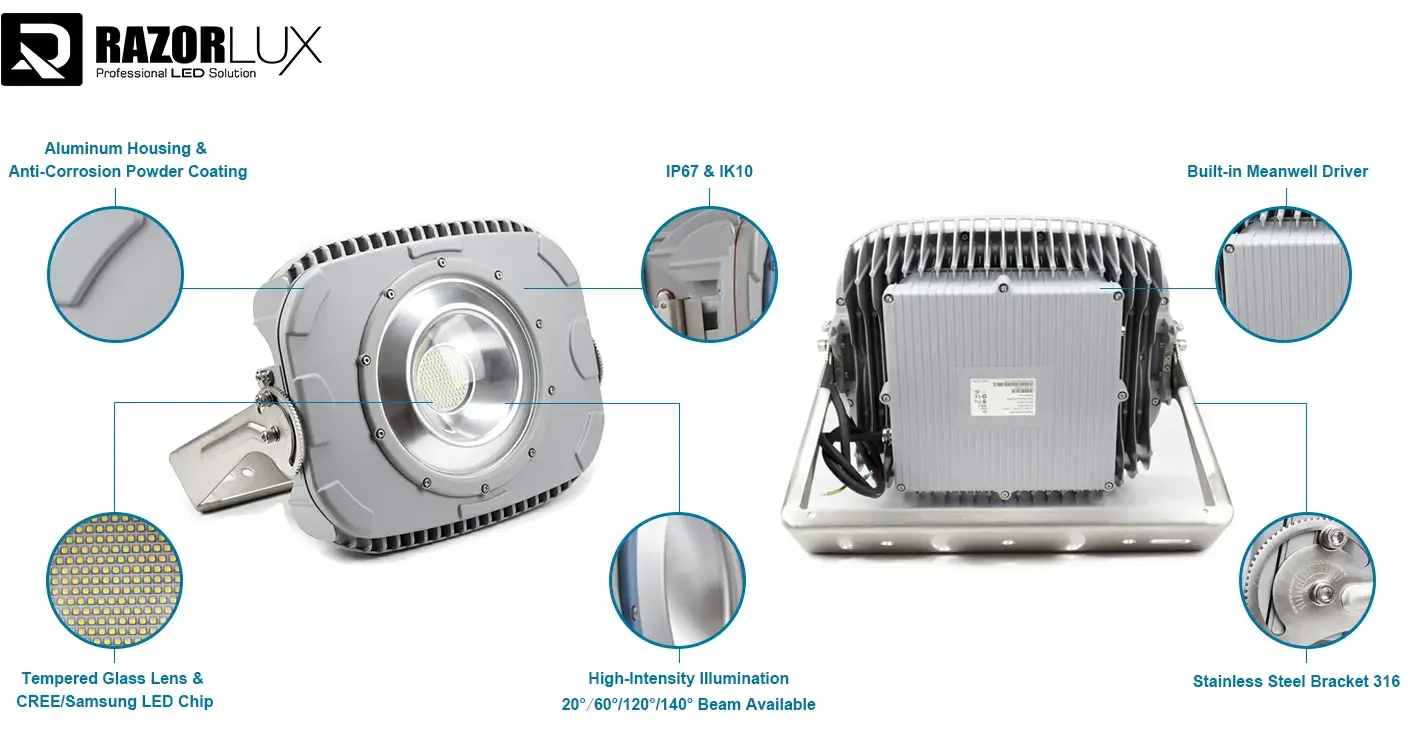
Bad weather can damage the lighting on outdoor tennis courts, so there need to be strict rules to keep it safe. Shelters with an IP67 grade keep out all dust and can handle getting wet for a short time. This is important in places where it snows or rains a lot. If the impact resistance grade is IK10, you won't have to worry about getting hit by a ball or getting into trouble. Whether it's cold in the Nordic countries in the winter or hot in the Middle East in the summer, the method always works. Between -40°C and +60°C, it can handle it.
Table 1: Razorlux RGL2-400A Technical Specifications
| Parameter | Specification | Advantage |
|---|---|---|
| Rated Power | 400W (replaces 800-1000W HID) | 60% energy reduction |
| Input Voltage | AC110-480Vac / DC100-800Vdc | Universal compatibility, no adapters |
| Luminous Efficacy | 130 lm/W | Superior efficiency |
| Color Temperature | 2700K-6500K | Customizable to facility preference |
| CRI | Ra>75 (Ra>80, Ra>90 available) | Excellent color accuracy |
| IP Rating | IP67 | Complete environmental protection |
| IK Rating | IK10 | Maximum impact resistance |
| Lifespan | >50,000 hours | 15-20 years maintenance-free |
| Warranty | 5 years (LED module & driver) | Long-term reliability assurance |
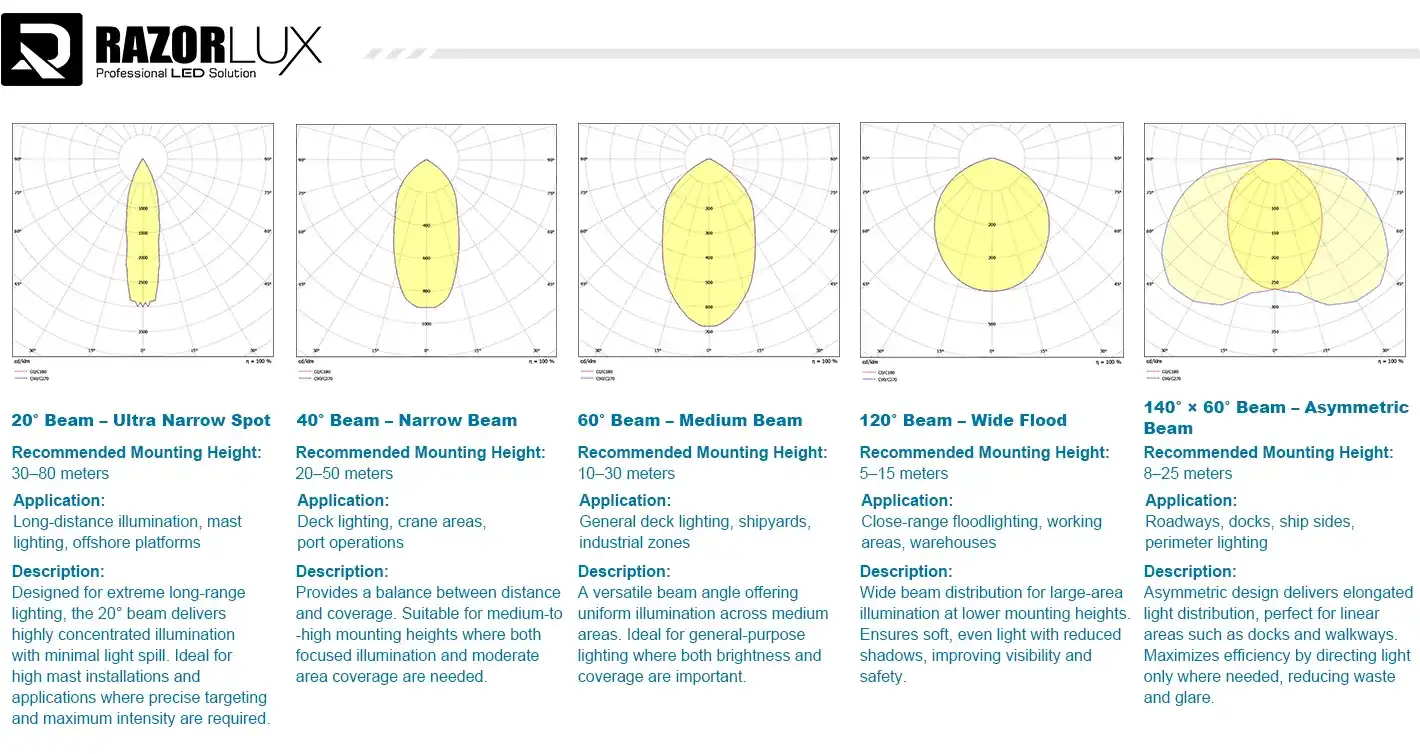
The Razorlux RGL2-400A Tennis Court LED Flood Lights model shows how modern engineering can be used to meet the needs of a real tennis court. Its patented multi-function design lets it be mounted in a variety of ways, and the stainless steel bracket keeps it strong even when winds reach 150 km/h. Meanwell power sources provide less than 10% THD and more than 0.98 power factor, which safeguards the electrical systems of a building from harmonic distortion. There are different beam angles (40°, 60°, 120°, and 140°x60°) that let you precisely distribute the light based on the court plan and where the poles are placed.
Advanced Control Features and Smart Integration
Modern LED systems have advanced control features that make the best use of energy and give you more options for how to use them. Photocell sensors automatically change the output based on the amount of light in the room. This cuts down on needless lighting at dusk. Motion recognition lets lights turn on only when courts are being used, which saves an extra 20–30% of energy in places where courts are only occasionally used. Integration with DALI or DMX protocols lets facility managers set up custom lighting scenes for different activities and events from a single interface, allowing centralized management across multiple court complexes.
Installation and Maintenance: Best Practices for LED Tennis Court Flood Lights
Installing LED lights correctly and taking care of them regularly will make them work better and last longer.
Mounting Height and Angle Calculations
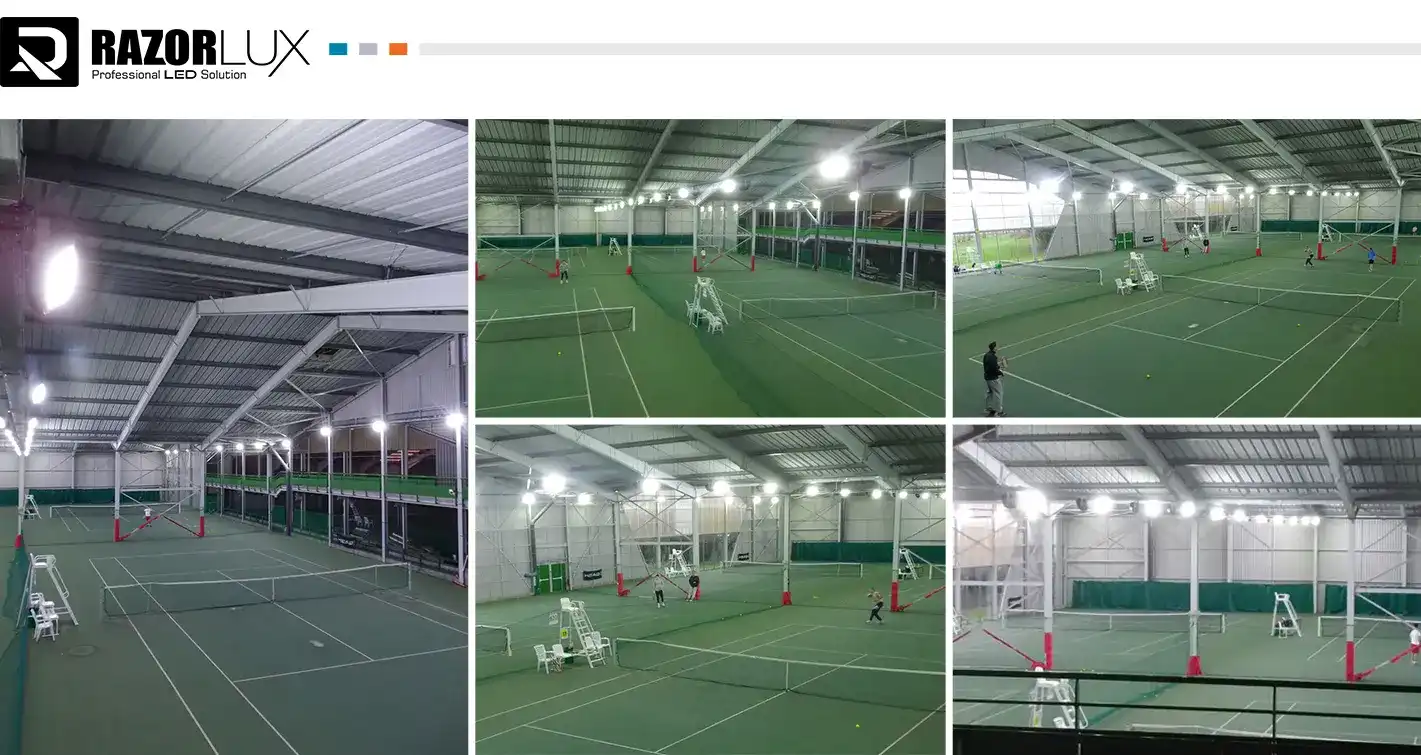
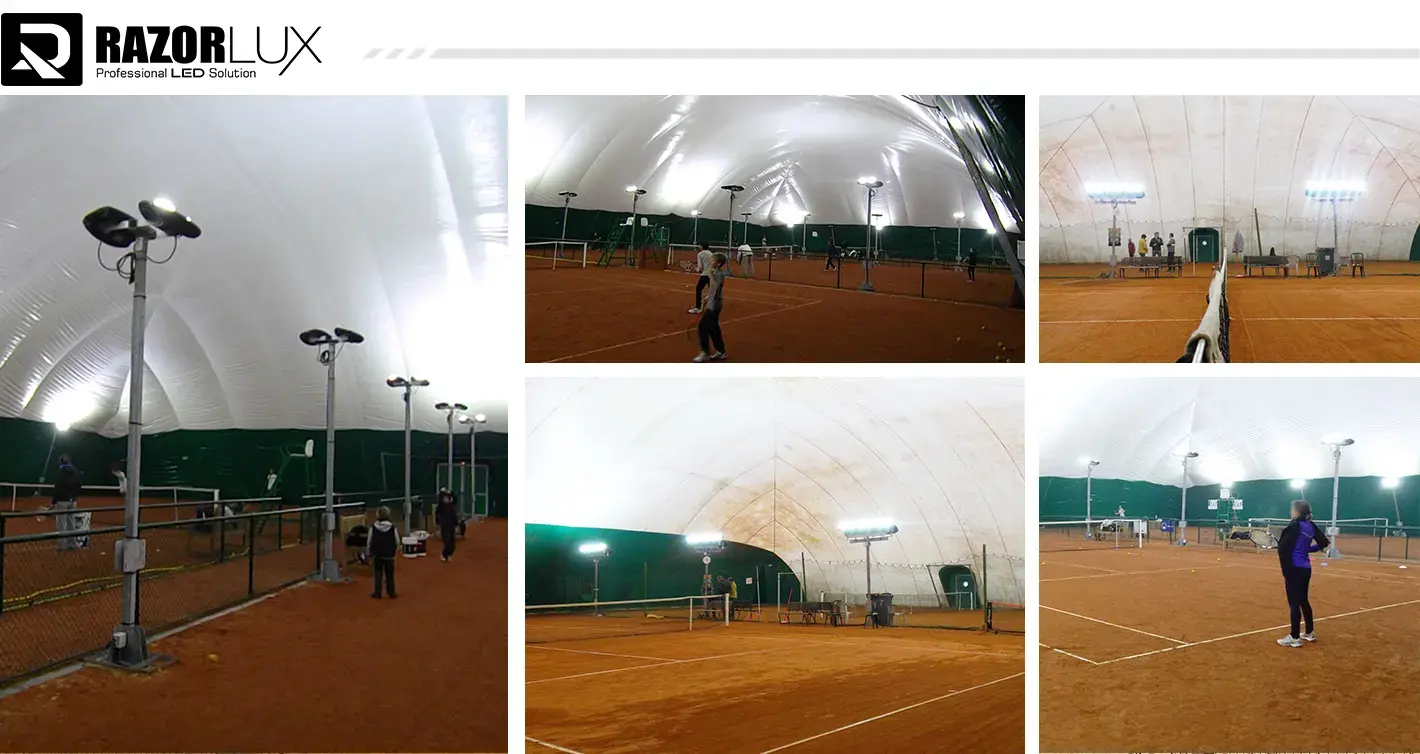
The placing of fixtures has a big impact on how evenly light is distributed and how much glare is prevented. For normal tennis courts, mounting heights between 8 and 12 meters are best for balance. For multi-court arrays, however, taller poles are needed to keep light from spilling over to other playing areas. Asymmetric beam angles work especially well because they direct light at forward angles that shine light toward the middle of the court while reducing direct glare for players looking up during lobs. Accurate looking, usually 10-15 degrees off vertical, makes sure that standards for regularity are met while keeping the eyes comfortable.
Electrical Safety and Regulatory Compliance
Local safety and electrical codes must be followed during installation. Overcurrent protection, ground fault protection, and surge reduction with a rating of 10–20kV transients should all be built into the circuits. Wide input voltage capability (110-480Vac) gets rid of the need for equipment that is only working with one voltage. This makes buying and installing equipment easier for foreign tasks. Facilities that work in places where the power grid isn't stable benefit from being able to accept DC inputs (100–800Vdc). This lets them connect to solar power systems or battery backup solutions so they can keep running even when the power goes out.
Routine Inspection and Cleaning Protocols
Tennis Court LED Flood Lights systems don't need as much care as metal halide alternatives, but they should still be checked on a regular basis to make sure they're working at their best. Visual checks every three months find problems like misaligned fixtures, corroded brackets, or dirty lenses. Cleaning once a year gets rid of the dust, pollen, and other natural buildups that slowly lower the light output. For IP67-rated fixtures, a simple water rinse is usually enough, but light cleaning solutions may be needed for tough deposits. These easy steps take about 15 to 20 minutes per bulb and stop the 10 to 15 percent loss of light that happens when housings aren't cleaned for years at a time.
Economic and Environmental Benefits of Upgrading to LED Flood Lights
The financial and environmental benefits of switching to LEDs go far beyond saving energy right away.
Quantifiable Return on Investment
For buildings that replace metal halide systems, the savings in energy costs usually pay for themselves in two to four years. At average commercial electricity rates of $0.12 to $0.15/kWh, a four-court complex that is used 1,500 hours a year will save $4000 to $6000 a year. Getting rid of the costs of replacing lamps adds another $1,200 to $1,800 a year when you count the bulbs, ballasts, and maintenance workers. Even though the starting equipment cost is higher, the total cost of ownership for LED systems is 50–65% less than that of keeping metal halide infrastructure over a 15-year period.
Table 2: 15-Year Total Cost of Ownership Comparison (4-Court Facility)
| Cost Factor | Metal Halide System | LED System | Savings |
|---|---|---|---|
| Initial Equipment | $12,000 | $18,000 | -$6,000 |
| Energy (1,500 hrs/yr x 15 yrs) | $72,000 | $28,800 | $43,200 |
| Lamp Replacements | $18,000 | $0 | $18,000 |
| Maintenance Labor | $9,000 | $1,500 | $7,500 |
| Total 15-Year Cost | $111,000 | $48,300 | $62,700 |
These numbers show how LED technology changes lighting from a regular cost of doing business into a strategic asset that makes a facility more profitable.
Environmental Stewardship and Sustainability
For a normal four-court building, switching to LED lights cuts carbon emissions by about 4–6 tons per year, which is the same as taking one passenger vehicle off the road. Installing LEDs can help a building get points toward LEED approval or other green building standards. This is especially true when smart controls and renewable energy are added. Because LED parts don't contain mercury or other dangerous materials, they are easier to get rid of when they're no longer useful than metal halide lamps, which need special recycle methods to keep the environment clean.
Enhanced Facility Value and Competitive Positioning
Modern lighting infrastructure improves the facility's reputation and brings in players who care about quality. When tennis clubs advertise LED lighting, they set themselves apart from competitors who are still using older systems. This attracts serious players who care about playing conditions. Tournament leaders are becoming more specific about LED standards when choosing host places. They know that professional-grade lighting improves the quality of the event and makes participants happier. Adopting LEDs is a way for buildings to show their commitment to sustainability. This is in line with corporate and institutional values and builds relationships with stakeholders who care about the environment.
Conclusion
Metal halide technology isn't good enough for current Tennis Court LED Flood Lights in terms of performance, cost, or the environment. LED flood lights have huge benefits, including dramatically lower energy costs, no upkeep needed, better visual quality, and longer operating lifespans that make facilities more profitable. The Razorlux RGL2-400A is an example of how advanced engineering can be used to make lighting solutions that are perfect for tennis courts. It has a strong build, a variety of beam options, and works with all voltages, which makes installation easier in a variety of facility types. With payback times of two to four years and service lives of fifteen to twenty years, switching to LEDs is one of the most financially sound infrastructure changes that building managers can make. Now is the best time to switch your tennis courts to professional-grade LED lighting because it will improve operations right away and save you money in the long run.
FAQ
What wattage LED fixture replaces my existing metal halide system?
Most places of business find that 400W LED lights can replace 800-1000W metal halide setups and provide the same or better lighting. The Razorlux RGL2-400A has a color temperature of 5700K and 52,000 lumens of brightness, which is 60% less than other similar products on the market. For exact replacement suggestions, we need to know the size of the court, the height of the mounting, and the level of light that is needed. That's why we encourage venues to ask for a free photometric analysis based on their plan and performance needs.
How do LED systems perform in extreme weather conditions?
Professional-grade LED court lights are built to last in harsh environments thanks to their strong construction and high protection ratings. IP67 shields keep dust and water out, even when it rains or snows a lot. They can also handle temperatures from -40°C to +60°C, so they will work reliably in both cold Nordic winters and warm tropical regions. IK10 impact protection keeps you safe from things like hail, ball hits, and other physical impacts. LEDs are naturally more durable than metal halide technology because they don't have fragile glass envelopes or electrodes. Metal halide technology often breaks down because it is exposed to thermal shock and vibration.
Can I test your LED fixtures before committing to a full installation?
We strongly recommend that samples be tested before large-scale purchases are made. Razorlux offers test units that can be used on-site, so your technical team can check the light quality, regularity, and player happiness in real-life settings. This risk-free test usually lasts between 30 and 60 days, which is enough time to see how well it works in different weather conditions and usage situations. Technical support is available for sample setups to help you find the best shooting angles and control settings. This way, you can see what our lighting solutions can do before you decide to buy them.
Partner with Razorlux for Professional Tennis Court LED Flood Lights
You should think about upgrading the lighting in your tennis facility as a long-term investment that will pay off in the long run. Razorlux is one of the best companies to make Tennis Court Led Flood Lights. They have more than 200 patents for new LED technology and have been engineering excellence for more than 20 years. Our RGL2-400A type has great lighting performance and is very durable. It also has a lot of standards, including CE, RoHS, UL, DLC, and ISO:9001, which meet the strictest buying needs.
We know that choices about lights affect a lot of people, from expert teams looking at specs to buying departments comparing the total cost of ownership. Razorlux gives full paperwork, like photometric test results, installation plans, and upkeep procedures, so that everyone in a company can make decisions with confidence. Our application engineering team provides free lighting design services, making custom solutions that meet the specific needs of your facility while also maximizing energy efficiency and the player experience.
Tennis courts in North America, Europe, and Asia depend on Razorlux to provide lighting options that work well season after season. You can talk to our team about your project needs by emailing sam@razorlux.com or going to razorlux.com. We'll give you detailed quotes, set up shipments of samples for you to look over, and help you through the whole process of buying and installing. If you switch to professional LED lighting, you'll see how it changes your tennis center into a top spot that players want to visit again and again.
References
1. International Tennis Federation. (2021). ITF Court Lighting Standards for Tennis Facilities. London: ITF Technical Department.
2. Illuminating Engineering Society. (2020). IES RP-6-20: Sports and Recreational Area Lighting. New York: IES Publications.
3. U.S. Department of Energy. (2022). LED Lighting for Sports Facilities: Energy Savings and Performance Benefits. Washington, DC: DOE Building Technologies Office.
4. European Committee for Standardization. (2019). EN 12193: Light and Lighting - Sports Facility Lighting. Brussels: CEN Standards.
5. Navigant Research. (2021). Global Market Analysis and Forecasts for LED Sports Lighting Systems. Boulder: Guidehouse Insights.
6. American Sports Builders Association. (2020). Tennis Court Construction and Lighting: Best Practices Guide. Atlanta: ASBA Technical Publications.