


_1750326878398.png)

Low Mast Light Buying Guide: Features, Benefits, and Uses
A Low Mast Light is an outdoor area lighting system mounted on poles typically ranging from 4 to 15 meters in height. It fills the performance gap between standard 6-meter street poles and towering 25-meter high mast systems. For shipyard purchasing managers, dock facility engineers, and industrial procurement supervisors, choosing the right pole-mounted fixture directly affects operational safety, energy budgets, and long-term maintenance costs. This guide breaks down everything you need to know — from technical specifications and application scenarios to procurement strategies — so you can make a confident, informed decision.
Understanding Low Mast Lights: Features and Operational Principles
Before you compare products or ask for quotes, it's helpful to know how these fixtures work and what makes a good one different from a bad one.
What Defines a Low Mast Light?
It is designed so that a low mast bulb can precisely light an area at a human size. A pole-mounted area light (8–12 meters) gives off controlled amounts of light where workers, cars, and security cameras need them, unlike high mast towers that flood big areas from very high up. This range of heights limits the amount of light that spills upwards, reducing glare for both walkers and drivers. It also meets the requirements of dark-sky laws that are becoming more common in U.S. city contracts.
LED vs. HID Technology
LED and HID (High-Intensity Discharge) are the two main technologies used in this group of products. Metal halide and high-pressure sodium HID lamps were the standard for decades, but they have a lot of problems: they take 3–5 minutes to warm up, their lumen output drops by more than 30% in 10,000 hours, and they contain mercury, which makes them harder to get rid of. LED area lights, on the other hand, get bright right away, keep more than 90% of their original lumens at 50,000 hours, and use 40–60% less energy to produce the same amount of light. It says that the U.S. According to the 2023 Solid-State Lighting report from the Department of Energy, more than 60% of all new outdoor lighting installations in North America are now LED luminaires.
Core Components That Matter
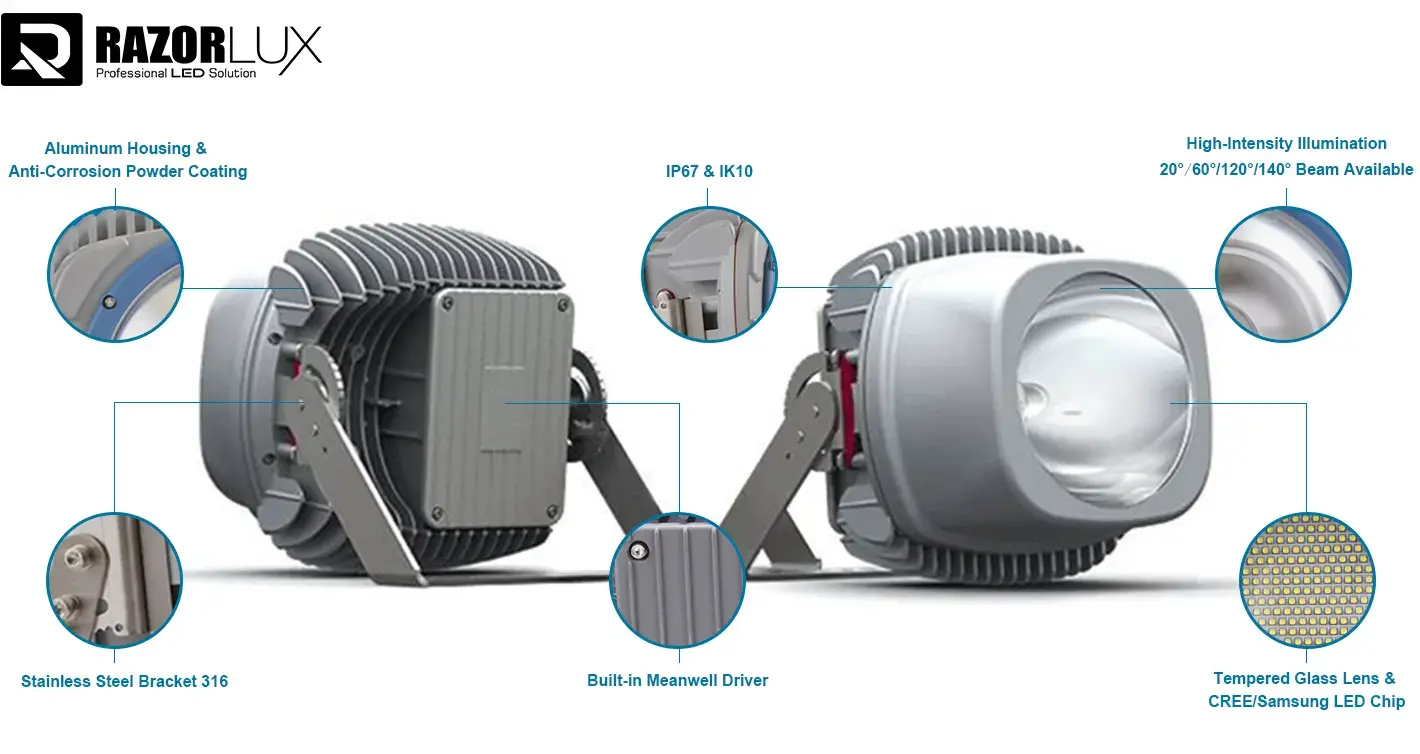
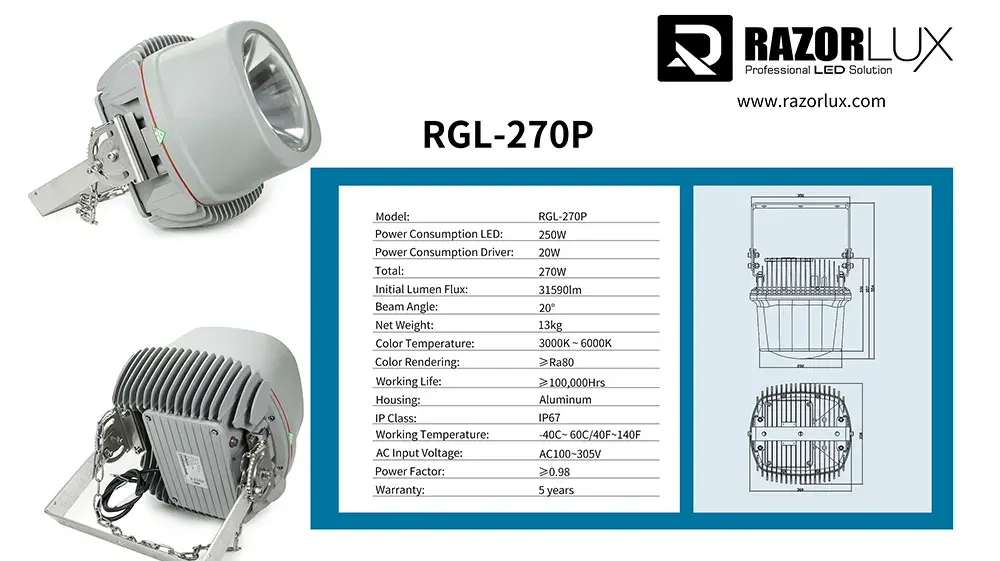
The LED module, the driver, and the heat control housing are the three parts of an area light fixture that work together to make it work. A high-efficiency LED module with chips from Samsung or Cree gives off the same amount of lumens across a wide range of color temperatures. With a power factor above 0.98 and overall harmonic distortion below 10%, a Meanwell driver can keep the current fixed. With a powder coating, an IP67 seal, and a die-cast aluminum housing, all electronics are protected against water, dust, and IK10-rated physical impact. These three things determine how long a fixture lasts, from three to fifteen years.
Benefits and Applications of Low Mast Lights in B2B Contexts
The business case is easy to understand once the technology basis is set. Area lights in this height range really helps a lot of different businesses run more smoothly.
Energy Savings and Reduced Operating Costs
A 120W LED area light can replace a 250–300W metal halide lamp and use more than half as much power while giving off the same amount of light or more. If an industrial building's lights are on for 12 hours a nite, 365 days a year, that one bulb saves about 820 kWh per year. If you do that for 200 outlets at a medium-sized transportation hub, you'll save more than 164,000 kWh of energy each year. With business energy rates in the U.S. averaging about $0.12/kWh (EIA, 2024), just upgrading the lights would save that much money every year.
Safety, Visibility, and Security Applications
Poor lighting directly leads to accidents in loading docks, shipyards, and industrial parks. According to OSHA rules, outdoor work areas should have at least 5 foot-candles of light and storage places should have at least 2 foot-candles of light. Asymmetrical beam optics LED area lights on poles (for example, low mast light with 140°×60° patterns) send horizontal light deep into loading zones and container bays. This gets rid of the shadows that high mast towers cast above stacked cargo. A CRI of Ra≥75 also makes sure that security cameras record accurate color information, which is important around ports and industrial parks with gates.
Broad Application Scenarios Across Industries
One of the best things about a well-designed area light unit is that it can be used in a lot of different situations. Here are the main release settings where this type of trigger gives measurable results:
- Municipal secondary roads and residential roundabouts: At 8–12 meters, these fixtures provide facial-recognition-level vertical illuminance for pedestrian safety without glare that disturbs adjacent residents.
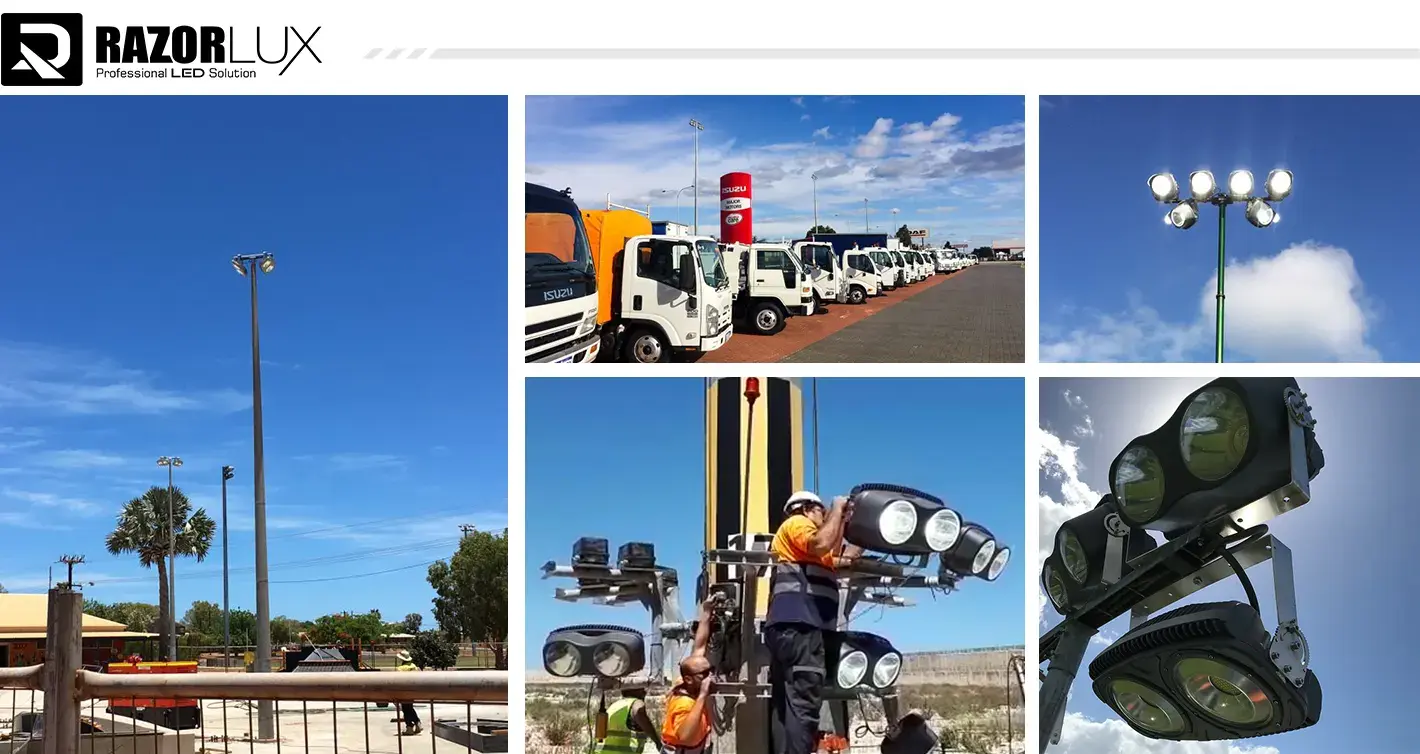
- Industrial logistics parks and loading docks: Fixtures positioned at 10–14 meters project light horizontally into truck bays and container openings, improving night-shift worker safety and operational throughput.
- Commercial parking lots and retail perimeters: At 6–9 meters, Type V square distribution optics cover large paved areas evenly, supporting both customer safety and accurate CCTV footage.
- Shipyards and port dock infrastructure: Corrosion-resistant housings with stainless steel brackets and IP67 ratings handle salt spray and humidity without accelerated degradation, meeting DNV and ABS environment classifications.
- Railway stations, bus terminals, and public squares: Consistent lumen output across wide color temperature ranges (2700K–6500K) allows facility managers to match ambient lighting character to the space's function.
- Sports facilities and outdoor stadiums: High uniformity ratios and minimal glare ensure both participant performance and spectator comfort in evening operations.
All of these places have one thing in common: the fixture has to work reliably nite after nite without having to be fixed often. That assumption puts real pressure on the quality of the build, the state of the certification, and the consistency of the supply chain.
Low Mast Light vs. Other Lighting Solutions: Making the Right Choice
Buying teams often have to look at a comparison grid that has a lot of different types of products. Specification mistakes can be very expensive, so it's important to know where each answer fits.
Low Mast vs. High Mast Lighting
High mast systems, which have poles longer than 18 meters and heads that can hold more than one fixture, are good for places like highway interchanges, large container terminals, and airport aprons where one point needs to cover a lot of space. However, high mast towers cast long, harsh shadows at ground level in places where there are vertical barriers like stacked containers, stopped trucks, or thick warehouse canopies. These blind spots can be fixed by lowering the mounting height and placing fixtures in different areas. For most industrial yards that are less than 5 acres, a network of 10–14-meter pole-mounted area lights works better than a single high mast tower in terms of regularity and ease of upkeep.
Low Mast vs. Bollard and Post Top Fixtures
Bollard lights (0.6 to 1.2 meters) and post top lights (3 to 5 meters) light up paths for people to walk and landscaped areas. They are not made to cover industry or business areas. At 10 meters, a 120W LED area light can replace four or five bollard groups and provide better light levels and uniformity across the same area. A pole-mounted area light is the right choice for any job that needs more than 10 foot-candles of light at ground level over an area bigger than 500 square meters.
Comparing Technology and Brand Tiers
There are three main types of low mast light products on the market: low-cost imports that don't have any third-party certifications, average fixtures that have CE and RoHS marks, and high-end units that have UL, DLC, SAA, and DNV/GL approvals. The table below lists the most important differences between products to help procurement teams choose the right ones for each project.
| Criteria | Budget Tier | Mid-Market Tier | Premium Tier (e.g., Razorlux RGL-120A) |
|---|---|---|---|
| Luminous Efficacy | 80–100 lm/W | 100–120 lm/W | 130 lm/W |
| IP Rating | IP44–IP54 | IP65 | IP67 |
| IK Rating | Not rated | IK07 | IK10 |
| Driver Brand | Unknown | Generic | Meanwell |
| LED Source | Generic | Generic/Epistar | Samsung |
| Certifications | None / CE only | CE, RoHS | CE, RoHS, UL, DLC, SAA, CB |
| Warranty | 1–2 years | 3 years | 5 years (LED + Driver), 10 years (Housing) |
| Working Temp Range | 0°C to 45°C | -20°C to 50°C | -40°C to 60°C |
Even though high-end lights cost more at first, they always end up being cheaper in the long run because they need less upkeep, last longer, and don't need to be replaced as often.
Procurement Strategies for Low Mast Lights: How to Buy Smart
Purchasing managers with a lot of experience know that the lowest price per unit doesn't always mean the lowest cost for the whole job. A structured process for buying things keeps both the budget and the schedule safe.
Define Your Technical Requirements First
Your engineering team should be clear on four things before they talk to any suppliers: the needed lux level at the target surface, the mounting height, the beam angle distribution, and the working environment classification. For industrial uses outside, IP67 and IK10 grades should be the absolute minimum that must be met. For sites near the coast or the water, mounting hardware made of stainless steel and housing finishes that don't rust add years of reliable service. If you know these numbers before you go shopping, you won't make the common mistake of choosing a light fixture based on its wattage alone.
Evaluate Suppliers on More Than Price
Without a doubt, a reliable seller should give you a full IES photometric file, a third-party test report proving the IP and IK ratings, LM-80 data for LED lumen maintenance, and copies of all certificates they say they have. Find out exactly what company makes the driver and the LED module. A device with a real Meanwell driver and Samsung LED chips shows a supply chain that can be checked. No matter how much they charge, suppliers who can't prove where parts come from or provide paperwork within 48 hours are a procurement risk.
Understand Total Cost of Ownership
The choice grid should compare three types of costs over 10 years: the cost of buying the thing, the cost of energy, and the cost of upkeep. Here is a simplified comparison for an installation with 200 fixtures at a medium-sized industrial site.
| Cost Category | 250W HID Fixture (200 units) | 120W LED Fixture (200 units) |
|---|---|---|
| Unit Purchase Cost | $80–$120 | $180–$280 |
| Annual Energy Cost (12h/day) | ~$52,560 | ~$25,229 |
| Lamp Replacement (per 5 years) | ~$8,000 | $0 (LED lifespan) |
| Maintenance Labor (per 5 years) | ~$12,000 | ~$3,000 |
| 10-Year Total Cost | ~$760,000+ | ~$420,000 |
The numbers make a strong case. At this size, the LED system saves more than $340,000 over ten years, even when the higher costs of buying them are taken into account.
Request Samples and Confirm Lead Times
Before committing to a full purchase order for an order of more than 50 units, you should always ask for a physical sample for your technical team to look over. Samples of low mast light from reputable manufacturers are sent out within 5–10 business days. Check the wait time for production and the way of shipping before you sign anything. For port and shipyard projects with set installation times, it's just as important for suppliers to be able to confirm delivery dates in writing and stick to them as it is for them to have good product specifications.
Design and Maintenance Tips to Maximize Low Mast Light Efficiency
When put wrong or not maintained on a regular basis, even the best fitting won't work as well as it should. These useful steps will keep your cash safe.
Fixture Spacing and Placement Principles
A spacing-to-mounting-height ratio of 3:1 to 4:1 is usually used by lighting designers to get a regularity ratio of 0.4 or better. For a 10-meter pole, this means that the lights should be 30–40 meters apart. If there are vertical obstacles like stacks of containers, building facades, or groups of equipment, close the gaps between the lights by 20 to 30 percent and think about using asymmetric beam optics (140°×60°) to shine light into shadow areas. Before deciding where the poles will go on the site plan, you should always run a photometric simulation using the manufacturer's IES files.
Smart Controls and Dimming Integration
These days, area light bulbs can work with 0–10V dimming, the DALI standard, or NEMA 7-pin socket controls. Adding motion detection or schedule-based dimming to a parking lot or warehouse yard can usually cut energy use by an extra 20–40% compared to leaving lights on all nite at full brightness. Facilities that work in shifts can save money by setting the lights to dim 100% during busy times and 30% during off-peak times. This saves money without affecting safety during busy times.
Routine Maintenance Schedule
LED area lights don't need as much upkeep as HID systems, but they still need some. Three things make up a useful repair schedule:
- Annual visual inspection: Check for physical damage to the housing, cracks in the lens cover, and signs of moisture ingress around the IP seal. Replace gaskets showing hardening or deformation.
- Biannual lens cleaning: Dust, industrial particulate, and salt deposits on the outer lens can reduce delivered lumen output by 10–15% within 12 months. A clean lens restores full photometric performance at zero cost.
- Five-year component review: At the midpoint of the fixture's working life, verify driver output voltage against factory specification and inspect mounting hardware for corrosion or mechanical fatigue, particularly in coastal and marine environments.
Fixtures made to IP67 and IK10 standards make it a lot longer between corrective maintenance tasks. However, setting proactive inspections keeps performance predictable and stops problems during vital operations.
Conclusion
Picking the appropriate area lighting fixture for a port, city, or factory is a technical and financial choice that will pay off for at least ten years. A properly chosen pole-mounted LED low mast light will use less energy, have fewer service interruptions, and provide better vision than the HID systems it replaces. It should have IP67/IK10 ratings, a reliable driver brand, and the right beam spread for your site geometry. The choices you make about procurement during the specification stage will determine whether your facility works well or needs a lot of repairs. Before making a decision, take the time to compare certificates, ask for examples, and figure out the total cost of ownership. The money you spend up front on the right device from a reputable maker is well spent.
FAQ
How does a low mast light differ from a standard street light?
Standard street lights use optical systems that are linear and are designed to spread light along a single axis. Pole-mounted area lights use wide-area optics (Type III, IV, or V distributions) to light up bigger areas from a single fixing point. This makes them better for parking lots, yards, and open industrial areas.
Can these fixtures be used in coastal or marine-adjacent environments?
Yes, as long as the device has a real IP67 rating and parts made of stainless steel on the outside. Facilities that are close to the ocean should choose clamps and housings made of 316-grade stainless steel with a C5-M rust protection rating according to ISO 12944 so that they don't break down quickly from salt spray.
What beam angle should I specify for a loading dock application?
For landing docks and truck bays, an uneven 140°×60° beam angle sends light across the opening of the bay instead of straight down. This gets rid of shadow pockets under truck hoods and inside containers, which makes work safer and speeds up the process.
Are these fixtures compatible with smart lighting controls?
Most new LED area light units can use standard 7-pin NEMA socket controllers to control dimming and monitoring via DALI or Zhaga-based IoT. If adding smart controls is part of your project, make sure the manufacturer says the NEMA socket is included before you place your order.
What maintenance interval should I plan for?
When using IP67 sealing and LED technology, the light should be fixed every 5–7 years. To keep the full optical output for as long as it works, the lenses should be cleaned every six months and inspected once a year.
Get a Quote from Razorlux — Trusted Low Mast Light Manufacturer
As of 1998, Razorlux had already sold tested and approved LED area lighting to shipyards, industrial parks, and port facilities in over 30 countries. Our RGL-120A low mast light has 130 lm/W of light output, IP67/IK10 security, and a 5-year guarantee. It comes with Meanwell drivers and Samsung LED modules. Our team replies within 24 hours with full paperwork, whether you need a single sample for technical review or enough for the whole project. You can email us at sam@razorlux.com or go to our website at razorlux.com to get pricing, specifications, and certifications for your next project.
References
1. U.S. Department of Energy — 2023 Solid-State Lighting R&D Opportunities Report, 2023U.S.
2. Energy Information Administration — Commercial Buildings Energy Consumption Survey (CBECS), 2024
3. Illuminating Engineering Society — The Lighting Handbook, 10th Edition, IES, 2011
4. International Electrotechnical Commission — IEC 60529: Degrees of Protection Provided by Enclosures (IP Code), IEC, 2013
5. DiLaura, D., Houser, K., Mistrick, R., & Steffy, G. — The IESNA Lighting Handbook: Reference & Application, Illuminating Engineering Society of North America, 2000
6. European Committee for Standardization — EN 62262: Degrees of Protection Provided by Enclosures for Electrical Equipment Against External Mechanical Impacts (IK Code), CEN, 2002