


_1750326878398.png)

How Do LED Sports Lighting Fixtures Improve Game Visibility?
Led Sports Lighting Fixtures enhance game visibility by providing high-lumen, even lighting on playing surfaces with little glare and shadow. These lights have precision optics and high efficiency LED chips, unlike metal halide or halogen systems, to provide continuous, consistent light from 4000K-6500K. Improved depth perception for players and broadcast-ready crispness for cameras. CRI over 75 – up to Ra90 possible — assures players and referees can perceive colour and movement adequately, especially in fast-action environments.
Understanding LED Sports Lighting Fixtures and Their Impact on Game Visibility
When stadium managers or lighting experts are called in to plan a new installation, the first inquiry often is the same: can the players truly see properly? The answer depends on 3 fundamental technological variables: light quality, homogeneity and optical control. Modern sports lighting handles all three at once.
How LED Chips and Drivers Work Together
In any high performance sports light the two most crucial pieces are the LED Chip and the driver. The chip produces photons . The driver adjusts the electrical current to maintain the output . Razorlux lights like the RGL-120A, have an LED array that takes 108W, and the Meanwell driver takes 12W, for a total of 120W — not a lot of room, and a lot of power to replace 250-300W HID lamps without sacrificing brightness. The system gives out 14,400 lumens at 5700K (measured after 1 hour of operation for precision).
Optical Engineering and Beam Control
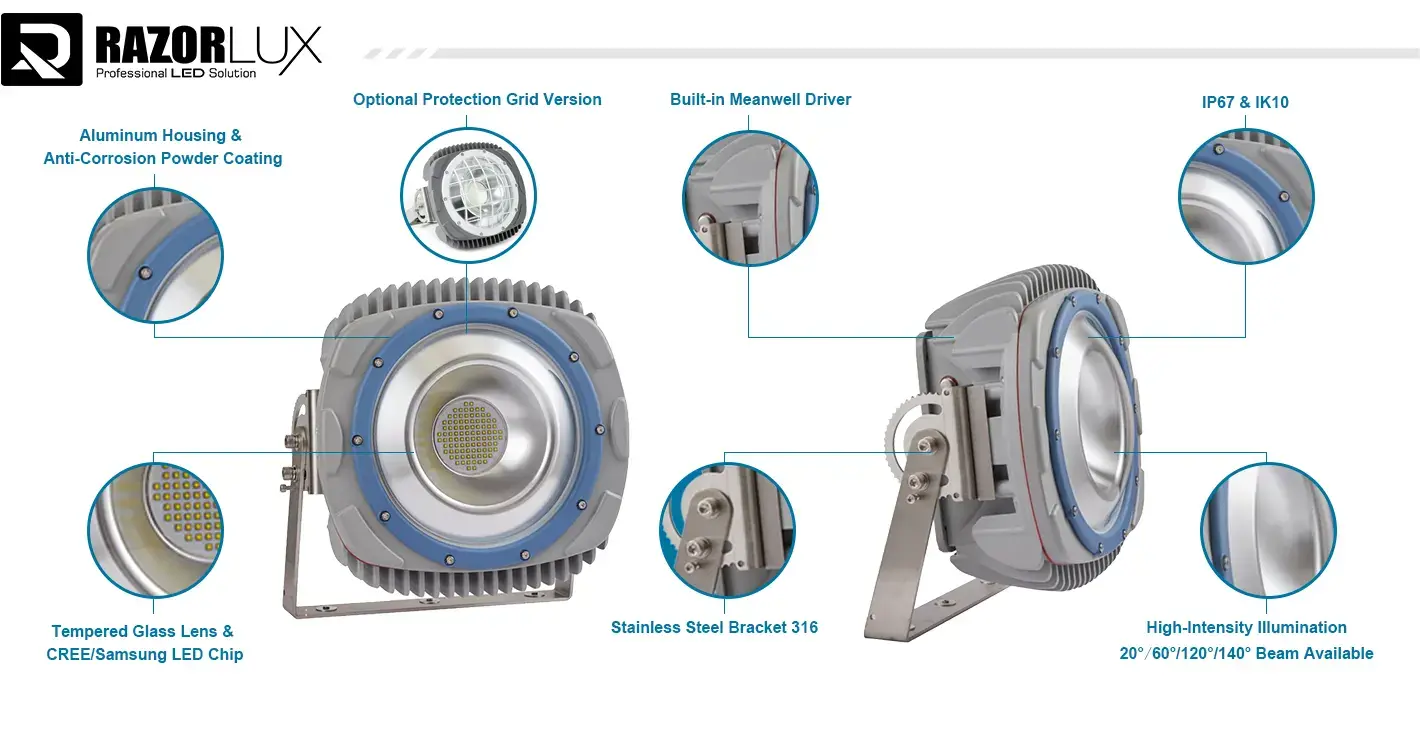
Optics, is about where the light lands and how evenly it spreads. The RGL-120A has three beam angles to select from: 60°, 120° and 140°x60°. The 60° beam concentrates light in a specific region and is ideal for pole mounted installations near the edge of a field. The 120° and asymmetric 140°x60° variant has a wider spread of light, ideal for indoor multi-purpose arenas. One of the most common installation problems is choosing the wrong beam angle which creates inconsistent illumination ratios that limit the player’s field of vision.
Color Rendering and Depth Perception
CRI (Colour Rendering Index) is a measure of how well a light source shows the colours of various objects compared with natural light. Standard CRI of Ra75, Ra80 and Ra90 versions are available from Razorlux upon request. Higher CRI significantly impacts a player’s ability to see the ball, follow opponents and interpret court markings. Broadcasting with a low CRI will wash out the picture and it will fail the 4K quality assessment. For locations with HD broadcast needs, fixtures with a Television Lighting Consistency Index (TLCI) rating of 85 or above are suggested.
Key Factors That Make LED Sports Lighting Ideal for Sports Visibility
Not every LED sports light works the same. There are certain technical factors that buying teams must look at before making a purchase decision that separate an okay installation from an excellent one.
Lumen Output and Illuminance Standards
International organisations such as IES and FIFA set minimum levels of lighting for sporting arenas. FIFA’s Category IV guideline for international television matches requires the playing field to have a minimum horizontal brightness of 2,000 lux. LED sports lighting fixtures include the Razorlux RGL-1000A, which requires 1,000W of electricity yet gives out 130,000 lumens, the equivalent of 2,200-2,500W HID installations, and hence can fulfil the demands of the biggest stadiums. The 120W RGL-120A offers 14,400 lumens of practical and cost-effective lighting for community courts and training facilities.
Here is an analysis of Razorlux's two main types to help buyers choose the right one:
Specs of RGL-120A and RGL-1000A? The rated power is 120W, and the rated power is 1000W. Lumen output: 14,400 lm Rated lumen output: 130,000 lm. The light efficiency is 130lm/W, and the rated colour temperature is 2000-6000K and 2700-6500K. It is IP67 certified and has an IK10 rated impact protection. The service life is ≥50,000 hours and the replacement HID lamps are 250–300W and 2200–2500W The LED and driver have a 5-year guarantee and are IK10 certified.
| Specification | RGL-120A | RGL-1000A |
|---|---|---|
| Rated Power | 120W | 1000W |
| Lumen Output | 14,400 lm | 130,000 lm |
| Lamp Efficiency | 130 lm/W | 130 lm/W |
| Color Temperature | 2000–6000K | 2700–6500K |
| IP Rating | IP67 | IP65 (upgradeable to IP67) |
| IK Rating | IK10 | IK10 |
| Working Life | ≥50,000 hrs | ≥50,000 hrs |
| Replace HID | 250–300W | 2200–2500W |
| Warranty (LED/Driver) | 5 years | 5 years |
The two types are shown next to each other, and you can see that they both have the same core efficiency rate of 130 lm/W and the same warranty. The RGL-1000A is designed for professional stadium use.
Energy Efficiency and Operating Costs
Both the RGL-120A and the RGL-1000A are at the 130 lm/W level that is suggested for corporate usage. The power cost for five hundred 1,000W metal halide lamps running 2,000 hours per year is around $10,000 ($10/kWh). They produce the same amount of lumens as the 1000W LED equivalents but the number is more than halved. Five year guarantee and the savings add up rapidly.
IP67 Weatherproofing and IK10 Impact Resistance
Lighting at outdoor venues can be destroyed by rain, moisture, dust, balls or maintenance equipment. The RGL-120A is IP67 rated, meaning it is fully dustproof and can be immersed in water up to one metre. The best kind offers IK10 (IEC 62262) impact safety. It’s capable of 20-joule hits. These two classifications make this fixture an ideal choice for areas where shaking and impact happen regularly such covered stadium ceilings, open sideline poles, and lighting masts.
Installation and Maintenance Best Practices to Ensure Maximum Light Performance
Even well-specified fixtures produce poor results if installed incorrectly. A disciplined installation process protects the investment and ensures the lighting system performs as intended from day one.
Site Assessment and Fixture Placement
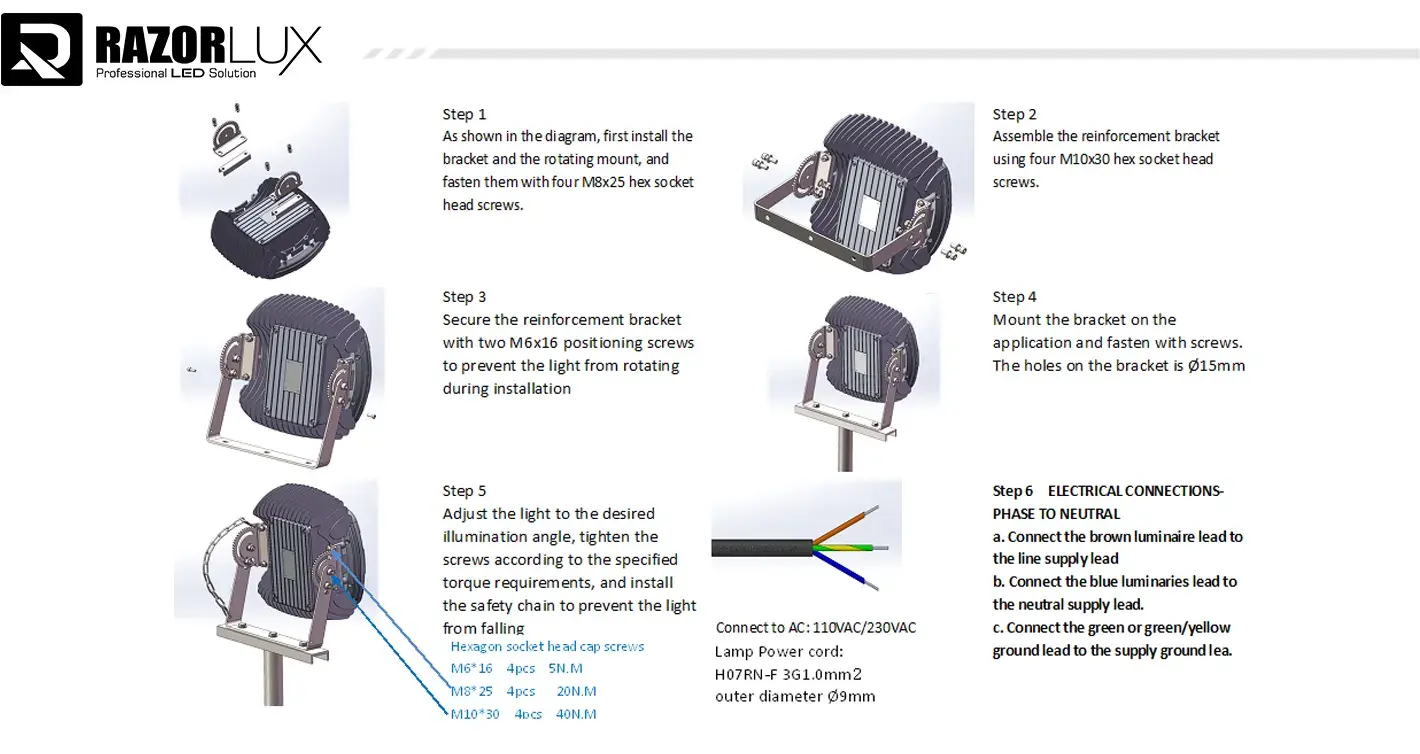
ngineers should do a photometric simulation in DIALux or equivalent software before the first led sports lighting fixtures is ever installed. In this stage, the pole heights, aiming angles and distance between fixtures are calculated such that they reach the desired uniformity ratio (U1/U2). For football fields which need an U1 ratio above 0.7, the pole arrangement is usually either four-corner or six-pole perimeter. The RGL-120A weights 8 kg and has a stainless steel mount for easier structural load calculation and multi-angle tilt for precision targeting.
Routine Cleaning and Inspection Schedules
Lumen output drops over time because dust collects on the surfaces of the lens – termed luminous depreciation. Annual output loss of 5–10% due to dust accumulation in dusty surroundings can be prevented by quarterly wash cleaning of the PC or PMMA lens surface using a non-abrasive cloth. At the same time, inspectors should examine for corrosion of terminal connections and bracket bolts, especially if salt air is present, such as in coastal installations where salt air speeds oxidation. The Razorlux fixtures have a powder-coated aluminium casing which gives a basic level of protection but personal inspection is still a good practice.
Retrofit Strategies for Existing Venues
The main challenge for venues with ageing metal halide systems is that the current poles and wiring were sized for 250-400W lamps. Switching to LED does not mean a rebuild of the infrastructure. The RGL-120A is compatible with the majority of current electrical supplies and does not require any additional converters, accepting an input voltage range of AC 80 to 315V and DC 80 to 400V. The stainless steel bracket design also allows for common pole installation options to dramatically reduce retrofit labour cost.
Comparing LED Sports Lighting Fixtures to Traditional Options for Superior Visibility
There's more to choosing LED lights over traditional ones than just comparing wattage. Total cost of ownership, light quality measures, and long-term support are all things that procurement teams need to think about.
Light Quality Metrics: Flicker, CRI, and Warm-Up Time
After being turned on, metal halide lamps need 15–20 minutes to reach full power. Also, they flicker a lot at 50/60 Hz cycles, which is what makes the "strobe effect" happen when you play back slow-motion video. LED lights get bright right away and have flicker rates below 1% ripple, which is important for places that show live TV events. With a power factor of ≥0.98 and a THD below 10%, the RGL-120A has stable electricity performance that lets you use lighting that works with cameras.
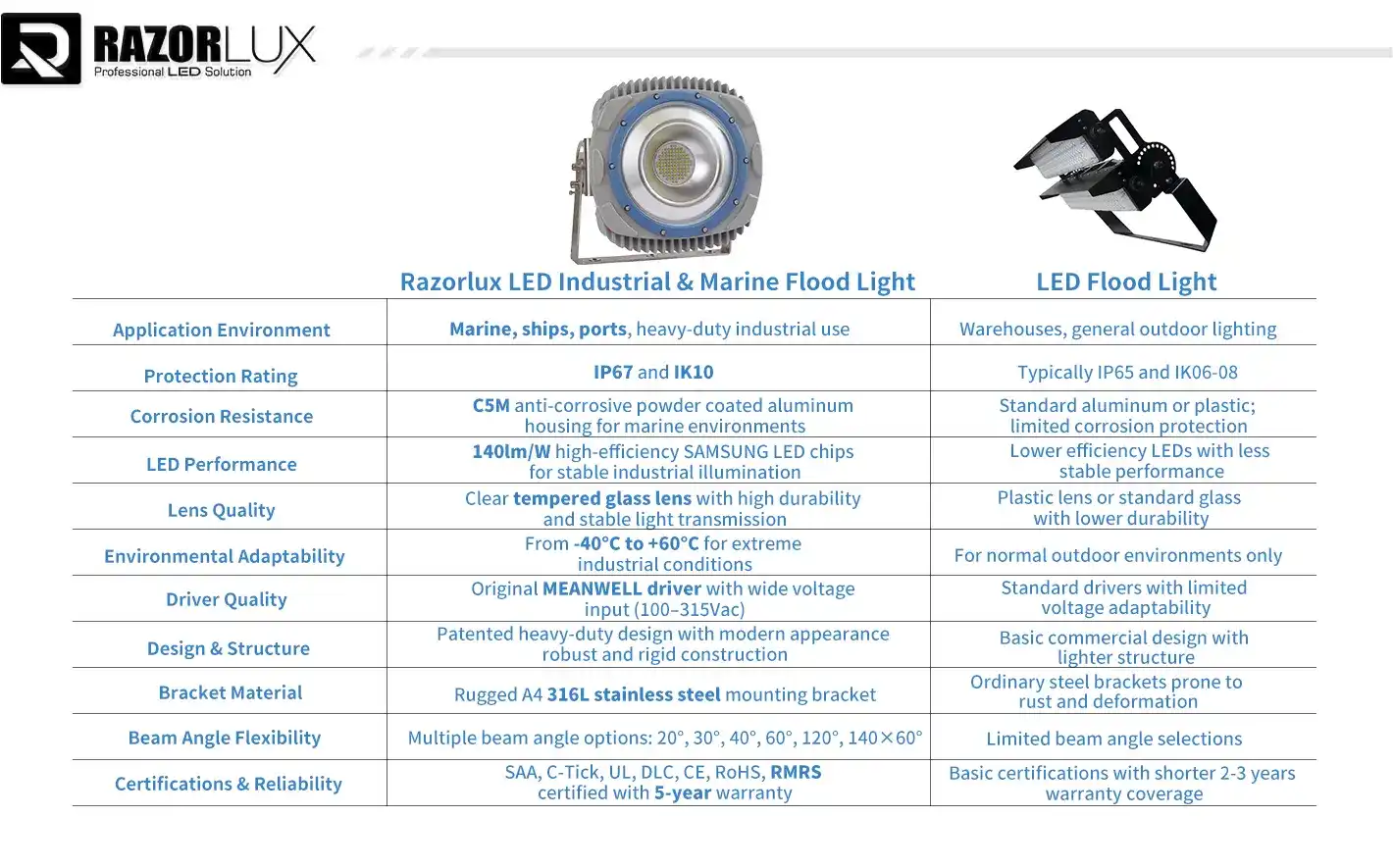
Here's a straight look at the differences between LED and standard HID lighting in the areas that procurement buyers care about the most:
There are two types of performance factors: LED (RGL-120A) and Metal Halide (250W equiv.). The warm-up time is instant, and the flicker rate is low to moderate to high. The lamp efficiency is 130 lm/W or 80–95 lm/W, and the rated lifespan is 50,000 hours or 10,000–20,000 hours. The energy consumption is 120W or 250–300W, and the IP rating is IP67 (usually IP54–IP65). The CRI is ≥Ra75 or ~Ra65. The warranty period is 5 years or 1–2 years.
| Performance Factor | LED (RGL-120A) | Metal Halide (250W equiv.) |
|---|---|---|
| Warm-Up Time | Instant | 15–20 minutes |
| Flicker Rate | <1% | Moderate to high |
| Lamp Efficiency | 130 lm/W | ~80–95 lm/W |
| Rated Lifespan | ≥50,000 hrs | 10,000–20,000 hrs |
| Energy Consumption | 120W | 250–300W |
| IP Rating | IP67 | Typically IP54–IP65 |
| CRI | ≥Ra75 | ~Ra65 |
| Warranty | 5 years | 1–2 years |
The data shows that LED technology brings about significantly better visibility, along with lower operating costs and longer service intervals.
Total Cost of Ownership
LED sports lighting fixtures cost more up front than metal halide ones. When maintenance costs, lamp replacements, and energy bills are spread out over 10 years, however, LED systems always have a lower total cost. Every 10,000 to 20,000 hours, metal halide lamps need to be replaced. With an LED lifespan of 50,000 hours, one LED fixture cycle is equal to three to five halide lamp replacements. This saves money on hiring access equipment, labor, and disposal fees for three to five cycles.
Certifications That Validate Performance Claims
Certification groups check maker claims on their own. The RGL-120A from Razorlux is certified by CE, RoHS, SAA, C-Tick, UL, DLC, CB, and ISO 9001. DLC (DesignLights Consortium) certification is especially important for buyers in North America because it lets lights qualify for utility refund programs that lower installation costs even more. UL listing proves that the product meets U.S. electricity safety standards, which is a common condition in American stadium buying rules.
Emerging Trends and Future Innovations in LED Sports Lighting Technology
The industry is moving toward smarter, more connected lighting systems that do more than illuminate a playing surface.
Adaptive Lighting Controls and IoT Integration
DALI and 0-10V dimming protocols enable venue operators to remotely modify lighting settings based on event type, time of day or broadcast needs. IoT-enabled fixtures can take scheduling commands, monitor energy use in real time, and create alarms when a driver or module starts to fail. This data driven strategy saves reactive maintenance and extends the service intervals of the fixtures.
Sustainability and End-of-Life Management
LED fixtures do not contain mercury like metal halide lamps, which require controlled disposal under environmental regulations. Razorlux fixtures are designed with a 100% recyclable aluminium housing. As more governments adopt Green Building Standards and sports facilities seek LEED certification, the lack of hazardous elements in lighting systems is a procurement advantage.
Market Outlook and Future-Proofing Investments
The worldwide LED sports lighting market is predicted to surpass $4.1 billion in 2028, up from $2.3 billion in 2023, fuelled by stadium improvements, broadcast quality needs and energy regulations, according to MarketsandMarkets. Buyers specifying fixtures with open-protocol control interfaces rather than proprietary solutions now are protecting their infrastructure from obsolescence as smart building standards evolve.
Conclusion
Increasing game exposure is not simply one thing to change. LED sports lighting fixtures need to put out the proper amount of lumens, to represent colour accurately, to manage beam dispersion and to be designed to last in all types of weather. The Razorlux RGL-120A and RGL-1000A satisfy all these requirements with tested specifications: 130 lm/W efficiency, IP67 protection, IK10 impact resistance and an expected lifespan of 50,000 hours with a five-year guarantee. These data are not only marketing promises, they are a means for procurement managers to evaluate vendors and create a basis for long term performance.
FAQ
What lumen output do I need for an outdoor football field?
FIFA Category II standards for training grounds recommend a minimum of 500 lux horizontal illuminance. For top-level match play with broadcast coverage, 1,500–2,000 lux is typical. The RGL-1000A at 130,000 lumens per unit is designed for professional-level applications, while the RGL-120A suits community fields and training facilities.
What does IP67 mean for a sports light?
IP67 means the fixture is fully protected against dust ingress and can withstand immersion in water up to one meter deep for 30 minutes. For outdoor sports venues exposed to heavy rain, this rating ensures continued operation without water damage.
Can Razorlux fixtures replace existing metal halide installations?
Yes. The RGL-120A accepts AC 80–315V and DC 80–400V input without an additional adapter, making it compatible with most existing electrical supplies. The stainless steel bracket fits standard pole mounting systems.
Are Razorlux fixtures eligible for energy rebates in the US?
The RGL-120A holds DLC certification, which qualifies it for utility rebate programs offered by many U.S. energy providers. Buyers should check with their local utility for specific rebate amounts.
What warranty does Razorlux offer?
The LED module and driver each carry a five-year warranty. The housing carries a ten-year warranty. Razorlux also provides technical assistance and replacement parts through after-sales support.
Get a Quote from Razorlux — Trusted LED Sports Lighting Fixture Manufacturer
Razorlux has been making high-quality lights for sports and factories since 1998. They have over 200 patents and certifications, such as UL, CE, DLC, SAA, RoHS, and ISO 9001. Our team responds quickly with full technical documentation and sample fixtures for you to look over, whether you need to upgrade a single venue or place a bulk order for a stadium project. For a price quote on our Led sports lighting fixtures, please email sam@razorlux.com or go to razorlux.com. You can try out samples before you decide to place an order.
References
1. Illuminating Engineering Society (IES). IES RP-6-15: Recommended Practice for Sports and Recreational Area Lighting. IES, 2015.
2. MarketsandMarkets. LED Sports Lighting Market — Global Forecast to 2028. MarketsandMarkets Research, 2023.
3. FIFA. Football Stadiums: Technical Recommendations and Requirements, 5th Edition. FIFA, 2011.
4. U.S. Department of Energy (DOE). Solid-State Lighting Technology Fact Sheet: Flicker. DOE Office of Energy Efficiency and Renewable Energy, 2019.
5. DesignLights Consortium (DLC). Technical Requirements for Solid-State Lighting, Version 5.1. DLC, 2022.
6. DiLaura, D., Houser, K., Mistrick, R., & Steffy, G. The Lighting Handbook: Reference and Application, 10th Edition. Illuminating Engineering Society, 2011.