


_1750326878398.png)

Marine Flood Lights 1000W for Shipyards: Key Specs to Check
When you're sourcing high-intensity lighting for shipyards, the specifications behind Marine Flood Lights 1000W can make or break your project's safety, efficiency, and long-term cost structure. These industrial-grade luminaires are engineered to deliver between 100,000 and 130,000 lumens in demanding maritime environments where salt corrosion, vibration, and extreme weather conditions are constant threats. Unlike standard outdoor floodlights, marine-rated 1000W fixtures integrate specialized materials, advanced thermal management, and wide voltage tolerance to ensure uninterrupted operation on vessel decks, dry docks, and offshore platforms. Understanding the core specifications—from ingress protection ratings to driver reliability—empowers procurement managers to select lighting solutions that minimize maintenance downtime, reduce energy costs, and meet stringent maritime compliance standards.
Essential Specs to Check Before Purchasing Marine Flood Lights 1000W
Choosing what to buy depends on how well the technical requirements match up with your facility's practical needs and environmental issues. Not paying attention to important factors can lead to early failures, fines for not following the rules, or low lighting levels that put workers at risk.
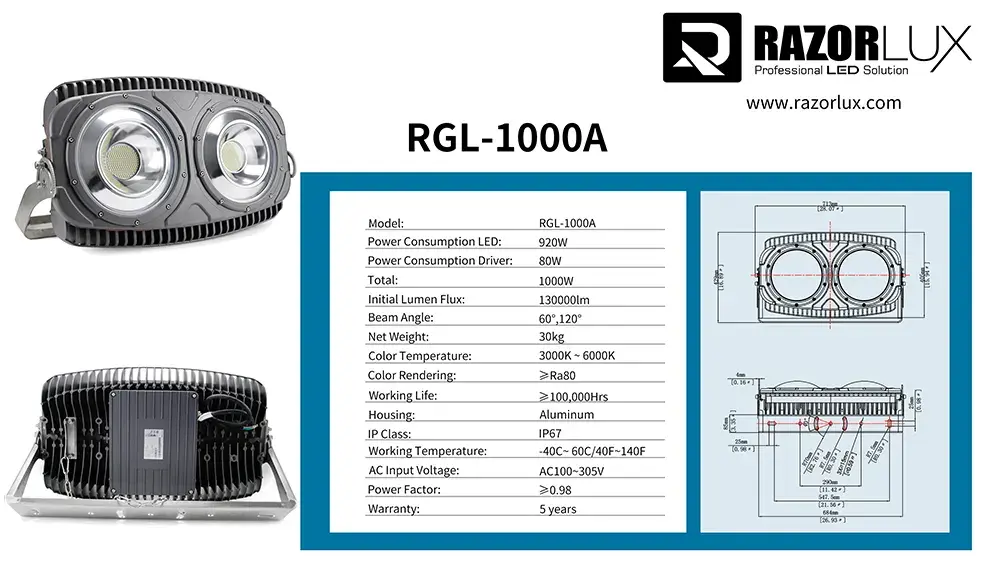
Ingress Protection and Environmental Sealing
The IP (Ingress Protection) number tells you how well a light keeps out dust and water. Shipyard uses need at least IP67, which means it is completely dust-tight and can withstand being submerged in water for 30 minutes at a depth of 1 meter. Fixtures with an IP67 rating keep water out when docks are being pressure washed, it rains hard, or waves spray on the docks. The IK rating for mechanical impact resistance is also very important. An IK10 rating means that the lens can withstand 20 joules of impact energy, which is the same as dropping a 5 kg object from 40 cm.
Color Temperature and Beam Angle Selection
Visibility and worker comfort are affected by color temperature. Fixtures with color temperatures between 5000K and 5700K are common in shipyards. These provide moderate white light that improves clarity and makes long work sessions easier on the eyes. You can choose the beam angle based on the covering area and height of the mounting. Narrow beams (15° to 30°) focus light for tall masts or specific tasks, while wide beams (60° to 120°) light the whole deck from lower mounting points. Some manufacturers offer asymmetric beam patterns (like 140°x60°) to keep light from spilling into nearby waterways as little as possible while still covering the whole deck.
Driver Quality and Power Factor
The generator changes the AC power that comes in to the DC current that the LED arrays need. Mean Well and other top-tier makers make drivers with power factors higher than 0.98 and overall harmonic distortion lower than 10%. This makes sure that the power is converted efficiently and in line with utility rules. It can accept a wide range of input voltages, including DC 127–431V or dual-range AC inputs, so it can work with both standard shore power and vessel electrical systems. Lightning strikes and switching surges that are common in Marine Flood Lights 1000W electrical networks can be stopped by integrated surge protection devices (SPD) with a rating of 10kV or higher.
Thermal Management and Lifespan
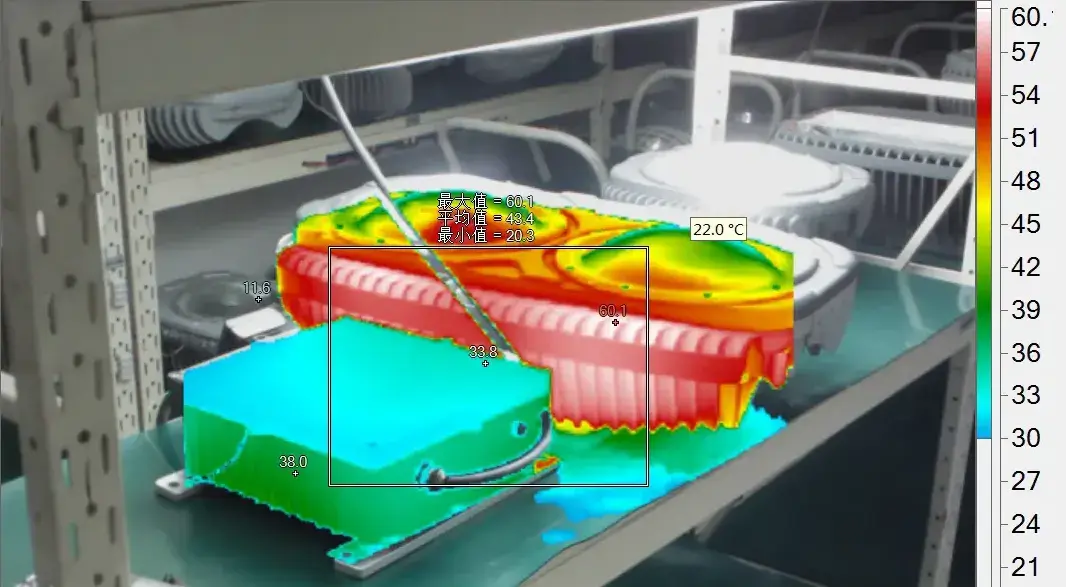
Junction temperature (Tj) has a direct effect on how long an LED lasts. When working at full power in 60°C ambient temperature, good naval floodlights use oversized heatsinks with optimized fin shapes or graphene-enhanced thermal interface materials to keep Tj below 85°C. This thermal control makes the light last longer than 50,000 hours at the L80B10 standard (maintaining 80% lumens with less than 10% catastrophic failures). That's more than 11 years of continuous use or 20+ years of normal duty cycles.
Comparing Top Marine Flood Lights 1000W Brands and Models
There are a lot of companies that make boat lights, and each one focuses on a different set of technical methods and certifications. Knowing these differences helps buying teams match the skills of a product with the needs of a project and the available funds.
Razorlux RGL-1000P: Integrated Innovation
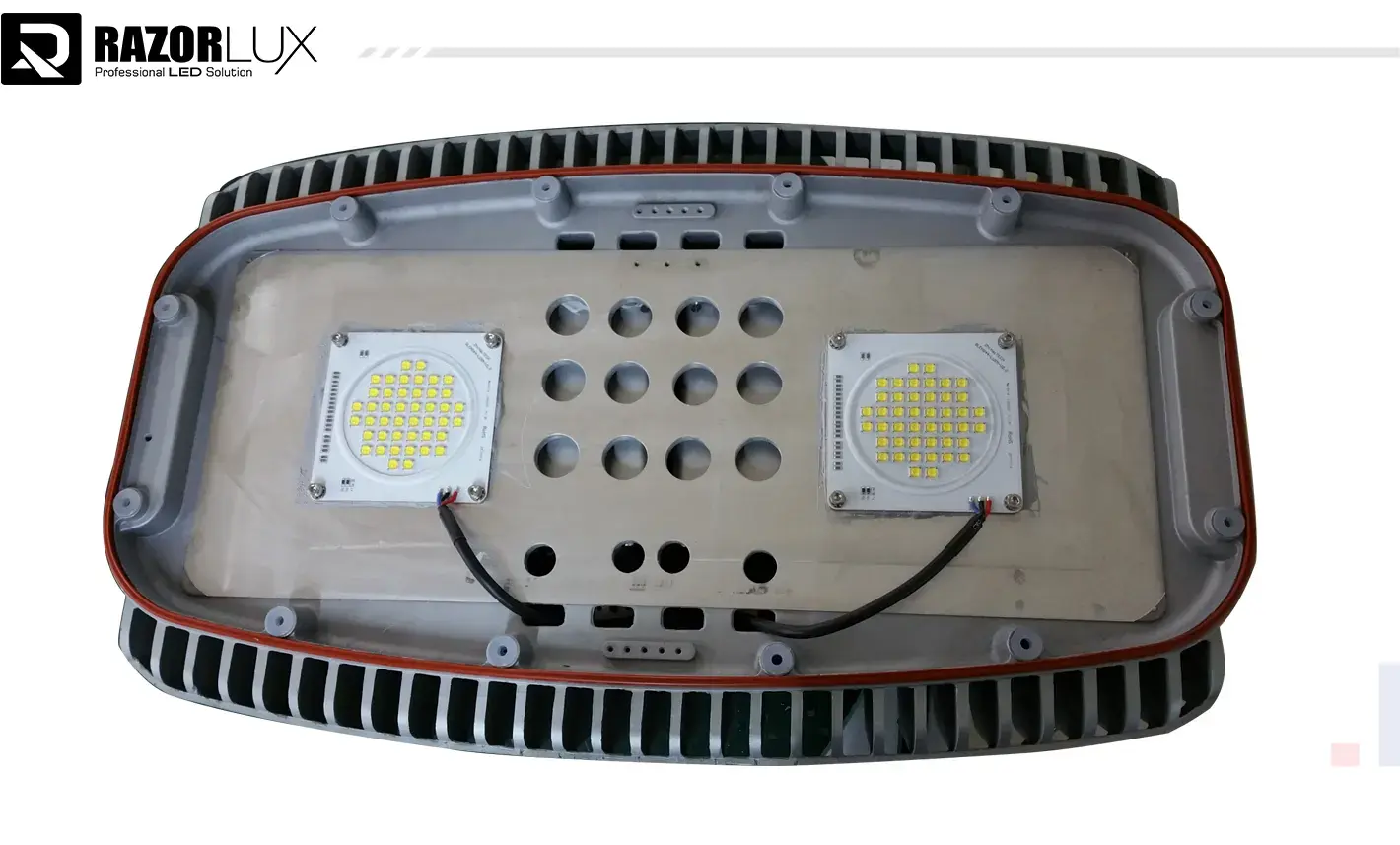
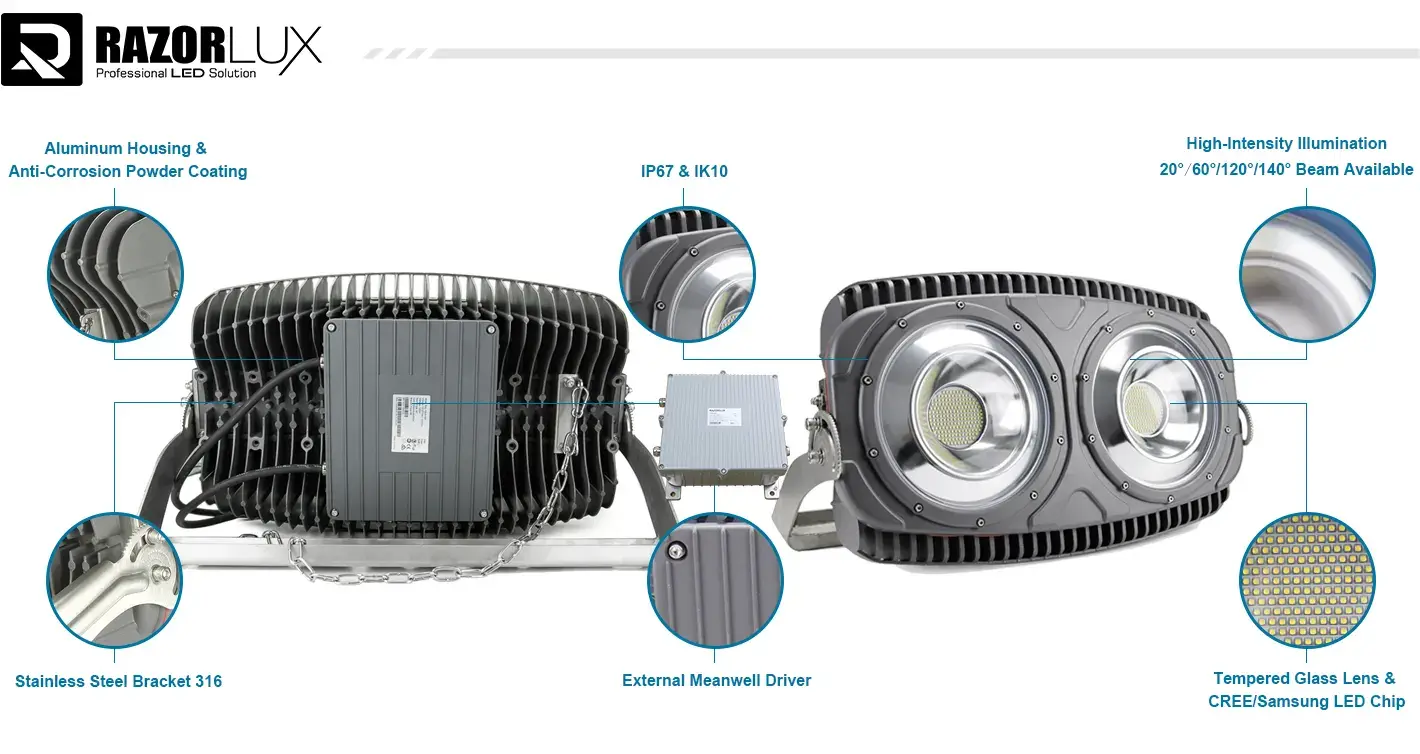
In terms of purpose-built naval engineering, Razorlux's RGL-1000P model is a great example. The light uses exactly 1000W (900W LED array plus 100W driver) and gives off 100,000 to 105,000 lumens, based on how the beam is set up. Its patented multi-function design lets you choose from seven different beam angles: 15°, 20°, 30°, 40°, 60°, 120°, and 140°x60°. This means that a single fixture platform can be used for a wide range of tasks, from searchlighting to general lighting.
The housing is made of powder-coated aluminum and weighs only 29 kg, which includes the stainless steel mounting bracket, which makes it easier to install on structures that need to be light. Wide voltage acceptance (AC 80–360V or DC 100–400V) lets it be used with a variety of electrical systems without any changes. Razorlux backs the RGL-1000P with a five-year warranty on both the LED modules and drivers, as well as a 10-year warranty on the housing. This shows that they are confident in the durability of the materials.
Philips and Osram: Established Reliability
In its marine lighting line, Philips focuses on driver safety and modular component repair, which makes it appealing to sites with complex maintenance plans. Osram works on high-tech optics and precise beam control, and they often use secondary lens systems to make sure that no light leaks out. Both brands cost a lot, but they come with a lot of global service networks and approvals from big classification societies like DNV-GL and Lloyd's Register.
Emerging Manufacturers: Cost Versus Certification
A number of new companies are making devices that are reasonably priced and work well enough for less demanding uses. Teams in charge of buying things should carefully check the legitimacy of certifications, since cheaper products often come with fake CE marks and test reports. Checking that certifications include the name of the maker, the model number, and the issuing body's contact information helps people avoid buying things that don't follow the rules, which could put their insurance coverage or governmental approvals at risk.
How to Choose the Best Marine Flood Lights 1000W for Your Shipyard: A Decision Guide
Finding lighting solutions that meet operational needs means finding a balance between technical performance, regulatory compliance, total cost of ownership, and the supplier's capabilities. A structured review system stops mistakes that cost a lot of money and makes sure that everyone is happy in the long run.
Assessing Operational Lighting Needs
First, set the amount of brightness that is needed based on industry norms. The International Association of Marine Aids to Navigation and Lighthouse Authorities (IALA) says that general deck areas should have at least 20 lux of light, while critical task zones like welding stations and inspection areas should have at least 200 lux. Figure out how many fixtures are needed by using photometric data from the manufacturer's IES files and taking into account the surface reflectance, including height and spacing.
Evaluating Environmental Challenges
In the Nordic regions, where shipyards are located, temperatures drop below freezing, so fixtures need to be rated for -40°C operation without heater elements. In tropical facilities, there is constant high humidity (95%+) and high temperatures that are getting close to 60°C. Extreme changes in temperature and dusty air are common in the Middle East. Instead of choosing general "marine-rated" goods that may not have been tested in this setting, make sure that the fixture specs are right for the job.
Calculating Total Cost of Ownership
The price you pay for something is only 20–30% of what it costs to own and run for 10 years. Lifecycle costs are mostly made up of energy use: a 1000W LED light that is on 12 hours a day for a year uses 4,380 kWh of electricity and costs $438 to $876 a year at the average industrial electricity rate of $0.10 to $0.20 USD per kWh. In difficult installs, maintenance costs can be higher than the cost of the fixtures themselves. These costs include staff for access, tools, new parts, and lost production time during outages. Even though they cost more up front, styles that use less energy and require less upkeep pay off in the long run.
Validating Supplier Credentials
A supplier's review goes beyond just looking at the product specs. It also looks at how well they can make the product, their quality systems, and their service infrastructure. Getting ISO 9001 certification shows that you handle quality in a planned way, and getting approvals for 1000W Marine Flood Lights like ABS, BV, DNV, and Lloyd's shows that you've done a good job of getting third-party validation. Ask for proof that production is still going on, like references from recent projects or pictures of the building, to make sure that you are the maker and not a distributor or trading business.
Razorlux runs several validation labs, including the Xi'an LED Lighting Engineering Laboratory, which is approved by China's National Development and Reform Commission. This lab allows for in-house testing of resistance to salt spray, thermal cycling, and photometric performance. Our 436 granted patents (and more than 300 pending) cover new ways to package LED chips, control driver algorithms, and design housings. This shows that we are continuously investing in engineering instead of just reselling the same old things.
Warranty and After-Sales Support
A full warranty guards against problems with the way the product was made and breakdowns that happen before they should. Leading makers offer different guarantee terms for LED modules, drivers, and housings because these parts fail in different ways and last for different amounts of time. Razorlux covers LED modules and drivers for five years and the housing frame for ten years, which is longer than the usual three-year warranty in the business.
Technical support that responds quickly is very helpful during installation problems and operational problems. Make sure that the supplier has English-speaking engineers who can be reached during business hours, gives you detailed installation guides with measurements, and does photometric calculations using professional software like DIALux or AGi32.
Marine Flood Lights 1000W Installation and Maintenance Best Practices
Proper fitting methods and regular maintenance schedules improve the performance of fixtures and increase their useful life in harsh Marine Flood Lights 1000W settings. Following the manufacturer's instructions and best practices in the business stops common failure modes and makes sure the system works safely.
Pre-Installation Planning and Site Survey
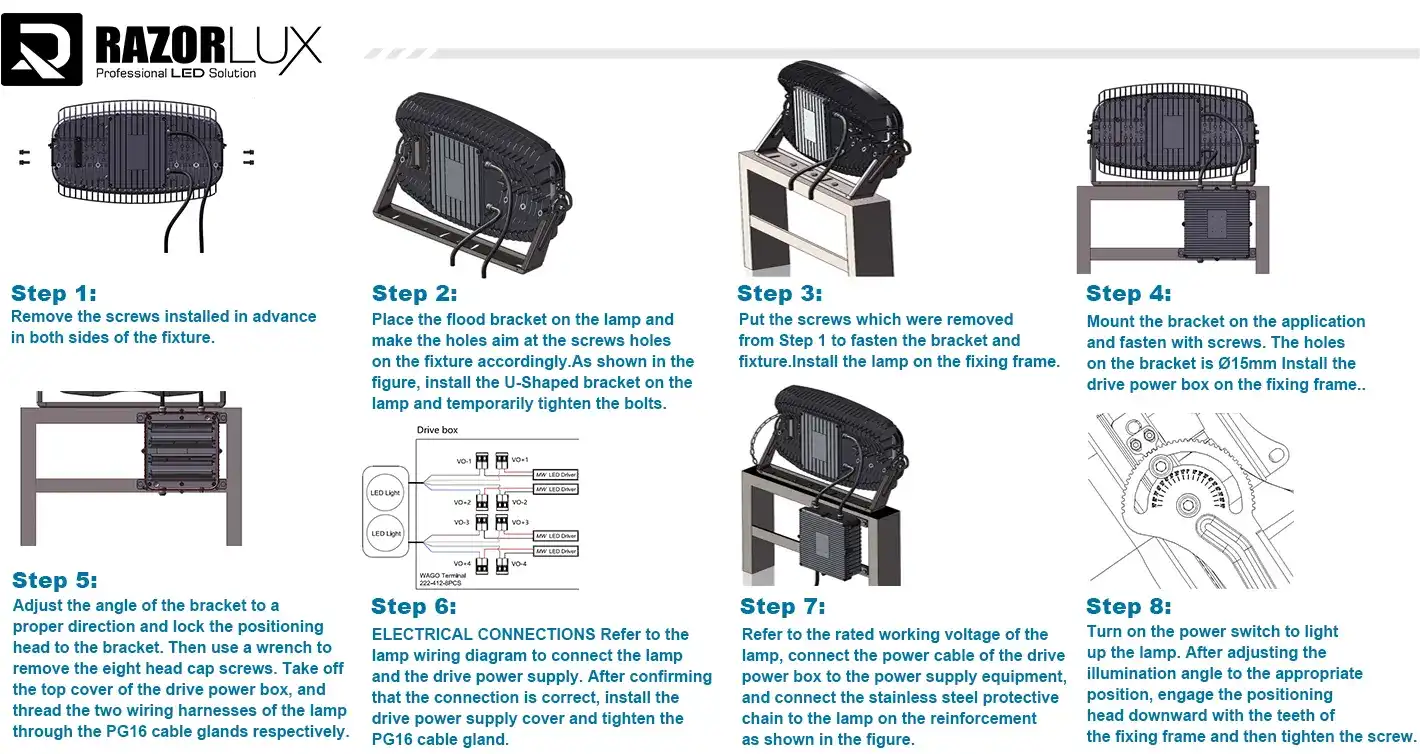
Before installation starts, use manufacturer IES files for photometric models to find the best places to put, the right heights, and the best angles for aiming. Check that the fixing surfaces are strong enough to hold the fixture's weight plus wind loads. An outdoor 29-kilogram floodlight will create a lot of wind resistance. Plan the path of the pipe so that it doesn't have any sharp turns that make pulling wires harder. Also, make sure that junction boxes don't get too much direct water spray.
Electrical Installation Requirements
When installing electrical systems in marine environments, you have to be very careful. To keep IP67 integrity at entry points, use cable glands with double O-ring seals. To stop galvanic corrosion, put dielectric grease on threaded connections. To add to the protection provided by fixtures, install surge protectors at panel locations. This will create a multilayered defense against sudden overvoltages. Before turning on the lights, check the voltage and frequency at the installation site. This is especially important on ships or bases that use generators for power.
In salty settings, grounding is very important. Use 316 stainless steel hardware to connect the fixture's grounding connections to the building's equipotential bonding system. This will stop voltage differences that speed up rusting. Aluminum fixtures and steel structures shouldn't come into direct contact with each other. To keep the two metals from touching, use nylon isolation washers or stainless steel adapter plates.
Initial Commissioning and Aiming Adjustment
Once the power is connected, use a variable transformer to make sure the device works correctly across the entire input voltage range. Use a calibrated lux meter to check the design calculations by measuring the amount of light at key deck spots and changing the fixture's aim as needed. Take pictures and write down the angles of the final aiming points to make it easier to fix them after repair or replacement. Some places put up paper aiming maps near where the mounts will go so that maintenance teams can use them as a guide.
Preventative Maintenance Protocols
Marine floodlights need to be checked and cleaned every three months to keep working at their best. Pollutants in the air and salt build up on lens surfaces, cutting light transmission by 20 to 40 percent after months of use. To clean lenses, use a mild soap and a soft cloth. Do not use rough materials that can scratch the protective coatings. Check the mounting hardware for corrosion and tighten the bolts to the recommended torque levels (usually 25 to 35 Nm for M12 mounting bolts).
Check the electrical connections once a year to make sure they are still tight and free of rust. If necessary, add new dielectric grease. Check the lens seals for cracks or thickening, and replace the gaskets before they break if it looks like they might. Check the lumen output with a lux meter at set reference points and compare the readings to the initial settings to find signs of LED degradation or driver failures before they cause complete power outages.
Troubleshooting Common Failure Modes
Knowing how most problems happen speeds up the troubleshooting process and lowers downtime. It's more likely that a driver failure than an LED failure caused by wear and tear. Check the input power and driver output voltage before giving up on the light. Progressive dimming is a sign of problems with thermal management. Clean the heatsink fins to get air flowing again, and make sure the room temperature stays within the range of acceptable levels. Flickering or unstable output means that the electrical connections are bad or that the input voltage is low. Check the voltage while the load is on and look for loose or corroded terminations.
Water getting into the lens shows up as condensation or as visible corrosion on the LED boards. This usually happens because the seals were broken or the gaskets weren't installed correctly during the last repair. Take apart the fixture in a controlled setting to keep any extra water out. Thoroughly dry the inside parts, replace all the seals, and make sure the gaskets fit properly before putting it back together.
Certification and Compliance Considerations
Maritime lighting systems have to meet a lot of different rules and regulations, including those that protect the environment, electrical safety, and industry-specific standards. Installations that don't follow the rules could lose their insurance, be fined by the government, or be held responsible during an investigation into an accident.
Essential Safety Certifications
CE marking shows that a product meets European Union regulations, but it doesn't mean that the rules are being followed. Make sure that the CE declarations refer to specific directives (Low Voltage Directive 2014/35/EU, EMC Directive 2014/30/EU) and include test report numbers from accredited laboratories. In addition to UL 1598, UL 1598A has special rules for installing things on naval vessels. These rules cover wiring methods, resistance to corrosion, and shaking tolerance that are specific to shipboard settings. UL listings from well-known testing labs offer more confidence than uncertified CE statements.
Classification Society Approvals
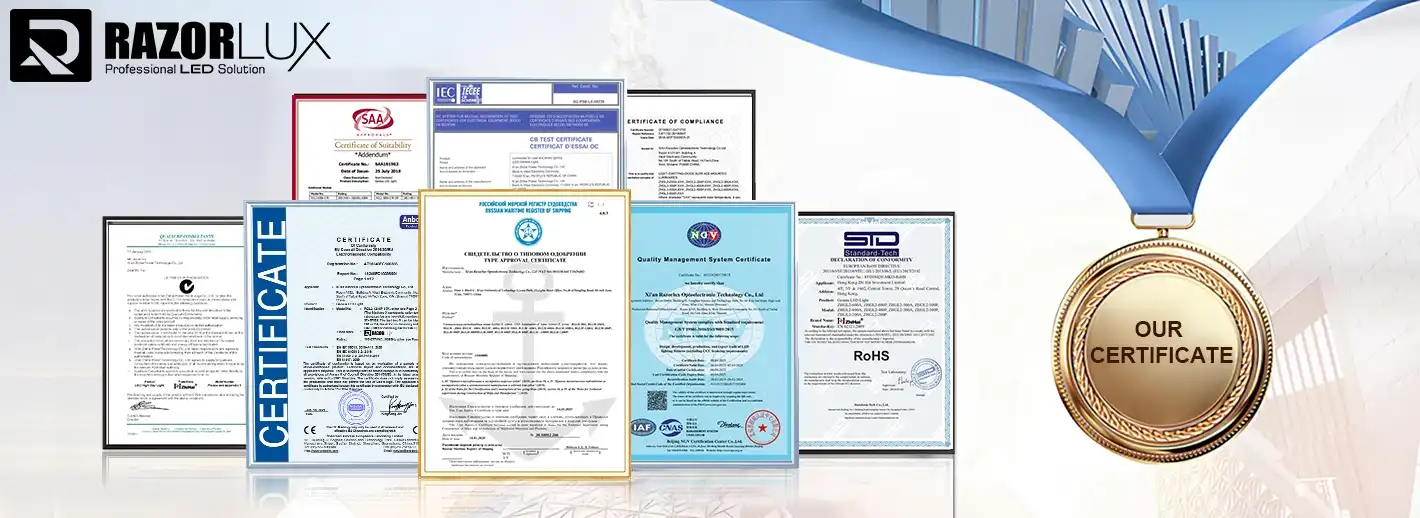
Internationally registered ships usually need lighting that has been cleared by classification groups such as Bureau Veritas, ABS (American Bureau of Shipping), DNV (Det Norske Veritas), Lloyd's Register, or ABS. In addition to normal electrical safety licenses, these approvals include type tests for vibration, EMC protection, and environmental exposure. Fixtures that are going to be installed on a vessel should have the right society stamps or approval papers on them. To avoid fake paperwork, buying teams must check these documents against society databases.
Razorlux has RMRS (Russian Maritime Register of Shipping) certification as well as CE, RoHS, SAA, UL, DLC, and CB certifications. This means that it can be used in maritime markets around the world without having to wait for extra approvals. Our certificates are checked for validity on a regular basis to make sure they stay valid and keep up with changing standards.
Environmental and Energy Regulations
RoHS (Restriction of Hazardous Substances) compliance gets rid of lead, mercury, cadmium, and other harmful materials used to make fixtures. This makes them easier to throw away when they're no longer needed and keeps repair workers from being exposed. Getting certified by the DesignLights Consortium (DLC) lets you use energy-saving rebate programs in North America, which lower the net cost of buying lights by 15 to 30 percent in utility areas that participate. Some types of products get similar benefits from ENERGY STAR certification, but high-output industrial fixtures often go beyond what ENERGY STAR covers.
Real-World Applications and Case Studies
When you look at setups that have worked well, you can see how the choices you make about specifications help solve real-world problems. This gives you more than just theoretical performance claims.
Shipyard Dry Dock Lighting Upgrade
A Nordic shipyard replaced 100 old 2000W metal halide fixtures with 60 new 1000W LED floodlights. This cut the total lighting load from 200kW to 60kW and raised the average brightness of the deck from 35 lux to 50 lux. The instant-on feature of the LED lights got rid of the 10-minute warm-up times that came with HID lamps, which increased output during short maintenance windows. The building's changing supply (190-240VAC) could be handled without any extra control thanks to the wide voltage tolerance. The project paid for itself in 18 months by saving energy and getting rid of the need to replace HID lamps every three months, which saved an average of $8,500 a year.
Offshore Platform Helideck Compliance
Updating the lighting around an offshore oil platform's helideck was needed to meet new rules from the Civil Aviation Authority that said the lighting had to be at least 150 lux. Because of the platform's weight limits and high corrosion risk, the fixtures had to be very light and long-lasting. Installed floodlights with 140°x60° asymmetric beam patterns provided the necessary illumination with 40% fewer outlets than symmetric beam options, which reduced the load on the structure and the amount of work needed to place them. After five years, the fixtures are still working at 92% of their original capacity with no problems, even though they are constantly exposed to salt spray and the temperature changes from -20°C to +45°C.
Port Terminal Area Lighting
A Southeast Asian port authority improved the lighting in 3.2 kilometers of shipping terminals by using high-efficiency LED floodlights that can work with a wide range of voltages (AC 90–305V). Because of the voltage tolerance, the site's old electrical system didn't need 48 voltage controllers, which saved $34,000 in equipment costs. Over the course of five years, the 130 lm/W fixture efficiency cut electricity use by 7.2 million kWh, which saved $864,000 in energy costs and cut carbon emissions by 4,320 metric tons.
Cost Analysis and Return on Investment
Knowing how different lighting options will affect your finances helps you make smart purchasing choices that balance limited funds with cost-effectiveness and longevity.
| Cost Factor | Traditional 2200W Metal Halide | 1000W LED Floodlight | Difference |
|---|---|---|---|
| Fixture Purchase Price | $850 | $1,450 | +$600 |
| Installation Labor (per fixture) | $220 | $220 | $0 |
| Annual Energy Cost (4,380 hrs/year @ $0.12/kWh) | $1,157 | $526 | -$631 |
| Annual Maintenance Cost | $185 (lamp replacement + labor) | $25 (cleaning) | -$160 |
| 10-Year Energy Cost | $11,570 | $5,260 | -$6,310 |
| 10-Year Maintenance Cost | $1,850 | $250 | -$1,600 |
| Total 10-Year Cost | $14,490 | $7,960 | -$6,530 (45% reduction) |
Comparing the two shows that LED lights have better lifetime value, even though they cost more at first, because they use less energy and don't need as much upkeep. The time it takes to get your money back depends on the electricity rate and duty cycle.
Energy Efficiency Impact
Facilities that have lights on all the time get their money back faster than those that only use them sometimes. A shipyard with 12-hour night shifts (4,380 yearly hours) breaks even in 18 months, while a port station that is open 24 hours a day, seven days a week, eight thousand hours a year, pays for its LED premiums in just eleven months. For these figures, the cost of energy is $0.12/kWh. Places with higher rates, like the Middle East and some parts of Europe, see returns that are relatively faster.
Avoided Replacement Costs
Metal halide lights break down quickly in salt water, and they usually need to be replaced every 6,000 to 9,000 hours, even though the manufacturers say they can last for 15,000 hours or more. Each repair costs between $45 and $75 for the lamp and between 1.5 and 2 hours of work, which adds up to $150 to $220 per event. Facilities with tough mounting spots, like offshore platforms or tall masts, have to pay even more for labor because they need to use cranes or Marine Flood Lights 1000W vessels to move the workers. These ongoing costs are completely eliminated by LED fixtures, which only need to be cleaned and inspected once a year for maintenance.
Technical Specifications Comparison Table
| Specification Parameter | Razorlux RGL-1000P | Industry Standard Range | Performance Advantage |
|---|---|---|---|
| Rated Power Consumption | 1000W (900W LED + 100W driver) | 950W - 1,200W | Precise power management |
| Luminous Output | 100,000 - 105,000 lm | 95,000 - 130,000 lm | High-efficiency baseline |
| Luminous Efficacy | 130 lm/W | 110 - 150 lm/W | Above-average efficiency |
| Color Temperature Options | 2700K - 6500K | Fixed 5000K - 5700K typical | Application flexibility |
| CRI (Color Rendering Index) | Ra>75 (Ra>80, Ra>90 optional) | Ra>70 - Ra>80 | Enhanced visual accuracy |
| Input Voltage Range (AC) | 80-360VAC (90-305VAC standard) | 100-277VAC typical | Superior voltage tolerance |
| Input Voltage Range (DC) | 100-400VDC or 500-800VDC | 120-277VDC typical | Vessel compatibility |
| Power Factor | ≥0.98 | ≥0.90 - ≥0.95 | Minimized reactive power |
| Total Harmonic Distortion | <10% | <15% - <20% | Reduced electrical interference |
| IP Rating | IP67 | IP65 - IP67 | Maximum water protection |
| IK Rating | IK10 | IK08 - IK10 | Maximum impact resistance |
| Operating Temperature Range | -40°C to +60°C | -30°C to +50°C typical | Extended environmental range |
| Beam Angle Options | 7 options (15° to 140°x60°) | 3-4 options typical | Application versatility |
| Rated Lifespan | ≥50,000 hours (L80B10) | 40,000 - 60,000 hours | Long-term reliability |
| Warranty Period | 5 years (LED/driver), 10 years (housing) | 3-5 years typical | Extended protection |
This comparison of specifications shows that Razorlux fixtures meet or beat industry standards in key performance areas. They also offer more freedom by supporting a wide range of voltages and allowing for multiple beam angle setups from a single fixture platform.
Conclusion
When choosing Marine Flood Lights 1000W for use in a shipyard, it's important to carefully consider the specifications for protection against water and debris, energy efficiency, voltage tolerance, and material durability. Because of the hard facts of corrosion from saltwater, high temperatures, and mechanical vibration, fixtures must be custom-built to go above and beyond standard industrial ratings. Lifecycle cost should be more important than initial price when making purchasing decisions, since energy use and maintenance costs make up most of the total ownership costs over 10 to 15 years of use.
Manufacturers of high-quality goods can be told apart from others by having full certifications from well-known testing and classification societies, using systematic quality management that is backed up by ISO 9001, and offering warranties that are backed by established manufacturing facilities instead of trading operations. Switching from metal halide to LED technology saves money because it uses 55–65% less energy and doesn't need to change lamps as often. Usually, the payback time is less than two years.
Razorlux has more than 25 years of experience in power supplies and thermal control, as well as specialized marine engineering that is backed by RMRS, UL, and other world certifications. Our RGL-1000P platform has 130 lm/W efficiency, 316L stainless steel mounting hardware, industrial-grade Mean Well drivers, and different beam angle options so that a single fixture design can be used in a variety of installation situations.
FAQ
1. What makes Marine Flood Lights 1000W different from standard industrial floodlights?
Marine-rated lights are made with special materials that don't rust, like copper-free aluminum housings with a C5-M powder coating and 316L stainless steel parts that can handle being exposed to salt spray. They have better sealing (at least IP67) to keep water out during pressure washing or wave splashing, and they also have IK10 impact resistance for mechanical protection. Wide voltage tolerance lets shaky vessel electrical systems work, and strong heat management makes sure that the system works reliably in temperatures ranging from -40°C to +60°C.
2. Can LED Marine Flood Lights 1000W truly replace 2000W metal halide fixtures?
Yes, because it has better visual control and a higher luminous efficacy. LED fixtures get 130 lumens or more per watt, while metal halide fixtures only get 70 to 90 lumens per watt. They also only shine light in one direction, so less light is wasted. A good 1000W LED floodlight gives off the same amount of light as, or more than, 2000–3000W HID lamps, but it uses 55–70% less energy.
3. What voltage compatibility should I specify for shipyard installations?
Standard industrial power (208–480VAC in North America and 380–400VAC in Europe and Asia) is usually used in shipyards that are on land. Choose devices with input values of 90–305VAC or more to account for voltage drops when the motor starts up or the generator load switches. For placements on ships, they might need DC input (100–400VDC) so they can connect straight to the ship's electrical systems. You can plug in either AC (80–360VAC) or DC (100–400VDC or 500–800VDC) to a Razorlux light.
4. How do I verify certification authenticity?
Ask for all the certification paperwork, such as test report numbers, the names of the labs that issued the certificates, and the times that the certificates are valid. Check certifications using databases maintained by the issuing body. For example, UL has a public directory of product certifications, and classification societies provide verification services for approved equipment. "LED floodlight" descriptions are not used on real certifications; instead, specific manufacturer names and model numbers are listed. Razorlux sends full paperwork packages with all of their products, which include copies of their certifications and test results.
5. What maintenance schedule is appropriate for marine floodlights?
Clean the lenses every three months with a mild detergent to get rid of salt deposits and get the light passing through again. Do electrical tests once a year to make sure connections are tight, grounding is continuous, and plugs are not breaking down. Keep track of lumen loss over time by writing down measures of illuminance taken at set reference points. Gaskets and seals should be replaced every 5 to 7 years, before they start to show signs of wear. This preventative approach keeps performance at its best and keeps you from having to make emergency repairs when something goes wrong.
Partner with Razorlux for Your Marine Lighting Solutions
Marine equipment developers and procurement managers in shipyards need Marine Flood Lights 1000W providers who know how to work in harsh conditions and understand the technical challenges that come with it. Razorlux makes custom lighting solutions that are backed by 436 granted patents, full global certifications, and performance that has been tested in hundreds of installations around the world.
Our RGL-1000P platform has a 130 lm/W efficiency and a patented multi-function design that supports seven beam angle setups. This makes inventory simpler and meets a wide range of application needs. Mean Well drivers that can handle a wide range of voltages (AC 80–360V, DC 100–400V) make sure that they work reliably in all of the world's electrical systems. The IP67/IK10 grades and 316L stainless steel mounting tools make this product durable enough for long-term use in marine environments.
Our five-year warranty on LED modules and drivers—extending to 10 years for housing structures—demonstrates confidence in manufacturing quality and provides financial protection against premature failures. Dedicated after-sales support addresses installation questions, provides maintenance guidance, and ensures rapid response for any service requirements.
Contact our specification team at sam@razorlux.com to discuss your project requirements. We'll provide detailed technical recommendations, photometric analysis, and competitive quotations tailored to your facility's operational needs.
References
1. International Electrotechnical Commission. (2022). IEC 60092-306:2022: Electrical Installations in Ships — Part 306: Equipment — Luminaires and Lighting Accessories. Geneva: IEC.
2. International Electrotechnical Commission. (1989). IEC 60529:1989: Degrees of Protection Provided by Enclosures (IP Code). Geneva: IEC.
3. International Electrotechnical Commission. (2002). IEC 62262:2002: Degrees of Protection Provided by Enclosures for Electrical Equipment Against External Mechanical Impacts (IK Code). Geneva: IEC.
4. International Electrotechnical Commission. (2017). IEC 60068-2-52:2017: Environmental Testing — Part 2-52: Tests — Test Kb: Salt Mist, Cyclic (Sodium Chloride Solution). Geneva: IEC.
5. International Electrotechnical Commission. (2007). IEC 60068-2-6:2007: Environmental Testing — Part 2-6: Tests — Test Fc: Vibration (Sinusoidal). Geneva: IEC.
6. International Organization for Standardization. (2015). ISO 9001:2015: Quality Management Systems — Requirements. Geneva: ISO.