


_1750326878398.png)

Marine Flood Lights: What Features Should You Look For?
When buying marine flood lights for a vessel, offshore platform, or dock facility, the improper choice may lead to premature fixture failure, expensive mid-project replacements, and safety issues. Marine flood lights are powerful, wide-angle luminaires built for saltwater, continual vibration, and high-humidity environments that would rapidly deteriorate regular outdoor lamps. Unlike general-purpose floodlights, they need to fulfill stringent protection requirements, have globally recognized certifications, and produce steady output for 50,000+ hours. In this article, we’ll break down all the features that matter before you make a bulk purchase or submit a project request.
Understanding Marine Flood Lights: Key Features and Specifications
Before comparing products, it helps to understand what separates a purpose-built marine fixture from a generic Waterproof Floodlight. The differences are technical, material-based, and certification-driven.
What Makes a Flood Light Truly "Marine Grade"
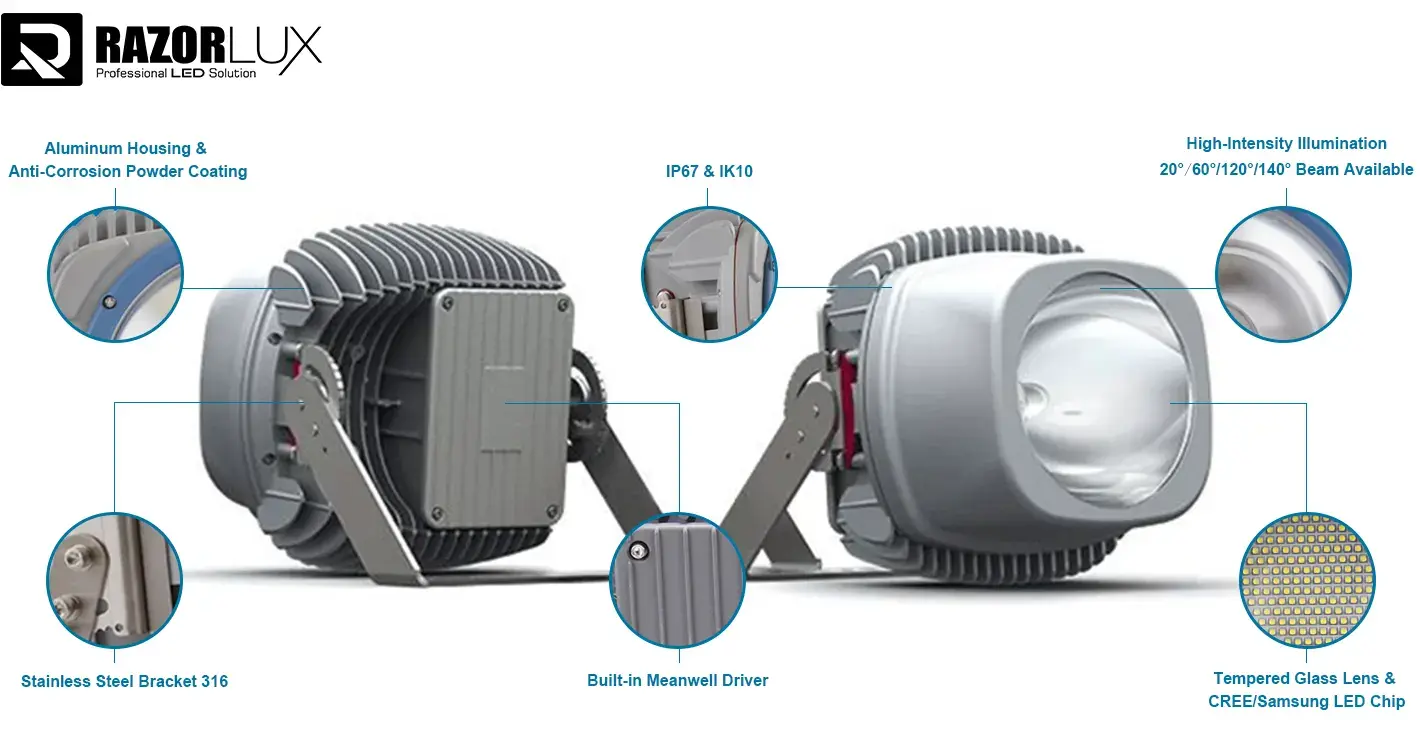
A marine-grade fixture uses housing materials with low copper content die-cast aluminum (typically below 0.4%) or 316L stainless steel brackets to resist galvanic corrosion. The lens is UV-stabilized tempered glass or polycarbonate, rated to survive high-pressure deck washdowns. Standard outdoor lights simply are not built to these tolerances.
IP and IK Ratings Explained
IP67 means the fixture is fully dust-tight and can withstand temporary submersion in water up to one meter. IK10 is the highest impact resistance rating, protecting against 20 joules of mechanical force — equivalent to a 5 kg weight dropped from 40 cm. For deck-mounted or dock-facing applications, both ratings are non-negotiable.
Color Temperature and CRI in Maritime Use
Color temperature affects operational safety. A range of 4000K–5700K gives strong white light that cuts through fog and mist on open decks. A CRI of Ra ≥ 75 ensures that workers can accurately distinguish colors on equipment panels and cargo markings. Fixtures offering Ra ≥ 80 or Ra ≥ 90 on request add an extra layer of visual accuracy for precision tasks.
Beam Angle Options for Different Zones
Beam angle determines how light distributes across a surface. Narrow beams (15°–30°) work well for spotting specific equipment zones or mast-mounted long-throw applications. Wide beams (60°–140°×60°) suit large deck areas, loading docks, or cargo holds that need even area coverage without harsh shadows.
How to Choose the Right Marine Flood Light for Your Application
Selecting the right fixture is not about picking the highest wattage. It is about matching technical parameters to the specific operating environment and load requirements of your vessel or facility.
Define Your Use Case First
A commercial fishing vessel running 18-hour deck operations needs different fixtures than a dry dock repair facility or an offshore gas platform. For vessels, vibration resistance and salt spray tolerance dominate the specification. For dock facilities, uniformity of light distribution and long-term lumen maintenance matter more. Defining the use case before reviewing datasheets saves considerable evaluation time.
Core Metrics to Compare Across Products
The following table provides a side-by-side reference of the key technical parameters procurement teams should evaluate when comparing marine flood lights:
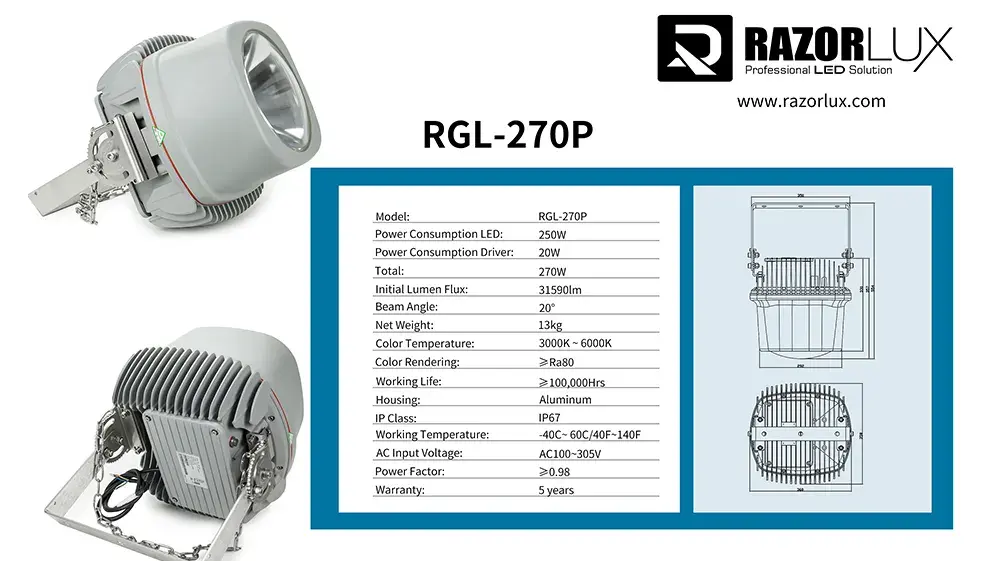
| Parameter | Minimum Acceptable | Recommended Standard | Razorlux RGL-270P |
|---|---|---|---|
| Luminous Efficacy | 100 lm/W | ≥130 lm/W | 130 lm/W |
| IP Rating | IP65 | IP67 | IP67 |
| IK Rating | IK08 | IK10 | IK10 |
| Working Temperature | -20°C to +50°C | -40°C to +60°C | -40°C to +60°C |
| Power Factor | ≥0.90 | ≥0.98 | ≥0.98 |
| THD | <20% | <10% | <10% |
| Warranty | 2 years | 5 years | 5 years (LED + Driver) |
| CRI | Ra≥70 | Ra≥75 | Ra≥75 |
These numbers are not pulled out of thin air. The minimum standards for a marine luminaire to be considered safe are defined by the IEC 60598 standard and the classification body regulations of ABS and DNV. Products that reach or surpass these standards provide procurement managers a defensible specification on which to base bids or pass technical audits.
LED vs. Halogen vs. Solar: Trade-offs That Matter
LED lighting uses up to 80% less electricity than comparable halogen lamps and does not need a warm-up period, important on board vessels where generator load control is vital. Halogen units are inexpensive to purchase but tend to fail after 2,000-4,000 hours of use in maritime settings. Solar-powered alternatives are great for distant dock perimeter illumination, but can not consistently provide the 30,000+ lumen brightness heavier labor areas demand. LED is the standard for professional maritime applications.
Custom vs. Standard Designs
Standard catalog goods provide most uses. However, special arrangements are required for offshore facilities with ATEX zone restrictions, navy vessels with tactical dimming demands, or shipyards with peculiar mounting geometries. When a manufacturer gives an OEM/ODM option, various beam angles, variable CCT, and numerous input voltage ranges (AC90-305V and DC127-431V), the project flexibility is greatly increased.
Advantages of Modern Marine LED Flood Lights Over Traditional Options
The switch from HID and halogen to LED in the maritime world is not driven by marketing speak but by quantifiable performance facts. Numbers convey a tale.
Energy Savings and Lifecycle Costs
A 270W LED fixture replaces 600W- 1000W HID bulbs while providing equivalent or better lumen output. This results in significant savings in energy expenditure throughout the lifetime of 50,000 hours. The U.S. Department of Energy says LED lighting consumes at least 75% less energy than incandescent lighting, with similar benefits in industrial usage. For example, for a fleet operator operating 20 deck lights constantly, the yearly power savings alone may cover the original purchase cost in 18–24 months.
Durability Under Real Operating Conditions
LED chips produce significantly less heat at the lens than halogen sources, minimizing the thermal load on the seals and housings. Coupled with a well-designed heat sink, such as the aluminum, powder-coated housing of the RGL-270P, the fixture maintains lumen output across a working temperature range of -40°C to +60°C. This is relevant in locations as different as the Norwegian fjords and the Persian Gulf.
Environmental and Compliance Benefits
HID lighting contains mercury, whereas LED fixtures do not, making it easier to comply with hazardous waste laws for boats operating under MARPOL. RoHS certification means there are no banned compounds, whereas CE and RMRS certification means your product complies with safety requirements of the European and Russian Maritime Register of Shipping. These certificates immediately help port state regulatory inspections and mitigate the danger of non-compliance findings.”
Installation and Maintenance Guide for Marine Flood Lights
Even a correctly specified fixture will underperform or fail early if installation is done poorly. The following section covers the practices that protect IP ratings and structural integrity over the long term.
Mounting Position and Structural Considerations
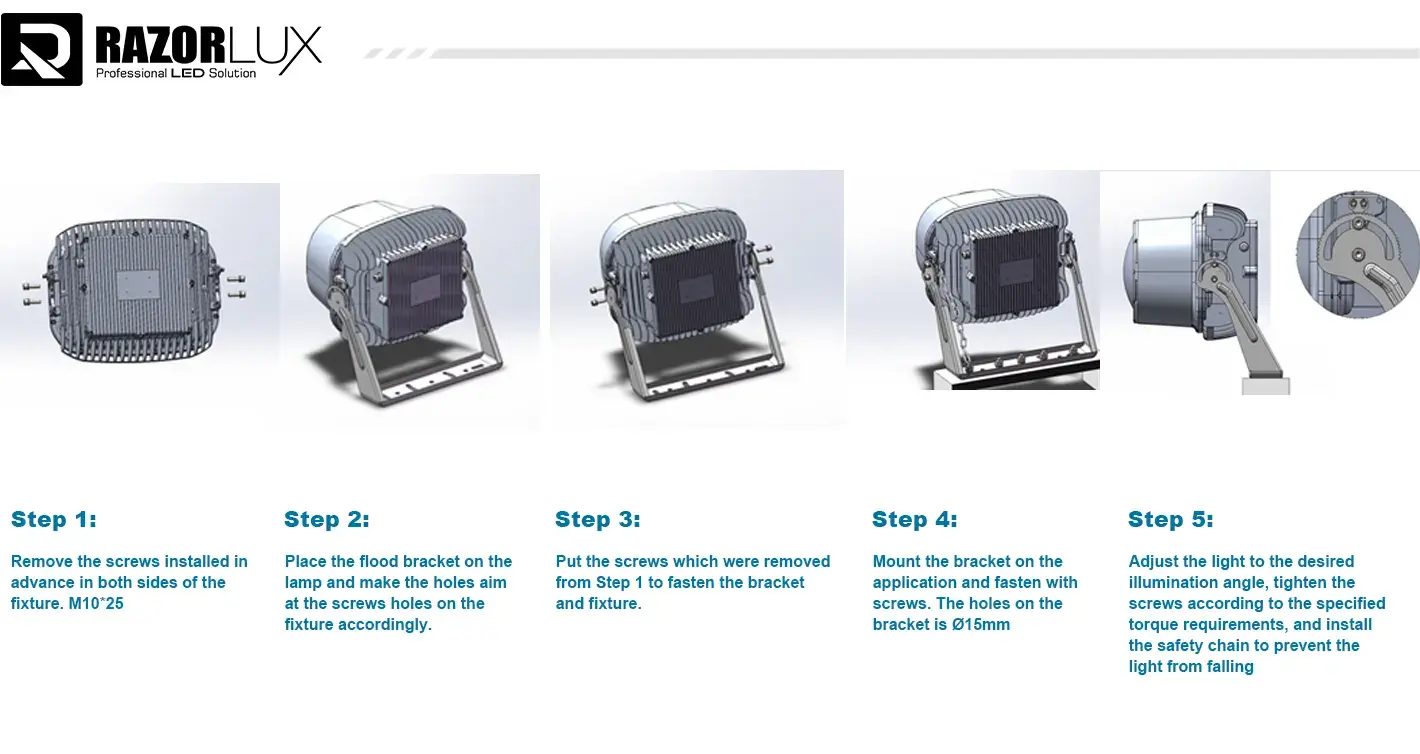
Mount fixtures away from exhaust outlets and heat sources. Use the included stainless steel bracket and torque all fasteners to the manufacturer's specified values. On vibrating surfaces such as engine room bulkheads, add anti-vibration washers to prevent fastener loosening over time. Always orient the fixture so that the cable entry point faces downward or is properly sealed with marine flood light-grade cable glands to prevent water tracking.
Wiring Safety and Waterproof Integrity
The IP67 rating of a fixture applies only when all sealing surfaces are intact. Any field modification — drilling additional holes, cutting the cable too short, or using non-rated connectors — voids that protection. Use tinned marine flood light wire with the correct gauge for the fixture's amperage draw. Apply self-amalgamating tape over all junction points in exposed locations. Verify continuity and insulation resistance before powering up.
Routine Maintenance Schedule
The following table outlines a recommended maintenance schedule for Marine LED Flood Light installations across different operating environments:
| Maintenance Task | Calm Harbor / Dock | Open Sea Vessel | Offshore Platform |
|---|---|---|---|
| External cleaning (salt deposit removal) | Monthly | Bi-weekly | Weekly |
| Lens inspection (cracks, UV yellowing) | Quarterly | Monthly | Monthly |
| Bracket/fastener torque check | Every 6 months | Quarterly | Quarterly |
| Seal and gasket inspection | Annually | Every 6 months | Every 6 months |
| Lumen output check (lux meter) | Annually | Annually | Every 6 months |
| Full wiring continuity test | Annually | Every 6 months | Every 6 months |
Following this schedule prevents the most common failure modes: seal degradation from UV exposure, fastener corrosion from salt accumulation, and connector oxidation from condensation cycling. A documented maintenance log also supports warranty claims and classification body re-inspections.
Case Study: Commercial Vessel Deck Lighting Replacement
A bulk ship operator in Southeast Asia replaced 40 old halogen deck lights with 270W LED bulbs with IP67 and IK10 standards. Maintenance call-outs for lights fell by more than 60% after 12 months in operation on Pacific and Indian Ocean routes. Crew stated lumen production was stable after long term operation in tropical humidity above 90%. "The brackets have been exposed to salt spray for a whole year with no evident corrosion," said the chief engineer of the vessel. "They passed their yearly classification examination with no defect findings.
Leading Marine Flood Light Brands and Supplier Insights
The maritime lighting industry is populated by European heritage brands, Asian specialist producers, and global industrial players. Knowing where each fits in the value chain allows procurement managers to make more educated sourcing selections.
Established Market Names
Philips (Signify) and Hella maritime are both household names in recreational and business maritime lighting. Philips has a wide variety of products and worldwide distribution. Hella Marine specializes in smaller vessels and navigation illumination. Rigid Industries is a well-known name in the North American leisure industry for their small LED work lights. These brands are targeted at certain market niches but may not necessarily have the complete complement of certifications – RMRS, SAA, C-Tick, UL, DLC – that offshore and heavy industrial procurement needs.
How to Evaluate a Supplier Beyond Brand Name
Certifications are the price of admission. What differentiates a reliable supplier from a mediocre one is paperwork completeness, sample availability, manufacturing capacity, and after-sales reaction time. Request salt spray test reports to ASTM B117, independent third-party photometric test data, and references from completed maritime or industrial applications. An ISO 9001-certified supplier has a defined quality control system that minimizes batch variation — a point that’s brought up time and time again when buying managers get irregular shipments on big orders.
B2B Procurement Channels and Logistics
Regarding bulk purchases, direct manufacturer partnerships usually provide better pricing, quicker technical support, and OEM/ODM flexibility than platform-based middlemen. Razorlux ships via DHL/FedEx (3–7 days for samples), air freight (5–10 days for mid-size orders), rail via China-Europe Express (18–22 days), and sea freight (15–50 days for FCL/LCL). Payment conditions include T/T wire transfer and Letter of Credit for bigger projects. We provide samples prior to your bulk purchase so that your technical team may evaluate fit, quality, and photometric performance before committing.
Why Long-Term Supplier Partnerships Reduce Risk
Spot buying could save you money on that one line item for that one time, but it makes your supply chain fragile. You can depend on repeat orders being the same thanks to a supplier with over 200 patents, over 25 years in manufacturing, and a GMP-certified plant. Frame purchase agreements with specified delivery windows, quality acceptance requirements, and warranty conditions preserve project schedules and save the administrative overhead of re-sourcing between projects.
Conclusion
The selection of the proper marine flood lights is based on five factors: protection rating, light output efficiency, material durability, certification compliance, and supplier dependability. When a fixture is IP67/IK10 rated, offers 130 lm/W or greater, is supported by certifications like CE, RMRS, UL, and RoHS, and comes from a source with shown quality control and rapid sample availability, procurement teams may specify with confidence. For a new-build bulk carrier, an offshore platform update, or a port facility renovation, ensuring the fixture spec matches the operational environment and backing it up with actual test results is the way to prevent expensive replacements and keep projects on time.
FAQ
1. What is the difference between IP67 and IP68 for marine fixtures?
IP67 certifies protection against temporary immersion in water up to one meter for 30 minutes. IP68 covers continuous submersion beyond one meter, with depth and duration defined by the manufacturer. For most deck and dock applications, IP67 is sufficient. Underwater hull lighting or submerged dock lighting would require IP68.
2. Can LED marine flood lights be retrofitted onto existing vessels without rewiring?
Yes, in most cases. Fixtures with wide input voltage ranges — such as AC90–305V and DC127–431V — accept virtually any vessel electrical system without an additional adapter. This directly reduces installation labor cost and complexity during retrofit projects.
3. What color temperature is best for open deck work areas?
For open deck operations where workers need to distinguish equipment labels, cable colors, and cargo markings, a color temperature between 4000K and 5700K with CRI ≥ 75 is the standard recommendation. Warmer tones (2700K–3000K) are better suited to interior accommodation areas where glare reduction matters more than task visibility.
4. How do RMRS and ABS certifications differ?
RMRS (Russian Maritime Register of Shipping) certifies products for vessels operating under Russian flag or in Russian waters. ABS (American Bureau of Shipping) certification applies to vessels classified under the ABS register, common in US-flagged commercial and offshore fleets. Projects that require compliance with both registers need a supplier whose products carry both certifications.
5. What warranty coverage should I expect from a quality manufacturer?
A credible manufacturer offers at minimum a 5-year warranty on the LED module and driver. Some suppliers extend housing warranty to 10 years. Razorlux provides a 5-year warranty on both the LED module and driver, with a 10-year housing warranty on select models.
Partner with Razorlux for Your Next Marine Lighting Project
Razorlux has supplied marine flood lights and heavy-duty LED solutions to shipyards, offshore platforms, and port facilities across more than 30 countries since 1998. With 200+ patents, ISO 9001 certification, and fixtures certified under RMRS, CE, UL, SAA, RoHS, and DLC, we give your technical and procurement teams exactly the documentation they need. Request a sample, download a full spec sheet, or ask for a project-specific quote directly from our team. contact us at sam@razorlux.com to connect with a marine flood light supplier that responds fast and delivers on time.
References
1. U.S. Department of Energy — Energy Savings Forecast of Solid-State Lighting in General Illumination Applications, 2019.
2. International Electrotechnical Commission — IEC 60598-1: Luminaires — General Requirements and Tests, 2020.
3. American Bureau of Shipping — Guide for the Classification of Offshore Installations, 2021.
4. ASTM International — ASTM B117: Standard Practice for Operating Salt Spray (Fog) Apparatus, 2019.
5. International Maritime Organization — MARPOL Annex VI: Regulations for the Prevention of Air Pollution from Ships, 2021.
6. Illuminating Engineering Society — IES TM-21: Projecting Long Term Lumen Maintenance of LED Light Sources, 2019.