


_1750326878398.png)

What Are the Best Crane Boom Lights for Heavy-Duty Lifting?
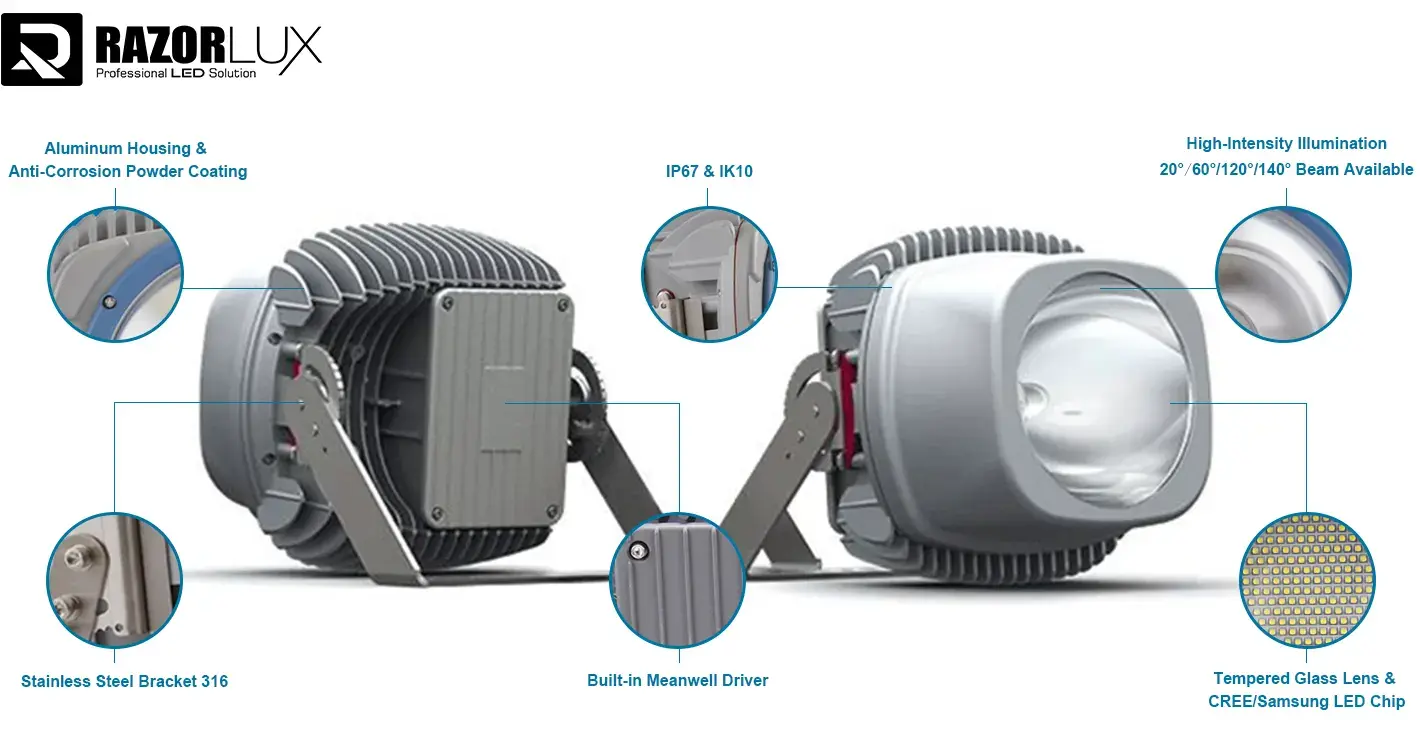
When you’re doing heavy-duty lifting tasks, appropriate illumination isn’t optional—it’s a safety essential. The finest Crane Boom Lights provide high brightness output, mechanical durability, and weather resistance to keep operators and ground staff safe throughout night shifts and low-visibility circumstances. With proven field performance, Razorlux RGL-150P is one of the best among industrial crane lights. With a rating of 150W, 13,200 lumens, IP67 protection, and a 20° concentrated beam, it is a suitable choice for shipyards, building sites, and offshore platforms, providing dependable light from heights over 50 meters.
Understanding Crane Boom Lights and Their Importance in Heavy-Duty Lifting
Before selecting any fixture for your crane, it helps to understand exactly what separates dedicated crane lighting from a standard work light. These are not interchangeable categories.
What Crane Boom Lights Actually Do
A crane jib light is a high-intensity light fixture fitted directly on the boom, jib, or trolley of tower cranes, mobile cranes, or ship-to-shore (STS) cranes. Its duty is to shine a tight, high-lumen beam down onto the load block and rigging zone from considerable heights, usually 50 to 100 meters. Without such specialized downward illumination, operators must depend on ambient site lighting, which seldom offers sufficient contrast for accurate load placing at height. Research in industrial safety management has shown that poor task illumination is a significant cause of crane accidents.
The Problem with Shadow Zones
A problem typically underrated by purchasing managers and site engineers is the shadow zone formed by the crane structure itself. The boom, trolley, and hook block generate uneven shadows over the floor of the work area, and ambient floodlights at ground level are not reliable to fill in the gaps. The load-mounted, well-aimed light moves with the load, ensuring the rigging zone is always lighted, no matter where the crane is or the ambient circumstances.
Why Vibration Resistance Is Non-Negotiable
Standard metal halide or halogen lamps burn out fast on crane boom lights because crane operation involves constant mechanical stress – abrupt pauses, trolley motion, sway caused by wind, load shock — all convey vibration into the structure. This is where solid-state LED technology is much superior since there is no filament or gas envelope to shatter. The Razorlux RGL-150P goes one step further with IK10 impact resistance and ruggedized housing, ideal for areas where mechanical strain is a regular occurrence.
Types of Crane Boom Lights: Choosing the Right Lighting Technology
Not every fixture described as a crane boom light work light is built to the same standard. Understanding the key technology differences will help your technical team make a faster, more confident recommendation.
LED vs. Halogen: A Practical Comparison
The table below summarizes the performance differences between LED and halogen crane lighting based on verified industry data:
| Feature | LED (e.g., RGL-150P) | Halogen / HID |
|---|---|---|
| Lumen Output | 13,200 lm @ 150W | ~12,000 lm @ 300–400W |
| Lamp Efficiency | 130 lm/W | 30–50 lm/W |
| Rated Lifespan | ≥50,000 hours | 2,000–5,000 hours |
| Vibration Resistance | High (solid-state) | Low (filament-based) |
| IP Rating | IP67 | Typically IP54 or lower |
| Warm-Up Time | Instant | 3–5 minutes |
| Operating Temp. Range | -40°C to +60°C | Limited cold-start capability |
LED fixtures require a higher upfront investment, but the total cost of ownership over a five-year period is substantially lower when you account for replacement bulbs, maintenance labor at height, and energy consumption.
Beam Angle and Height Matching
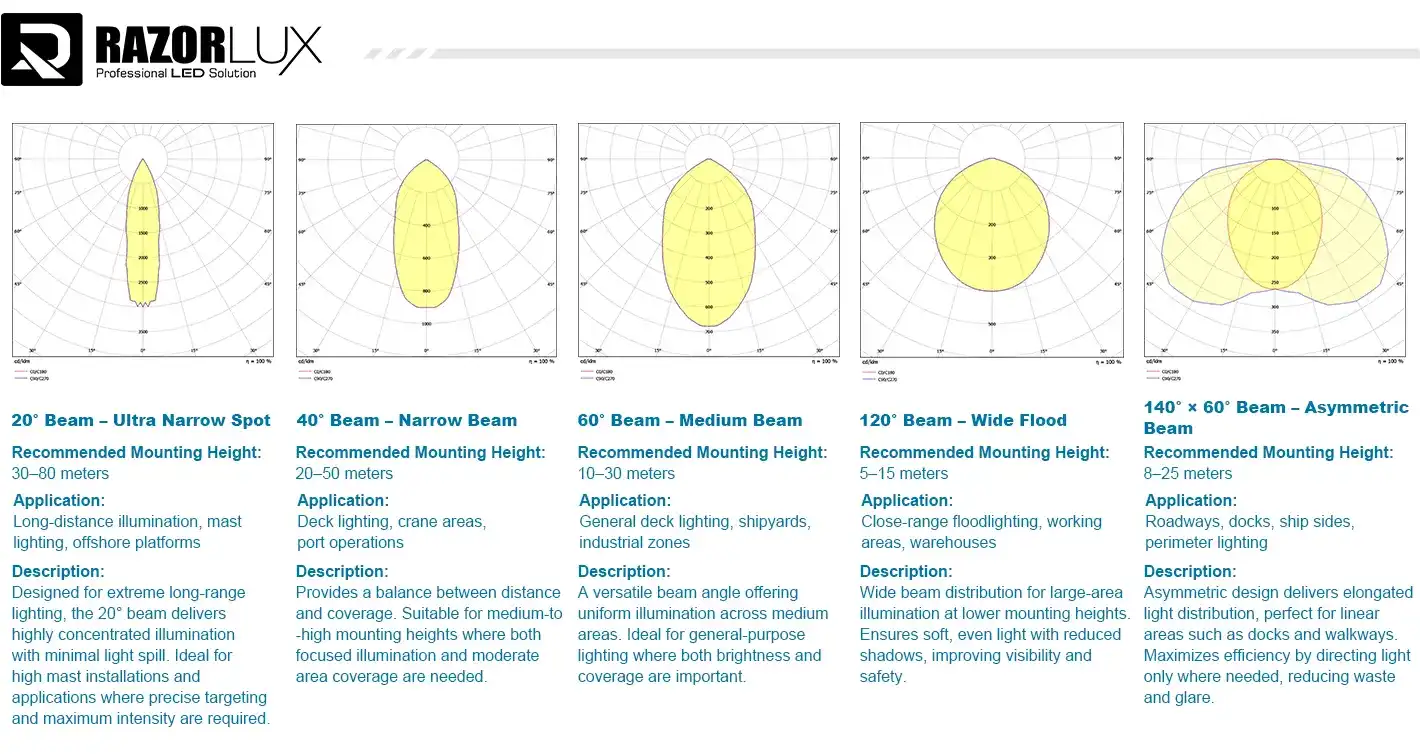
Beam Angle: One of the most often disregarded parameters in crane lighting procurement is beam angle. A wide-angle floodlight (60°-120°) will perform nicely at 5 meters, but at 60 meters it will generate a painfully diffuse, low-lux pattern. When mounted at high altitude on tower cranes, the proper range is a narrow beam of 15°–30°. The Razorlux RGL-150P has a 20° beam angle, and that is by design, as most tower crane installations set the light 40 to 80 meters above the work area. This narrow projection allows adequate foot-candle levels to facilitate safe rigging operations, without causing the operator to squint from glare.
Power Compatibility and Voltage Range
Cranes are powered by generators, shore power connections, and onboard electrical systems, all of which are seldom clean or constant power sources. You need a driver that has a broad input voltage. The RGL-150P accepts AC 80–315V and DC 80–400V without an external adapter, meaning it can connect directly to virtually any crane power system worldwide, from a European 230V shore supply to a Middle Eastern generator running variable output. The integrated Meanwell driver also offers surge protection against voltage spikes prevalent in heavy equipment settings.
How to Choose the Best Crane Boom Lights for Your Operations
Choosing the right fixture is a structured decision, not a guessing process. Here is a decision framework that purchasing managers and engineering contractors can apply directly.
Step 1: Define Your Environmental Conditions
Start with your operating environment. Salt spray, extreme cold, dust, and chemical exposure each place different demands on the fixture's housing and sealing. For maritime applications — ship decks, port cranes, offshore platforms — you need a minimum of IP67 and a corrosion-resistant housing. For desert or construction environments, IP65 may suffice, but IK10 impact resistance becomes more important due to debris and equipment contact. The RGL-150P carries both IP67 and IK10 ratings, covering the most demanding environments in both maritime and industrial sectors.
Step 2: Evaluate Total Cost of Ownership
Buying departments tend to look at the initial purchase price, but the real number is the total cost of ownership throughout the life of the product. When comparing providers, take the following into account:
- Energy consumption: 150W LED vs 400W HID (approx. 250W savings per fixture per hour). On a 10-hour night shift, that's 2.5 kWh saved per fixture, per shift, on crane boom lights.
- Replacement frequency: An LED with a lifespan of 50,000 hours will be replaced significantly less often than a 3,000-hour halogen. Changing lights on a crane boom means downtime for the equipment and a technician operating at height – both pricey.
- Warranty coverage: The RGL-150P is covered by a 5-year warranty on the LED module and driver, and a 10-year guarantee on the housing, greatly lowering the risk of unforeseen repair expenditures.
Together, they provide a compelling financial argument your management team can build on at budget approval.
Step 3: Verify Certifications Against Project Requirements
Many industrial and port projects, particularly those involving government procurement, open bidding, or classification society approval, require specific certifications before a product can be installed. The table below lists the certifications held by the Razorlux RGL-150P and the markets or applications they support:
| Certification | Relevant Market / Application |
|---|---|
| CE | European Union, general industrial |
| RoHS | International, hazardous substance compliance |
| UL | United States market |
| SAA / C-Tick | Australia and New Zealand |
| DLC | US energy efficiency rebate programs |
| CB | International CB Scheme member countries |
| ISO 9001 | Quality management system verification |
Having this documentation ready shortens your internal approval process and simplifies compliance during project audits.
Installation, Maintenance, and Safety Tips for Crane Boom Lights
Even the best-specified fixture will underperform if it is installed incorrectly or neglected over time. This section covers the practices that keep crane lighting performing at specification throughout its rated lifespan.
Installation Best Practices
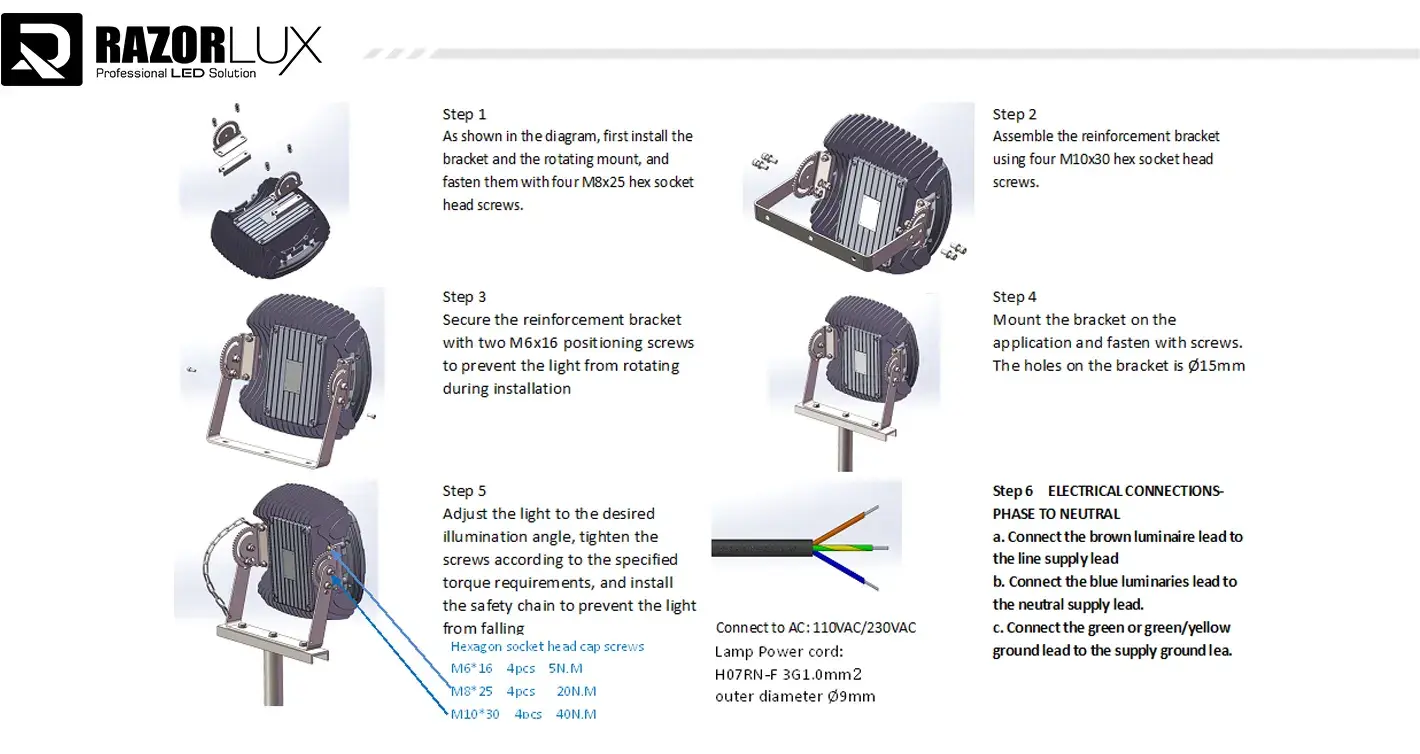
The RGL-150P uses a stainless steel bracket that accommodates multiple mounting angles, allowing on-site adjustment to achieve the correct beam aiming without additional hardware. During installation, the technician should verify that the beam center falls on the intended hook block position at the crane's typical operating radius. All wiring connections must be sealed using appropriate IP-rated cable glands to maintain the fixture's ingress protection rating. Never route cables where they can contact moving structural components.
Routine Maintenance Schedule
A structured maintenance plan extends fixture lifespan and prevents unplanned failures. Here are the recommended intervals and tasks:
- Monthly: Visually inspect the housing for cracks, corrosion, or loose fasteners. Check cable gland integrity.
- Quarterly: Clean the lens with a non-abrasive cloth and mild detergent. Remove salt deposits on maritime installations.
- Annually: Verify beam alignment, inspect the mounting bracket for fatigue, and test the driver output voltage.
- As needed: Replace any corroded fasteners with equivalent stainless steel hardware.
These tasks can be completed during scheduled crane maintenance windows, minimizing additional downtime.
Glare Control and Operator Safety
A narrow 20° beam aimed correctly at the work zone should not create direct glare for the crane operator. However, if the fixture is mounted or aimed incorrectly, reflected light from the hook block or load surface can reach the cab. Before commissioning, the site engineer should conduct a glare check with the operator present and adjust the bracket angle as needed. Compliance with OSHA 1910.303 and ANSI/IESNA RP-7 for industrial lighting should be confirmed as part of the project handover documentation.
Procurement Insights: Where and How to Buy Crane Boom Lights
B2B procurement teams need to choose the proper crane boom light provider. It’s not just about a datasheet comparison. Supplier dependability, accuracy of documentation, and assistance after delivery are essential for your project success.
Evaluating Suppliers as a Crane Boom Lights Manufacturer
After the technical team has confirmed the product requirements, the buying department is responsible for evaluating the operational dependability of the supplier. Some important factors are verified lead times, minimum order quantities, availability of samples for testing before you purchase, and the supplier’s track record within your business. Razorlux has been producing LED lighting systems since 1998 and has more than 200 patents in LED Packaging, power management, and structural design. We have sample orders available for your technical team to test and evaluate before you commit to large purchases.
Documentation and Certification Support
A supplier that cannot provide full paperwork — test reports, CE declarations, UL certifications, installation drawings — poses risk downstream to your project. Razorlux delivers complete technical packages containing product specs, IES photometric files, installation guidelines, and certifications that may be used by your engineering team for populating project submittals.

Logistics and Delivery Reliability
Crane installation projects are scheduled. Late supply of lights may delay commissioning and push back project handover deadlines, which produces financial penalties in contract-based projects. Depending on the amount and timeframe of the order, Razorlux delivers via air, sea, and rail, and keeps inventories to facilitate rush orders. Email the team at sam@razorlux.com to discuss lead times for your project timeline. For further product information, please visit razorlux.com
Conclusion
Getting the correct crane boom lights jib lighting fixture is a combination of having known specs that fit your working environment, checking certifications that meet your project needs, and finding a supplier that will assist your project from sample order to after-sales service. The Razorlux RGL-150P, 150W, 13,200 lumens, 130 lm/W, IP67, IK10, 20° beam, 5-year guarantee, meets the basic technical requirements for tower crane, shipyard, and offshore illumination applications. When your team is ready to consider possibilities, having recorded performance data and samples on hand simplifies the selection process.
FAQ
1. What beam angle should I specify for a tower crane at 60 meters?
For mounting heights between 40 and 80 meters, a beam angle of 15° to 30° is the correct range. A wider angle dissipates light before it reaches the ground, producing low lux levels at the rigging zone. The Razorlux RGL-150P ships with a 20° beam, which is matched to this height range.
2. Can crane-mounted lights handle constant vibration?
Yes, provided the fixture is specifically designed for the application. LED technology eliminates the filament fragility of halogen options, and the RGL-150P adds IK10 impact protection and a reinforced stainless steel bracket to manage mechanical stress from crane operation.
3. What input voltage range does the RGL-150P support?
The RGL-150P accepts AC 80–315V and DC 80–400V through its Meanwell driver, without an external adapter. This covers shore power, generator supply, and onboard crane electrical systems across all major global markets.
4. Which certifications should I require from a supplier?
For US projects, request UL and DLC. For European projects, require CE and RoHS. For maritime classification, request DNV/GL or ABS documentation. The RGL-150P holds CE, RoHS, UL, SAA, DLC, CB, and ISO 9001.
5. Are samples available before a bulk order?
Yes. Razorlux provides sample units for technical team testing and evaluation. Contact sam@razorlux.com to request a sample and discuss your project specifications.
Ready to Source Crane Lighting That Performs? Contact Razorlux Today
Your project timeline depends on getting the right fixture, properly certified, delivered on schedule. As a trusted crane boom lights manufacturer with over 25 years of production experience, Razorlux delivers the RGL-150P with full certification documentation, a 5-year warranty, and flexible logistics options. Send your project specifications to sam@razorlux.com to request a quote and sample today.
References
1. Illuminating Engineering Society. IES Lighting Handbook, 10th Edition. Illuminating Engineering Society, 2011.
2. Occupational Safety and Health Administration. OSHA Technical Manual: Lighting. U.S. Department of Labor, 2015.
3. American National Standards Institute / Illuminating Engineering Society. ANSI/IES RP-7: Recommended Practice for Lighting Industrial Facilities. IESNA, 2017.
4. Det Norske Veritas. DNV-OS-A101: Safety Principles and Arrangements for Offshore Installations. DNV GL, 2021.
5. International Electrotechnical Commission. IEC 60598-1: Luminaires — Part 1: General Requirements and Tests. IEC, 2020.
6. Energy Efficiency & Renewable Energy Office, U.S. Department of Energy. Solid-State Lighting R&D Plan. U.S. DOE, 2022.