


_1750326878398.png)

Why Import a 400W Equivalent LED Flood Light for Warehouses?
Today, one of the most sensible moves a warehouse facility manager or procurement engineer can make is to bring in a 400W Equivalent Led Flood Light. Traditional metal halide or high-pressure sodium lights use 400 watts and waste a lot of energy as heat, whereas Razorlux's RGL2-400P produces 48,000 lumens at 130 lm/W with just 400W total consumption. The RGL2-400P replaces 400-600W HID bulbs. Built with an IP67 protection rating, IK10 impact resistance, a MeanWell driver, and certifications like UL, CE, DLC, and RoHS, this industrial flood light meets the operational issues that warehouses encounter every day in the real world.
Understanding 400W Equivalent LED Flood Lights and Their Advantages
Before making any purchase decision, it is essential to understand precisely what this type of lighting provides and why it has become the preferred option throughout industrial buildings internationally.
What "400W Equivalent" Actually Means
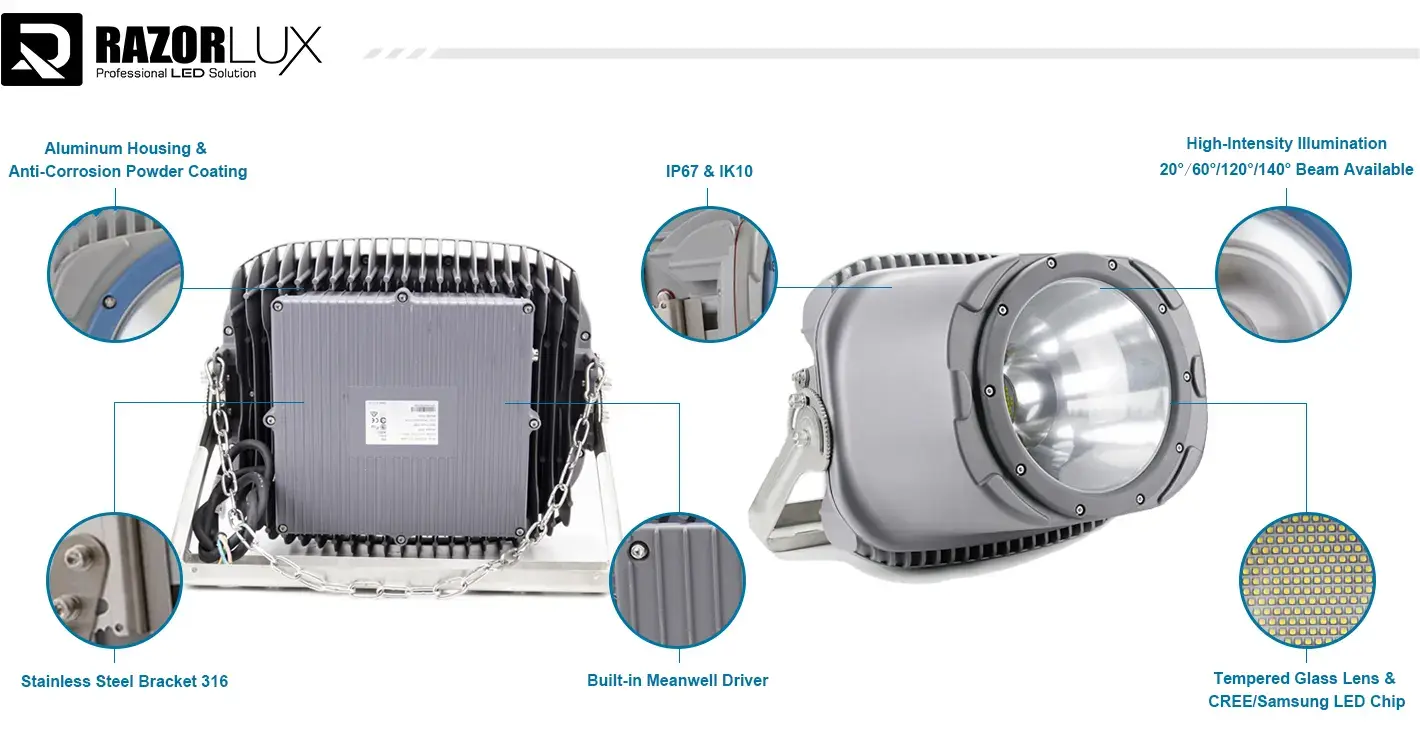
“400W equivalent” means the light output is equal to a standard 400W metal halide or HPS bulb, not that it uses that much electricity. The Razorlux RGL2-400P draws a real 400W total (360W LED + 40W driver) and outputs 48,000 lumens at 5700K — a luminous efficacy of 130 lm/W. Legacy HID lamps generating equivalent lumen output often require 450-600W and suffer severe lumen decay during the first year of operation.
Core Technology Behind the Performance
The RGL2-400P has a die-cast aluminum housing with powder coating for heat control and corrosion protection. The MeanWell power supply has a power factor of ≥0.98 and THD of less than 10%, which is important for buildings with sensitive electrical infrastructure. The fixture may be used with broad input ranges of AC 110-480V and DC 100-800V and will work in practically every electrical system in the world.
Lifespan and Lumen Maintenance Advantages
According to the Illuminating Engineering Society (IES), metal halide lamps have a lumen depreciation of around 20% after the first 6 months of use. The RGL2-400P has a rated operating life of ≥50,000 hours, 5 years warranty on the LED module and driver, and 10 years guarantee on the housing. For a warehouse operating lights 18 hours a day, it means around 7.6 years of steady operation before any need for replacement.
Comparing 400W Equivalent LED Flood Lights with Alternative Lighting Solutions
Not every high-wattage 400W equivalent LED flood light is built the same way. Procurement managers often ask whether a 400W LED fixture is truly the right choice compared to other options on the market. Here is an honest comparison.
LED vs. Metal Halide: An Operational Cost Breakdown
The energy savings alone are the case. A warehouse using 50 metal halide lights at 450 watts apiece for 18 hours per day would cost around $14,800 per year for energy at $0.10/kWh. By switching to 50 LED flood lights at 400W each, this drops to around $13,140, but the true reduction is achieved by removing the 10- to 15 minute warm-up and restrike delay of HID lamps. But instant-on capability is not a trivial convenience—it immediately affects operational safety and security reaction time.
| Criteria | 400W Metal Halide | Razorlux RGL2-400P LED |
|---|---|---|
| Actual Power Draw | 450–600W | 400W |
| Lumen Output | ~32,000 lm (initial) | 48,000 lm (stable) |
| Luminous Efficacy | ~70–80 lm/W | 130 lm/W |
| Rated Lifespan | 10,000–15,000 hrs | ≥50,000 hrs |
| Warm-Up Time | 10–15 minutes | Instant |
| IP Rating | IP54 (typical) | IP67 |
| IK Rating | IK06 (typical) | IK10 |
| CRI | Ra65–75 | Ra≥75 (Ra80/90 available) |
| Maintenance Interval | Every 1–2 years | Every 5+ years |
| Certifications | Limited | UL, CE, DLC, RoHS, SAA, CB |
400W vs. 500W LED Options: Finding the Right Balance
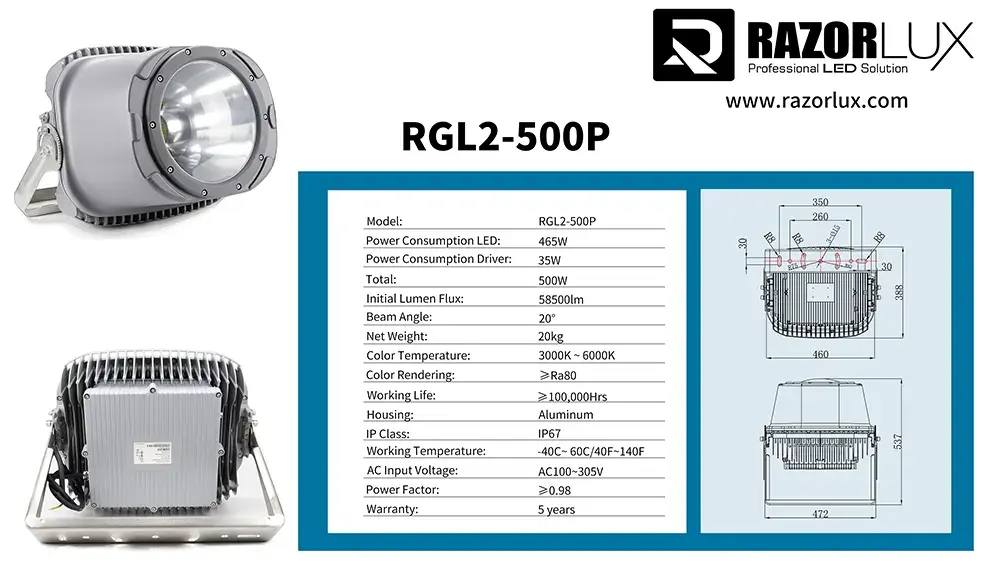
Some facility engineers default to 500W LED fixtures, assuming more wattage means better coverage. In a standard warehouse bay measuring 30m × 30m with a 10m ceiling height, a 500W fixture often creates excessive brightness in the center while underperforming at the perimeter. The RGL2-400P, with its selectable beam angles of 15°, 20°, or 30°, allows engineers to precisely control light distribution, achieving better uniformity ratios without overspending on wattage.
Dimmable and Smart Control Compatibility
Dimming capability is useful in warehouses with varying occupancy – loading docks, storage lanes, reception rooms, etc. The RGL2-400P is compatible with motion sensors and building management systems for energy savings during off-peak hours and has 0-10V dimming control. Traditional HID systems cannot simply provide this kind of flexibility without costly ballast adjustments.
Procurement Considerations for Importing 400W Equivalent LED Flood Lights
Sourcing industrial-grade 400W equivalent LED flood lights from overseas requires more than comparing unit prices. The decision involves evaluating supplier credibility, certification completeness, logistics reliability, and long-term support capacity.
Evaluating Supplier Credentials and Certifications
A good LED Flood light provider must have certain international certifications that are relevant to the market you are targeting. In the U.S., regarding warehouse projects, the two most crucial are DLC (DesignLights Consortium) listing and UL certification. The DLC designation makes items eligible for utility rebate schemes that may decrease the effective purchase cost by 20-40% depending on the state. Razorlux’s RGL2-400P is CE, RoHS, SAA, C-Tick, UL, DLC, CB, and ISO 9001 compliant – a full complement of certifications and paperwork to satisfy technical review teams in most markets.
Total Cost of Ownership vs. Unit Price
Procurement managers focused only on per-unit price often overlook the full financial picture. Here is a simplified TCO comparison for a 100-fixture warehouse installation over 5 years:
| Cost Category | Low-Cost Generic LED | Razorlux RGL2-400P |
|---|---|---|
| Unit Price (estimated) | $80 | $150 |
| Total Purchase Cost (100 units) | $8,000 | $15,000 |
| Estimated Replacements (5 yr) | 30 units @ $80 | 0 units |
| Replacement Labor Cost | $3,000 | $0 |
| Energy Cost Difference (5 yr) | Higher (lower efficacy) | Saves ~$2,800 |
| Warranty Coverage | 1–2 years | 5 years (module + driver) |
| Net 5-Year Cost | ~$14,800 | ~$12,200 |
The numbers demonstrate that paying more upfront for a certified, high-efficacy fixture from an established manufacturer results in lower total spending over the product's operational life.
Logistics, Lead Times, and Supplier Responsiveness
Xi'an Razorlux Optoelectronic Technology Co., Ltd. has operated since 1998 and maintains large inventory reserves to support prompt shipment. The company offers flexible shipping via air, rail, and sea freight, and provides complete technical documentation — including drawings, installation guides, and test reports — to support engineering teams during the specification and approval phase. Sample orders are available for pre-purchase testing, which is a standard request from technical departments before committing to bulk procurement.
Installation and Maintenance Best Practices for Warehouse LED Flood Lights
Getting the installation right from the start protects both the product investment and the safety of warehouse personnel. Proper mounting, wiring, and maintenance scheduling all affect long-term performance.
Mounting Height, Beam Angle Selection, and Layout Planning
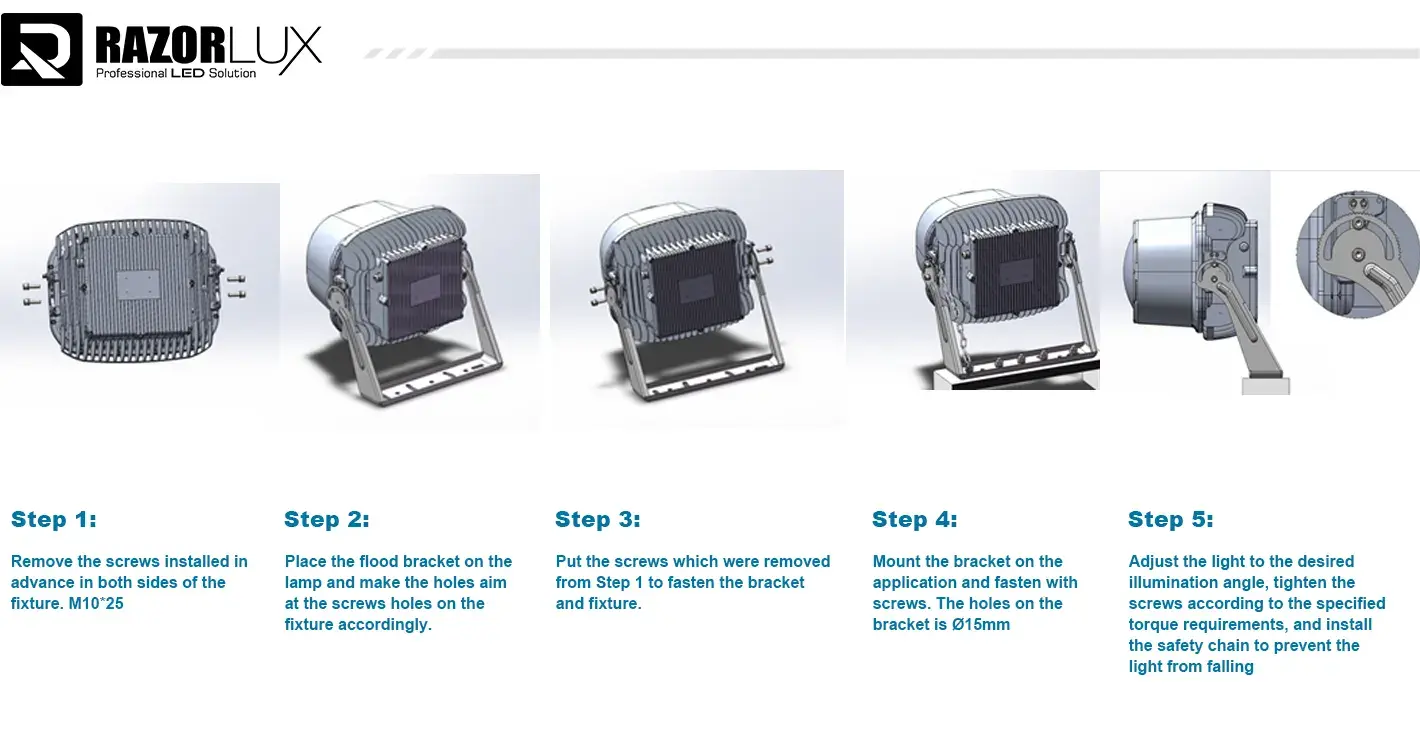
For a warehouse with 10m ceilings, a 30° beam angle is typically recommended for aisle lighting to concentrate output in the work zone. For open floor areas or loading bays with higher ceilings (12–15m), the 15° or 20° beam angle delivers more targeted, high-intensity illumination. The RGL2-400P weighs 19kg and includes a stainless steel bracket, so structural assessments of the mounting surface should be completed before installation.
Electrical Compatibility and Safe Wiring Practices
One of the practical advantages of the RGL2-400P is its wide input voltage tolerance — AC 110–480V without any additional adapter, and DC 100–800V in two ranges. This means the same fixture model works in North American 120V systems, European 230V installations, and industrial 480V three-phase environments. Electricians should verify breaker capacity, ground connections, and conduit routing before energizing the circuit.
Scheduled Maintenance and Inspection Protocols
LED flood lights require far less maintenance than HID systems, but they are not entirely maintenance-free. A recommended protocol includes:
- Every 6 months: Visual inspection of housing, bracket, and sealing gaskets for physical damage or corrosion. Check for moisture ingress, particularly in high-humidity environments.
- Annually: Clean the lens surface with a non-abrasive cloth to remove dust accumulation, which can reduce lumen output by 5–10% over time. Inspect wiring connections and terminal tightness.
- Every 3 years: Conduct a lux meter reading across the installation to confirm that illuminance levels still meet the original design specification. Document findings for maintenance records.
Following this schedule preserves the IP67 rating effectiveness and ensures the fixture continues to perform at rated output throughout its 50,000-hour lifespan.
Future Trends and Strategic Advantages of Importing Advanced LED Flood Lights
The industrial lighting industry is not a static market. Regulatory pressure, energy costs, and technological development are all going in the same direction – up in efficiency and connectivity.
Energy Efficiency Regulations Promoting LED Adoption
The U.S. Department of Energy has been steadily increasing minimum efficiency criteria for commercial and industrial lighting. DLC’s Premium tier now mandates effectiveness of >130 lm/W for numerous product categories – a mark the RGL2-400P hits right on the nose. In the EU, the Ecodesign Regulation has phased out most of the fluorescent and HID light categories, and LED is the only compatible alternative for new installations or replacements. Importing approved LED flood lights puts facilities ahead of future compliance standards.
Smart Lighting Integration and IoT Readiness
Industrial warehouses are becoming progressively embedded in linked ecosystems of facility management. The RGL2-400P has a 0 to 10V dimming interface that is intended for use with occupancy sensors, daylight harvesting systems, and DALI control networks. As a 2023 study from the International Energy Agency (IEA) states, smart lighting solutions in commercial buildings provide an extra 30-50% of energy savings on top of basic LED replacement. Such extra decrease would mean big dollar savings per year for high-volume distribution facilities running 24/7.
Customization Options for Specific Warehouse Conditions
Razorlux offers project-specific customisation on color temperature (2700K-6500K), CRI grade (Ra75, Ra80 or Ra90), beam angle, input voltage configuration and housing finish. Thermal management setup may be specified for cold storage facilities running as low as -40°C. Hazardous material zones necessitate certain zone housing treatments. With 200+ patents and 25+ years of manufacturing expertise, this level of manufacturing flexibility means procurement teams don’t have to compromise on specs to match a conventional catalog product.
Conclusion
Warehouse lighting options have long-term financial, safety and regulatory implications. A properly specified 400W equivalent LED flood light, certified, well constructed and supplied from a manufacturer with established manufacturing capability, provides substantial returns during its operating life. The Razorlux RGL2-400P ticks all the boxes a serious procurement team needs: 130 lm/W effectiveness, IP67/IK10 protection, MeanWell power supply, broad voltage compatibility, and a comprehensive certification portfolio including UL and DLC. The argument for making the move is simple for institutions that are operating older HID systems.
FAQ
1. How long do warehouse LED flood lights actually last?
The Razorlux RGL2-400P carries a rated working life of ≥50,000 hours. At 18 operating hours per day, that equals approximately 7.6 years before reaching the L70 lumen maintenance threshold. The LED module and driver each carry a 5-year warranty, and the housing carries a 10-year warranty.
2. Are these fixtures suitable for cold storage warehouses?
Yes. The RGL2-400P operates reliably across a working temperature range of -40°C to +60°C (-40°F to +140°F), making it fully compatible with cold storage, freezer, and refrigerated distribution environments without any additional modification.
3. What certifications should I verify before importing LED flood lights into the U.S.?
For U.S. imports, the two most important certifications are UL listing (safety compliance) and DLC listing (energy efficiency, required for utility rebates). The RGL2-400P carries both, along with CE, RoHS, SAA, CB, and ISO 9001.
4. Can I request samples before placing a bulk order?
Razorlux provides samples for testing and technical evaluation. This is a standard step recommended before bulk procurement, allowing your engineering team to verify performance, dimensions, and installation compatibility firsthand.
Upgrade Your Warehouse Lighting with Razorlux — Request a Quote Today
Your warehouse deserves lighting that works as hard as your operations do. Razorlux's 400W equivalent LED flood light (Model RGL2-400P) gives procurement managers and facility engineers a certified, field-tested solution backed by 25+ years of manufacturing experience and over 200 patents. Whether you are sourcing as a direct buyer or evaluating us as a 400W equivalent LED flood light supplier for a large-scale project, we are ready to provide technical documentation, samples, and competitive pricing. Reach out to our team at sam@razorlux.com to start the conversation.
References
1. Illuminating Engineering Society. IES LM-80: Measuring Luminous Flux and Color Maintenance of LED Packages, Arrays, and Modules. IES, 2015.
2. U.S. Department of Energy. Solid-State Lighting R&D Annual Report. DOE Office of Energy Efficiency and Renewable Energy, 2023.
3. International Energy Agency. Tracking Buildings: Energy Efficiency Indicators for Buildings. IEA, 2023.
4. DesignLights Consortium. DLC Technical Requirements V5.1 for Solid-State Lighting. DLC, 2022.
5. DiLaura, David L., Kevin W. Houser, Richard G. Mistrick, and Gary R. Steffy. The Lighting Handbook: Reference and Application, 10th ed. Illuminating Engineering Society, 2011.
6. European Commission. Commission Regulation (EU) 2019/2020: Ecodesign Requirements for Light Sources. Official Journal of the European Union, 2019.