


What Makes LED Sports Lighting Fixtures Energy Efficient?
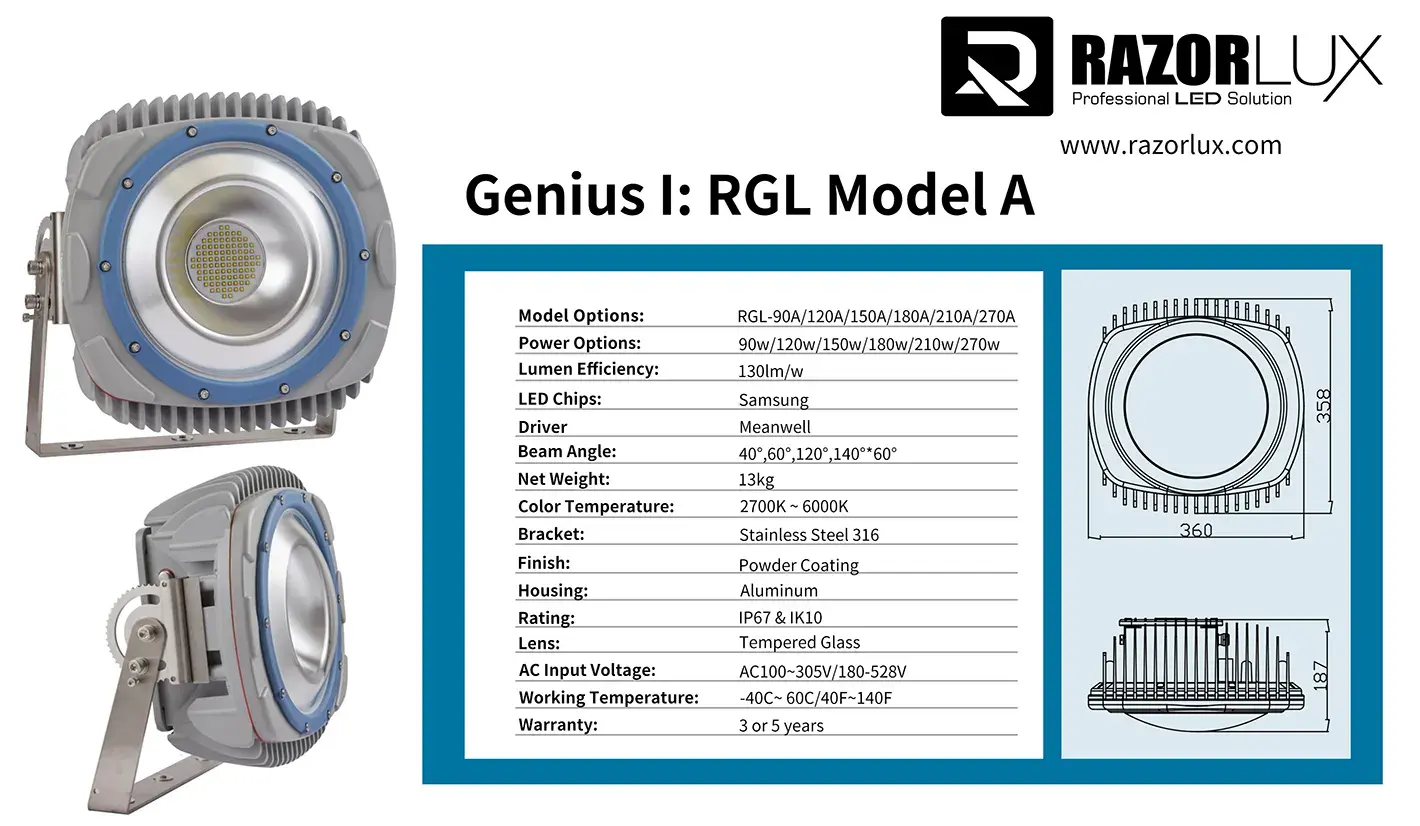
Led Sports Lighting Fixtures achieve energy efficiency through a combination of high-performance semiconductor chips, precision optical systems, and intelligent driver electronics. Unlike metal halide or halogen lamps that waste significant energy as heat, quality LED fixtures convert the majority of electrical input directly into usable light. Razorlux's RGL-120A, for example, delivers 14,400 lumens at just 120W with a lamp efficiency of 130 lm/W — replacing 250–300W HID lamps while maintaining IP67 protection and a 50,000-hour rated lifespan. These technical properties make modern sports lighting a sound investment for facility managers seeking lower operating costs.
Understanding Energy Efficiency in LED Sports Lighting Fixtures
Before they can compare products or place orders, procurement teams need to have a good grasp of what "energy efficiency" means at the component level. How well each watt is turned into useful light for the whole playing area is also important, not just the wattage.
Lumens Per Watt: The Core Metric
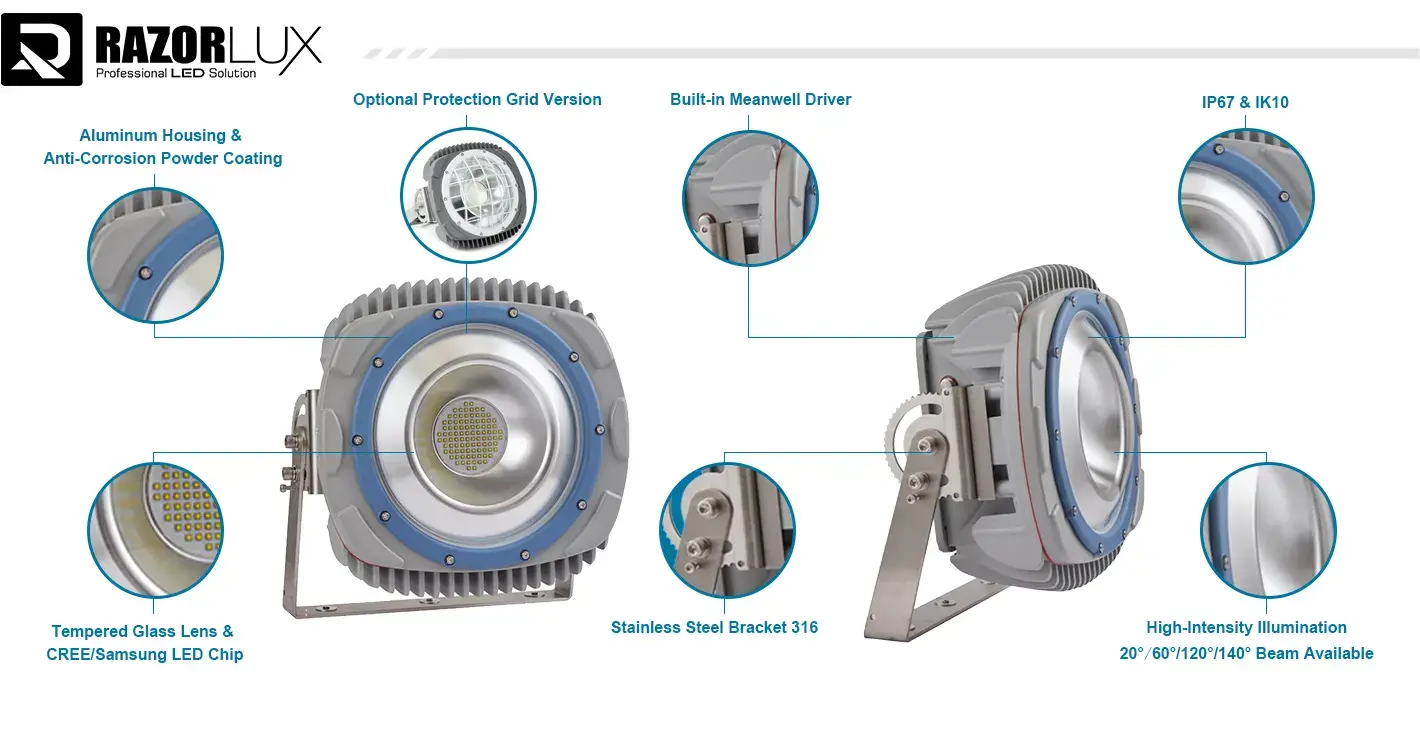
Find out how much light something gives off in lumens per watt (lm/W). This is the best way to tell if it uses little energy. Lamps that put out 130 lm/W give off 130 lumens of light for every watt they use. Most metal halide lights don't get above 80–100 lm/W, and most halogen sources don't get above 20 lm/W. For every 120W it draws, the Razorlux RGL-120A lights up at exactly 130 lm/W and sends out 14,400 lm.
LED Chip Quality and Semiconductor Design
The type of LED chip used determines how well electricity is converted into light. Good chips that make less heat and give off more light per unit of power are made with new semiconductor materials. High-bin LED parts that Razorlux uses have been tested and will work for more than 50,000 hours. This means that the light output won't drop quickly as the bulb ages. It will stay the same.
Driver Electronics and Power Factor
People who want to buy something often forget to think about how well the drivers work for LED sports lighting fixtures. It is important for a good driver to keep the power factor at or above 0.98 and the total harmonic distortion (THD) below 10%. This means that the power system gets clean, useful power. A Meanwell driver is used in the RGL-120A. Meanwell is a well-known name all over the world. DC inputs range from 80Vdc to 400Vdc, and AC inputs range from 80Vdc to 315Vac. This means that it can work with electric grids all over the world.
Core Technologies Behind LED Sports Lighting Energy Savings
Sports lights with high power can save energy in more than one way. They are made possible by many technologies working together. For example, chips are made more efficient, and the temperature of the whole system is controlled.
Thermal Management and Junction Temperature Control
The main thing that makes LEDs less useful and shorter in life is heat. When the junction temperature rises above what is safe, the light output drops and the life of the part is cut short. Powder-coating the metal frame of the RGL-120A keeps heat away from the LED grid. This means it can be used in cold places in northern Europe and hot docks in the Middle East. It works from -40°C to +60°C (-40°F to +140°F).
Optical Systems: Beam Angle Precision
Lights that aren't being used lose power. When lenses are precise, the output goes right where it needs to go, which is onto the playing field. It doesn't go up into the sky or to other close areas. The RGL-120A has three beam angles: 60°, 120°, and 140°×60°. Each option is made to provide even lighting across a certain size of court or field. This means that fewer lights and less power need to be used.
Smart Control Compatibility
More and more, current stadium lighting systems have controls for dimming, planned switches, and management based on how the lights are being used. When workers use fixtures that support 0–10V or DALI dimming, they can lower the output during training sessions or when the business isn't busy. This keeps 30–50% of the energy that setups with fixed output use from being used. The way that Razorlux fixtures are controlled can be changed to fit the needs of a certain building automation system.
Comparing LED Sports Lighting to Traditional Sports Lighting Solutions
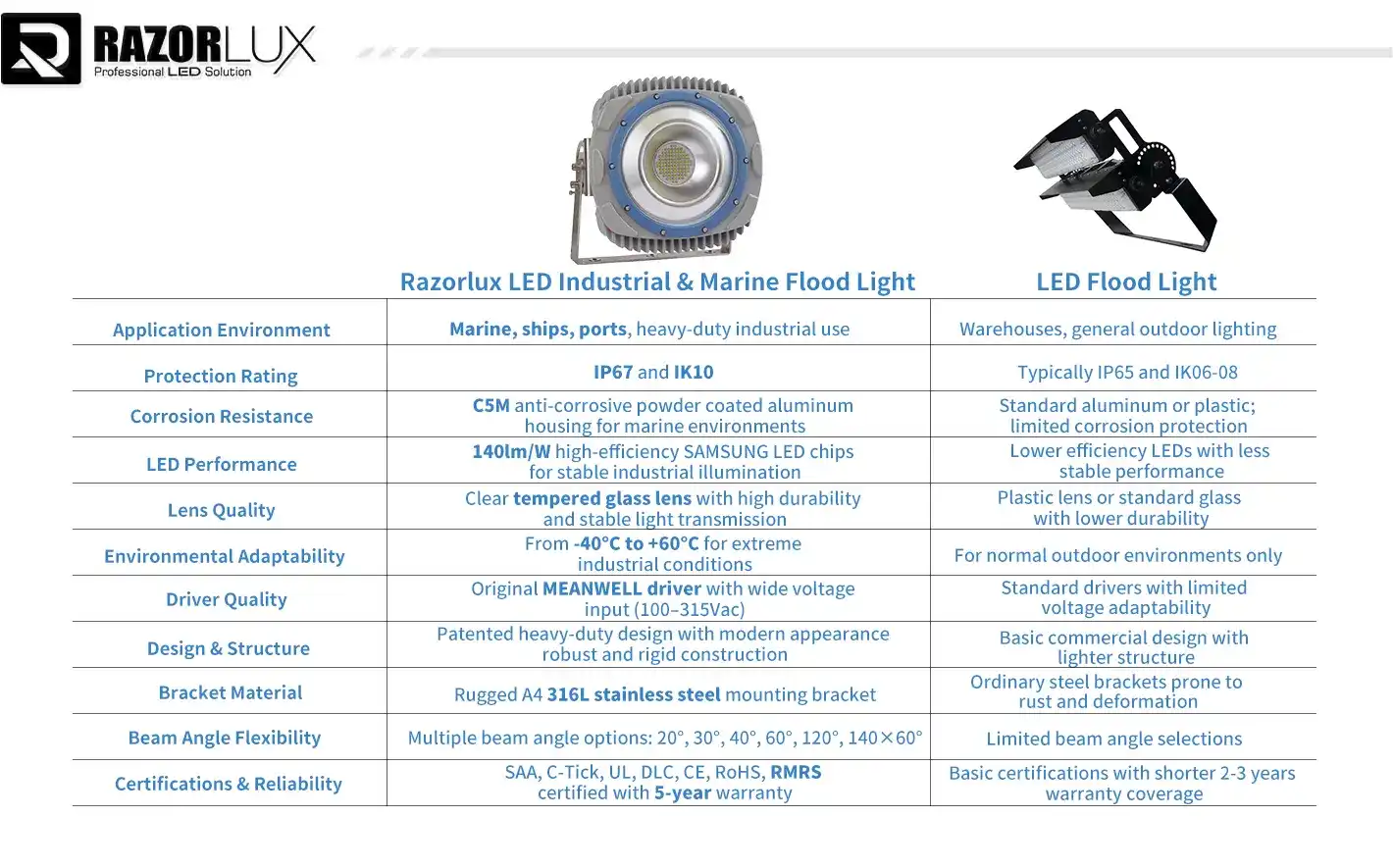
It's easy to see from the numbers why procurement managers might want to get rid of old systems. There are some important differences between LED sports lighting fixtures, the Razorlux RGL-120A (LED) and a regular 300W metal halide fixture that are shown in this table.
| Parameter | Razorlux RGL-120A (LED) | Metal Halide 300W (HID) |
|---|---|---|
| Rated Power | 120W | 300W |
| Luminous Output | 14,400 lm | ~18,000 lm (initial) |
| Efficacy | 130 lm/W | ~60 lm/W |
| Rated Lifespan | ≥50,000 hrs | ~15,000 hrs |
| Warm-Up Time | Instant | 15–20 minutes |
| IP Rating | IP67 | Typically IP65 |
| Maintenance Frequency | Low | High (lamp + ballast) |
| Energy Savings vs HID | — | Up to 60% savings with LED |
All of the above data comes from written maker specs and averages for the HID technology business that were found by a third party.
Reduced Energy Demand Over Product Lifecycle
You save about 180W per hour when you switch out a 300W metal halide light for a single RGL-120A unit. The building is used for 2,000 hours a year and has 50 games. That saves about 18,000 kWh a year, which is a big chunk of the costs and carbon emissions.
Instant-On Performance and Event Management
Metal halide lamps need 15 to 20 minutes to get fully bright, and you can't turn them back on right away after turning them off. When the power goes out, at public events, or in an emergency, LED lights are very helpful because they give off full power right away. This useful benefit makes the building more efficient and cuts down on the fuel used by backup engines.
Environmental Compliance and Regulatory Alignment
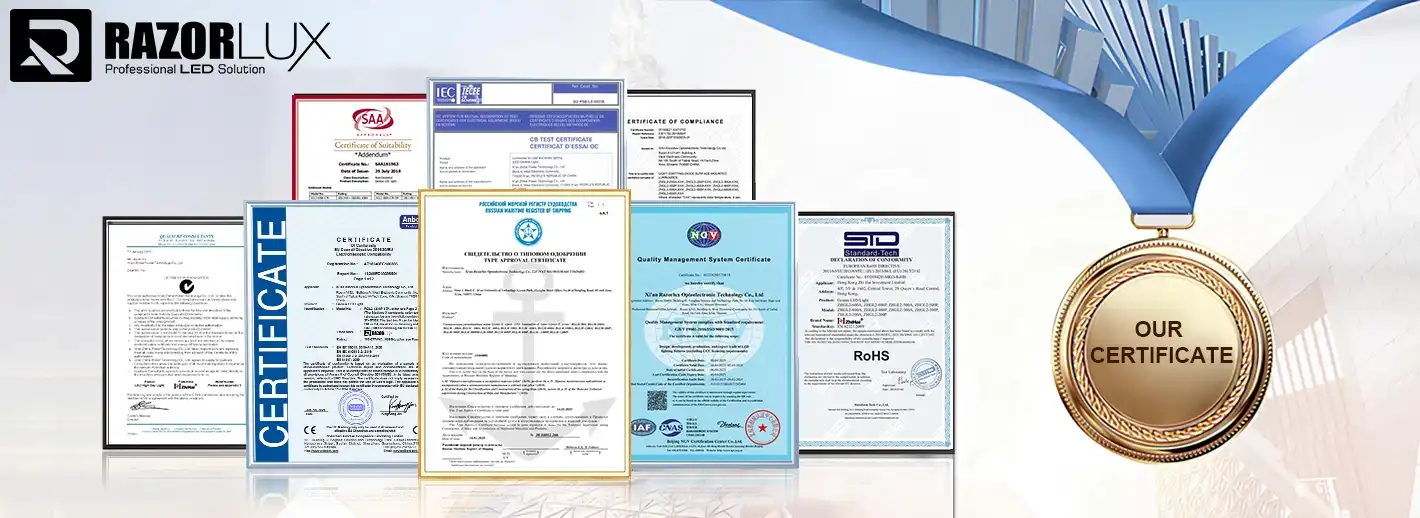
There is no mercury in LED bulbs, but there is in fluorescent or HID lights. This means that the RGL-120A passes environmental standards in North America, Europe, Australia, and Southeast Asia. It has been approved by CE, RoHS, UL, DLC, SAA, C-Tick, CB, and ISO 9001. This paperwork takes away a big problem that procurement managers who work for government or state-linked procurement systems had with following the rules.
Installation and Maintenance Practices That Maximize Energy Efficiency
If you don't take care of or put the light in the right place, it won't work as well, even if it needs to use less energy. Here are the real steps that can be taken to keep the fixture's energy efficiency for as long as it lasts.
Fixture Positioning and Spacing
The right fixing height, target angle, and distance between lamps all affect how evenly the light shines. There are hotspots and dark spots where there isn't enough space, so building managers often add extra lights that aren't needed. Lighting designers and engineers can get photometric data files (IES format) from Razorlux for each beam angle option. This way, they can make sure that the coverage models they make before the lights are installed are correct.
Bracket Material and Structural Integrity
The clamp that comes with LED sports lighting fixtures RGL-120A is made of stainless steel, which doesn't rust in places that are wet, near the coast, or where chemicals are active. If a bracket breaks, the fixture will move out of place, the light will not shine evenly, and so on. This wastes energy. IK10 impact resistance makes sure that the housing can handle stress from wind, vibration, or accidentally touching it.
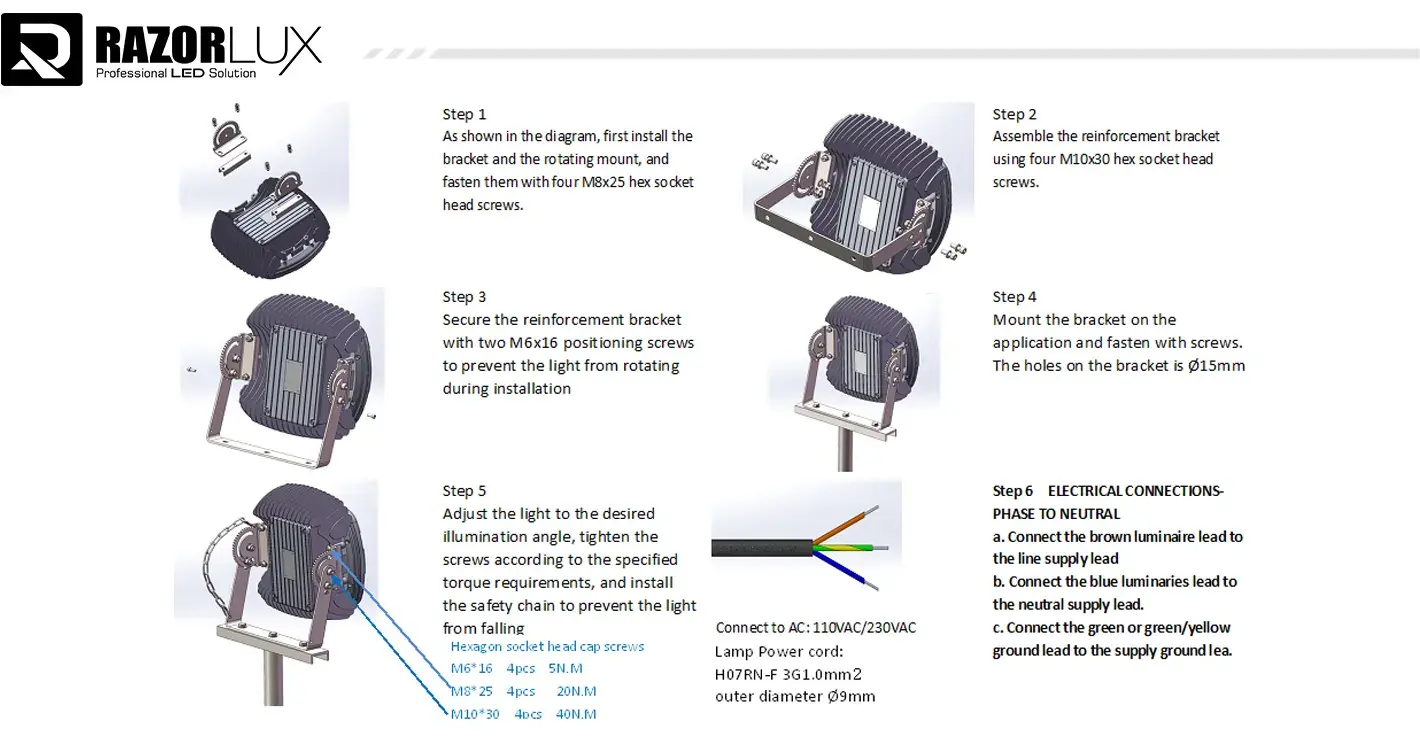
Routine Inspection and Cleaning Protocol
Lens surfaces can lose 10–20% of their light over time as dust and living things build up on them. Cleaning every three months in places with a lot of dust or near the coast, for example, keeps the light output close to what is stated. There is a metal powder coating on the RGL-120A's body that stops the surface from getting dirty. This makes it easy to clean without taking it apart.
How to Choose the Most Energy-Efficient LED Sports Lighting Fixtures for Your Facility
You need to match the technical specs of the fixture to the site conditions and your long-term operational goals in order to choose the right one. These are the things that B2B buying teams always look at first when they're evaluating:
| Specification | RGL-120A | RGL-1000A |
|---|---|---|
| Total Power | 120W | 1000W |
| Luminous Flux | 14,400 lm | 130,000 lm |
| Beam Angles | 60°, 120°, 140°×60° | 40°, 60°, 120°, 140° |
| IP Rating | IP67 | IP65 (upgradeable to IP67) |
| Replaces HID | 250–300W | 2200–2500W |
| Weight | 8 kg | 29 kg |
| Warranty (LED/Driver) | 5 years / 5 years | 5 years / 5 years |
| AC Input Range | 80–315Vac | 80–305Vac |
| Applications | Courts, training areas, docks | Stadiums, large industrial zones |
Certifications and Documentation
In places with a lot of rules, like shipyards, offshore platforms, and government-run ports, procurement managers need all the detailed information from a seller before they can accept them. The CE, RoHS, UL, DLC, SAA, CB, C-Tick, and ISO 9001 all say it is safe. If you ask, you can get full test results, photometric data sheets, and installation tips. This helps the technical team look over the whole process of buying.
Warranty Terms and After-Sales Coverage
There are warranties on both the LED module and the driver for 5 years, and on the case for 10 years. This lowers the total cost of ownership by a lot. Razorlux stands behind this with expert help, replacement parts, and tips on how to create lighting. You won't have to worry about not having enough help after the sale, which slows down project maintenance.
Customization and Procurement Flexibility
It's not always true that standard specs will work in every situation. You can change the color temperature (2,700K–6,500K), the beam angle, the way the housing is set up, and how it works with your control system with Razorlux. People who want to buy a lot of goods or work with OEM partners can use framework buying agreements or sample orders for pre-approval testing. This adaptability is very helpful for engineering firms that are in charge of many projects at once, each with its own site needs.
Conclusion
LED sports lighting fixtures save energy because they have many technical benefits, such as high luminous efficiency, efficient driver electronics, precise beam control, and good heat management. The Razorlux RGL-120A, which has 130 lm/W, IP67 protection, and a lifespan of 50,000 hours, is proof of this. It can replace 250–300W HID sources right away. Businesses that buy things from other businesses use performance data, not marketing talk, to decide whether to switch to high-quality LED lights. Long-term, the best way to save energy is to find fixtures that are the right size and shape for your site and come with full certification support and good after-sales service.
FAQ
How much energy can LED sports lighting fixtures save compared to metal halide lamps?
Quality LED fixtures typically reduce energy consumption by 50–65% compared to equivalent metal halide installations. The Razorlux RGL-120A consumes 120W while replacing a 250–300W HID lamp — a saving of up to 60% per fixture per operating hour.
What certifications should I look for when buying LED sports lighting?
For most B2B applications, look for CE, RoHS, UL, and DLC as a baseline. Facilities in Australia require SAA and C-Tick. Industrial and marine applications may additionally require IK10 impact rating and IP67 ingress protection. Razorlux products carry all of the above, with ISO 9001 manufacturing certification.
How does smart dimming affect energy efficiency?
Dimming controls reduce fixture output — and power draw — proportionally during periods of lower demand. A fixture dimmed to 70% output typically draws around 70% of rated wattage. Across a full operating year, scheduled dimming during off-peak hours can reduce total energy consumption by 25–40%.
Does fixture installation quality affect energy efficiency?
Yes. Incorrect aiming angles, insufficient spacing, or structural misalignment waste light output and may require additional fixtures to compensate. Using manufacturer-supplied photometric data and IES files during the design phase ensures efficient coverage from day one.
What is the typical lifespan of a quality LED sports lighting fixture?
Most premium fixtures are rated at ≥50,000 hours to L70 (the point at which output drops to 70% of initial value). At 2,000 operating hours per year, this equates to 25 years of service before lumen depreciation becomes operationally significant.
Partner With Razorlux for Proven LED Sports Lighting Solutions
Since 1998, Razorlux has sold high-performance LED lights all over the world. They have over 200 patents and certifications to back this up. As a respected company that makes Led sports lighting fixtures, we offer the RGL-120A and RGL-1000A lines with full technical paperwork, samples, and a 5-year product guaranty. Check out www.razorlux.com or email our sales team at sam@razorlux.com to get a visual report, a taste of the product, or a price that is made just for your project. Your project's due date is important to us, so we respond quickly and with full details.
References
1. DiLaura, D. L., Houser, K. W., Mistrick, R. G., & Steffy, G. R. (2011). The Lighting Handbook: Reference and Application (10th ed.). Illuminating Engineering Society.
2. U.S. Department of Energy. (2022). Energy Savings Forecast of Solid-State Lighting in General Illumination Applications. Office of Energy Efficiency and Renewable Energy.
3. Navigant Consulting. (2019). LED Adoption in Commercial and Industrial Buildings. U.S. Department of Energy Building Technologies Office.
4. Illuminating Engineering Society. (2020). IES RP-6-20: Recommended Practice for Sports and Recreational Area Lighting. IES Publications.
5. European Committee for Standardization. (2021). EN 12193: Light and Lighting — Sports Lighting. CEN.
6. International Energy Agency. (2023). Tracking Clean Energy Progress: Lighting. IEA Publications.