


_1750326878398.png)

Where to Buy a Most Powerful Flood Light from a Reliable Supplier
When shipyard managers, port operators, and offshore facility engineers hunt for industrial-grade lighting solutions, finding a trusted flood light manufacturer is mission-critical. The appropriate provider of high-intensity LED flood lights, including the Most Powerful Flood Light, is more than simply a source of brightness. They offer proven performance, reliable supply chains, and technical assistance to keep your operations operating 24/7. If you are lighting up a container port in Singapore or upgrading a Norwegian offshore platform, knowing where to get heavy-duty lighting from a reliable supplier saves your project schedules and budgets from expensive failures.
Understanding What Makes a Flood Light "Most Powerful"
Beyond Wattage: The Real Performance Metrics
Many purchasing teams confuse brightness with power, but industrial lighting requires a more complicated examination. The luminous efficacy in lumens per watt (lm/W) is a measure of how effectively the electrical power is converted into visible light. This is what makes a Most Powerful Flood Light very powerful. A 1200W fixture that emits 130 lm/W of light emits 156,000 lumens and can uniformly illuminate vast dock areas or mining operations. That efficiency is directly proportional to your operating expenses, in that it reduces the quantity of energy used for the same amount of light output needed to ensure safety.
Another issue that often gets overlooked in real life is color temperature. There are several color temperatures from 2700K to 6500K to employ in your fixtures for different jobs. For example, warmer light (3000K–4000K) is more eye-friendly for maintenance operations, whereas cooler daylight equivalents (5000K–6500K) are easier to view for crane operators and security monitoring systems. The Color Rendering Index (CRI >75) ensures that individuals can perceive colors correctly. This allows personnel to distinguish between cables of the same color, paint markings, or warning signs when required in an emergency.
Durability Standards That Define Industrial Reliability
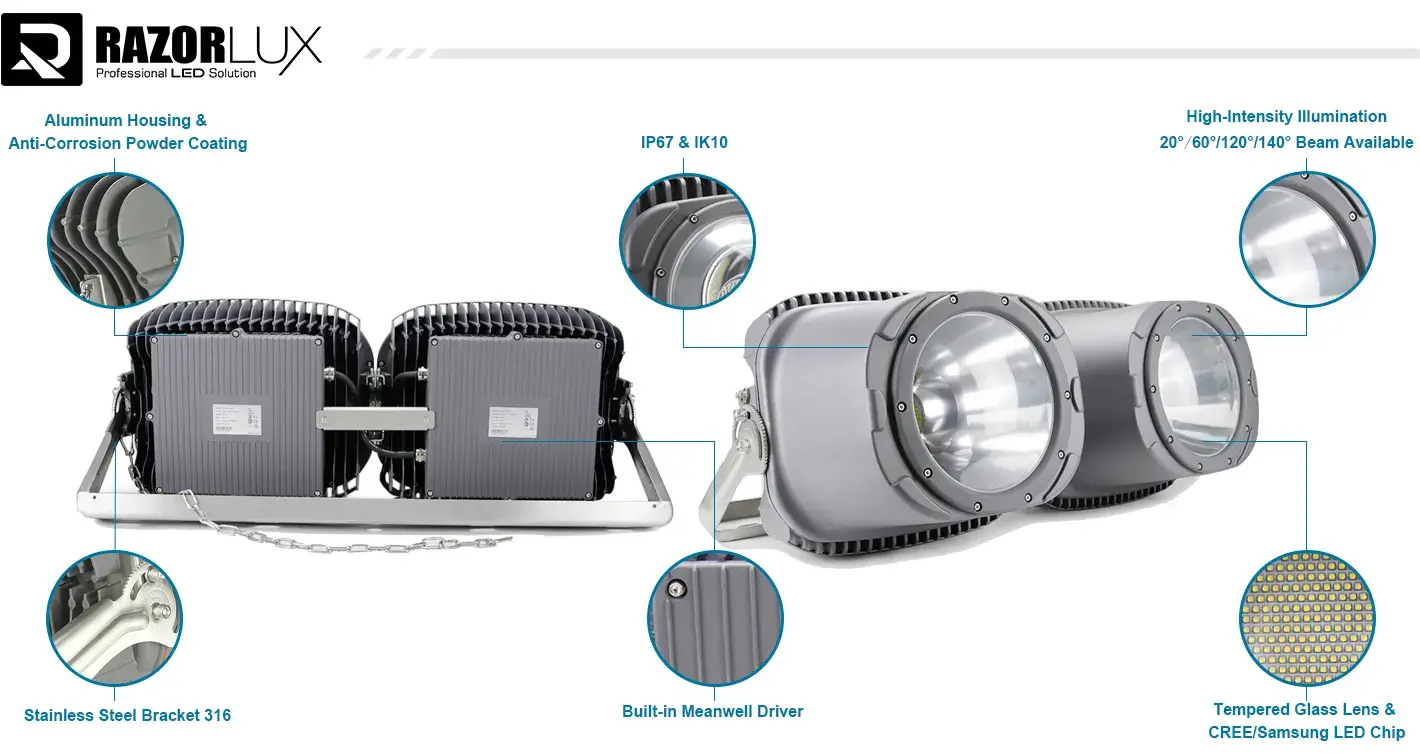
The environmental protection grade differentiates between items manufactured for consumers and those utilized in factories. The IP67 classification means that the gadget is dust-proof and can survive submersion up to 1 meter for 30 minutes. This is extremely crucial if equipment is exposed to salt spray, pressure washing, or abrupt floods. The IK10 impact grade can withstand 20 Joule hits, which is equivalent to a 5-kilogram weight falling from 40 cm. This is a safeguard against crane accidents, falling tools, and deliberate acts of vandalism in unsecured places.
The material selection supports these ratings. Cold-forged aluminum alloy housings provide good heat dissipation and greater corrosion resistance than die-cast housings. Regular steel would rust in months in a naval environment, but stainless steel mounting bolts keep the structure sturdy. Lenses made of tempered glass are resistant to thermal shock caused by rapid temperature change, which is especially significant when fixtures cool down rapidly in the Arctic cold or a tropical hurricane.
Energy Efficiency and Total Cost of Ownership
LED technology has transformed the economics of industrial lighting. Traditional 2000W metal halide lights used a lot of electricity and needed replacing every 6000 hours. Newer LED choices like the Razorlux RGL-1200P provide the same amount of light for 1200W and last 50,000 hours or more. This translates into substantial savings: a building with 20 fixtures operating 12 hours a day saves around $45,000 a year in energy expenses (at $0.12/kWh) and another $15,000 in repair costs from reduced labor and replacement parts.
The wide input voltage range (AC100-305V, DC127-431V) may work with the unstable power grid, which may occur in distant mines, offshore platforms, or ports under development. Therefore, you do not have to purchase costly voltage stabilizers. Mean Well drivers are the gold standard in the industry and offer clean, flicker-free power so that LED chips last longer and fulfill the demands of high-speed cameras for broadcast-grade sports illumination.
How to Choose High-Intensity LED Solutions for Your Operation
Application-Specific Requirements Analysis
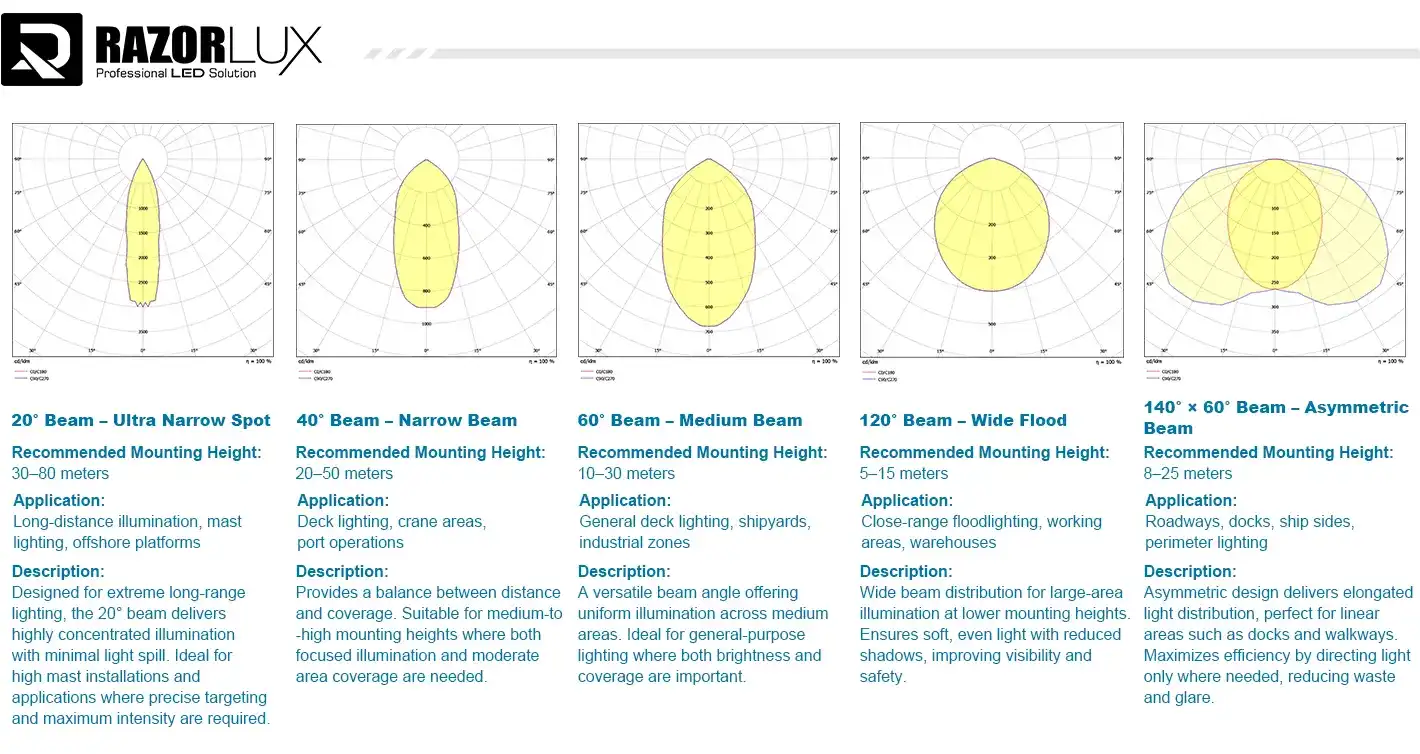
Different workplace settings need different types of lights. Finding the Most Powerful Flood Light for container ports requires high-mast lamps (25–40m mounting height) with Type III or IV beam distributions to keep light from getting into other areas while still lighting up the stacking areas. Adjustable beam angles (15° to 120°) are important to shipyards because they allow for precise lighting in welding bays, blast cleaning chambers, and dry docks. Offshore platforms need fixtures that have been approved by marine classification societies like DNV-GL and ABS. These societies test the fixtures' resistance to rust in seawater by using rapid salt spray testing.
Beam Angle Selection Directly Impacts Coverage Efficiency
The choice of beam angle has a direct effect on how well coverage works. Narrow beams (15° to 30°) focus light over long distances, making them perfect for high-mast or perimeter security. For general area lighting, medium beams (40° to 60°) offer a good mix of range and intensity. Wide-angle distributions (120° or uneven 140°x60°) work well in low-mounting situations where overlapping light patterns make even lighting without dark spots or high contrast ratios.
Technical Specifications Checklist for Procurement Teams
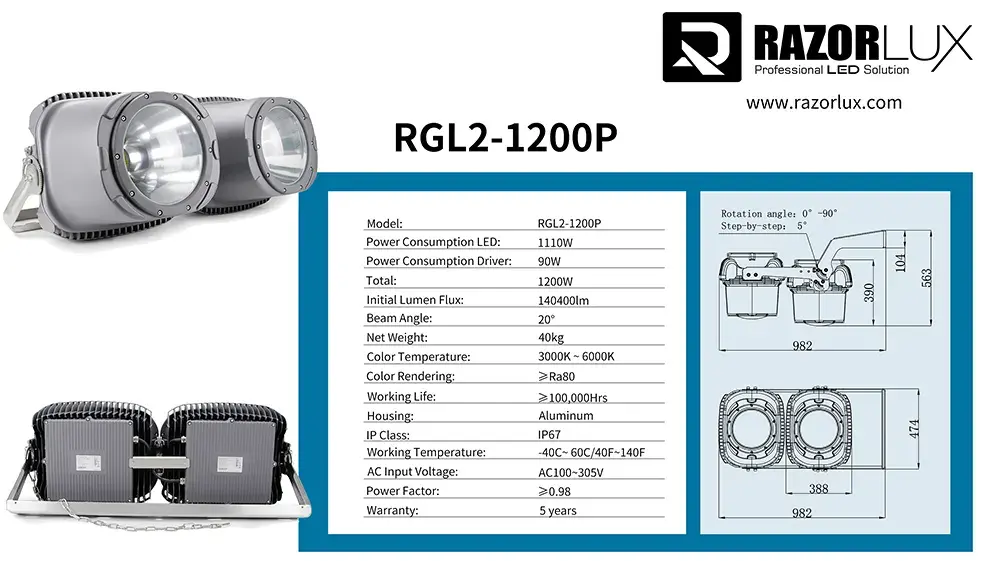
When engineers look at flood lights, they should check the lumen maintenance rates (L70 >50,000 hours means the fixture keeps 70% of its output after this time), the ability to manage temperature (junction temperature <75°C stops LEDs from breaking down too quickly), and the surge protection (minimum 10kV for coastal/industrial areas). LED chips from Samsung or Philips have been shown to be reliable, and Mean Well drivers offer programmable dimming methods (0-10V, DALI) that can be used with smart building control systems.
Working temperature range (-40°C to +60°C) allows year-round use from ports in the Russian Arctic to factories in the Middle East. In structural engineering, weight is important. For example, a 50-kilogram fixture needs the right kind of truss or pole, while lighter options might not work as well as a heat sink. It's important that warranties cover both parts and workmanship. Razorlux's 5-year warranty covers manufacturing flaws, driver failures, and LED chip performance loss, protecting your investment.
Budget-Performance Balance Strategies
Purchasing managers are always under pressure to find the best balance between up-front costs and long-term value. Entry-level industrial lights may cost 30–40% less at first, but they often don't have approved parts, so they fail 200–300% more often within three years. This is what a real cost comparison should have:
- Energy consumption over 50,000 hours (LED efficiency has a direct effect on this)
- Maintenance schedules and labor costs (special tools are needed to get to high-mast lights).
- Access to spare parts and compatibility (proprietary parts lock you into one vendor)
- Certification compliance (not having the right paperwork can slow a job or get you in trouble with the law)
Project-based procurement often benefits from partnerships with vendors that offer volume discounts, longer payment terms (L/C for international transactions), and technical support that includes photometric calculations. Razorlux uses DIALux software to create unique lighting layouts that include exact fixture counts, mounting places, and projected light levels before making any purchases.
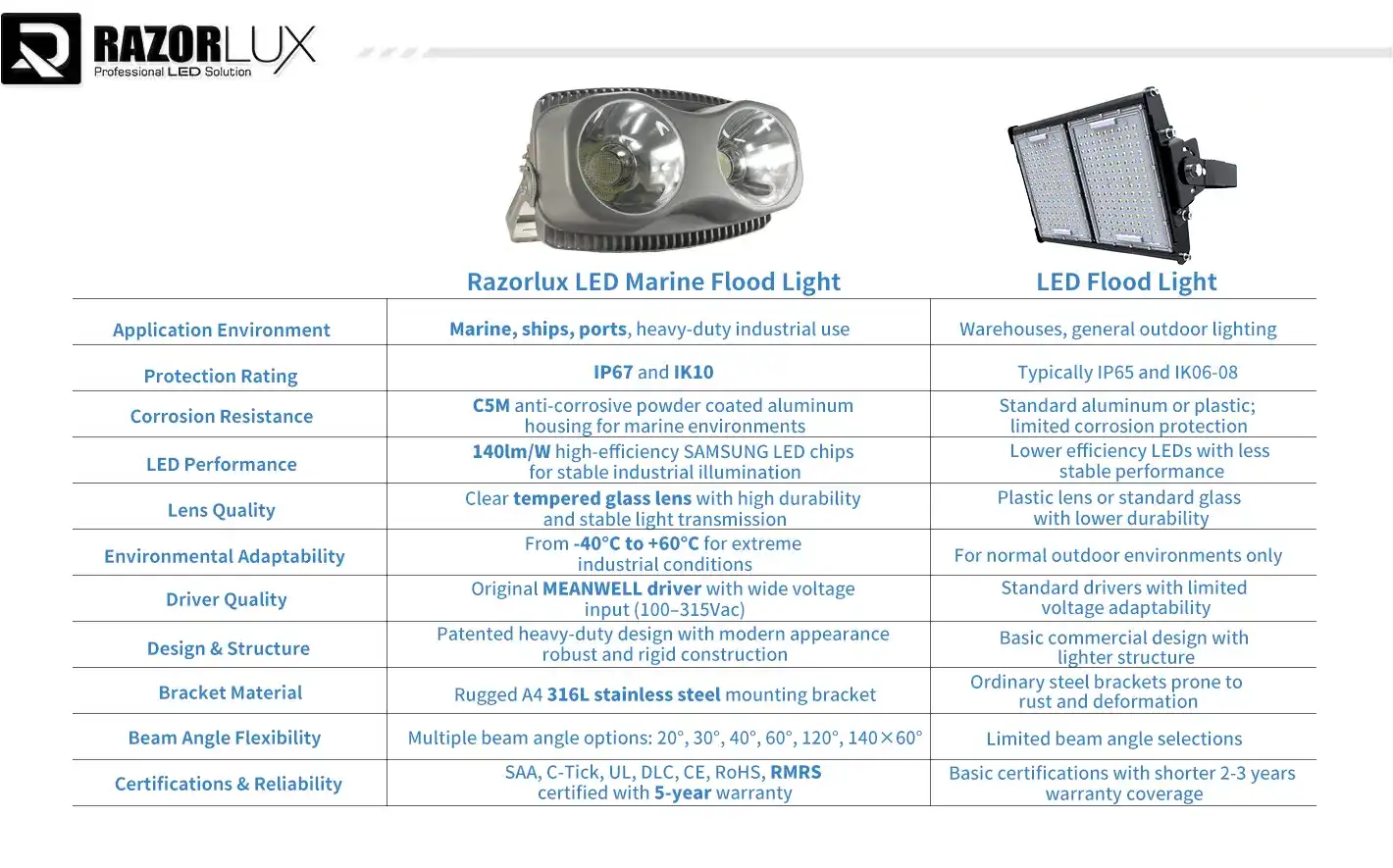
Comparison of Leading Industrial Flood Light Technologies in 2024
Established Global Brands vs Specialized Manufacturers
Multinational companies like Philips and Osram have a lot of products, and their names are well known and used all over the world. Their high-end fixtures have cutting-edge features like environmental sensors, wireless mesh networking, and algorithms that predict when maintenance will need to be done. However, prices often include big brand premiums (40–60% more than specialized manufacturers) and low minimum order quantities that make it hard for medium-sized projects. Identifying the Most Powerful Flood Light from a specialized manufacturer like Razorlux can often be more cost-effective.
Specialized industrial lighting companies only make lights that can be used in harsh environments. They do this by creating unique temperature management systems and multi-voltage platforms. Because of this, customizations like changed beam patterns, mounting configurations, or built-in backup systems for emergencies can be made more quickly and are usually delivered within 4 to 6 weeks. Because they don't have to pay markups to distributors, direct manufacturers make high-specification fixtures available to regional factories or smaller port officials.
| Performance Parameter | Standard Industrial LED | Razorlux RGL-1200P | Premium Global Brand |
|---|---|---|---|
| Luminous Efficacy | 110-120 lm/W | 130 lm/W | 125-135 lm/W |
| Input Voltage Range | AC100-277V | AC100-305V, DC127-431V | AC100-277V |
| Operating Temperature | -20°C to +50°C | -40°C to +60°C | -30°C to +55°C |
| Impact Rating | IK08 | IK10 | IK09 |
| Warranty Period | 3 years | 5 years | 5 years |
| Typical Lead Time | 8-12 weeks | 4-6 weeks | 10-16 weeks |
Innovation Trends Shaping Industrial Lighting
The fastest-growing segment is smart lighting integration. Fixtures now come with Internet of Things (IoT) sensors that track how much energy they use, how long they run, and the temperature inside. Predictive maintenance algorithms let site managers know about problems before they happen, so replacements can be planned for planned breaks instead of emergency shutdowns. Wireless control systems (Zigbee, LoRaWAN) let you change the lighting in real time, so you can dim areas that aren't important when there isn't much going on and brighten them up when crane operations get busier.
Human-centered lighting ideas that were first used in homes are now influencing industrial design. Tunable white systems change the color temperature during shifts, which supports circadian rhythms and may help lower accidents caused by tiredness. While more study is being done, early users of 24-hour port operations say that workers are 12–18% more alert during night shifts.
Certification Requirements by Industry and Region
Marine applications must comply with the norms of the classification society. For example, DNV-GL MARINE and ABS TYPE APPROVAL require fixtures to withstand 15° tilts, vibrations similar to those of marine diesel engines, and electromagnetic compatibility (EMC) with guiding systems. Systems in Europe must have the CE mark, which signifies compliance with the LVD (Low Voltage Directive) and the EMC Directive. However, in North America, UL listing and DLC certification are more crucial for utility rebates.
ATEX and IECEx certifications are necessary for hazardous environments such as chemical terminals, oil refineries, and explosive atmospheres. The approvals ensure the fittings will not allow the creation of sparks or high surface temperatures that might cause volatile gases to ignite. Razorlux is internationally certified, including CE, RoHS, UL, and SAA. This implies that the same fixture requirements may be used for projects on various continents.”
Where and How to Buy Industrial Flood Lights from Trusted Suppliers
Evaluating Manufacturer Credibility and Technical Capability
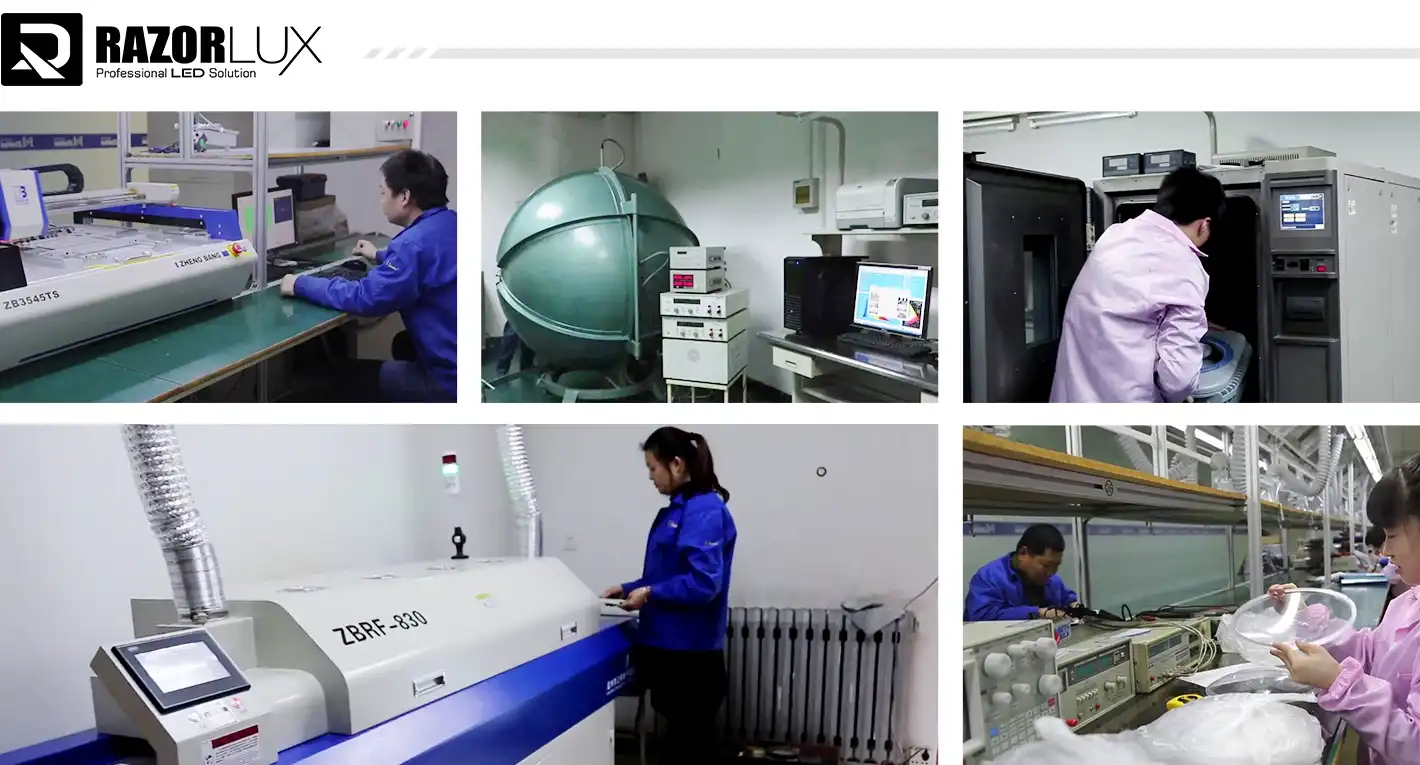
The first step in evaluating a supplier is to check the production infrastructure. ISO 9001 recognition means quality management procedures are in place, but does not imply the lighting specialists are good. #3. The most powerful floodlight maker must have approved testing labs. China's National Development and Reform Commission authorized the “Xi'an LED Lighting Engineering Laboratory” of Razorlux. Razorlux does its own thermal stress testing, salt spray rust analysis, and photometric verification, rather than relying on findings by other firms.
Patent collections are a proxy for actual R&D investment. Razorlux has 436 patents for novel methods to package LED chips, improved ways to deal with heat, and modular housing designs. That demonstrates they are continually improving and not simply duplicating existing technology. Company longevity is also crucial. Razorlux is one of the earliest firms in power supply engineering, founded in 1998. They went into LED lighting in 2006 and picked up a lot of fundamental stuff that their younger rivals don’t know.
Direct Manufacturer vs Distributor Trade-Offs
When you buy directly from makers, you avoid the markups that distributors add, which are usually between 25 and 40 percent. You can also talk to engineering teams directly for technical advice, and you can make changes to the product as needed. Custom changes for each project, like making mounting brackets for oddly shaped poles, adding lightning arrestors to open areas, or changing lens coatings for harsh UV environments, can be made more quickly and without having to wait for communication to be relayed through a third party.
Distributors, on the other hand, offer benefits such as localized goods (which means faster delivery for pressing replacements), consolidated operations when buying a lot of different types of products, and sometimes better payment terms because of long-term relationships. Hybrid approaches work well: work with manufacturers on big projects and keep in touch with distributors for MRO (maintenance, repair, and operations) needs.
International Procurement Logistics and Documentation
When buying lights across international borders, you need to bring certain paperwork with you. Manufacturers should send accurate commercial invoices with HS codes (usually 9405.40 for LED lights), certificates of origin that allow preferential tariff rates under free trade agreements, and conformity declarations that match the rules of the destination country. Razorlux has exported to more than 60 countries, so they know how to properly prepare the paperwork so that customs approval times are kept to a minimum.
| Shipping Method | Transit Time | Optimal Order Size | Cost-Efficiency | Best Applications |
|---|---|---|---|---|
| International Express (DHL, FedEx) | 3-7 days | 0.5-300 kg | Premium pricing | Sample orders, urgent replacements |
| Air Freight | 5-10 days | 300+ kg | Moderate | Project deadlines, moderate volumes |
| Rail (China-Europe) | 18-22 days | 2+ CBM / 500+ kg | Good | European projects, mid-size orders |
| Sea Freight (FCL/LCL) | 15-50 days | 2+ CBM / 500+ kg | Excellent | Large projects, non-urgent bulk orders |
After-Sales Support and Warranty Execution
What separates outstanding sellers from transactional ones is the support they provide after the sale. A thorough warranty should include fast response times (24 to 48 hours for technical concerns), on-site failure investigation to determine why things failed, and advance replacement plans to reduce downtime. Razorlux's warranty policy states that new devices will be sent within 72 hours of accepted warranty claims. Then customers ship back the faulty products. That way, manufacturing doesn’t have to halt while the warranty is handled.
Technical support involves more than simply solving issues. The fixtures’ performance is further enhanced by installation assistance, optical testing after start-up, and training for maintenance crews on correct usage of the lights. Some suppliers can diagnose luminaires remotely using onboard IoT sensors. The sensors may detect issues like driver deterioration or LED string failures before the whole fixture fails and ceases operations.
Ensuring Long-Term Value Through Strategic Maintenance and Upgrades
Preventive Maintenance Programs for Industrial Lighting
Fixtures endure longer and don't break down in emergencies, which may be highly costly. For a Most Powerful Flood Light, it is recommended that you inspect it every six months to make sure the mounting hardware is secure enough (vibrations may cause the fasteners to loosen over time), the lens surfaces are clean (salt or dust build-up reduces output by 20-30%), and that there is no corrosion in the electrical connections. Thermal imaging cameras can identify overheated parts before they fail. Replacing a $150 driver early may save $2,500 in fixture replacements and $5,000 in emergency service calls.
IP67-rated fixtures are simpler to maintain since they are sealed to keep out dirt and other impurities. But the gaskets on the closures wear out with time and need to be changed every 5 to 7 years to keep intruders away. Modular designs also make repairs quicker, since technicians are able to replace whole driver modules in minutes, rather than hunt for problems on circuit boards. Razorlux fixtures include standard parts and tool-free access panels, so most repairs may be done by basic maintenance workers without any training.
Energy Management Strategies and Smart Controls
Lighting normally represents 15 to 25 percent of the energy in an industrial facility, so it makes sense to look for methods to reduce energy. Occupancy monitors and sun harvesting systems automatically turn down the lights when a room is unoccupied or when there is adequate natural light. This decreases energy consumption by 30 to 50 percent without compromising safety. “We’ll turn down the lights from midnight to 4 a.m. when not much is going on, saving money and making the fixtures last longer — LEDs that are run at 75% output last 40% longer than those run at full power.”
Integration with building management systems (BMS) allows for more sophisticated strategies. For example, if workers are gently brought up to brightness 30 minutes before a shift change, they can adjust, and if they are slowly brought down thereafter, they know the shift is ended. Energy analytics discover weird things.... For instance, a fixture that pulls too much current might signal a damaged driver, and one that takes no power can indicate a power supply issue, before it goes dark and accidents happen.
Technology Refresh Cycles and Upgrade Pathways
Every year, LED technology gets about 10% more efficient and 15–20% better at balancing cost and performance. Facilities that want their lights to last 10 to 15 years should think about modular systems that let parts be upgraded without having to change the whole device. Retrofit kits that replace LED modules and drivers but keep the housings and mounting hardware get 60–70% of the benefits of new technology for 35–40% of the cost of a full replacement.
Some markets are seeing the rise of Lighting-as-a-Service (LaaS) models, which change capital spending to operational costs. In exchange for monthly fees based on lighting levels or operating hours, suppliers own the fixtures and take care of all maintenance, upgrades, and replacements. Heavy industry doesn't use these kinds of agreements very often yet, but factories with complicated financing may find them useful.
Navigating the Procurement Journey: From Specifications to Installation
Putting Together Detailed Technical Specifications
For procurement to work well, there must be clear specifications for a Most Powerful Flood Light that match the need for efficiency with a reasonable budget. Setting goal lighting levels with lighting designers or consultants (usually 150–300 lux for general industrial areas and 500+ lux for precision work zones) makes it possible to use objective criteria for evaluation. Specifications should spell out the bare minimum of standards that are accepted, such as IP rating, CRI, and efficacy, while still letting sellers offer better solutions that are a better deal.
Performance-based specifications work better than prescriptive methods sometimes. Instead of requiring specific fixture models, you should describe what you want to achieve: "light up a 50m x 80m container stacking area to an average of 200 lux with a maximum 4:1 uniformity ratio using fixtures mounted on four 30m high-mast poles." Qualified suppliers will then come up with the best solutions, which may include more efficient methods than were originally thought of.
Pilot Installations and Testing of Samples
Getting two to four sample units to test before making big promises guards against problems with quality or specifications that don't match up. Using calibrated lux meters at certain distances, testing should make sure that the photometric performance matches the published data. It should also check the build quality and how easy it is to install, and it should make sure that it works with the existing electrical infrastructure. Longer testing, lasting 30 to 60 days, finds early problems that wouldn't be seen in plant testing.
Real-world validation comes from pilot sites in representative places. Before ordering more than 200 units for the whole building, a shipyard might put up six fixtures in one dock bay and get feedback from the welders, crane workers, and maintenance staff. This method finds practical issues like glare problems, poor coverage in certain areas, or growing problems that can't be seen in theoretical planning.
Talking About Terms That Will Protect the Project's Interests
Payment plans should be in line with project deadlines and how risks are shared. A common agreement is to pay a 30% deposit, then pay the remaining 60% after production is complete and the product has been inspected before shipping. The remaining 10% is held until installation proof or 30-day burn-in is complete. Letters of credit protect foreign deals, and inspection certificates are what release payment.
When shipments are late, delivery schedules should include terms for liquidated fees to make up for lost output and project delays. On the other hand, early shipping rewards make suppliers more likely to put your order first. The warranty terms must make it clear what is covered, what isn't covered (like improper installation or over-voltage events), how to file a claim, and how long it will take for someone to respond. Razorlux's standard warranty covers early replacement and technical support. For large projects, extending coverage or adding on-site service can be negotiated.
Commissioning and Checking for Performance
Professional setup makes sure that lighting systems work the way they were meant to. Photometric scans with calibrated tools check the levels of light at grid points across the project area to make sure they meet the requirements and set baseline data for planning future maintenance. Functional testing makes sure that control systems work properly. It makes sure that the lighting acts easily, that backup systems for emergencies work within the time limits that were set, and that smart features work properly with the platform for facility management.
Long-term benefits come from training support staff during launch. Hands-on training in routine maintenance, troubleshooting, and safe working practices (including working at heights and with high-voltage electrical systems) cuts down on the need for future service calls and improves the company's ability to solve problems on its own. Suppliers who offer detailed training guides, video tools, and expert hotlines keep operations going even after installation teams leave.
Real-World Applications Across Maritime and Heavy Industries
Success Stories in Port and Terminal Infrastructure
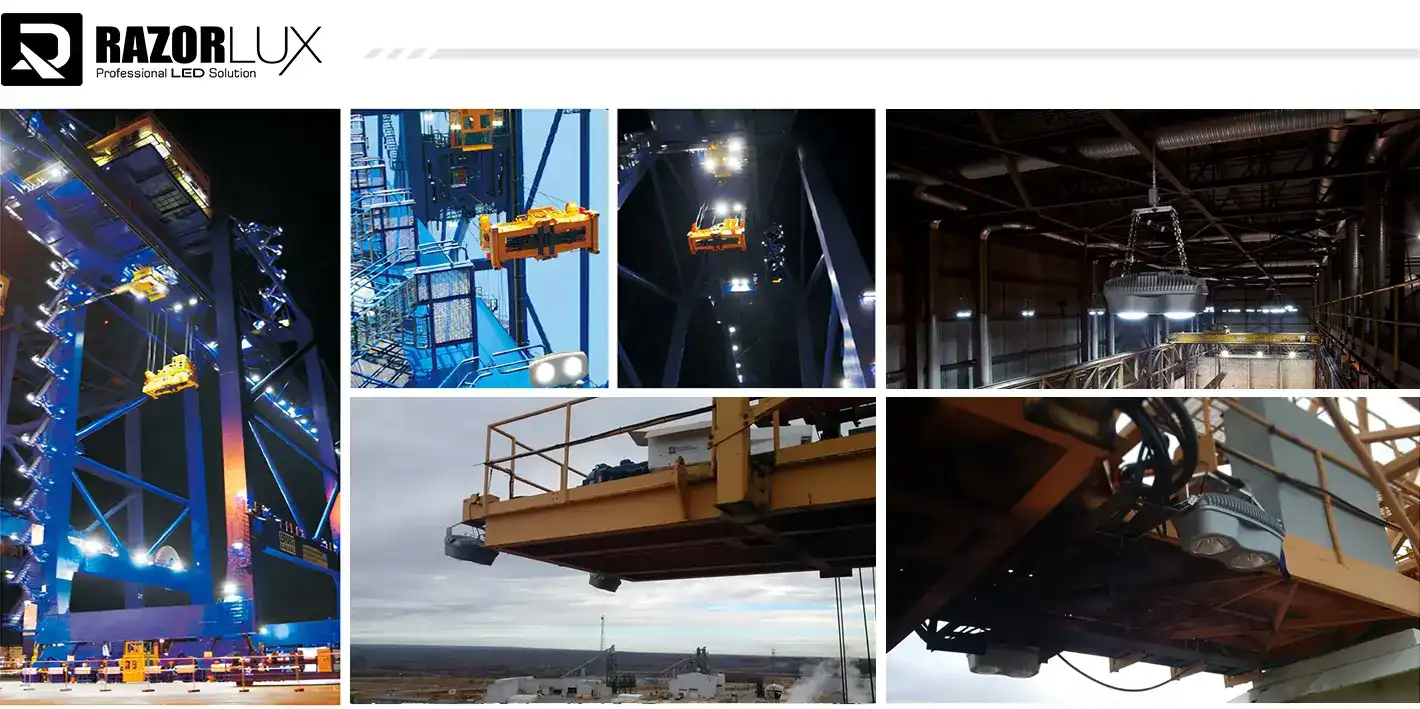
Modern container terminals like Singapore's Pasir Panjang Terminal have switched thousands of fixtures to LED technology. This cuts energy use by 65% while improving lighting quality, which makes it easier for crane operators to be safe and for security guards to keep an eye on things. A Most Powerful Flood Light like Razorlux's RGL-1200P provides 250+ lux of average illumination across stacking yards from 40m mounting heights. Narrow beam optics keep light pollution from affecting nearby living areas to a minimum, which is important for ports that work in cities.
When handling coal, ore, or grain, bulk transport ports need to take certain things into account. In places with a lot of dust, lenses need to be cleaned often unless the fixtures have hydrophobic coatings that let rainwater wash away dirt on its own. When gritty dust and high humidity come together, they speed up the breakdown of metal; corrosion resistance becomes very important. Marine-grade coatings and stainless steel parts make fixtures last longer in these harsh conditions, from 3 to 5 years for standard construction to 10 to 15 years.
Uses for Offshore Platforms and Marine Vessels
Offshore oil and gas sites in the North Sea, the Gulf of Mexico, or West Africa have to deal with some of the harshest conditions in the business. They have to deal with salt spray, high winds, extreme temperatures, and rules that require them to have two sets of emergency lights. Classification society permits (DNV-GL, ABS) make sure that things meet standards for marine vibration, electromagnetic compatibility with navigation systems, and building that doesn't catch fire.
Commercial and fishing ships are using LED technology more and more in both repairs and new builds. Less power use means less load on generators and lower fuel costs, which is very important when diesel costs $3 to $5 per gallon in remote places. Less heat from LED lights makes working conditions better in engine rooms and processing areas, and since they last longer, they don't need as much maintenance during long trips away from supply ports.
Heavy Industrial Manufacturing and Mining Operations
Lighting that can handle high temperatures, strong shaking, and airborne contaminants is needed in steel mills, paper plants, and foundries. For nighttime activities, open-pit mines need lighting systems that cover large areas. These systems are made up of fixtures placed on portable light towers that are moved as the digging goes on. The RGL-1200P can handle a wide range of voltages (AC100-305V, DC127-431V), which is good for remote mining sites where generator power quality can change. Its IK10 impact resistance protects against rock fragments from blasting operations.
There are some extra problems that come up when fixtures are used in underground mines. They have to be certified as explosion-proof in environments that could contain a lot of methane, work reliably in environments with 100% humidity, and handle constant vibration from drilling equipment. Some types of industrial LED lights are made with stronger materials, better seals, and electronic parts that can handle shock loads higher than what is needed for surface installation.
Conclusion
To get high-performance industrial flood lighting, you need to carefully look at the technical specs, the supplier's abilities, and the long-term value propositions. Whether to use well-known global brands or specialized manufacturers depends on the needs of the project. Selecting a Most Powerful Flood Light means checking certifications, getting full insurance, and building relationships with providers who can provide ongoing technical support. Smart settings, better efficiency, and efforts to be more environmentally friendly are all changing the way industrial lighting is bought and used. Procurement professionals can build lighting systems that improve safety, productivity, and operational efficiency for decades by staying up to date on these changes and keeping their attention on basic performance criteria like lumen output, durability ratings, energy efficiency, and reliable supply chains.
FAQ
1. How do I determine the appropriate wattage for my specific industrial application?
Focus on lumen output and mounting height instead of wattage alone to decide if a Most Powerful Flood Light is right for you. A 1200W light with 156,000 lumens gives off about 200 to 250 lux at ground level when it is set up in a high-mast setup 30 to 40 meters above the ground. When mounted lower (10–15m), you need fewer lumens or beam angles that aren't as wide. To make sure you choose the right fixtures, you should talk to lighting experts or use photometric tools like DIALux. Razorlux offers free layout design services that figure out the best number of fixtures and where to put them based on the size of your site and your lighting needs.
2. What advantages do LED flood lights offer specifically for marine and heavy industrial environments?
LED technology works better in tough conditions because it turns on instantly (unlike metal halide), keeps working even when it's cold (whereas HID lights lose 30–40% of their brightness), and doesn't get damaged by vibrations like filament-based technologies do. Using less energy cuts costs by 50–70% compared to regular lighting, and lights that last 50,000 hours or more mean less upkeep is needed, which is especially helpful when they are mounted on offshore platforms or inside ship holds that need to be accessed by scaffolding. LED lights also get rid of dangerous materials like mercury that are found in fluorescent and HID lamps. This makes them easier to throw away and lowers their environmental impact.
3. Can I order customized large-quantity flood lights with specific modifications for my project?
Manufacturers with a good reputation allow customization for orders over 100 to 200 units. Common changes include making custom mounting brackets that fit poles with odd shapes, changing beam patterns to get the best coverage for different site plans, adding surge protection for areas prone to lightning strikes, or adding emergency backup battery systems. Razorlux's engineering team works together on custom solutions. It usually takes two to three weeks for design validation and prototype production, and then four to six weeks for mass production. Most of the time, you need to order at least 50 to 100 units to make major changes. However, smaller orders may be able to handle easier changes like changing the mounting angle or the length of the cables.
Partner with Trusted Marine and Industrial Lighting Specialists at Razorlux
When your operations demand uncompromising illumination performance, Razorlux delivers industrial flood light solutions engineered specifically for maritime, offshore, and heavy-duty environments. Our RGL-1200P series combines 156,000-lumen output with IP67 ingress protection, IK10 impact resistance, and Samsung LED chips paired with Mean Well drivers—components selected for maximum reliability in the harshest conditions. As both a manufacturer and supplier with 25+ years of power electronics and LED lighting expertise, we provide complete project support from photometric calculations through commissioning and ongoing maintenance.
Our procurement specialists understand the unique challenges facing shipyard purchasing managers, marine equipment integrators, and offshore facility engineers. We respond to technical inquiries within 24 hours, provide sample units for field testing, and deliver complete documentation packages including certifications, technical drawings, and IES photometric files. Whether you're retrofitting a Norwegian port with cold-weather-rated fixtures, illuminating a Singapore shipyard requiring marine classification approvals, or supplying lighting for an Australian mining operation needing wide-voltage compatibility, Razorlux offers a Most Powerful Flood Light solution certified to international standards including UL, CE, DNV-GL, and ABS.
Experience the difference of working directly with a dedicated industrial flood light manufacturer. Contact our team at sam@razorlux.com to discuss your project requirements, request photometric layouts, or arrange sample shipments. Our comprehensive support ensures your lighting infrastructure delivers decades of reliable, cost-effective performance.
References
1. Illuminating Engineering Society. (2020). IES Lighting Handbook: Reference and Application (10th ed.).
2. U.S. Department of Energy. (2023). LED Lighting for High-Bay and Low-Bay Applications. Washington, DC: Office of Energy Efficiency & Renewable Energy.
3. International Association of Ports and Harbors. (2022). Port Lighting Standards and Best Practices. Tokyo: IAPH Technical Committee.
4. Marine Technology Society. (2021). Offshore Platform Safety Standards: Lighting Requirements. MTS Journal, 55(3), 78-92.
5. International Electrotechnical Commission. (2019). IEC 60529: Degrees of Protection Provided by Enclosures (IP Code) (3rd ed.).
6. American National Standards Institute. (2023). ANSI/IES RP-6-22: Sports and Recreational Area Lighting. Washington, DC: ANSI.