


_1750326878398.png)

Where to Buy Outdoor Lighting for Volleyball Court Systems
Some of the unique challenges that B2B buyers encounter when purchasing outdoor volleyball court lighting systems include: the trade-off between initial capital outlay and long-term operational costs, adherence to international safety standards, and selecting vendors capable of delivering uniform quality across various projects. Be it a beach volleyball facility on the coast in Singapore, a municipal sports complex in Norway, or an industrial recreation area in the UAE, the correct lighting partner may make your project a sustainable asset rather than a financial drain. This guide combines technical data, market intelligence, and procurement strategies to help purchasing managers, engineering contractors, and facility operators select reliable Outdoor Lighting For Volleyball Court systems that provide high performance standards and support your operational objectives.
Understanding Outdoor Volleyball Court Lighting Requirements
Outdoor Lighting For Volleyball Court systems need particular lighting to fulfill the unique visual requirements of the sport. Unlike static work zones, volleyball players glance up at the night sky as they rapidly follow the ball up and down. Poor lighting design causes glare, uneven lux distribution, and visual fatigue, impacts that make games less safe and less entertaining to play.
Industry Standards and Lux Benchmarks
EN 12193 and IES RP-6-15 require an average horizontal lighting of around 200 lux for recreational courts (Class III), whereas competitive venues (Class I) need over 750 lux with uniformity ratios above 0.7 (IES Lighting Handbook, 2020). Take into account that the vertical lighting should be at least 500 lux at 1.5 meters above the playing surface so that the ball during the serve or spike is correctly monitored. These requirements directly influence fixture selection, pole height, and aiming angles.
Fixture Technologies: LED, Metal Halide, and Beyond
LED technology is currently the industry leader because of its greater efficiency (130–140 lm/W vs. 70–90 lm/W for metal halide), instant-on capability, and lower maintenance requirements. Metal halide systems are less expensive initially but more costly to replace and lose brightness over time. Solar is not particularly prevalent yet since it is hard to get in certain areas and batteries can only retain so much electricity. For corporate purchasers concerned with total cost of ownership, LED systems save energy and pay for themselves in 18–36 months, and they live longer—over 50,000 hours (U.S. Department of Energy, 2021).
Environmental and Safety Considerations
Corrosion is accelerated by salt spray in coastal and offshore facilities. To keep out water and balls that get trapped in them, fixtures need to have C5-M rust ratings or IP67/IK10 protection. Temperature resilience is also significant. Systems working in hot environments such as the Middle East (ambient up to 60°C) or cold environments such as Scandinavia (-40°C) need extensive thermal management and a broad range of input voltages (AC110-480V) to sustain their output levels without the need for additional adapters.
Evaluating Outdoor Volleyball Court Lighting Solutions on the Market
To choose the best outdoor lighting for a volleyball court system, you need to compare makers, technologies, and durability measures in a structured way. The research below gives procurement teams a way to look at market offers in the context of their own operations.
Leading Manufacturers and Their Market Positioning
| Manufacturer | Core Technology | Typical Efficacy | Target Market | Notable Certifications |
|---|---|---|---|---|
| Philips | LED with optics from OptiVision | 135 lm/W | Places for business and government | CE, UL, DLC |
| Musco | Hybrid systems with HID and LED | 120 lm/W | Professional sports stadiums | Certified by UL, FCC, and IES |
| Cree | High-CRI LED groups | 140 lm/W | Broadcast-grade venues | UL, DLC Premium |
| Razorlux | LEDs made for industry with Meanwell drives | 130 lm/W | Marine, offshore, and heavy-duty courts | ISO 9001, CE, RoHS, UL, DNV/GL |
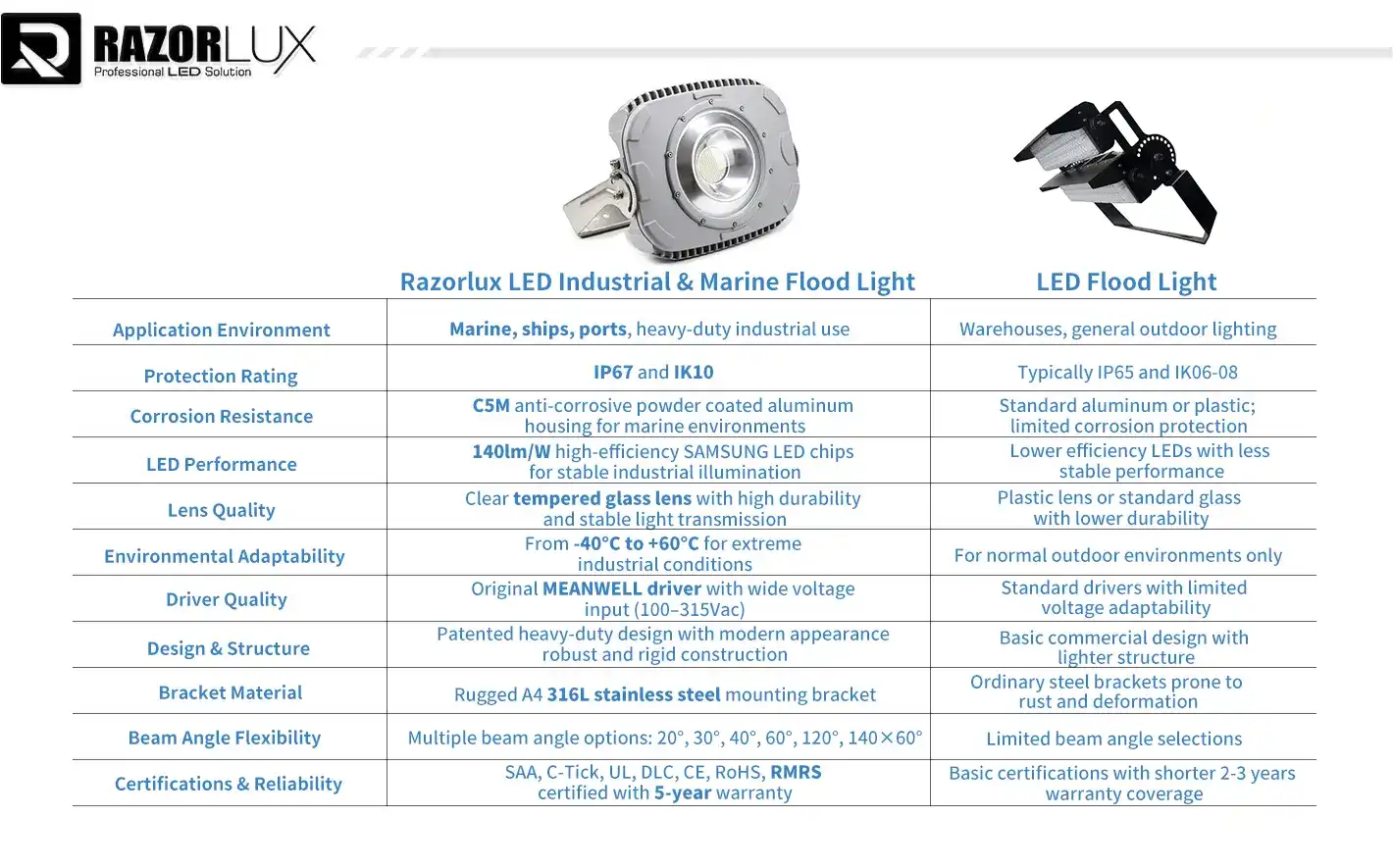
Razorlux is perfect for harsh situations with IP67-certified housings, impact-resistant up to IK10, and voltage acceptance from 110V to 480V and DC100V to 800V. This is from Maritime Lighting Engineering. As such, site-specific transformers are not necessary, simplifying installation for multi-site projects throughout Europe, Asia, and the Middle East.
LED vs. Metal Halide: A Cost-Performance Analysis
The decision between LED and metal halide will rely on the length of the project and ease of maintenance. Metal halide lights need to be replaced every 8,000 to 12,000 hours. They are also costly to dispose of due to hazardous elements. However, LED systems retain 70% of their light output even after 50,000 hours with relatively little maintenance. Replacing an 800 to 1000 W metal halide lamp with a 400 W LED light that is utilized 10 hours per day saves about 4,380 kWh per pole per year, or $438 USD at $0.10/kWh, or $21,900 over five years for a typical 10-pole system (Advanced Lighting Guidelines, 2022).
Weather Resistance and Material Durability
Powder-coated aluminum die-cast housings won’t degrade under UV light or when heated and chilled. The mounting clamps are stainless steel therefore, there is no problem with galvanic corrosion in marine environments. IP grades count. IP65 is dust and water jet resistant, whereas IP67 may be immersed for a limited duration, which is highly relevant in countries like Southeast Asia that experience monsoons. Impact rating IK10 means fixtures are tough enough to take a direct hit from a ball moving at above 100 km/h during competitive serves.
Where to Buy Outdoor Lighting for Volleyball Court Systems
To find trustworthy suppliers of Outdoor Lighting For Volleyball Court systems, you need to look at three things: the quality of the products, the stability of the supply chain, and the support provided after the sale. A tiered method that combines direct manufacturer involvement for big projects and distributor networks for fast delivery is good for B2B buyers.
Direct Manufacturer Partnerships
When you work with makers like Razorlux, you can change things like the color temperatures (2700K–6500K), the beam angles (40°, 60°, 120°, 140°×60°), and the voltage settings to fit the local grid standards. Direct procurement gets rid of markups by middlemen, which is especially helpful for multi-phase projects that need more than 50 fixtures. Manufacturers with ISO 9001 and DNV/GL certifications show that their processes are mature and can be tracked, which is important for government-funded projects that are subject to compliance audits.
Industrial Distributors and B2B Platforms
Platforms like Alibaba, ThomasNet, and Made-in-China bring together suppliers, but they need to be carefully checked out. Give priority to vendors who offer:
- Fill out scientific sheets with photometric IES files
- Test reports from a third party (LM-79, LM-80)
- Samples are available with fees that can be returned.
- Clear lead times (usually 15 to 30 days for common setups)
Regional distributors offer localized storage and faster turnaround times for replacement parts, which is important for businesses that don't have their own electrical teams.
Geographic Sourcing Strategies
| Region | Preferred Source | Key Advantage | Typical Lead Time |
|---|---|---|---|
| Northern Europe | European sellers who have CE/RoHS in stock | Aligning with regulations and making VAT easy | 7–14 days |
| Middle East | Bring in goods directly from Asian manufacturers | Customization and low costs | 20–35 days |
| Southeast Asia | Manufacturers in the area with service centers in the area | Closeness after the sale and voltage compatibility | 10–20 days |
For projects in Norway or Denmark, it's best to work with suppliers who know how to follow the strict rules about light pollution (for example, Dark Sky compliance). This will keep you from having to make expensive changes. Buyers in the Middle East benefit when suppliers offer different DC input options for solar-hybrid installations on offshore platforms that are far away.
Customization and Installation Support
Complex sites, like beach volleyball resorts with multiple courts or raised leisure decks in the water, need custom solutions. Installation risk is lower when manufacturers offer CAD-based photometric models and on-site testing services. Razorlux makes custom mounting brackets for poles that don't have standard shapes, and they also integrate 0–10V/DALI dimming for energy management systems. This is to meet the needs of engineering companies who are in charge of large-scale operations.
How to Choose the Right Lighting System for Your Volleyball Court
Setting your procurement framework for Outdoor Lighting For Volleyball Court systems, which includes your price cap, performance floor, and operational limits, is the first step in the selection process. This organized method keeps you from spending too much on features that aren't needed and from not specifying enough, which can cause the project to fail too soon.
Budget vs. Total Cost of Ownership
LED systems cost between $300 and $800 per fixture up front, depending on the brand and wattage (200W to 400W). Including work, a 10-pole construction costs about $5,000 to $12,000. But five-year TCO estimates need to take into account things like energy use, repair work, and lamp replacements. LED systems with 130 lm/W efficacy and 50,000-hour lifespans have a 40–60% lower TCO than metal halide systems of the same size (Lighting Research Center, 2021).
Competitive vs. Recreational Lighting Requirements
Recreational sites can handle less regularity (0.5 ratio) and average lux (200–300), which lets them use fewer poles and lights with lower wattages. To get 750+ lux and keep glare below GR 50, competitive venues need multi-pole arrays (8–12 poles for regulation courts) with asymmetric optics. For accurate color rendering on high-speed cameras, broadcast-quality installations need drivers with less than 1% flicker and a CRI of 80 or higher.
Energy Efficiency and Environmental Impact
In many U.S. states and EU regions, systems that put out more than 130 lm/W can get energy rebates that cover 10–20% of their starting costs. Products that are certified by DLC Premium or similar programs have to meet high standards for how well they work. For buyers who care about the environment, fixtures with recyclable aluminum housings and conflict-free materials are in line with the ESG procurement policies that are being required more and more in government and corporate bids.
Fixture Placement and Beam Optimization
A pole height of 8 to 12 meters is good for controlling glare and even out the light. Lower placement lowers the fixture's power needs but raises direct glare; higher poles need more lumen output to keep the surface lit up. Asymmetric beam distributions (for example, 140°×60°) send light onto the court while stopping it from spilling onto nearby properties. This is very important for urban setups that get complaints about light trespass. Photometric models with AGi32 or DIALux software check designs for errors before they are bought, which cuts down on the cost of trial and error.
Maintenance, Upgrading, and Future-Proofing Your Volleyball Court Lighting
Proactive repair plans and planned upgrades are important for the long-term success of an Outdoor Lighting For Volleyball Court system. If facilities don't do regular checks, they will break down faster, especially in settings that are corrosive or hot.
Routine Maintenance Protocols
Compared to their HID predecessors, LED devices don't need as much maintenance. Some tasks that are suggested are:
- Lenses should be cleaned every three months to keep dirt from building up and lowering output by 15–20%
- Checking electrical connections once a year for corrosion or loose terminals
- Thermal imaging scans every two years to find drivers that are getting too hot
To keep waste from building up, salt-spray areas need to be cleaned every six months with demineralized water. Facilities that are close to steel mills or chemical plants should have more frequent inspections because of the exposure to flying particles.
LED Retrofit and Solar Integration
Putting LED lights on old metal halide poles can cut energy costs by 60–70% without making any changes to the structure, as long as the poles pass new wind-load calculations. Remote areas without access to the power grid can use solar-hybrid systems, but the size of the batteries needs to take into account days when it rains a lot (usually 3–5 days of isolation). Grid-tied operation and solar supplementation are combined in hybrid designs, which lowers demand charges during peak times.
Smart Controls and IoT Integration
Modern systems include 0–10V or DALI dimming, which lets you:
- Scheduled dimming (30–50% less light) during off-peak hours
- Full brightness is only turned on by occupancy monitors when courts are running.
- Cloud-based remote diagnostics let repair teams know about driver problems before they cause power outages.
These features lower running costs by an extra 20–30% and increase device lifespans by making them less sensitive to heat. For operators with multiple sites, centralized management tools offer real-time data on energy use that support ISO 50001 energy management certification.
Adapting to Evolving Standards
Lighting standards are updated from time to time. For example, in 2018, EN 12193 was changed to make requirements for vertical illumination higher. Compliance upgrades can be made without replacing the whole fixture with modular designs that have LED engines and drivers that can be swapped out. Contracts for buying things should include terms that guarantee the availability of parts for 10 years or more. This will protect long-term installations from becoming obsolete.
Razorlux Outdoor Lighting For Volleyball Court: Performance-Driven Solutions for Demanding Environments
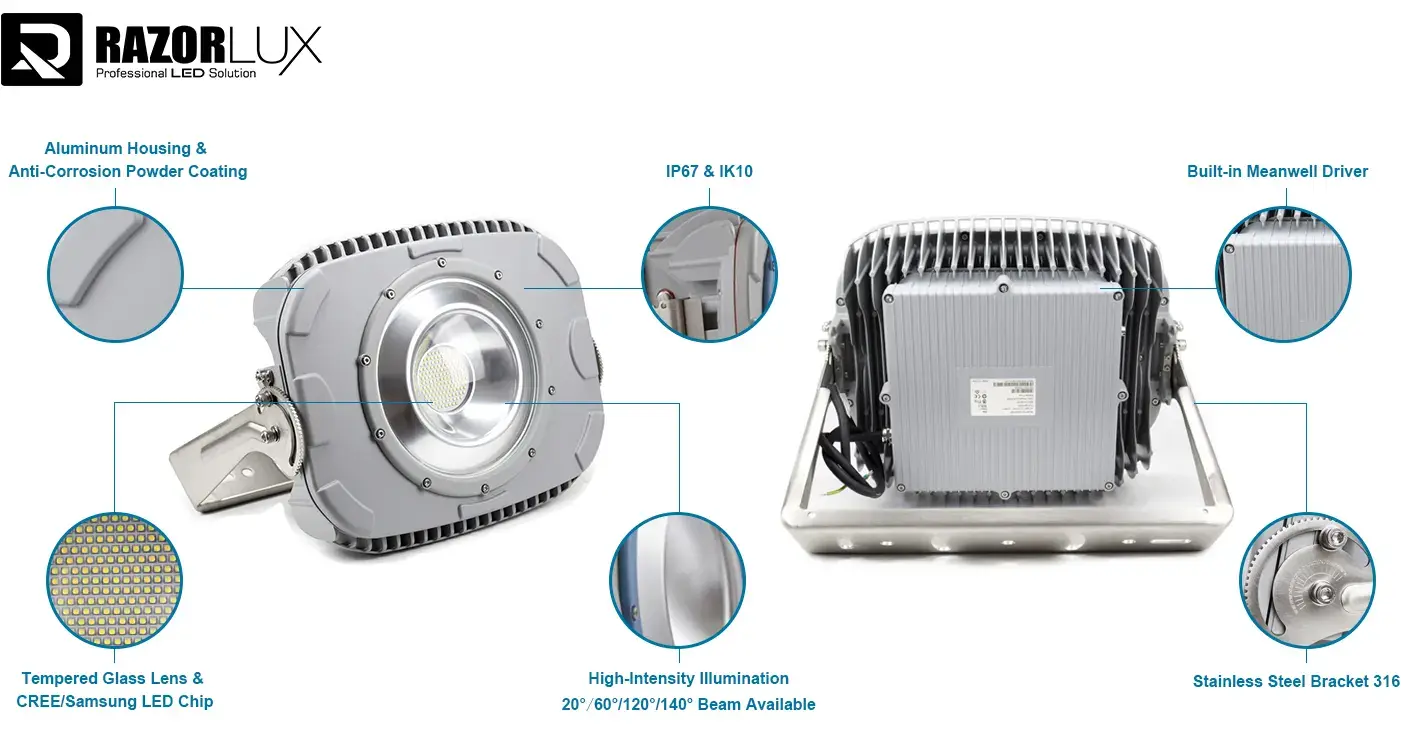
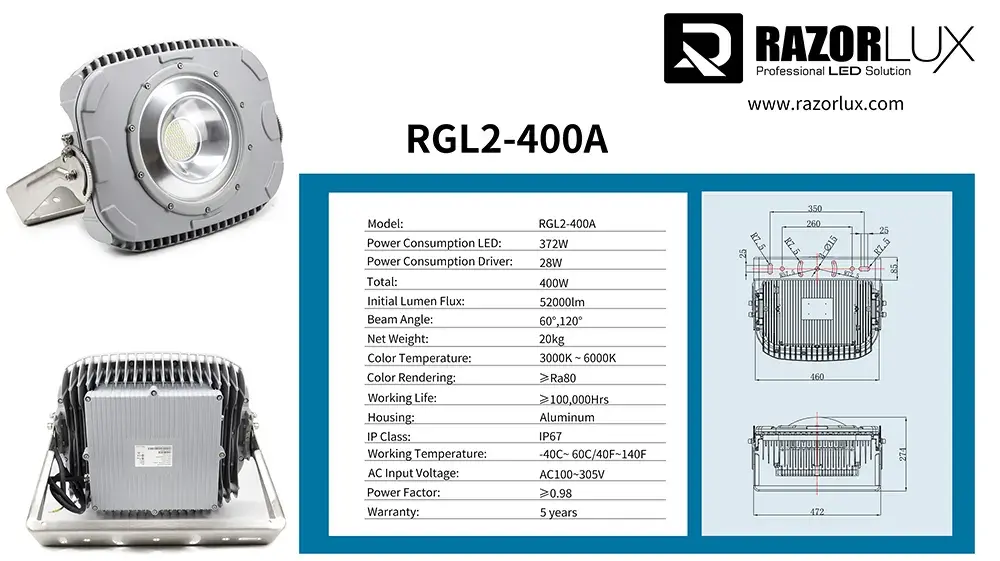
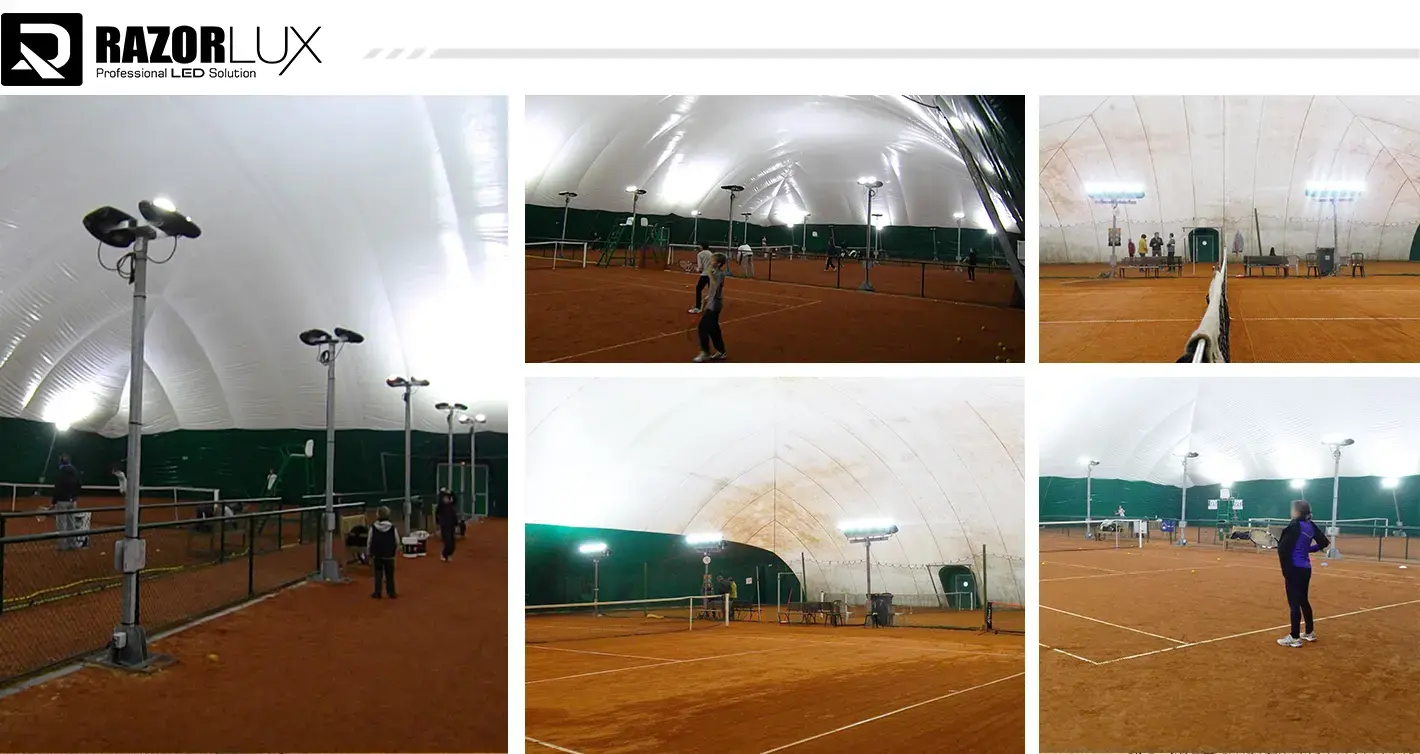
Razorlux's RGL2-400A type is a great example of tech that is made for rugged Outdoor Lighting For Volleyball Court conditions. The 400W fixture uses Samsung LED chips and Meanwell power supplies, which are known for being reliable in the naval and offshore businesses. They produce 52,000 lumens at 130 lm/W. The IP67/IK10 grade ensures it can work in salt-spray areas, and the international input voltage (AC110–480V, DC100–800V) means there is no need for a transformer for deployments around the world.
Technical Advantages for B2B Procurement
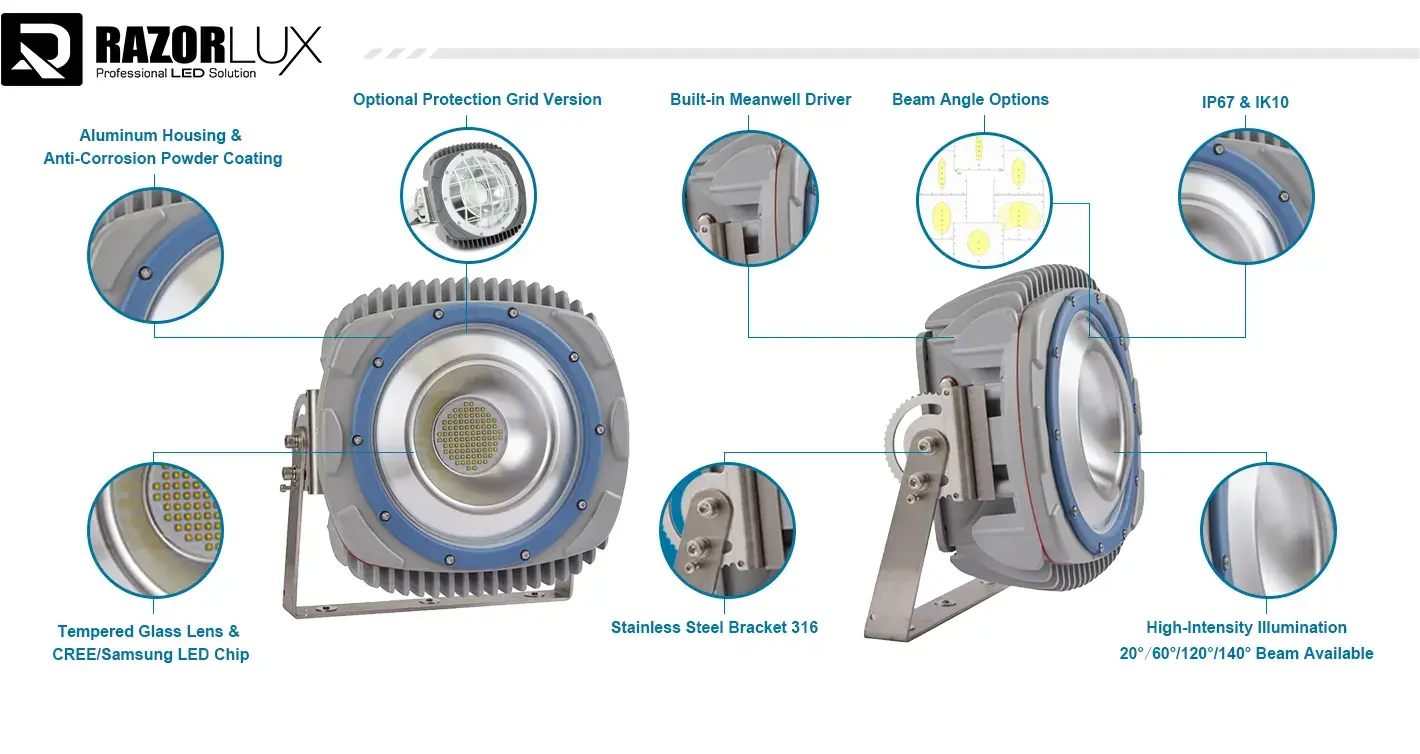
With a single stainless steel bracket system, the unique multi-function design can be used for different mounting situations, such as pole-top, side-arm, or trunnion. This makes inventory management easier for projects that are spread out over more than one site. You can choose from beam angles of 40°, 60°, 120°, and 140°×60°. This lets you fine-tune the light spread without making any special tools, which cuts lead times for normal orders to 15–20 days. The aluminum die-cast housing can work in temperatures ranging from -40°C to +60°C, which is important for winters in Scandinavia and summers in the Middle East.
Real-World Application Scenarios
Beach volleyball courts at resorts on the coast of Malaysia and Australia use Razorlux fixtures, which need C5-M corrosion protection because they are exposed to salt water 24 hours a day, seven days a week. People who run offshore platforms in the North Sea like that the DC voltage works with their power equipment. Norway's municipal buildings use Dark Sky-compliant optics that keep the 500+ lux level of regularity and follow strict light pollution laws.
Warranty and After-Sales Commitment
The fact that LED modules, drivers, and housings are covered by a five-year warranty shows that the company is confident in the choice of components and the thermal design. Razorlux keeps new parts in stock for ten years after a purchase, which addresses the worry about long-term serviceability that comes up when buying something. Technical support answers emails (sam@razorlux.com) or messages on the razorlux.com portal within 24 hours and helps with installation, photometric simulations, and fixing problems.
Strategic Considerations for Port and Industrial Applications
Facilities in heavy industry and ports have to deal with special problems, like high cranes that limit the height of poles, classifications for explosive atmospheres (ATEX/IECEx), and having to operate 24 hours a day, seven days a week. Lighting problems make it impossible to move goods or keep workers safe, so dependability is a must for any Outdoor Lighting For Volleyball Court installation in these zones.
Explosion-Proof and Hazardous Location Ratings
Fixtures that are Zone 1/Division 1-rated are needed in ports that handle petrochemicals or offshore platforms that process hydrocarbons. Razorlux's standard sports lighting doesn't have any built-in safety certification, but the company can make custom enclosures that meet ATEX/IECEx standards if asked, which it can do because it has experience in the oil and gas industry. To get quotes that meet the requirements, procurement teams should include requirements for hazardous locations when they send out RFQs.
Crane-Safe Mounting and Vibration Resistance
Volleyball courts on the quayside next to container terminals must not put up poles that get in the way of crane booms. Another option is to use asymmetric optics and place the device low-profile on the outside of a building. Heavy machinery nearby causes vibrations that need stronger driver mounts and shock-absorbing LED arrays, which are standard in Razorlux's marine-grade designs.
Integration with Facility Management Systems
For centralized control, big port owners add lighting to SCADA or BMS systems. Fixtures that use the Modbus RTU or BACnet protocols can be programmed, have their energy used tracked, and send out alerts for planned repair. Razorlux is a DALI-to-BACnet gateway that lets you connect sports lighting to business systems without having to use their own software.
Conclusion
Technical performance, seller dependability, and long-term cost effectiveness must all be considered when purchasing Outdoor Lighting For Volleyball Court systems. B2B buyers can get a competitive edge by choosing LED technology that has been tested and proven to work (130+ lm/W), is resistant to water and dust (IP67/IK10), and has a lot of certifications (CE, UL, DNV/GL). When you work directly with the maker, you can make changes and avoid having to pay extra for distribution, and area dealers can quickly fill in orders for replacements that you need right away. Strategic procurement looks at the total cost of ownership, which includes things like energy use, upkeep work, and ways to update, instead of just the original price of the fixture. Razorlux's marine-heritage tech gives it the durability and flexibility needed for heavy-duty industrial, offshore, and coastal settings where regular sports lighting breaks down quickly.
FAQ
1. What lux level is required for competitive volleyball court lighting?
For competitive settings (Class I according to EN 12193), the Outdoor Lighting For Volleyball Court needs to be more even than 0.7 and have an average horizontal brightness of 750 lux. At 200 to 300 lux, recreational courts (Class III) work well. At 1.5 meters, the vertical illumination should hit 500 lux to help you track the ball accurately during high plays. If systems don't meet these standards, players' eyes get tired, and they are more likely to get hurt because they don't know where the ball is going.
2. How does LED lighting compare to metal halide for volleyball courts?
LED systems use 130–140 lm/W of energy, while metal halide systems use 70–90 lm/W. This means that LED systems use 60–70% less energy. LEDs can turn on instantly, so there are no warm-up times, and they keep 70% of their lumen output for 50,000 hours, while metal halide bulbs only last 8,000 to 12,000 hours. LED has a lower total cost of ownership, even though it costs more up front. It pays for itself in 18–36 months by saving money on energy and upkeep costs (U.S. Department of Energy, 2021).
3. Can I retrofit existing poles with LED fixtures?
Most steel or concrete poles can be retrofitted with LED lights as long as they pass new structural calculations that take wind load and weight changes into account. LED lights usually have less structural stress because they weigh 30–40% less than metal halide units of the same size. The electrical equipment needs to be checked because magnetic ballasts and LED drivers work at different voltages. Talking to a structural engineer and a licensed electrician makes sure that the rules are followed and that everyone is safe.
4. What certifications should I verify before purchasing?
Check that the CE (for European markets), UL (for North America), RoHS (for hazardous substance compliance), and IP/IK standards are right for your area. DNV/GL or ABS certification is needed for marine or offshore uses. In many parts of the U.S., DLC Premium listings are eligible for energy returns. Request LM-79 and LM-80 test reports from a third party to confirm the claimed lumen output and degradation rates. Self-reported specifications are not reliable.
Secure Reliable Outdoor Lighting For Volleyball Court Supplier Partnerships Today
Razorlux has been a top Outdoor Lighting For Volleyball Court maker since 1998. Their lighting systems are trusted on offshore platforms, at seaside resorts, and in factories. They have over 200 patents in LED engineering and are made to last in marine environments. Our RGL2-400A type has an output of 130 lm/W, a security rating of IP67/IK10, and works with voltages ranging from 110V to 480V and DC100V to 800V, so there are no costs associated with adapting to different sites. We help B2B buying teams with photometric modeling, beam angles that can be changed, and full warranties that cover five years for Meanwell power sources and Samsung LED chips. Whether you're setting up a beach volleyball complex in Singapore or a public sports center in Norway, our expert team can give you quick quotes, test samples, and set up the facility for you. Email sam@razorlux.com to talk about the needs of your project. Within 48 hours, you'll get a detailed proposal.
References
1. Illuminating Engineering Society (IES). (2020). IES Lighting Handbook, 10th Edition. New York: IES.
2. U.S. Department of Energy. (2021). LED Lighting for Sports and Recreational Facilities. Washington, DC: DOE Office of Energy Efficiency and Renewable Energy.
3. European Committee for Standardization. (2018). EN 12193:2018 - Light and lighting - Sports lighting. Brussels: CEN.
4. Lighting Research Center. (2021). Total Cost of Ownership for LED and Conventional Light Sources.
5. Advanced Lighting Guidelines. (2022). Energy Savings from LED Sports Lighting Retrofits. Palo Alto, CA: New Buildings Institute.
6. International Dark-Sky Association. (2020). Outdoor Sports Lighting Best Practices Guide. Tucson, AZ: IDA.