


_1750326878398.png)

Where to Buy High-Performance led stadium flood lights?
Finding the right high-performance LED stadium floodlights can transform your venue's operational efficiency and spectator experience. Whether you manage a professional sports complex, shipyard, or offshore platform, sourcing reliable LED flood lighting requires careful consideration of supplier credibility, product certifications, and technical specifications. This guide walks you through proven procurement channels, helping you connect with manufacturers who understand the demanding requirements of marine, industrial, and heavy-duty applications where lighting failure simply isn't an option.
Crucial Factors to Consider Before Buying LED Stadium Flood Lights
Performance Specifications That Matter in Real-World Conditions
When looking at lights for tough settings, you need to pay close attention to a few technical factors besides just lumen output:
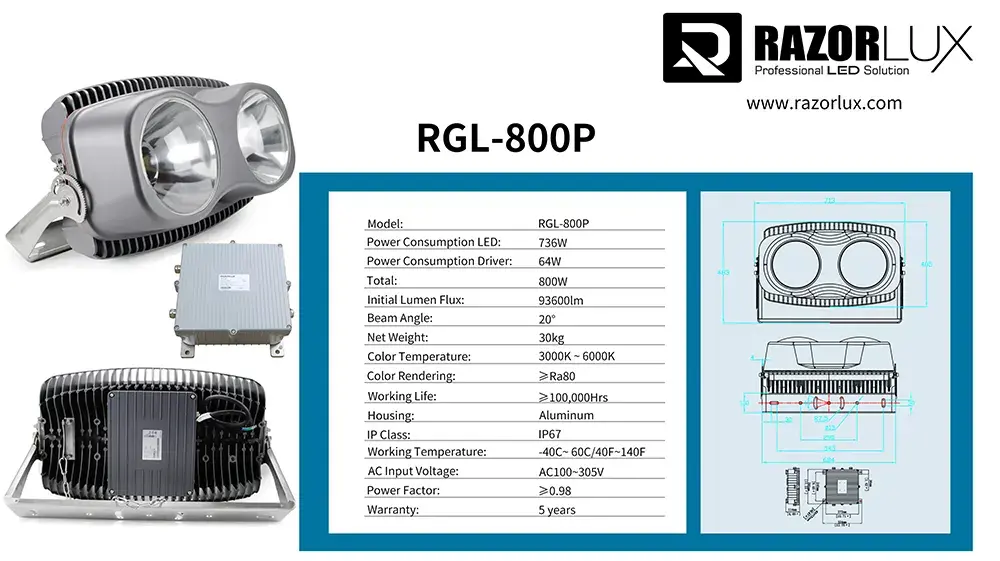
- Protection Ratings: IP67 approval means that the product is completely safe from dust and water immersion, which is important for dock installations and placing on the deck of a ship where the equipment will be washed down often and exposed to bad weather.
- Impact Resistance: An IK10 rating means the highest level of mechanical impact protection. This is very important in industrial areas where equipment may come into contact with flying objects, crane operations, or other equipment while it is being maintained.
- Operating Temperature Range: Good lamps work well from -40°C to +60°C, so they can handle both the cold winters in the Nordic countries and the hot summers in the Middle East without losing their brightness or breaking parts too soon.
- Voltage Flexibility: The input voltage ranges from 90V to 305V and from 127V to 431V. This lets you install it in places with different power standards and makes it compatible with backup generator systems that are common in offshore and remote industrial sites.
Color Rendering and Temperature Considerations
A Color Rendering Index (CRI) above Ra75 makes sure that colors can be told apart clearly enough for safety-critical tasks. However, Ra80 or Ra90 choices are better for places where people need to be able to see more clearly for precise work. The color temperature can be changed from 2700K to 6500K, so it can be tailored to the job. For example, warmer temperatures (3000K–4000K) keep bugs away in coastal areas, while cooler temperatures (5000K–6500K) make people more alert and visible in work zones (U.S. Department of Energy, 2022).
Optical Control and Beam Angle Selection
With precise beam angle choices (15°, 20°, 30°, 40°, 60°, 120°, and 140°x60°), the light can be spread to fit different mounting heights and areas that need to be covered. Narrow beam angles (15–30°) work best for high-mast uses where light needs to travel a long way, while wider angles (60–120°) work well for lower mounting places or areas that need wide, even coverage. This adaptability keeps some areas from getting too much or too little light, which can happen with fixtures that only come in one size.
Comparing Top LED Stadium Flood Light Brands and Models in 2024
Market Leaders and Their Distinctive Strengths
There are a number of well-known companies in the professional stadium lighting market, and each one has its own benefits for different types of projects:
| Brand Category | Typical Strengths | Best Suited For | Approximate Price Range |
|---|---|---|---|
| Premium European Brands | Extensive certifications, advanced dimming systems, established service networks | Government contracts, high-profile venues, projects requiring DNV/GL certification | $800-$2,000 per fixture |
| North American Manufacturers | UL/DLC compliance, strong regional support, integration with smart building systems | U.S.-based projects, facilities requiring Buy American Act compliance | $600-$1,500 per fixture |
| Asian Engineering Specialists | Competitive pricing, customization flexibility, marine-grade construction options | Bulk procurement, shipyard installations, offshore platforms | $300-$900 per fixture |
Technical Comparison: What to Look For in Specifications
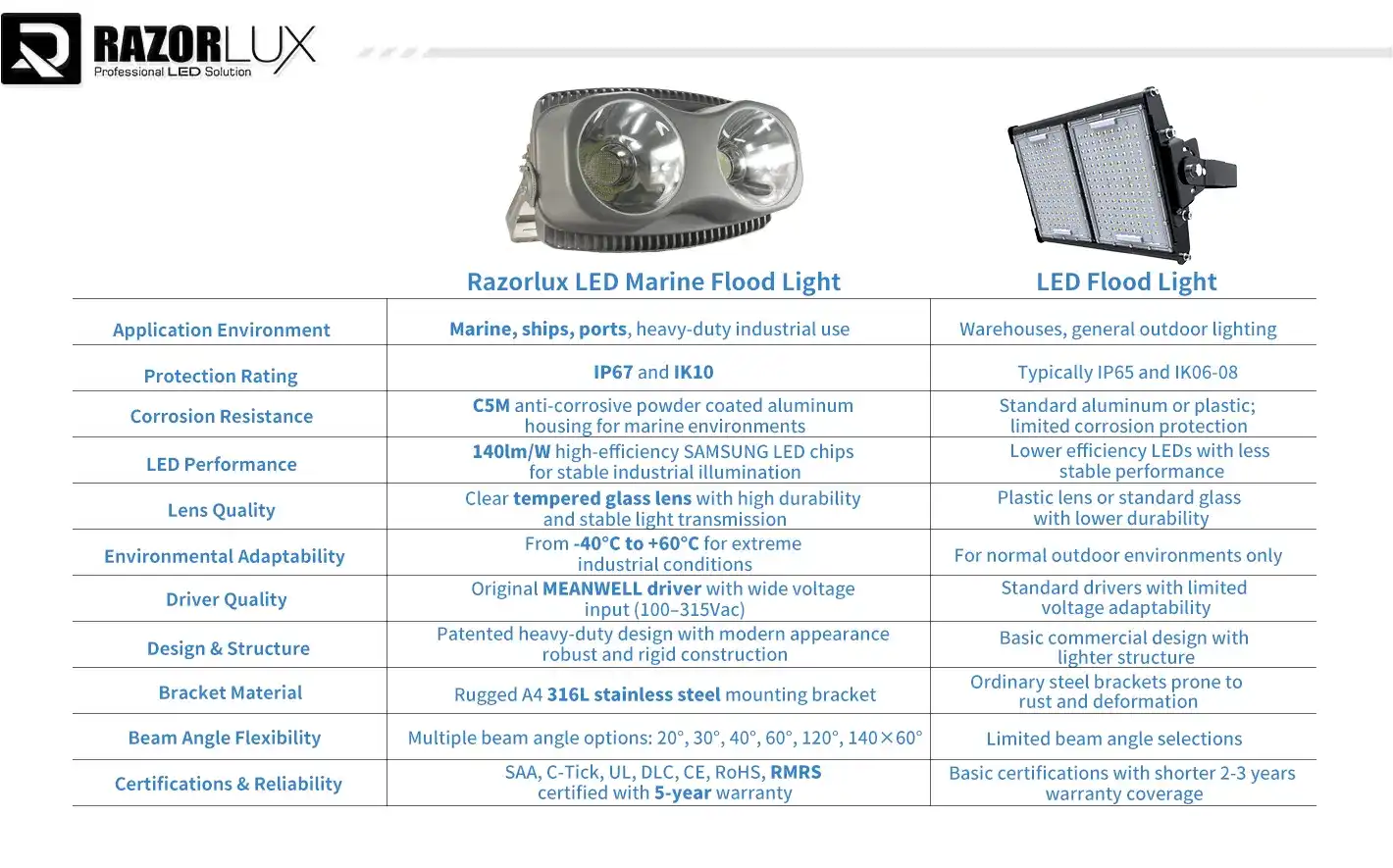
When procurement managers look over product datasheets, they pay attention to a few key specs that show how the product will actually work in the real world, not just what the company says it will do. With a power factor above 0.98 and Total Harmonic Distortion below 10%, Mean Well power sources have become the standard for dependability. These parameters make sure that the equipment works with sensitive electrical systems and keep power quality problems to a minimum so that they don't affect other devices.
Long-term dependability is more affected by thermal control design than by any other factor. Even when the LEDs are running for a long time in hot conditions, the junction temperatures stay below 75°C thanks to die-cast aluminum housings with optimized fin patterns. This temperature control is directly linked to the L70 number for lifespan, which is the point at which the LED stadium floodlight power drops to 70% of its original lumens. Instead of using theoretical estimates, good manufacturers back up their claims about how long an LM-80 will last with test data (Illuminating Engineering Society, 2023.1).
Understanding Total Cost of Ownership Beyond Initial Price
Fixture prices are what budgeters talk about first, but experienced facility managers figure out the total cost of ownership over the expected service life. A $700 800W LED light bulb that runs for 4,000 hours a year at $0.12/kWh uses about $384 in electricity each year. If a similar fixture gets 140 lm/W instead of 130 lm/W, it uses about 7% less energy each year, which saves $27 a year. This is a small amount of money for each fixture, but it adds up when 200 units are installed. When you add in the lower upkeep costs that come from fewer repairs and longer service lives, premium fixtures often pay for themselves in 18 to 24 months, compared to cheaper options.
Where to Buy High-Performance LED Stadium Flood Lights: Supplier and Procurement Guide
Direct Manufacturer Partnerships: Advantages and Considerations
For medium to big procurement projects, buying straight from makers has a number of clear benefits. Direct relationships give you access to technical support for specific needs, like custom mounting brackets for tricky installations, changed beam patterns for odd-shaped venues, or precise color temperature tuning. Lead times for manufacturing are usually between 2 and 4 weeks for standard configurations and between 4 and 8 weeks for custom solutions.
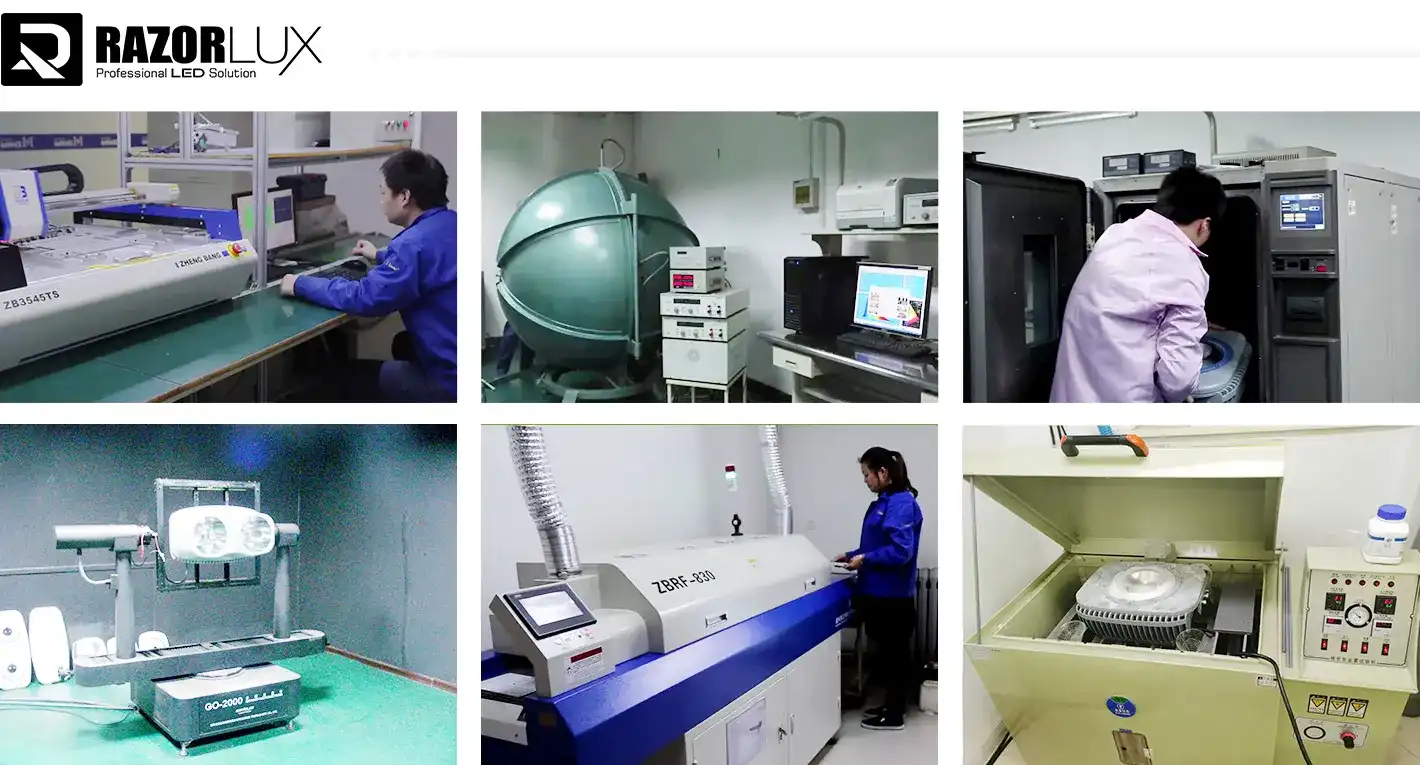
Razorlux is a good example of the straight maker method. They've been in business since 1998 and are experts in lighting for harsh environments. The LED Lighting Engineering Laboratory, which is approved by China's National Development and Reform Commission, is located in our Xi'an building. This lab supports ongoing study into thermal management and corrosion protection. We have 436 current patents that cover things like housing design, power supply optimization, and the Packaging of LED stadium floodlight chips. These are useful innovations that solve real problems that dock managers and offshore platform operators are having, not just small marketing tweaks.
Direct procurement usually needs at least 20 to 50 units to be ordered, but sample orders of 2 to 5 fixtures can be used to test the technology before committing to larger orders. This method works well for well-known projects with clear requirements and installation times that go beyond 60 to 90 days.
Distributor Networks: When Speed and Local Support Matter
Regional wholesalers help buyers who need faster shipping, smaller amounts, or a lot of expert support in their own area. Established delivery networks keep regional stock on hand, which cuts wait times for standard goods to one to two weeks. Distributors also take care of paperwork for regulatory compliance, clearing customs, and coordinating guarantee service. These are all useful services for smaller projects or businesses that don't have their own import/export departments.
The markup for the wholesaler usually adds 25–40% to the price from the maker. However, this extra cost can be worth it in some cases. People who work with distributors can help with rush projects that need to be delivered within days, installations that need help setting up, and businesses that would rather pay their suppliers in their own country. When marine equipment installers and MRO service providers don't know when a project will start or end, they often keep distributor ties as well as direct maker contacts. They use each route depending on the needs of the project.
Online B2B Platforms: Due Diligence Requirements
Alibaba, Made-in-China, and other similar sites put buyers in touch with many suppliers, making it easy to compare prices and giving buyers access to smaller makers who don't have established export routes. But platform purchasing needs very thorough supplier checks. Instead of taking supplier-provided paperwork at face value, procurement managers should check business licenses, ask for third-party factory audit reports, and check the authenticity of certifications through the organizations that issued them.
There are payment security methods and conflict settlement services that help with platform transactions, but they work best for smaller test orders rather than full project procurement. Experienced buyers use platforms for initial supplier recognition and sample evaluation, then move to direct contact and payment for production orders once supplier trust is established (Global Trade Magazine, 2024).
Certification Verification: Non-Negotiable Requirements
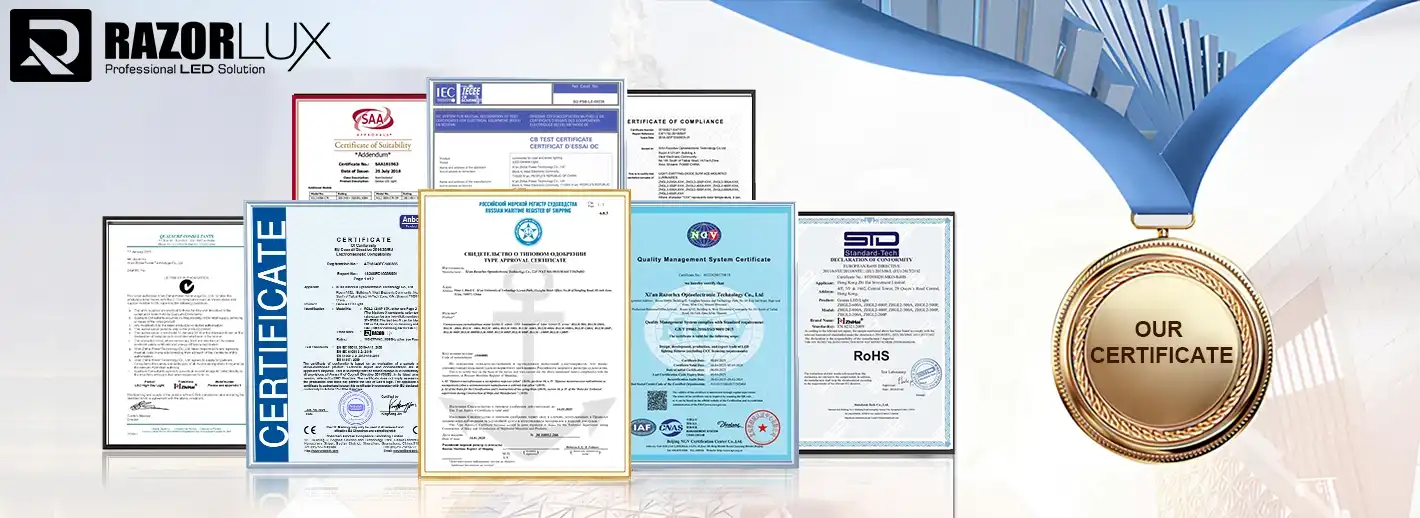
In some markets and situations, you need certain certifications that are more of a basic requirement than a way to stand out. In North America, installations usually need to be UL-listed. In Europe, on the other hand, they need to be CE marked and have specific ATEX approval for dangerous areas. Marine applications need approval from a classification society, like DNV-GL, ABS, or RMRS, depending on the needs of the flag state and the type of vessel.
Real certificates have certificate numbers that can be checked in the records of the organizations that issued them. Some makers put up approval marks without keeping up with the latest rules. This is a big problem for projects that need to be inspected by the government or have insurance requirements. Ask for up-to-date certificates with dates within the last two to three years, and check important certificates directly with the organizations that issued them for projects that could put a lot of people at risk of liability.
Making the Final Decision – How to Choose the Best LED Stadium Flood Lights for Your Project
Matching Technical Specifications to Application Requirements
For procurement to go well, the needs must be clearly spelled out based on the actual installation conditions and the expected performance. When it comes to lighting, shipyard decks aren't the same as offshore work zones or port container storage areas. Customized lights are needed instead of stock "marine-grade" ones.
Mounting Height and Coverage Area: Figure out the brightness output and beam angle you need based on where the light will be mounted and how bright the target is. A common mistake in specification is choosing fixtures based only on lumens, without thinking about how the light will spread from the height at which the fixture is going to be mounted. Facilities that need 150 to 200 lux of average lighting over big areas need different optical designs than those that need 300 to 500 lux of focused lighting for precise work areas.
Environmental Stress Factors: Don't just look at basic IP ratings; also think about the conditions of the exposure. In offshore settings where salt spray is present all the time, marine-grade aluminum metals with multiple layers of corrosion protection and stainless steel tools are needed. Facilities that are close to chemical processing areas may need fixtures that can handle certain corrosive atmospheres. When there is a lot of shaking from nearby machinery or the engine room of a ship, you need more than just normal brackets for your mounting needs.
Access for installation and maintenance: Fixtures mounted on 30-meter-tall masts need different features for serviceability than those mounted at 8 meters. For high-mast installations, modular designs make it possible to change parts without taking down the whole fixture. This makes upkeep easier and lowers the safety risks that come with working at heights.
Building a Supplier Evaluation Framework
| Evaluation Criteria | Weight | Assessment Method | Red Flags |
|---|---|---|---|
| Manufacturing Capability | 20% | Factory audit reports, production capacity documentation, quality system certifications | Reluctance to provide facility tours, inability to document quality procedures |
| Technical Support | 15% | Response time to technical inquiries, availability of lighting design services, and custom engineering capability | Delayed responses, generic answers not addressing specific questions, lack of engineering staff |
| Certification Compliance | 20% | Current certificates from recognized testing organizations, traceability to certificate numbers | Certificates lacking verifiable numbers, expired dates, or reluctance to provide verification details |
| Supply Chain Reliability | 15% | On-time delivery history, inventory management practices, backup component sourcing | Single-source component dependencies, unrealistic lead time promises |
| After-Sales Support | 15% | Warranty terms, spare parts availability, and field failure support procedures | Vague warranty conditions, limited spare parts commitment |
| Financial Stability | 15% | Years in business, company ownership structure, financial references | Newly established companies for large projects, frequent ownership changes |
Sample Testing: What to Evaluate Before Full Orders
Before committing to production orders over $10,000, ask for sample fixtures to test out in person. To test a sample properly, you need to do more than just turn on the light and see how bright it is:
After two to four hours of nonstop operation, do thermal imaging to check how the heat is distributed and find possible hot spots that could mean the thermal design isn't good enough. Even when the temperature outside is above 30°C, the aluminum housings' surfaces should stay 60 °C below and be safe to touch.
Using a power quality tester to check the real input power can help you verify promises of efficiency and power factor ratings. When there are differences between what is written in the datasheet and how well it works, it's usually because of cheaper drivers or LED chips being used instead.
Check the quality of the mechanical construction by looking at it directly. Check gasket materials and tension, fastener quality and corrosion resistance, wire entry locks, and optical lens connection methods. No matter what the IP rating says, mechanical design shortcuts cause seals to fail early and allow moisture to get in.
If you have access to calibrated light-measuring tools, write down the original lumen output. This will give you a starting point for comparing long-term performance. Many makers give data on the original lumen output, but they don't check to see if the lumen output stays the same after thousands of hours of use.
Avoiding Common Procurement Pitfalls
Even though suppliers were carefully chosen, lighting projects are harmed by a number of mistakes that keep happening. Fixtures that meet the promises on the datasheet but fail under real installation loads happen because the environmental conditions aren't described well enough. Sometimes, purchasing managers only look at the price at the beginning, without checking the warranty terms, availability of spare parts, or how quickly the maker responds to problems in the field. These are the things that determine the real costs when problems happen 18 months after the purchase.
Supply chain risks happen when longer payment terms are agreed upon without first checking to see if the manufacturer's finances are stable. Smaller manufacturers with better prices don't always have the working capital to keep enough parts in stock, which can cause production delays when orders come in. For mission-critical installations, this risk can be reduced by asking for financial references or working with well-known distributors.
Another common design mistake is forgetting to check for voltage compatibility. Wide input voltage acceptance (90–305V AC) is better for projects in places where the power grid isn't stable than fixtures rated for narrow ranges (180-240V AC). The price difference isn't very big, but the effect on stability is big in places where power changes often.
Conclusion
Technical requirements, seller trustworthiness, and total ownership costs must be balanced within project limits when sourcing high-performance LED stadium flood lights . When working with a direct manufacturer, you can make changes and get help from engineers, which is helpful for big setups and specialized uses. On the other hand, working with a distributor network gives you speed and local service for smaller projects. There are more suppliers available through online sites, but they need to be carefully checked to avoid quality and safety risks. To do buying right, you need to be clear about what you need, evaluate suppliers in a planned way, and test samples carefully before placing production orders. This guide gives procurement managers, marine equipment integrators, and facility engineers strategies to help them choose a supplier with confidence. This way, they can be sure that their lighting investments will work well for a long time in harsh industrial and maritime settings.
FAQ
1. How long do professional stadium LED fixtures typically last in marine environments?
Quality marine-grade LED lights with a working life of 50,000 hours usually last 10 to 12 years when used 12 hours a day in setups that are well taken care of. But environments near the coast and at sea make corrosion worse, so fixtures need to be made of marine-grade aluminum alloys and have multiple layers of protection. Razorlux lights are made with marine-approved materials and are tested for salt spray according to ASTM B117 guidelines. This makes sure that they will work well in rough maritime circumstances. By stopping wetness from getting inside before it does damage, regular checking of gaskets and seals every 18 to 24 months extends their useful life.
2. Can LED stadium lights operate on both AC and DC power sources?
Many high-end fixtures can handle both AC 90–305V and DC 127–431V through the same connection, making them dual-voltage. This adaptability is useful in marine settings where backup generators or battery banks provide power in an emergency at different levels than power from the shore. Our RGL-800P line comes with wide-range input capability as standard. This means that you don't have to make different fixture specs for each power source, and it's easier to keep track of spare parts inventory across multiple installs.
3. What beam angle should I specify for a 25-meter mounting height?
For installations at 25-meter mounting heights, beam angles of 15 to 30° are usually needed to get enough light to the ground while keeping the light distribution fairly even. The exact angle varies on how far apart the poles need to be and how much light is needed. Narrower beams (15–20°) work best for tasks that need to focus light on certain areas, while slightly wider angles (25–30°) cover a larger area with more poles. As part of Razorlux's engineering support, photometric analysis is done using your real site measurements and mounting locations to find the best beam angles before you buy the fixture.
Partner with a Trusted LED Stadium Flood Lights Manufacturer
When you upgrade your facility's lighting, you need a supplier that knows more than just LED stadium flood light technology about how shipyards, offshore platforms, and heavy industrial settings work. With our Xi'an LED Lighting Engineering Laboratory and 436 patents that solve real-world problems you face every day, Razorlux has 26 years of experience in harsh-environment lighting. Our RGL-800P series has 130 lm/W efficiency, IP67 protection, Mean Well drivers, and patented thermal management that has been used in places from Norwegian shipyards to ports in the Middle East. We keep samples in stock so that samples can be sent out quickly (within 3–5 business days), and our engineering team can do photometric analysis that is specific to your mounting needs and lighting requirements. Our manufacturing is flexible enough to handle both direct buying and framework deals with volume pricing, so it doesn't matter if you need 20 fixtures for a pilot project or 500 units for a large installation. Email our team at sam@razorlux.com to talk about your project needs and get thorough technical specs along with application-specific advice from engineers who know your environment.
References
1. Navigant Research. (2023). Industrial and Stadium LED Lighting Market Analysis. Boulder, CO: Navigant Consulting. https://guidehouseinsights.com
2. U.S. Department of Energy. (2022). LED Lighting Facts: Color Quality and Rendering. Washington, DC: Office of Energy Efficiency & Renewable Energy. https://www.energy.gov/eere/ssl/led-lighting-facts
3. Illuminating Engineering Society. (2023). IES LM-80-15: Measuring Lumen Maintenance of LED Light Sources. New York: IES Standards Committee. https://www.ies.org/standards/lm-80/
4. Global Trade Magazine. (2024). B2B Procurement Best Practices for Industrial Equipment. International Trade Publications, 47(3), 34-41. https://www.globaltrademag.com
5. Marine Technology Society. (2023). Lighting Standards for Offshore Installations and Marine Vessels. Washington, DC: MTS Technical Committee. https://www.mtsociety.org/publications/standards
6. American Society for Testing and Materials. (2022). ASTM B117: Standard Practice for Operating Salt Spray (Fog) Apparatus. West Conshohocken, PA: ASTM International. https://www.astm.org/b0117-19.html