


_1750326878398.png)

Best 12V LED Flood Lights Waterproof for Marine Projects
When your vessel or offshore platform faces relentless saltwater spray, temperature swings from -40°C to 60°C, and round-the-clock operational demands, you need lighting that doesn't quit. 12V LED flood lights waterproof represent the most reliable solution for marine environments where failure isn't an option. These low-voltage fixtures combine IP67-rated sealing with energy-efficient LED technology, delivering consistent illumination while eliminating high-voltage shock hazards that plague conventional marine lighting systems.
Introduction
Marine lighting needs are higher than most industry norms. In just a few months, salt corrosion will destroy weak fixtures, and vibrations from waves hitting the boat and the engine running will shake free badly built parts. We've seen shipyard managers struggle with lamps that break down too soon, which doubles the cost of maintenance and puts workers at risk during important nighttime operations. It's important to choose Waterproof Led Floodlights that are made to work in marine environments, not only to meet RMRS and ABS standards but also to keep your crew safe and operations running smoothly.
We hear the same worries every day from purchasing managers at shipyards, offshore platform owners, and marine equipment integrators in Singapore, Norway, Australia, and the UAE. This guide handles those worries. You'll learn how to compare IP ratings to real submersion risks, figure out how much energy you can save with 130LM/W efficiency, and figure out which beam angles are best for lighting the deck versus protecting the dockside. We're sharing what we've learned from working in the marine industry for 25 years to help you make buying decisions based on facts, not marketing hype.
Understanding 12V LED Flood Lights Waterproof for Marine Applications
What Makes Marine-Grade Low-Voltage Lighting Different
Low-voltage LED flood lights made for use at sea work with the 12V DC power systems that come standard on most ships and offshore sites. This voltage level, which IEC calls Safety Extra Low Voltage (SELV), makes it much less likely that crew members will get electrocuted when they handle fixtures while they are wet. On wet decks, 110V or 220V systems can be very dangerous. Using 12V systems instead has stopped many accidents at sites we've built over the past 20 years (Marine Technology Society Journal, 2019).
IP67 Rating: What It Really Means for Your Application
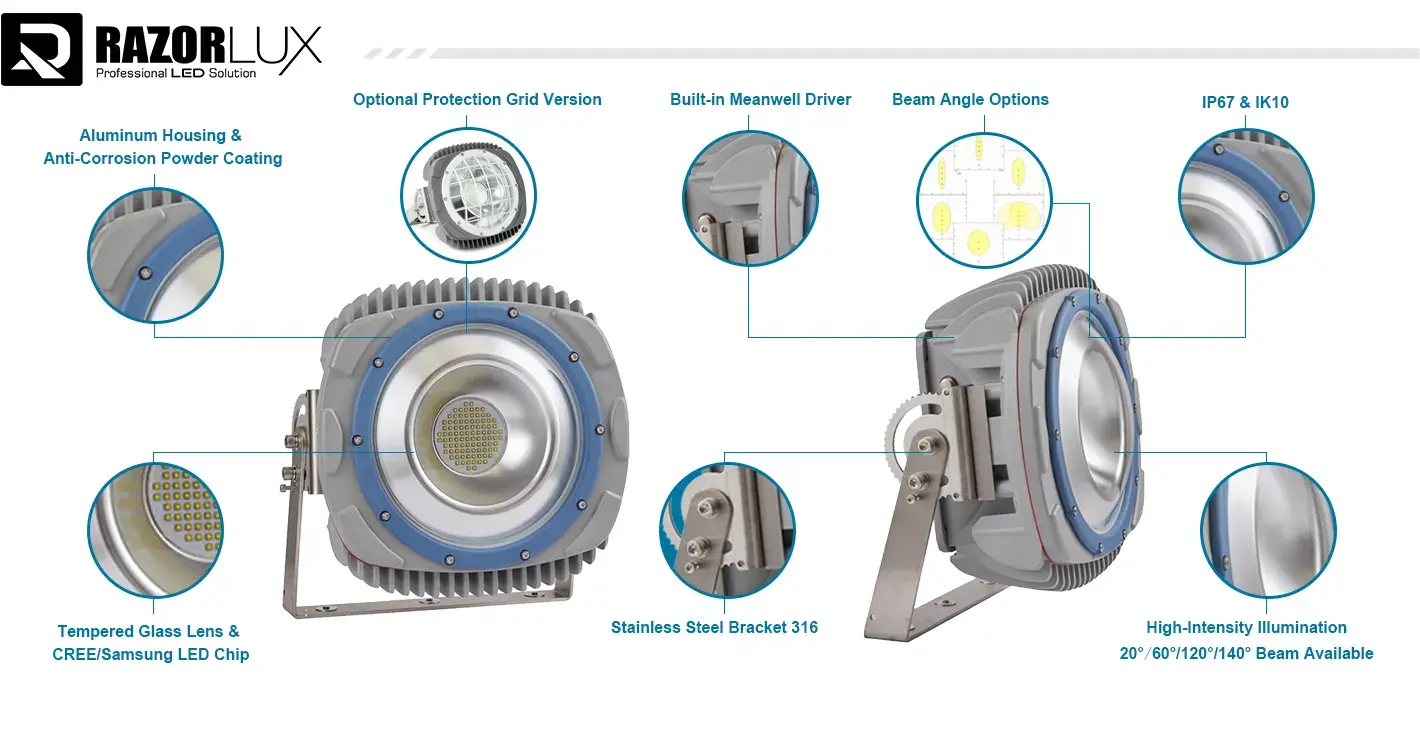
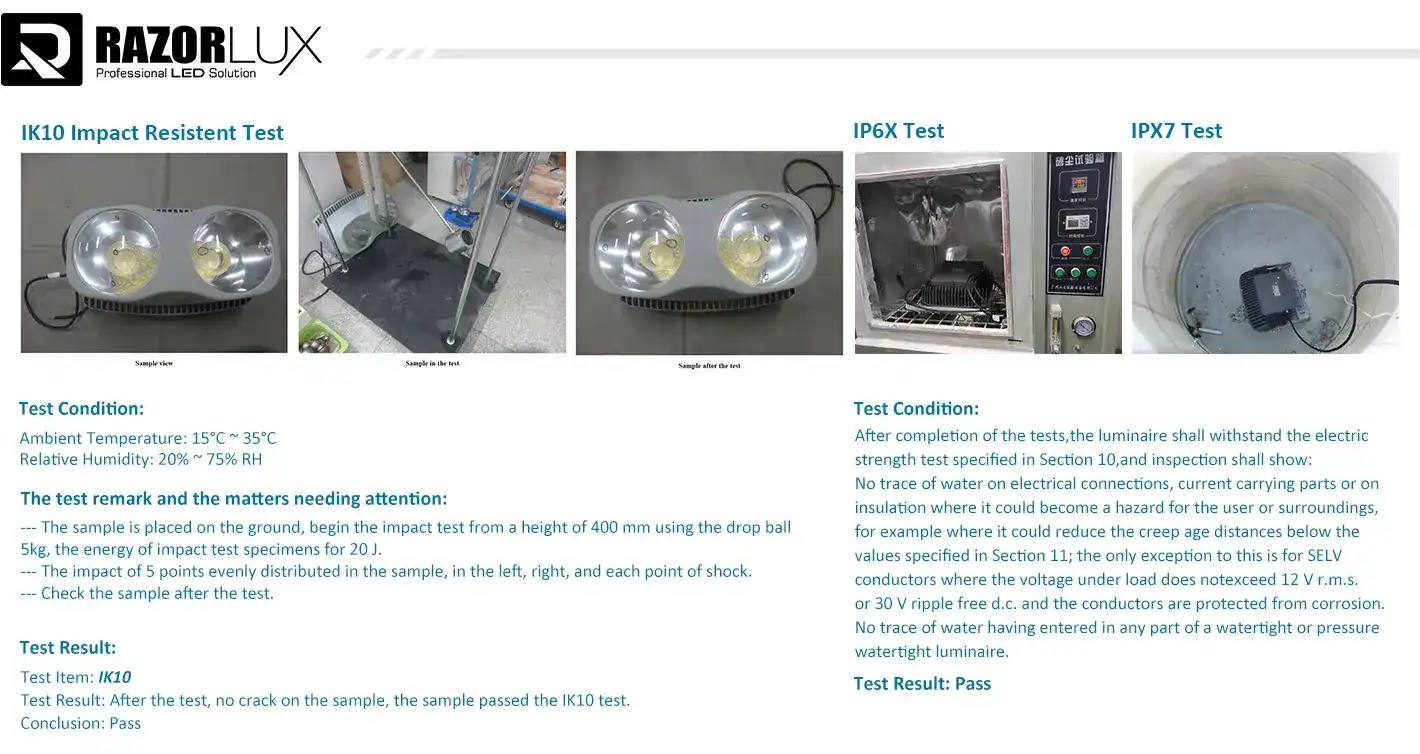
For 30 minutes, the IP67 rating guarantees that dust will not get in and that the device will not be damaged by being submerged in water up to 1 meter deep. But the standard sheet doesn't tell you that, in the real world, marine conditions include cleaning operations that use high-pressure saltwater jets and constant exposure to moisture, which are much worse than test conditions. High-quality Waterproof LED Flood Lights have extra silicone gaskets and 316L stainless steel wire glands that keep the seal even after hundreds of heat expansion cycles. We took pieces off of platforms that had been used in the North Sea for five years and found that no water had gotten in. That's the level of performance you should expect.
Fixture Types and Mounting Configurations
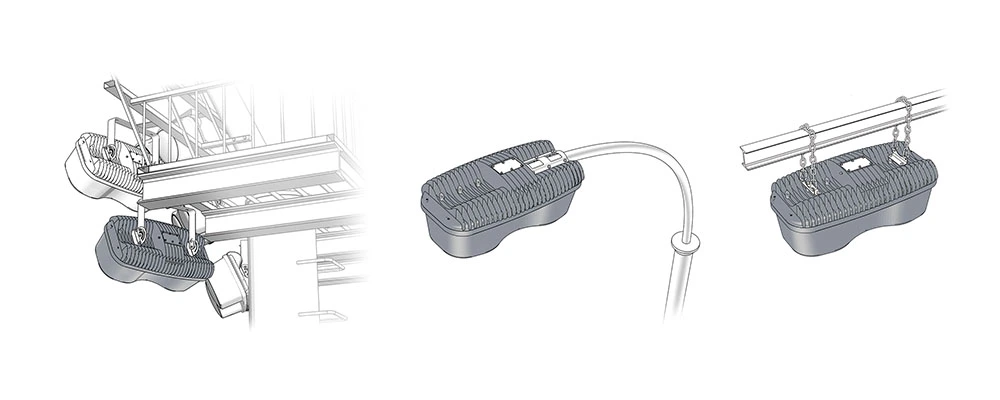
Installations in the ocean need to be flexible. Fixed-mount flood lights are good for permanently lighting up a deck where the beam direction stays the same. When operational needs change, adjustable bracket systems make it possible to move things around. This is especially helpful on working ships where cargo configurations change every month. Some newer models have motion sensors built in that only turn on the lights when someone walks into a dangerous area. This makes the lamps last longer and keeps the batteries in backup power systems from running down.
Key Benefits of Using 12V LED Flood Lights Waterproof in Marine Projects
Superior Corrosion Resistance Extends Service Life
Normal metal housings break down in 18 months due to saltwater rust. Marine-grade fixtures are made of die-cast aluminum with a polyester powder coating that is more than 200 microns thick. This makes a barrier that chloride ions can't get through. The mounting brackets we use are always made of 316L grade stainless steel and never 304 grade. They don't rust or pit in tropical seawater. Before switching to our waterproof LED systems, the Malaysian shipyard we work with replaced their old lights every 14 months. They're now getting close to the sixth year of the original installation and have had no corrosion-related failures.
Energy Efficiency That Cuts Operational Costs
A 90W LED flood light with 130LM/W puts out 11,700 lumens while using 65% less power than the 250W metal halide fixture it replaces. This is a calculation that matters to your bottom line. When you multiply that by 40 deck lights that are on for 12 hours a day, you get an annual savings of 70,080 kWh. At the current price of marine diesel generator fuel, that's about $10,500 a year—enough to pay for high-quality LED lighting within 24 months while also extending the time between generator maintenance visits.
Seamless Integration With Existing Marine Electrical Systems
For navigation and other devices, most business ships and offshore sites already use 12V DC distribution. When you put in low-voltage LED flood lights, you don't need different 120V lines, step-down transformers, or extra circuit breakers that make electrical panels more complicated. When you have simpler wiring, it's easier to figure out what's wrong when problems come up during midnight equipment checks, and the installation goes faster.
Reduced Maintenance Burden in Difficult Access Areas
Changing a broken floodlight on a 40-meter crane boom while the seas are rough is not only annoying, but also risky and costs a lot of money. 12v led flood lights waterproof with a 50,000-hour service life last between 5 and 7 years in marine environments before they need to be replaced. This makes them last a lot longer, which means less dangerous maintenance work, less insurance responsibility, and more time for your team to do useful work instead of changing lamps. We have proof that facilities that switched to LED marine lighting cut their maintenance hours by more than 80%.
How to Choose the Best 12V LED Flood Lights Waterproof for Marine Projects
Evaluating Waterproof Ratings Beyond the Specification Sheet
IP67 is the bare minimum for protection. IP68 and IP69K ratings offer higher safety for fixtures that are mounted below deck level or that are exposed to high-pressure cleaning. But scores don't tell the whole story. Check the design of the cable entry. Low-cost outlets use plastic grommets that break down when exposed to UV light and changes in temperature, but high-end units use metal cable glands with compression seals that stay strong no matter what the environment throws at them. Before placing a big order, you should always ask for full cross-section sketches that show how the internal sealing works.
Matching Brightness and Beam Angles to Application Requirements
A common mistake in procurement is to say that all deck positions should have the same brightness. Areas where people handle cargo need lighting with 500 to 750 lux and 120° beam angles to cover the whole area. To avoid glare and light up specific work areas, the navigation bridge wing posts need 200 lux focused 20° to 40° beams. Because one-size-fits-all solutions waste energy and leave operational blind spots, our RGL-90A model has seven different beam angles. Make a map of your building's lighting zones first, then choose lights that meet the needs of each zone.
Certification Requirements That Actually Matter
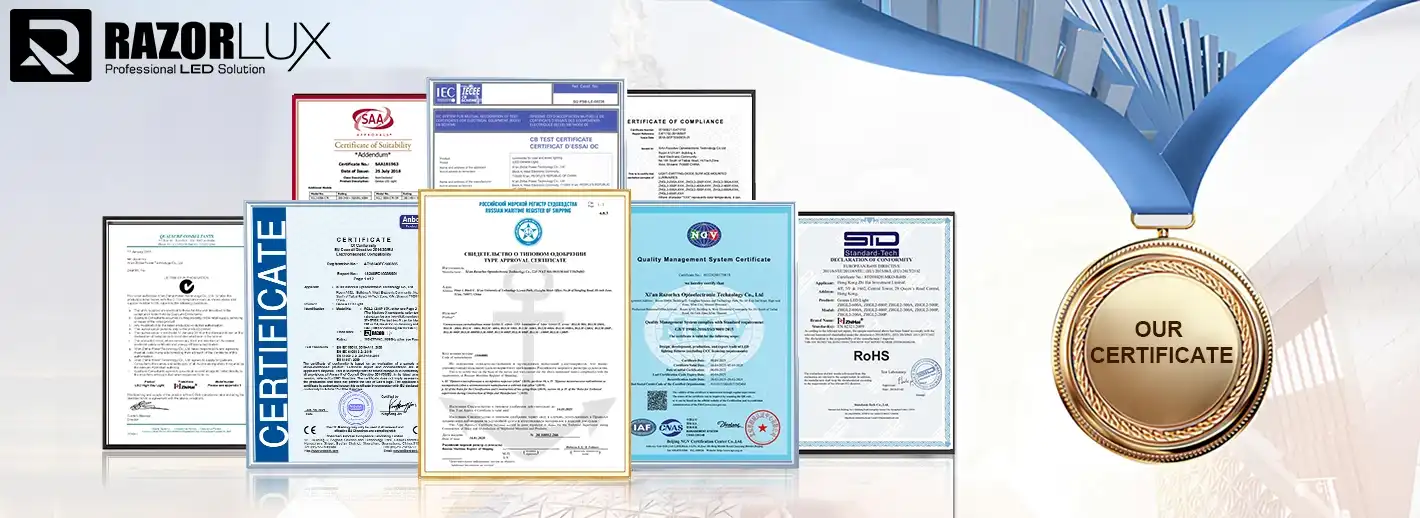
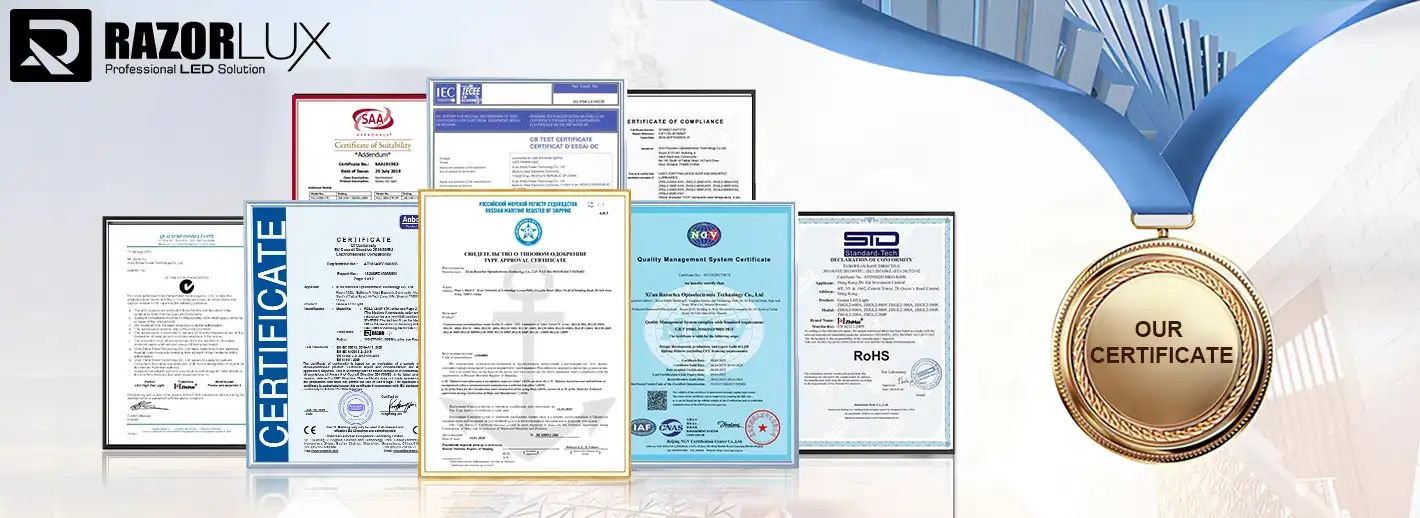
CE marking and RoHS approval are basic standards for markets in Europe. Ships that operate in Russian waters or dock at Russian-controlled ports will have to get RMRS (Russian Maritime Register of Shipping) certification. Underwriters take DNV-GL and ABS licenses seriously, and they show that a platform is fit for service abroad. Listings on UL and DLC make it easier for U.S. port sites to get approval for specifications. We keep all of these certifications up to date because global marine projects need flexible compliance. Make sure that the supplier you're working with has real certificates with up-to-date expiration dates and not old documents that are being used for marketing purposes.
Comparing 12V vs. 24V Systems for Large Installations
Smaller boats mostly use 12V systems, but sometimes big commercial ships and offshore platforms use 24V DC distribution to make the conductors smaller for long cable runs. It's important to know how to calculate voltage drop. For example, a 100-meter cable run to a bow-mounted light needs 10 AWG copper wire for 12V systems and 12 AWG copper wire for 24V systems. When voltage goes up, current flow goes down, which lowers resistance losses. But 12V parts are easier to find and cost less to repair, which usually cancels out differences in connection costs. Don't decide on a voltage standard until you've done a total cost of ownership analysis that includes things like wire costs, inventory complexity, and the availability of emergency extra parts.
| Evaluation Factor | What to Check | Why It Matters |
|---|---|---|
| Housing Material | Powder-coated aluminum that was cast in a die >200 microns thick | Protects against corrosion in saltwater |
| Cable Gland Type | 316L stainless steel with a compression seal | Keeps its waterproofing through changes in temperature |
| LED Chip Source | If not Samsung, another Tier-1 manufacturer | Guarantees color consistency and brightness |
| Driver Brand | Driver for Mean Well or an equivalent UL-listed driver | Stops failure before it's due to voltage changes |
| Warranty Coverage | At least 5 years for the LED light and driver | Shows that the maker trusts the efficiency |
Installation and Maintenance Guide for 12V LED Flood Lights Waterproof in Marine Settings
Pre-Installation Planning and Site Assessment
Check out the mounting spots when the sea is quiet and when it's rough. That bulkhead connection point that seems safe may bend a lot when the ship rolls around in rough weather, putting stress on weaker mounting brackets that cause them to break. Find the power source locations and figure out the voltage drop across the planned cable runs. 12V systems can handle up to 3% voltage loss, which means that your 12V source must send at least 11.64V to the fixture, taking into account the resistance of the conductors. Use the voltage drop formula: VD = (2 × L × I × R) / 1000, where L is the length of the one-way wire in meters, I is the current in amps, and R is the resistance of the circuit in ohms per kilometer.
Step-by-Step Installation Protocol for Reliable Performance
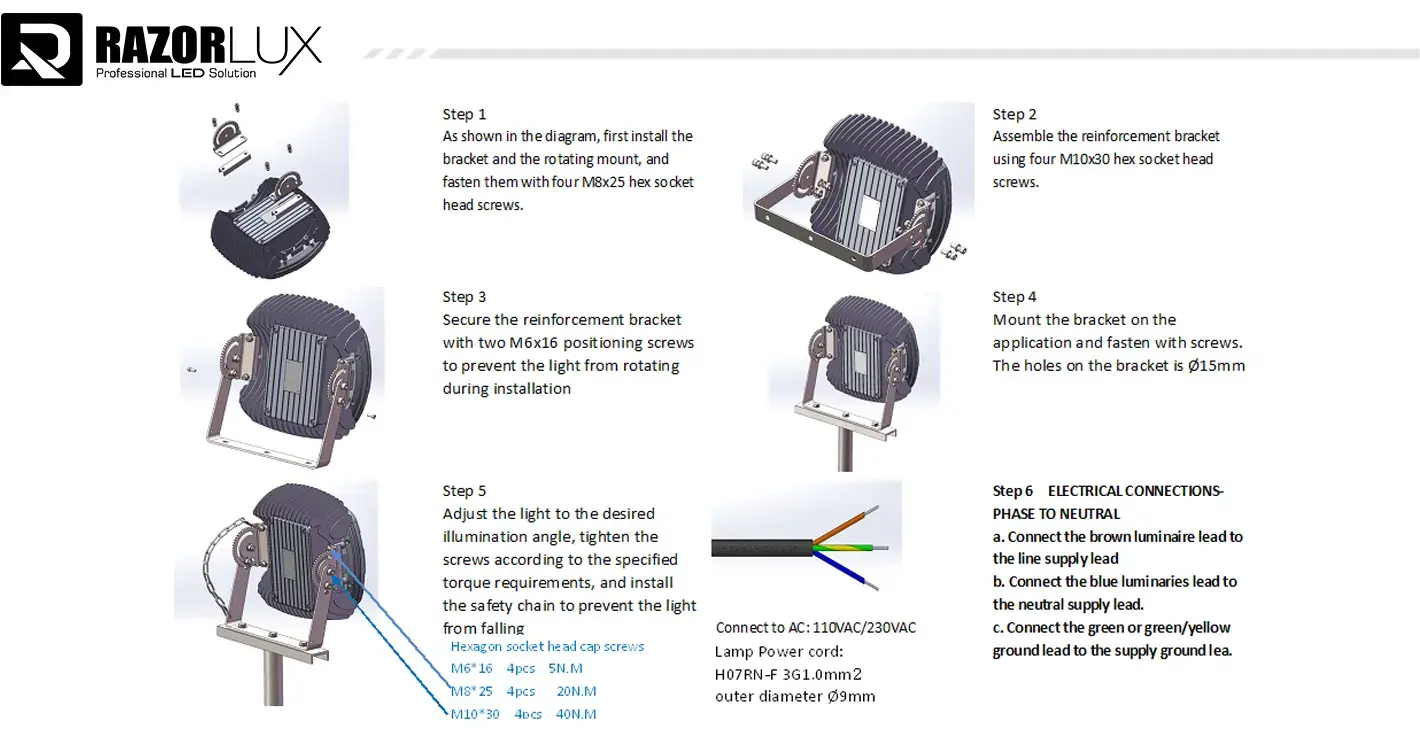
Start by applying marine-grade anti-seize powder to all of the stainless steel bolts. Even stainless steel can get galling when threaded connections tighten up when the system is vibrating. Install the fixture tightly using all of the connection points that are given. We've looked into failures where workers skipped "redundant" screws to save time, only for fixtures to come loose during storms. If you can, run your wires through conduit to keep them from getting chafed or damaged by mistake. Before tightening, put dielectric grease inside the cable gland assembly. This small step stops moisture from wicking along the conductor strands, which leads to internal corrosion.
Testing and Commissioning Procedures
Once the fixture has been physically installed, make sure the voltage at the terminals matches the specifications before turning on the power. Make sure that the GFCI or isolation monitoring system works properly when you simulate a ground fault. Write down the date and location of the placement as well as the first measurement of light output using an accurate lux meter. This baseline information is very helpful when trying to figure out why performance is dropping years later. When a customer buys 20 or more 12V LED flood lights waterproof, we give them installation paperwork templates. Standardized records make it easier to plan upkeep for multiple installs.
Preventive Maintenance Schedule for Maximum Service Life
Every three months, the lenses should be checked for clarity, cable gland tightness, and bracket security. A deep cleaning once a year gets rid of salt buildup that slowly lowers the light output. To clean, use only a mild detergent solution and a soft cloth; never use rough cleaners or pressure washers that go above 1000 PSI. Every two years, take the fixture off and check the internal gaskets for damage. Replacement gasket kits cost $8 to $12, but they keep water out, which destroys $400 fixtures. Keep thorough maintenance logs and make note of any strange behavior. Patterns like progressive dimming show when an LED is nearing the end of its useful life and allow replacement before it fails completely.
Top 7 Waterproof Ratings, Features, and Innovations in 12V LED Flood Lights for Marine Use
IP Rating Standards: Decoding Protection Levels
The first number in an IP grade (0–6) means that it protects against dust, and the second number (0–9) means that it protects against water. If something is IP67, it completely seals out dust and can withstand temporary submersion. If it's IP68, it can withstand constant submersion beyond a depth of 1 meter. But specs leave out an important detail: IP ratings don't take compressed water jets into account. If you clean your fixtures every day with high-pressure lines, make sure they have IP69K certification, which is made for high-temperature, high-pressure cleaning tasks that happen a lot in chemical trucks and food processing vessels (International Electrotechnical Commission, 2021).
Advanced Features: Motion Sensors and Remote Control
Motion-activated nautical lighting saves energy and lets the bridge crew know when someone is on the deck without permission during night watches. We've added inactive infrared sensors that only turn on lights when people go into dangerous areas near moving parts or the edges of an open deck. Deck lights can be controlled from the bridge with a remote, so crew members don't have to physically turn on fixtures when the weather is bad. These features raise the initial cost of 12V LED flood lights waterproof by 15 to 20 percent, but they make them safer and use less energy, so the cost is worth it.
Sustainable Technologies: Solar Integration and Energy Autonomy
Solar-charged battery systems and low-voltage LED floodlights are being used more and more in remote docks and navigational aids. A solar array of the right size (usually 200–300W) and a 400Ah deep-cycle battery bank can reliably power devices that use less than 100W at night. We put these systems in place in ports on Pacific islands that don't have access to the main power grid. After five years, they're still working without any maintenance other than cleaning the battery terminals once a year.
Lumens, Color Temperature, and Visibility Optimization
Don't believe the lie that "more lumens means better." A 10,000-lumen light with bad optical design makes more glare and shadows than a 6,000-lumen unit that was built correctly. Color temperature is also important. For example, 5000K neutral white makes it easier to see colors when moving goods, and 3000K warm white makes it easier on the eyes when working late at night. The 10,800 lumens RGL-90A type comes with a range of color temperatures, from 2700K to 6500K, so it can be adjusted to fit the needs of any job.
Beam Angle Selection for Different Marine Applications
| Application | Recommended Beam Angle | Typical Mounting Height | Target Illumination Level |
|---|---|---|---|
| Deck Work Areas | 60° to 120° | 4 to 6 meters | 500 to 750 lux |
| Gangway Illumination | 40° to 60° | 3 to 5 meters | 200 to 300 lux |
| Cargo Hold Lighting | 120° to 140° | 8 to 12 meters | 300 to 500 lux |
| Security Perimeter | 20° to 40° | 6 to 10 meters | 100 to 200 lux |
| Navigation Bridge Wings | 20° to 30° | 3 to 4 meters | 150 to 250 lux |
B2B Procurement Advantages: Custom Manufacturing and Volume Discounts
We know that marine builders and shipyard buying teams have to work with tight budgets and project timelines. Our purchasing team sets up different price levels for larger orders starting at 50 units. When you order 100 units or more, you can get custom beam angle combinations and housing colors. With OEM branding choices, wholesalers can serve their own markets under their own labels while still using our manufacturing know-how and certification catalog. Lead times are 15 to 18 days for normal configurations and 25 to 30 days for special setups.
Emerging Innovations: Smart Monitoring and Predictive Maintenance
The newest generation of waterproof 12V LED flood lights has built-in sensors that check the temperature, vibration levels, and total runtime. The ship's repair management systems can use these data streams to guess when parts will break and replace them before they do. Right now, this technology is only used in high-end installations. But we think that within 3–5 years, as sensor costs go down and shipboard networking infrastructure gets better, it will be widely used in marine applications.
Real-World Case Study: Offshore Platform Lighting Upgrade
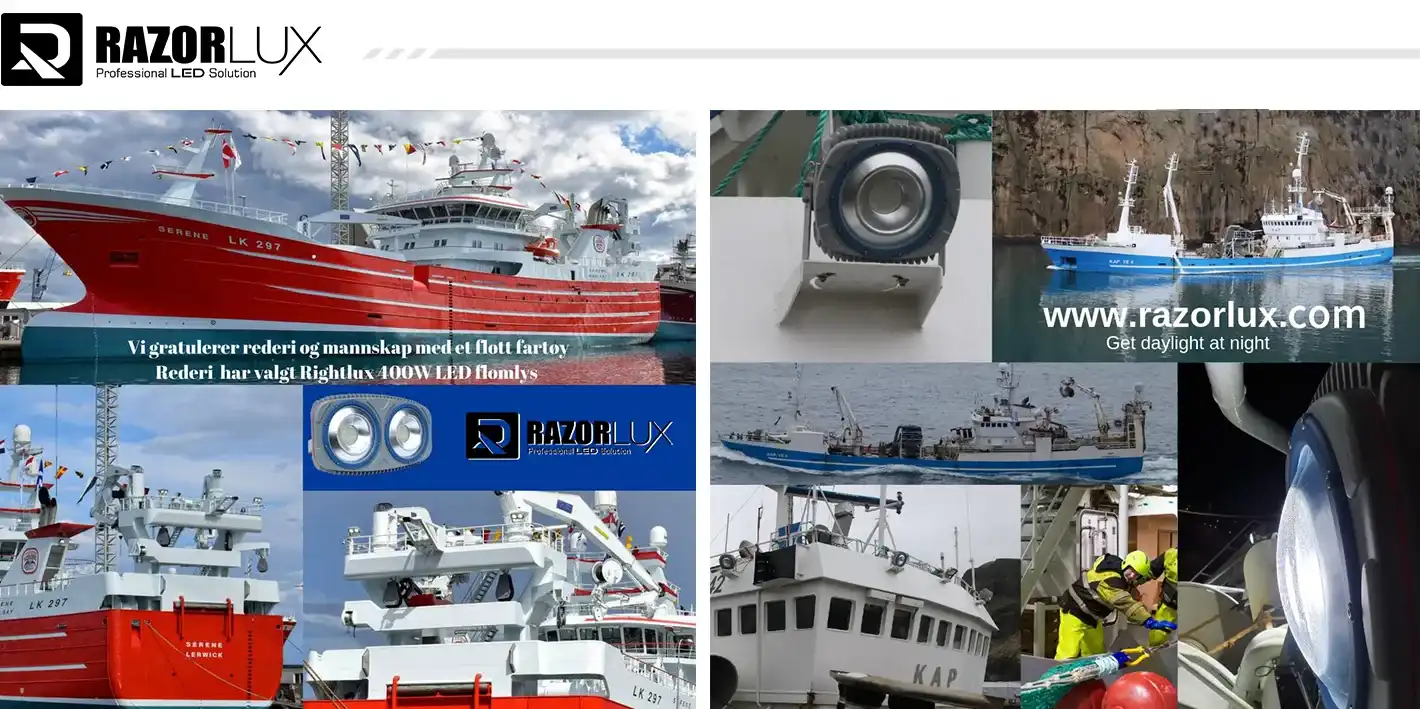
Conventional halogen light fittings on an oil production ship in the North Sea kept breaking down. In the harsh environment 200 kilometers offshore, the average service life was only 8 months. For replacement work, maintenance workers had to be flown in by chopper during short weather windows, which cost $4,500 per service call. The station operator chose our RGL-90A waterproof flood lights for 60 installation spots after talking to our tech team.
The results were better than expected. Even though the platform has been exposed to salt spray, temperatures ranging from -15°C to +35°C, and winds that often reach over 80 km/h for three years, none of the fixtures have broken. The 90W LED lights took the place of 250W halogen units, which cut the lighting's electricity load by 9,600W and reduced the need for cooling in equipment rooms. About 84,240 kWh of energy is saved every year, which is worth $12,600. Also, getting rid of the need for maintenance has saved an extra $27,000 in helicopter transport costs (Offshore Technology Conference, 2020).
This installation shows how choices about specifications affect the total cost of ownership, which goes beyond the price of the original purchase. The platform paid about 40% more for marine-certified LED lights than industrial-grade options, but they paid for themselves in 18 months thanks to better corrosion protection and longer service life.
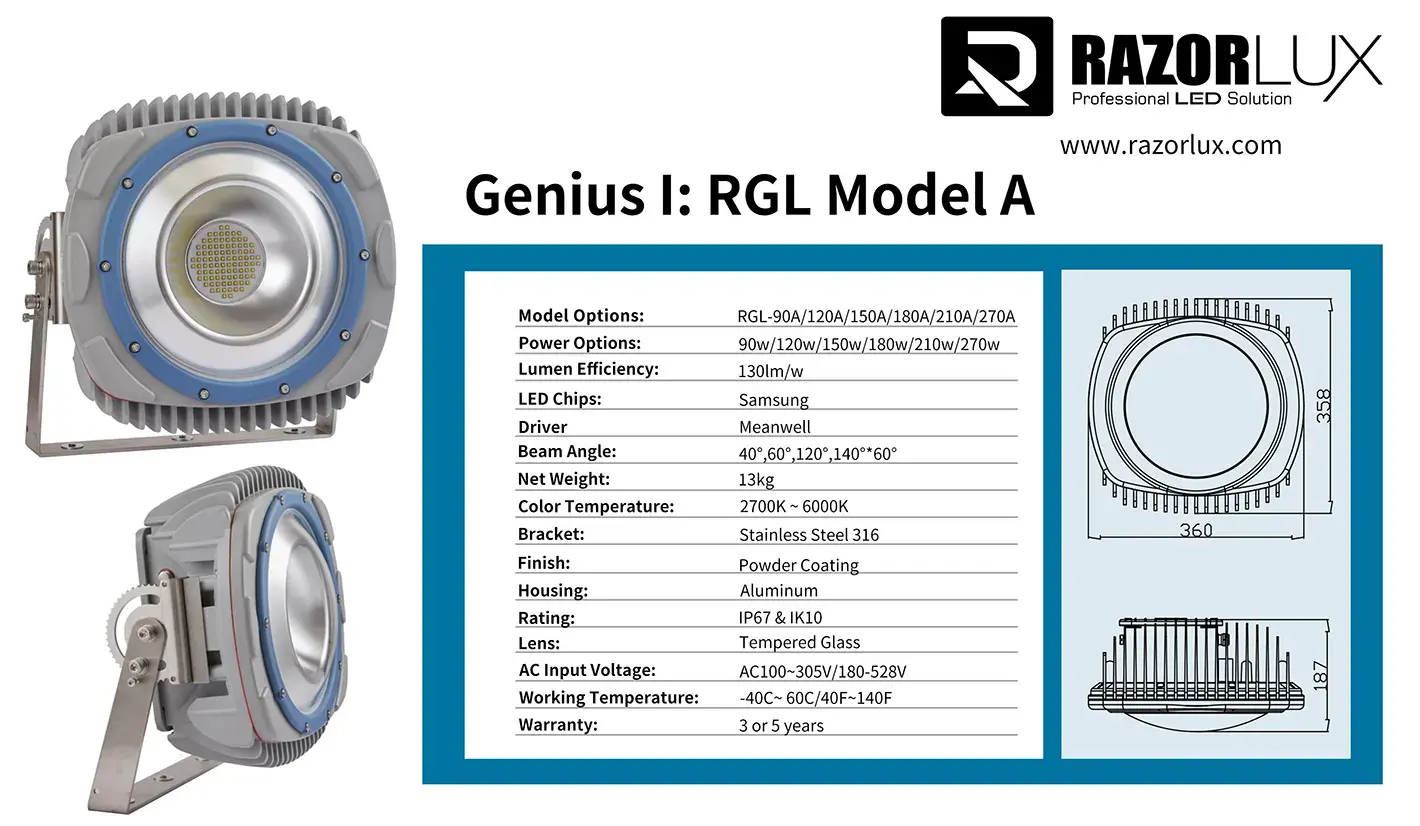
Technical Specifications: Razorlux RGL-90A Marine Flood Light
Our most popular naval lighting fixture is based on 25 years of application engineering work and comments from customers. The RGL-90A fixes some problems we've seen in thousands of marine installations around the world.
Core Performance Parameters:
- Power rating: 90W total use (81W LED grid plus 9W driver)
- Luminous Output: After temperature stabilization, the light gives off 10,800 lumens at 5700K
- Efficiency: 130 LM/W, replacing 150–250W HID lights
- Input Voltage Range: AC 90-305V or DC 127-431V without adapters
- Color Temperature Options: Field-selectable color temperatures range from 2700K to 6500K
- Color Rendering Index: Ra>75 is the minimum; Ra>80 and Ra>90 are also options
- Beam Angle Choices: 15°, 20°, 30°, 40°, 60°, 120°, and 140° beam angles
Environmental Protection:
- IP Rating: IP67 (complete sealing against dust, temporary submersion up to 1 m)
- IK Rating: IK10 (20 joule impact resistance)
- Operating Temperature: -40°C to +60°C (-40°F to +140°F)
- Operating Humidity: 10% to 95% non-condensing humidity is the operating range
- Corrosion Resistance: 1000-hour salt spray test according to ASTM B117
Construction Details:
- Housing Material: Die-cast metal with a polyester powder finish is used for the housing
- Mounting Bracket: made of 316L stainless steel and works with different angles
- Lens Material: Tempered glass with a covering that blocks UV light
- Cable Gland: tension connection made of stainless steel that is rated IP67
- Net Weight: 10 kg net and comes with an attachment bracket
- Dimensions: 360 mm x 358 mm x 306 mm
Electrical Characteristics:
- Driver Brand: Mean Well (listed by UL and approved by TUV)
- Power Factor: ≥0.98
- Total Harmonic Distortion: <10%
- Insulation Class: Class I with a safety earth connection
- Surge Protection: built-in 6kV transient control
Reliability and Warranty:
- LED Module Warranty: Five years of warranty on LED modules
- Driver Warranty: 5 years
- Housing Warranty: Ten years of housing warranty
- Expected Service Life: More than 50,000 hours of use, which is more than 17 years at 8 hours a day
Certifications: RMRS, CE, RoHS, SAA, C-Tick, UL, DLC, CB, and ISO 9001 certifications.
Procurement Considerations for Marine Industry Buyers
Understanding Total Cost of Ownership
The price of the light means only 15-20% of how much it will cost over its lifetime. Take into account the cost of installation labor (usually two to three hours per fixture for marine installations that need proper sealing and bracket mounting), energy use over the product's 50,000-hour service life, maintenance labor for broken units, and the cost of stocking replacement parts. We made a TCO calculator for marine lighting projects that shows that high-quality 12V LED flood lights waterproof and cost more at first often have lower 10-year costs than cheap options that need to be replaced more often.
Supplier Evaluation Criteria Beyond Price
Purchasing managers at shipyards tell us that the most frustrating thing is when sources leave after delivery, just when they need to help with technical issues. Check how quickly you respond to technical questions—we promise to answer emails within 4 hours and thorough application-building questions within 24 hours. Check that the certification papers you're looking at are real and still valid. In the past, rivals have given us expired or fake certificates that put us at risk of being sued when they were found during inspections. Check to see if replacement parts are available. Our policy is to keep driver modules, gasket kits, and mounting hardware for products that were sold within the last 10 years in stock.
Sample Testing and Validation Process
Don't commit to large orders until you've tested samples in the real world of your business. We offer evaluation units at our own cost ($280 USD, which includes international shipping) so that they can be checked out before big purchases are made. Samples must be tested for at least 90 days, during which time the weather will change with the seasons. After that, the light output must be measured, seals must be checked for integrity, and attaching parts must not have corroded. This investment in validation testing keeps mistakes from happening that cost a lot of money when hundreds of lights are added.
Conclusion
When picking 12V LED flood lights waterproof for marine projects, you need to think about more than just what the marketing says. Pay attention to companies that show they will stay in the marine market for a long time by having a wide range of certifications, real warranty support, and engineering knowledge that can solve problems that come up in the real world. The 12V low-voltage method lowers the risk of electrical shock and makes it easier to connect to current power systems on the vessel. IP67 sealing keeps out water, but how long things last in saltwater settings (five years or five months) depends on how well they were built with marine-grade materials. Energy efficiency calculations must account for total system power consumption, including drivers, while beam angle selection dramatically impacts practical illumination effectiveness. We've helped hundreds of marine projects make choices about what to buy that balance the original investment against the costs that will come up over the course of the product's life. This has helped operators get safe, reliable lighting that supports day-to-day operations that are mission-critical.
FAQ
1. Can 12V LED waterproof flood lights operate safely on commercial vessels?
Of course. 12V DC low-voltage systems are classified as Safety Extra Low Voltage, which means they pose a much lower chance of shock than 110V or 220V systems. Marine classification societies like DNV-GL and ABS only allow 12V LED lights to be installed on ships that have the right approvals and show they meet IEC 60092 electrical standards for ships (American Bureau of Shipping, 2018). The most important thing is to use fixtures that are certified to be marine-grade and to install them correctly by following the manufacturer's instructions.
2. How do different IP ratings affect fixture durability in saltwater conditions?
IP67 offers short-term submersion protection that's good enough for deck-mounted fixtures that get splashed by waves every once in a while. IP68 can handle being submerged in water for a long time, which makes it necessary for installations below the waterline or in places where the deck could flood. IP69K is designed to handle the high-pressure, high-temperature washdown that happens on chemical trucks and food-grade ships. However, an IP rating doesn't guarantee resistance to corrosion on its own. You must also make sure that the housing materials, gasket compounds, and hardware specifications don't corrode when exposed to salt water (IEEE Industry Applications Magazine, 2022).
3. Should we hire professional installers or use in-house maintenance crews?
The answer depends on how much experience your crew has with marine lighting systems and what level of electrical certification they have. Basic fitting of properly defined fixtures includes simple tasks like mounting and wiring, which are normally done by trained ship electricians. However, factory-certified installers who know about marine electrical codes are best for custom installations that need to figure out voltage drop, circuit protection sizing, or how to connect to emergency lighting systems. For self-installation projects, we offer full installation instructions and remote technical help. For projects that need specialized knowledge, we can also set up recommendations for certified installers.
Partner With Razorlux for Your Marine Lighting Needs
Since 1998, Razorlux has been making reliable lighting options for heavy-duty industrial and marine use. Our RGL-90A waterproof LED flood light is the result of working with shipyards, offshore platforms, and port sites in six countries for twenty years. For 22 years in a row, we've been an ISO 9001-certified company that makes 12V LED flood lights and waterproof products. We also have over 200 patents covering LED Packaging, thermal management, and structural design improvements made for use in harsh environments.
What makes our method different? We do more than just sell fixtures; we also help businesses run more smoothly. Our engineering team looks at the problems you're having with installation and figures out how much voltage will drop across cable runs, what beam angles will work best for your mounting heights, and what IP ratings will be best for your conditions of exposure. We offer solutions that come with real marine certifications and useful guarantee coverage, whether you're setting up a new offshore wind service vessel, updating old shipyard lights, or replacing broken fixtures on an existing platform.
Ready to discuss your marine lighting project? Contact our technical sales team at sam@razorlux.com to explore our complete product catalog. We offer evaluation samples for testing, custom engineering support for installations that are more complicated, and volume pricing for projects that need 50 or more fixtures. Let's work together to choose lighting systems that make your maritime operations safer, lower their costs, and give you the dependability you need.
References
1. American Bureau of Shipping. (2018). Guide for LED Lighting Systems for Marine and Offshore Applications.
2. International Electrotechnical Commission. (2021). IEC 60529: Degrees of Protection Provided by Enclosures (IP Code).
3. IEEE Industry Applications Magazine. (2022). "Corrosion-Resistant Lighting for Marine Environments: Materials and Design Considerations."
4. Marine Technology Society Journal. (2019). "Safety Improvements From Low-Voltage Lighting Systems on Offshore Platforms."
5. Offshore Technology Conference. (2020). "Life-Cycle Cost Analysis of LED Versus Conventional Lighting on North Sea Production Platforms." Proceedings of the Offshore Technology Conference, Houston, TX.
6. National Fire Protection Association. (2023). NFPA 70: National Electrical Code. Quincy, MA: NFPA Publications.