


_1750326878398.png)

Where to Mount Marine LED Flood Lights 120V for Maximum Coverage?
Proper placement of Marine LED Flood Lights 120V can dramatically improve visibility, safety, and operational efficiency across maritime installations. Strategic mounting optimizes light distribution by reducing shadow zones, enhances durability by minimizing exposure to mechanical stress, and ensures compliance with maritime safety regulations. Effective positioning considers beam angles, fixture elevation, environmental hazards like salt spray zones, and electrical accessibility—all critical elements that determine whether your investment delivers maximum illumination coverage or falls short under demanding conditions.
Understanding Marine LED Flood Lights 120V and Their Mounting Challenges
Marine lighting works in very different situations than lighting used in factories. The rusting process is sped up by saltwater, electrical parts are put at risk by constant humidity, and mounting hardware is stressed by engine noises and wave action. Because of these things, picking the right Marine LED Flood Lights 120V and fixing the spot is hard and has a direct effect on how long it works.
What Defines Marine-Grade LED Flood Lights at 120V
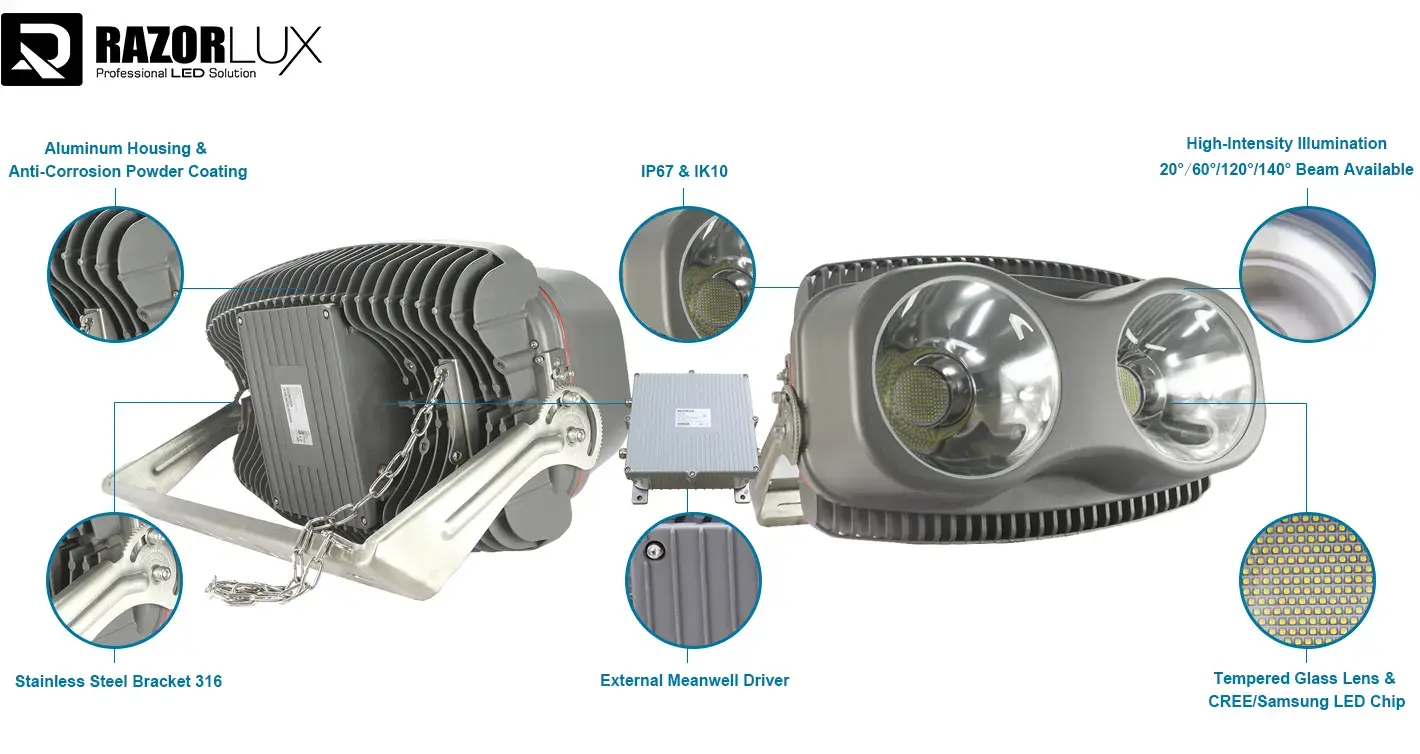
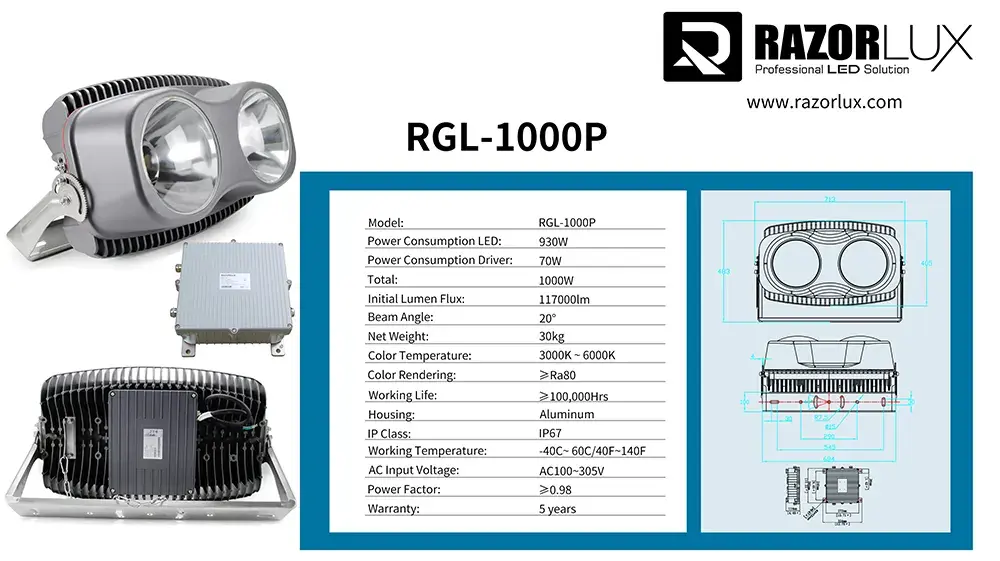
Marine LED Flood Lights 120V have special parts that allow them to work in harsh circumstances. This way of engineering is shown by our RGL-1000P-L20 model, which is a 1000W fixture that gives off 105,000 lumens and is 130 lm/W efficient. It is housed in powder-coated aluminum and has IP67 protection against water and dust. The bracket is made of stainless steel, which doesn't rust, and the Mean Well driver can handle voltage changes from 80VAC to 305VAC, which is common on ships with generator power systems. Voltage spikes that damage standard fixtures can't happen with this wide input tolerance.
Typical Applications Across Marine Environments
High-output Marine LED Flood Lights 120V are used in shipyards to light up work areas where precise welding and assembly happen all the time. These lights are put on helidecks and drilling areas of offshore platforms so that people can see during crew changes and emergency evacuations. They are used along loading docks at ports to make sure that crane operators can read the markings on containers correctly. They are put on poles and gunwales of fishing boats so they can work at night. To get even coverage without making dangerous glare zones, mounting must be done carefully for each application.
Core Mounting Challenges in Maritime Settings
Several problems make installation decisions harder. Saltwater makes electrolytic reactions happen between metals that are not the same, which weakens mounts over time. Constant humidity gets into junction boxes that aren't sealed well, which leads to short circuits. Diesel engines' vibrations can loosen bolts, which can cause fixtures to become misaligned or come free. When waves hit smaller boats, they create shock loads that regular commercial-grade fastening gear can't handle. Aside from physical dangers, the complicated Marine LED Flood Lights 120V wiring needs careful planning to keep the voltage steady along long cable runs, especially on big platforms where the lengths are more than 100 meters.
Key Factors to Consider When Mounting Marine LED Flood Lights 120V
When choosing where to put something, you have to weigh a lot of technical and practical factors. Bad choices can lower coverage, make maintenance more difficult, and even break safety rules. Systematically evaluating each factor makes sure that installations of Marine LED Flood Lights 120V meet both the immediate need for light and the long-term need for durability.
Identifying Optimal Mounting Locations on Vessels and Structures
Bow and Stern Positions: Mounts that face forward light up approach zones, which makes it easier to navigate and avoid collisions at night. Light work decks are placed at the stern, where they are used to move goods and fix broken equipment. Place things above the line where the waves are most likely to splash down to avoid direct contact with saltwater.
Evaluating IP Ratings and Corrosion Resistance Requirements
The ingress protection rating tells you how well a Marine LED Flood Light 120V fixture can keep solid particles and water out. IP67 certification means that the construction is dust-tight and that it can withstand temporary immersion up to one meter, which is enough for most marine uses. IP68 provides continuous submersion protection, which is only needed for installations that will be submerged in water.
Compliance with Marine Electrical and Safety Standards
Marine LED Flood Lights 120V sites have to follow strict rules and regulations. The American Bureau of Shipping (ABS) says that fixtures in dangerous places must meet explosion-proof standards. This is not as important for standard deck lighting, but it is for fixtures near fuel storage or engine rooms. Fixtures for certain types of vessels are approved by DNV-GL type approval. Russian ships need to be certified by RMRS, while US ships need to be certified by UL 1598A.
Step-by-Step Installation Guide for Marine LED Flood Lights 120V
Methodical fitting steps for Marine LED Flood Lights 120V keep mistakes to a minimum and make sure that things work as they should. Skipping steps or failing to do the work that needs to be done first can cause things to fail early, pose safety risks, and cost more over their entire life. The best ways to do things with marine lights have been honed over many years and are included in this book.
Pre-Installation Assessment and Preparation
Do a full site study before you place any Marine LED Flood Lights 120V fixture. Find out how far apart the proposed mounting points are and make sure that the structural members can hold the weight of the fixture plus wind loads. Our RGL-1000P-L20 is 29 kg heavy. Mounting surfaces must be able to handle several times that weight in addition to the loads that come from shaking and the weather.
Mounting Techniques for Maximum Stability
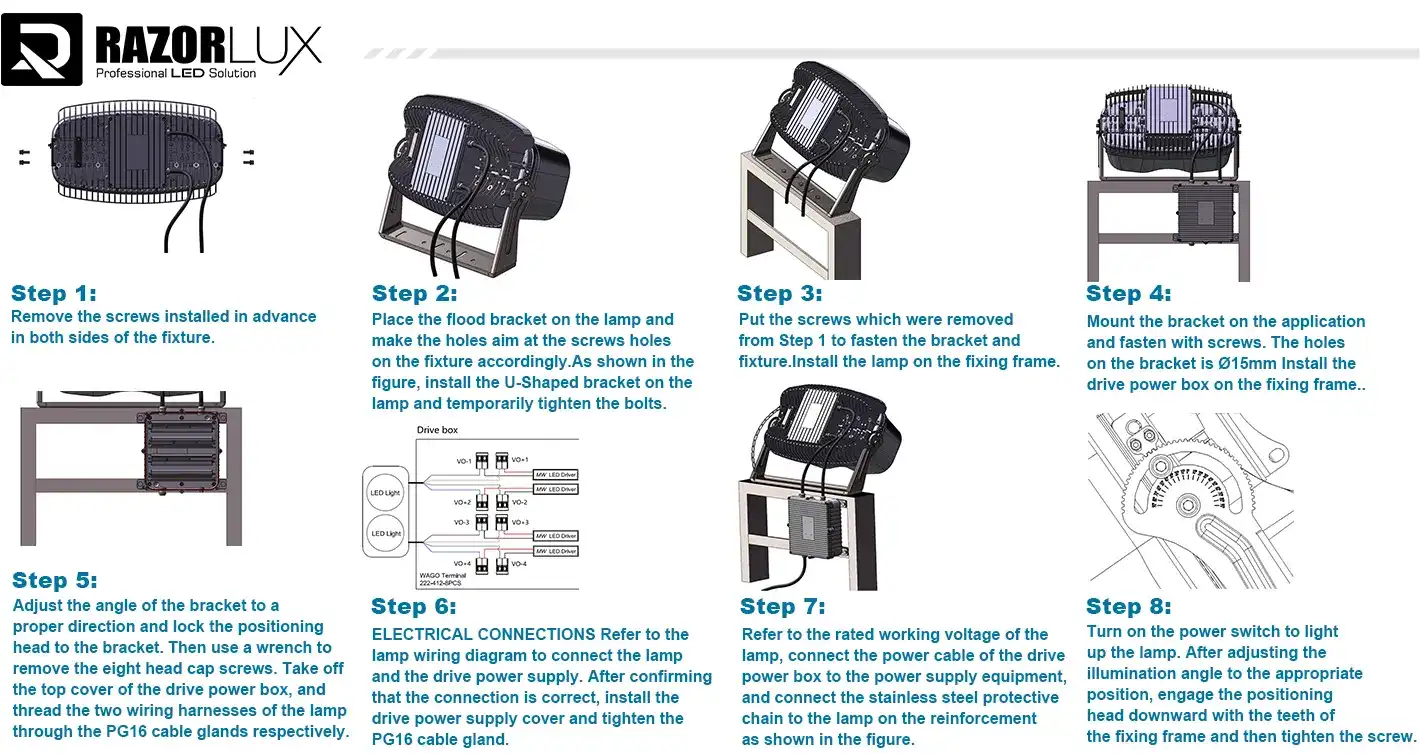
Use fasteners that are right for the substrate to attach the stainless steel mounting bracket to structural members. Structures made of steel can use through-bolts with locking nuts, but structures made of aluminum need bigger bearing surfaces so that loads are spread out and not crushed. Use anti-seize compound on threads to stop galling, which makes removal of Marine LED Flood Lights 120V harder in the future.
Wiring Best Practices and Waterproof Connections
When running Marine LED Flood Lights 120V wire, make sure to avoid sharp turns that put stress on the conductors by using conduit or safe sleeving. Support the cables at regular intervals to keep them from sagging, which can cause water to pool and friction points to form. Keep insulation away from surfaces that get hot, like exhaust pipes, because they can damage it.
Testing Procedures and Beam Adjustment
Before finishing the installation, turn on the circuit and make sure it works right. Make sure the Marine LED Flood Lights 120V screen is fully bright and not flickering, which could mean there are problems with the voltage or that driver parts are failing. Check the real voltage at the fixture connections when the load is on them. If it's significantly different from 120V, there are problems with the wiring that need to be fixed.
Comparing Mounting Solutions Based on Application and Lighting Performance
Different maritime environments need different ways of mounting. When procurement managers know how Marine LED Flood Lights 120V choice, gear design, and installation difficulty all work together, they can better match solutions to specific project needs while keeping total ownership costs low.
Voltage Considerations: 120V vs. 12V Marine LED Systems
For bigger installations, the 120V architecture has clear benefits. Higher voltage lowers the flow of current needed to deliver the same amount of power. This lets smaller gauge wiring go over long distances without a big voltage drop. In places like ships or platforms with many 1000W Marine LED Flood Lights 120V fixtures, 120V systems need less copper, which saves money on materials and makes installation easier in crowded cable runs.
Fixed vs. Adjustable Mounting Hardware
Fixed Mounts: Brackets that don't move are best for permanent installs on piers, platforms, and the tops of buildings. These designs get rid of moving parts that can rust and come loose, so Marine LED Flood Lights 120V light patterns stay the same. When planning, fixed mounts work best when coverage needs are clear and aren't likely to change.
Adjustable Systems: Ships that need to be able to change between different modes of operation or types of cargo need to be able to adapt to different situations. With adjustable Marine LED Flood Lights 120V mounts, the beam can be moved without having to replace the fixture. To stop drift, swivel devices must have bearings that don't rust and safe locking. In settings that change quickly, the extra complexity is worth it because operations can be more flexible.
Real-World Case Studies Demonstrating Strategic Mounting
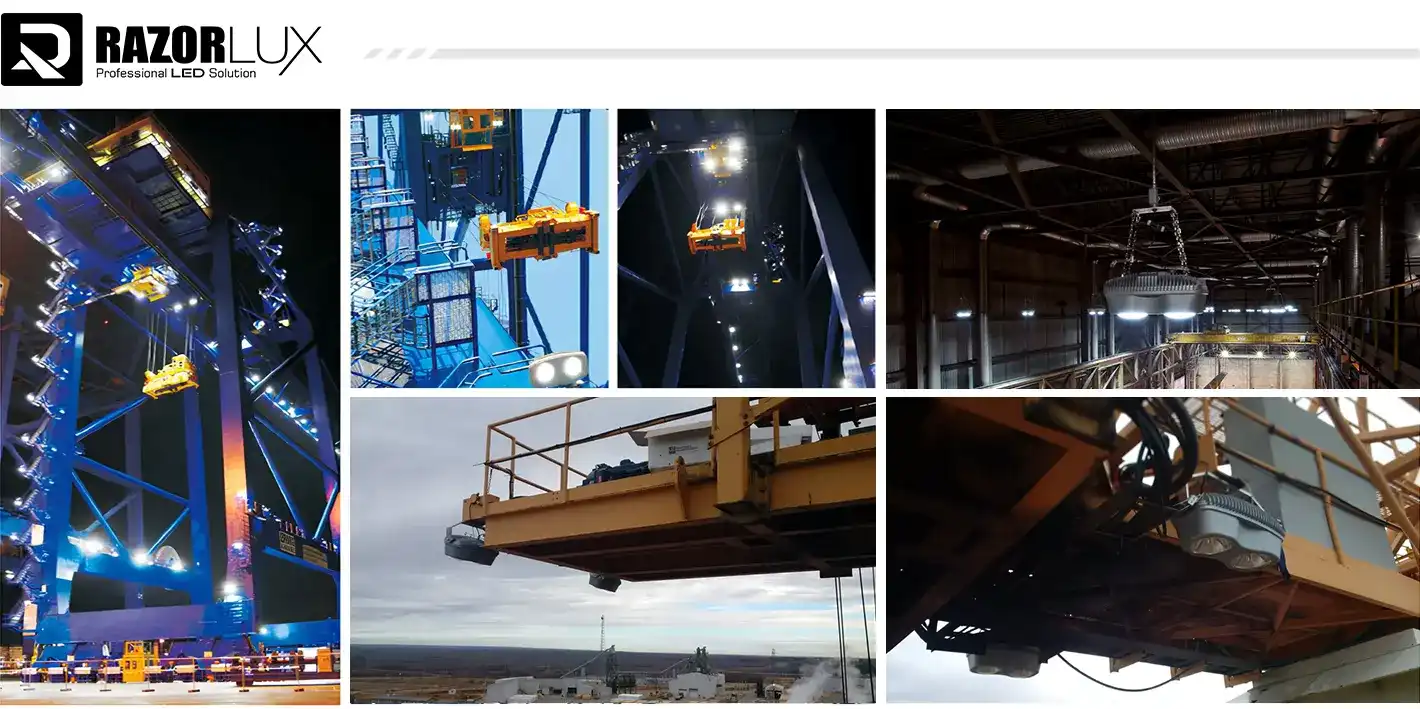
Our Marine LED Flood Lights 120V RGL-1000P-L20 units were recently installed in the dry docks of a Norwegian factory to replace 2000W metal halide lights. Strategically placing the lights at 12-meter heights on scaffold structures saved 50% of the energy used and made the lighting more even by 40%. The IP67 grade meant that pressure washing could be used for regular cleaning without stopping the service. Within 18 months, the project paid for itself through lower energy and upkeep costs.
Energy Efficiency, Lifespan, and Maintenance Considerations in Mounting Decisions
Strategic mounting of Marine LED Flood Lights 120V has effects that go far beyond the cost of installation. Fixture placement affects operational costs by changing how much energy is used, replacement intervals by changing how much the fixture is exposed to the environment, and how easy it is to do maintenance. All of these factors have a big impact on the total cost of ownership.
How Mounting Height and Angle Affect Power Efficiency
The inverse square rule says that when you double the distance, you get four times as much light hitting the target area. When you mount Marine LED Flood Lights 120V too high, a lot of the light goes out before it gets to the work area, which wastes energy. Our 20° beam angle focuses the light, but the best height for mounting 1000W fixtures is usually between 8 and 15 meters, based on how much area is needed.
Mounting Decisions That Extend Operational Lifespan
Thermal control has a big impact on how long a Marine LED Flood Lights 120V fixture lasts. LEDs don't make as much heat as older technologies, but they still need enough airflow to stay cool. Mounting in tight spaces or places that block airflow shortens the lifespan by raising junction temperatures. Our aluminum housing has thermal dissipation fins. To improve convective cooling, place these fins vertically when you can.
| Place of Mounting | Duration of Expected Maintenance | Main Concerns | Actions that are suggested |
|---|---|---|---|
| Structures on the upper deck | 12 to 18 months | Integrity of the seal, rust of fasteners | Visual check and torque testing once a year |
| Work Areas at Mid-Level | 6 to 12 months | Loss of vibration and cable chafe | Checking the wire route every six months |
| Spray Zones and Lower Deck | 3 to 6 months | Speeded up rust and water entry | Detail inspection every three months; replace seals as needed |
| Equipment areas with walls | 18 to 24 months | Heat buildup and dust buildup | Cleaning once a year and checking with thermal imaging |
Maintenance Access and Service Procedure Planning
Positions for mounting Marine LED Flood Lights 120V should make regular repair easier, without the need for special tools. Fixtures that can be reached by permanent ladders or platforms have low service costs. Fixtures that need scaffolding or lift equipment, on the other hand, cost more each time they need to be serviced. During planning, make a map of the repair access routes and check that there are enough space to remove and change fixtures.
Addressing Common Installation Mistakes and How to Avoid Them
When installing Marine LED Flood Lights 120V, even teams with a lot of experience run into problems. By learning from common mistakes, project managers can take steps to avoid them, which cuts down on the cost of redoing work and ensures quality the first time. Knowing about these problems is especially helpful when judging the skills of contractors or teaching in-house maintenance teams.
Improper Electrical Grounding and Bonding
If you don't ground your Marine LED Flood Lights 120V equipment properly, you could get an electric shock if the insulation breaks, stray currents could speed up corrosion, and lightning hits or generator problems could damage your LED drivers. All of the metal parts on a marine craft need to be connected to a shared ground reference by extensive bonding networks. Lighting sources must connect to this system using connecting wires of the right size.
Inadequate Seal Protection and Moisture Management
Even though Marine LED Flood Lights 120V has an IP67 grade, water protection can be lost if it is not installed correctly. When you tighten cable glands too much, you crush the seals, which creates leak routes. When you under-tighten something, gaps are left that let water in. Capillary action can pull water along conductor strands and into electrical connections when conduit is threaded into junction boxes without a closing substance.
Mismatched Beam Patterns and Coverage Gaps
Sometimes, procurement teams choose Marine LED Flood Lights 120V lights based only on their power or lumen output, without thinking about how that affects the beam angle. Our 20° focused beam model and a 1000W light with a 60° beam spread make very different patterns of coverage. Mismatched choices lead to uneven lighting, with dark spots and areas with too much light, which defeats the installation's purpose.
Vibration-Induced Fastener Loosening
In Marine LED Flood Lights 120V settings, systems are constantly being shaken by machinery, waves, and operations. In these conditions, standard fasteners slowly come loose, which causes beams to become misaligned, electrical connections to fail, and eventually fixtures to come loose, which poses a safety risk and damages equipment.
Voltage Drop Miscalculations
When there are long Marine LED Flood Lights 120V cable runs between power sources and fixtures, the voltage drops. This is because of the resistance of the conductors. Our lamps can work with input voltages ranging from 80VAC to 305VAC, but too much voltage drop lowers the light output and could cause the driver to fail early. A lot of Marine LED Flood Lights 120V setups don't think about this effect enough, especially on big platforms where fixtures are mounted hundreds of meters away from the power lines.
Advanced Mounting Techniques for Specialized Marine Applications
In addition to standard lighting for decks and piers, some naval settings need creative Marine LED Flood Lights 120V mounting options that can solve specific operating problems. These advanced applications need more advanced technical knowledge but offer big benefits when standard methods don't work.
Helideck and Aviation Safety Lighting Integration
Offshore platforms and Marine LED Flood Lights 120V equipped ships with landing areas for helicopters must follow CAP 437 (UK) or a similar ICAO standard that specifies the lighting patterns, intensities, and colors that must be used. In addition to the specialized helideck lighting systems, perimeter Marine LED Flood Lights 120V provide general area lighting without making arriving pilots feel lost due to the glare.
Underwater Hull Lighting and Below-Waterline Applications
Some ships use underwater Marine LED Flood Lights 120V to keep an eye on things like sea life, keep an eye on security, or dock at night. For these setups to work, the fixtures need to be IP68-rated and have special mounting systems that can handle marine growth and impacts from floating garbage.
Explosive Atmosphere Zones and Dangerous Locations
Compliance Approach: Standard Marine LED Flood Lights 120V, like our RGL-1000P series, might not have certifications for use in explosive atmospheres. For projects that need lights in dangerous places, the Marine LED Flood Lights 120V lamps must have the right zone ratings, which are usually Zone 1 or Zone 2 for gas and vapor atmospheres. The Marine LED Flood Lights 120V mounting tools must also be explosion-proof and use rigid tubing with threads instead of flexible wire connections. Talk to certified electrical engineers who specialize in hazardous area classification to make sure that the installation follows all the rules. If it doesn't, there are huge risks of disaster.
| Type of Application | Important Requirements | Complexity of Mounting | Needs for Certification |
|---|---|---|---|
| The edge of the helideck | Accurate beam control and no glare | Moderate—needs coordination with aviation | 14 of ICAO's CAP 437 |
| The Underwater Hull | Pressure compensation and an IP68+ rating | Expertise needed for high-hull penetration | Approval from the classification society |
| Explosive Air Conditions | Fixtures and pipe systems that are zone-rated | Need a highly specialized electrical contractor | ATEX, IECEx, and NEC 500 |
| Gantry and Crane | Isolation from vibration and flexible wire handling | Moderate—thoughts on moving equipment | Standard marine certificates are enough |
Dynamic Positioning and Moving Equipment Integration
Engineering Solutions: Use heavy-duty sound isolators to mount Marine LED Flood Lights 120V fixings on equipment. Use festoon cable systems or cable reels to control the movement of power conductors without putting too much stress on their bends. Choose Marine LED Flood Lights 120V fixtures with stronger mounting holes that are made to work with mobile devices. As you plan where to run the cables, make sure they don't get squished in places where machinery is moving. Setting up regular inspection times is important because moving Marine LED Flood Lights 120V setups need more upkeep than fixed ones because they wear out faster when they're always moving.
Conclusion
Strategic mounting of Marine LED Flood Lights 120V transforms maritime illumination from a basic operational necessity into a performance advantage. Proper positioning maximizes coverage, extends fixture lifespan through reduced environmental stress, and delivers superior energy efficiency by optimizing light distribution. Successful installations balance technical factors—beam angles, ingress protection, voltage considerations—with practical concerns like maintenance accessibility and regulatory compliance.
Partner with Razorlux for Marine-Grade LED Area Flood Lights
Choosing the right LED Area Flood Lights manufacturer can affect how well your facility works, how safe it is, and how much it costs to maintain over time. Razorlux has more than 20 years of experience in marine and heavy-duty industrial lights. They have 436 patents that cover improvements in thermal management, driver technology, and housing design optimization. Our RGL-1000A flood lights are made of aluminum and have 130 lm/W efficiency thanks to Samsung LED chips and Mean Well drivers. They come with a 5-year warranty and are certified by RMRS, DNV, CE, UL, and DLC, among others.
For unique lighting plan designs, photometric analysis, and low bulk prices on your shipyard, port facility, or offshore platform project, email our engineering team at sam@razorlux.com. We give you full technical documentation, chances to test samples, and quick help throughout the whole procurement process, from coming up with the initial specifications to helping you with installation and planning for maintenance over the product's lifetime. You can trust Razorlux to provide you with reliable LED Area Flood Lights that have been tested and proven to work in the harshest naval and industrial settings in the world.
References
1. Illuminating Engineering Society, "Recommended Practice for Outdoor Lighting in Marine Environments," IES Technical Memorandum TM-28-2019.
2. Maritime Equipment Manufacturers Association, "LED Lighting Durability Standards for Shipboard and Offshore Applications," MEMA Technical Report 2021-04.
3. Department of Energy, "Solid-State Lighting Research and Development: Multi-Year Program Plan," DOE Office of Energy Efficiency and Renewable Energy, 2023.
4. International Association of Ports and Harbors, "Best Practices for Port and Terminal Lighting Infrastructure," IAPH Guidelines Document, 2022.
5. American Society for Testing and Materials, "Standard Practice for Operating Salt Spray (Fog) Apparatus," ASTM B117-19, 2020.
6. LED Systems Reliability Consortium, "Thermal Management Impact on LED Component Longevity," LSRC Technical Publication Series, Vol. 8, 2023.