


_1750326878398.png)

Which LED Area Flood Lights Deliver the Best Site Coverage?
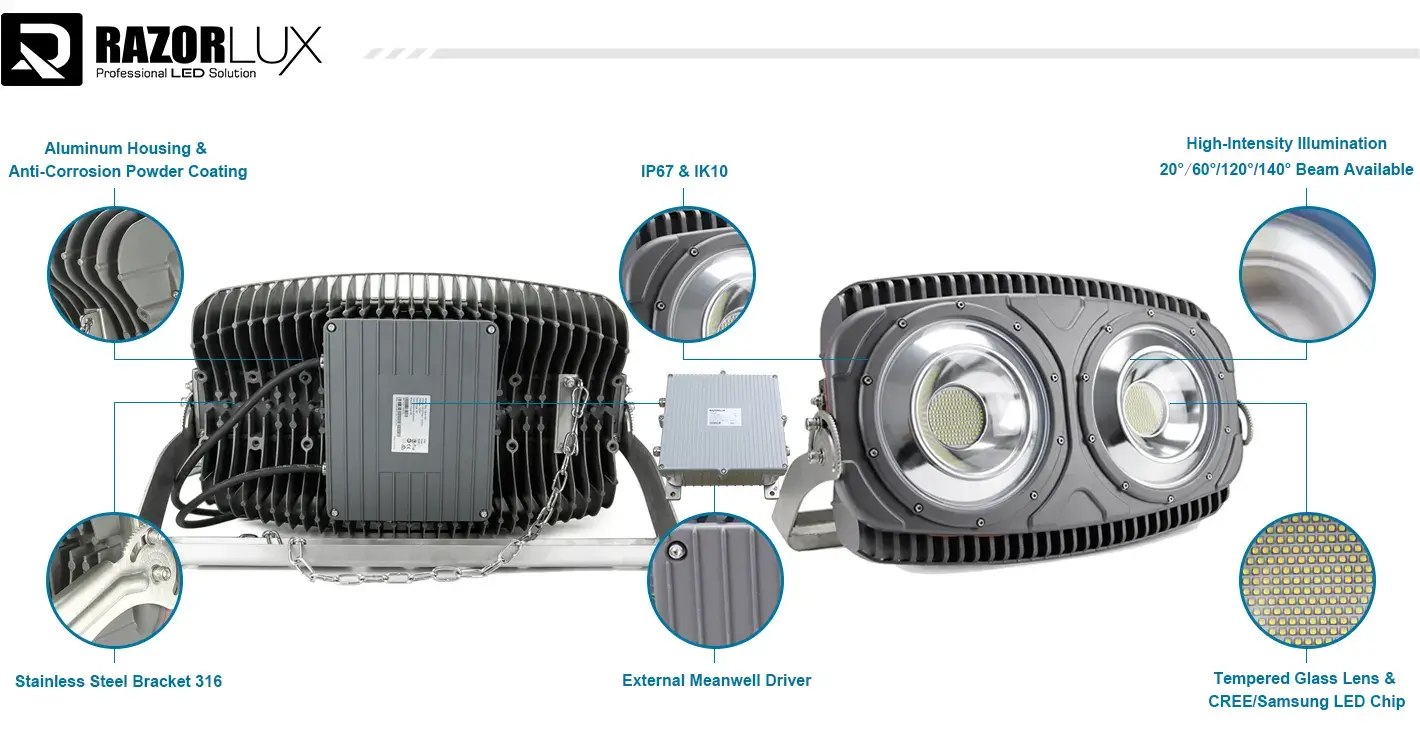
When we assess site coverage performance, high-quality LED Area Flood Lights combine optimal lumen output, precise beam distribution, and robust construction to illuminate expansive outdoor spaces uniformly. The best solutions deliver 130 lm/W or higher efficiency, feature adjustable beam angles ranging from 15° to 140°, and maintain IP67-rated protection against environmental challenges. Samsung or Philips LED chips paired with Meanwell drivers ensure consistent performance across temperatures from -40°C to 60°C, making these fixtures ideal for ports, industrial yards, and commercial sites where reliability directly impacts operational safety and security.
Core Factors That Determine the Best Site Coverage with LED Flood Lights
Photometric properties must be perfectly aligned with operational needs and environmental conditions in order for site coverage to work well. There are three main factors that determine how well lighting works: the amount of lumens it produces, the shape of its beam, and its spectral properties, which are shown as color temperature.
Lumen Output and Brightness Considerations
Lumen brightness is a measure of how much visible light a bulb gives off. To replace old 1,000- to 2,000-watt discharge LED Area Flood Lights, industrial settings usually need 400 to 1,200 watts of power. A 1,000 W LED bulb that puts out 130 lm/W gives off 130,000 lumens, which is enough light to make a 20,000-square-foot area suitable for busy industrial work. When making decisions about what to buy, the mounting height must be taken into account because the inverse square law says that twice the distance makes the light only 1/4 as bright as it was before.
The table below shows how power levels are related to common service areas:
| Power Rating | Lumen Output (130 lm/W) | Coverage Area (20-30 foot mounting) | Typical Application |
|---|---|---|---|
| 400W | 52,000 lm | 6,000-8,000 sq ft | Small parking areas, building perimeters |
| 600W | 78,000 lm | 10,000-14,000 sq ft | Loading docks, equipment yards |
| 1000W | 130,000 lm | 18,000-24,000 sq ft | Port terminals, large industrial sites |
| 1200W | 156,000 lm | 22,000-28,000 sq ft | Ship construction areas, offshore platforms |
For these figures, normal industrial lighting goals are 5–10 foot-candles for general areas and 20–30 foot-candles for specific work areas.
Beam Angle Flexibility and Distribution Patterns
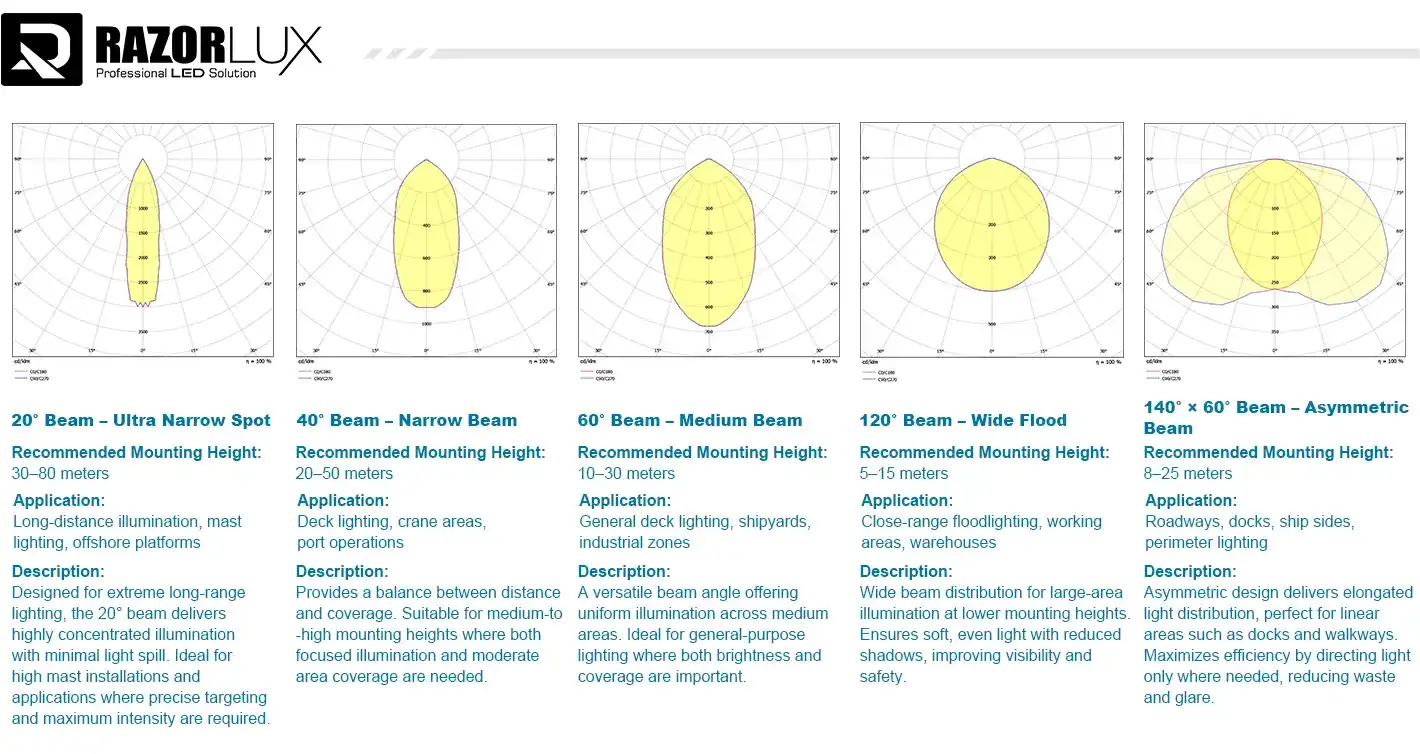
The choice of beam angle affects how focused or spread out the light pattern looks. Narrow 15° and 20° beams work well as flashlights to draw attention to certain buildings or shine light over long distances. Angles between 40° and 60° are good for general area lighting, and lights should be mounted at a modest height. Wide 120° and uneven 140°×60° distributions work best in parking lots, where fixtures are placed along the edges to push light forward across lanes while reducing the waste of backlight.
Color Temperature Selection for Optimal Visibility
Color temperature, which is defined in Kelvin, affects how people see colors and features when they are in artificial light. The 2700K warm white spectrum makes lighting that looks good in homes more comfortable, but it makes it harder to see in factories. The bland white 4000K color rendering is balanced and good for business plazas and mixed-use areas. The 5000K bright white gives clear, high-contrast vision that is ideal for security areas, inspection areas, and other places where it's important to tell the difference between colors accurately.
A study in the Journal of Light & Visual Environment confirms that 5000K lighting improves the distance needed to recognize faces by 15–20% compared to 3000K lighting at the same lux levels[2]. This benefit is especially useful for how well video cameras work and how well human security patrols work.
Energy Efficiency and Total Cost of Ownership
Using less energy has a direct effect on operating costs over the life of the device. Metal halide systems from the past need 400 to 600 watts to make 30,000 to 40,000 lumens (60 to 75 lm/W), but new LED lamps can make 130 to 170 lm/W. This difference in efficiency means that facilities that run hundreds of fixtures on 12-hour cycles every night will save 55–65% on energy costs, which is a big deal for businesses. If you replace a 2000W discharge lamp with a single 1000W LED fixture, you'll save about 8,760 kWh per year, which is worth between $800 and $1,200 based on your area's energy costs.
Comparing the Leading Types of LED Area Flood Lights for Outdoor Site Coverage
There are several different types of LED flood lights on the market, and each one is best for a certain set of tasks. By knowing these categories, buying teams can match the features of fixtures to the needs of the site instead of using one-size-fits-all solutions that don't work.
Standard LED Flood Lights vs. High-Performance Industrial Units
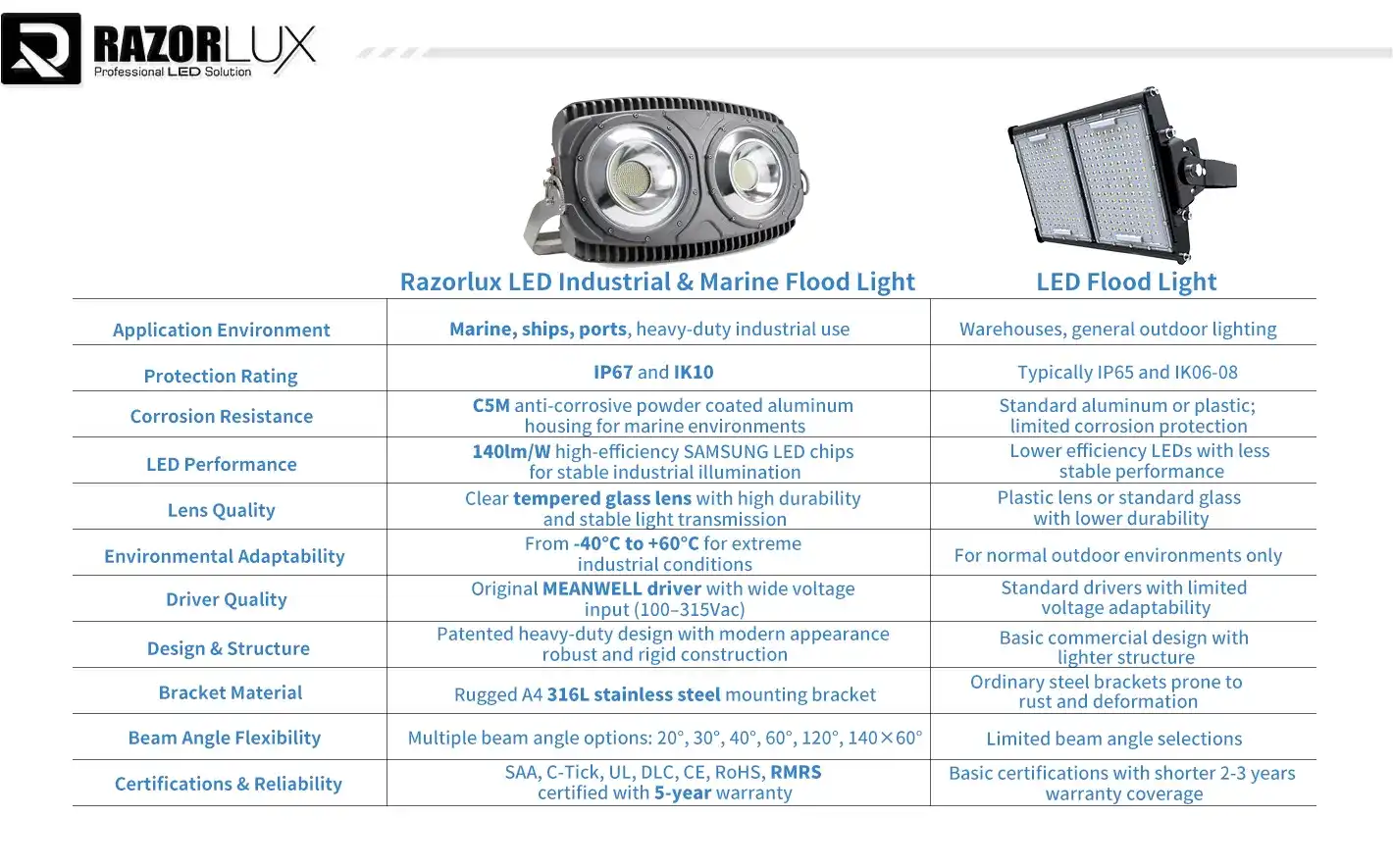
Consumer-grade LED flood lights are made with common parts that don't have much heat control. They usually have an IP65 rating and a lifespan of 25,000 hours. These units work fine for home use, but they break down quickly when used continuously in industry. Professional fixtures have ADC12 die-cast aluminum housings with built-in heat sink fins that keep junction temperatures below critical levels that hurt the performance of LED chips. For high-end models, Samsung LM301H or Philips Luxeon chips are paired with Meanwell HLG or XLG-series drivers. These parts were chosen because they have been shown to work reliably in harsh conditions.
The Role of Advanced Control Systems
The addition of motion sensors cuts down on energy use during times of low activity while keeping security ready. Photocell controls change output automatically based on the amount of light around them. This gets rid of the need for manual switching and stops operation during the day. The ability to dim LED Area Flood Lights makes them last longer by lowering electrical stress during times of low demand. For example, running at 70% power can double the LED L70 grade. These control systems work well with platforms for managing buildings, which let you keep an eye on everything from one place and plan maintenance ahead of time.
Understanding IP and IK Ratings for Environmental Protection
The International Protection (IP) rating system describes how well something keeps solids and liquids from getting in. The IP65 rating means that the construction is dust-tight and protected against water jets coming from any direction. This is enough for installations that are covered. IP67 approval means that the product will be waterproof up to one meter for 30 minutes. This is very important for dock areas and other places that might get flooded or cleaned. Impact resistance is measured by the IK grade. IK10 certification can handle 20 joules of impact energy, which is the same as dropping a 5 kg mass from 40 cm. This is very important for places where equipment crashes or vandalism happens.
This comparison shows how different types of security work best in different settings:
| Environment Type | Minimum IP Rating | Minimum IK Rating | Example Applications |
|---|---|---|---|
| Covered loading docks | IP65 | IK08 | Warehouse perimeters, covered parking |
| Exposed coastal areas | IP67 | IK10 | Ports, shipyards, offshore platforms |
| Heavy industrial zones | IP67 | IK10 | Steel mills, mining operations, rail yards |
| Standard commercial sites | IP65 | IK08 | Retail parking lots, building facades |
Precision-engineered silicone gaskets and tempered glass lenses make Razorlux fixtures meet IP67 and IK10 standards. This means they will work reliably for a long time in the harshest maritime and industrial settings.
Corrosion Resistance for Marine and Coastal Applications
Testing fixtures with salt spray according to ASTM B117 guidelines shows big differences in how well they work. If you don't do anything else, powder-coated metal housings will start to rust after 500 hours of contact. Marine-grade fixtures have an electrophoretic coating or a C5-M anti-corrosion treatment that makes them resistant to salt spray for more than 3,000 hours. In coastal areas, carbon steel gear often breaks down because of rust. Stainless steel mounting clamps don't have that problem.
Facilities that are less than five miles from the coast should make sure that their fixtures have been checked to meet marine rust standards. The investment premium is usually 15 to 20 percent more than the normal price of an industrial unit, but it keeps units from breaking down too soon, which would stop activities and raise the cost of replacement.
Procurement Guide: How to Choose and Source the Best LED Area Flood Lights
Instead of choosing a generic product, the first step to successful procurement is a full site assessment. Before hiring sellers, technical teams need to figure out how much illumination is needed, what problems might arise in the surroundings, and what performance standards should be set.
Defining Site-Specific Requirements
Using calibrated lux meters to measure the current level of light sets a baseline and finds areas that need more light. Facility managers should write down the hanging heights, the distance between the poles, and any obstacles that affect the way light is distributed. Protection level requirements are based on things like the temperature range, humidity levels, and the amount of contamination (dust, chemical vapors, salt spray, etc.) that are present. Different types of operational patterns—continuous 24/7 operation vs. dusk-to-dawn cycles—affect how temperature is managed and how long something is expected to last.
Evaluating Component Quality and Certifications
The choice of LED chip has a big impact on how well and how long a light works. The Samsung LM301B/H line and Philips Luxeon are the best choices, with L90 ratings that go over 60,000 hours in the right temperature conditions. Bridgelux and Lumileds' mid-range chips work well and don't cost as much. There is a big risk with generic chips that don't come with manufacturer specification sheets because no one has written down how often they fail or how long their lumens last.
How long a fixture lasts depends on how reliable the driver is and how important the LED chips are. Menwell drivers are the most popular choice for commercial use because they have a failure rate of less than 0.2% over 50,000 hours. These units have power factor correction that is higher than 0.95, which meets the standards for utility harmonic distortion while also making the most of energy efficiency. Wide input voltage ranges (100-305VAC or DC127-431V) can handle changes in the power grid that happen in industrial settings and allow global deployment without needing to make changes for each voltage.
Certification Requirements for International Projects
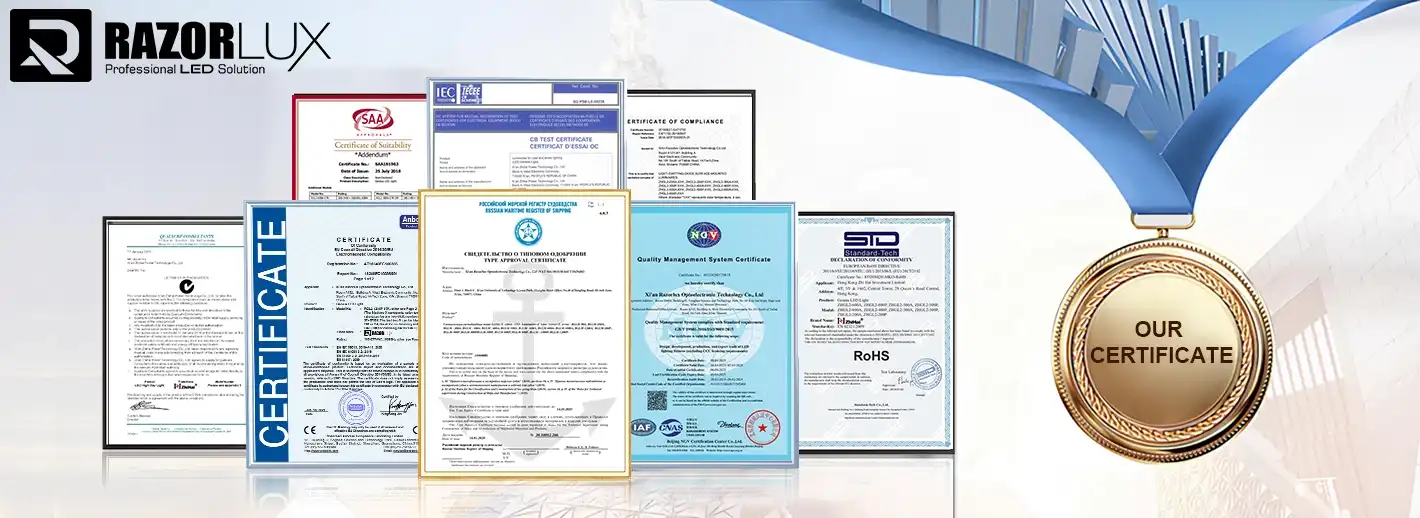
European markets require CE marking to show that they follow the EMC Directive and the Low Voltage Directive. RoHS approval confirms limits on dangerous substances. For electrical safety, the American market needs UL listing or an equivalent ETL certification. Fixtures that are listed on the DLC can get utility return programs that cover 20 to 40 percent of the cost of buying them. Installations in Australia need to be certified by both SAA and C-Tick. Maritime classification groups, such as DNV/GL, ABS, and RMRS, give ships and offshore buildings extra certification.
When evaluating vendors, procurement teams should ask to see full license paperwork. Real companies keep their certificates up to date and are happy to give you test reports from approved labs. If certifications are missing or have lapsed, it means that the goods aren't compliant, which puts companies at risk of liability and keeps projects from getting governmental approval.
Leading Manufacturers and Supply Chain Considerations
Well-known brands like Philips, Cree, OSRAM, and GE Lighting have a lot of products and help networks all over the world. These brands cost a lot, but they are known to be reliable and come with long warranties. Mid-market manufacturers, like Razorlux, offer similar technical performance at lower prices, which is especially helpful for large-scale projects where volume discounts have a big effect on total costs.
When it comes to marine and heavy-duty industrial applications, Razorlux has more than 20 years of experience with LED technology. Our unique multi-function design works with a variety of installation options and meets IP67/IK10 safety standards. With Samsung LED chips and Meanwell drivers, the RGL-1000A model gives off 130,000 lumens at 130 lumens per watt. Wide input voltage compatibility (AC100-305V, DC127-431V) lets it be used all over the world without any regional differences. Beam angles ranging from 15° to 140°×60° make it possible to precisely distribute light based on the shape of each spot. The five-year guarantee shows that we trust the quality of the parts and the way they are put together, which has been improved by ISO 9001 quality control systems.
Bulk Purchasing Strategies and Terms
When working on big projects, it makes sense to work directly with the manufacturer to get better prices and more customization options. People who buy more than 100 units usually get savings of 15 to 25 percent off the regular price. Framework deals set firm prices for multi-phase projects, which protect budgets from changes in the market and guarantee supply. Letters of credit and other payment terms make foreign deals possible and protect both parties. Customized specifications, like special beam angles, voltage ranges, or mounting hardware, have lead times that are 4 to 6 weeks longer than stock product delivery. This means that you need to plan your purchases early to avoid schedule delays.
Installation and Maintenance Best Practices for Sustained Site Coverage
When you install something correctly, you get the most out of it and keep it from breaking early because of bad fitting, bad electrical connections, or exposure to the environment.
Mounting Height and Spacing Calculations
The needed fastener power and spacing intervals are directly affected by the mounting height. According to the inverse square rule, if you double the mounting height, you need to quadruple the lumen power to keep the same amount of illumination at ground level. Area floodlights are usually put up 25 to 40 feet high on poles or building sides in industrial facilities. Using photometric files (IES format) for computer modeling lets you place fixtures precisely, which gives you even lighting while keeping equipment costs low.
Professional lighting designers use tools like AGI32 or DIALux to test setups before they are bought. These programs can take in site CAD drawings and calculate the amount of light falling on defined grid points. This helps find the best places for fixtures and the best angles for aiming them. By following industry standards like IESNA RP-8 for roadway lighting or RP-6 for sports facilities, the layouts stop over-lighting (which wastes energy) and under-lighting (which poses safety risks).
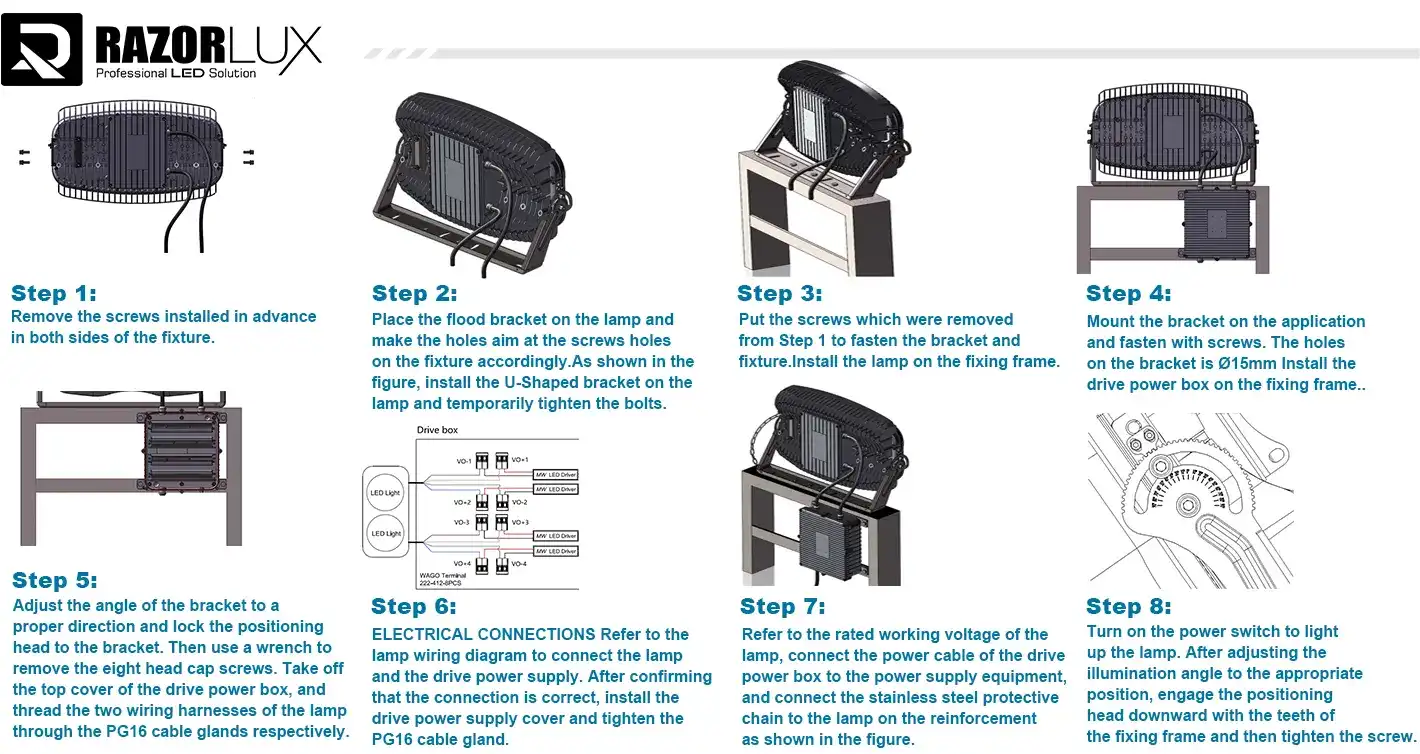
Electrical Connection and Surge Protection
Voltage changes and transient surges that happen in industrial settings can damage electronics that are sensitive to them. Surge protection devices rated for 10kV to 20kV lightning-induced transients should be used in all installations. The National Electrical Code says that grounding systems must have different connections for ground that are not connected to neutral wires. For junction boxes to meet the safety levels of fixtures, they need to have an IP67 rating and use marine-grade wire glands that keep the seals intact. Stranded copper conductors rated for 90°C operation should be used in the wiring. They should be big enough to keep the voltage from dropping below 3% at full load.
Preventive Maintenance Schedules
Inspections every three months find problems early on and buildup in the environment that hurts performance. Maintenance teams should make sure that the fixing hardware is tight, clean the lens, and check the amount of illumination in key areas. A deep cleaning once a year gets rid of salt deposits, industrial waste, and biological growth that block light from passing through lenses. Using infrared cameras to test electrical lines can find resistance problems before they become major problems. Keeping detailed repair logs lets you use statistical analysis to figure out when to replace something and avoid unexpected power blackouts.
When to Replace vs. Repair
Instead of failing all of a sudden, LED fixtures lose lumens over time. When the measured illuminance falls below 70% of its original value, it becomes more cost-effective to replace the light than to keep using it even though the output is getting worse. When a driver fails, it's usually better to replace the whole unit than to try to fix it in the field, since the cost of work is higher than the cost of replacing the equipment. Having spare fixtures on hand lets you change them quickly without having to wait for a long time. This is especially helpful for factories that run continuous production plans and need to stop operations when the lights go out.
Conclusion
To get the best site coverage, you need to make sure that the specifications of your LED Area Flood Lights are right for the environment, your needs, and your budget. High-efficiency lights that put out 130 lm/W or more use less energy and provide better lighting that makes things safer and more secure. Strong construction with IP67/IK10 ratings makes sure that it will work reliably in harsh marine and industrial environments. Long-term efficiency and total cost of ownership depend on the quality of the parts, especially the LED chips and drivers. Purchasing teams should give more weight to manufacturers that offer thorough certifications, well-documented case studies, and quick technical support. When you place and take care of a fixture the right way, it lasts longer and gives off better light throughout its working life.
FAQ
1. Are LED area flood lights truly waterproof for outdoor installation?
Professional-grade lights that have been certified with an IP67 rating protect completely against dust entry and can be submerged temporarily up to one meter deep. This rating is very important for sites near the coast, docks, and places that get a lot of rain or washdown processes. Consumer-grade IP65 units can handle water jets but not submersion, so they should only be used in protected or covered areas.
2. What wattage and color temperature work best for security lighting?
Most security applications call for 600W to 1000W LED fixtures that give off 78,000 to 130,000 lumens at 5000K color temperature. This mixture gives both human guards and security cams better visibility with high contrast, which makes it easier to recognize faces. When compared to bright white options, the crisp daylight-white range makes it easier to tell the difference between colors. This can help with assessing threats and investigating incidents through recorded video.
3. How do LED systems compare with solar-powered flood lights?
Grid-connected LED systems work the same way no matter what the weather is like, which makes them stable for important lighting needs like security and operations. Solar-powered options work in remote areas that don't have access to electricity, but they need large batteries and solar panels that are too big to work during long times of cloudiness. The initial cost of solar systems is usually more than three to four times that of similar grid-connected installations, and in most places, the payback period is longer than ten years.
Choose Razorlux as Your Trusted LED Area Flood Lights Manufacturer
Razorlux makes commercial-grade lighting solutions that are designed to meet the specific needs of maritime, port, and heavy industrial settings. Our RGL-1000A series uses Samsung LED chips and Meanwell drivers to make LED Area Flood Lights that are 130 lm/W efficient and last for 50,000 hours or more. The IP67 waterproof rating and IK10 impact protection make sure that it can work reliably in the toughest conditions, such as on offshore platforms and in coastal docks. We have over 400 patents and have been developing LED technology for 20 years, so we can give large-scale projects the technical know-how and reliable supply chain they need. Email our team at sam@razorlux.com to talk about your particular site coverage needs and get custom lighting layout ideas that improve visibility while lowering energy costs.
References
1. Illuminating Engineering Society. (2020). IES LP-7-20: Lighting Practice for Parking Facilities. Retrieved from https://www.ies.org
2. Fotios, S., & Gibbons, R. (2018). Road lighting research for drivers and pedestrians: The basis of luminance and illuminance recommendations. Lighting Research & Technology, 50(1), 154-186. https://journals.sagepub.com/home/lrt
3. International Electrotechnical Commission. (2021). IEC 60529: Degrees of protection provided by enclosures (IP Code). Retrieved from https://www.iec.ch
4. U.S. Department of Energy. (2022). LED Lighting for Industrial Facilities. Office of Energy Efficiency & Renewable Energy. https://www.energy.gov/eere/ssl/industrial-lighting
5. National Institute of Standards and Technology. (2019). Life-Cycle Assessment of Energy and Environmental Impacts of LED Lighting Products. NIST Special Publication 1212. https://www.nist.gov/publications
6. American Society for Testing and Materials. (2023). ASTM B117-19: Standard Practice for Operating Salt Spray (Fog) Apparatus. Retrieved from https://www.astm.org