


_1750326878398.png)

Why Choose 12V LED Flood Lights Waterproof for OEM Systems?
Choosing the right illumination solution for OEM systems requires balancing safety, performance, and long-term reliability. 12V LED flood lights, waterproof, offer a unique combination of low-voltage safety, robust environmental protection, and energy efficiency that makes them ideal for marine, industrial, and heavy-duty applications. These specialized fixtures deliver consistent performance in harsh conditions while meeting stringent international standards. Their compatibility with battery systems, renewable energy sources, and mobile equipment positions them as the optimal choice for OEM integrators seeking dependable 12V LED flood lights waterproof solutions that enhance product value and operational safety.
Understanding 12V LED Flood Lights Waterproof — A Complete Overview
Low-voltage Waterproof LED Flood Lights are a big step forward in the science of industrial lighting. Safety Extra Low Voltage (SELV) systems run these fixtures. SELV systems usually work at 12 volts DC or compatible AC/DC configurations. These systems are safer than traditional line-voltage options because they use lower voltage.
What Defines a Quality Waterproof LED Flood Light
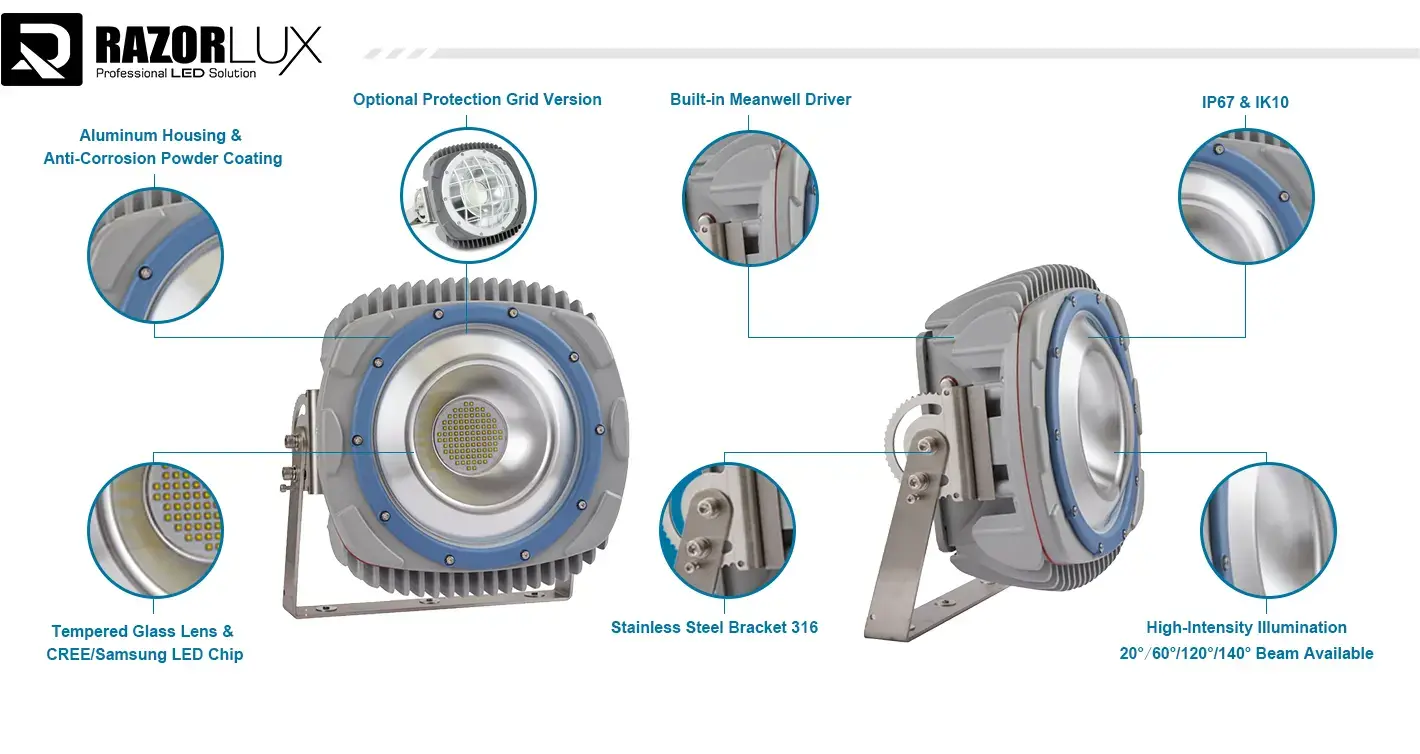
A real waterproof LED flood light has a number of important parts that work together. Based on IEC 60529.1, the IP rating system checks for protection against solids and liquids (IEEE, 2019)[1]. Our lights are certified IP67, which means they can withstand being completely sealed off from dust and being submerged in water for a short time up to a depth of one meter. Advanced closing methods use marine-grade silicone seals, precisely machined metal housings with powder coating, and tempered glass lenses that don't break when hit or exposed to UV light.
When working in wet conditions, the 12-volt operating voltage is clearly better. Unlike 120V or 240V systems, where touching wet metal can cause major shock risks, 12V systems are below the point at which skin resistance stops dangerous current flow. Because of this, they are very useful in places like factories, offshore platforms, and docks where workers are often in wet conditions.
Core Components That Ensure Reliability
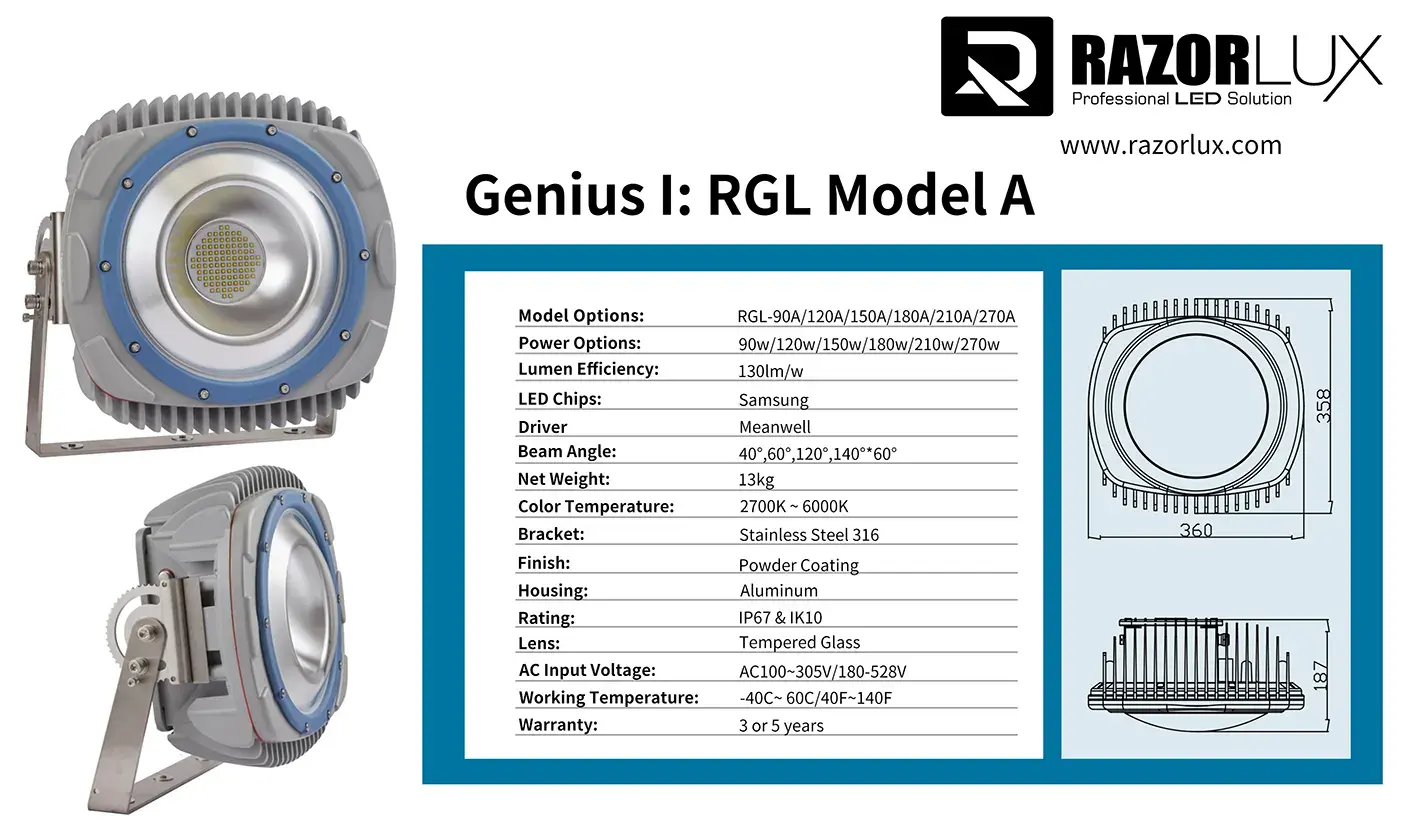
High-quality waterproof flood lights use high-end parts that have a direct effect on how long they last and how well they work. Mean Well power supplies are used in our RGL-90A type. These supplies are known throughout the industry for being strong and able to handle a wide range of input voltages (AC90-305V, DC127-431V). Because of this, the same fixture can work with different power systems without the need for extra adapters, which is a huge benefit for international OEM applications.
The brightness and color quality are controlled by the LED array itself. Our fixtures use high-quality LED chips with color rendering index (CRI) values above Ra75 to get 130LM/W of efficiency. Compared to metal halide or halogen bulbs, these are much more efficient, which means they use a lot less energy. This cuts costs by up to 70% while still providing better lighting.
Engineering for Extreme Environments
Standard lights can't handle the problems that come up in marine and industrial settings. Changes in temperature cause thermal stress, and mechanical vibrations loosen most bolts. Salt spray speeds up rust. Our engineering method takes each factor into account in a planned way.
Even when exposed to saltwater, the stainless steel fastening plate doesn't rust. The aluminum housing has optimized fin designs that get rid of heat as quickly as possible, keeping junction temperatures well below the critical levels. Thermal management has a direct effect on the lifespan of LEDs. For example, U.S. Department of Energy research from 2021 shows that proper heat control extends working life beyond 50,000 hours, lowering the need for replacement and upkeep costs [2].
The same amount of care is paid to impact resistance. The IK10 rating means that the fixture can withstand 20 joules of impact energy, which is the same as dropping a 5 kg object from 40 cm. This durability is very important on working boats, construction sites, and industrial buildings where things are often hit by mistake.
Key Technical Specifications and Features for OEM Integration
OEM integrators need detailed technical specifications to make sure that systems work together without any problems. As part of the decision process, a number of factors are compared to the needs and limits of the application.
Critical Performance Parameters
Task visibility and coverage area are directly affected by the amount of light and how it is spread out. Our 12V LED flood lights waterproof and come with a range of beam angles, including 15°, 20°, 30°, 40°, 60°, 120°, and 140°×60°. Narrow beams (15° to 30°) focus light for long-range projection, which is great for security around perimeters or helping people find their way. Wide beams (120° to 140°) cover a large area for lighting work areas and decks.
The table below shows how the following key specifications compare for common uses:
| Parameter | Marine Deck Lighting | Offshore Platform | Industrial Facility | Mobile Equipment |
|---|---|---|---|---|
| Beam Angle | 60°-120° | 40°-60° | 120°-140° | 30°-60° |
| Mounting Height | 3-8 meters | 8-15 meters | 4-10 meters | 2-5 meters |
| Color Temperature | 5000-6000K | 4000-5000K | 4000-6000K | 5000-6500K |
| Vibration Resistance | Moderate | High | Low-Moderate | Very High |
| Salt Spray Exposure | Continuous | Continuous | Minimal | Variable |
Color temperature selection affects how comfortable workers are and how well they do their jobs. Cooler temperatures (5000–6500K) make you more alert and help you see details better, making them good for inspection jobs and guidance. Warmer temperatures (2700–4000K) make it easier on the eyes when they are exposed for long periods of time.
Electrical Compatibility and Control Options
Integration difficulty is based on voltage compatibility. Our multi-function design, which is trademarked, can take both AC (90–305V) and DC (127–431V) input without moving or changing the settings. This universal compatibility makes it easier for OEM manufacturers to keep track of their stock in markets around the world with different electrical standards.
Total harmonic distortion (THD) and power factor affect how well a system works as a whole. Power factor ≥0.98 and THD <10% are maintained by our lights, which meet utility standards and maximize the efficiency of energy conversion. A high power factor cuts down on wasted reactive power, which lowers costs and the need for electrical infrastructure (International Electrotechnical Commission, 2020)[3].
Installation Flexibility and Mounting Solutions
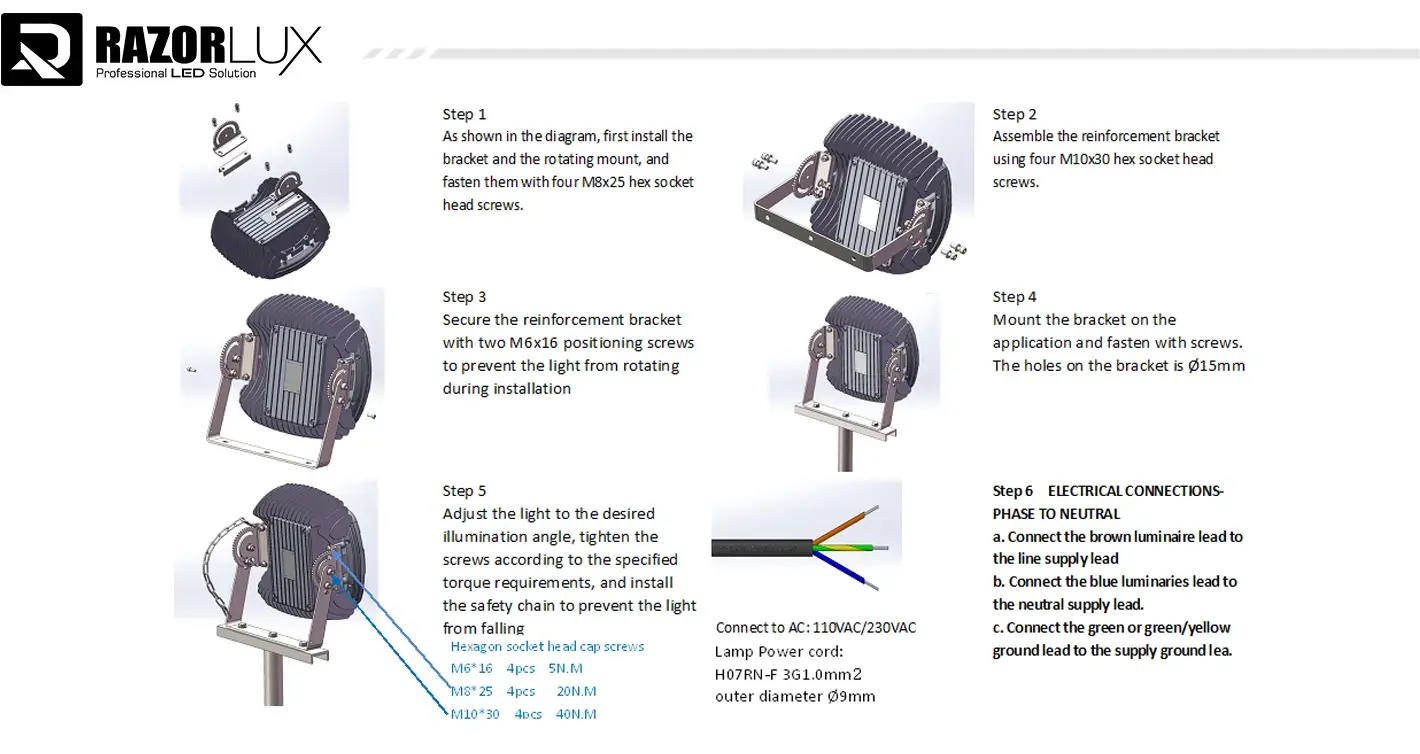
OEMs need a variety of mounting choices. Our stainless steel bracket system can be used for yoke mounting, surface mounting, and pole mounting. The design is flexible and lets you place it vertically 180° and rotate it horizontally 360°, which lets you aim the beam precisely while installing it.
Cable entry points have waterproof compression glands that can fit cables with sizes of 6 to 12 mm. The glands maintain IP67 integrity and can fit standard types of marine-grade cables. The most common point of failure in waterproof lighting setups can be avoided by choosing the right cables and terminating them correctly.
Comparing 12V LED Flood Lights Waterproof with Other Lighting Solutions
When making choices about what to buy, it helps to compare different products in a fair way. Knowing the pros and cons of various voltage levels, power sources, and quality levels can help you make the best choice for your needs.
12V vs. 24V LED Systems
Choosing the right voltage affects both safety and efficiency. Because batteries are becoming more common, the 12V standard is used most often in cars, boats, and phones. Most cars, boats, and portable electronics use 12V electrical systems, which makes integration easy because you don't have to change the power.
For safety reasons, smaller volts are better in wet places. When it's dry, the body's electrical resistance stops dangerous current flow below 30V. When it's wet, that resistance drops to about 15V. When compared to 24V options, the 12V system offers more safety (National Fire Protection Association, 2022)[4].
24V methods, on the other hand, are better for high-power uses. Higher voltage lowers the amount of current needed for the same amount of power, which lets smaller wire gauges be used for longer cable runs. When installing in a big building, this is an important thing to think about, but it's not as important when installing small OEM equipment because cable runs are still short.
Solar vs. Direct-Powered LED Solutions
Off-grid uses are appealing for solar-powered flood lights, but they have their own problems. Solar dependence means that performance changes depending on the weather, where you are, and the time of year when sunlight is available. Keeping batteries adds weight, bulk, and upkeep needs, as well as more places where things can go wrong.
With direct-powered 12V flood lights, you don't have to worry about these things. Power transmission that stays the same makes sure that lights work no matter the time of year or weather. For OEM uses that need reliable performance, like offshore platforms, working boats, and industrial facilities, direct-powered systems are the best choice.
Key differences can be seen in the following comparison:
| Feature | 12V Direct-Powered | Solar-Powered | 24V Direct-Powered | 120V AC Standard |
|---|---|---|---|---|
| Initial Cost | Moderate | High | Moderate | Low-Moderate |
| Installation Complexity | Low | Moderate | Low | High (electrical certification required) |
| Performance Consistency | Excellent | Variable | Excellent | Excellent |
| Safety in Wet Environments | Excellent | Excellent | Good | Poor |
| Maintenance Requirements | Low | Moderate-High | Low | Moderate |
| Energy Source Dependence | Grid/Battery | Sunlight | Grid/Battery | Grid |
Premium Quality vs. Economy Options
There are big changes in quality between expensive and economy floodlights, which can be seen in their prices. Economy lights usually have LED chips that aren't as good and don't work as well (80–100 LM/W vs. 130 LM/W), cheaper drivers that break down quickly, and poor heat management that speeds up wear and tear.
From 25 years of experience in manufacturing, we know that initial cost savings quickly go away when you add in the costs of repairs, maintenance labor, and downtime. The total cost of ownership is lower for high-end fixtures made with tried-and-true parts and strict quality control. This is especially true in situations where repair access needs scaffolds, vessels are being dry-docked, or production is stopping.
Procurement Guide: Where and How to Source Quality 12V LED Flood Lights Waterproof
When looking for industrial lighting, you need to look at more than just price when comparing suppliers. Quality makers set themselves apart by getting licenses, choosing the right parts, using different production methods, and being able to offer support.
Essential Certifications and Standards
International certifications show that safety and performance standards are being met. RMRS (Russian Maritime Register of Shipping), CE (European Conformity), RoHS (Restriction of Hazardous Substances), SAA (Standards Australia), C-Tick, UL (Underwriters Laboratories), DLC (DesignLights Consortium), CB (Certification Body Scheme), and ISO 9001 quality management certification are just some of the certifications that our fixtures have.
Not just pieces of paper, these certificates are the result of strict testing procedures and ongoing compliance tracking. For UL certification, which is recognized all over North America, factories must go through a lot of electrical safety tests and random inspections. RMRS certification specifically addresses problems that come up in the marine environment, such as vibration, corrosion, and electromagnetic compatibility needs that are important for installations on ships (American Bureau of Shipping, 2021).
Component Quality and Supply Chain Transparency
Reliable makers list the names of their parts instead of using general terms. Our fixtures clearly use Mean Well power supplies, which is an important feature to keep in mind since driver failure is the most common way for 12V LED flood lights waterproof to stop working. Mean Well has a reputation for being reliable because they use conservative design methods, test their products thoroughly, and backs up their warranties.
In the same way, the quality of the LED chips has a big effect on how consistently they work. Due to business deals, we can't name specific chip providers. However, our sourcing requirements require tier-one makers with clear quality control methods and the ability to track each batch. This care in choosing the parts gets rid of the performance variations and early failures that come with cheaper options.
Customization Capabilities and OEM Support
OEM applications often need customizations that go beyond what is available in catalogs. Our engineering team can change things like unique beam patterns, special mounting brackets, built-in control systems, and the color or finish of the housing. With these features, OEM makers can make their goods stand out while using our lighting knowledge and manufacturing infrastructure.
The process of customization starts with a professional meeting to find out what the application needs, what the working environment is like, and what the integration limits are. Before making a prototype, we give engineers detailed drawings and specifications to look over. Customers try sample units to make sure they work well before production scales up.
Evaluating Supplier Reliability
Supplier evaluation includes more than just product specs. It also looks at things like manufacturing capacity, quality systems, and long-term stability. Some key signs are:
- History and skills in manufacturing: Razorlux was formed in 1998 as Xi'an Zhihai Power Technology Co., Ltd., and has over 25 years of experience in marine and industrial LED lights. This long-term success shows that the market accepts it and that it has technical know-how that newcomers can't match.
- Portfolio of patents: Our more than 200 patents cover LED packaging, power control, and structural design. They show real engineering innovation, not just putting together products. Getting a patent requires a lot of money to be spent on research and development, and it shows that you are committed to making technology better.
- Production capacity and inventory management: To meet shipping dates without sacrificing quality, large OEM orders need production capacity. Our GMP-certified factory and well-established inventory systems make sure that even large orders are delivered on time, which is very important when production schedules depend on parts being available.
- Quality management systems: Our ISO 9001 certification, which we've had for 22 years, sets up systematic quality control methods that are used at every stage of the industrial process. Before it is shipped, every fixture goes through a lot of tests, such as temperature cycling, shock strength, and waterproof validation.
Why 12V LED Flood Lights Waterproof Are the Preferred Choice for OEM Systems
Low-voltage waterproof lighting is the best choice for tough OEM uses because it meets safety standards, performance requirements, and operating limits. This demand exists in the marine, industrial, and heavy-duty areas for a number of reasons.
Superior Safety Profile in Hazardous Environments
In wet manufacturing settings, electrical safety is the most important thing to think about. When insulation fails or connections corrode, which happens a lot in marine and industrial settings, traditional line-voltage systems (120V–240V) pose a deadly shock risk. The 12V working voltage gets rid of this risk by using basic physics instead of depending only on the integrity of the insulation.
This safety benefit also applies to the steps used for installation and upkeep. When compared to working on systems with line voltage, 12V systems have less strict safety rules that technicians must follow. This simplification speeds up troubleshooting, lowers insurance rates in some places, and lowers the number of certifications needed for maintenance staff.
Operational Efficiency and Cost Reduction
The energy economy has a direct effect on practical economics, especially in places where lights are on all the time or almost all the time. Our 130 LM/W efficacy is much higher than that of older technologies. For example, metal halide fixtures only get 60–90 LM/W, while halogen floods only get 15–25 LM/W. This difference in efficiency leads to proportional drops in energy costs.
Here are the main economic benefits that make buying managers want to buy our waterproof LED technology:
Dramatic energy savings: the 90W rated power replaces 150–250W HID versions and provides better lighting. This gap saves between 3,000 and 8,000 kWh per fixture over its 50,000-hour life, which is about $300 to $800 at industrial energy prices.
Longer periods between replacements: fixtures placed today will probably last longer than the tools they light up, with a lifespan of 50,000 hours or more. Because it lasts so long, it gets rid of the need for regular purchases, inventory management, and installation work that comes with regular lighting.
Less maintenance is needed because the sealed construction and high-quality parts make failures less likely than with lights that need to be re-lamped, having ballasts replaced, or having seal maintenance done regularly. When it comes to offshore platforms, ships, or factories that need special tools or production to be stopped in order to do maintenance, this reliability saves a lot of money.
Compatibility with green energy: The DC voltage compatibility lets solar cells and battery storage systems be connected directly, without having to go through a lossy AC/DC exchange. This feature is useful for sites that are far away, backup systems in case of a disaster, and efforts to be more environmentally friendly.
Over time, these operational benefits add up, turning what seems like a higher initial cost into a better total cost of ownership. More and more, people who work in procurement are aware that making decisions about specifications based only on the price of purchase consistently undervalues dependability and lifecycle costs.
Enhanced Product Value for OEM Manufacturers
OEM manufacturers compete by making their products stand out and improving how good they are thought to be. The quality of the lighting system has a direct effect on how customers feel about the brand. Poor lighting can cause eye strain and accidents, and early breakdowns can lead to warranty claims and damage the brand's image.
Adding high-quality, waterproof LED flood lights improves the placement of the product in a number of ways. The wide range of certifications (RMRS, CE, UL, etc.) makes it easier to get into regulated businesses and foreign markets. Customers want proof that products meet safety and environmental standards more and more. Our full certification package meets these needs without charging OEM manufacturers extra for testing.
The strong construction and track record of dependability lower the warranty exposure. Our 5-year warranty on LED modules and drivers shows that we have full faith in the quality of the parts and the way they are made. This policy protects OEM makers from damage to their image and the money they could lose if their lighting systems fail.
Customization Flexibility for Diverse Applications
OEM uses include a huge range of things, from lighting on the decks of fishing boats to high cranes in steel mills, and from security systems for ports to work lights on mine equipment. Because of this, personalization is needed beyond just choosing from a collection.
OEM manufacturers and our engineering team work together to make sure that lighting solutions are the best they can be for each application. Choosing the right beam angle changes the way light covers and reduces glare. Color temperature affects how aware workers are and how well they can tell colors apart. Different mounting configurations are used to work with limited space and different aiming needs. Dimming, remote switching, and emergency backup modes are all possible with control integration.
The unique multi-function design can handle these differences while keeping the core's dependability. Because it can handle a wide range of voltages (AC90-305V, DC127-431V), it doesn't need different models for different markets or uses. Beam angles ranging from 15° for a narrow spot to 140° to 60° for a wide flood meet almost all covering needs. With choices between 2700K and 6500K, color temperatures can be optimized for different tasks and user preferences.
With its ability to customize products and large production capacity, Razorlux is more of a strategic partner than just a seller of parts. OEM manufacturers can use specialized engineering knowledge and production infrastructure that is already in place, so they don't have to spend money developing lighting technology.
Real-World Applications Demonstrating Proven Performance
Real-world application experience verifies requirements and shows how things work in the real world. Our fixtures work in tough conditions in a variety of industries, showing that they are reliable in situations that make normal lighting difficult.
Marine Vessel Integration
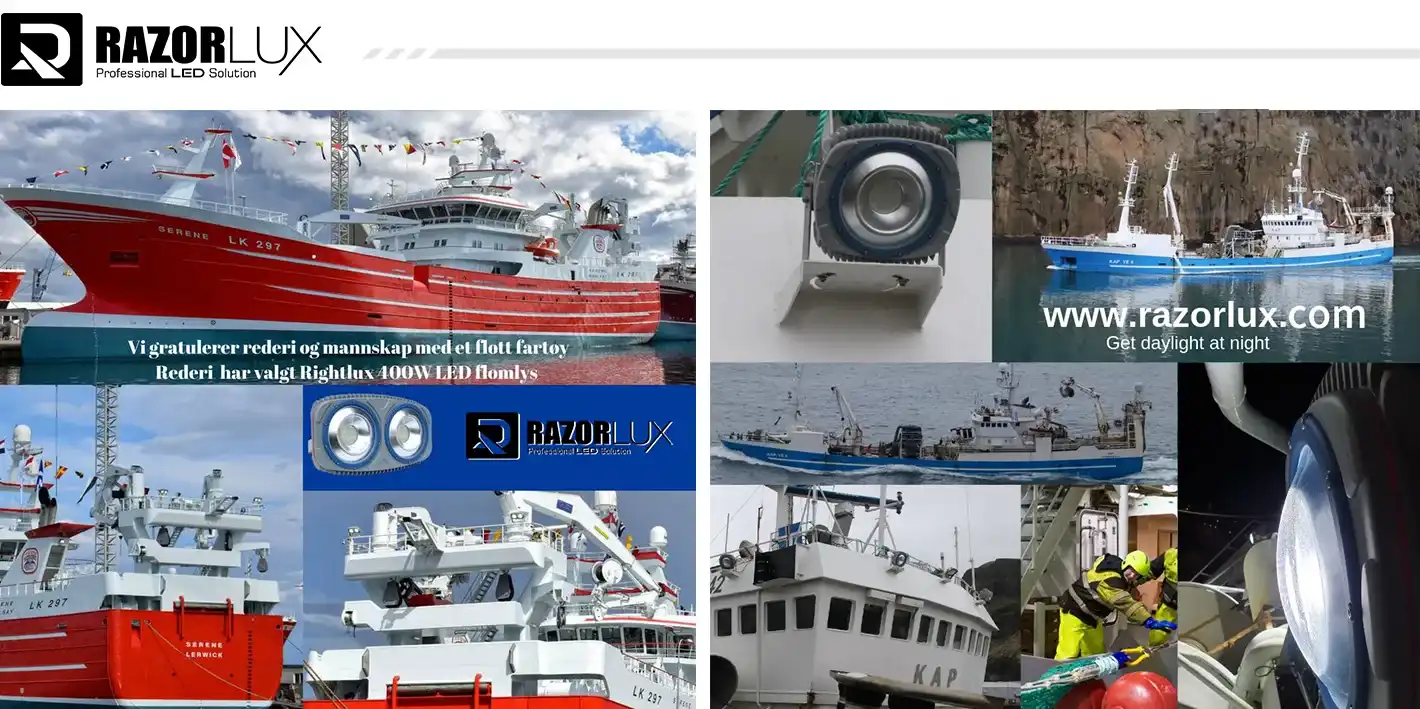
Some of the hardest lighting conditions are found on commercial fishing boats that work in the North Atlantic. In these uses, saltwater spray, bad weather, constant vibration, and long duty cycles are all combined. Our fixtures that were put on Norwegian fishing fleets have shown that they work reliably through multiple seasons, keeping their good lighting even though they are constantly exposed to saltwater and mechanical stress.
The ability to work with DC power is especially useful in naval settings. Most ships' electrical systems run on 12V or 24V DC from battery banks that are charged by alternators that are powered by the engine. Connecting directly to the ship's power gets rid of the loss of efficiency and failure points that come with the DC-AC inverters that are needed for regular lighting.
Offshore Platform Work Lighting
Lighting on oil and gas platforms needs to be able to resist hurricane-force winds, constant salt spray, and wide ranges of temperatures while still providing steady light for activities that are very important for safety. Our fixtures have been used a lot on platforms in the Middle East and the North Sea. Installations that have been going on for years show that they will last for more than 50,000 hours.
The large input voltage range can handle the changes in power quality that happen when platform generators are used in situations with changing loads. The strong construction can handle the mechanical stress that comes from wind loading and vibration, and the finish won't rust, even after being exposed to salt water for a long time.
Industrial Facility Applications
Heavy industrial settings have their own problems, such as the buildup of dust, the exposure to chemicals, the extremes of temperature, and the risk of mechanical impact. Heavy industrial buildings like steel mills, paper mills, and big warehouses have used our waterproof flood lights in places where other lights failed too soon.
The IP67 rating stops dust and water from getting in, which is what usually breaks down LEDs and drivers in dusty industrial settings. The IK10 impact resistance can handle accidental contact from dropped items and tools used for moving things around. These safety features make fixtures last longer and require less downtime for upkeep in 24 hours a day, seven days a week production.
Conclusion
It is measurable that choosing 12V LED flood lights waterproof for OEM systems improves safety, performance, and lifecycle costs. Low-voltage operation is naturally safe, which protects people working in wet areas and makes installation easier. Mean Well drivers and high-efficiency LED chips are some of the high-quality parts that make sure the light works reliably even when the conditions are harsh. International certifications that cover a lot of areas make it easier to get into markets and follow the rules in many different types of industries and places. The 130 LM/W efficiency and lifespan of more than 50,000 hours save a lot of money over time, which covers the initial cost. Long-term supply relationships are built on our 25 years of manufacturing knowledge, 200+ patents, and ISO 9001-certified quality processes. These fixtures provide the dependability and performance that set premium OEM goods apart from generic options, whether they are used to add lighting to ships, offshore platforms, industrial equipment, or mobile machinery.
FAQ
1. Can 12V waterproof LED flood lights operate directly from vehicle batteries?
Yes, our fixtures can handle DC inputs from 127V to 431V, which is the range of voltages that are common in vehicle charging systems. The wide voltage tolerance can handle systems with 12V or 24V nominal voltage without having to change the configuration. When installing a vehicle, the circuit should be properly protected, and voltage drop estimates should be done for wire runs longer than 3 meters.
2. What distinguishes an IP67 rating from lower IP ratings?
If something is certified IP67, it means that it can withstand dust entry (first digit 6) and water exposure up to 1 meter deep for 30 minutes (second digit 7). Lower ratings, like IP65, can handle water jets but not immersion. Marine uses, settings that are washed down, and outdoor sites that are likely to flood need at least IP67 protection to work reliably for a long time.
3. How does color temperature selection affect application performance?
Color temperature has a big effect on how well users can see and how comfortable they are. Cooler temperatures (5000–6500K) make it easier to see contrast and details, which makes them great for inspection tasks and navigation. Warmer temperatures (2700–4000K) make it easier on the eyes when they are exposed for a long time. Our fixtures come in a range of 2700K to 6500K so that you can make the best choice for your needs and preferences.
Partner with a Trusted 12V LED Flood Lights, Waterproof Manufacturer
Razorlux offers high-quality waterproof LED lighting options and has been making these products for over 25 years. We have many international certifications, such as RMRS, UL, CE, and SAA, which make us a top supplier of 12V LED flood lights and waterproof lighting. This way, you can be sure that your OEM goods meet all global safety standards. During the procurement process, our engineering team helps with customization, provides detailed technical documentation, and communicates quickly. Shipyard managers, marine equipment integrators, and industrial procurement professionals are welcome to try the difference in quality for themselves. Email our team at sam@razorlux.com to talk about your specific application needs, get technical specifications, or set up a sample evaluation. Razorlux is trusted by top makers in the maritime, offshore, and industrial sectors for mission-critical lighting uses.
References
1. Institute of Electrical and Electronics Engineers (IEEE). (2019). IP Rating Standards and Testing Protocols for Electrical Enclosures. IEEE Standards Association. Retrieved from https://standards.ieee.org/standard/60529-2019.html
2. U.S. Department of Energy. (2021). LED Lighting Facts: Thermal Management and Lifespan Considerations. Office of Energy Efficiency & Renewable Energy. Retrieved from https://www.energy.gov/eere/ssl/led-lighting-facts
3. International Electrotechnical Commission (IEC). (2020). Power Quality Standards for LED Lighting Systems. IEC Technical Committee 77A. Retrieved from https://www.iec.ch/homepage
4. National Fire Protection Association (NFPA). (2022). NFPA 70: National Electrical Code - Low Voltage System Safety Requirements. NFPA Publications. Retrieved from https://www.nfpa.org/codes-and-standards/all-codes-and-standards/list-of-codes-and-standards/detail?code=70
5. American Bureau of Shipping (ABS). (2021). Guide for LED Lighting Systems for Marine and Offshore Applications. ABS Technical Publications. Retrieved from https://www.eagle.org/publications
5. Illuminating Engineering Society (IES). (2020). IES LM-80-20: Measuring Luminous Flux and Color Maintenance of LED Packages, Arrays and Modules. IES Technical Memoranda. Retrieved from https://www.ies.org/standards/