


_1750326878398.png)

Why Choose the Most Powerful Flood Light for OEM Projects?
Choosing the Most Powerful Flood Light for OEM projects fundamentally transforms operational reliability in demanding industrial environments. When shipyards in Norway face brutal Arctic winters, or offshore platforms in Qatar endure relentless heat and salt spray, standard lighting solutions fail within months. High-performance LED flood lights engineered with 156,000-lumen outputs and IP67-rated enclosures solve the critical problems OEM buyers face daily: premature equipment failure, costly maintenance cycles, and insufficient illumination that compromises worker safety and project timelines.
Key Criteria for Choosing the Most Powerful Flood Light
Luminous Performance and Beam Distribution
Choosing the right beam angles changes how well lighting works. For high-mast applications, a 15° narrow beam focuses the Most Powerful Flood Light to illuminate ship hulls from 40 meters away. For warehouse interiors that need even coverage, a 120° wide-angle distribution is best. Razorlux's unique multi-function design has seven beam configurations: 15°, 20°, 30°, 40°, 60°, 120°, and 140°x60°. This makes it easy to match the beam exactly to the needs of the application without having to worry about keeping extras on hand.
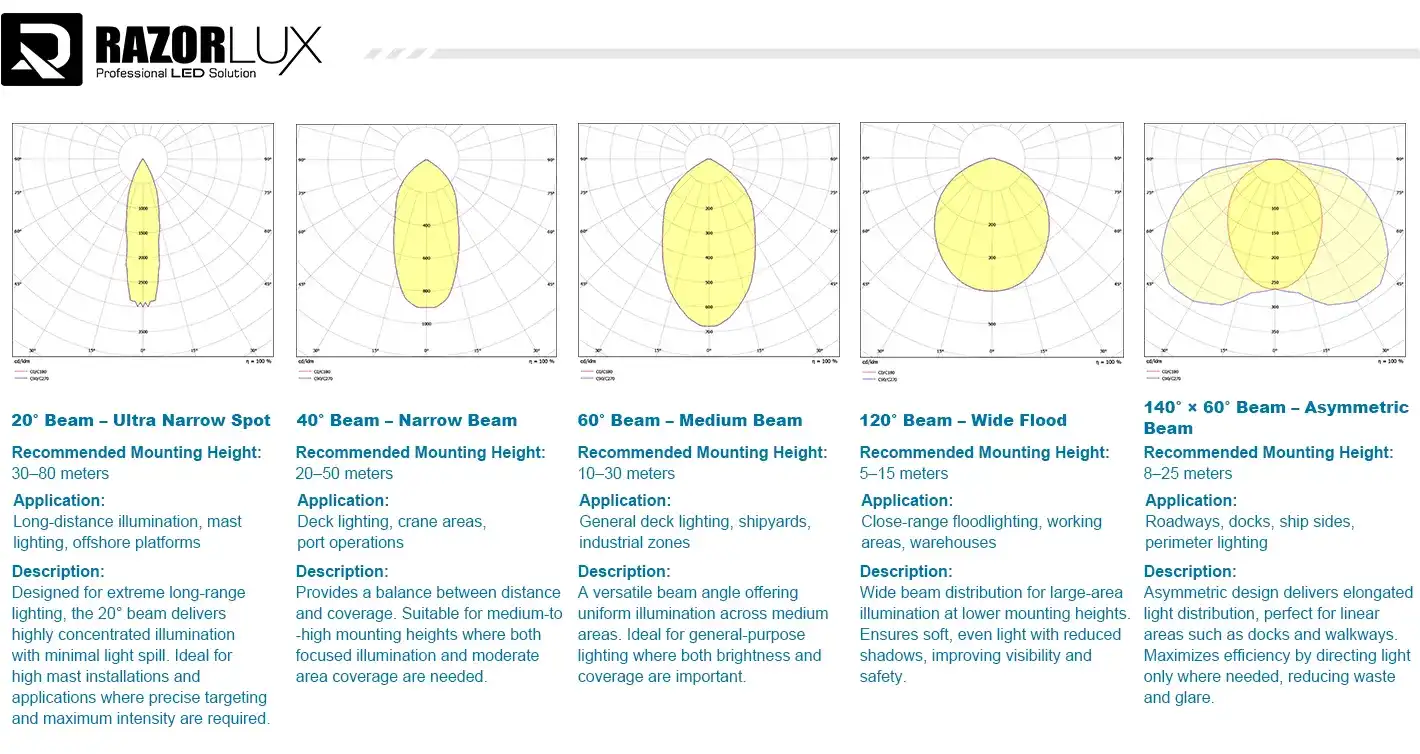
Specifications for lumen power need to be carefully interpreted. A lot of the time, marketing claims use initial lumens instead of maintained lumens after the material has been heated and cooled. Professional-grade units use advanced thermal management, like cold-forged heat sinks and phase-change cooling, to keep output constant over the life of the unit.
Environmental Protection and Material Engineering
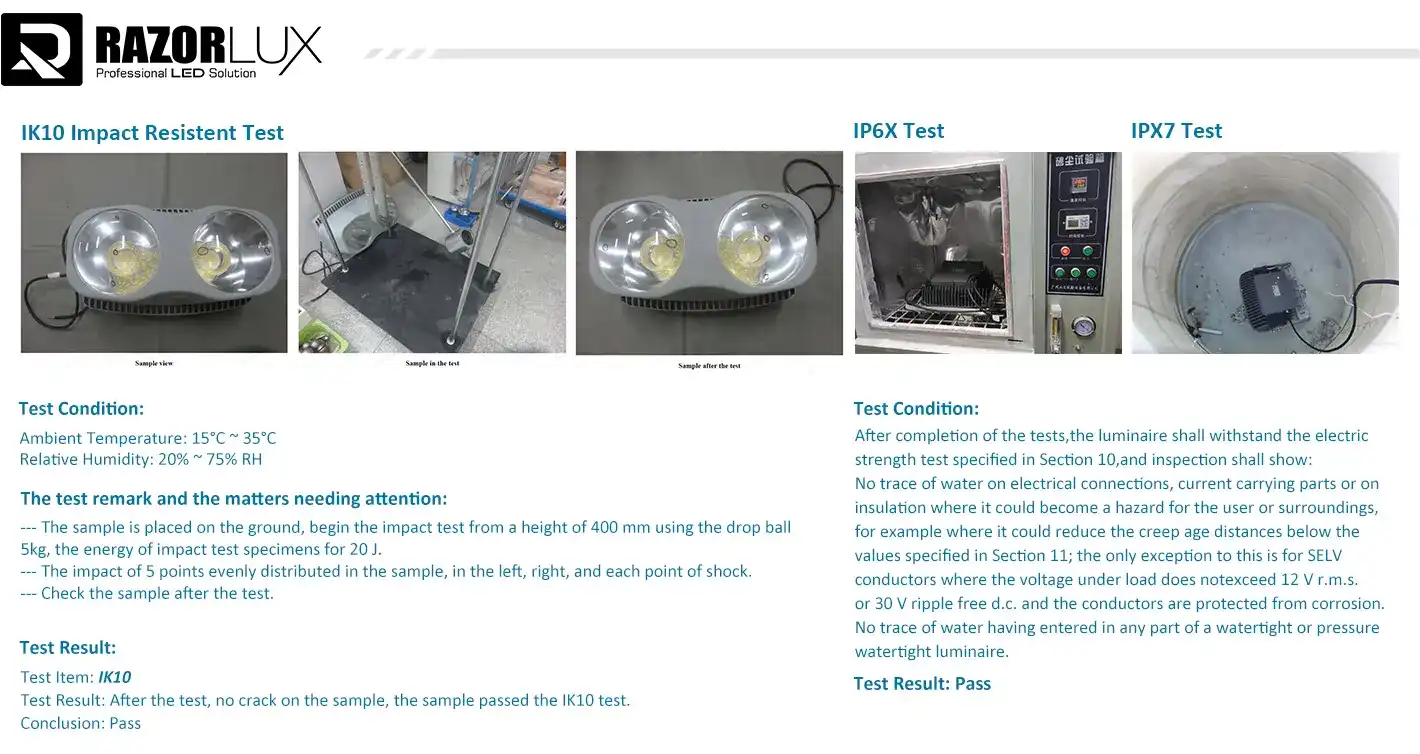
The IP rating system describes how well something keeps solids and liquids from getting in. IP65 approval means that the seal is dust-tight and protects against water jets, making it ideal for most outdoor uses. IP67 certification adds resistance to water immersion up to one meter deep for 30 minutes. This is very important for marine sites that are at deck level, where waves can occur.
Corrosion resistance depends on the choice of material. According to ASTM B117 testing standards, marine-grade powder coating on aluminum alloy housings keeps salt spray corrosion at bay. When installed on steel structures, stainless steel mounting brackets stop galvanic corrosion. This gets rid of a common place where things break in coastal areas.
| Performance Metric | Standard Requirement | Premium Specification |
|---|---|---|
| Luminous Efficacy | 100-120 lm/W | 130-160 lm/W |
| Operating Temperature Range | -20°C to 40°C | -40°C to 60°C |
| LED Lifespan (L70) | 30,000 hours | 50,000+ hours |
| Impact Resistance | IK08 | IK10 |
| Corrosion Resistance | 500-hour salt spray | 1,000+ hour salt spray |
Power Supply Flexibility and Smart Integration
Electrical infrastructure at industrial places around the world is very different. A flood light that can only accept a certain range of power makes placement harder. Wide-range power supplies that accept AC90-305V and DC127-431V can handle voltage changes that happen on offshore sites that are driven by generators and let the ship's electrical systems connect directly to them, meeting all international standards.
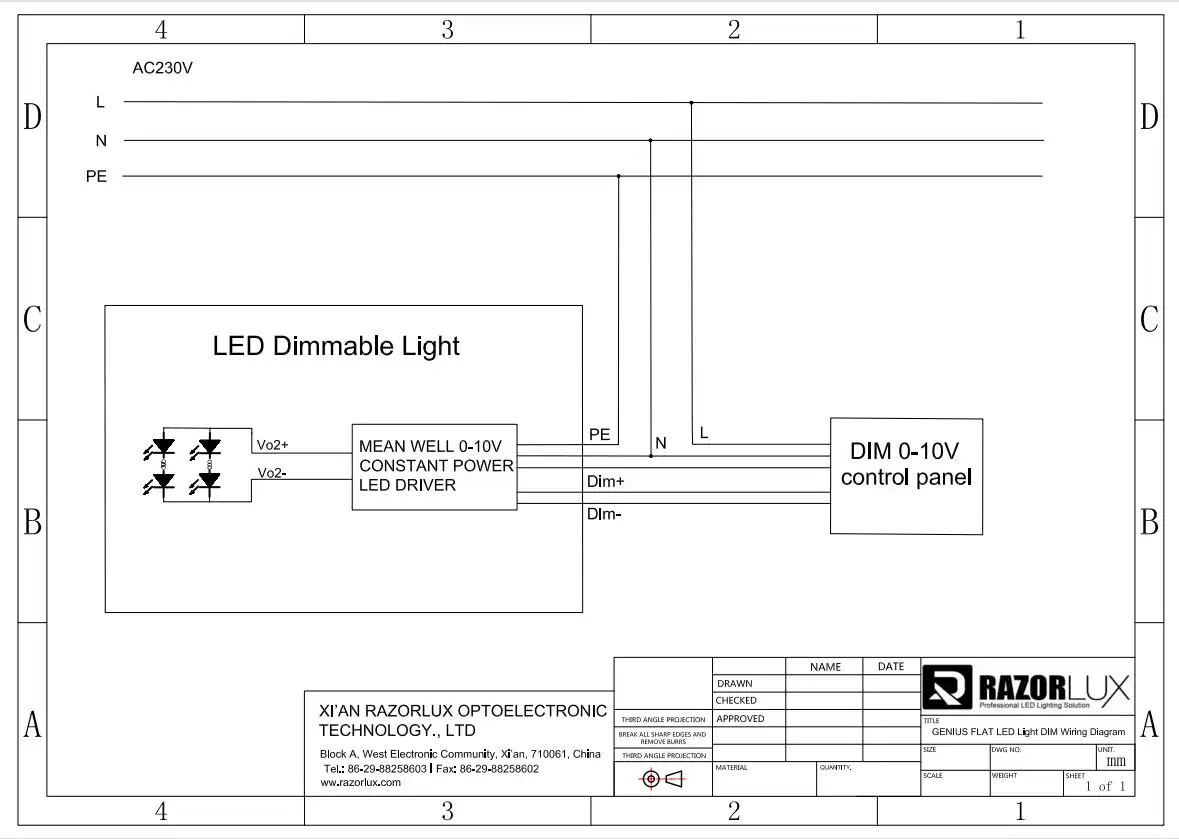
Smart lighting features are becoming more and more important in buying decisions. Large facilities can be managed from one place because it works with 1-10V dimming protocols, DALI control systems, and LoRaWAN wireless networks. Motion monitors save energy in areas that aren't used very often while still being able to turn on instantly when activity happens. This is especially useful for security apps that watch over port perimeters or shipyard entry points.
Comparative Analysis: Powerful Flood Lights vs Regular and Other Lighting Solutions
Performance Benchmarks Against Standard Equipment
Metal halide lights that use 400W make about 36,000 lumens at first, but that drops to 25,000 lumens after 8,000 hours while using 455W, which includes ballast losses. A similar LED system gives off 52,000 lumens at 400W and doesn't lose much brightness over 50,000 hours. When you add up the advantages over dozens or hundreds of fixtures, the math becomes too strong to ignore.
Spotlights and floodlights look a lot alike, but they are used for very different things. With a 30° spot, light is focused on a small area. This can help draw attention to certain work areas or architectural features. Flood lights that are spread out between 90° and 120° make coverage patterns that overlap and get rid of shadows over large operational areas. Shipyards that load cargo containers at night need flood lighting, and lighting could be used to show how cranes are working or where navigational marks are.
Real-World Application Comparison
Philips, Osram, and Cree are just a few of the well-known companies that make high-quality industrial lighting solutions. Philips works on smart connectivity features, Osram on reliability for car use, and Cree on raw lumen-per-watt economy. Razorlux stands out by using application-specific engineering to make products that are made to withstand the harsh conditions of maritime and heavy industrial settings from the start, rather than commercial fixtures that have been changed to fit.
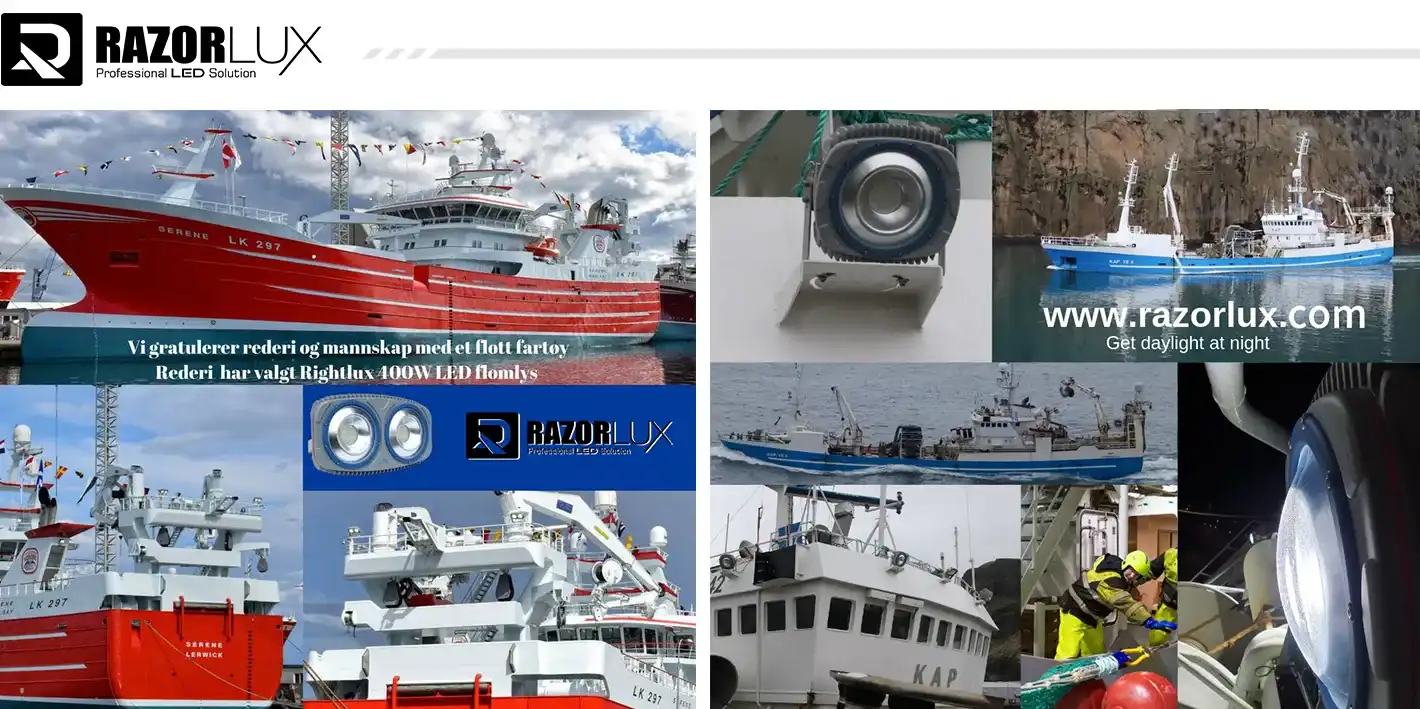
A Norwegian shipbuilder just recently made a video about how they switched from 1000W HPS (High-Pressure Sodium) lighting to 600W LED flood lights. Even though the power was cut by 40%, the measured illumination went up by 60%, and over 18 months, repair work went from being done every three months to not being done at all. The project paid for itself in 2.3 years because it saved money on energy and maintenance costs (Floodlight Technology Review, 2022).
Certification and Component Quality Differences
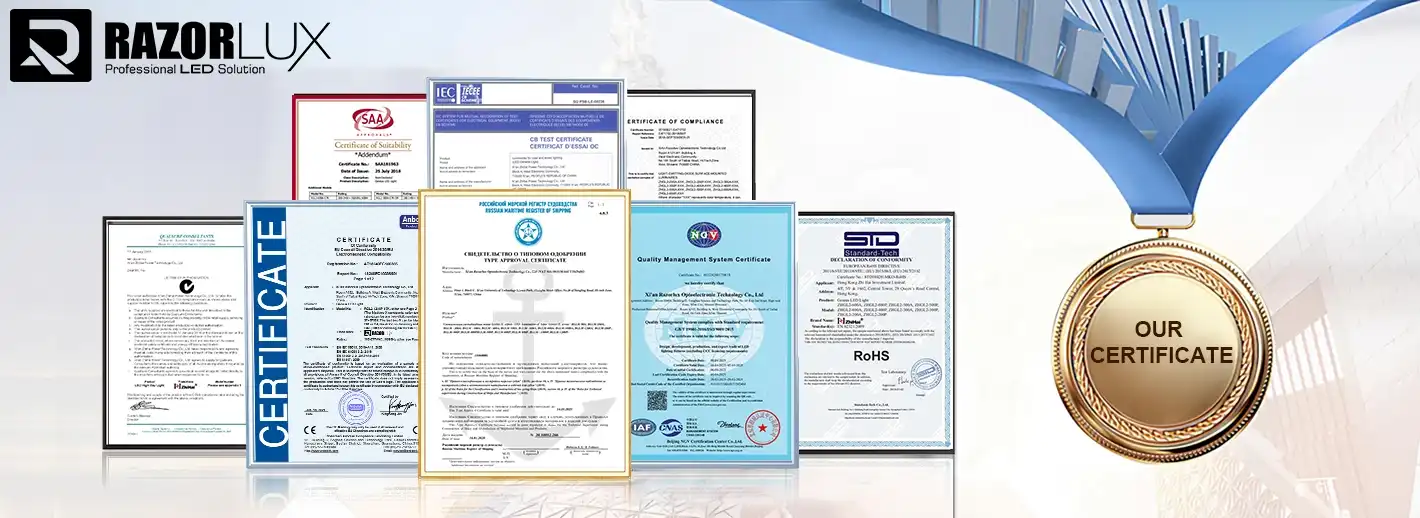
It's not true that all certifications are equal. If something has a CE mark, it means it meets European standards, but the level of strictness depends on which body issued the mark. To get UL and DLC listings from North American safety groups, products must go through a lot of testing and plant checks. For marine classification approvals from DNV-GL, ABS, or Lloyd's Register, the highest standards must be met. These fittings must be able to withstand conditions that would destroy equipment that only meets basic CE requirements.
Where a component comes from has a direct effect on its durability. When it comes to maintaining lumens and junction temperature stability, Samsung and Philips LED chips made in Korea always do better than generic alternatives. Meanwell power supplies from Taiwan are the most reliable drivers on the market, with failure rates of less than 0.2% per year. If you list these parts by name in your purchase papers, you'll get tested technology instead of cheaper alternatives.
Procurement Guide for OEM Clients: Buying the Most Powerful Flood Light
Supplier Evaluation and Qualification Process
Established makers show their skills by having the right certifications, output capacity, and expert support systems in place. Getting ISO 9001 quality management certification means that processes are controlled in a planned way, but make sure that the certification covers more than just sales. Companies with national research titles, like Razorlux's Xi'an Most Powerful Flood Light Engineering Laboratory, which is approved by China's National Development and Reform Commission, have research and development skills that go beyond those of most makers (Razorlux, 2024), the company says.
How reliable deliveries are is affected by how much can be made. When demand goes up, a manufacturer with dedicated production lines can keep up a steady output, but companies that outsource assembly risk weakening their supply chains. Ask detailed questions, like, "What percentage of parts are made in-house?" In general, how long does it take to get 500 units? Can you give me the names of people in the same line of work?
Pricing Structure and Total Value Assessment
Prices that are quoted don't always tell the whole story. Ask for specific details that include the cost of the fixtures, the shipping terms (FOB, CIF, DDP), and any charges for customization. International shipping from China to Nordic countries via sea freight usually takes 35-45 days at the most economical rates, while air freight lowers travel to 7-10 days with corresponding cost increases (Razorlux Shipping Guide, 2024).
There's more to look at in warranty terms than just how long they last. It doesn't mean much to have a five-year warranty if the terms of coverage aren't clear and the claim process is slow. Check to see if the warranty covers a full replacement, just repair parts, or credit for a portion of the cost. Manufacturers who offer full technical support, such as help with installation, advice on lighting design, and quick responses to problems in the field, are worth a small price boost over sellers who aren't well known.
| Supplier Capability | Minimum Standard | Preferred Qualification |
|---|---|---|
| Production Capacity | 5,000 units/month | 10,000+ units/month |
| Certification Portfolio | CE, RoHS | UL, DLC, DNV-GL, ABS, CE, RoHS |
| R&D Team Size | 5 engineers | 10+ engineers with advanced degrees |
| Quality Control System | ISO 9001 | ISO 9001 + industry-specific audits |
| Lead Time (500 units) | 6-8 weeks | 4-6 weeks |
| Technical Support | Email response within 48 hours | Dedicated account manager, 24-hour response |
Customization Options and OEM Services
Catalog products that are already made to work well in many situations, but in harsh conditions, they often need to be changed. Generic flood lights can be turned into project-specific solutions by adjusting the beam angle, making custom mounting brackets, setting up specific voltages, or adding control systems. Manufacturers who have their own tech staff can make these changes quickly and easily, but manufacturers who have to rely on outside partners have to deal with delays and communication problems.
When you're adding lighting to larger equipment packages or making sure that the brand is consistent across all systems that are supplied, private labeling and branding services are important. Check to see if the manufacturer allows custom Packaging, co-branding of user guides, and product identification plates with your company's information. With these services, you'll be seen as a full-service solution provider instead of just a marketer.
Sample Testing and Validation Protocol
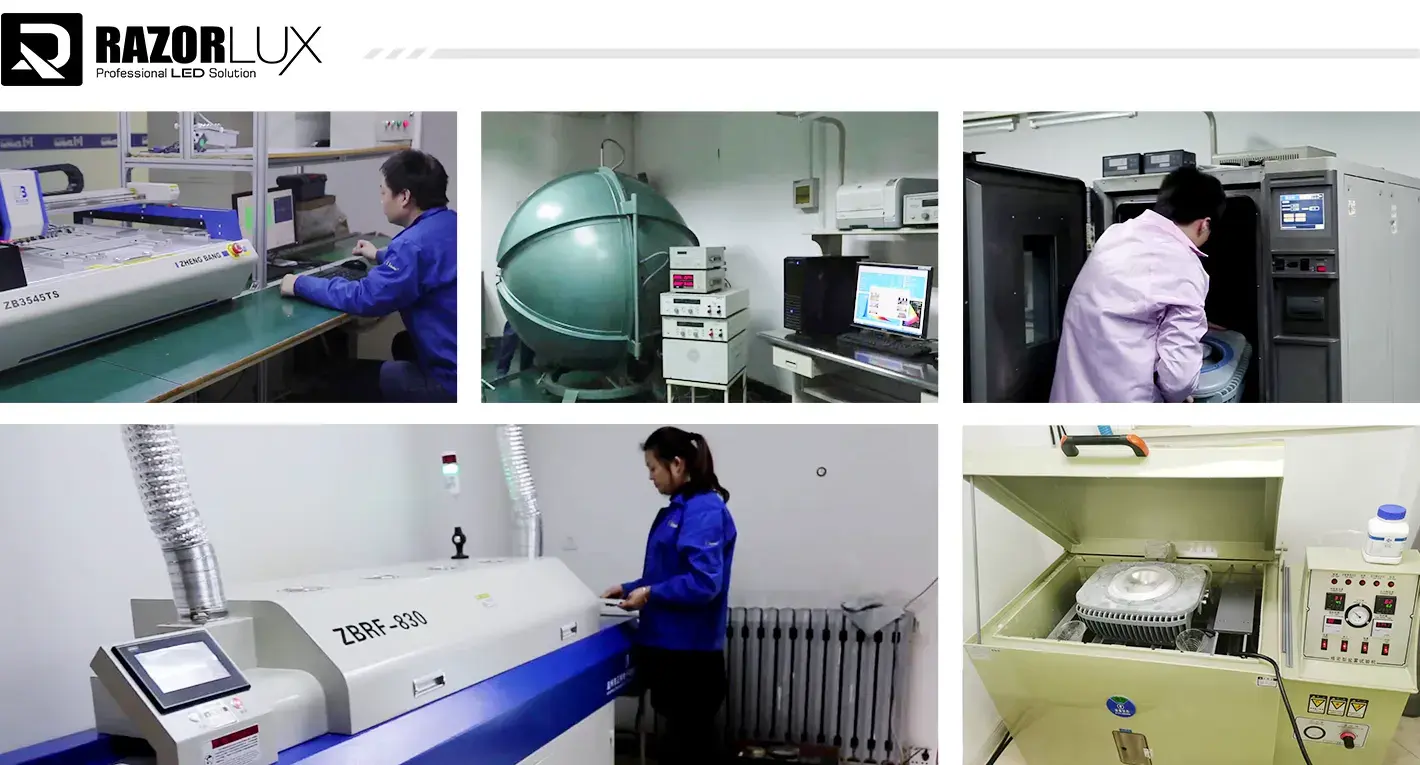
Never agree to buy a lot of something without first testing it out. Ask for samples to test; reputable companies will give you test units for free or as credit for future orders. Your technical team should do practical tests, like measuring the actual lumen output with properly calibrated tools, making sure the beam patterns are correct, checking that the dimming works, and checking the quality of the construction.
When you can, put samples through environmental stress tests. IP67 claims are backed up by a 24-hour submersion test. By switching between very high and very low temperatures, possible seal problems can be found. Vibration testing is like installing big machinery or a ship. Systematically record results to back up the case for buying something and set performance standards for future quality control.
Future Trends and Energy Efficiency of Powerful Flood Lights
LED Technology Evolution and Efficiency Gains
The brightness of LEDs keeps getting better and better. Commercial products that can reach 200 lm/W are moving from being lab prototypes to being mass-produced. Because of this progress, floodlights that give off the same amount of light as 1000W bulbs today will only need 650W in three years, while keeping or even improving the color quality and lifespan.
These energy gains are made possible by new ideas in thermal control. Graphene-enhanced thermal interface materials, vapor chamber heat spreaders, and actively cooled designs (which are less popular because they are less reliable) all improve efficiency. Knowing about these technologies helps you choose equipment that will stay competitive over its entire useful life, instead of becoming useless during its warranty period.
Smart Lighting Integration and IoT Connectivity
With wireless mesh networks, lighting facilities can be turned into smart systems. Fixtures send information about their operating state, energy use, and main floodlights to platforms for central control. This makes it possible to do predictive maintenance, like changing drivers before they break instead of waiting for power cuts to happen. It also makes the best use of energy by dimming lights based on occupancy and collecting sunlight.
Integration of security adds another layer. Modern flood lights come with IP cameras, motion sensors, and two-way audio communication. These pole-mounted installations combine a number of security functions into a single unit. This merger lowers the cost of equipment while making coverage better and the system more reliable.
Sustainability and Regulatory Compliance
Environmental laws require lighting that uses less energy more and more. Title 24 in California, directives from the European Union, and other similar systems around the world set minimum requirements for effectiveness and limits on dangerous materials. Choosing goods with full approvals (RoHS, REACH, DLC) makes sure they meet current and future rules, which keeps your projects from needing expensive fixes.
The environmental impact of a lifecycle goes beyond the amount of energy used. The long life, recyclable aluminum structure, and mercury-free LED technology all help cut down on trash and disposal costs. More and more, corporate sustainability reports include information about scope 2 emissions from bought electricity. Lighting that is more energy-efficient directly improves these metrics while lowering operational costs.
Adaptive Optics and Programmable Beam Control
New optical technologies make it possible to shape a beam dynamically without having to make any mechanical changes. Electronically controlled lens arrays let you change the focus and distribution patterns from a distance. This means that software configuration can make a single type of fixture work for more than one purpose. This versatility makes keeping track of inventory easier while also making lighting work best for certain tasks or operating modes.
Changing the color temperature adds another level of personalization. Tunable white flood lights can change from warm (2700K) to cool (6500K) color temperatures to meet the needs of different applications. For environmental compliance, warmer temperatures lower blue light pollution, while cooler temperatures improve eye clarity for fine work.
Conclusion
Choosing high-performance industrial Most Powerful Flood Lights is an investment in the safety, dependability, and long-term cost-effectiveness of operations. Strong construction that meets IP67 and IK10 standards, high lumen output (above 130 lm/W), and tested parts from Samsung and Meanwell make for lighting infrastructure that can handle the roughest maritime and industrial settings. OEM clients get fewer maintenance tasks, safer working conditions, and much lower energy costs compared to older lighting technologies. Full certifications like UL, CE, DNV-GL, and ABS show that a product meets international standards and give buyers the proof they need for complicated buying processes. Procurement managers find lighting solutions that improve project results and support operating excellence over long service lives by putting performance, reliability, and total cost of ownership ahead of the initial purchase price.
FAQ
1. What lumen output qualifies as a "most powerful" flood light for industrial applications?
Depending on the job, industrial-grade floodlights usually have between 50,000 and 200,000 lumens. Fixtures with 100,000 lumens or more are often used in shipyards and ports to light up large areas from high mounting positions. The highest level of performance, the 1200W Razorlux type with 156,000 lumens, is best for the toughest settings. Instead of just increasing output, lumen needs should be figured out by taking into account the mounting height, coverage area, and industry-standard amounts of illumination.
2. Can high-wattage LED flood lights be safely installed indoors?
Yes, as long as there is enough airflow and the fixtures have the right environmental approvals. The main thing to think about is how to get rid of the heat. A 1200W bulb produces a lot of heat and needs airflow to cool it down. The wide voltage input range (AC90–305V) makes it easy to connect to building electrical systems for indoor installations. Explosion-proof ratings are needed in dangerous places with flammable dust or gas, which means that they need special certifications on top of normal IP ratings.
3. How does LED maintenance compare to traditional metal halide systems?
LED systems need a lot less upkeep because they last longer and are solid-state, meaning they don't have weak filaments or gas-filled tubes. Metal halide lamps need to be replaced every 10,000 to 15,000 hours and must be thrown away properly because they contain mercury. Quality LED flood lights with Samsung chips keep working for more than 50,000 hours without needing new lamps. All that needs to be done is cleaning the optical surfaces and checking the mounting hardware every so often. This difference gets rid of the problems that come up when trying to coordinate maintenance access in factories that are already running.
Partner with Razorlux for Uncompromising Industrial Lighting Solutions
Razorlux makes LED floodlights that have been tried in war and are designed to withstand the harsh conditions of maritime and heavy industrial settings. Our unique multi-function design can meet a wide range of beam needs from a single base, making it easier to buy and making sure you get the best lighting for your needs. We have more than 25 years of specialized knowledge, output that is ISO 9001-certified, and more than 436 patents. This gives us the technical depth and manufacturing skills that OEM projects need. Our Most Powerful Flood Light manufacturer credentials include a long list of international approvals, such as UL, DLC, DNV-GL, ABS, CE, and RoHS. They have also been used in thousands of installations in Norway's shipyards, the UAE's ports, and Australia's offshore platforms, showing that they work well. You can talk to our technical team at sam@razorlux.com about your project needs, get detailed specifications, or set up sample testing that shows why procurement managers around the world trust Razorlux for mission-critical lighting.
References
1. DNV-GL. (2020). Rules for Classification: Ships, Part 4, Chapter 9 - Electrical Installations. DNV-GL Maritime Standards. https://www.dnv.com/maritime/
2. Illuminating Engineering Society. (2021). Recommended Practice for Industrial Lighting Applications (IES RP-7-21). IES Technical Publications. https://www.ies.org/standards/
3. Maritime Technology Review. (2022). LED Retrofit Case Study: Aker Shipyard Efficiency Improvements. Maritime Technology, 59(3), 45-52. https://www.maritech.org/publications/
4. National Electrical Manufacturers Association. (2023). ANSI C136.31-2023: American National Standard for Roadway Luminaire Ingress Protection. NEMA Standards. https://www.nema.org/standards/
5. Razorlux Optoelectronic Technology. (2024). Technical Specifications: RGL-1200P High-Power LED Flood Light System. Razorlux Product Documentation. https://www.razorlux.com
6. U.S. Department of Energy. (2023). LED Lighting: Energy Efficiency and Performance in Industrial Applications. DOE Solid-State Lighting Program. https://www.energy.gov/eere/ssl/led-lighting