

_1750326878398.png)

What Beam Angle Works Best for Low Mast Lights?
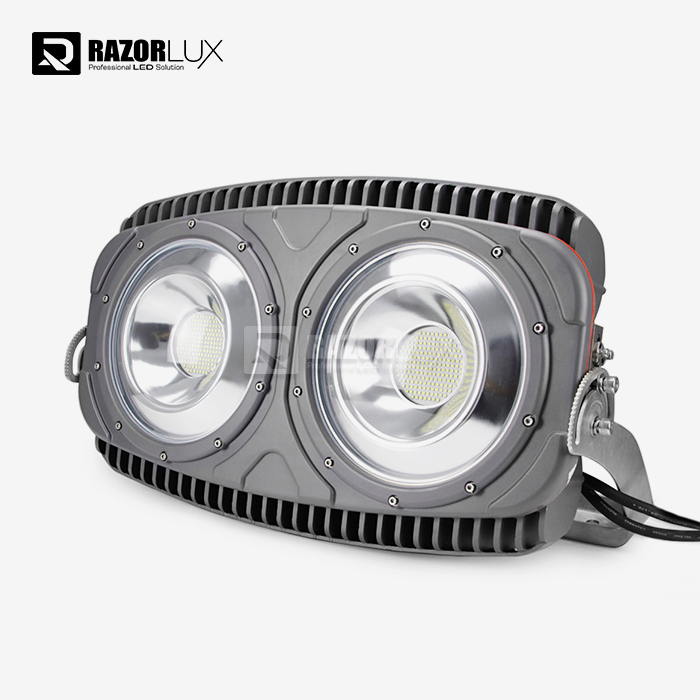
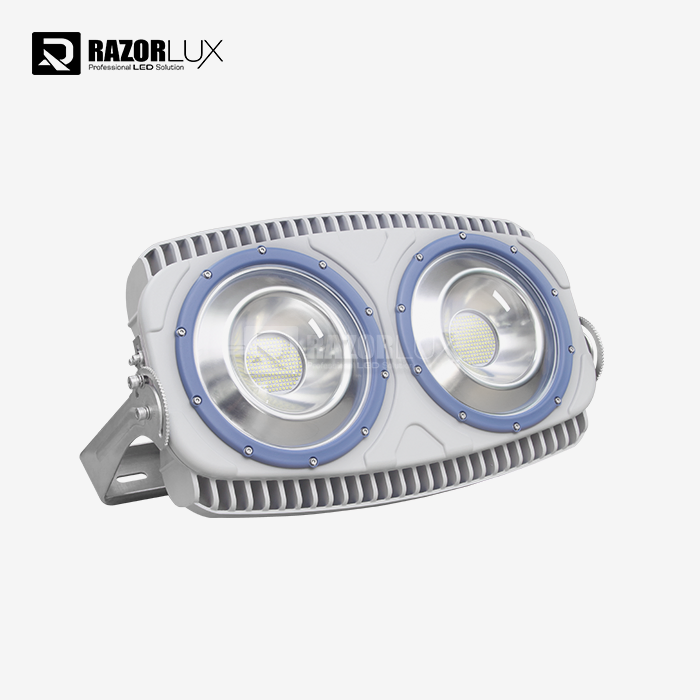
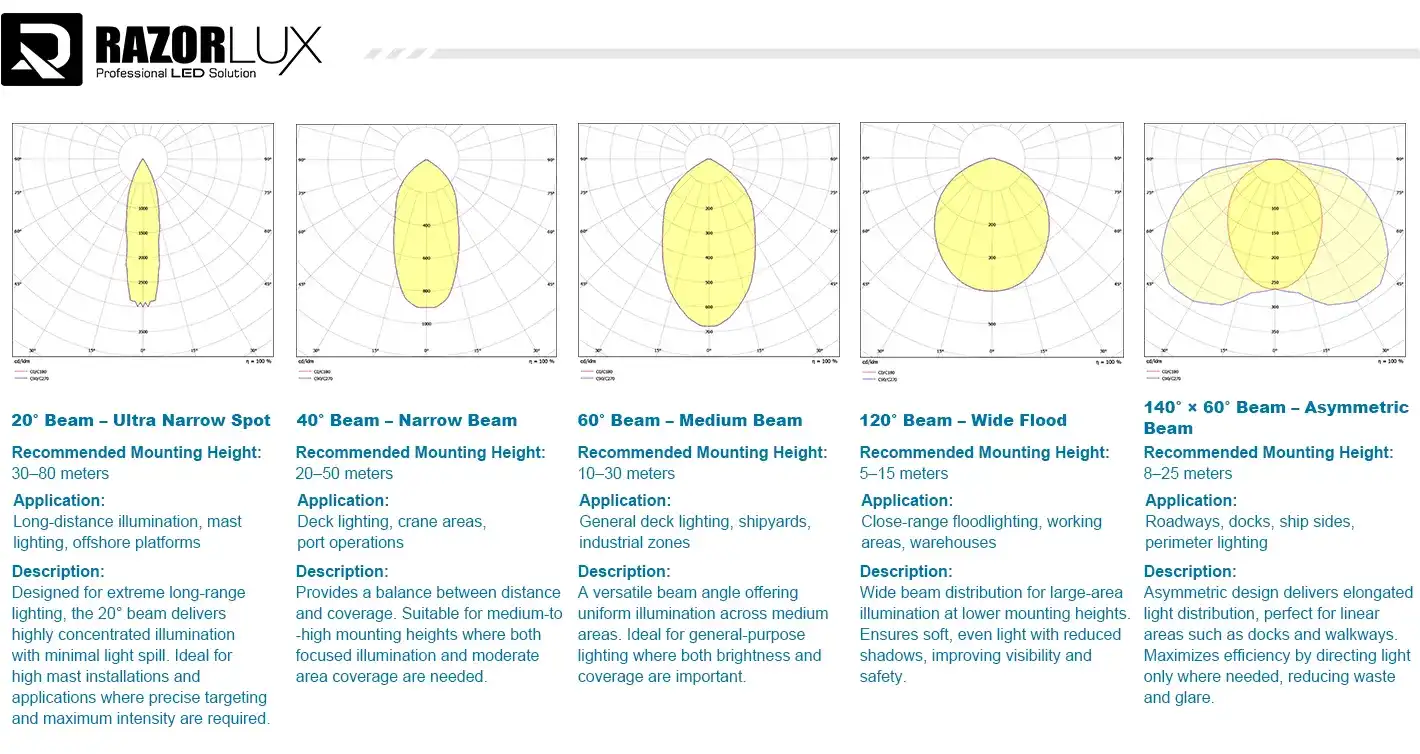
It takes a lot of care to pick the right beam position for outdoor industrial Low Mast Light and marine LED lights. For mounting heights between 8 and 15 meters, which are common in logistics hubs, docks, and port facilities, the best beam angle strikes a mix between good coverage and low glare. Narrow beams (60°) focus light on specific areas for tasks, while medium to wide beams (120°–140°) cover a larger area, lowering dark spots and making the lighting more even. Razorlux's unique multi-function designs let you choose from beam angles of 60°, 120°, and 140°×60° to fit a wide range of project needs. This makes sure that light is distributed evenly without spilling or wasting energy in busy business settings.
Understanding Beam Angles and Their Role in Low Mast Lighting
What Exactly Is a Beam Angle?
The cone of light that a luminaire sends out is called its beam angle. It is recorded at the point where the strength drops to half of its highest level. This setting directly affects how light spreads across a target surface in LED area lighting. Narrow angles focus light on specific areas, while wider angles spread light widely over bigger areas. It is important to know about this aspect when choosing lights for areas like ports, parking lots, and industrial yards, where even lighting affects both safety and efficiency.
How Beam Angle Impacts Uniformity and Glare
The choice of beam angle has a big effect on uniformity, which is the ratio between the average and minimum light levels. "Zebra striping," in which bright and dark lines move across roads or work areas, is caused by angles that aren't matched up correctly. By sharing light patterns between poles next to each other, wide beams improve consistency. However, angles that are too wide can cause glare, especially when lights are placed low and in the line of sight of workers and drivers.
Categories: Narrow, Medium, and Wide Beams
Beam angles are divided by industry standards into three main groups:
- Narrow (15°–60°): This type of focused lighting is great for drawing attention to certain buildings, stacks of containers, or crane paths in shipyards where precise vision is important.
- Medium (60°–120°): This type of coverage is good for roads, warehouses, and mixed-use areas that need even lighting without too much overspill.
- Wide (120°–180°): This type of lighting is good for open parking lots, port docks, and areas with a lot of people walking around because it creates a soft, safe environment.
By choosing the right group, you can cut down on light pollution, save energy, and make sure you're following city dark-sky laws. For procurement managers, the first step in choosing area lighting that meets both technical and legal needs is to make sure that Low Mast Light's beam angle matches the pole height and the plan of the site for the Low Mast Light installation.
Comparison of Beam Angles for Different Low Mast Light Applications
Parking Lots and Roadways: Medium to Wide Coverage
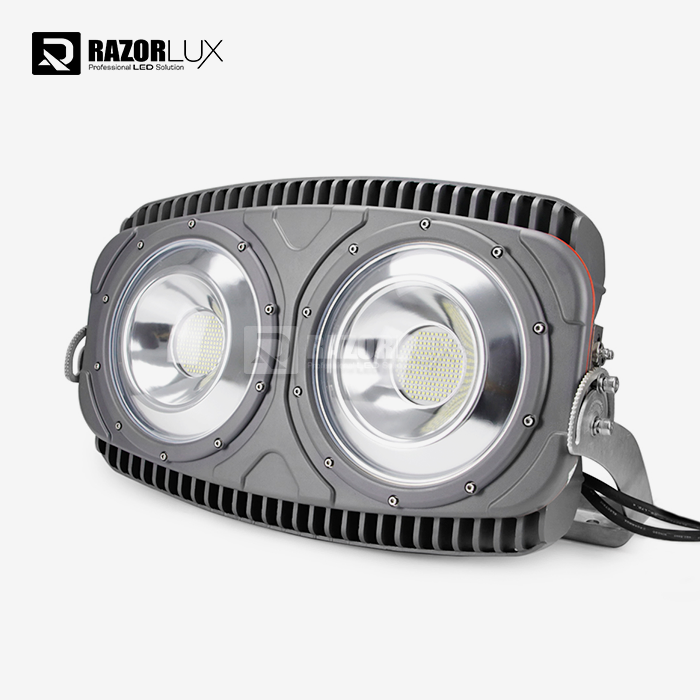
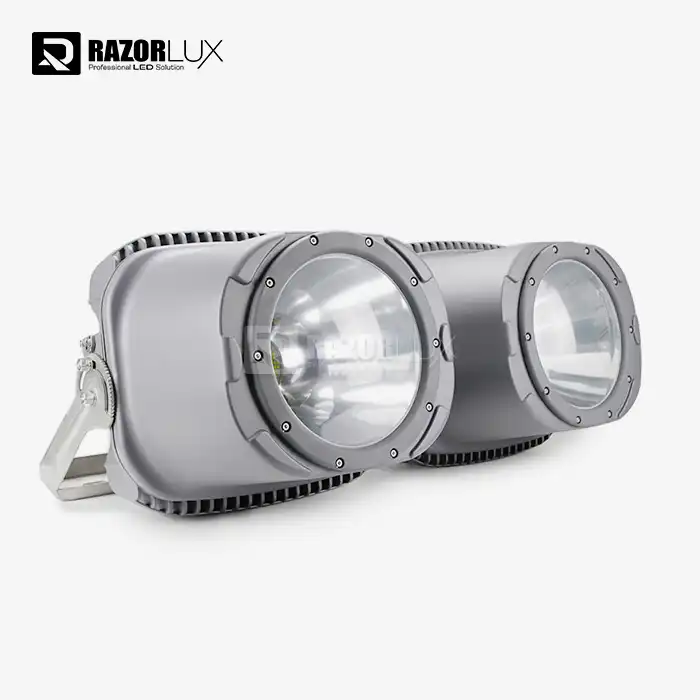
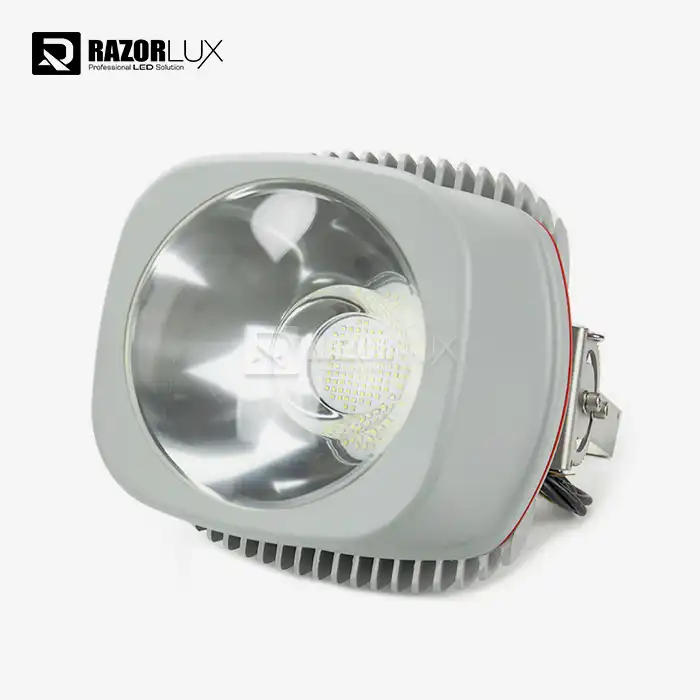
To help drivers find their way and keep pedestrians safe, parking lots and side roads need even lighting with no shadows. When you combine medium beam angles (60°–90°) with Type III or Type IV IES distributions, light doesn't pass through to nearby properties as much, but there is still enough vertical illumination for security cameras and face recognition. With wider beams (120°), you don't need as many poles, which lowers the cost of installation and infrastructure. This is important for big shopping malls and storage centers. Our RGL-120A line has beam angles that can be changed between 60°, 120°, and 140°×60°. This lets project planners change how the light is distributed during installation. This adaptability makes sure that the lighting for roads and parking lots meets the IESNA RP-8 standards, which balances saving energy with making the lighting look good for any Low Mast Light project.
Sports Fields and Recreational Areas: Focused Narrow Beams
To help athletes and fans see, athletic sites need high lux levels that are focused within clear limits. Narrow beam angles (15°–40°) keep spill light from affecting living areas nearby while sending the most intense light onto playing fields. The 200–500 lux levels needed for beginner to semi-professional sports can be reached by mounting lights 10–15 meters away and carefully controlling the optics. Our system's 60° beam choice gives you the exact control you need for lighting around tennis courts, loading docks, and helipad aprons that need to have clear lines of light.
Walkways and Architectural Lighting: Ultra-Wide Ambient Beams
Wide beams (140°–180°) that make soft, friendly light are good for sidewalks, public plazas, and the outside of buildings. To improve safety and looks, these apps put a high value on color rendering (CRI >75) and reducing glare. Asymmetrical distributions and low hanging heights (6–9 meters) keep people from seeing the LED source directly. This makes it easier for older or visually disabled people to use without disability glare. Our 140°×60° asymmetric choice is designed to work in these situations because it gives you horizontal spread with controlled vertical cutting. This makes sure that the ADA rules are followed while keeping the warm color temperatures (2700K–4000K) that are chosen in business and hospitality design.
| Application | Recommended Beam Angle | Typical Lux Range | Key Consideration |
|---|---|---|---|
| Parking Lots | 90° to 120° | 10 to 30 lux | More than 0.4 |
| Roadways | 60° to 90° (Type III/IV) | 15 to 25 lux | Cutoff compliance and glare control |
| Sports Fields | 15° to 40° | 200 to 500 lux | Boundary accuracy and reducing spill light |
| Walkways | 120° to 180° | 5 to 15 lux | Light coming from the side, CRI >75 |
| Loading Docks | 60° to 90° | 100 to 200 lux | Getting rid of shadows under roofs |
Technical Guidelines for Choosing and Installing Low Mast Lights Based on Beam Angle
Factors Influencing Beam Angle Selection
The best beam angle is determined by three factors that affect each other: pole height, fastener spacing, Low Mast Light, and mounting direction. Because the longer throw distance makes the ground impact bigger, taller poles (12–15 meters) allow for thinner beams. On the other hand, shorter mounts (8–10 meters) need wider angles to get the same area without adding more poles for a Low Mast Light setup. Fixture spacing, or the space between the poles, has a direct effect on regularity. When it comes to area lighting, spacing-to-mounting-height ratios (S: MH) are usually between 3:1 and 4:1. To avoid dark spots, narrower beams need closer spacing. bigger beams, on the other hand, can have bigger gaps, which saves money on materials and work.
Installation Best Practices for Beam Control
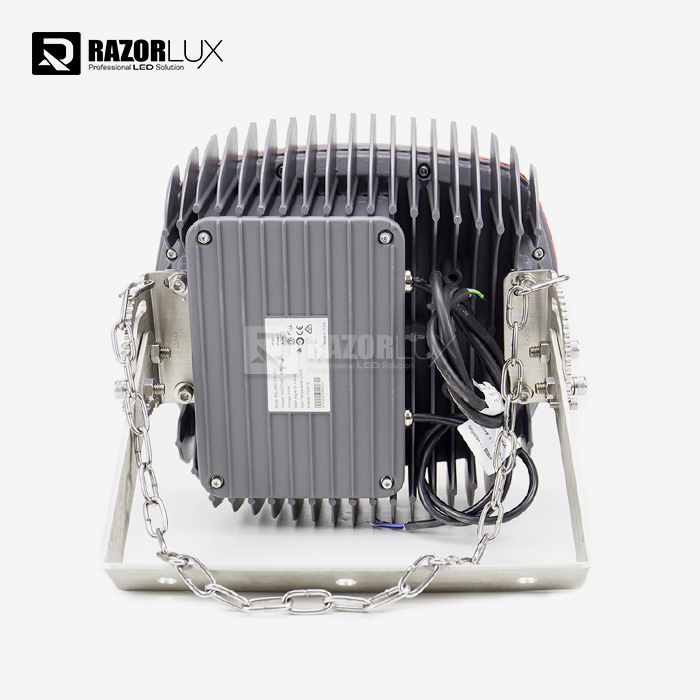
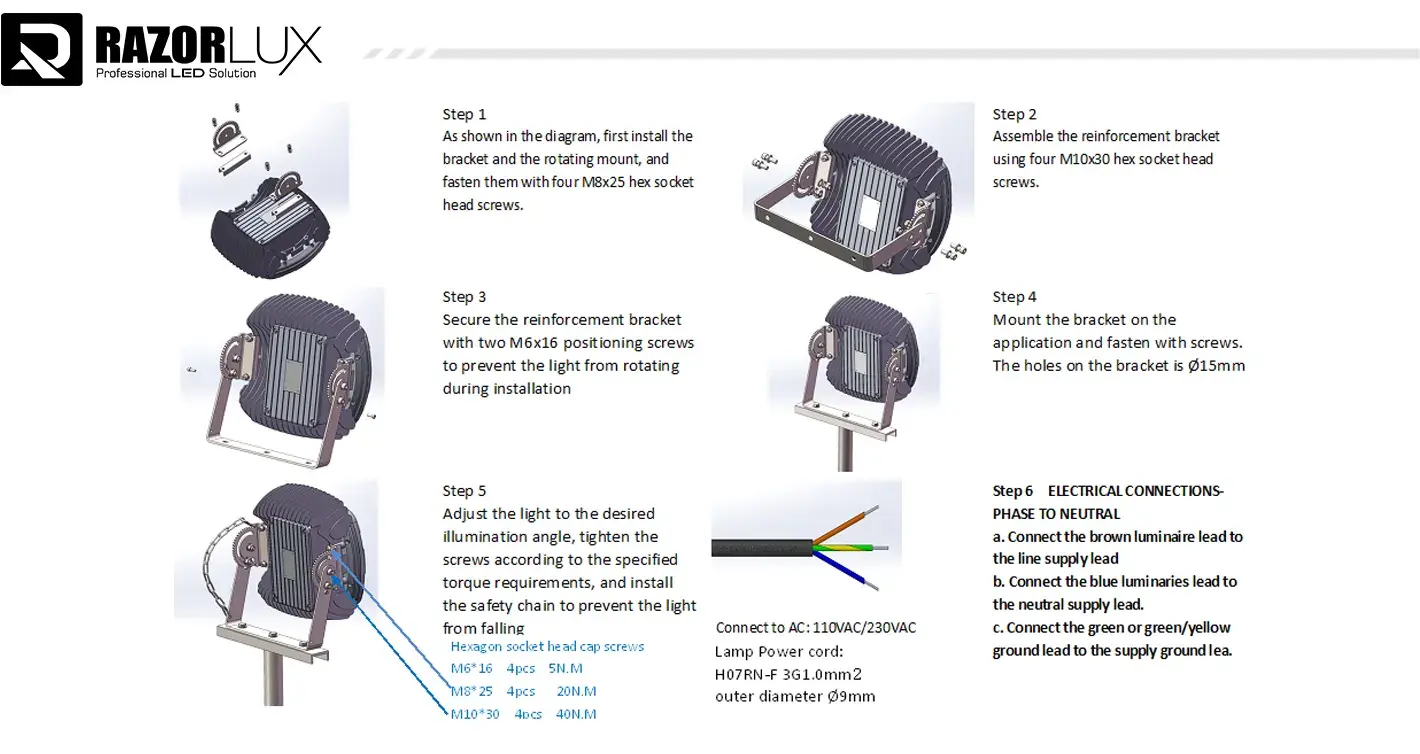
When putting up lights with narrow or asymmetric beams, precise shooting is very important. Even a small misalignment of 5° can change the lighting pattern in a big way, leaving hotspots or dangerous shadows near loading zones or pedestrian crossings. Mounting clamps should have degree-marked, adjustable trunnion bolts that make it easier to set up correctly the first time and reset during repair rounds. Optical add-ons like glare screens, barn doors, and honeycomb louvers make beam control even better. Choosing IP67-rated housings with toughened glass protects the beam quality over the fixture's 50,000-hour life in coastal docks and offshore platforms where salt fog and moisture speed up optical degradation.
Maintenance Guidelines to Preserve Beam Quality
Optical parts should be checked regularly to make sure they stay clean and unbroken. Lenses can become cloudy with salt spray, dust from factories, and bird droppings, which can lower the effective beam strength by 30% or more. Cleaning every three months with pH-neutral liquids stops long-term etching and keeps the optical performance high. Managing heat also has an effect on beam uniformity. When junction temperatures stay above 85°C for a long time, LED lights lose lumens and colors change. When used in temperatures ranging from -40°C to +60°C, our aluminum die-cast housings with built-in heat sinks keep the beam angle and strength stable throughout the guarantee time.
Comparing Low Mast Light Beam Angles with Other Outdoor Lighting Options
Low Mast vs. High Mast: Coverage and Glare Implications
High mast systems (above 18 meters) use narrow beams (10° to 30°) to send light over long distances, which makes them perfect for airport grounds and container ports. But their very long throw makes sharp shadows behind things that are tall, like stacked containers or cars. This problem can be fixed by installing Low Mast Light systems with medium to wide beams (60°–140°). These bring the light sources closer to the target, which lowers the depth of shade and makes the lighting more even in crowded areas. High masts also focus upkeep tasks at a few key areas, but they need pricey lowering systems or bucket trucks that are longer than 25 meters. Standard tools can be used to repair fixtures that are mounted 8 to 15 meters up. This cuts down on downtime and running costs for building managers.
LED Precision vs. Traditional HID Technologies
Older HID (High-Intensity Discharge) systems can't precisely control the beam because they send light in all directions and need extra mirrors to work. This causes 20–40% of the light to be lost through lenses that don't work well and spill into places it shouldn't be. With LED technology, secondary optics like lenses, mirrors, and TIR (Total Internal Reflection) arrays are built right into the luminaire. This makes it possible to get beam angle limits of just ±3°. The RGL-120A can be used instead of 250–300W HID lights and has better color uniformity (CRI >75) and luminance (130 lm/W). The lower running costs and carbon footprints from saving energy are in line with the ESG (Environmental, Social, and Governance) promises that companies are being forced to make in more and more port authority and city contracts.
Flood, Bollard, and Area Lighting: When to Choose What
Flood lights have very narrow lines (<30°) that can be used for decorative lighting or security lighting. Bollards give off light that shines in almost all directions (>180°) to help people find their way. Area lighting is in the middle. It has movable beams (60°–140°) that work well in places with a mix of uses that need both useful and safety lighting. Fixture types should be chosen based on their intended use. For example, bollards should be used in pedestrian areas, floods should be used around perimeters for safety, and adjustable-beam systems should be used in logistics yards, parking lots, and shipyard operational areas that need to be flexible and adaptable over time.
| Fixture Type | Typical Beam Range | Mounting Height | Best Use Case |
|---|---|---|---|
| High Mast | 10° to 30° | 18–30 m | Airports and container hubs |
| Low Mast (LED) | 60° to 140° | 8–15 m | Shipyards, parking lots, and logistics hubs |
| Flood Light | <30° | Different | Safety and spotlights |
| Bollard | >180° | 0.6 to 1.5 m | Walkways for people |
Procurement Guidance: Selecting the Best Low Mast Lights Based on Beam Angle
Verifying Photometric Data and Technical Specifications
Suppliers you can trust give you IES photometric files and LM-79 test results that show Low Mast Light the recorded beam angle, intensity distribution, and uniformity measures. Compare these papers to lighting estimates for the project that were made with software like AGi32 or Dialux. When released data doesn't match real performance, it's usually because the optical design or parts aren't very good for a low-mast light procurement. Ask for specific product datasheets that list not only the standard beam angle but also the field angle (where the light intensity is 10% of its peak) and the cutoff angle (where the intensity drops to almost zero). These secondary factors show how cleanly the beam ends, which has an effect on glare and light trespass laws.
Evaluating Suppliers and Requesting Customization
Leading makers let you change the beam angle by using lenses that can be switched out or modular optical systems. Because of this, a single fixture type can be used for many different tasks. This makes managing inventory easier and cuts down on the time it takes to get new parts. Check the supplier's skills by looking at their production ability and certifications (CE, RoHS, UL, DLC). A company like Razorlux, which has over 200 patents and in-house research and development labs and quality systems that are ISO9001-certified, has the technical depth to support complicated, multi-phase projects with consistent quality control.
Why Razorlux Stands Out as a Trusted Supplier
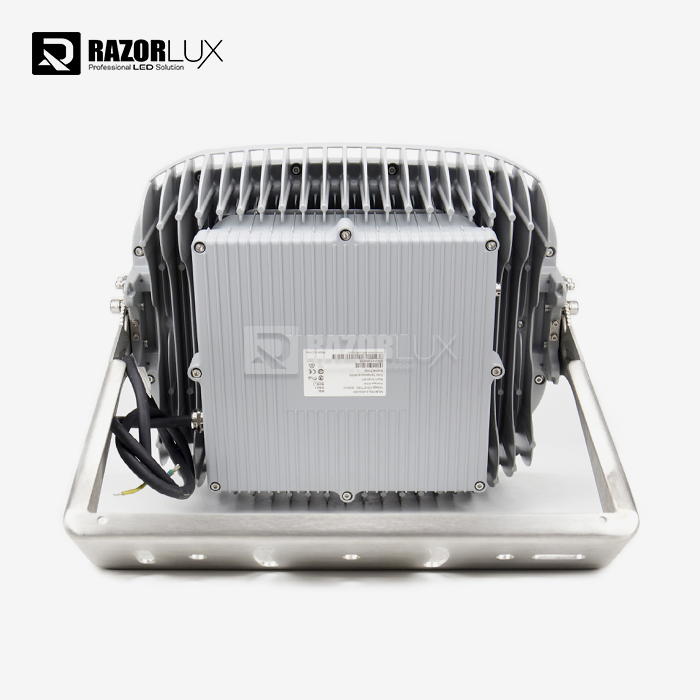
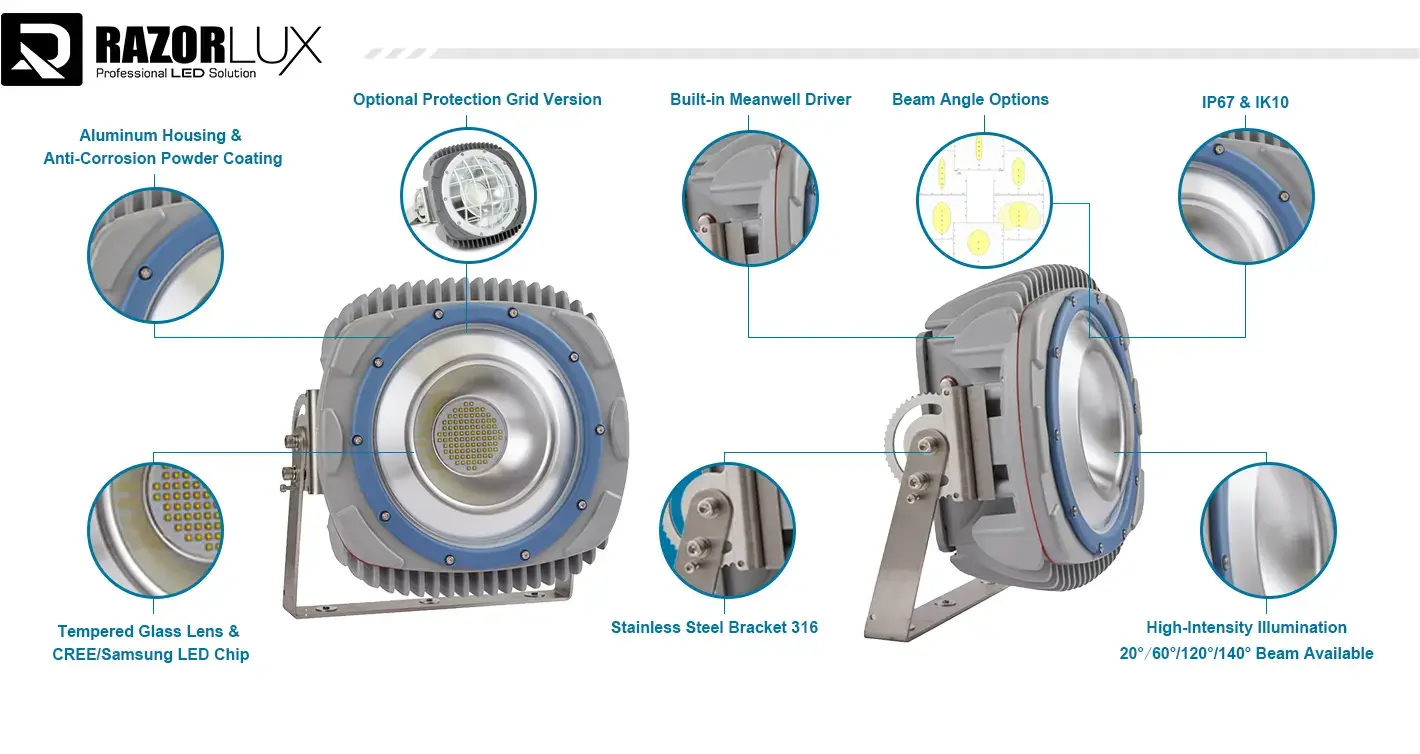
Razorlux has been around since 1998 and used to be called Xi'an Zhihai Power Technology. They have more than 20 years of experience in naval and industrial LED solutions. Our patented multi-function design and beam angles of 60°, 120°, and 140°×60° make the RGL-120A line perfect for meeting the needs of buying managers at shipyards, engineers working on offshore platforms, and owners of logistics centers in Northern Europe, Southeast Asia, and the Middle East. Our lights can handle salt spray, temperatures ranging from -40°C to +60°C, and mechanical vibration thanks to their Meanwell power sources, Samsung LED chips, and IP67/IK10 protection. Full approvals, like CE, RoHS, UL, DLC, and maritime-specific DNV/GL, make sure that all target markets follow the rules. We help our customers with every step of the buying process, from pre-sales technical advice to personalized samples, detailed CAD drawings, flexible OEM/ODM services, and quick after-sales support backed by a 5-year guarantee. Our offices are in both China and the United States. This lets foreign buyers working on complicated, multi-stakeholder projects quickly communicate and get localized service.
Conclusion
Choosing the right beam angle for outdoor LED area lighting is a technical choice that has direct effects on how the lights work and how much they cost. Narrow beams focus light on areas that need it for specific tasks; middle beams find a good mix between coverage and efficiency; and wide beams provide general lighting in places where people can walk. Matching the beam angle to the mounting height, pole spacing, and type of application cuts down on wasted energy, eliminates glare, and ensures that optical standards are met. For tough marine, industrial, and infrastructure projects around the world, Razorlux's RGL-120A line provides proven beam angle flexibility, guaranteed quality, and strong supply chain support for any Low Mast Light requirement.
FAQ
1. What beam angle should I choose for a 10-meter pole height?
A 90° to 120° beam angle usually gives the best coverage and regularity for a 10-meter mounting height in a general-use parking lot or transportation yard. This range makes sure that there is enough overlap between poles next to each other while keeping glare and light trespass to a minimum. If your site has vertical obstacles like storage racks or crates, you might want to use a bigger asymmetric distribution (140°×60°) to fill in dark areas better with your Low Mast Light.
2. Can I adjust the beam angle after installation?
Some lights have flexible optics that let you switch out the lenses, which lets you change the beam angle on the spot. The RGL-120A line lets you choose the beam angle during the original setup process. Even though lenses can't be switched out in the field, our pre-sales advice process makes sure you choose the right angle before we ship, so you don't have to pay for expensive repairs later on. Always check with your provider about this during the quotation process.
3. How does beam angle affect energy consumption?
Through needed pole density, beam angle has a secondary effect on energy efficiency. Narrow beams need closer spacing to keep things even, which means more lights and more wattage overall. With wider beams, there are fewer poles, which means less energy use and lower building costs. No matter what beam angle you choose, our 120W lights with 130 lm/W efficiency replace 250–300W HID lamps, saving you a lot of energy.
Partner with Razorlux for Precision-Engineered LED Lighting Solutions
Razorlux is a top Low Mast Light maker with more than 20 years of experience. They offer approved, high-performance LED area lighting that is made to meet the strict needs of shipyards, offshore platforms, and heavy industrial settings. The RGL-120A line has 130 lm/W effectiveness, marine-grade IP67/IK10 protection, and flexible beam angles of 60°, 120°, and 140°×60°. It can meet your most difficult outdoor lighting needs. We keep a lot of parts in stock, can send samples quickly, and offer full expert help for the whole lifecycle of your project. To get full photometric data, IES files, or unique lighting layouts, email our team at sam@razorlux.com. We offer reliable solutions for sale that come with a 5-year warranty and a collection of global certifications. Let us help you get compliant, cost-effective lighting.
References
1. Illuminating Engineering Society (IES). Recommended Practice for Roadway Lighting (ANSI/IES RP-8-18). New York: IES, 2018.
2. Commission Internationale de l'Éclairage (CIE). Guide on the Limitation of the Effects of Obtrusive Light from Outdoor Lighting Installations (CIE 150:2017). Vienna: CIE, 2017.
3. International Maritime Organization (IMO). Standards for Ship Maneuvering and Navigation Lighting (SOLAS Chapter V). London: IMO, 2020.
4. U.S. Department of Energy. Solid-State Lighting Technology Fact Sheet: Beam Angle and Light Distribution. Washington, DC: DOE Office of Energy Efficiency, 2021.
5. European Committee for Standardization. Light and Lighting – Lighting of Work Places – Part 1: Indoor Work Places (EN 12464-1:2021). Brussels: CEN, 2021.
6. American National Standards Institute. American National Standard for Roadway and Area Lighting Luminaire Distributions (ANSI C136.31-2010). Washington, DC: ANSI, 2010.
_1750410540049.webp)