


_1750326878398.png)

Can 120 Volt LED Outdoor Flood Lights Be Used for Commercial Sites?
120-volt LED outdoor floodlights with high voltage that work on normal 120V AC circuits are perfect for business settings like shipyards, offshore platforms, industrial stores, and port facilities. These devices don't have the voltage drop and transformer failure problems that are common with low-voltage systems. This makes them the best choice for procurement managers who want to light up large outdoor areas reliably and efficiently. Modern 120V LED solutions have better driver technology and tough housings rated IP65 to IP67. They work well even in difficult situations like salt spray, high temperatures, and mechanical vibration, and they use less energy than 130 lumens per watt.

Understanding 120 Volt LED Outdoor Flood Lights and Their Suitability for Commercial Sites
What Makes 120V LED Flood Lights Different from Low-Voltage Systems
120-volt LED outdoor floodlights can be connected directly to industrial power lines, unlike 12V or 24V landscape lighting, which needs step-down transformers. This direct-line function means that there are no external transformers that could fail from heat or moisture. The internal LED driver changes the AC energy to a stable DC that powers diode arrays with high efficiency. Purchasing managers at shipyards and big industrial sites like how simple it is. Fewer failure spots mean lower upkeep costs and less downtime when operations are very important.
Core Performance Features Critical for Commercial Environments
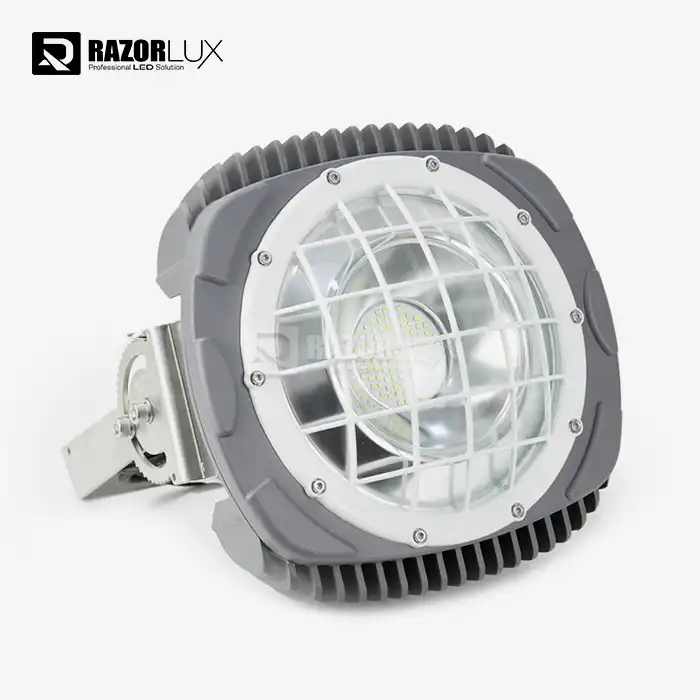
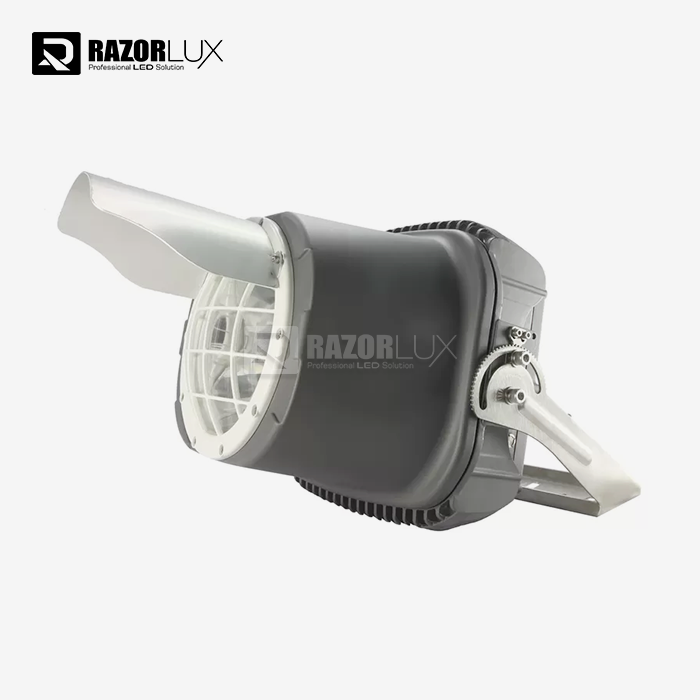
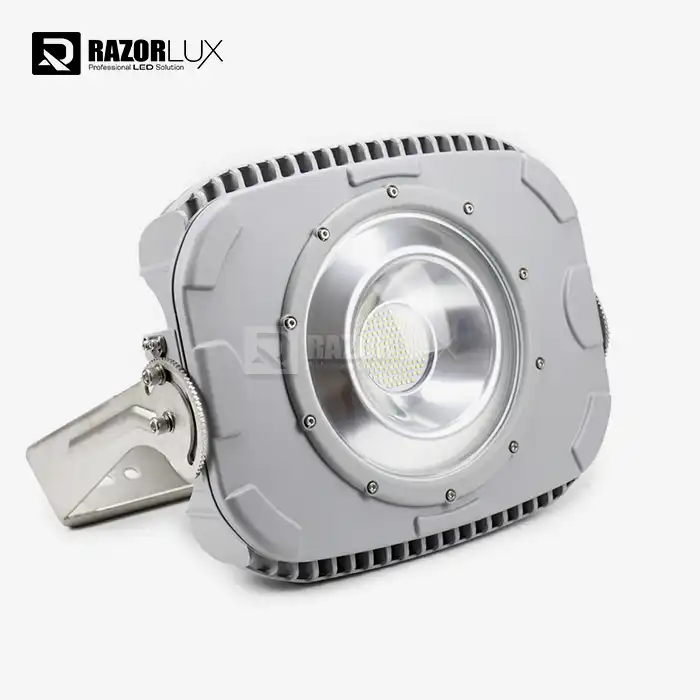
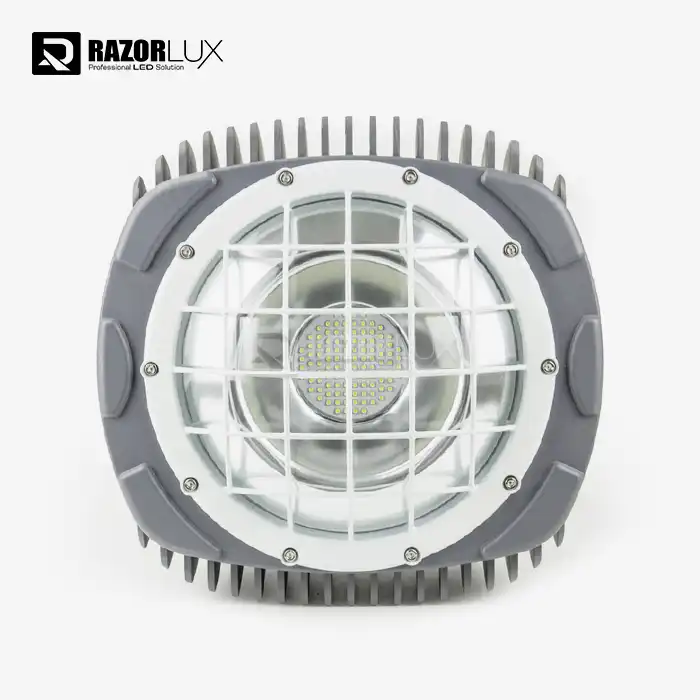
Commercial-grade LED floodlights have to be able to handle weather stresses that home goods never have to. Razorlux's RGL-1000A model is a great example of this because it has a patented multi-function design that can work in temperatures ranging from -40°C to +60°C, making it suitable for both cold ports in Northern Europe and hot factories in the Middle East. It can replace old 2200–2500W metal halide lights with its 1000W rated power (900W LED array plus 100W driver consumption), which gives off 130,000 lumens at 130 lumens per watt. This level of performance makes sure that there is enough light for CCTV tracking at loading docks and that there are no shadows in areas where cranes are used.
Important requirements that meet business buying standards are:
- Voltage Flexibility: The AC input range of 80–305Vac handles grid changes that happen a lot in industrial settings, and the DC input choices (100–400 Vdc, 500–800 Vdc) help green energy microgrids on remote offshore platforms.
- Thermal Management: The powder-coated aluminum housing and stainless steel brackets successfully transfer heat, keeping junction temperatures below 85°C even when the system is running 24 hours a day, seven days a week.
- Ingress Protection: The IP65 rating (which can be upgraded to IP67) keeps dust and high-pressure water jets out. This is important for washdown areas in chemical plants and ships.
- Impact Resistance: The IK10 grade can handle mechanical shocks from dropped tools, shaking cranes, and vehicles running into each other by mistake.
Port building managers have said things like, "These lights are getting old too fast; they need to be replaced with ones that are rated IP67." These features address those issues.

Beam Angle Options and Light Distribution Patterns
On business sites, precise light control is needed to light up particular work areas without wasting light. Razorlux has four beam angles: 40°, 60°, 120°, and asymmetric 140°x60°. This lets lighting experts change the throw lengths and areas that are covered. Narrow 40° beams shine light up the sides of buildings or across wide docks at container ports, and 120° wide floods cover parking lots evenly. People often say, "We need bright deck lights that don't blind crane operators." This optical flexibility solves the problem.

Key Performance and Installation Considerations for Commercial Use
Evaluating Lumen Output and Color Temperature for Work Safety
Minimum amounts of light, measured in lux (lumens per square meter), are required by industrial safety guidelines. With a 60° beam, a 1000W 120-volt LED outdoor floodlight system that puts out 130,000 lumens can reach 200+ lux from 30 meters away, which is more than what OSHA requires for general building areas and more than what the marine industry recommends for deck operations. Instead of just believing what marketing says, procurement teams should check visual data through IES files. Razorlux offers integrating sphere test results that make sure the real output fits the datasheets.
When doing precise jobs, the color temperature you choose affects your ability to see clearly. Our range of 2700K to 6500K can be adjusted to suit your needs:
- 2700–3000K Warm White: Lessens glare in places near homes, lowering complaints about light pollution.
- 4000K Neutral White: This color renders colors accurately (CRI ≥75) and efficiently, making it a good choice for general loading zones.
- 5000–5700K Cool White: This color makes contrast better for inspection work and is often used in ship repair bays and quality control stations.
- 6000–6500K Daylight: Makes people more alert during night shifts, which are typical at 24-hour ports.
IP Rating Specifications and Real-World Durability
The International Security (IP) code spells out the levels of security against solids and liquids. This is where commercial buyers get confused: what does IP65 vs. IP67 mean for a factory on the coast? In both grades, the first number (6) means that the airtightness is completely sealed off. Water protection is what makes them different. IP65 can handle low-pressure water jets coming from any direction, which is good for rain and rare cleaning. IP67 adds resistance to water immersion up to 1 meter for 30 minutes, which is very important for devices that are placed near splash zones on docks or offshore platforms.
Razorlux puts fixtures through long salt spray tests according to ASTM B117 standards. Units are exposed to 5% sodium chloride fog nonstop for 48 to 96 hours. This backs up claims of corrosion resistance that matter to engineering managers who ask, "We're looking for a light that won't rust in salt water and can be used on ship decks." The 30 kg net weight of the stainless steel bracket makes mounting stable even when diesel generators and heavy equipment are running all the time.

Installation Best Practices for High-Voltage Commercial Fixtures
Professional placement makes sure that the electricity is safe and works at its best. When working with 120V AC, you must follow the rules in the National Electrical Code (NEC):
Pre-Installation Checklist:
- Check that the circuit breaker can handle the total power of lights that are daisy-chained (1000W per unit).
- Make sure the wire size is right for the length of the run (10 AWG copper for 30A lines is common).
- Check that the structure of the fixing area is strong enough to hold the 30 kg (66 lb) weight of the fixture.
- Plan the path of the conduit to keep visible wire safe from damage caused by objects and UV light.
Mounting Location Strategy:
Position affects both the quality of the light and how easy it is to do upkeep. At container ports, mounting heights of 10 to 15 meters give 120° beams wide coverage, while at 20 meters or more, smaller 40° optics get rid of dark spots between stacked containers. By tilting lamps 10-15° lower, you can get the most light at ground level while minimizing sky glow that gets in the way of the crane operator's view.
When smart tools are added, usefulness is increased. Razorlux lights work with both 0-10V dimming signals and DALI standards, which lets you:
- Automated schedule that turns lights down by 50% during quiet times, which saves energy
- Set off motion sensors in outer security zones
- There are emergency bypass modes that keep the screen bright during incident reaction.

Comparing 120 Volt LED Outdoor Flood Lights with Alternative Solutions
LED vs. Traditional Metal Halide and High-Pressure Sodium
Many industrial sites still have old HID (High-Intensity Discharge) lights because of investments made in the past. The total cost of ownership study, on the other hand, shows that 120-volt LED outdoor floodlights are better:
| Performance Metric | 1000W LED (Razorlux RGL-1000A) | 2500W Metal Halide | Advantage |
|---|---|---|---|
| Initial Lumen Output | 130,000 lm | 140,000 lm | Similar to |
| Lumen Maintenance @ 10,000 hrs | 95% (123,500 lm) | 70% (98,000 lm) | LED keeps its brightness |
| Warm-Up Time | Right away, full brightness | 5 to 10 minutes | Right away, a safety answer |
| Energy Consumption | 1000W | 2500W | 60% discount |
| Lifespan (L70) | 50,000 hours or more | 15,000 hours | 3.3 times better service |
| Maintenance Cycles (10 years) | 1 to 0 backups | 4 to 5 replacements | Savings on labor costs |
A 10-year TCO estimate for a port building that is used for 4,000 hours a year shows huge savings. Assuming that power costs $0.12/kWh and work costs $150 per light replacement:
LED Total Cost: $1,200 (fixture) + $4,800 (energy over 40,000 hrs) + $150 (one replacement) = $6,150
MH Total Cost: $600 (fixture) + $12,000 (energy) + $750 (five repairs) = $13,350
The LED investment pays for itself in two and a half years and saves $7,200 over the life of the light. Facility managers have said, "Concern about premature lamp failure leading to higher maintenance costs."

Solar vs. Grid-Powered LED Flood Lights
Solar-powered lights are good for environmental concerns, but they can't always be used in heavy-duty business settings. Solar panels need to be facing south (Northern Hemisphere) without any obstructions. They don't work as well in high-latitude places like Norway and Sweden during the winter. Operating hours are limited by the size of the battery—usually 8–10 hours on a full charge—while grid power allows for unlimited runtime.
Razorlux's wide input voltage range (80–305Vac) makes it easier to integrate green energy in different ways. For example, facilities can get grid power from wind or water sources while still being able to run continuously. With the 100–400Vdc DC input choice, you can even connect directly to solar inverter systems without storing power in batteries. This combines green energy with industrial-grade performance.
Advanced Control Options: Motion Sensors and Timers
Energy control is more than just making sure lamps work well. Intelligent settings adjust the lighting to how it is actually used:
- Motion Sensor Applications: Security lighting around the perimeter stays at 30% power until PIR (Passive Infrared) sensors sense movement. It then increases to 100% for set amounts of time. This cuts down on wasted energy during quiet times while keeping sight high enough to be a deterrent.
- Astronomical Timer Integration: Lights turn on and off automatically based on the seasons' sunrise and sunset times. This eliminates the need for human setting and makes sure that environmental permits that limit light pollution are followed.
- DALI Network Advantages: The Digital Addressable Lighting Interface protocol lets you handle and watch hundreds of lights from a single computer. Facility managers are notified in real time when a bulb fails, which lets them do preventative maintenance instead of responding to dark spots that put people in danger.
Selecting the Right 120-Volt LED Outdoor Flood Lights for Commercial Procurement
Evaluating Brand Reputation and Certification Compliance
"Which company supplies your power supply? "Can you provide certifications?" is a question that procurement managers should ask because the source of a component has a direct effect on the dependability of 120 Volt LED Outdoor Flood Lights. Razorlux recommends Meanwell drivers, which are the best power sources in their field and are known for having a mean time between failures (MTBF) of more than 50,000 hours and meeting all world safety standards.
Both types of certification files are important. What our matches have:
- UL Listing: Verifies that systems in North America meet the strict UL 1598 standards for electrical safety
- DLC Premium: Allows projects to get energy refunds, which lowers the real purchase price by 20 to 40 percent.
- CE/RoHS: Makes sure that the European market follows the rules about dangerous substances
- Marine Certifications: Approvals from DNV/GL and ABS show that the product is suitable for use on ships and offshore sites.
These certificates directly address the "lack of certifications or documentation" that often slows down projects.
Warranty Terms and After-Sales Support Structure
A 5-year guarantee that covers both LED modules and drivers shows that the company behind the product is sure it will last. But guarantee response varies a lot. Razorlux keeps regional service centers open and ships new parts within 24 to 48 hours to keep downtime to a minimum. Our technical support team can help with installation in a number of languages, which makes things easier for foreign buying teams that are having trouble communicating.
Exclusions in warranties need to be carefully looked over. Damage from bad construction, overvoltage, and illegal changes is not covered by standard coverage. Longer 10-year housing guarantees protect against corrosion failures, especially in marine settings where salt air speeds up the breakdown process.
Customization Options and OEM Capabilities
Specifications often need to be changed for big projects. Razorlux's production freedom lets it:
- Custom Beam Patterns: Different patterns can be made to fit different wall heights or throw lengths.
- Mounting Bracket Variations: Different types of mounting brackets are available, including trunnion, yoke, and fixed pole-mount designs.
- Color Temperature Tuning: Precise Kelvin limits to keep the brand's look consistent across multiple installations.
- Private Labeling: OEM partnerships let equipment providers sell to end customers under their own name.
This adaptability answers problems that industrial equipment sellers have said, like "We need to give them to our technicians for confirmation" through sample testing.
Ensuring Long-Term Value: Maintenance, Lifespan, and Energy Savings
Realistic Lifespan Expectations Under Commercial Operating Conditions
Manufacturers often give L70 rates, which are the number of hours until 70% of the original lumen output is lost, assuming ideal lab conditions. In the real world, the promised lifespan of 120 Volt LED outdoor flood lights is kept even in difficult circumstances because Razorlux's thermal management design keeps the temperatures at the LED junctions below 85°C even when the temperature outside is 60°C.
Accelerated life testing puts devices through temperature changes (-40°C to +60°C), voltage spikes according to IEEE C62.41 standards, and constant vibrations. Installations at Singapore's Jurong Port show that lights have been used for more than 40,000 hours with less than 5% brightness loss, proving that predictions made in the lab are accurate in the field.
Preventive Maintenance Protocols Extending Service Life
Even strong fixtures should be checked every so often. The following repair plans are suggested:
Quarterly Visual Inspections (15 minutes per fixture):
- Make sure the mounting bracket is tight and tighten the screws again if vibrations have made the links loose.
- Check the brightness of the lens and get rid of any dirt or salt that is getting in the way of light transfer.
- Make sure there are no signs of water getting in (condensation inside the glass).
Annual Deep Maintenance (45 minutes per fixture):
- Inspection of an electrical link using thermal imaging to find hot places that show bad connections.
- Handheld lux meters are used for photometric tests to record changes in lumen maintenance.
- Older units that are getting close to their 5-year service intervals need new gaskets.
Facilities that follow this schedule report 15-20% longer repair gaps than setups that aren't taken care of.
Quantifying Energy Savings and ROI Calculations
Heavy industry is using LEDs more because they use less energy and cost less. In a normal port building, replacing 100 units of 2500W metal halide lights with 1000W LED lights does the following:
Annual Energy Savings:
- Old system: 1,000,000 kWh
- New system: 400,000 kWh
- Savings: 600,000 kWh x $0.12/kWh = $72,000 a year
Maintenance Cost Reduction:
- $45,000 saved over 10 years, or $4,500 a year.
The total 10-year benefit adds up to $765,000. At a starting cost of $120,000 for 100 units, the payback time is only 1.6 years. This financial clarity supports approvals for major expenditures.
Real-World Case Study: Offshore Platform Retrofit
A Norwegian energy company ran an oil rig in the North Sea that had lighting problems all the time because of salt corrosion and shaking. After making the move to Razorlux RGL-1000A units with IP67 upgrades and IK10 impact protection, the platform achieved:
- Zero fixture failures in the 36 months after installation.
- Improved deck lighting from 80 lux to 150 lux on average, increasing chopper landing safety.
- 47% less energy used, even though more light is being produced.
- Maintenance crew reallocation as lighting service calls dropped by 90%.
Performance Specifications and Technical Comparison
Knowing specific technical factors helps procurement teams tell the difference between goods. The following table shows important specs:
| Specification | Razorlux RGL-1000A | Industry Standard Range | Procurement Advantage |
|---|---|---|---|
| Luminous Efficacy | 130 lm/W | 100-130 lm/W | Best-in-class efficiency |
| Input Voltage Range | AC 80-305V, DC 100-800V | AC 100-277V typical | Accommodates voltage fluctuations |
| Power Factor | ≥0.98 | 0.90-0.95 typical | Reduces reactive power penalties |
| Total Harmonic Distortion | <10% | 15-20% typical | Minimizes grid interference |
| Operating Temperature | -40°C to +60°C | -20°C to +50°C typical | Extended climate range |
| CRI (Color Rendering) | ≥Ra75 (Ra90 available) | Ra70-80 typical | Enhanced visual accuracy |
| Surge Protection | IEEE C62.41 compliant | Varies by manufacturer | Reduces lightning damage risk |
| Warranty Coverage | 5 years comprehensive | 2-3 years typical | Long-term cost protection |
Large industrial users pay less for energy demand charges when the power factor is higher. Because the input voltage range of 120 Volt Led Outdoor Flood Lights is so wide, voltage controllers are not needed in places where the power grid is unstable. When THD is less than 10%, it doesn't mess up sensitive electronics like PLCs and transmission gear.
Conclusion
High-voltage LED flood lighting is the best choice for business places that need dependability, efficiency, and long-term value. Moving from old HID systems to new 120V LED technology removes the need for maintenance, cuts down on energy use, and provides better lighting that improves operating safety. When choosing between choices, procurement managers should give more weight to fixtures that have been certified for marine use, can handle a wide range of input voltages, and come with full warranty support from expert teams. Payback times of less than two years and service lives of ten years or more make LED adoption a smart operating gain. Case studies and TCO breakdowns show that using the right fixtures can give you measured returns and solve problems like early failure and slow service response.
FAQ
Are commercial-grade LED flood lights strong enough to handle bad weather?
Premium fittings with an IP67 rating and IK10 impact resistance work successfully in temperatures ranging from -40°C to +60°C, so they can be used in both arctic ships and warm ports. Corrosion resistance for coastal systems is proven by salt spray tests according to ASTM B117. The powder-coated metal body and stainless steel mounting tools make it resistant to damage from UV light, humidity, and chemical contaminants common in industrial settings.
What kind of insurance support can business buyers expect?
Leading makers offer 5-year guarantees that cover all parts of the LED module, including the drivers and the housing. Check to see if the guarantee is being honored by looking up service center addresses and replacement parts. Marine settings that are corrosive offer extra security through extended 10-year housing guarantees. The warranty terms should make it clear what kinds of things aren't covered, like bad fitting or overvoltage, while still making the claim process easy to use.
Can these LED systems be used with smart building controls?
0-10V analog dimming, DALI digital networks, and DMX for synchronized lighting effects are just a few of the control methods that modern business LED lights can handle. Integrating with BMS (Building Management Systems) allows for unified monitoring, automatic scheduling, and keeping track of how much energy is used. The cosmic timer and motion sensor support make the best use of energy without lowering the level of security lighting. During the evaluation process, the procurement specs should check for control compatibility to ensure seamless integration.
Partner With Razorlux for Your Commercial LED Lighting Solutions
Razorlux is ready to help you with your industrial lighting projects. They have more than 200 patents in optical design and heat management and have been in the LED innovation business for more than 20 years. Our qualifications as a 120 Volt Led Outdoor Flood Lights maker include ISO 9001 approval and strict quality control methods that meet the strictest buying requirements for ships, offshore platforms, and heavy industrial facilities. In project-based buying settings, we know how important it is to deliver on time, provide full technical documentation, and provide quick after-sales support. Send an email to sam@razorlux.com to get full specification sheets, photometric reports, and unique models for your engineering team to look over. Our OEM skills help equipment integrators who need private-label solutions, and bulk buying deals offer cheap prices that are perfect for installations with multiple sites.
References
1. Illuminating Engineering Society (IES). IES Lighting Handbook: Reference and Application. 10th Edition. New York: Illuminating Engineering Society, 2011.
2. National Electrical Manufacturers Association (NEMA). ANSI C78.377-2017: Specifications for the Chromaticity of Solid State Lighting Products. Rosslyn, VA: NEMA, 2017.
3. U.S. Department of Energy. LED Lighting for Harsh and Hazardous Locations: A Guide for Procurement Professionals. Washington, DC: Office of Energy Efficiency & Renewable Energy, 2019.
4. International Commission on Illumination (CIE). CIE 121-1996: The Photometry and Goniophotometry of Luminaires. Vienna: CIE Central Bureau, 1996.
5. Det Norske Veritas (DNV). Rules for Classification of Ships, Part 4 Chapter 9: Electrical Installations—Lighting Systems. Høvik, Norway: DNV GL, 2021.
6. Razorlux Optoelectronic Technology. Technical White Paper: Thermal Management in High-Power LED Flood Lighting for Marine Applications. Xi'an: Razorlux Research Institute, 2023.
 VIEW MOREwarehouse led high bay lights
 VIEW MOREoutdoor rink flood lights
 VIEW MORE12 volt led flood lights waterproof
 VIEW MORELed Mine
 VIEW MOREMarine Led Deck Flood Lights
 VIEW MORERoHS Waterproof Garden Led Light 48000lm Solar Powered Security Lights
 VIEW MORE300W Floodlight
 VIEW MOREBest Led Floodlights