

_1750326878398.png)

Industrial LED Flood Lights Outdoor for Heavy Duty Applications
When your shipyard is hit with constant salt spray or your remote platform is hit with winds of -40 degrees, lighting problems are not only annoying, they're also dangerous and expensive. Industrial Led Flood Lights Outdoor solve this problem by providing strong, energy-efficient lighting designed to work in harsh naval, port, and heavy-duty settings. In contrast to older metal halide or HPS systems that need to be relamped often and use a lot of energy, current LED flood technology can start up right away, maintain brightness levels better, and work for more than 50,000 hours. Razorlux has been improving lighting solutions for over 20 years so that shipyard managers, port engineers, and industrial workers can rely on them to keep important activities safe 24 hours a day, seven days a week.
Understanding Industrial LED Flood Lights for Outdoor Heavy Duty Use
Heavy-duty outdoor flood lights are a special type of solid-state lighting that is designed to last for years in situations that would kill regular fixtures in months. These luminaires have high-intensity LED arrays, ruggedised housings, improved thermal management, and military-grade sealing to work reliably in places like tropical factories and shipping lines in the Arctic.

What Defines Heavy-Duty LED Flood Technology
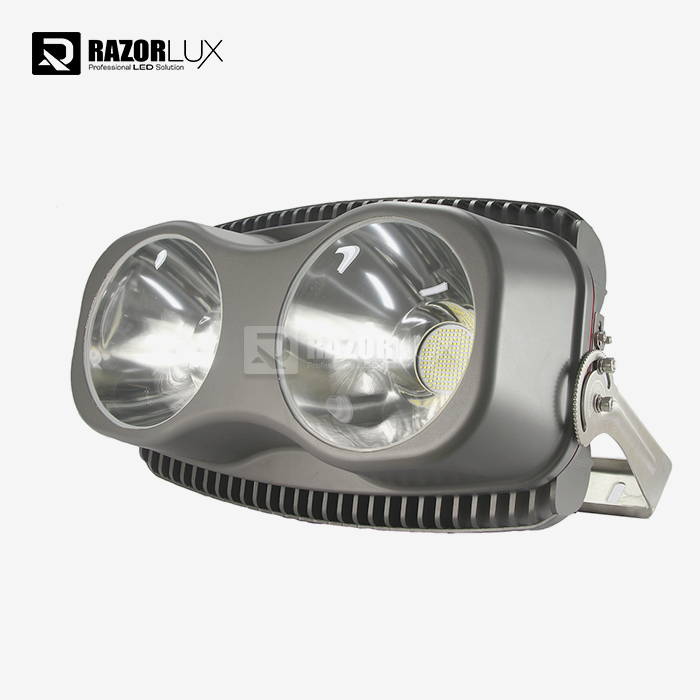
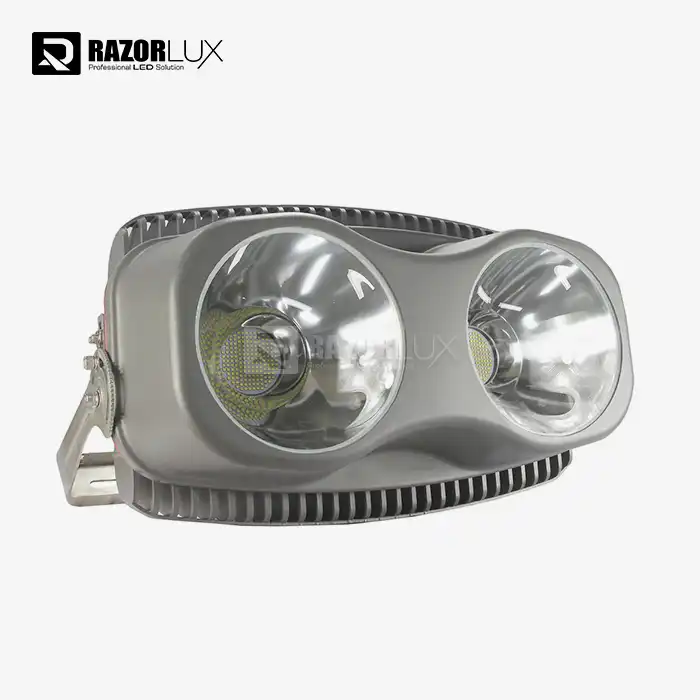
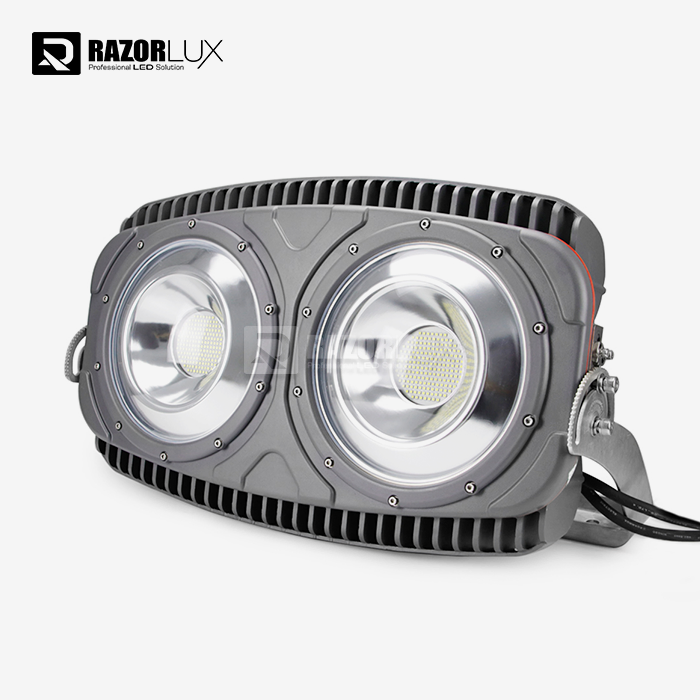
Outdoor LED floodlights made for industrial use have a number of important engineering parts built in. Depending on the size of the application, the LED box itself usually has SMD3030 or high-power COB panels that put out 10,000 to 130,000 lumens. Razorlux's RGL-1000A type, which is rated at 1000W and 130LM/W efficient, produces a steady 130,000 lumens after temperature stabilisation, which is the same amount of light as two 2200W or 2500W HID systems. This is because high-quality LED chips are paired with Meanwell power supplies, which are known for being reliable in harsh industrial settings. Professional fixtures and market goods are different when it comes to thermal control. Our finned aluminium heat sinks effectively remove junction temperatures, stopping the loss of lumens and colour shift that happen in units that aren't cooled properly. Specialised low-temperature driver circuits and thermal design that has been proven through thorough ageing tests make it possible to operate at temperatures ranging from -40°C to 60°C. Industrial LED Flood Lights Outdoor technology ensures these components work in harmony.
IP and IK Ratings That Matter in Real Conditions
The ingress protection rating tells you how long something will last in wet, dusty, and corrosive environments. IP65 approval means that the enclosure is completely dust-tight and can withstand water jets coming from any direction. This is enough for most industrial yards. Upgrading to IP67 adds resistance to submersion up to one metre for 30 minutes. This is important for dock areas that are subject to wave action or cleaning routines that use pressure washing. Impact resistance is just as important in industrial areas where tools are often dropped, things fly, and equipment crashes happen all the time. The fixture can handle 20 joules of impact energy, which is the same as dropping a 5 kg mass from 40 cm. This is the highest rating that can be given. When combined with powder-coated aluminium housings and mounting frames made of corrosion-resistant stainless steel, these specs mean that the lights will last, not just survive.

Optical Control and Beam Geometry Options
Precise visual control is needed for industrial lighting to work well so that as little light as possible is lost and there is no glare. Razorlux has beam angles of 40°, 60°, 120°, and an asymmetric 140°×60° setup. Narrow beams at 40° focus light for high-mast uses or long throws like those found in container yards. When mounted at lower heights, like in stores or under roofs, wide 120° optics work well. The asymmetric choice is for lighting around the edges of a property, where rectangular covering patterns keep light from going past the property lines. Colour rendering index (CRI) affects how well you can see and how safe you feel. Our normal Ra>75 specification is good enough for most industrial jobs. If you need better colour separation, you can choose the Ra>80 or Ra>90 versions. These are great for areas where quality control is important or where cranes are used, where signal colours must be clearly seen.
How to Choose the Best Industrial LED Flood Lights for Heavy Duty Outdoor Applications
To choose the right flood lighting, you have to weigh the technical specs against the daily needs and the total cost of ownership. Purchasing managers in shipyards, steel mills, and other places have to make decisions using similar frameworks, though the specifics depend on the location. Selecting high-quality Industrial LED Flood Lights Outdoor involves analyzing these critical parameters carefully.
Critical Procurement Specifications to Evaluate
What matters most are the wattage and light power. Instead of choosing based on watts alone, which is an attitude that comes from the days of incandescent bulbs, you should define the needed lux levels at the working plane height and then figure out how many lumens you need. A 1000W LED light with 130,000 brightness replaces older systems that used twice as much power. It also makes things easier to see by improving colour quality and lowering glare. Electrical changes that cost a lot of money can't happen because of input voltage flexibility. The RGL-1000A works with AC80-305Vac and DC100-400Vdc (with an optional 500-800Vdc range), so it can handle voltage changes that happen at remote industrial sites and different power standards from Norway to Qatar. Power factor ≥0.98 and THD <10% make sure that the system works with the grid and is efficient.
| Technical Parameter | Standard Requirement | Razorlux RGL-1000A Performance | Competitive Advantage |
|---|---|---|---|
| Luminous Efficacy | >110 LM/W | 130 LM/W | 15-18% energy savings vs. industry average |
| Operating Temperature | -20°C to 50°C | -40°C to 60°C | Extended range for Arctic/desert deployment |
| Voltage Range | AC100-240Vac | AC80-305Vac, DC100-800Vdc | Universal compatibility, reduced infrastructure cost |
| Ingress Protection | IP65 minimum | IP65 standard / IP67 upgrade | Enhanced reliability in marine environments |
| Impact Resistance | IK08 typical | IK10 certified | 250% greater impact tolerance |
Comparing LED Technology Against Legacy Systems
Switching from HID, metal halide, or HPS technology to LED has real benefits beyond just saving energy. Before they can be used again, HID systems need to be warmed up for 10 to 15 minutes and then cooled down for the same amount of time. This can cause security problems and operating delays. LEDs give off full brightness right away and can handle an infinite number of switching cycles without losing their quality. The cost of replacing a lamp goes beyond the price of a bulb. Changing a light bulb 25 meters up a high-mast pole usually costs $300 to $800 per service call and needs special tools, traffic control, and safety rules. Since HID lamps usually last between 10,000 and 15,000 hours, a 24/7 business needs to replace the bulbs every one to two years. LED systems that last 50,000 hours or more don't need to be replaced for at least ten years, which saves a lot of money on maintenance costs and increases uptime. Another practical benefit is that colours stay stable. As metal halide lights get older, they turn green, which makes it harder to see and understand colours. LEDs keep their colour temperature constant over their entire life, which makes using a crane safer and eye inspection work more accurate.

Certification Requirements and Supplier Reliability
Marine and heavy industry uses need strict approval compliance. DNV/GL and ABS certifications show that the product can be used in marine settings, such as on ship decks and offshore platforms. Regional certifications, like CE for Europe, UL/DLC for North America, and SAA/C-Tick for Australia, make it easier to get goods through borders and make sure they meet local electricity rules. Evaluating a supplier is more than just looking at the product information. Quality systems for manufacturing are very important. ISO 9001 certification means that processes are standardised and can be tracked. Razorlux's quality standards include DFMEA (Design Failure Mode and Effects Analysis), ageing tests that run for 24 to 48 hours to look for early failures, goniophotometer checks of IES files, and ASTM B117 salt spray tests that run for more than 1000 hours for coastal uses. Knowing where a component came from boosts trust. Choosing Meanwell drivers, which are the most reliable in the power supply business, and well-known LED chips lowers the chance of failure in the field. Generic parts that are bought to save money often break down too soon, wiping out any price savings that were made in the first place through warranty claims and damage to the company's image.
Matching Fixtures to Specific Heavy-Duty Environments
Specification objectives are set by the needs of the application. In shipyard drydocks, fixtures need to be able to handle being washed with high-pressure water during maintenance periods. This is when upgrading to IP67 becomes worth it. Offshore oil platforms have to deal with corrosive salt air and possible Category 1 Division 2 hazardous location requirements. This means they need special housings and certifications that go beyond standard industrial grades. Container port lighting focuses on high mounting places (20–40 meters) with narrow beam control to keep spills to nearby waterways to a minimum while keeping enough light levels for safe crane operation and cargo handling. Thermal performance is important in steel mills because temperatures near furnaces can reach 50 to 60°C, putting a lot of stress on thermal management systems. Impact strength and vibration tolerance are important in mining because heavy machinery works all the time in small areas. The IK10 impact grade, vibration-resistant mounting, and sealed construction keep the product from breaking too soon from shock loads and dust in the air.

Installation and Maintenance Best Practices for Industrial LED Flood Lights Outdoor
Whether fixtures work as expected or break down too soon depends on how well they were installed. Long-term dependability and safety compliance are affected by site survey, mounting method, and electricity integration. Proper handling of Industrial LED Flood Lights Outdoor during the setup phase ensures maximum operational life.
Site Assessment and Mounting Considerations
To start, use real IES files for photometric modelling instead of general estimates. Software tools figure out how many fixtures, where to put them, and what angles to aim them at to reach the desired brightness levels with the least amount of overlighting and energy waste. This planning stage keeps expensive changes from having to be made in the field after installation. The structure and height of the mounting affect both the visual performance and the ease of upkeep. Because of the high cost of entry, high-mast installations (20 meters or more) need narrow beam angles and fixtures that don't need much upkeep. When mounted lower (8–12 meters), the beams are wider, but they may need to be cleaned more often in dusty places. Mounting problems are avoided by doing structural pressure calculations. It is important to remember that the RGL-1000A is 29 kg, so the mounting gear needs to be able to handle both static loads and wind loads in open areas. Stainless steel brackets are better at resisting corrosion than regular steel ones. This is especially true in marine environments where galvanic corrosion between different metals speeds up the breakdown process.
Electrical Installation and Safety Protocols
Local electrical codes say that all wiring should be done by qualified electricians. The RGL-1000A's Class I insulation needs to be properly grounded; safety and surge protection are both compromised by poor ground connections. Carefully check the polarity because reverse polarity can damage sensitive driver circuits, even if the input safety features are in place. When sites are outside, and lightning hits and sudden changes in the power grid are possible, surge protection becomes very important. Most events are stopped by internal 10kV surge protection devices (SPDs), but extra protection at the panel level is a good idea for important installations. Keep coverage up to date by keeping track of inspection and rating plans for safety devices. Connections that are weatherproof keep water out. To keep the IP rating intact, use the right cable glands that are matched to the cable diameter and apply the right amount of torque. Leave small downward loops in the cables (called "drip loops") before entry points to stop water from moving along the wires and into the fixtures.

Maintenance Routines and Troubleshooting
Fixtures last longer and work better when they get regular care. Visual checks every three months find physical damage, loose mounting hardware, or worn-out gaskets before small problems get worse. After a yearly deep cleaning, dust and other particles that have built up on heat sinks are removed. This stops the temperatures from rising and speeds up the ageing of LEDs.
| Maintenance Activity | Frequency | Key Checkpoints | Impact of Neglect |
|---|---|---|---|
| Visual Inspection | Quarterly | Mounting security, lens clarity, visible damage | Mounting failure, water ingress, safety hazard |
| Heat Sink Cleaning | Annually (6 months in dusty environments) | Fin cleanliness, thermal paste condition | Elevated junction temperature, reduced lifespan |
| Gasket/Seal Inspection | Annually | Compression, cracking, UV degradation | Loss of IP rating, internal corrosion |
| Electrical Connection Check | Biennially | Torque verification, corrosion, ground continuity | Intermittent operation, fire hazard |
| Photometric Testing | Every 3 years | Lux level verification, beam pattern | Inadequate illumination, safety compliance |
Systematic diagnosis is the first step in fixing common problems. Flickering is often a sign of loose links, incompatible systems that don't work with each other, or driver problems. Complete failure means there are problems with the input power, tripped safety devices, or a failed driver. Meanwell drivers have LED trouble signs that make diagnosis easier. If the light dims more than usual, it could mean that the heat sinks are blocked or that the temperature outside is too high and above the rated limits.
Warranty Administration and Compliance Documentation
Razorlux's 5-year guarantee on LED modules and drivers offers good safety, and making sure you have all the right paperwork makes the claims process go smoothly. Keep notes of the installation, logs of upkeep, and results of photometric tests. These papers show the right way to install and use the product within its rated limits. This keeps warranty claims from being denied because of improper use or abuse. Compliance with certification goes beyond the initial purchase. Some marine classifications need to be re-certified or inspected every so often. Keep copies of all important certificates, like CE declarations, UL listings, and DNV type approvals, that can be easily found. This will make audits easier and keep operations running smoothly while inspections are happening.
Energy Efficiency and Cost Benefits of Industrial LED Flood Lights Outdoor
A study of the total cost of ownership shows that LED technology has many more economic benefits than just lowering power bills. In high-use situations, the energy savings alone often make the switch worth it within 18 to 36 months. Upgrading to Industrial LED Flood Lights Outdoor represents a strategic investment in long-term facility efficiency.
Quantifying Energy Consumption Savings
A direct study of energy use shows that LEDs are efficient. The RGL-1000A uses 1000W (900W LEDs and 100W driver), but it gives off the same amount of light as 2200–2500W HID systems—a 55–60% drop. At $0.12/kWh industrial rates and 4,380 annual operating hours (12 hours a day), this saves each fixture between $630 and $788 per year. A port facility with 50 fixtures saves $31,500 to $39,400 a year, quickly recouping the cost of change. Improving the power factor and harmonic interference has extra benefits. Utilities charge less for reactive power when the power factor is ≥0.98. THD less than 10% lowers the temperature of the neutral wire and the stress on the transformer. This keeps the electrical infrastructure from breaking down early and limits its capacity. When voltages are compatible, transformer costs are avoided. Accepting AC80-305Vac gets rid of the need for voltage control equipment that is usually needed in remote areas or places where grid power isn't stable. Sites that use DC power, like solar panels and boats, benefit from direct connections that don't lose power when switching between AC and DC.
Maintenance Cost Reduction and Lifespan Analysis
Over the life of a device, maintenance costs often go over energy costs. The 50,000-hour life of LEDs means that 3–4 HID lamp repair cycles are no longer needed in 24/7 operations. At $150 to $300 per lamp change, which includes labour, equipment, and downtime, not having to do these things saves each fixture $450 to $1,200 over ten years. Risk is transferred when you get extended protection. Razorlux offers a 5-year warranty on key parts like LED modules and drivers, and a 10-year warranty on the housing, so you can be sure that it will work well for a long time. Usually, HID battery guarantees last for one to two years, and lamps need to be replaced every year. Less frequent failures make operations more reliable. Lighting problems that happen out of the blue in production or goods handling areas put people in danger and waste time and money. LED reliability cuts down on emergency service calls and the costs that come with them while keeping the quality of the work environment stable.
Bulk Procurement and Customization Advantages
Volume pricing and customisation choices are helpful for big jobs. Standardising on a single fixture platform makes it easier to keep track of inventory, train employees, and stock up on spare parts. Razorlux provides OEM and ODM services, which let you add specific mounting ports, custom beam patterns, or control systems that work with your current setup. Staged rollout strategies spread out the cost of capital while saving money right away in areas that are being changed. To show ROI and make sure requirements are clear before a full-scale rollout, start with the zones that get the most use or need the most upkeep. With this method, fixtures can also be tested in real-life site conditions before a full inventory is committed to.
Environmental Compliance and Sustainability Value
Environmental certifications make businesses look more environmentally friendly, which is something that buyers, investors, and regulators are growing interested in. CE and RoHS compliance get rid of dangerous materials like mercury in HID lamps, making them easier to throw away and lowering the company's environmental liability. Projects that are listed with Energy Star and DLC can get energy refunds and green building credits. Getting companies to reduce their carbon footprints is in line with their environmental goals. If each fixture uses 1,500W less, it will save about 6-7 tonnes of CO2 over its 10-year life, based on the average grid carbon intensity. Multiply by the number of lights in a facility to get a good idea of how much it helps the environment.
It gets easier to handle the end of life in a responsible way. Aluminium and circuits in LED lights can be recycled, but they don't contain mercury, which is toxic and needs to be thrown away in a special way. Compared to older technologies, this makes dismantling easier and makes it easier to follow the rules.
Market Trends and Future Developments in Industrial LED Flood Lights Outdoor
The industrial lighting market is still changing quickly as connection, control technology, and concerns about the environment change the criteria for buying lighting in ways other than just replacing fixtures. High-performance Industrial LED Flood Lights Outdoor are now integrating smart technologies to meet these evolving demands.
Smart Controls and Automation Integration
Motion sensors and occupancy sensors cut energy use by 30 to 50 percent in areas that are only occasionally used. Automatic lowering or switching off lights when no one is using them is especially helpful in loading docks, repair areas, and areas around the outside. These days, sensors can be built right into fixtures or work as networked systems that control many units. Dimming can do more than just save energy; it can also make operations more flexible. Most building management systems can connect to 0-10V analogue dimming, which lets you set up dimming profiles that match how the building works. Digital Addressable Lighting Interface (DALI) lets you control and watch each fixture's state. This lets you plan for repair by keeping track of working hours and fault conditions. When lighting is connected to the internet of things, it changes from an inactive grid to an active data system. Networked fixtures keep an eye on things like working temperature, energy use, and photometric output. This lets repair teams know about problems before they happen. Some implementations use existing electrical and network infrastructure to add sensors that measure things like temperature, humidity, and air quality in the environment.
Sustainability Certification and Circular Economy Approaches
As concerns about greenwashing grow, it becomes more important for third parties to check the truth of environmental claims. Instead of marketing claims that can't be backed up, look for certifications from well-known groups. Energy Star, DLC Premium, and other similar programs have strict testing procedures that make sure the performance claims are accurate. The concepts of the circular economy affect how products are made. Modular design lets you change the driver without throwing away the whole fixture, which cuts down on waste and increases its useful life. Razorlux designs make it easier to service individual parts, so you don't have to throw away working housings and glasses too soon when the power supplies fail. Buyers who care about the environment are drawn to supply chains that are open and sustainable. Conflict-free materials certification, plant environmental management systems (ISO 14001), and carbon-neutral shipping choices are some of the things that set suppliers apart when technical specs are identical, and bids are being competed on.
Procurement Evolution Toward Direct Factory Relationships
For critical infrastructure parts, purchasing departments are increasingly choosing direct relationships with manufacturers over distributor channels. Direct involvement usually leads to better pricing on large orders, better technology help, and more customisation options. This change is made easier by companies like Razorlux that have been exporting for a long time, have sales teams that speak more than one language, and have a collection of foreign certifications. Factory audits and reviews of quality systems are now commonplace in the buying process. Serious buyers ask for tours of the plant (either virtually or in person), look at the quality control processes, and make sure the certification is real. By doing this, you can avoid making expensive mistakes like working with unreliable sellers who don't have the manufacturing capacity or quality systems to back up what they say on their marketing materials. Price locks and guaranteed availability for multi-year projects are part of long-term supplier deals. Framework contracts set the rules for ongoing purchases while allowing for changes in amount and delivery times as the project moves through its stages. These connections are very helpful when there aren't enough parts or when there are problems with logistics that affect spot markets.
Conclusion
When choosing Industrial LED Flood Lights Outdoor for heavy-duty uses, you need to carefully look at the technical specs, the reliability of the supplier, and the total cost of ownership. Fixtures have to work reliably in places with high and low temperatures, corrosive atmospheres, and mechanical pressures that would destroy home-grade goods in no time. Installations last decades instead of years because they are sealed with IP67, can withstand impacts with IK10, can handle a wide range of voltages, and use high-quality parts like Meanwell drivers. Energy savings of 55–60% compared to older HID systems and a lot less upkeep are two great benefits that make the investment worthwhile while also making the workplace safer and more visible. As smart controls and sustainability standards change the way things are bought, industrial sites can set themselves up for long-term success by working with well-known makers who offer full support, a track record of success, and constant innovation.
FAQ
How does ambient temperature affect LED performance and lifespan?
High atmospheric temperatures raise the temperature at the LED joint, which speeds up the loss of lumens and shortens the lamp's life. Good lights, like Razorlux's RGL-1000A, use big heat sinks and thermal control systems to keep the junction temperatures safe, even when the temperature outside is 60°C. Operating at high temps for a long time may lower the 50,000-hour rate by 10 to 20 percent, but it is still much longer than HID options.
Can LED flood lights still work well when it's freezing outside?
Of course. LEDs work right away at full brightness down to -40°C, while HID lamps need time to warm up and sometimes don't work at all in very cold weather. Specialised driver circuits can handle cold starts without lowering performance. LED technology is very useful for shipping facilities in the Arctic, ports in northern Europe, and industrial sites in Russia because of this.
What distinguishes IP65 from IP67 protection ratings practically?
Both scores mean that there is no dust at all. The difference is how well they fight water: IP65 can handle pressurised water jets like normal rain and hosing, while IP67 can handle being submerged for 30 minutes in water up to one metre deep. IP65 is good enough for most industrial uses. Upgrade to IP67 if you live in a place that gets flooded, hit by waves, or needs a lot of pressure washing for upkeep.
Are LED floodlights safe enough to be installed in dangerous places?
Normal LED floodlights don't have approvals for use in dangerous places like Class I Division 1/2, ATEX, or IECEx. In places where there are dangerous gases or dust, you need special explosion-proof housings and licenses. Through our technical team, Razorlux can help you choose the right certified models for dangerous environments.
Partner With Razorlux for Reliable Industrial LED Flood Lights Outdoor Solutions
Razorlux is a reliable company that makes Industrial LED Flood Lights Outdoor. They have over 20 years of experience solving engineering problems in naval, port, and heavy-duty lighting situations. Our RGL-1000A type is the result of a lot of money spent on research and development and testing in some of the harshest places in the world, like Middle Eastern refineries and offshore bases in Norway. When there are tight dates for projects, and quality must not be compromised, procurement managers choose Razorlux because we have military-grade quality control, full international certifications (CE, RoHS, UL, DNV/GL), and quick technical help from engineers who know how your business works. We keep a lot of goods on hand so that we can quickly send out samples and deliver production on time. We can customise your order beyond what's listed in our catalogue. Email our technical team at sam@razorlux.com to talk about mounting options, vision needs, or integrating a control system that is unique to your building. Razorlux not only sells fixtures but also full lighting solutions that will support your business for decades. These solutions come with detailed paperwork, installation instructions, and a 5-year guarantee.
References
1. International Electrotechnical Commission. (2023). IEC 60598-2-5: Luminaires - Particular Requirements for Floodlights. Geneva: IEC Publications.
2. Illuminating Engineering Society of North America. (2022). IES RP-6-21: Recommended Practice for Sports and Recreational Area Lighting. New York: IESNA Technical Publications.
3. U.S. Department of Energy. (2023). Solid-State Lighting Program - LED Lifetime and Reliability. Washington, DC: Office of Energy Efficiency and Renewable Energy.
4. Society of Maritime Industries. (2021). Marine Lighting Standards and Best Practices for Shipyards and Offshore Installations. London: SMI Technical Committee.
5. International Association of Ports and Harbors. (2022). Guidelines for Container Terminal Lighting Design and Energy Management. Tokyo: IAPH Secretariat.
6. American Petroleum Institute. (2023). API RP 540: Electrical Installations in Petroleum Processing Plants. Washington, DC: API Standards Department.
_1750410540049.webp)