

_1750326878398.png)

How Does a 1000 Watt Led Sports Light Reduce Energy Costs?
When compared to regular 2000–3000W metal halide or high-pressure sodium lamps, a 1000 Watt Led Sports Light uses about 50–70% less power and produces a lot more light (about 130 lumens per watt). This big drop directly leads to lower monthly electricity bills, especially for big buildings that keep their lights on for longer periods of time. In addition to saving energy right away, LED technology gets rid of the delays that come with HID systems' warm-up and restart times. It also lowers the heat output that puts stress on HVAC systems and lowers maintenance costs because LEDs last over 50,000 hours.
Understanding the Energy Efficiency of 1000 Watt LED Sports Lights
Core Technology Behind Superior Efficiency
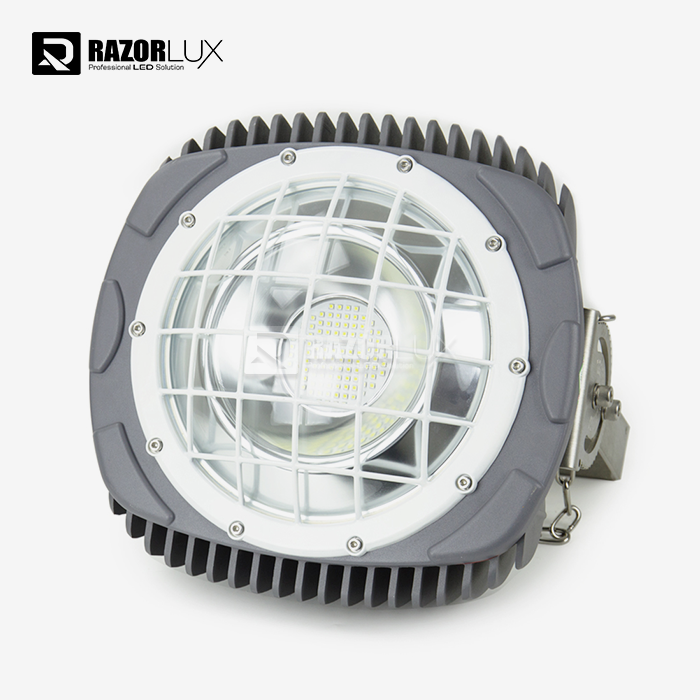
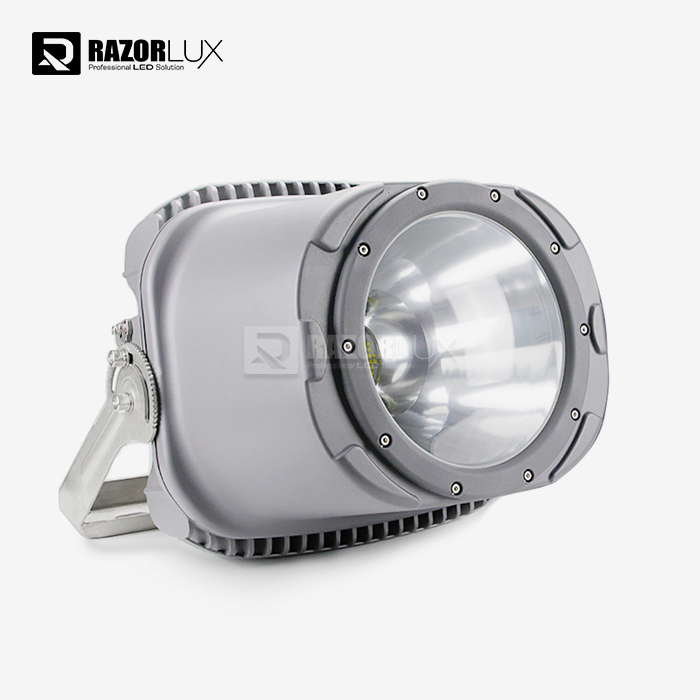
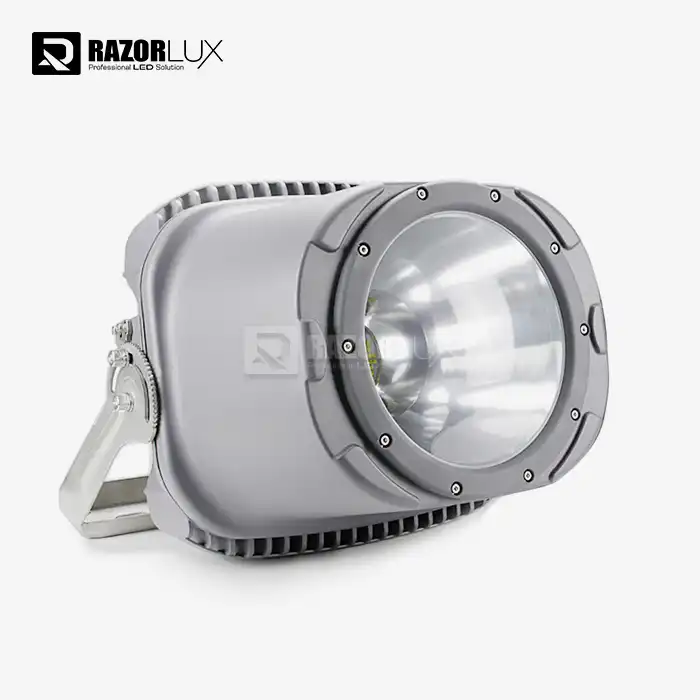
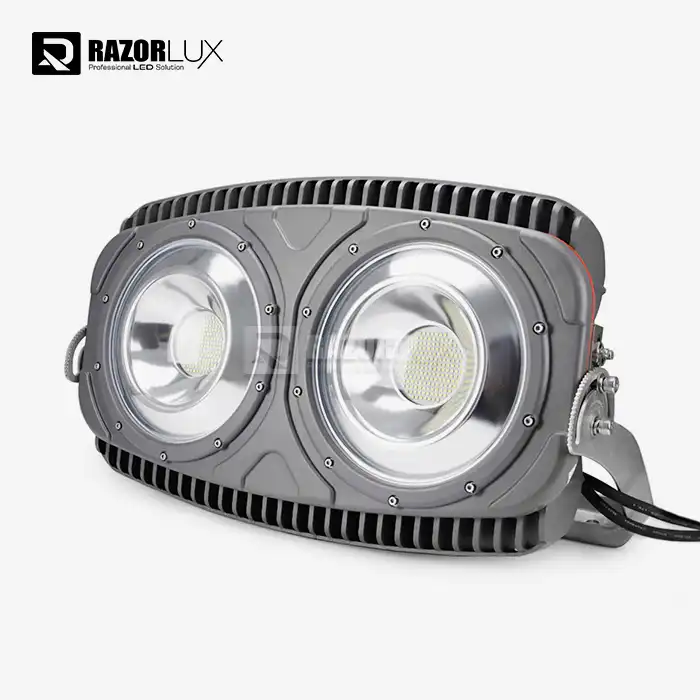
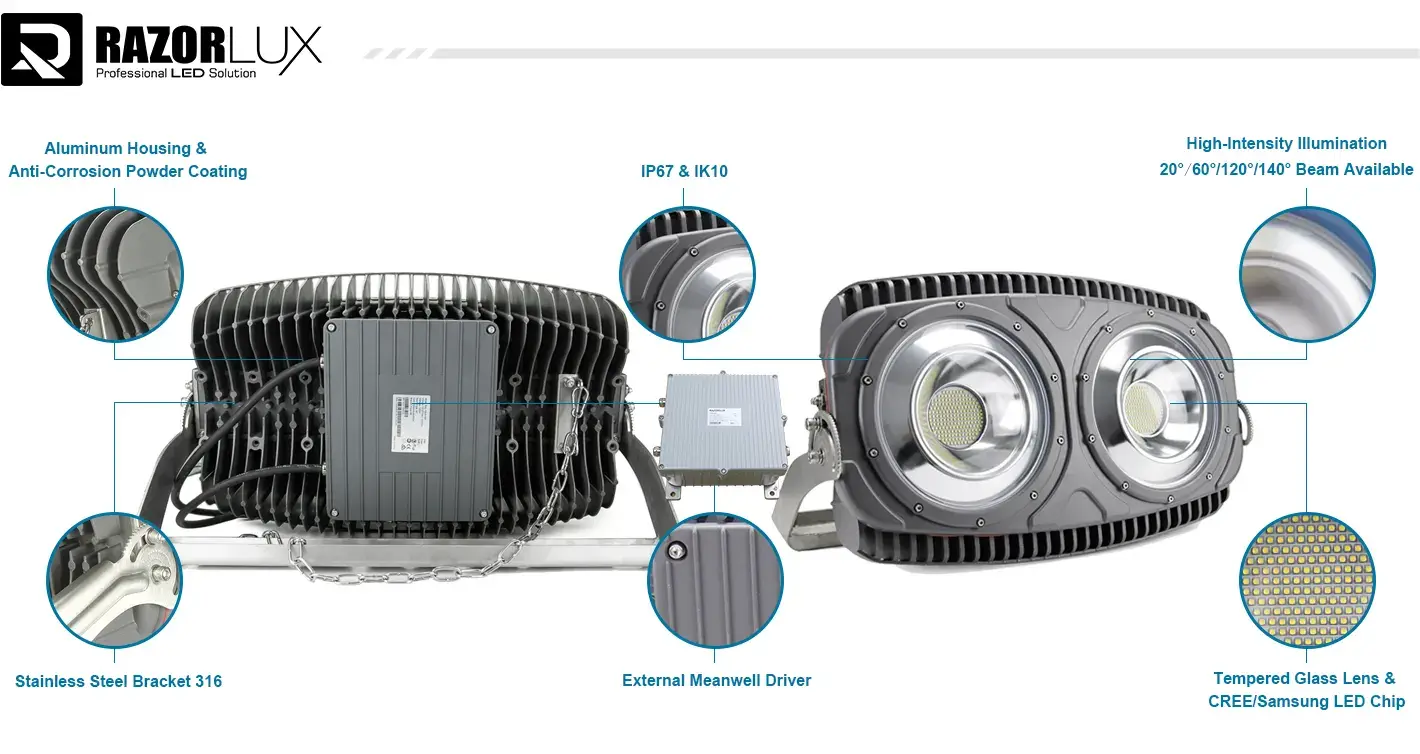
The energy savings of high-output LED lights come from big steps forward in the science of semiconductor lighting. Modern LED chips turn electricity into visible light with very little heat loss, unlike old HID lamps that waste a lot of energy as thermal radiation. Razorlux's RGL-1000A is a great example of this economy. It gets 130,000 lumens of light from just 1000W of power, which used to require 2000–3000W metal halide lamps. Several technical reasons led to this increase in efficiency. To keep the lumen output constant, high-end LED chips use advanced phosphor coatings and junction temperatures that are just right. Integrating Meanwell power sources guarantees steady current flow with power factors higher than 0.98 and overall harmonic distortion lower than 10%. This leads to cleaner power use and less stress on the electrical infrastructure.
Optimized Brightness with Minimal Power Waste
It's not just about brightness per watt when it comes to energy economy; it's also about putting useful light where it's needed. Traditional HID lamps give off light in all directions, so they need shields that either block or redirect a lot of the light they produce. Precision-engineered optics in LED sports lights guide light with beam angles of 40°, 60°, 120°, or asymmetric designs like 140°x60°, making sure that the target area gets the most light. The RGL-1000A's stable flux output of 130,000 lumens after an hour of use shows another important efficiency factor: lumen loss during warm-up is very low. It can take metal halide lights 15 to 20 minutes to get fully bright, and they lose a lot of lumens when they are turned off and on again. LED fixtures can turn on instantly at full brightness, so there is no wasted energy during the start-up phase.
Smart Controls Amplify Energy Savings
HID systems from the past can't work with the smart control methods that newer LED sports lighting systems can. Facility managers can lower the amount of power used during practice, maintenance, or events that don't need as much light by using 0-10V or DALI connections for dimming. In multi-field buildings, motion monitors can turn on zonal lighting, which makes sure that lights only turn on in places that are being used. The RGL-1000A can accept a wide range of voltages as inputs, including AC 80–305V, DC 100–400V, and even high-voltage DC 500–800V. This gives it a lot of options for how it can be used in battery backup and renewable energy systems. Because they are flexible, buildings can take advantage of energy rates based on when they are used and emergency power control strategies that lower costs even more.
Key Features That Drive Energy Cost Reduction
Extended Lifespan Reduces Replacement Costs
When figuring out the total cost of ownership, purchasing managers and building managers always say that upkeep costs are a hidden cost. Usually, traditional metal halide lamps need to be replaced every 6,000 to 15,000 hours, which requires expensive lifts, work crews, and time when the machine isn't working. The RGL-1000A is recommended to work for more than 50,000 hours, which is about 11 years of use at 12 hours a day. This is because it is built to last with die-cast aluminium housings that have been powder-coated and modular LED arrays and driver units that come with their own five-year warranties. The housing comes with a ten-year promise, which shows that the company is confident in its long-term structural stability. When you figure out how much it would have cost to replace a single fixture at a high mast installation, the financial effect is clear: just the labour to change one fixture can cost $500 to $1,500, not counting the cost of the new unit. Compared to metal halide systems, places with 100 lights will not have to repair 15-20 lamps every year. This cut saves between $75,000 and $150,000 over ten years just in maintenance labour costs. It doesn't take into account lost output during service outages or the cost of keeping new parts in stock.
Advanced Thermal Management Preserves Efficiency
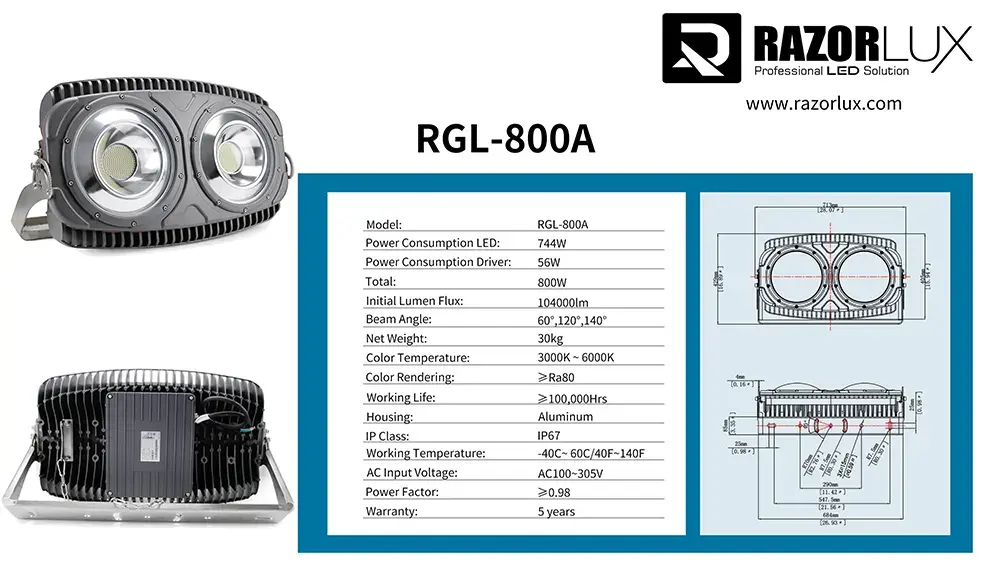
In any lighting setup, heat means lost energy. Good thermal management is directly linked to long-lasting component life and high luminous efficiency. The RGL-1000A has a specially designed heat dissipation system that keeps junction temperatures in the right ranges even when the temperature outside is between -40°C and 60°C (-40°F and 140°F). The aluminium construction acts as a huge heat sink, and the geometric shape of the device creates natural convection paths that improve airflow without the need for fans or active cooling systems. This passive thermal management method cuts down on extra power use and boosts reliability. Active cooling systems add failing points and extra energy use that lower overall efficiency. Sustained thermal performance is very important in tropical areas and indoor arenas that are closed off, where the temperature is already high enough to stress electrical parts. Facilities in places like Singapore, Malaysia, and the Middle East can keep up their performance without the loss of efficiency that comes with things that aren't cooled properly.
Environmental Protection Maintains Peak Performance
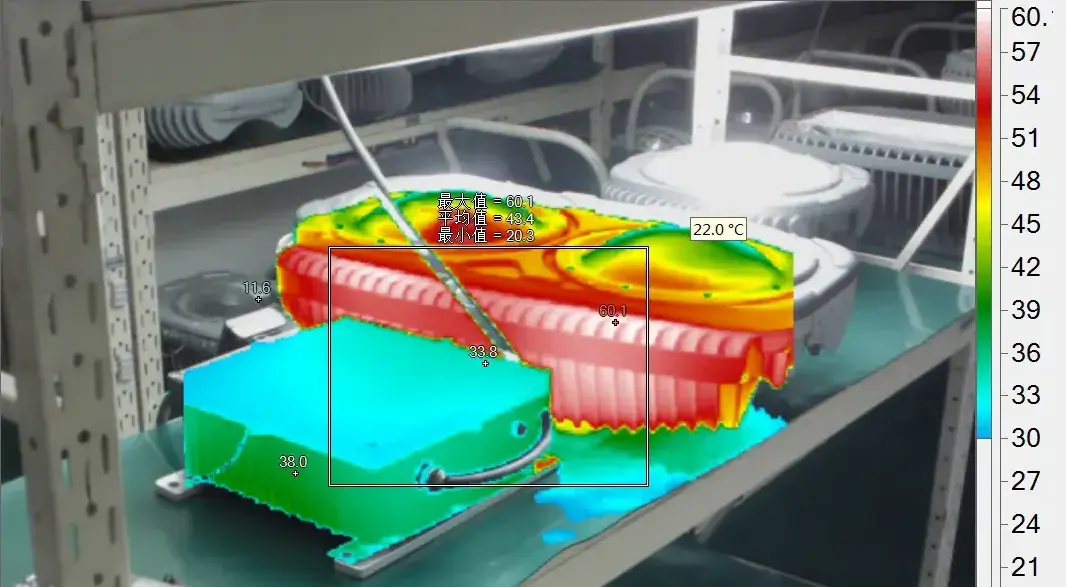
The RGL-1000A has IP65 and, if desired, IP67 ingress protection ratings. These ratings make sure that dust, moisture, and corrosive elements can't get inside the fixture housing and damage the internal parts. This safety is necessary to keep the fixture's energy efficiency over its lifetime because moisture gets into LED chips and control components faster, which both lower the fixture's luminous efficiency. Coastal factories, offshore platforms, and port facilities are especially tough because salt spray makes rusting happen faster. The corrosion-resistant powder coating and stainless steel bracket protect the structure, and the sealed optical compartments keep moisture from building up on the LED arrays. 1000 Watt LED Sports Light Facilities that work in these tough conditions have found that faucets that are properly sealed last 30 to 40 percent longer than those that aren't. This means that the facilities use less energy and don't have to pay for replacements as often.
| Feature | Energy Impact | Cost Benefit |
|---|---|---|
| 50,000+ hour lifespan | Reduces replacement frequency by 70% vs. HID | Savings of $75,000-150,000 per 100 fixtures over 10 years |
| Passive thermal management | Eliminates fan power consumption (20-50W per fixture) | Additional 2-5% energy savings |
| IP67 ingress protection | Prevents efficiency degradation from environmental exposure | Maintains rated performance for full warranty period |
| Wide operating temperature range | Consistent performance without climate control dependencies | Reduces HVAC burden in enclosed spaces |
Practical Applications and Installation Tips to Maximize Savings
Ideal Use Cases for Maximum Efficiency
The RGL-1000A is advertised as sports lighting, but it works really well in many industrial and marine settings where longevity and efficiency are important. Professional sports venues are the most obvious place where high-output LED lighting is used, but it is also useful in dock work areas, container terminal yards, offshore platform helidecks, and big manufacturing facilities. The multi-function design that has been patented works with different mounting options, such as high-mast poles, truss systems, and building-mounted brackets. Managers at the shipyard like how the light doesn't break easily when it hits something or vibrates. The IK10 grade means that the housing can handle mechanical shocks that would break most HID lamp envelopes. This toughness comes in handy in heavy-duty industrial settings where vibrations are constantly caused by crane operations, moving materials, and ships. Port facilities have documented 60-65% energy reductions when replacing 2000W metal halide high-mast lighting with 1000W LED equivalents. A typical container terminal operating 200 high-mast fixtures for 12 hours daily can realize annual electricity savings exceeding $180,000, assuming industrial electricity rates of $0.12 per kWh.
Strategic Mounting and Positioning
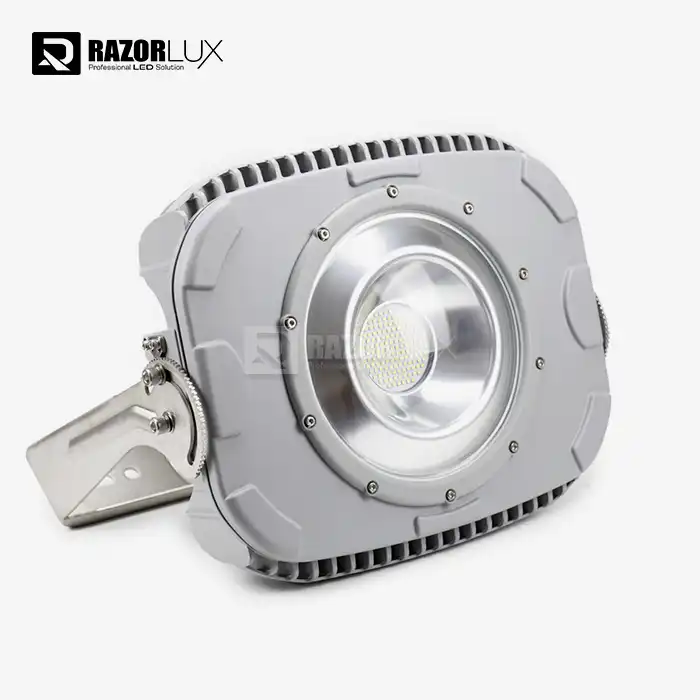
The right placement has a direct effect on both how well the lighting works and how much energy it uses. When figuring out the mounting height, you need to take into account the beam angle. For example, 120° beams are wider and cover a wider area, so they work well at lower mounting heights. On the other hand, 40° beams are narrower and focus the light over longer distances at high-mast installations. With dimensions of 671x405x379mm and a weight of 29 kg, the RGL-1000A needs mounting points that are physically sound, especially at heights above 20 meters where wind loads become important. The stainless steel bracket makes attachment safe and lets you change the angle to get the best light distribution. Facilities should do optical studies to find the best places to put lighting fixtures so that they don't give off too much light. Too much light wastes energy and makes it hard to see. Integration with current equipment is often what determines whether a project is possible. Different types of electrical systems can use the wide input voltage range, so they don't need special transformers or voltage regulation equipment. This flexibility cuts down on construction costs and gets rid of the efficiency losses that come with voltage converters.
Control System Integration
To save the most energy, smart control strategies that match the level of lighting to the needs of the operation are needed. Because it works with 0-10V dimming standards, the RGL-1000A can be connected to building management systems, astronomical clocks, and occupancy monitors. Facilities can set up schedule plans that lower output to 30–50% during times of low activity, which saves the same amount of energy. Multi-zone control is especially useful in big buildings where operations happen at different times. Shipyards can light up active work berths with full intensity while keeping lighting low in staging areas and access roads. Compared to all-on/all-off switching methods, this zonal approach can cut the overall amount of energy used by lights in a building by another 20 to 30 percent.LEDs are efficient, which is good for emergency backup power systems because they lower the need for power when the utility goes out or when the diesel generator is running, which increases the range and fuel reserves. A building with 100 fixtures that each use 1000W needs 100kW of generation capacity, while the same amount of HID lighting needs 200–300kW. This means that during emergencies, the generator will use two-thirds less fuel.
Comparison Insights: 1000 Watt LED Sports Light vs. Alternatives
Energy Consumption Analysis
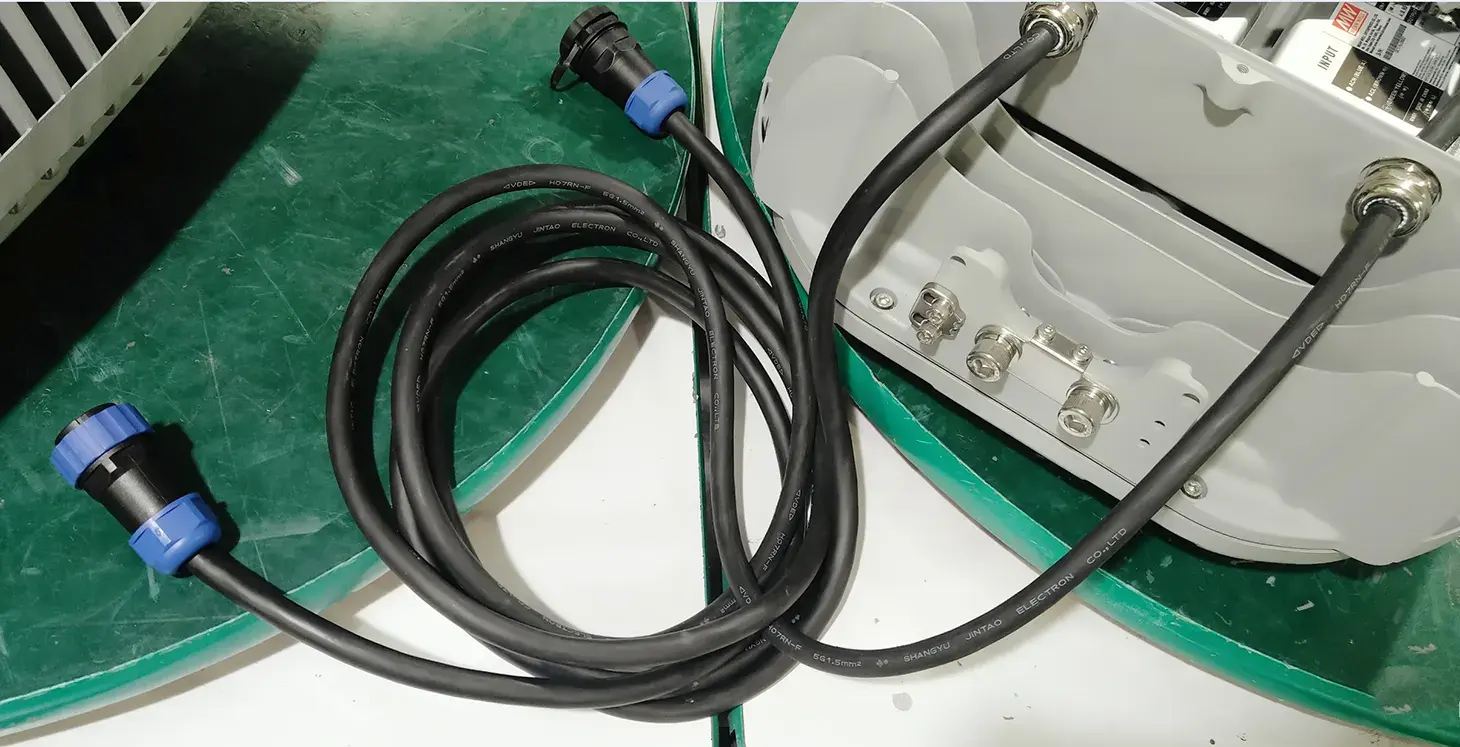
Direct studies of energy use show that LED technology has big practical cost benefits. Along with the light brightness, traditional metal halide systems need to know how much power the ballast is losing, which is another 10 to 15 percent. A 2000W metal halide fixture with a ballast uses about 2200–2300W, while an LED fixture with the same output uses only 1000W. When you add up all the effects on a building's lighting system, they become very strong. Think about a port that runs 150 high-mast fixtures for 4,380 hours a year, or 12 hours a day. When you compare annual energy use, you can see big differences:
Metal Halide System:
- 150 fixtures × 2,200W × 4,380 hours = 1,445,400 kWh annually
- At $0.12/kWh = $173,448 annual electricity cost
LED System (RGL-1000A):
- 150 fixtures × 1,000W × 4,380 hours = 657,000 kWh annually
- At $0.12/kWh = $78,840 annual electricity cost
The $94,608 saved each year is a great return on investment, and the money is usually paid back within two to three years, even when the higher starting costs of the LED fixtures are taken into account. Over the more than 50,000-hour lifespan, this medium-sized facility has saved more than $500,000, which does not include the money saved on maintenance.
Heat Output and HVAC Impact
Energy efficiency is more than just lowering the power used by fixtures. Traditional HID lights give off a lot of infrared radiation, which raises the temperature inside tight areas. Indoor stadiums and covered shipyards have to make up for their lack of ventilation by adding more air conditioning units. This adds to the overall cost of running the business. Compared to how much light they give off, LED lamps give off a lot less direct heat. The RGL-1000A loses 1000W through its heat sink, but this is mostly due to convective heat transfer, which means heat rises away from areas that are being used. Metal halide lamps send out infrared energy that heats the floors and work surfaces directly where people work. After installing LEDs in high-bay uses, buildings with temperature control systems can show that their HVAC energy use dropped by 15 to 25 percent. Depending on the weather in the area, an arena with 80 pieces might need 40–60 tonnes less air conditioning capacity to cool down. This could save an extra $15,000–$25,000 a year in energy costs.
Lifecycle Environmental Impact
As companies set carbon reduction goals and sustainability requirements, environmental concerns are becoming more and more important in their purchasing decisions. LED lighting has real environmental benefits that go beyond just saving energy. Because LEDs last longer, they produce less waste. For example, an LED light that replaces five metal halide lamps over its lifetime will produce 80% less waste. Since LEDs don't use mercury or other dangerous materials, they don't need to be thrown away in a certain way, which saves money and time. Metal halide lights have 15 to 40 mg of mercury per unit, so they need to be handled as hazardous trash, which costs an extra $5 to $15 per lamp to get rid of. 1000 Watt LED Sports Light, by changing 100 lamps every year, businesses can save $500 to $1,500 on the cost of managing hazardous trash. Calculations of the carbon footprint show that LEDs are better throughout the whole lifetime of a product. When normalised to delivered lumens over lifespan, manufacturing energy, operational consumption, and end-of-life disposal all favour LED technology by more than 60%.
| Performance Metric | RGL-1000A LED | 2000W Metal Halide | Advantage |
|---|---|---|---|
| Power consumption | 1,000W | 2,200W (including ballast) | 55% reduction |
| Operational lifespan | 50,000+ hours | 6,000-15,000 hours | 3-8x longer |
| Warm-up time | Instant-on | 15-20 minutes | Eliminates delay |
| Lumen maintenance | L70 @ 50,000 hrs | 60-70% @ 10,000 hrs | Superior consistency |
| Color rendering | Ra>75 (Ra>90 available) | Ra 65-75 typical | Enhanced visibility |
| Hazardous materials | None | 15- 40 mg mercury | Eliminates disposal costs |
Making the Right Procurement Decision
Evaluating Supplier Credentials
Choosing a dependable manufacturer has a direct effect on how much energy you save and how reliably your system works in the long term. Purchasing managers should give more weight to sellers who can show a wide range of certifications, such as CE, RoHS, SAA, C-Tick, UL, DLC, CB, and ISO:9001 quality management systems. These approvals show that safety standards and performance requirements are met in all foreign markets. Since its founding in 1998, Xi'an Razorlux Optoelectronic Technology Co., Ltd. has been a trustworthy producer with over 20 years of experience in LED technology. The fact that the company has more than 200 patents covering LED Packaging, power control, and structure design shows that it can keep coming up with new ideas. Marine-grade certifications, such as DNV/GL and ABS compliance, make sure that products meet the high standards needed for maritime and offshore uses. Where you get your components has a big effect on how reliable and efficient they are. When compared to generic options, suppliers who use Meanwell power sources, Samsung or Cree LED chips, and branded optics offer measurable quality benefits. These parts are put through a lot of tests and come with independent approvals that lower the risk of buying them.
Warranty and After-Sales Support
Total cost of ownership calculations that justify LED investments are protected by warranties that cover everything. The RGL-1000A comes with a five-year warranty on the LED modules and drivers and a ten-year warranty on the housing. This shows that the manufacturer is confident in the product and gives procurement managers peace of mind about risk reduction. In addition to the length of the warranty, you should also look at how quick and technically skilled the seller support teams are. Facilities that work in remote areas or specialised fields need suppliers that know how to deal with problems that are unique to their applications and can offer quick technical advice. Razorlux offers more than just selling products. Their specialised expert support helps with things like installation, photometric formulas, and integrating control systems. Technical teams can check the claims of performance of sample evaluation programs before agreeing to large-scale buying. Progressive suppliers offer evaluation units that can be tested in the field under real operating conditions. This lets engineering departments check the lumen output, thermal performance, and environmental resilience. Facilities that are switching from HID to LED technology for the first time find this evaluation process very helpful.
Bulk Purchasing Strategies
Volume pricing structures and coordinated delivery schedules are good for big projects. Framework deals should be made so that prices stay the same over multiple years for shipyards building multiple ships, port expansions needing hundreds of fixtures, or industrial site retrofits. Razorlux can be customised to fit different needs, such as changing colour temperatures (between 2700K and 6500K), beam angles, and fixing bracket arrangements. This gives facilities the freedom to stick with a single supplier while still meeting the needs of a wide range of applications across their infrastructure. Logistics of delivery have a big effect on project timelines. Buying from suppliers who keep enough stock on hand and offer a range of shipping choices, such as air freight for pressing needs and consolidated sea freight for bulk orders that need to be as cheap as possible, has benefits that go beyond unit pricing.
Conclusion
Energy cost reduction through lighting represents a proven strategy backed by measurable performance data and documented facility savings. 1000 Watt LED Sports Light The RGL-1000A has an instant-on feature, 130 lumens per watt economy, and a lifespan of 50,000 hours or more. These features together lower running costs by 55 to 70 percent compared to traditional HID options. In addition to saving energy right away, the overall cost benefits are increased by fewer repairs, no more hazardous waste removal, and lower HVAC loads. When purchasing managers look at lighting upgrades, they should give more weight to suppliers that offer full certifications, high-quality parts, and technical support that guarantees long-term performance and dependability.
FAQ
Can the RGL-1000A Directly Replace Our Existing 2000W Metal Halide Fixtures?
Absolutely—the RGL-1000A provides equivalent or superior illumination to 2000-3000W metal halide systems while consuming only 1000W. The higher directional efficiency of LED optics compensates for lower nominal wattage, typically delivering 20-30% greater on-surface illumination levels. Mounting brackets accommodate standard pole configurations, though you should verify structural adequacy for the 29kg fixture weight and wind loading characteristics.
What Dimming Control Options Are Available?
The RGL-1000A supports 0-10V analog dimming protocols compatible with most building management systems and lighting control panels. DALI digital control integration is available through customization for projects requiring addressable fixture control. Dimming capability extends from 10-100% output, enabling energy savings during low-activity periods while maintaining instant return to full brightness when required.
How Does Performance Change in Extreme Temperatures?
Actually, LEDs work better in cold places—in the north, buildings often measure 5-8% higher lumen output at -20°C compared to 25°C ambient conditions. The RGL-1000A's rated operating range of -40°C to 60°C ensures consistent performance across virtually all global climates. The Meanwell power supply incorporates temperature compensation to maintain stable output across this wide range.
What Certifications Support Our International Projects?
The RGL-1000A carries CE, RoHS, SAA, C-Tick, UL, DLC, CB, and ISO:9001 certifications, enabling deployment across European, North American, Australian, and Asian markets. For marine applications, we provide DNV/GL and ABS compliance documentation. Our technical team can supply region-specific test reports and compliance declarations to support your procurement documentation requirements.
Partner with Razorlux for Your Next Lighting Project
With tested 1000 Watt LED Sports Light solutions backed by over 20 years of engineering excellence, Xi'an Razorlux Optoelectronic Technology Co., Ltd. is ready to help you achieve your energy efficiency goals. Our RGL-1000A model has the durability, efficiency, and dependability that heavy-duty, maritime, and industrial applications around the world need. As a reliable LED sports light maker, we offer full technical documents, the ability to make changes, and quick customer service to make sure your project goes well. Email our technical sales team at sam@razorlux.com to talk about your unique needs, ask for performance estimates, or set up an evaluation of a sample. Let us show you how Razorlux lighting solutions can help you save money on energy costs and improve the way your business works.
References
1. U.S. Department of Energy. "LED Lighting for Sports and Recreation Facilities: Energy Savings and Performance Benefits." Building Technologies Office, 2022.
2. International Dark-Sky Association. "Best Practices for Outdoor Sports Lighting: Balancing Performance, Energy Efficiency, and Environmental Impact." Technical Publication IDA-TP-2021-04.
3. Maritime and Coastguard Agency. "Code of Safe Working Practices for Merchant Seafarers: Lighting Requirements for Shipboard Operations." Chapter 18, 2023 Edition.
4. Illuminating Engineering Society. "Recommended Practice for Sports and Recreational Area Lighting." ANSI/IES RP-6-21, 2021.
5. Logistics Management Institute. "Total Cost of Ownership Analysis for Industrial LED Lighting Retrofits in Port Facilities." LMI Research Report NS905T1, 2022.
6. Society of Naval Architects and Marine Engineers. "Electrical Systems Design for Modern Shipyards: Energy Efficiency Standards and Best Practices." SNAME Technical Paper T&R-2023-12.