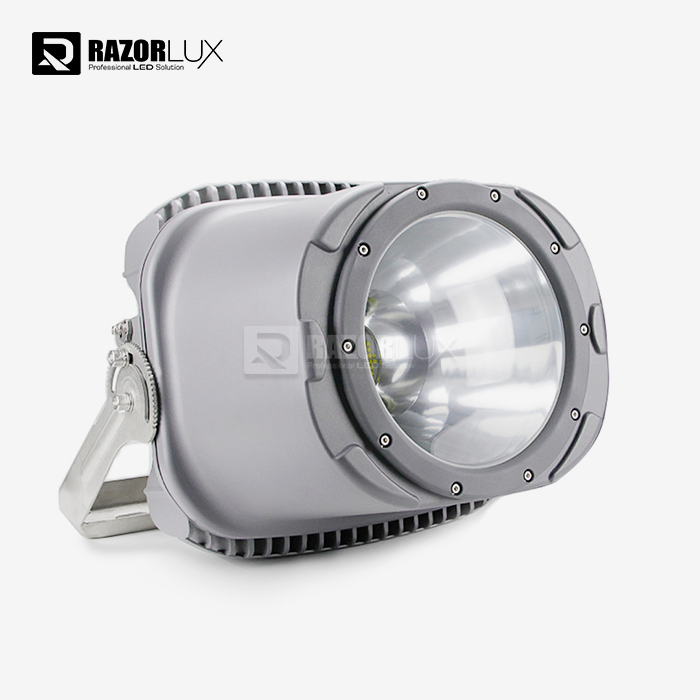


_1750326878398.png)

How Long Does a Waterproof LED Flood Light 400W Actually Last?
When you're managing a shipyard, offshore platform, or port facility, lighting isn't just about visibility—it's about safety, productivity, and cost control. A Waterproof LED Flood Light 400W.Buying something has a lot of costs. The question "How long will it last?" has a direct impact on these costs. Many people and companies that use 400W LED flood lights say that they should last between 50,000 and 100,000 hours, or 11 to 22 years if they are used all the time. But this number changes a lot based on where the parts are, how good they are, and how well they are taken care of. Buyers can keep their money and processes safe by using these numbers as a guide.
Understanding the Lifespan of Waterproof LED Flood Light 400W
Knowing How Long a Waterproof LED Flood Light 400W Will Last
What Determines LED Flood Light Longevity?
Three important parts must work together for industrial LED lights to last as long as they should. The light power of an LED chip from a good company like Samsung or CREE can last for 50,000 hours and still be 70% of what it was at first (L70). The motor is under the most stress when the machine is going because it is in charge of power. A good motor from Meanwell or Inventronics doesn't break down too quickly because it is designed to be safe at high temperatures, reduce voltage surges, and keep the voltage stable.
The Role of IP67 Rating in Lifespan Extension
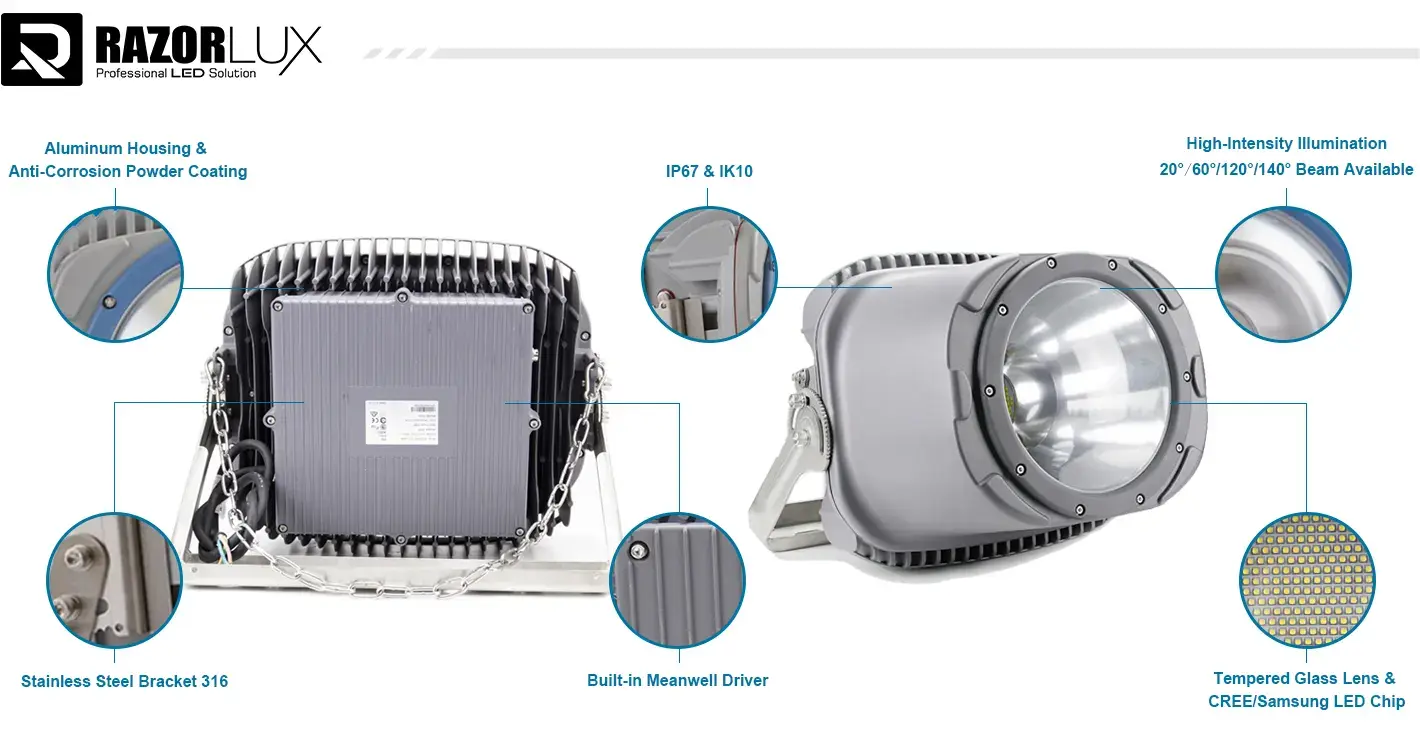
The number IP67 doesn't just mean that something can handle rough conditions; it also means that it will last. The number "6" means that there is no way for dust to get in, so small particles can't hurt the inside. As long as you stay out of the water for thirty minutes, the "7" number means you are safe. You'll need this to clean decks, be outside in the rain, and get sprayed.
How Operating Voltage Range Affects Durability
Good units have an input voltage range of AC90-305V or DC127-431V, which keeps the grid stable and makes the unit last longer. Electricity always changes in docks and other work areas. These changes happen when heavy machinery starts up, when welding tools are used, and when generators are turned on and off. When there is a brownout, a strong generator that changes the voltage on its own keeps the current steady. During jumps, this keeps the LED chips from working too hard. Electrical links and solder joints break down over time because they stretch and shrink. This voltage resistance slows down thermal cycles.
Luminous Efficacy and Its Connection to Longevity
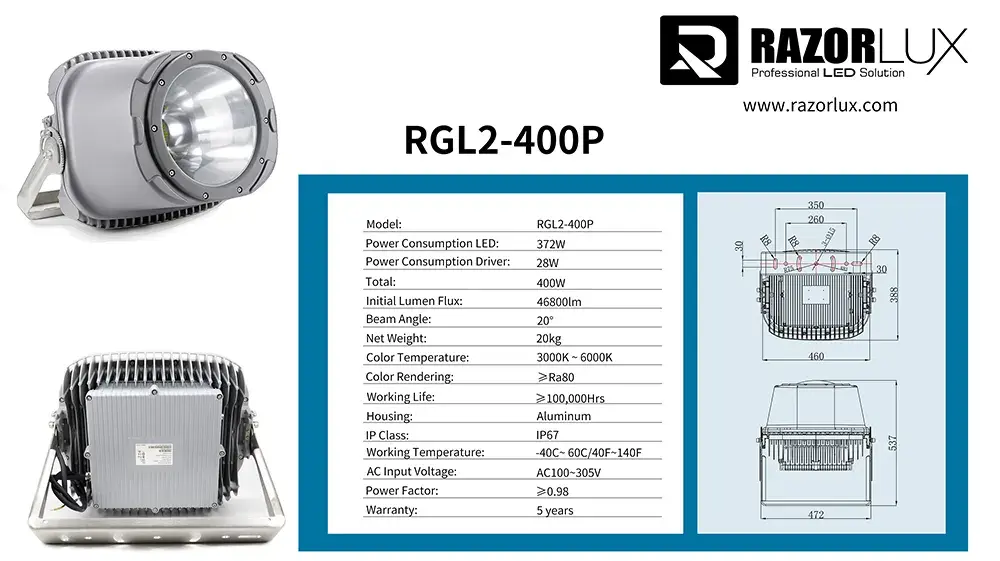
Lumens per watt (lm/W), which measure luminance efficacy, is a good way to tell how good something is overall. The Razorlux RGL2-400P can produce 130 lumens per watt and 48,000 lumens of stable light once the temperature is balanced. When something is more efficient, it wastes less energy as heat, which makes the parts less stressed by heat. Low-quality lights that say they are 400W but only produce 90–100 lm/W make too much heat, which speeds up the failure of the LEDs and drivers. This difference in efficiency is what makes cheap fixtures break after only 20,000 hours and designed solutions last longer than 80,000 hours.
| Important Parts | Indicator of Quality | Changes in Lifespan |
|---|---|---|
| LED Chips | Samsung/CREE vs. other brands | 30,000 hours vs. 80,000 or more hours to L70 |
| Driver | Electronics vs. basic Meanwell | Protection from surges and temperature control |
| Housing | Whether it's die-cast aluminum or stamped steel | How well heat is cooled |
| System for sealing | Rubber vs. silicone seals and ePTFE | Stopping moisture from getting in |
| Interface for Heat | Paste for heat or air gaps | Temperature control at the junction |
Expected Operational Hours in Marine Environments
Real-world data from installations offshore shows that Waterproof Led Flood Light 400Ws that are properly specified last between 60,000 and 85,000 hours in salt spray, high humidity, and changing temperatures. This means that it will work nonstop for 12 to 15 years. But parts that don't have enough rust protection (like C5 powder coating or stainless steel brackets) start to break down after three to five years, and they actually fail after 25,000 to 35,000 hours. Investing in marine-grade building pays off because it doesn't need to be replaced as often and costs less to maintain.
Performance Factors Affecting Waterproof LED Flood Light 400W Durability
The first line of defense against natural attack is the building material. The ADC12 die-cast metal is better at transferring heat while still keeping its shape.
Driver Quality and Electrical Protection
The driver makes up 30–40% of the cost of the fixture but decides how reliable it is in tough circumstances. Premium drivers have a lot of safety features that make fixtures last a lot longer. Harmonic distortion is lessened and grid compatibility is improved by active power factor correction (PFC >0.98). Lightning strikes are common in open installations, so surge protection rated to 10kV line-to-neutral and 20kV line-to-ground protects against them. When temperatures get too high, thermal derating instantly lowers output to avoid a catastrophic failure. Our failure mode study shows that 55% of early breakdowns are caused by drivers that don't have these features.
These safety features work together to make it stronger:
- Constant Current Regulation: Keeps the LED drive current fixed even if the input voltage changes. This stops heat stress from current changes.
- Soft-Start Circuitry: Slowly turns on the LED array, preventing sudden current spikes that can damage solder joints and chip connections.
- Short-Circuit Protection: Turns off output automatically when fault conditions arise, stopping fails that damage multiple parts.
- Over-Temperature Shutdown: Checks the temperature of the driver case and turns off the output before critical temperature levels damage internal parts.
Procurement managers should check that these safety standards are included in technical paperwork when they look at driver specs. A basic driver costs 15-20% more than a protected unit, but the protected unit has a mean time between failures (MTBF) of 100,000 hours or more, while the basic driver only lasts 30,000 hours.
Environmental Stress Factors in Marine Applications
Lighting in marine settings is subject to factors that speed up the aging process. Salt spray leaves behind conductive layers that help surfaces track and rust. Unless UV-stabilized formulations are specified, UV radiation from the sun breaks down lens materials and polycarbonate parts. Temperature changes from -40°C at night to +60°C in the sun are called thermal cycling. They wear down materials by making them expand and contract. Ship engines, cranes, and waves all cause vibrations that break solder joints and loosen connections. Figuring out the right environmental grades and building standards depends on knowing these stress factors.
| Factor of the Environment | Method for Degradation | Plan a countermeasure |
|---|---|---|
| Salt Spray | Electrochemical wear and tear | Hardware made of 316SS and C5 powder coating |
| Sunlight (UV) | Breakdown of polymers | UV-protected PC glass and layers for protection |
| Changing the temperature | Material wear and tear, seal failure | Silicone seals and a metal body |
| How humid it is | Corrosion and condensation | An air-permeable membrane and a conformal coating |
| Vibration | Joint failure and connection loosening | Lock washers and electronics in pots |
Maintenance Practices That Extend Service Life
Routine maintenance greatly increases the life of an activity beyond what is specified. Every three months, the lens should be checked for clarity, corrosion on any uncovered areas, and that the fixing hardware is still in place. A deep cleaning once a year gets rid of salt buildup and other contaminants that speed up the breakdown process. Thermal image scans find units that are working at high temperatures before they break down completely. Changing the gasket every 5 years keeps the IP rating valid. We have proof of instances where fixtures rated for 60,000 hours worked for 95,000 hours or more thanks to strict upkeep plans, while installations that weren't cared for failed after 35,000 hours.
Comparing Waterproof LED Flood Light 400W with Other Options
Comparing Other Options to the Waterproof LED Flood Light 400W
Fixed vs. Motion-Sensor-Enabled Systems
Adding motion monitors or smart controls cuts down on working hours, which in turn increases the fixture's lifespan. A sensor-activated system that runs for two hours a day instead of twelve hours increases the life of a 50,000-hour fitting from eleven years to sixty-eight years. However, other parts will wear out regardless of how much they are used. The energy savings are big: a Waterproof LED Flood Light 400W that runs for two hours instead of twelve hours a day saves about $190 a year. But sensor reliability in marine settings is a problem; salt buildup on PIR sensors leads to false triggers, and radar-based sensors cost an extra $120-180 per post. Check to see if the organizational trends are worth the extra complexity and cost.
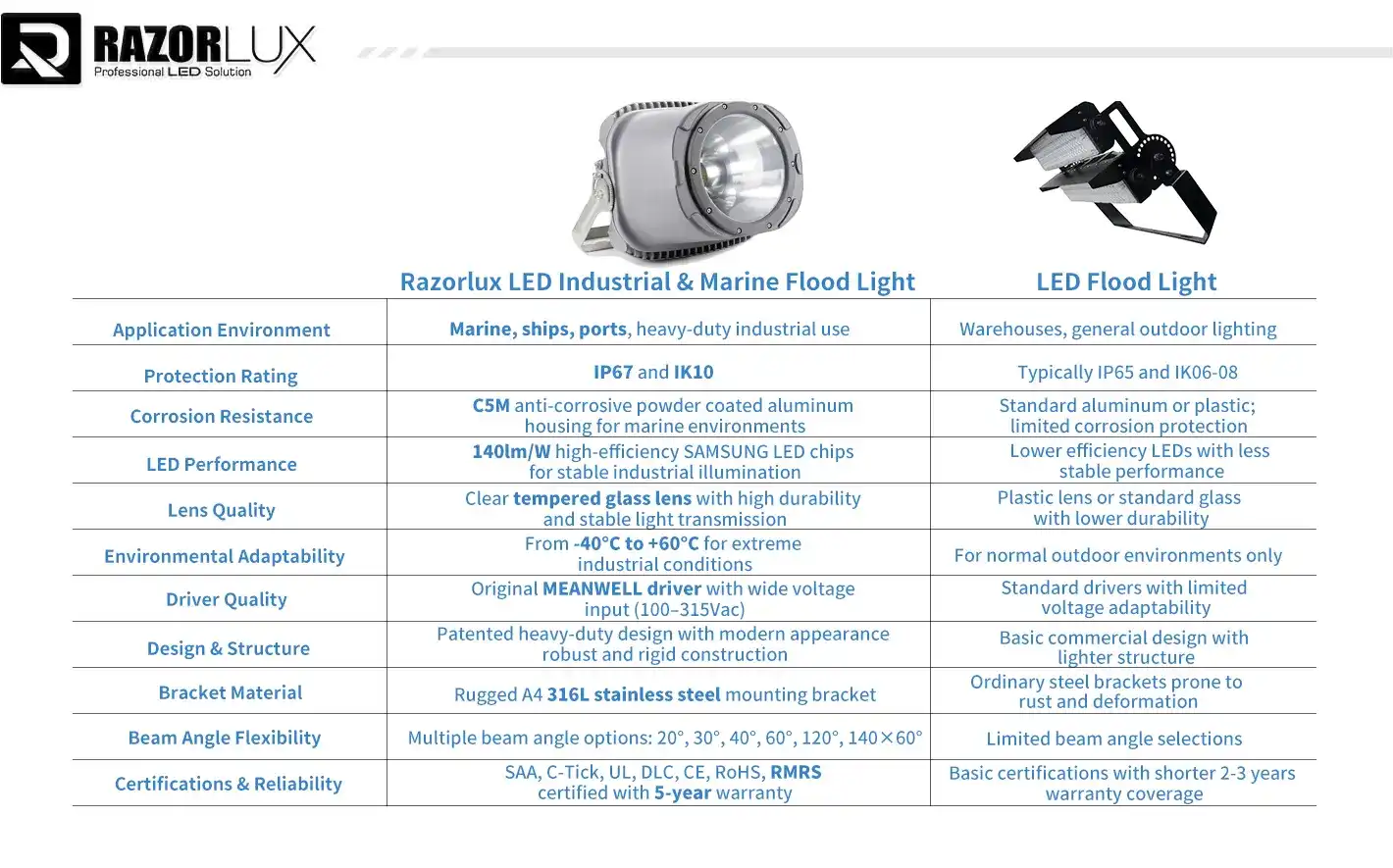
Because of these trade-offs, it's important to carefully look at the needs of each site:
- Continuous Operation Zones: Non-switched, dusk-to-dawn operation is good for loading docks, navigation channels, and security perimeters.
- Intermittent Use Areas: Occupancy sensing saves a lot of money in places like storage yards, repair bays, and alternative entry routes.
- Emergency Backup: As a backup plan in case of an emergency, important safety lights should keep working on their own and not be switched on and off.
Smart control systems also let you monitor failing fixtures from afar, so you can fix them before they break completely. This way, you can schedule maintenance instead of waiting for an emergency to happen.
Brand Comparison and Quality Indicators
To tell the difference between trustworthy manufacturers and commodity suppliers, you need to look at certain technical factors. Well-known brands like Razorlux, Philips, and Dialight release detailed photometric data (IES files), offer third-party testing certifications (DLC Premium, UL, DNV-GL), and name the brands of the parts they use (Meanwell drivers, Samsung chips). Generic suppliers often don't have test data that can be checked, use parts that aren't branded, and give only vague certifications. This difference in quality can be seen in the prices: professional-grade 400W fixtures cost between $380 and $680, while standard units cost between $120 and $220. Total cost of ownership analysis always favors high-quality units; the extra money spent at the beginning is paid back in two to three years by fewer problems and less upkeep.
| Factor of Comparison | High-end LED (Razorlux RGL2-400P) | HID 1000W Metal Halide | Generic LEDs on a Budget |
|---|---|---|---|
| Initial Cost | $580 to $620 | $450 to $520 | $180 to $240 |
| Annual Energy Cost (12hr/day) | $210 | $525 | $210 |
| Lifespan (hours) | 60,000 to 80,000 | 10,000 to 15,000 | 25,000 to 35,000 |
| Maintenance Frequency | 10 to 15 years | Two to three years | 4-6 years old |
| Light Output | 48,000 lm | 45,000 to 50,000 lm | 38,000 to 42,000 lm |
| Cost Over 10 Years | $2,700 to $2,900 | $6,850 to $7,400 | $3,800 to $4,600 |
OEM Customization and Project-Specific Solutions
Large purchases are helped by OEM customization options that make fixtures work best for certain uses. Changing the beam angle (15°, 30°, 60°, 120°, or uneven distributions) lets more useful light shine through and less wasteful light escapes. The choice of color temperature (2700K warm to 6500K cool) affects how well you can see in fog and how comfortable the crew is during long operations. Voltage specification matching site electrical systems (110V, 277V, 480V) gets rid of the need for transformers. Customizing mounting brackets lets you meet the needs of different structures. These changes can be made by manufacturers with in-house engineering teams and flexible production, but importers and wholesalers usually only offer stock configurations.
How to Maximize the Lifespan of Your Waterproof LED Flood Light 400W
How to Make Your Waterproof LED Flood Light 400W Last as Long as It Can
Maintenance Protocols and Inspection Schedules
Systematic maintenance programs find new problems before they become major problems. Set up eye checks every three months to look for damage to the lens, corrosion in the case, loose mounting, and broken cables. Use light meters to take yearly photometric readings to find lumen loss that is greater than the standard aging curve. Every two years, use infrared cameras to do thermal scans to find units that are running too hot, which could mean that the drivers are under a lot of stress or the thermal interface is breaking down. In places with a lot of dust or salt spray, clean the lenses every six months. If dirt and dust build up, output drops by 15 to 30 percent and heat absorption goes up. Document inspection findings to trend performance and predict replacement needs.
The maintenance list should include these specific things to check:
- Visual Inspection: Check visually for damage, rust spots, discoloration, or warping of the lens and case.
- Electrical Testing: Make sure the input voltage stays stable, check the current draw to see if the driver is breaking down, and make sure the ground connection is solid.
- Thermal Assessment: Write down the temperatures of the housing's surfaces and compare them to readings taken at the start of the fitting process.
- Photometric Testing: Find the illuminance at certain points and compare it to the data from the initial commissioning to find out how much lumen depreciation there is.
- Seal Integrity: Check the compression set of the seals, the tightness of the cable glands, and the breathing membrane to make sure it's not blocked.
Maintenance tasks should be carefully recorded, creating archives that help find broken fixtures and guide decisions about what to buy for future projects.
What to Expect When Buying Waterproof LED Flood Light 400W
Waterproof LED Flood Light 400W: What to Look for
Price Ranges and How Cost Affects Quality
The Waterproof LED Flood Light 400W market is split into different quality levels, each with its own price range. Economy lights, which cost between $120 and $240, have common LED chips, basic drivers, and very little environmental protection. They should only be used in protected, non-critical areas. Mid-range models, which cost between $280 and $420, have named drivers and better thermal control to meet the needs of most industries. Premium marine-grade fittings, which cost between $480 and $720, have the best parts, are fully certified, and offer C5 corrosion protection. These are necessary for offshore bases, factories, and important infrastructure. The difference in price is due to the quality of the parts, which directly affects how reliable they are. A $600 fixture that lasts 80,000 hours is a better value than a $200 unit that breaks after 25,000 hours.
Bulk Ordering Advantages and Volume Pricing
Large-scale purchases bring about big economic benefits that go beyond lowering unit prices. When you order 50 or more units, you usually get 12 to 18% off the list price, and when you order 200 or more units, you may get 22 to 28 percent off. In addition to lower prices, ordering in bulk lets you make useful changes, such as standard mounting brackets that make installation easier, pre-programmed color temperatures that work best for certain tasks, and custom beam angles that make coverage more effective. When you combine your shipping, you save money on freight costs and import taxes. Setting up framework agreements with suppliers guarantees stable prices, faster reordering for maintenance stocks, and priority allocation during supply shortages.
When negotiating good terms for bulk purchases, you should pay attention to these important points:
- Tiered Pricing Structure: Set clear breakpoints at 50, 100, 200, and 500 units, and lock in discount rates for 12 to 24 months. This is called a tiered pricing structure.
- Payment Terms: Ask for longer terms (Net 60–90) for big orders to reduce the impact on your working capital and keep your relationships with suppliers.
- Delivery Scheduling: Set up deliveries at different times to match the stages of the project. This way, you can avoid storage costs and capital tie-ups while getting volume prices.
- Quality Control: Need pre-shipment inspection reports, sample tests, and acceptance criteria with ways to reject or replace items that don't meet the standards.
Certification Requirements for Marine Applications
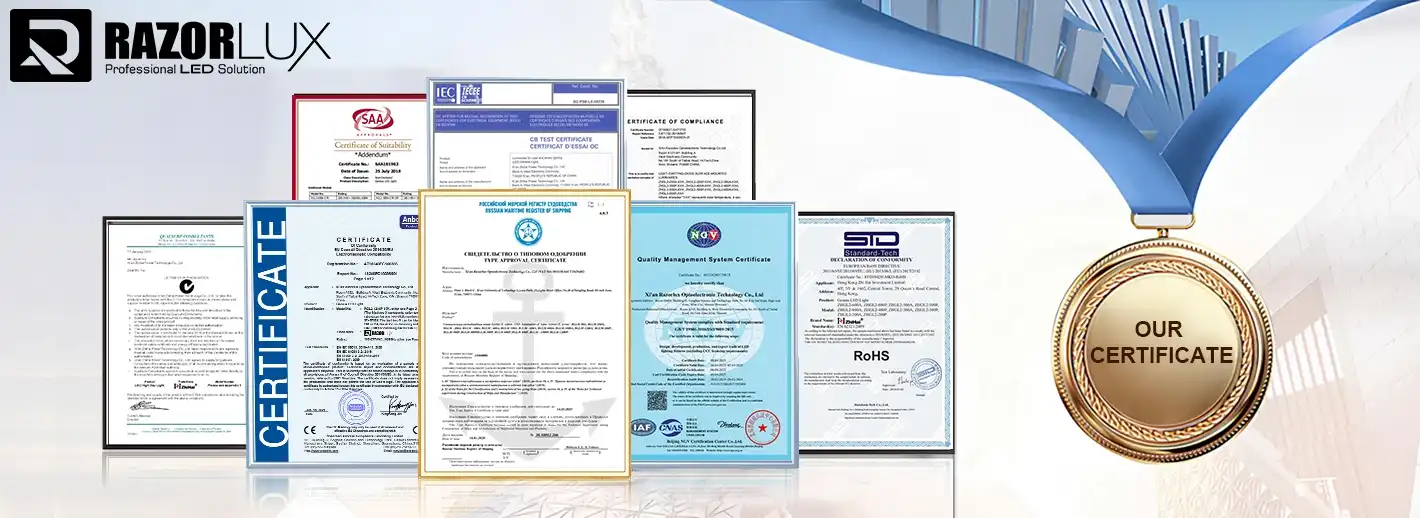
In addition to normal electricity safety approvals, marine systems need certain certifications. DNV-GL (Det Norske Veritas - Germanischer Lloyd) type approval makes sure that equipment meets the standards for vibration, electromagnetic compatibility, and resistance to the environment in the marine business. The American Bureau of Shipping (ABS) certification also confirms that something is suitable for use at sea. Hazardous area installations (Zone 1/2 or Division 1/2) on chemical tankers, gas carriers, or petrochemical facilities will need to be certified by either ATEX or IECEx. Following RoHS and REACH rules protects the Earth. Make sure that the certifications cover the whole fixture. Some sellers only get approval for the parts they sell, leaving you open to risk.
| Type of Certification | Sent By | Validates | Needed for |
|---|---|---|---|
| Type Approval from DNV-GL | The Norwegian Veritas | Environmental resistance in the maritime | Ships and platforms in the ocean |
| Certification for ABS | The American Shipping Office | Standards for the marine industry | Installations on ships |
| UL 844 and UL 1598 | Laboratories for Underwriters | Electrical safety and places that could be dangerous | Places in the US |
| IECEx/ATEX | European Union / World | Safety in an explosive environment | Zones with danger |
| CE | Conformity in Europe | EU rules on product safety | The European market |
| Testing for IP67 | Separate test labs | Verification of ingress protection | Use on or off the water |
OEM vs. Off-the-Shelf Solutions
Standard stock items work well most of the time, but OEM customisation meets certain needs that make it worth the money to spend on development. Off-the-shelf parts are cheap and ready to use right away because they are mass-produced. Also, they've been checked out and shown to work well. With OEM development, changes can be made based on the application. For example, beam patterns can be made to fit odd mounting forms, controls can be built in to make installation easier, and environmental protection can be improved above and beyond standard ratings. The OEM needs to send us at least 100 to 200 units, and the lead time is 8 to 12 weeks. Prices also go up by 10 to 15 percent. When a project has standard needs that cover more than one step, OEM funding is the best way to go. Setting up something that will only be used once rarely makes the costs of customisation worth it.
After-Sales Support and Warranty Considerations
The guarantee terms make it clear that the company that made the thing is sure it will work well. You can get full warranties on LED modules, drivers, and housings for a certain amount of time. Most of the time, they cover housings for 10 years and LEDs and motors for 5 years. With the guarantees, you can also get new parts and Packaging. Be very careful with the parts of the warranty that don't cover things like bad fit, power changes, or weather that isn't what the maker says it can be. Check out the site for help after the sale. Service centers in the United States are better at replying quickly than sellers who only sell things from other countries. Technical support, such as help with making apps, fixing issues, and following the steps for downloading, is useful for as long as a product is made. You should look at cases from businesses like yours to make sure that guarantee claims are handled quickly and that customer service is good.
Conclusion
In conclusion, a Waterproof LED Flood Light 400W is a smart investment for marine and industrial facilities that want to run more efficiently and safely. When properly designed, fitted, and kept, quality fixtures with 60,000 to 80,000 operational hours will give you 12 to 18 years of solid service. The difference between high-end and low-cost goods comes from basic differences in the quality of the parts, thermal engineering, and environmental protection. These are the differences that decide whether your investment works perfectly for ten years or needs to be replaced at great cost every three to four years. Total cost of ownership should be more important than starting price, thorough certifications should be more important than general claims, and supplier support skills should be more important than transactional relationships when making procurement decisions. Knowing the technical factors that affect how long LEDs last lets buying managers choose solutions that stick to budgets, keep operations running smoothly, and meet safety goals in harsh naval and industrial settings.
FAQ
How does the IP67 grade change the life of an LED flood light?
The IP67 rating directly extends operational life by keeping out the outside elements that cause 60–70% of early failures. The "6" (dust-tight) keeps out rough particles that wear down circuit boards and connections. The "7" (which is protected against short-term soaking) keeps water out, which would otherwise cause rust, short circuits, and condensation on optical surfaces. If you live near the coast and there is salt spray, the difference between IP67 protection and lower ratings is 10 years or more of reliable use versus failure within 2 to 3 years. Using silicone gaskets, marine-grade cable glands, and breathable membranes to properly seal the device will keep it safe for a long time. This is because breathable membranes stop pressure differences that push water past seals.
Should I hire professionals to put in my 400W LED flood light, or can I do it myself?
How hard it is to install depends on how skilled the electrician is and how the spot is set up. Experienced maintenance staff can easily make simple replacements on existing mounting structures with easy-to-reach wiring by following the manufacturer's instructions. Professional installation is recommended for new setups that need to be analyzed for structural mounting, electrical load estimates, or to meet the requirements of marine classification societies. 25% to 30% of warranty claims are turned down because the installation was done wrong, such as the mounting being in the wrong place or the cables not being supported properly or being over-torqued.
How long is the guarantee on waterproof LED flood lights made for businesses?
Marine LED fixtures made for professionals usually come with 5-year warranties on the LED modules and drivers and 10-year warranties on the aluminum housings and mechanical parts. Different parts have different lifespans. For example, electronic parts are put under a lot of stress during use, while corrosion-resistant housings last longer than electrical parts. Most economy products only cover you for one to three years, which shows that the company isn't sure how long the parts will last.
Partner with Razorlux for Long-Lasting Marine LED Solutions
You can trust Razorlux as a producer of Waterproof LED Flood Light 400W because they have over 20 years of experience making high-quality lighting for tough environments. Our RGL2-400P series has 130lm/W efficiency, IP67/IK10 protection, and Meanwell drivers to deliver 60,000+ operational hours in the most demanding marine and industrial applications. Backed by RMRS, DNV-GL, UL, and CE certifications, our fixtures serve shipyards across Norway, offshore platforms in the North Sea, and industrial facilities in Singapore. We offer complete project support—from lighting design calculations and technical specifications to bulk order customization and responsive after-sales service. Contact our technical team at sam@razorlux.com to discuss your specific requirements, request photometric data and IES files, or arrange sample testing. Whether outfitting a new vessel, upgrading port infrastructure, or replacing aging HID systems, Razorlux delivers proven solutions engineered for the long haul.
References
1. Illuminating Engineering Society. "Recommended Practice for Lighting Maritime Facilities." IES RP-12-21, 2021.
2. International Electrotechnical Commission. "Degrees of Protection Provided by Enclosures (IP Code)." IEC 60529:2013+AMD1:2020.
3. U.S. Department of Energy. "LED Luminaire Lifetime: Recommendations for Testing and Reporting, Third Edition." DOE SSL Program, 2021.
4. Det Norske Veritas. "Environmental Conditions and Environmental Loads." DNV-RP-C205, 2019.
5. ASSIST Recommends. "Luminaire Reliability, Durability, and Quality Specifications for LED Systems." Volume 11, Issue 1, Alliance for Solid-State Illumination Systems and Technologies, 2020.
6. National Electrical Manufacturers Association. "Application Gu