


_1750326878398.png)

Industrial LED Flood Lights Outdoor Buying Guide for Businesses
To choose the best industrial-grade outdoor flood lighting, you need to carefully consider its technical specs, how long it will last in the elements, and how much it will cost in the long run. Industrial Led Flood Lights Outdoor are designed to provide better lighting in tough places like docks, offshore platforms, ports, and big manufacturing plants. Unlike most industrial fixtures, these light fittings have better thermal management, housings that won't rust, and higher ingress protection ratings (IP65/IP67) so they can handle salt spray, high temperatures, and mechanical impact. This guide talks about important things that purchasing managers, marine equipment integrators, and lighting engineering contractors should think about when they are looking to buy reliable lighting solutions, use less energy, and lower running costs and repair cycles.
Understanding Industrial LED Flood Lights Outdoor: Features and Benefits
Industrial LED Flood Lights Outdoor are a big step forward from old systems like metal halide and high-intensity discharge (HID). These solid-state lighting lights are designed to work 24 hours a day, seven days a week in harsh outdoor situations. They provide constant high lumen output while using a lot less energy.
Core Technical Advantages
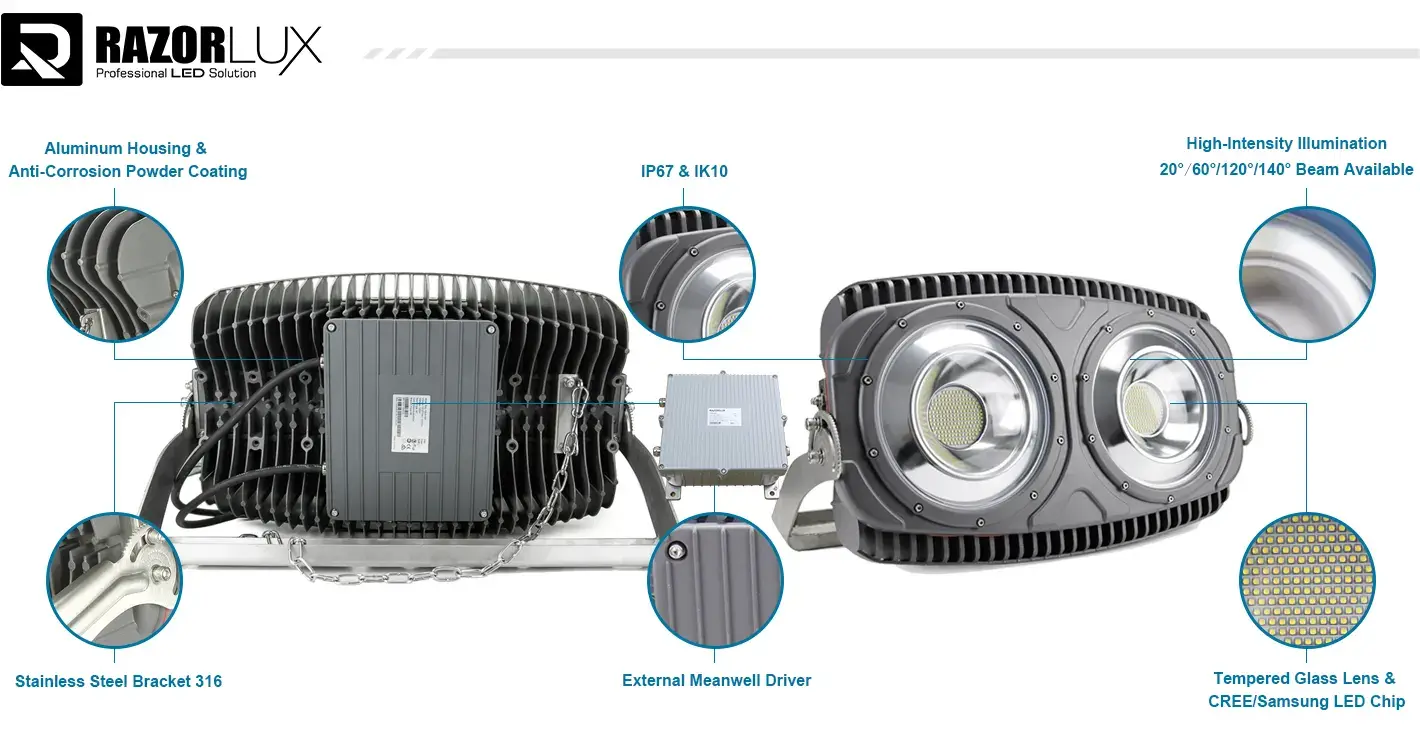
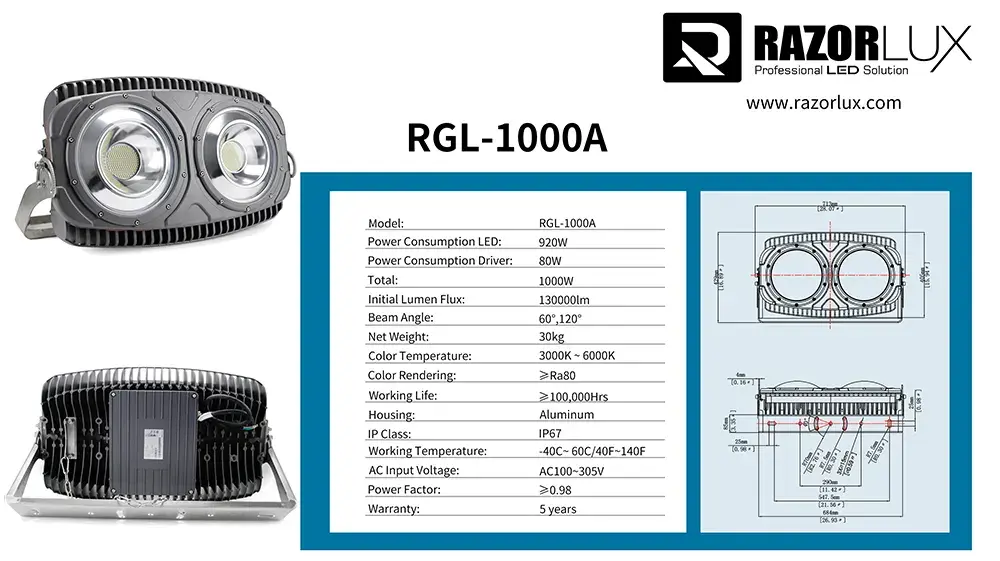
Modern Industrial LED Flood Lights Outdoor have a lighting efficiency of more than 130 lm/W, which means they use up to 70% less energy than traditional HID lamps. This efficiency comes from advanced LED chip technology, which often uses high-quality parts from Samsung or similar companies, and carefully designed control systems from companies like Mean Well. This method is shown by the Razorlux RGL-1000A type, which has 130,000 lumens and only 1000W of total power use, replacing 2200–2500W HID versions. In addition to saving energy, LED technology gets rid of the delays that come with traditional discharge lamps. For security and emergency lighting protocols in ports and offshore installations, the ability to turn on instantly is essential. The longer operating lifespan—usually 50,000 hours or more—dramatically lowers upkeep costs. This is especially important for projects that need access via aerial lifts or scaffolding.
Environmental Resilience and Safety Compliance
Lighting solutions for industrial settings need to work well in temperatures ranging from -40°C to +60°C and in environments with up to 95% humidity. Die-cast aluminium housings with powder-coated finishes are very resistant to corrosion, which is important for naval and seaside uses where salt spray speeds up the breakdown of materials. The ingress protection rating tells you how well a fixture keeps dust and water out. IP65 approval means that the building is dust-tight and protects against low-pressure water jets. It is good for most outdoor industrial settings. Upgrading to IP67 gives you submersion protection, which is useful for dock sites that are subject to wave action or pressure-washing routines. Impact resistance rates (IK10) make sure that the material will survive damage from vandalism and accidents involving handling tools.
Operational Flexibility and Control Integration
Different beam angle settings (40°, 60°, 120°, and 140°×60°) allow for precise light distribution that fits the needs of each space. For high-mast uses or specific task lighting, narrow beam angles focus the light, while wide-angle lenses cover loading zones and work yards evenly. Choosing the right colour temperature affects how things look and how safe they are. Cooler temperatures (5000–6500K) make you more alert and help you focus on fine-grained tasks, while warmer tones (2700–4000K) lower glare and make it easier to see for long periods of time. Colour Rendering Index (CRI) values above Ra75 make sure that colours can be told apart correctly, which is important for quality control and seeing safety signs.
How to Choose the Right Industrial LED Flood Lights Outdoor for Your Business
When making choices about purchases, technical requirements should be matched with practical needs and the surroundings. A methodical evaluation process lowers the chance of poor performance or equipment breaking down too soon.
Assessing Power Requirements and Lumen Output
To find the right wattage, you must first figure out how much light is needed based on the size of the area and the type of activity. IES and EN 12464, two international standards, set minimum lux values for several industrial jobs. Most of the time, 200 to 500 lux is enough for high-bay industrial areas, while 750 to 1000 lux may be needed for precision assembly zones. The coverage area and mounting height are directly related to the lumen output. Depending on the beam angle and reflection, an Industrial LED Flood Light Outdoor with 130,000 lumens can light up an area of 400 to 600 square meters when placed 15 to 20 meters above the ground. Purchasing managers should ask for photometric data (IES files) so they can model how light is distributed and make sure the project requirements are met.
Evaluating Protection Ratings and Material Durability
Strong building standards are needed for harsh industrial environments. The first number in the IP grade tells you about dust resistance (6 means dust-tight), and the second number tells you about water resistance (5 means water jets, 7 means temporary immersion). Shipyards and marine sites should use fixtures with an IP67 rating so they can handle being cleaned with high-pressure water and being exposed to waves. Impact resistance (IK scores) is a way to measure how strong something is when it hits something else. IK10 approval means that the product can withstand 20 joules of impact force, which is the same as dropping a 5-kilogram mass from 400 mm. This is important for places where cranes are used and where cars drive. Marine-grade aluminium with multi-layer powder coating should be used for the housing so that galvanic rusting doesn't happen in saltwater.
Certification Requirements and Compliance Verification
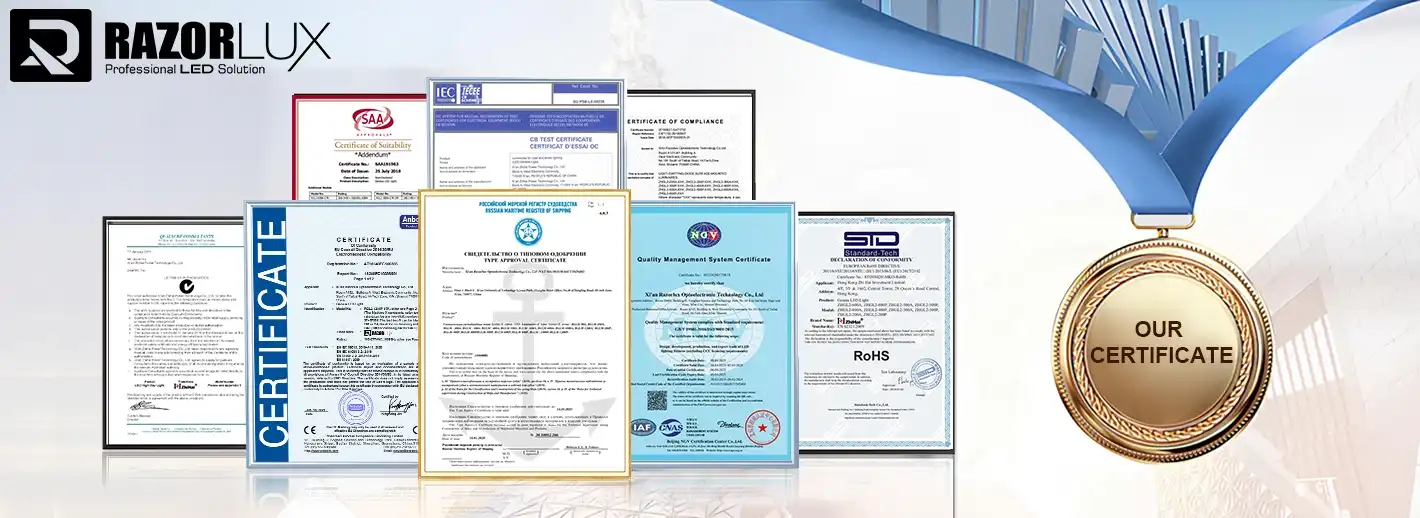
Certain certifications are needed for international marine and industry projects. DNV-GL and ABS approvals show that the product is safe for use on boats, and CE and RoHS labels show that it meets European safety standards. Listings on UL and DLC make it easier to buy things in North America, which is often needed for insurance and warranty coverage. To keep electrical systems from interfering, shipyard purchasing managers should check that driver specs include Total Harmonic Distortion (THD <10%) and Power Factor (≥0.98). A large input voltage range (AC80-305V, DC100-400V) can handle power changes that happen a lot in developing regions and offshore platforms that are far away.
| Selection Criteria | Minimum Standard | Recommended for Marine/Heavy Industry |
|---|---|---|
| Luminous Efficacy | 100 lm/W | 130+ lm/W |
| IP Rating | IP65 | IP67 |
| IK Rating | IK08 | IK10 |
| Operating Temperature | -20°C to +40°C | -40°C to +60°C |
| Surge Protection | 4kV | 10kV |
| CRI | Ra>70 | Ra>75 (Ra>80 for precision work) |
Warranty Terms and Component Traceability
Five-year guarantees on both LED modules and drivers are standard in the industry and show that the maker trusts the quality of the parts. Longer housing guarantees (10 years) show that you care about protecting against rust and keeping the structure strong. Buying agreements should spell out how to file a warranty claim, when new parts will be available, and how long it will take for technical help to respond. Purchasing confidence grows when component sourcing is clear. When compared to generic options, fixtures that use named drivers (Mean Well, Inventronics) and LED chips (Samsung, Lumileds) are more reliable. By asking for component datasheets and thermal management documentation, engineering teams can make sure that their designs are correct before placing large orders.
Installation and Safety Tips for Industrial LED Flood Lights Outdoor
When fixtures are installed correctly, they work better and last longer, and workers are safe. Hiring qualified electricians who are used to working in industrial settings lowers risk and makes sure that codes are followed.
Pre-Installation Site Assessment
By doing thorough site surveys, you can find growing problems, limitations in the electrical infrastructure, and environmental risks. Installation delays can be avoided by making a map of the current conduit paths, transformer capacity, and circuit safety devices. Corrosion studies in marine settings help choose the right materials for cable glands and fixing tools. Structural load estimates make sure the fixing area is strong enough. A 29-kilogram fixture, fixing base, and wind load need strong support points. Supports for high-mast installations must be designed to take into account dynamic wind loads and vibrations from nearby machines. Working with structure engineers during the planning stages keeps changes from being too expensive.
Electrical Safety and Code Compliance
National electrical codes (NEC in North America, IEC standards around the world) must be followed for all installations. Protective earth connections must be made for Class I insulation, and the grounding resistance must be checked according to the rules in your area. Electrical fires can be avoided with dedicated circuit breakers that are the right size for the inrush current and have the right arc fault protection. When placed at distribution panels, surge protection devices (SPDs) protect against short-term overvoltages caused by lightning strikes and switching activities. Individual fixture surge protection (10kV minimum) is a second line of defence that is especially useful for sites that are far away and have exposed wires. Protective integrity is kept up by checking SPD performance regularly.
Mounting Configuration and Optical Alignment
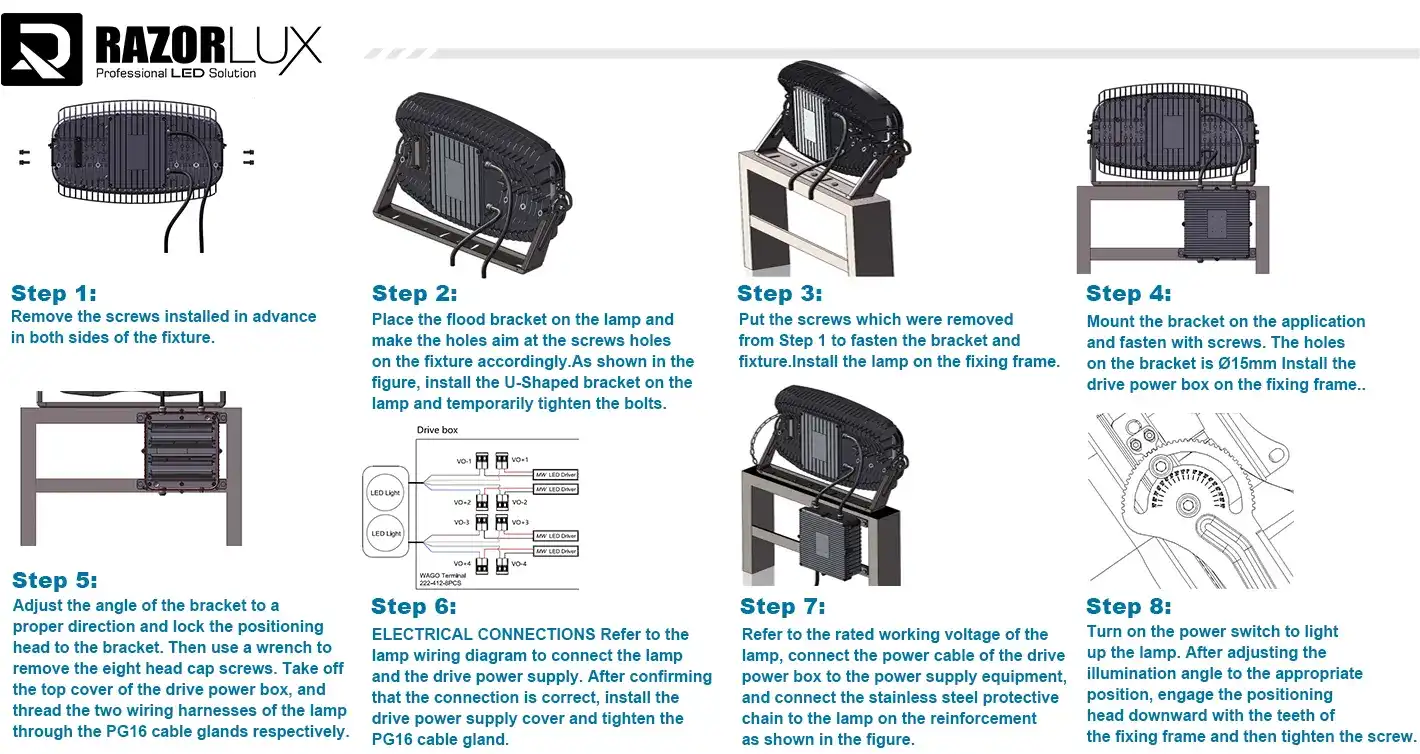
When you aim correctly, you can avoid glare, light trespass, and wasted light. Fixtures should be tilted so that there aren't too many straight viewing points and there is enough light at ground level. Adjustable mounting clamps with locked pivot mechanisms keep the alignment even when the system is being loaded with wind and shaking. Hardware made of stainless steel doesn't rust in naval environments. Calculations of spacing make sure that there is even lighting with no dark spots or areas that overlap too much. Photometric modelling software helps place fixtures by taking into account things like mounting height, beam angles, and surface reflection. Keeping the clearances that the maker specifies around fixings stops heat from building up and makes sure that the cooling works well.
Maintenance Planning and Troubleshooting
Setting up preventative repair plans for your tools makes it last longer. Inspections should be done every three months to make sure the lens is clean, the gasket is intact, and the mounting hardware is tight. Every year, thermal imaging studies find driver overheating and LED degradation before they become too bad to fix. Having extra driver units and mounting parts on hand cuts down on downtime while fixes are being done. Keeping track of installation information like serial numbers, mounting locations, and photometric measurements makes it easier to fix problems and file warranty claims. Systematic analysis finds the root causes of performance problems. A failure in thermal management usually causes dimming or colour change, while a failure in the driver or source voltage can cause flickering.
Leading Brands and Reliable Suppliers of Industrial LED Flood Lights Outdoor
Working with well-known manufacturers guarantees the quality of the products, their authenticity, and long-term support. There are a few well-known stars in the industrial LED lighting market, as well as experts in naval lighting.
Evaluating Manufacturer Credentials
Reputable suppliers show ongoing R&D spending through patent portfolios and product innovation cycles. Companies that have their own testing labs and are certified by ISO 9001 keep quality control uniform. When factories use automatic assembly and burn-in testing, the goods they make are more stable than when they do it by hand. Razorlux has shown its dedication by securing over 200 patents since its founding in 1998 in areas such as LED packing, thermal management, and structure design. The company's DFMEA failure mode analysis and military-grade quality control systems make sure that their products are very reliable in tough naval and industrial settings. Their thorough testing methods are backed by global standards like UL, DNV-GL, TUV, CE, and SAA.
Comparing Product Portfolios and Customization Capabilities
Industrial LED Flood Lights Outdoor Leading makers have large product lines that meet a wide range of application needs. Catalogue depth shows how good an engineer is at their job and how well they understand the market. Customisation services, such as changed beam patterns, unique voltage configurations, and built-in sensors, show that manufacturing can be flexible, which is helpful for complicated projects. Offshore platform workers often need pieces that can't explode and meet ATEX or IECEx standards for being in a dangerous area. Shipyards might need fixtures that work with DC 100-400V or 500-800V power systems on ships. When suppliers offer these specialised versions, customers don't have to deal with multiple vendors, which makes buying and maintaining things easier.
Supply Chain Reliability and Logistics Support
Performance in delivery has a direct effect on project timelines. Manufacturers who keep a large store and flexible production capacity can handle last-minute requests and changes to projects. Clear information about lead times lets you make accurate plans, and global distribution networks cut down on shipping costs and the hassle of customs. Sample apps let you test the technology before making big investments. Purchasing managers should ask for test units to make sure the heat performance, light quality, and fitting compatibility are all correct. Engineering review processes are helped by detailed technical documents like installation instructions, photometric reports, and temperature management data.
| Manufacturer Attribute | Indicators of Reliability |
|---|---|
| Experience | 15+ years in industrial/marine lighting |
| Patent Portfolio | 50+ patents in LED technology and design |
| Certifications | Marine (DNV-GL, ABS), Regional (UL, CE), Quality (ISO 9001) |
| Component Sources | Named-brand drivers and LED chips with datasheets |
| Warranty Terms | 5-year minimum on modules and drivers |
| Technical Support | Dedicated engineering support with photometric modeling |
| Delivery Performance | <4 weeks standard, expedited options available |
Cost Analysis and Total Ownership Considerations
The initial costs of fixtures are only a small part of the total costs over their lifetime. Long-term budgets are mostly made up of costs for energy use, upkeep work, and new parts. Total cost of ownership (TCO) should be compared over the expected project lifespans, which for industry setups are usually 10 to 15 years. A 1000W LED flood light that uses 130,000 lumens and runs for 4,000 hours a year at $0.12/kWh costs about $480 a year in electricity. Similar HID lights need 2,200W to produce the same amount of light, which costs $1,056 a year, or $576 a year per bulb. Since LED lamps last 50,000 hours instead of 10,000 hours, they don't need to be re-lit four times, which saves hundreds of dollars in labour costs per light. Buyers should ask potential providers to do energy modelling and total cost of ownership (TCO) studies. When you look at local energy rates, maintenance labour costs, and estimated working hours, you can see that charging more for better efficiency and dependability is worth it.
Installation and Safety Standards for Maritime Applications
Marine and offshore settings present unique construction problems that need specialised knowledge. Understanding the rules and environmental stressors is important for making sure installations are legal and last a long time.
Regulatory Compliance and Classification Society Requirements
For equipment approval, ships and offshore buildings must meet the standards of a classification society like Lloyd's Register, Bureau Veritas, or DNV-GL. Lighting fixtures need to be type-approved to show that they meet standards for vibration resistance (IEC 60092-504), electromagnetic compatibility (IEC 60533), and ingress protection. Installation methods must be in line with the electrical rules for the vessel, which spell out the types of cables, how they should be contained, and how they should be protected. Tankers and chemical carriers must meet explosion-proof standards, which means they must have approved hazardous site fixtures. Survey checks are completed with documentation packages that include test certificates, material declarations, and installation instructions.
Corrosion Prevention and Material Selection
Through galvanic reactions between metals that are not the same, saltwater speeds up electrolytic breakdown. Marine-grade aluminium alloys (5000 or 6000 series) with anodised or powder-coated finishes should be used for fixture housings. Mounting hardware made of stainless steel must be grade 316 to keep it from pitting and rusting. Cable glands and connecting systems need seals that are IP67 rated and resistant to UV light. Regular inspections make sure the seal is still intact and let you change the gasket before moisture gets in. In harsh settings, fixtures last longer with sacrificial anode systems or induced current cathodic protection.
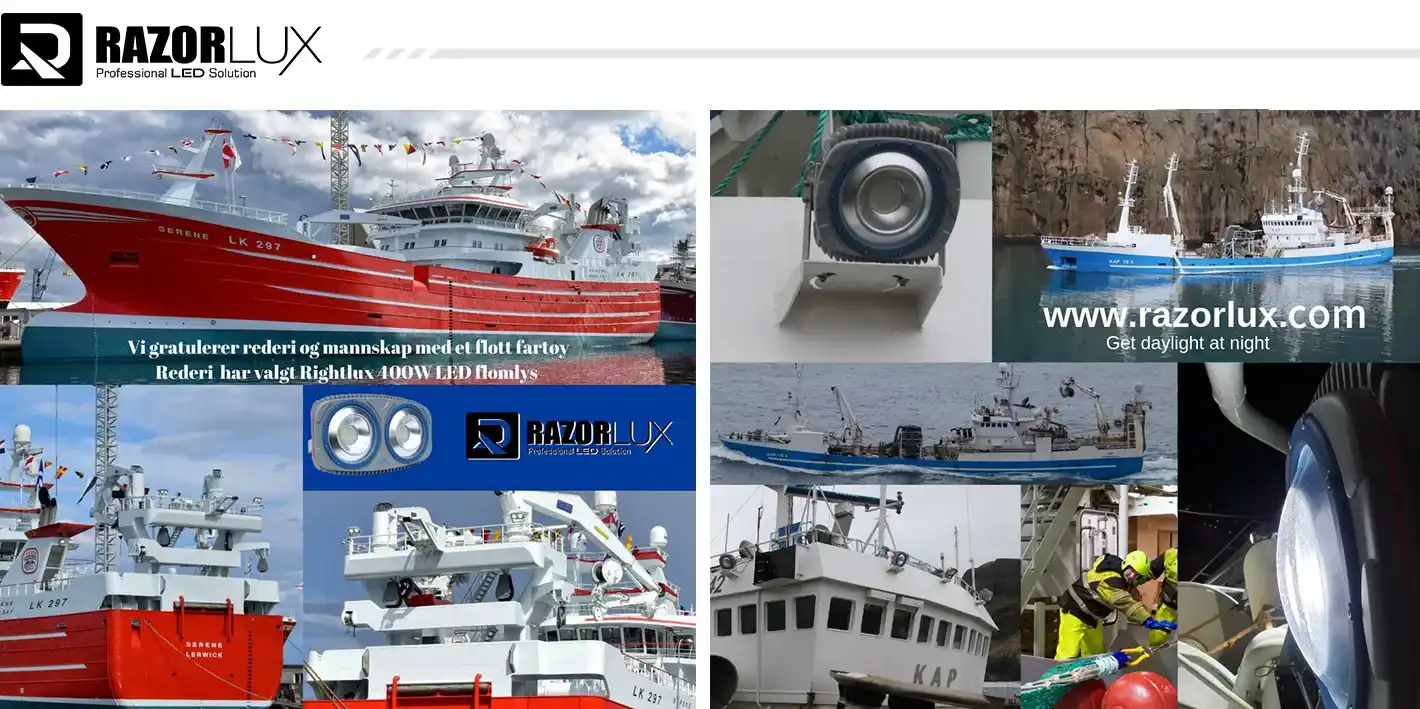
Vibration Isolation and Shock Mounting
Marine boats are constantly shaking because of gear and waves, and they also get shock loads when they moor. LED lights must be able to handle these dynamic forces without losing their optical alignment or wearing out their parts. Vibration damping isolators built into resilient mounting systems stop wear from happening too quickly. Locking hardware keeps things from coming loose when they're shaken. Thread-locking chemicals and lockwire methods keep fasteners from coming apart. Retightening things every so often during routine maintenance keeps the motor secure and electricity continuity.
Conclusion
To buy Industrial LED Flood Lights Outdoor, you have to find a balance between technical performance, sturdiness in the outdoors, and cost-effectiveness over the product's entire life. For tough maritime and heavy industrial uses, shipyard purchasing managers, marine equipment integrators, and facility engineers need to look for fixtures that offer IP67 ingress protection, IK10 impact resistance, and proven corrosion resistance. Products with 130+ lm/W efficiency, branded parts (Samsung LEDs, Mean Well drivers), and full certifications (DNV-GL, UL, CE) reduce maintenance costs and make sure safety standards are met. The best results in procurement come from working with well-known makers who offer expert help, customisation options, and clear warranty terms. Reviewing the specifications carefully, trying samples, and figuring out the total cost of ownership help people make smart choices that improve operating safety and lower long-term costs.
FAQ
How does thermal management affect LED fixture lifespan?
LED joint temperatures stay below 85°C thanks to finned aluminium heat sinks that effectively remove heat. This keeps light output constant and stops colour shift. Poor heat management can cut working life by 50% or more, especially in places where the temperature is high. It has been shown that fixtures made with computational fluid dynamics modelling and thermal interface materials between the LEDs and heat sinks last longer.
What distinguishes IP65 from IP67 protection ratings?
Both grades promise dust-tight construction, but they have different levels of water protection. IP65 can handle low-pressure water jets coming from any direction, so it can be used for rain and cleaning. IP67 offers short-term protection against submerging up to a depth of 1 metre for 30 minutes. This is very important for dock installations that are likely to be affected by wave action or pressure-washing routines. Marine apps should be at least IP67.
Why specify high power factor and low THD?
When the power factor is above 0.95, reactive power use goes down. This means that corporate energy accounts pay less for utility demand charges. Electrical system interference that can mess up sensitive instruments and communications gear is stopped when Total Harmonic Distortion is less than 10%. These requirements are especially important for ships and remote sites that don't have a lot of generator power.
Partner with Razorlux for Reliable Industrial LED Flood Lights Outdoor
Razorlux makes reliable Industrial LED Flood Lights Outdoor that are designed to work in naval, offshore, and big industrial settings. Our RGL-1000A model has a 130,000-lumen output and is made of aluminium that doesn't rust and has IP67 protection and IK10 impact-proof. It also has Mean Well drivers and Samsung LED chips inside. As an Industrial LED Flood Lights Outdoor manufacturer with over 200 patents and 20 years of experience making products just like these, we know what shipyards, ports, and offshore platforms need. Email our engineering team at sam@razorlux.com to get full technical specs, optical data, and sample units. Our procurement experts can make custom lighting designs for you, offer low-volume discounts, and provide all the paperwork you need to meet your certification needs. For mission-critical lighting systems, five-year guarantees and global compliance certifications make a big difference in how reliable they are.
References
1. Marine Equipment Directive Council Directive 2014/90/EU. European Commission Standards for Marine Equipment Certification, 2014.
2. Illuminating Engineering Society. "IES Recommended Practice for Outdoor Industrial Lighting." ANSI/IES RP-7-21, New York, 2021.
3. International Electrotechnical Commission. "Maritime Navigation and Radiocommunication Equipment and Systems - Electromagnetic Compatibility." IEC 60533:2015, Geneva, Switzerland.
4. Classification Society Standards Committee. "Rules for Classification of Ships: Electrical Installations." DNV-GL Maritime Standards, Oslo, Norway, 2020.
5. U.S. Department of Energy. "Solid-State Lighting Program: Life-Cycle Assessment of LED Lighting Products." Technical Report DOE/EE-1718, Washington D.C., 2019.
6. International Maritime Organization. "Code on Alarms and Indicators: Guidelines for Lighting Requirements on Ships." IMO Resolution MSC.302(87), London, United Kingdom, 2010.
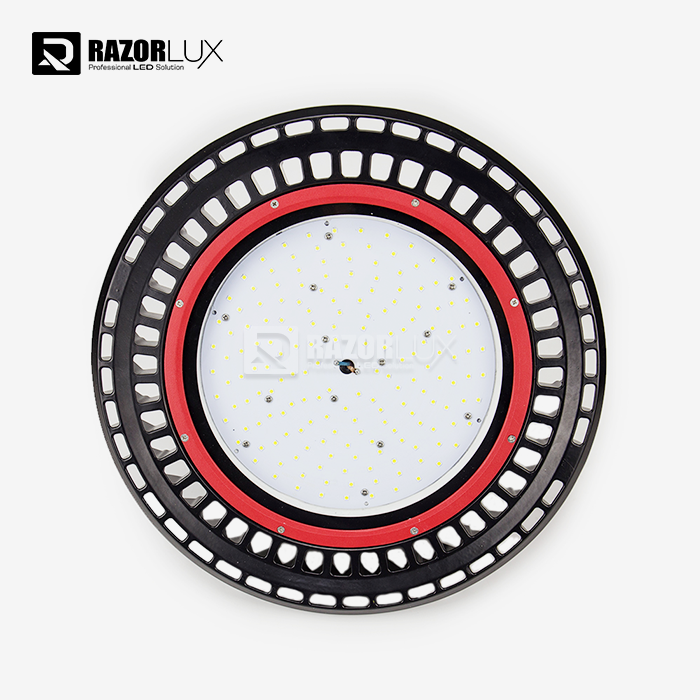 VIEW MOREwarehouse led fixtures
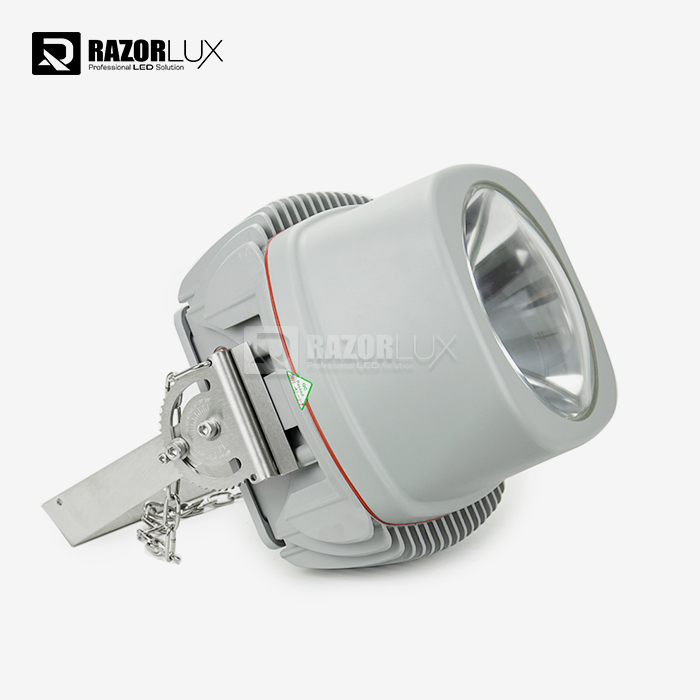 VIEW MOREcrane spot light
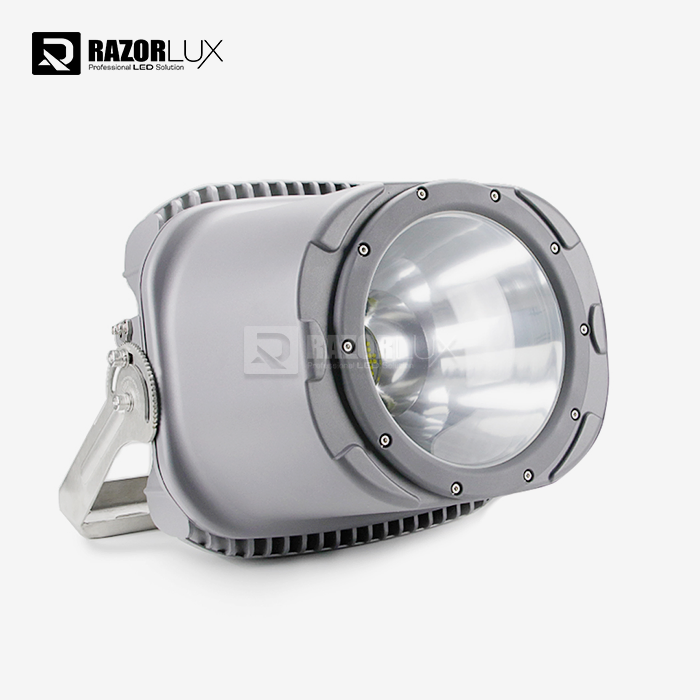 VIEW MOREoverhead crane lights
 VIEW MOREled arena flood lights
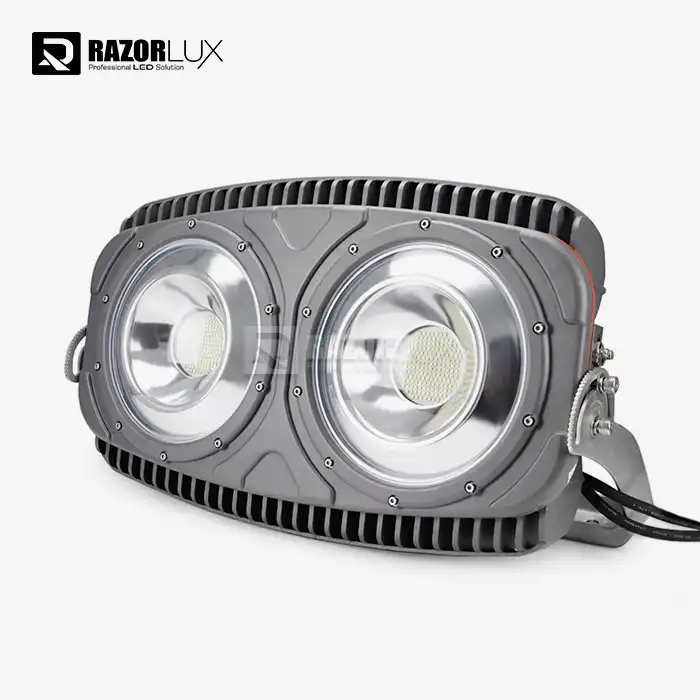 VIEW MOREOutdoor Tennis Court Lighting
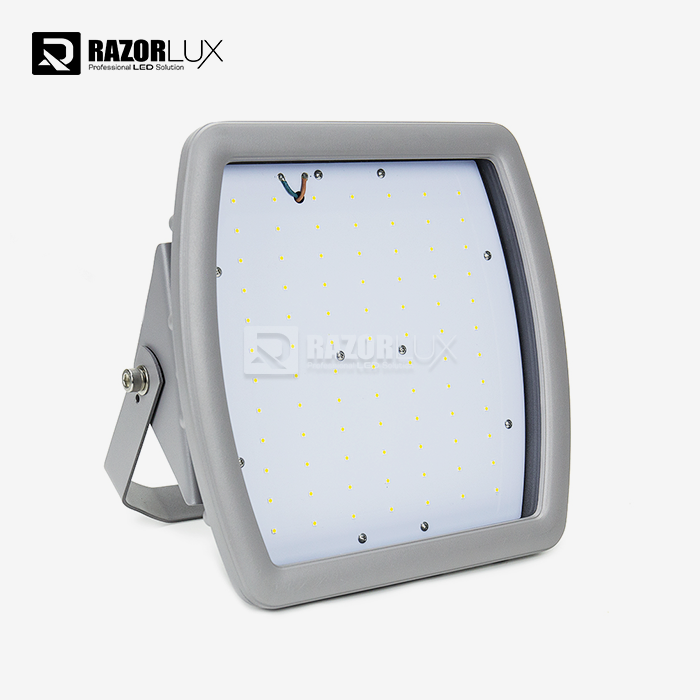 VIEW MOREHazardous Area Lighting Fixtures
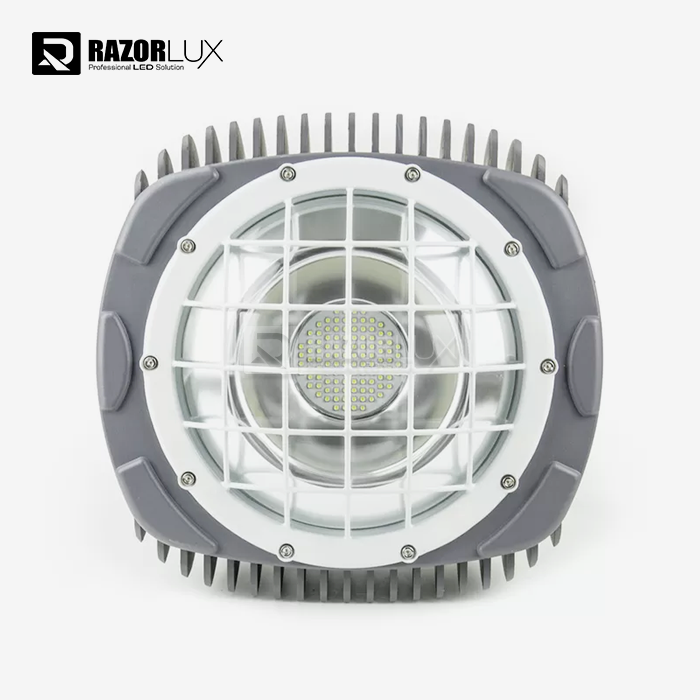 VIEW MORELED softball field lighting high mast flood light systems
 VIEW MOREHigh Mast Sports Arena Lighting 130lm/W 600 Watt Outdoor Stadium Lighting