


_1750326878398.png)

Marine Flood Lights 1000W Installation Guide for Beginners
To get the best performance in rough marine settings, installing Marine Flood Lights 1000W needs to be carefully planned and carried out. This detailed guide covers the whole installation process, from getting ready for the installation to trying it afterward. It also talks about common problems that dock workers and marine equipment fitters run into. Whether you're updating the lights on an offshore platform, putting fixtures at a port station, or changing the deck of a business vessel, knowing the right way to install something will protect your investment and make sure it works reliably in any situation.
Understanding Marine Flood Lights 1000W: Basics and Benefits
Compared to older incandescent systems, industrial-grade naval lighting is a big improvement. Modern LED-based lights work very well and solve problems that have been bothering marine operations for decades, like breaking down early from vibrations, making too much heat, and being vulnerable to saltwater corrosion.
What Makes 1000W Marine Lighting Different
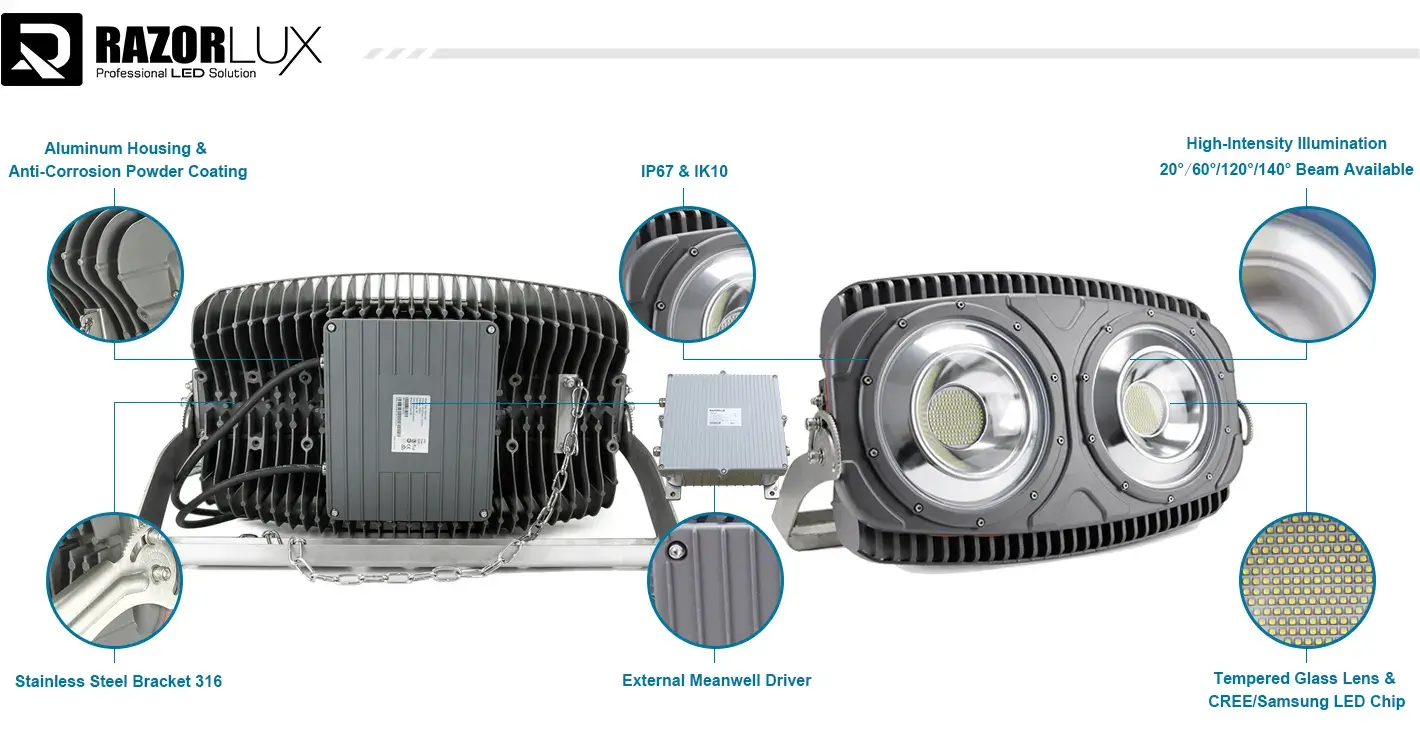
Marine-rated floodlights work in a specific way that is based on engineering. Unlike most industrial lighting, these units have to keep producing the same amount of light even when they are exposed to salt spray, temperature changes from -40°C to 60°C, and regular vibrations from ship engines. The 1000W number refers to the equal light output, not the real power usage. Newer LED technology can now produce 100,000 lumens or more while using only 900W for the LED array and 100W for the driver, which makes them a good replacement for 2200–3000W metal halide systems. This efficiency means that ships that use generator power will save a lot of fuel.
Core Performance Advantages
Marine lights with high power solve important operating problems. Better lighting from high-quality lights makes sure that ships can navigate safely and workers can do their jobs during long shifts at night at sea. Razorlux engineering provides 130 lumens per watt by using advanced heat management and high-quality Samsung LED chips. The light output stays stable even after being used nonstop. With beam angle choices running from narrow 15° spots to wide 140°x60° spreads, the extended coverage feature lets a single bulb light up a bigger deck area, which means fewer installation places are needed.
IP67 and Corrosion Protection Standards
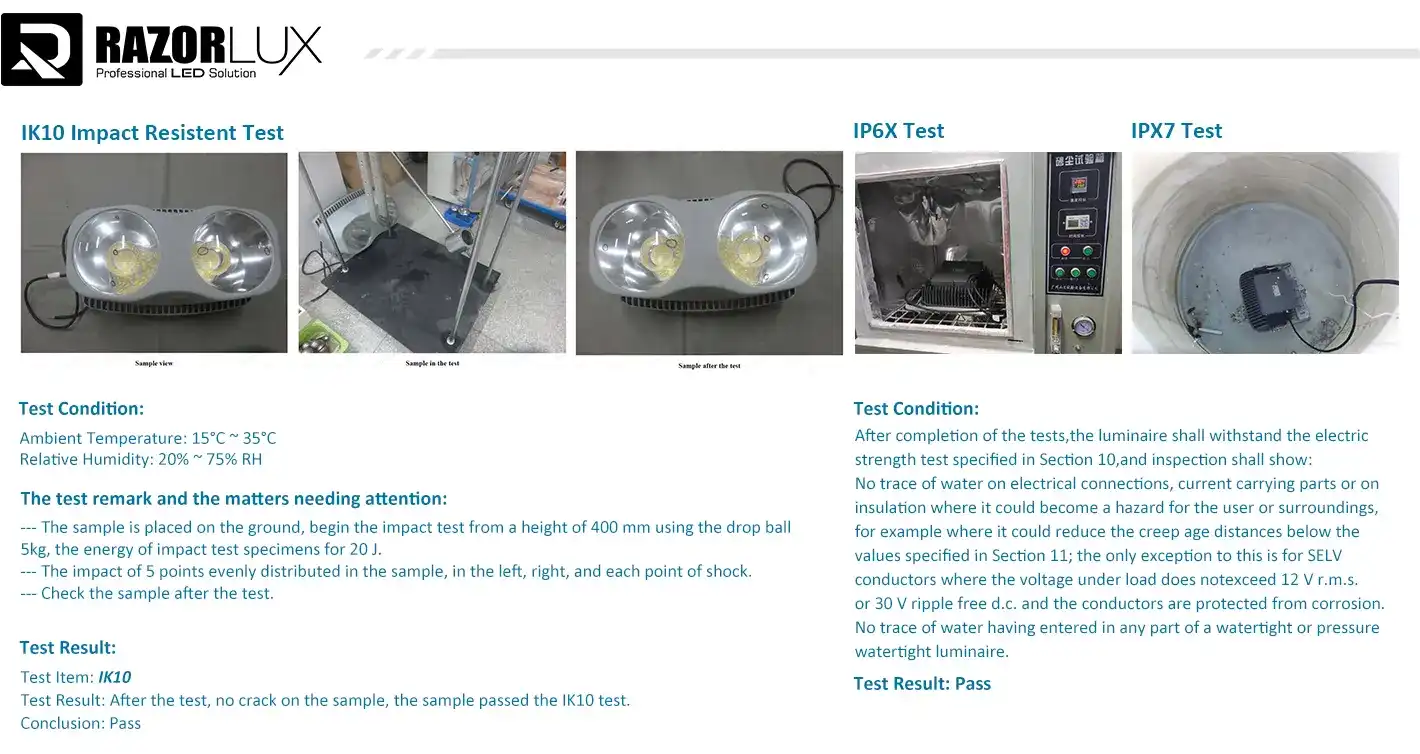
Certifications for waterproofing are very important when buying things for the marine industry. The IP67 rating makes sure that dust can't get in and that the device can withstand being submerged in water up to one meter deep for 30 minutes. This is very important when rough weather is happening and waves are hitting deck fixtures. Marine lighting should have more than just simple protection. It should have copper-free die-cast aluminum housings, chromate conversion coating, electrophoresis treatment, and a final C5-M rated polyester powder finish. This all-around method stops the electrolytic processes that cause buildings to fail early in saltwater settings. The IK10 impact grade makes sure that the toughened glass lens can handle being hit by heavy machinery and bad weather.
| Performance Metric | Traditional Metal Halide | Razorlux LED 1000W | Operational Impact |
|---|---|---|---|
| Actual Power Consumption | 2200-3000W | 1000W (900W LED + 100W driver) | 60% energy reduction lowers fuel costs |
| Luminous Output | 80,000-110,000 lumens | 100,000-105,000 lumens | Equivalent brightness with better directional control |
| Lifespan | 5,000-8,000 hours | 50,000+ hours (L80B10) | Reduces replacement frequency and maintenance downtime |
| Warm-up Time | 15-20 minutes | Instant full brightness | Immediate illumination during emergencies |
| Operating Temperature Range | -20°C to 40°C | -40°C to 60°C | Reliable performance in Arctic and tropical conditions |
| Vibration Resistance | Moderate (frequent ballast failures) | High (solid-state design) | Fewer failures from engine vibration and wave impact |
This comparative analysis demonstrates why procurement managers increasingly specify LED technology for new installations and retrofit projects. The total cost of ownership calculation favors LED systems despite higher initial investment, particularly when factoring maintenance labor costs at sea.
Step-by-Step Installation Guide for Marine Flood Lights 1000W
Marine Flood Lights 1000W: Whether your lighting investment works as planned or becomes an upkeep headache depends on how well it was installed. Poor workmanship is punished in marine settings; one weak connection point lets water in, which causes the whole device to fail.
Pre-Installation Planning and Safety Protocols
Installation that goes well starts long before the tools are brought out. Look at the electrical plans for the vessel to make sure that the fitting site has enough power and load capacity. Marine boats usually use a range of voltages. Good fittings can handle AC 80-360V or DC 100-400V inputs without the need for extra switches, so they can handle the voltage changes that happen when the generator load changes. Get the tools you'll need, like a torque wrench, marine-grade wire strippers, heat shrink tubing and a heat gun, dielectric grease, stainless steel mounting hardware, and the right fall protection gear if you'll be working at a height. Safety rules must be followed in maritime settings. Before you start working on the electricity, turn off the circuits at the switch box and follow the lockout/tagout steps. Use a voltmeter to make sure there is no power instead of just depending on the warning lights. For installations on business ships or offshore sites, work with operations management to pick times when the weather is safe. Doing electrical work when the seas are rough is dangerous and shouldn't be done.
Mounting Hardware and Physical Installation
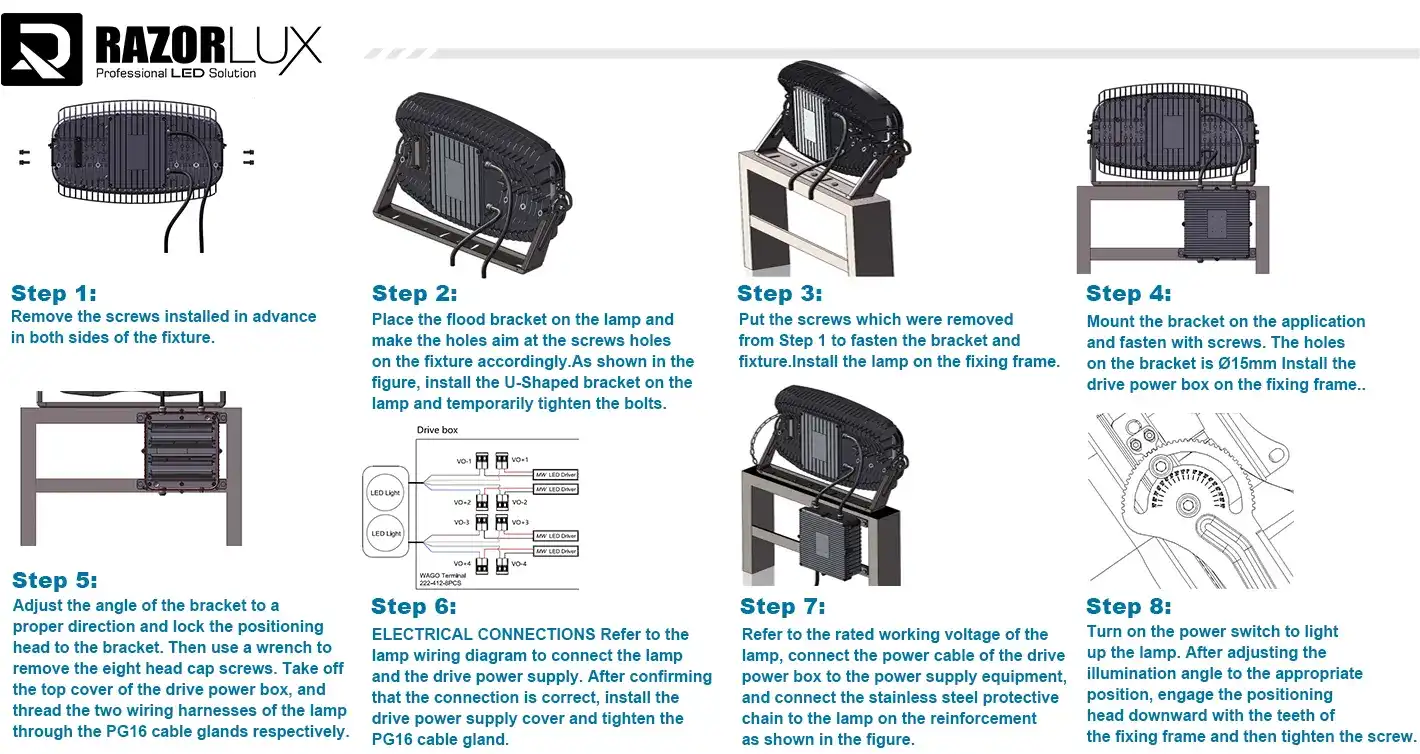
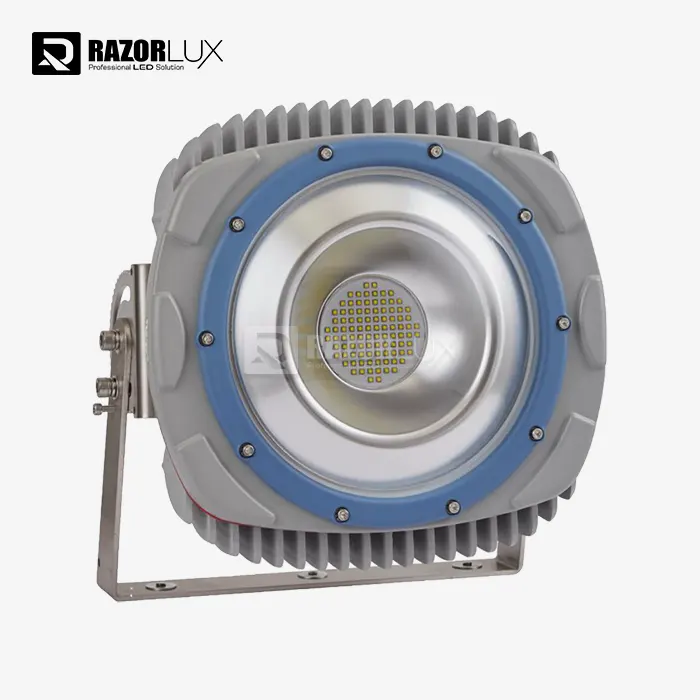
The stainless steel bracket system is just as important to the fixture's life as the light unit itself. Razorlux uses 316L marine-grade stainless steel U-brackets that can be adjusted by 270°, which lets you set the beam precisely after fixing. Place the bracket so that light can flow freely, but keep drains in mind—orient the bulb so that water doesn't pool where the cables enter. Use the clamp as a guide to mark where the mounting holes will go, then drill test holes that are the right size for the mounting surface. For high-stress areas, deck fixing to steel buildings needs self-tapping stainless screws or through-bolts with backing plates. Carefully follow the force specs when attaching the bracket. Over-tightening can damage aluminum alloy housings by stripping threads or cracking mounting surfaces; under-tightening lets movement and sound wear them down. The 29 kg weight of the bulb requires a strong connection. Weak mounts or screws that are too light can cause catastrophic installation failures in bad weather. Cable management is just as important. Use UV-resistant cable ties or stainless steel clips to hold power lines every 30 centimeters, and make sure there are service loops at connection places so the cable can bend.
Electrical Wiring and Connection Procedures
Marine electricity links have to follow tighter rules than systems on land. When stripping wire insulation, be careful not to expose too much bare material, as this can lead to rust. Also, make sure that the marine-grade plugs you use are rated for the circuit's current. Before putting the parts together, put a lot of dielectric grease on all the connection points. This moisture-displacing substance stops galvanic rust, which happens when different metals are exposed to saltwater. The fixture input can accept both AC and DC power sources, but when installing DC power, the polarity is important—reverse polarity protection circuits keep the fixture from breaking, and the right installation makes sure the driver works at its best. Professional installations include surge protection devices rated for 10–20kV transient suppression, which protects expensive LED drivers from lightning-caused voltage spikes and load-switching transients that are common in marine electrical systems. Cable glands are the most important seal between the hard outside world and the safe inside of the device. Before making any electrical connections, thread the wire through the joint. Then, tighten the compression fitting to the torque specs given by the maker. If it's not tightened enough, the IP67 waterproof rating will be lost. Make sure that the outer sheath of the wire fits properly inside the compression zone and doesn't leave the inner conductors open to the seal mechanism.
Post-Installation Testing and Commissioning
Verification testing makes sure that the work was done right before the job is considered finished. Turn the circuit back on and watch how the lights behave when they first come on. Good LED systems reach full brightness right away, without having to wait for them to warm up. Dimming or flashing means there are problems with the link that need to be fixed right away. Check the real voltage at the fastener terminals to make sure it's within the allowed input range. Readings that are outside of this range suggest that the wires or connections are too small or poorly made, causing too much voltage drop. Thermal performance testing is done after one hour of constant operation. Infrared thermometers should show junction points on heatsinks that are below 85°C. Higher readings mean that thermal transfer isn't working well, which needs to be fixed right away to avoid long-term damage. Look closely at all the connection places and see if the ends or wire insulation have changed color from heat. For water ingress tests, a low-pressure water spray is directed at cable glands and housing gaps while internal moisture buildup is watched. If moisture gets in, the seal needs to be fixed right away.
| Installation Phase | Required Tools & Materials | Critical Checkpoints | Common Mistakes to Avoid |
|---|---|---|---|
| Site Preparation | Voltage tester, mounting template, drill, stainless hardware | Verify circuit capacity, confirm mounting surface integrity | Skipping load calculations, using incompatible fastener materials |
| Physical Mounting | Torque wrench, backing plates, anti-seize compound | Check bracket alignment, confirm 270° adjustment function | Over-tightening bolts, inadequate backing support |
| Electrical Connection | Wire strippers, crimping tool, heat shrink, dielectric grease | Verify polarity (DC), apply proper torque to terminals | Insufficient conductor stripping, missing moisture protection |
| Sealing & Weatherproofing | Cable glands, thread sealant, compression wrenches | Confirm IP67 seal integrity, check cable sheath positioning | Under-tightening glands, exposing inner conductors |
| Testing & Commissioning | Multimeter, infrared thermometer, water spray bottle | Measure voltage at fixture, monitor thermal performance | Declaring completion without thermal testing |
Marine Flood Lights 1000W: This systematic approach minimizes callbacks and ensures fixtures perform reliably throughout their 50,000+ hour design life. Procurement managers should specify these testing protocols in installation contracts to hold contractors accountable for proper workmanship.
Comparing Marine Flood Lights 1000W: Choosing the Right Product for Your Needs
Specification sheets only show a small part of the issue for choice. When buying teams know how different technologies and makers deal with real-world marine problems, they can make choices that balance the costs of the initial investment with the costs of running the business in the long term.
LED Technology Versus Legacy Halogen Systems
The comparison of technologies goes beyond simple calculations of how efficient they are. For many years, metal halide and halogen systems were the most popular types of naval lighting because they produced a lot of lumens and were thought to be reliable. However, these old technologies have secret costs that become clear as they are used. Seventy percent of the energy that goes into halogen systems is wasted as heat instead of light. This wastes energy and makes it hard to control the temperature in small areas. Vibrations, which happen all the time on ships, can damage the flimsy filament construction, causing early failures that stop important operations. Solid-state design in LED technology gets rid of these basic flaws. LED panels can handle the constant shaking from naval engines that would kill regular lights in months because they don't have any weak wires or leads. Because LEDs emit light in a specific direction, precise visual control is possible. Light is directed where it's needed instead of being scattered in all directions, which would require mirrors to reroute lost energy. Modern LED drivers with a power factor adjustment above 0.98 and a total harmonic distortion below 10% get better power from tank engines, which lowers the stress on the electrical system.
Evaluating Leading Manufacturers and Certifications
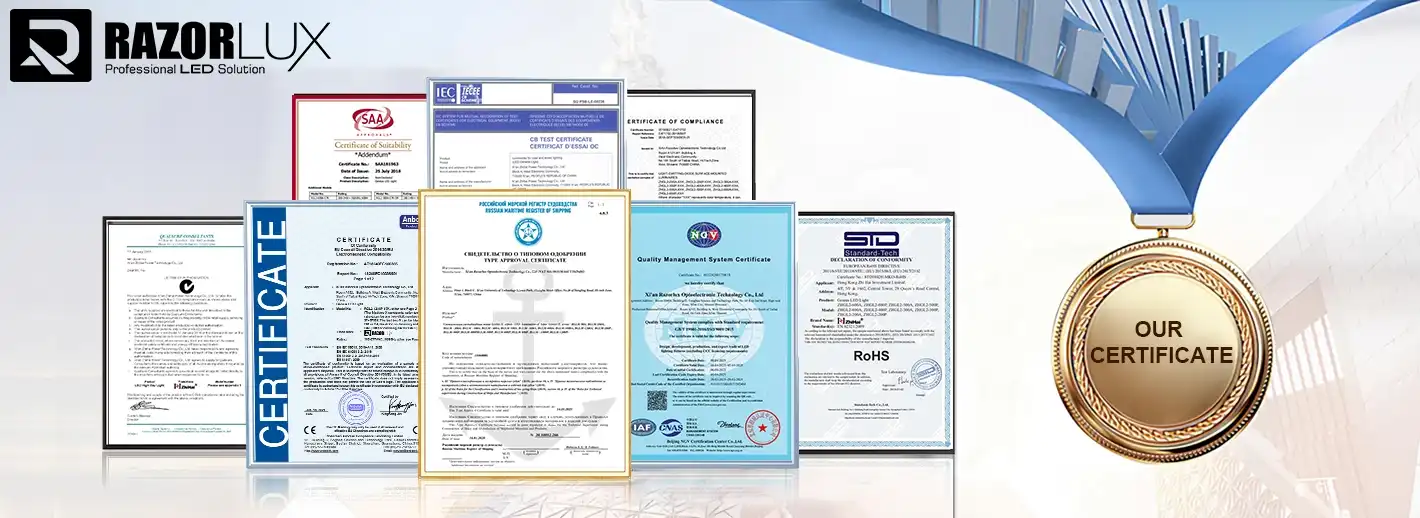
Component quality and technical rigor are directly linked to a brand's image. Well-known naval lighting brands like Hella and Philips have decades of experience in the field, but their high prices reflect the status of their brands. New specialized companies like Razorlux compete by offering the same or better performance at lower prices by focusing only on LED technology instead of keeping older product lines. Certifications are an objective way to check if a company is telling the truth about what they say. CE and RoHS are basic safety and environmental standards that must be met for products to be sold in Europe. The more difficult UL-1598A approval covers extra needs for lights placed on boats, like being able to withstand vibrations and salt spray, as well as entry protection validation testing. Classification society approvals from DNV, ABS, Lloyd's Register, or RMRS are very important. To get these certifications, fixtures must be tested by a third party and have ongoing quality system checks. This gives insurance companies and marine officials faith in the fixtures' dependability. Instead of letting manufacturers self-certify, procurement requirements should make it clear that these classification society approvals are needed.
Wattage Selection and Coverage Calculations
When you match the output of a light to the needs of an application, you avoid both under-illumination, which is dangerous, and over-specification, which loses money on capital and running budgets. The 1000W comparable class is good for decks that are medium to large, places where people move luggage, and work platforms that are far from shore that need 20 to 50 lux of steady illumination. Smaller vessels or extra lighting spots may be able to get enough light from 500W comparable lamps, which lowers the original cost and energy use. On the other hand, to meet legal minimums, big container ship decks or important helipads often need 1500W or more of similar power. Beam angle selection is also very important. Narrow 15-20° distributions focus lumens into faraway spotlights, making them good for lamps placed on masts that light up cargo holds or draw attention to navigation dangers. For general deck lights, medium 30° to 40° spreads balance throw distance and covering width. With wide 60–120° ranges, light can be spread evenly over big areas from relatively low hanging heights, which means fewer fixtures are needed. The unique 140°x60° uneven distribution is designed for specific uses, such as pier lighting, where long covering patterns need to match the shape of the dock. Before finishing specifications, professional lighting designers use photometric software to model coverage patterns. This earlier engineering investment avoids costly over-installation or poor lighting that needs extra lights.
Maintenance Tips and Energy Efficiency Best Practices
Preventive maintenance extends fixture lifespan and maintains performance specifications throughout the operational period. Marine environments accelerate degradation through multiple mechanisms that require systematic attention.
Routine Cleaning and Inspection Protocols
When salt builds up on optical surfaces, it lowers light output more than most users realize. Crystalline salt crystals spread and absorb light, cutting the amount of light that gets through by 20 to 30 percent within a few months of being put in places with a lot of salt spray. Set up cleaning plans every three months using a fresh water rinse, a light soap solution, and soft cotton cloths. Stay away from rough materials that can scratch protected lens coatings. Thoroughly rinse to get rid of any soap residue that could attract more salt buildup. Visual checks during cleaning rounds find problems before they become failures. Check the cable ports and housing seams for signs of rust. White or green spots around stainless steel screws show a galvanic reaction that needs your quick attention. Every year, check the strength of the fixing parts because temperature cycles and shaking can loosen connections over time. Check power lines for chafing where they touch deck structures. UV damage and mechanical wear and tear can finally damage insulation, which can lead to shocks and short circuits. Moisture inside the unit that can be seen through the lens means that the seal has been compromised and needs to be fixed right away. LED drivers and electrical connections quickly stop working when moisture gets into them.
Optimizing Energy Consumption and Smart Controls
Marine Flood Lights 1000W Smart control techniques can help even high-efficiency LED lights work better. Simple photocells turn on the deck lights at dusk and turn it off at dawn, so manual switches that get left on during the day don't waste time. Programmable clocks change the lighting schedules to match the work schedules, since loading goods usually only happens during certain shift times and doesn't need lighting 24 hours a day. Motion sensors work best in low-traffic areas like equipment storage areas and auxiliary machinery spaces, turning on lights right away when people walk in while reducing the number of hours the lights are on. For large installations, advanced networked control systems provide the most efficiency gains. Centralized tracking keeps track of how long fixtures are used and how much energy they use, which lets repair plans be made before problems happen. When there isn't much action, dimming can lower the output. For example, marine-rated motors that handle 0-10V dimming protocols can lower output to 10% while keeping the system stable, which cuts energy use by the same amount. Some operations use tiered lighting, which means that the minimum level of light needed for safety is always on and full brightness is only turned on during busy work times. These control methods make the energy-saving benefits of LED technology even better, and they can often achieve total energy savings of over 70% compared to older lighting systems.
Understanding Warranty Coverage and Service Support
Warranty terms show that the company that made the product is confident in its longevity. Standard guarantees that last two to three years are based on cheap materials that probably won't last in hard naval service. Professional marine lighting promises LED modules for 5 years or more and driver parts for the same amount of time. Some of the best makers even cover rust holes in the housing for 10 years. Razorlux backs up our engineering with full 5-year warranties on both LED arrays and Meanwell drivers. This shows that we have faith in the quality of the parts we use and how well they are put together. The length of the warranty is not the only thing that matters; service support infrastructure is also important. When something goes wrong, manufacturers who have regional service centers and new parts on hand keep ships from having to be shut down for too long. When evaluating vendors, procurement managers should check to see if parts are available and what the normal wait time is. For example, 30 days for delivery of a new part is not acceptable for important guidance lighting or safety lighting on a remote platform. The best manufacturers have advance replacement programs that ship new units as soon as they are notified of a failure. The faulty units are then sent back for guarantee review. Accessibility of technical support is also important to think about. Manufacturers that offer 24/7 phone help and foreign technical documents make it easier for businesses around the world to fix problems quickly.
Conclusion
Marine Flood Lights 1000W Installing and keeping high-output nautical lighting requires paying close attention to every detail throughout the span of the device. Strong fixing, marine-grade electrical connections, and good seals are all parts of the fitting process that set the stage for long-lasting performance. Capital investments are protected from failing too soon by choosing hardware with the right certifications, proven component quality, and full guarantee support. Regular repair stops the slow wear and tear that makes lighting less effective and less safe. Purchasing managers who set standards for proper installation and start preventative repair programs get the best return on investment and make sure that marine activities are safe. From old lighting technologies to new LED systems, switching has big practical benefits, but only if the right planning and execution are used during the installation process.
FAQ
Can LED marine flood lights truly replace traditional 2200W metal halide systems?
High-efficiency LED fixtures delivering 130+ lumens per watt produce equivalent illumination to legacy high-intensity discharge lamps while consuming 50-60% less power. The superior optical control inherent in LED technology actually improves effective illumination by directing light precisely where needed rather than scattering it omnidirectionally. Vessels upgrading to quality LED systems typically report better deck visibility alongside substantial fuel savings.
What specific features distinguish genuine marine-grade lighting from commercial products?
Authentic marine fixtures incorporate corrosion-resistant materials throughout—not just surface coatings. Look for copper-free aluminum alloys, 316L stainless steel brackets, and multi-stage protective coatings meeting C5-M durability classifications. Electrical components must handle wide voltage fluctuations common in marine power systems, typically AC 80-360V inputs. Classification society certifications from organizations like DNV or ABS provide independent verification that fixtures meet maritime environmental and safety standards.
How does mounting height affect coverage and fixture selection?
Lower mounting positions (3-5 meters) allow wider beam angles (60-120°) to achieve even coverage with fewer fixtures. Higher positions (8-12 meters) require narrower beams (20-40°) to maintain adequate illumination at deck level, though they provide better obstacle clearance. Professional installations use photometric modeling software to optimize fixture quantity, placement, and beam characteristics before procurement, avoiding both inadequate coverage and wasteful over-specification.
What warranty terms should I expect from quality manufacturers?
Professional marine lighting suppliers warrant LED modules and drivers for a minimum of five years, reflecting confidence in component selection and assembly quality. Premium manufacturers extend housing corrosion warranties to ten years. Shorter warranty periods suggest commodity-grade construction inappropriate for demanding maritime service. Beyond duration, evaluate service infrastructure—manufacturers with regional support centers and stocked replacement parts minimize downtime when failures occur.
Ready to Upgrade Your Marine Lighting with a Trusted Manufacturer?
Razorlux brings over two decades of specialized LED engineering expertise to demanding maritime applications. Our 1000W marine flood lights combine premium Samsung LED chips with Meanwell drivers, achieving 130 lm/W efficiency while maintaining IP67 and IK10 protection ratings. Comprehensive certifications including RMRS, UL, DNV, and ABS demonstrate our commitment to meeting the stringent standards that maritime operations demand. Whether you're a shipyard procurement manager planning new vessel construction, an offshore platform operator upgrading aging infrastructure, or a marine equipment integrator seeking a reliable Marine Flood Lights 1000W supplier, our technical team provides complete support from initial specification review through installation guidance and ongoing service. Contact sam@razorlux.com to discuss your project requirements, request detailed photometric data, or arrange sample units for field evaluation.
References
1. American Bureau of Shipping. (2021). Rules for Building and Classing Steel Vessels: Part 4, Vessel Systems and Machinery. ABS Plaza, Houston.
2. Illuminating Engineering Society. (2020). IES Lighting Handbook, 10th Edition: Chapter 27, Marine and Offshore Lighting. IES Publications, New York.
3. International Maritime Organization. (2019). SOLAS Consolidated Edition 2020: Chapter II-1, Construction - Subdivision and Stability, Machinery and Electrical Installations. IMO Publishing, London.
4. Det Norske Veritas. (2022). DNV-CP-0384: Electrical Installations on Ships and Mobile Offshore Units. DNV GL AS, Oslo.
5. National Electrical Manufacturers Association. (2018). NEMA LE 5: Solid State Lighting for Marine and Offshore Applications. NEMA Standards Publication, Rosslyn.
6. Lloyd's Register. (2021). Rules and Regulations for the Classification of Ships: Part 6, Control, Electrical, Automation and Communication Systems. Lloyd's Register Group Limited, London.
 VIEW MOREoverhead crane safety lights
 VIEW MOREfootball stadium led lights
 VIEW MOREMarine Led Spotlights For Boats
 VIEW MORELow Mast Light
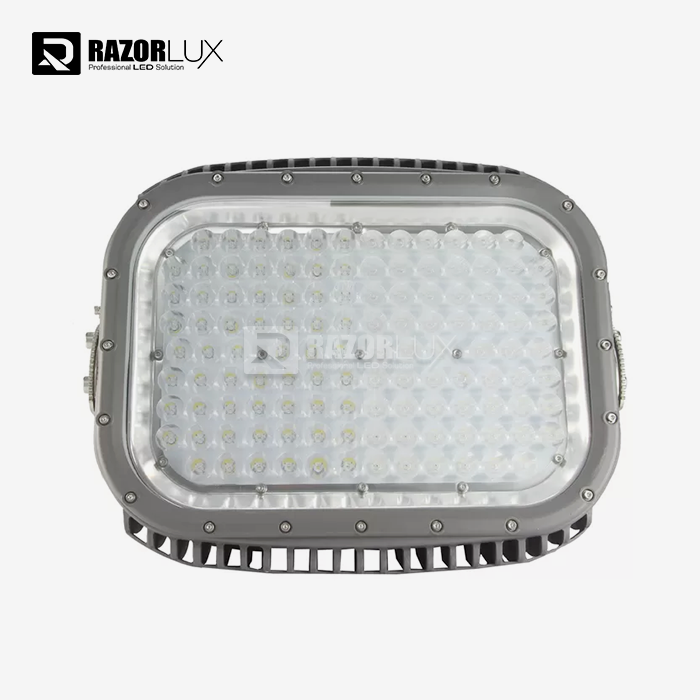 VIEW MOREEnergy Saving Dimmable LED Flood Light With Stainless Steel Bracket
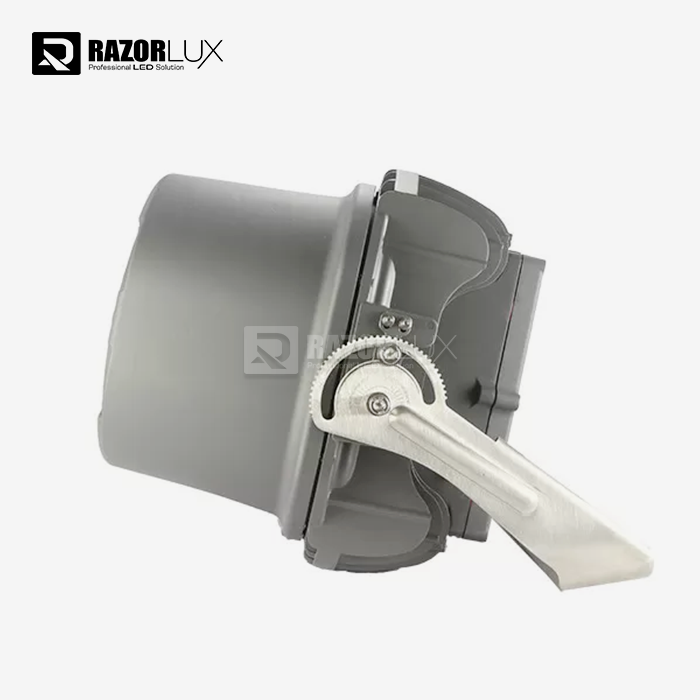 VIEW MOREFootball Field 140F Led Stadium Lights 1000 Watt 5700K Sports Lighting Fixtures
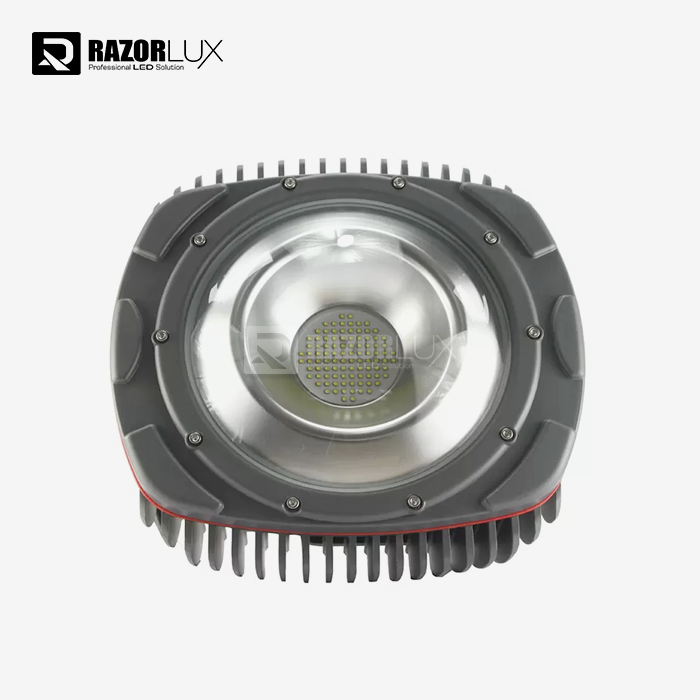 VIEW MORERound 120w Led Industrial Flood Light 14400lm Anti Glare Led Flood Light
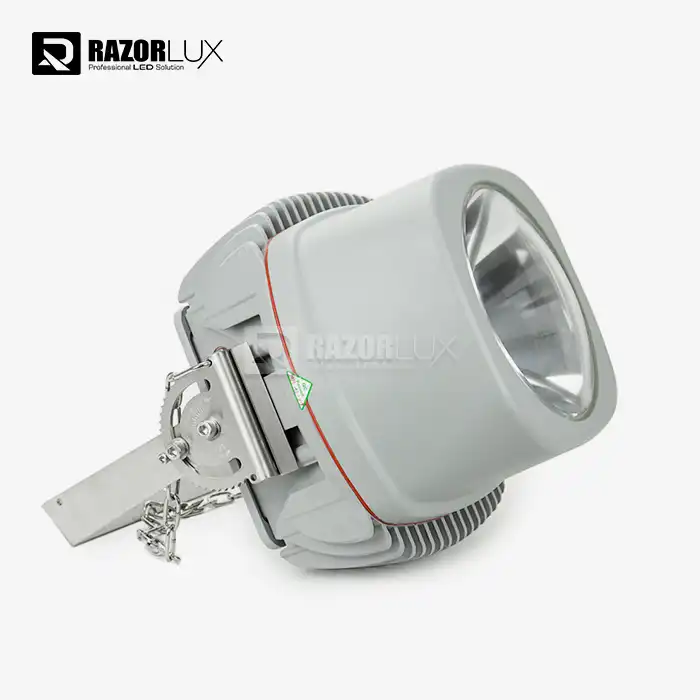 VIEW MORELed Softball Field Lights