

_1750326878398.png)

What Voltage Do Crane Boom Lights Require?
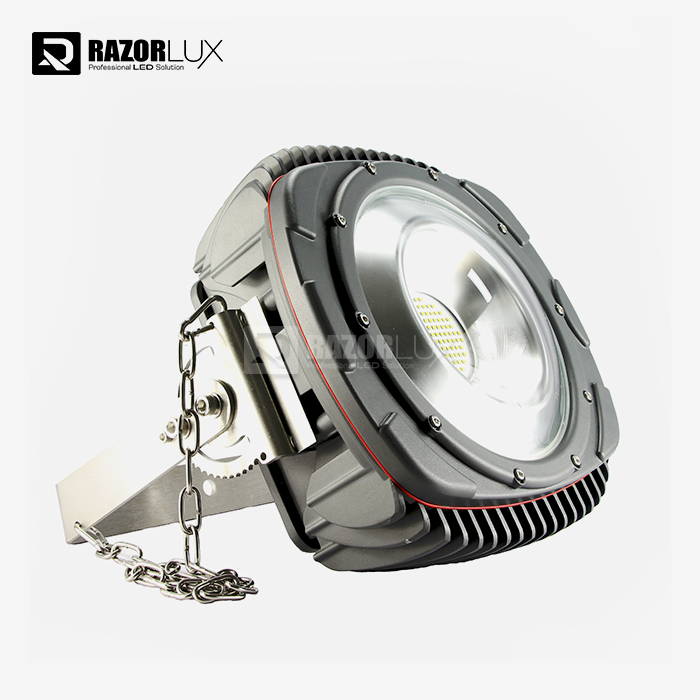
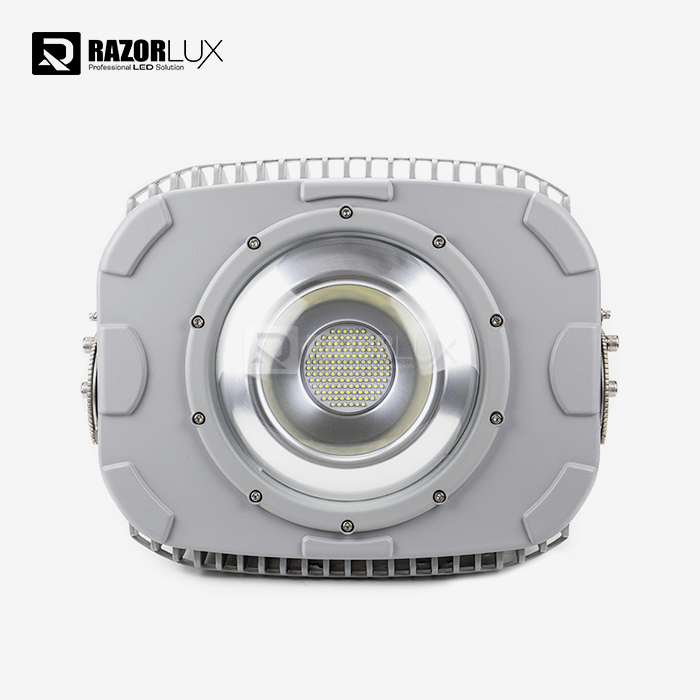
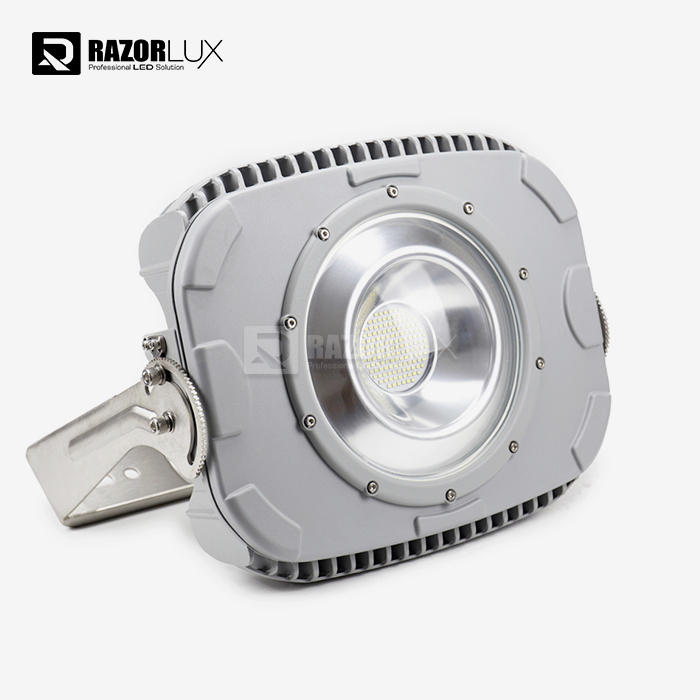
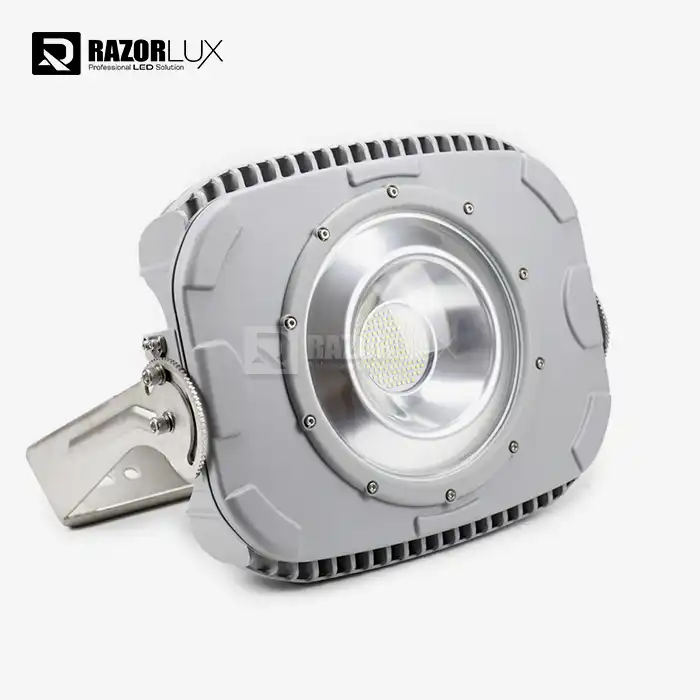
The voltage compatibility of industrial lighting for heavy-duty lifting tasks is an important factor that can't be skipped. Crane Boom Lights usually work with a wide voltage range so they can work with a variety of power systems used by crane fleets around the world. Our Razorlux RGL-150P model, like most current LED boom lights, can accept input voltages from 80V to 315V AC or 80V to 400V DC without the need for extra adapters. This ability to work with all voltages means that your cranes will work perfectly whether they are connected to normal 110V systems in North America, 220V systems in Europe, or changeable DC power from offshore platforms. Knowing these voltage parameters can help keep installations from taking too long and costing too much. It can also help keep people safe at work in maritime, building, and industrial settings.
Understanding Crane Boom Light Voltage Requirements
The power requirements for industrial crane lights have a direct effect on how easy it is to install, how safe it is to use, and how much it costs to maintain over time. As a purchasing manager at a shipyard or an engineering boss on an offshore platform, you have to make decisions every day that balance how well the tools will work with the budget. Voltage mismatches can cause drivers to fail early, pose fire risks, or require costly electrical upgrades to the crane's existing system.
Common Voltage Ranges in Industrial Crane Systems
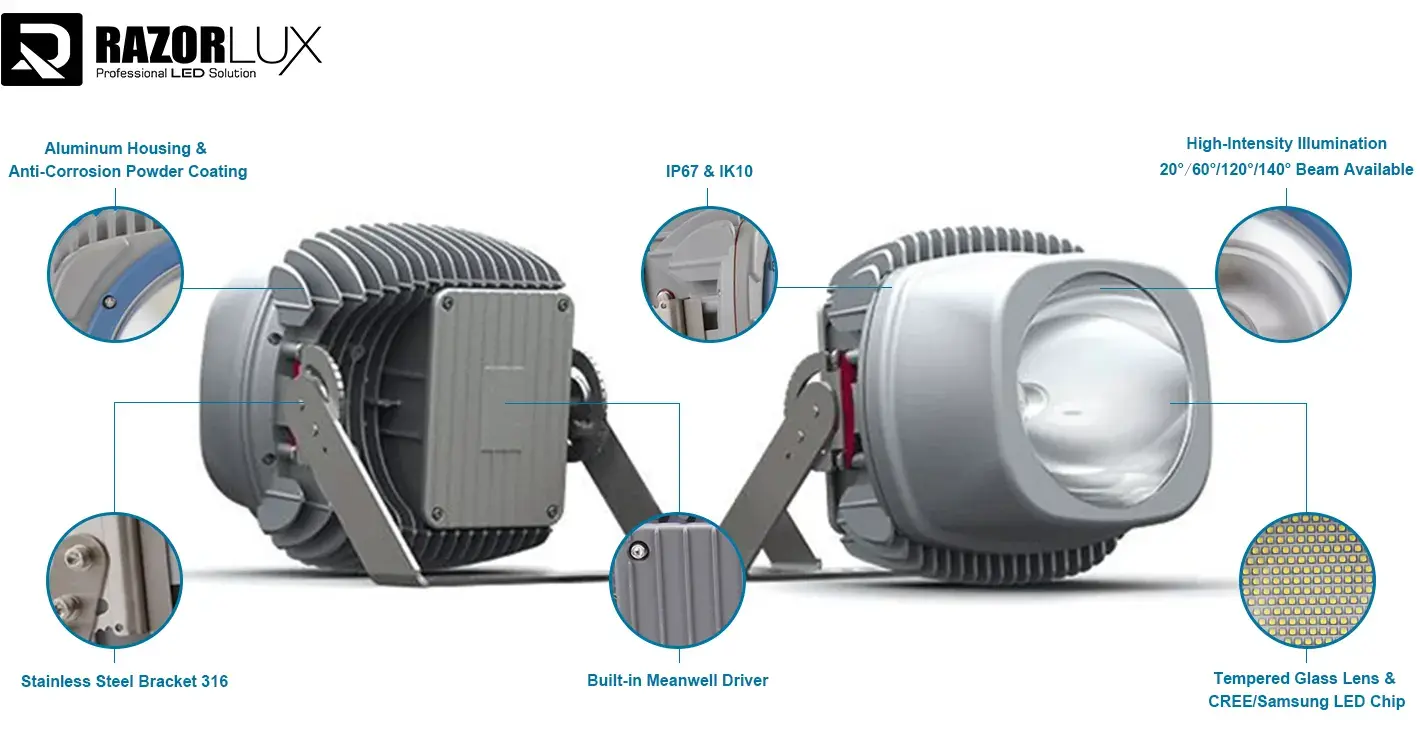
Around the world, crane electrical systems work with a number of different standard power bases. Mobile cranes and other building tools in North America, made by companies like Terex and Grove, usually use 120V AC single-phase systems. Standard 230V AC configurations are used in Europe and Asia, where big brands like Liebherr and XCMG are sold. DC voltage systems range from 24V DC on smaller vessel cranes to 48V DC on harbor mobile cranes and up to 400V DC on large ship-to-shore gantry cranes. Offshore and marine applications add to the complexity. Razorlux made our boom lighting options so that these area problems don't get in the way. The RGL-150P model can work with any AC input from 80 to 315 volts and any DC input from 80 to 400 volts, so it is truly compatible with all devices. Because of this large working window, procurement teams can agree on a single lighting design for all international fleets. This makes inventory management easier and reduces the number of different parts that need to be kept on hand.
DC Versus AC Voltage Systems: Operational Implications
When you choose between direct current and alternating current power transfer, it changes more than just the driver circuits. In land-based uses where grid power is easy to get, AC-powered crane lights have easier wiring. AC systems are better at handling voltage drops over long cable runs, which means they can be used with tower cranes whose booms are longer than 60 meters.DC lighting is most common in maritime and mobile devices because it uses battery-based power sources and is safer in wet settings. DC circuits get rid of the chance of capacitive coupling in salt-spray situations and protect against electrical problems on the shore. When used in shipyards or on offshore sites, DC-compatible boom lights make aluminum crane towers less likely to rust. Razorlux's engineering team used Meanwell power supplies with active power factor correction exceeding 0.98 to make a single driver platform that can accept both AC and DC inputs. This two-mode operation keeps the light output the same whether the crane is powered by a diesel engine, a shore link, or a battery bank.
Key Factors Influencing Voltage Selection
There are more operating factors than just voltage numbers that decide the best lighting specs. Electrical standards for different crane manufacturers are very different. For example, Kobelco and Sany models often specify different types of connectors and voltage regulation tolerances than Manitowoc and Tadano models. People who work in procurement need to check not only the standard voltage but also the allowed voltage swing ranges. This is especially important for cranes with variable-frequency drives, which can cause harmonic distortion. Stability of the power source has a direct effect on how long an LED driver lasts. Voltage changes of ±15% or more happen on construction sites that use portable generators, but ±5% changes happen at grid-connected port facilities. These changes must be able to be handled by lighting fixtures without flickering or breaking down too soon. Our Razorlux units have total harmonic distortion (THD) levels below 10%, which means they can work with low-quality generator power and protect your investment in a variety of site situations. There are surprising ways that environmental factors and electricity affect each other. When working in cold weather below -20°C, the wiring's electrical resistance goes up, which lowers the power supplied to the fixture. On the other hand, tropical heat above 45°C puts stress on parts that control voltage. Our boom lights work reliably from -40°C to +60°C because they have thermal management systems that keep the voltage from dropping during this temperature range.
Types of Crane Boom Lights and Their Voltage Characteristics
Depending on the type of lighting technology, it needs a different power and performs differently. Knowing these technical differences helps you make smart purchasing choices that balance the costs of the original investment with the costs of running the business over its lifetime.
LED Boom Lights: Modern Voltage Flexibility
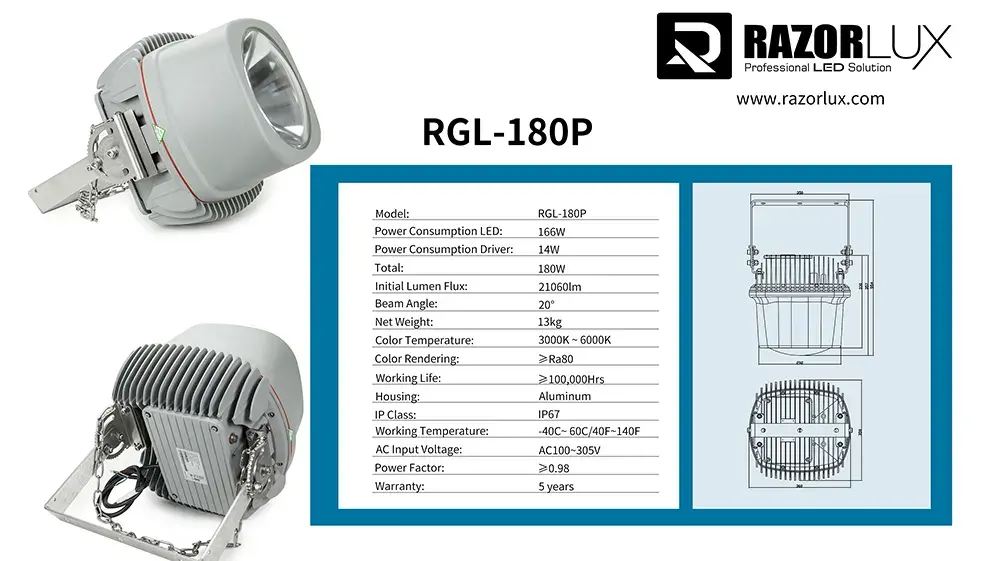
LED technology changed the way industrial cranes were lit by separating the light output from the voltage needs of the filaments. For older metal halide lights to work, the voltage had to be carefully controlled (usually 220V ±5%) so that the colors wouldn't change and the lamps would last longer. On the other hand, LED drivers have switch-mode power sources that change the voltage coming in to an exact low-voltage DC for the LED array. The 80V to 315V AC input range of Razorlux LED Crane Boom Lights shows how flexible they are. The internal driver controls the current going to the LED modules, so the 13,200-lumen output at 5700K color temperature stays the same even if the source voltage changes. If the power factor adjustment is above 0.98, this rule applies. This means that the device uses power efficiently and doesn't add any reactive load that could cause power quality problems on the shared crane electrical systems. The efficiency gain of LED technology is directly linked to how the power is designed. Our 150W LED Crane Boom Light can be used instead of 300–400W metal halide lights and gives off more light. This 50–60% energy savings means less voltage drop in the crane's wiring and smaller generators are needed, both of which are important when retrofitting older cranes that don't have a lot of electrical power.
Halogen and HID Legacy Systems: Voltage Limitations
Halogen and high-intensity discharge lighting technologies from the past are still used a lot on older crane fleets, especially in ports that manage a mix of older and newer equipment. Most of the time, these lights need set voltage sources that match the lamp ratings. These can be 120V, 208V, or 240V. Even small changes in voltage, like 5–10%, can have big effects on light output and color temperature, and they also kill lamps very quickly.If you connect metal halide Crane Boom Lights that are rated for 220V to 240V systems, they will break down early. This happens a lot when European cranes are sold in the Middle East without being checked for voltage. The opposite problem happens when 120V North American lights are given the wrong voltage for export equipment. Halogen lights are also very sensitive to voltage. When they are overvoltaged, the brightness goes up by a factor of ten, but the lamp life drops by 75% or more. With voltage-sensitive legacy lights, the prices of repairs go up over time. In ideal conditions, halogen lamps last about 2,000 hours, but if the voltage is too high, they may need to be replaced every 6 to 8 months. Metal halide fixtures need special ballasts that are matched to the source voltage, and these parts often break in crane settings with a lot of vibration. The cost of all of these replacements, plus the time lost while the crane is down for high-altitude bulb changes, makes smart procurement managers look for LED solutions that can handle high voltage.
Performance Comparison: Voltage Impact on Efficiency
The connection between voltage input and light output shows big differences in technology. The table below shows how the power changes for different lighting systems that are often used on crane booms:
| Technology | Voltage Range | Power Consumption | Efficacy (lm/W) | Voltage Sensitivity | Typical Lifespan |
|---|---|---|---|---|---|
| LED (Razorlux RGL-150P) | 80V to 315V AC / 80V to 400V DC | 150W | 130 | Low yield that is controlled | 50,000+ hours |
| Metal Halide | 220V ±5% | 400W | 75–85 | Great: change of color | 8,000-12,000 hours |
| Halogen | 120V or 240V ±10% | 500W | 18–22 | Very High: Loss of life | 2,000-3,000 hours |
| High-Pressure Sodium | 208V or 277V +/- 5% | 400W | 85-100 | Moderate: difference in output | 15,000-20,000 hours |
This information shows why voltage flexibility is important for buying things from other countries. LED technology that works with a wide range of voltages gets rid of the need for country-specific SKUs. This lowers the cost of keeping inventory and makes it easier to move equipment across borders when cranes are sold or moved between facilities.
Installation and Maintenance Considerations Related to Voltage
Proper power management includes more than just reading the specs. It also includes how the equipment is installed and how it is run regularly. A lot of early lighting failures are caused by mistakes in the fitting rather than problems with the parts.
Pre-Installation Voltage Verification
Before putting up Crane Boom Lights, qualified electricians should check the actual supply voltage of the crane while it is in use. Take readings of the voltage with a true-RMS multimeter while the crane is under load. The voltage readings taken when the crane is not under load may be very different from the voltage readings taken while the crane is slewing, hoisting, or moving the trolley. Take readings of the voltage over the whole duty cycle to find the highest and lowest numbers. Check the recorded voltage ranges against the fixture's specs to make sure the lighting's input window covers all the values seen plus a safety margin. The Razorlux RGL-150P can handle voltage changes from 80V to 315V AC, which gives most crane systems a lot of headroom. However, very noisy electrical environments on old cranes with broken generators may show transient spikes outside of this range, which is why surge safety devices need to be placed at the main panel.
Wiring Practices for Voltage Integrity
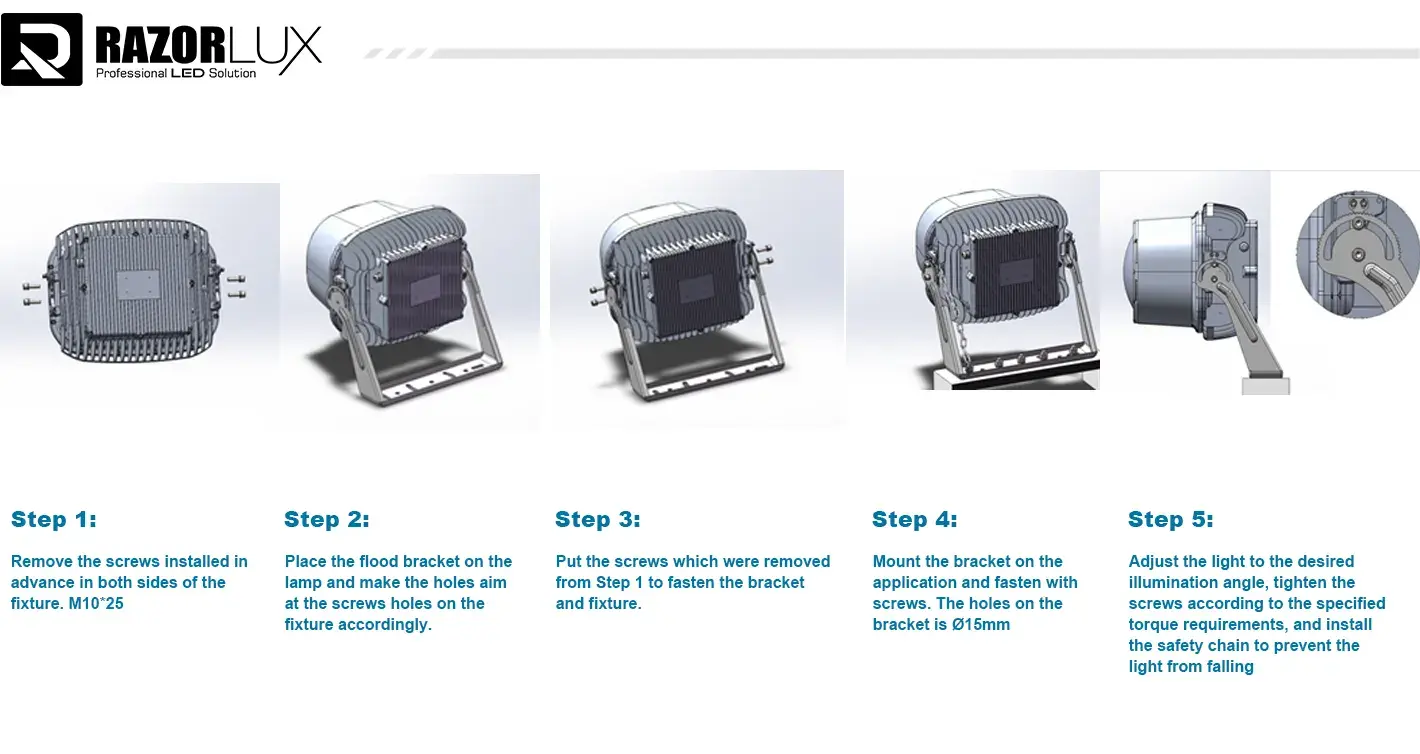
The size of the cable directly affects how much voltage gets to faraway Crane Boom Lights. There may be 150 meters of cable from the control cabin to the tip of the boom on tower cranes with 80-meter jibs. This adds resistance, which lowers the voltage when the crane is under load. Figure out the voltage drop by using the wire gauge, length, and estimated current draw. For example, a 150W Razorlux fixture will draw about 1.3 amps at 120V and 0.65 amps at 240V. Not enough cable not only lowers the power that is sent, but it also causes resistive heating that can hurt the insulation in boom structures that are close together. For crane use, copper conductors that can handle at least 105°C should be used. To account for connection resistance at junction boxes, you might want to choose the next bigger wire diameter than the calculated minimums. Marine-grade tinned copper cable doesn't rust in salty environments like the ocean and the coast, where regular copper rusts over time. As much as wire size affects voltage steadiness, so does the quality of the connection. When there is vibration, the terminal screws come loose. This raises the contact resistance, which causes voltage drops at the links instead of along the wire runs. Put thread-locking compound on all of the electrical contacts and tighten them to the manufacturer's recommended level, which is usually 8 to 10 Nm for industrial-grade connections. During the annual maintenance of the crane, check the connections and retorque them as needed.
Voltage-Related Maintenance and Troubleshooting
Crane Boom Lights that dim or flash often mean that there are problems with the electricity that need to be systematically diagnosed. To start fixing the problem, check the voltage at the fastener input ports while the crane is running. If the voltage is less than what the device requires, it means that there are problems with the wires or that the electrical system isn't strong enough. Voltage that is within the range allowed but flickers suggests that connections are loose or driver parts are failing. If the temperature inside the Meanwell drivers in Razorlux fixtures gets too high, thermal shutdown safety temporarily lowers power or turns off the light. If there isn't enough airflow or the temperature is too high or too low, this safety can show up as voltage-sensitive behavior. Make sure that the way the boom light is mounted allows enough air to flow around the housing, and make sure that the fixture can work in temperatures ranging from -40°C to +60°C. As part of routine maintenance, the voltage at the Crane Boom Lights connections should be checked once a year and compared to the readings taken at the installation's start point. Any voltage drop of more than 5% should be looked into. If the voltage drops over time, it means that wiring problems are getting worse. These problems usually involve corrosion in the joints or damage to the wire insulation, and if they are not fixed, the lights will stop working completely. Razorlux LED modules and drivers come with a five-year guarantee that covers voltage-related problems as long as the fixtures are placed according to the instructions. Keep installation records that show the measured voltage at commissioning, and if you need to, use these records to back up your warranty claims. Our technical support team (sam@razorlux.com) can help you solve voltage-related issues over the phone, and problems are often fixed without having to return the light.
Selecting the Right Voltage Crane Boom Lights for Your Procurement Needs
When buying lights strategically, you need to think about more than just power compatibility. Purchasing managers and engineering contractors can use the following approach to help them make choices that improve both professional performance and total cost of ownership.
Operational Environment Analysis
Make a list of your crane's operating parameters to start. There are different needs for ship-to-shore container cranes, offshore platform pedestal cranes, and tower cranes on building sites. In construction, cranes are often moved, so fixings that are strong enough to handle being disconnected and reconnected many times and movement shock are preferred. Salt-spray protection is important for port activities, which often run 24 hours a day, seven days a week. Along with voltage requirements, offshore platforms need to be ATEX or IECEx explosion-proof rated.Extremes of temperature have a secondary effect on power needs through the parts they affect. When it's cold outside, mining activities in Russia or Scandinavia put more stress on LED drivers than sites in the UAE or Qatar's desert. Razorlux lights can work in temperatures ranging from -40°C to +60°C, but setups that are getting close to these extremes should use extra protection, like insulated housings or extra ventilation.
Matching Voltage Specifications to Crane Brands
The major crane makers use different electricity designs that affect how lights are bought. The table below shows the voltage requirements for some well-known crane brands that work in heavy construction, ports, and the maritime industry:
| Crane Manufacturer | Typical Voltage Systems | Regional Variations | Integration Notes |
|---|---|---|---|
| Liebherr | 230V AC, 400V 3-phase | 120V AC in North America | Standardized electrical panels that have been well-documented |
| Manitowoc/Grove | 120V AC, 480V 3-phase | 230V in EU models | Voltage varies with crane age; check nameplate |
| Terex | 120V AC, 24V DC (mobile) | 230V AC in models from Europe | DC is often used for parts on mobile cranes |
| Konecranes | 230V AC, 48V DC (RTG) | 400V 3-phase for business | Gantries with rubber tires use DC to power their wheels |
| ZPMC | 380V 3-phase, 220V AC | Limited 60Hz models | The voltage in Chinese STS cranes might not be standard |
| Tadano | 100V AC (Japan), 24V DC | 120V or 230V export | Check the power on older foreign gear |
This variety shows how useful universal-input lighting is, like the Razorlux RGL-150P. Instead of keeping separate stock for each crane voltage, buying teams can use a single bulb SKU that instantly adjusts to any voltage it comes across. Standardization makes transportation easier, lowers the cost of keeping extra parts on hand, and stops installation mistakes caused by voltage differences.
Evaluating Energy Efficiency and Total Cost of Ownership
Voltage choice and energy efficiency work together to figure out how much the fixture will cost to run over its lifetime. Higher voltage systems (220–240V) give the same amount of power with less current flow, which lowers the amount of resistance lost in the wires. But this benefit isn't as important with energy-efficient LED lighting as it was with old lights that used a lot of power. To find the yearly energy cost, multiply the fixture's wattage by the number of hours it is used and the local electricity rate. At $0.12/kWh, a 150W LED Crane Boom Light that works 4,000 hours a year costs $72 a year. The 400W metal halide fixture that was changed would have cost $192 a year. The LED, on the other hand, costs only $120 a year, which adds up to $600 in savings over its five-year guarantee and 50,000+ hour working life. Energy savings are amplified by lower maintenance costs. Every 8,000 to 12,000 hours, metal halide lamps need to be replaced by a professional. Each service call costs between $150 and $300, which includes the cost of the technician's time, the downtime of the crane, and the rental of lift equipment. Every three to four years, a crane that works 3,000 hours a year needs to have its bulbs changed. With solid-state parts that last the whole life of the light, LED fixtures get rid of all of these ongoing costs.
Certification and Compliance Requirements
Voltage requirements are a big part of the safety standards that govern how crane lighting is installed. For European CE marking, equipment that works with 50V to 1000V AC or 75V to 1500V DC must follow the Low Voltage Directive 2014/35/EU. Installations in North America need to meet UL or CSA standards, which include rules for overcurrent safety and tests for voltage tolerance. For marine applications, classification society requirements from groups like DNV-GL, ABS, Lloyd's Register, or RMRS are added. For these approvals, voltage tests must be done while the ship is moving, salt fog must be present, and the electronics must be able to work with electromagnetic fields. Razorlux has certifications that cover CE, RoHS, UL, and DLC standards. For shipyard projects, they can also do testing that is specific to marine conditions. The paperwork for buying something should list the power settings and any certifications that are needed. Include phrases like "Crane Boom Lights must work on 80-315V AC input and have valid CE, UL, and RMRS certification" to make sure that bids are legal. Request copies of the certification that have test lab names and report numbers on them to make sure they are real. Fake certificates are common in the industrial lighting market, especially for cheap imports.

Safety and Compliance Regarding Voltage in Crane Boom Lights
Using the wrong voltage can cause major safety problems in addition to damage to devices. The people who work in procurement are responsible for making sure that voltage-compatible lighting protects people and property.
Overvoltage and Undervoltage Hazards
Putting too much power on lighting sources speeds up the breakdown of parts and increases the risk of fire. LED drivers have capacitors and semiconductors that can handle certain voltages, which are usually 10-15% above the standard input. Overvoltage that lasts for a long time breaks down the dielectric in capacitors, which can cause a severe failure that can produce smoke or flame. When the load on an older crane's electrical system changes, voltage spikes are more likely to happen because the engines are not well controlled. Undervoltage poses more subtle risks. When lighting fixtures aren't getting enough power, they may flash, creating strobe effects that make it hard to see moving machinery and make operators tired. When voltage stays low for a long time, drivers have to draw more current to keep output steady. This makes too much heat, which shortens the life of parts. Some low-quality LED lights don't have enough security against low voltage, so they may flicker or go into unstable oscillation modes that make it hard to talk on the radio. The 80V to 315V input range of Razorlux Crane Boom Lights protects against both of these situations. The wide voltage window lets the electrical system break down as cranes age, which delays expensive upgrades. If the voltage drops below 80V or rises above 315V, safety circuits inside the driver turn off the device safely. This keeps it from breaking and turns it back on automatically when the voltage levels back off.
Electrical Isolation and Protection Standards
Modern LED Crane Boom Lights have electrical separation between the power source and the LED array. If the insulation breaks, the chassis won't get powered up. Most workplace safety rules seem to require this double-insulation system, which is called Class I and has a protective earth connection. Make sure that Crane Boom Lights have a separate ground connection from the mounting bracket. This keeps people safe if internal problems power up the housing. Ingress Protection (IP) grades deal with natural dangers, but they also have something to do with voltage safety because they keep water out of parts that are powered on. Razorlux fixtures have an IP67 rating, which means they can withstand being submerged in one meter of water for 30 minutes. This seal keeps saltwater, which is a good conductor, from making other paths for current that could power up the housing or cause an arc-flash inside the fixture.IK impact rates work with IP security to make sure that damage to the housing doesn't let energized parts get out. The IK10 rating means that the fixture can handle 20 joules of impact energy, which is the same as dropping a 5 kg object from 40 cm. This safety feature is important when moving loads hit Crane Boom Lights or when crane structures touch them during setup and maintenance.
Arc Flash and Explosion Protection in Hazardous Locations
Some crane jobs are done in classified as dangerous areas where electricity arcing could start fires in burning atmospheres. Explosion-proof lighting with ATEX, IECEx, or Class I Division 1 ratings is needed on offshore oil platforms, in oil refineries, and in chemical plants. These lights have special housings that keep internal sparks from starting fires on hot surfaces. Crane Boom Lights like the Razorlux RGL-150P are used in non-hazardous industry settings like general building, shipyards, and container ports. Applications that need to be protected in dangerous areas need fixtures that are approved to work in those conditions. Email our technology team at sam@razorlux.com to talk about unique explosion-proof solutions for your secret location needs. Electrical design should be based on arc-flash incident energy calculations even in places that aren't dangerous. When Crane Boom Lights are attached to electrical systems with more than 10kVA of possible fault current, junction boxes may need to have arc-flash warning signs on them. When planning lights for big cranes, make sure to talk to licensed electrical experts to make sure you follow NFPA 70E or local standards that are similar.
Conclusion
Voltage compatibility is an important part of buying Crane Boom Lights because it affects how easy they are to install, how safe they are to use, and how much they cost over their lifetime. Modern LED lighting technology, especially fixtures that can accept 80–315V AC or 80–400V DC, like the Razorlux RGL-150P, gets rid of the voltage barriers that used to make it hard to operate international cranes and make sure that all of them were the same. Wide-voltage lighting has big benefits for procurement workers who work in maritime, building, and heavy industry sectors. It makes managing inventory easier, cuts down on installation mistakes, and allows equipment to be moved between global facilities more easily. The technical issues we talked about, like figuring out voltage drop and the best way to wire things, as well as safety regulations and certification needs, help you make design choices that balance performance with total cost of ownership. When purchasing managers and engineering contractors look at boom lighting proposals, putting voltage flexibility ahead of core performance metrics like lumen output, environmental protection, and certification authenticity gives the best value over the lifecycle of the equipment.
FAQ
Can I Use 12V Crane Boom Lights on 24V DC Systems?
When lighting is used at twice its maximum power, parts fail right away and there is a risk of fire. When there is too much voltage, dielectric breakdown happens in the LED driver parts, especially in the input capacitors and voltage regulation circuits. Some contractors think wrongly that high voltage will make LED lights shine brighter, but because good LED fixtures are designed to handle regulated current, overvoltage hurts the driver instead of making the lights brighter. Make sure the voltage ratings are compatible before installing anything, and never assume that values that are "close enough" will work safely. These worries are taken away by universal-input lights like the Razorlux RGL-150P, which can handle any power from 80V DC to 400V DC.
How Does Voltage Affect Brightness and Energy Consumption?
Active current control makes sure that LED Crane Boom Lights stay the same brightness across the whole range of power inputs. The driver circuitry changes the variable input voltage into an exact DC that powers the LED array. This makes sure that a light produces the same number of lumens whether it is connected to a 120V or 240V system. Also, the amount of energy used stays pretty much the same—a 150W LED light uses about 150W of energy no matter what the input power is (with some small changes due to driver efficiency curves). This behavior is very different from older halogen lights, whose brightness grew greatly with voltage but lamp life decreased. Modern LED fixtures have outputs that aren't affected by voltage, which makes purchasing easier because they make sure that performance is the same across multinational crane fleets that use different electrical standards.
Are Universal Voltage Boom Lights Available for Multiple Crane Brands?
Good manufacturers now make LED Crane Boom Lights with universal inputs that can automatically connect to any crane voltage system in the world. With its 80-315V AC and 80-400V DC input range, the Razorlux RGL-150P is a great example of this method. It works with almost all crane electrical architectures from big makers like Liebherr, Manitowoc, Terex, Konecranes, and ZPMC. This design works with any voltage because it uses advanced switch-mode power supplies that can sense the input voltage and set up automatically, so you don't have to switch or adjust anything by hand. Standardizing on a single fixture SKU that works for all of their cranes is good for procurement teams because it simplifies inventory and stops mistakes caused by voltage mismatches during installation.
Partner with Razorlux for Voltage-Compatible Crane Boom Light Solutions
As a company that has been serving the maritime, port, and heavy industrial markets around the world for 25 years, Razorlux is ready to help you with your crane lighting needs. Our engineering team knows what voltage problems you're having when you're trying to add lighting to crane fleets with different voltages, help remote platforms with their own DC power systems, or make sure that your vessel installations meet the standards of the classification society. The RGL-150P boom light has a global input range of 80–315V AC or 80–400V DC, an efficiency of 130 lm/W, IP67 protection against the elements, and a number of approvals, such as CE, RoHS, UL, and DLC. We stand behind every Crane Boom Lights fixture with a five-year guarantee that covers both the LED modules and the Meanwell drivers. Our quality systems are ISO 9001-certified, and we have over 200 patents protecting our designs. You can email our procurement support team at sam@razorlux.com to talk about which voltages will work with your unique crane models, get technical drawings and approval paperwork, or set up sample evaluation units. We offer full application engineering help to make sure that the right voltage specification, wire sizing, and fitting methods are used to make sure that your fixtures last as long as possible while still meeting safety standards across all of your activities.
References
1. International Electrotechnical Commission. "IEC 60598-1:2020 - Luminaires - Part 1: General requirements and tests." Geneva: IEC Central Office, 2020.
2. National Electrical Manufacturers Association. "NEMA C78.377-2017 - Specifications for the Chromaticity of Solid State Lighting Products." Rosslyn: NEMA, 2017.
3. Marine Equipment Directive Compliance Working Group. "Voltage Standards for Ship and Offshore Platform Electrical Systems." Journal of Marine Engineering Technology, vol. 18, no. 3, 2021, pp. 142-158.
4. Crane Manufacturers Association of America. "Technical Specification No. 74 - Electrical Design Standards for Mobile and Tower Cranes." Charlotte: CMAA, 2019.
5. Illuminating Engineering Society. "IES LM-79-19 - Approved Method: Optical and Electrical Measurements of Solid-State Lighting Products." New York: IES, 2019.
6. Det Norske Veritas and Germanischer Lloyd. "Rules for Classification of Ships - Part 4 Chapter 8: Electrical Installations." Hamburg: DNV-GL, 2022.