


_1750326878398.png)

Best Led Sports Lighting Fixtures for 2026: Expert Picks
When looking at the best Led Sports Lighting Fixtures for 2026, speed, longevity, and how much energy they use become clear. When compared to traditional metal halide systems, professional LED sports lighting provides better lighting for athletic areas while cutting costs by as much as 75%. These high-tech lighting solutions are needed in all modern sports places around the world because they provide quick clarity, better color rendering, and longer lifespans. Facility managers are moving faster toward LED sports field lights because they know they will save a lot of money in the long run. Modern LED floodlights work consistently for 50,000 hours or more, while older high-pressure sodium or metal halide lamps need to be replaced often and use a lot of energy. Because they last longer, they need less upkeep and cost less to own overall.
Selection Criteria for Premium Sports Lighting Systems
To pick the best outdoor sports lights, you need to carefully consider a number of important factors.
- Energy economy is the most important thing to think about because lighting systems in sports buildings are usually on for long periods of time. LED lights with a high brightness output must provide enough light while using an appropriate amount of power.
- When things are exposed to bad weather, shocks, and the chance of being hit, durability becomes very important. Waterproof LED lights with IP67 ratings make sure they work reliably in tough conditions. The building materials and quality of the construction have a direct effect on how well the house works and how much upkeep it needs over time.
- The quality of the light has a big effect on how well players do and how much fun fans have watching. Better color rendering (CRI >80) makes sure that colors are seen correctly, and good beam control keeps glare and shadows to a minimum. LED lighting for venues needs to light up the game areas evenly, without leaving dark spots or big changes in brightness.
- Total project prices are affected by how easy it is to install and do upkeep. LED sports flood lamps that are made in modules make fixes and improvements easier. Smart sports lighting systems can be monitored from afar, which lets you plan repairs ahead of time and save energy.
| Factor | Description | Importance |
|---|---|---|
| Energy Efficiency | Adequate illumination with low power consumption | Reduces operational costs |
| Durability | Waterproof fixtures with robust construction | Ensures reliable operation in harsh conditions |
| Light Quality | High color rendering (CRI >80) and proper beam control | Enhances player performance and spectator experience |
| Installation Flexibility | Modular designs for easy repairs and upgrades | Lowers maintenance costs |
| Smart Technology | Remote monitoring and energy optimization | Enables proactive maintenance |
Top LED Sports Lighting Fixtures for 2026
Razorlux RGL-120A: Versatile Multi-Sport Solution
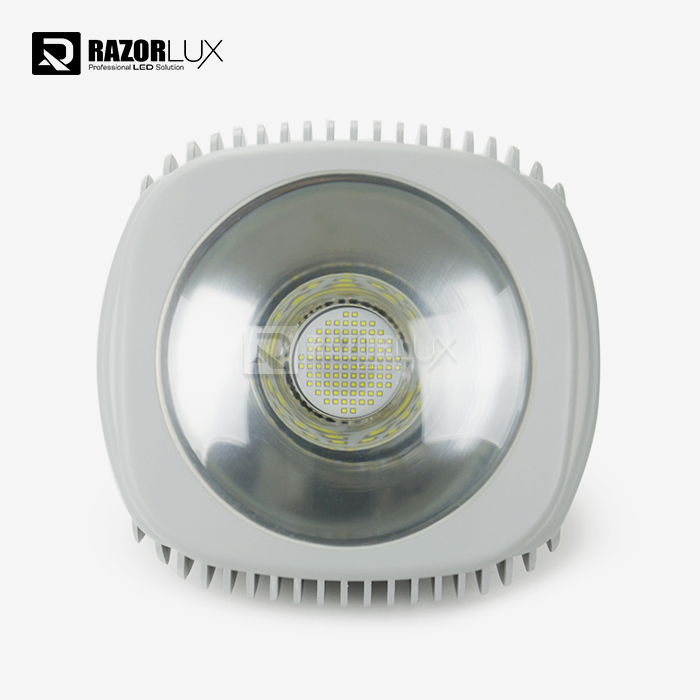
With its small sports lighting design, the RGL-120A exemplifies the most advanced engineering currently available. Despite having a total power usage of just 120W, this light is capable of producing 14,400 lumens, obtaining an amazing efficiency rating of 130 lm/W. The beam angles of 60°, 120°, and 140°x60° may be selected, allowing the revolutionary multi-function design to serve a wide range of athletic uses.

Key Performance Features:
- Power consumption: 120W total (108W LED + 12W driver)
- Lumen output: 14,400 lm (5700K after 1 hour stabilization)
- Color temperature range: 2000K-6000K customizable
- Color rendering index: Ra≥75 standard (Ra≥80, Ra≥90 available)
- Operating lifespan: ≥50,000 hours
- Dimensions: 360×358×187mm
- Weight: 8kg (17.6 lbs)
The strong metal structure and powder covering make it very resistant to rust, making it perfect for use in sea and coastal settings. Meanwell power sources work reliably over a wide range of voltages (AC80-315V, DC80-400V). The IP67 and IK10 grades make sure that you are safe from water and mechanical damage.
This light works great in medium-sized sports facilities, tennis fields, and leisure areas that need to save energy and take up little space. Because it can work in a wide range of temperatures (-40°C to 60°C), it can be used in many climates around the world.
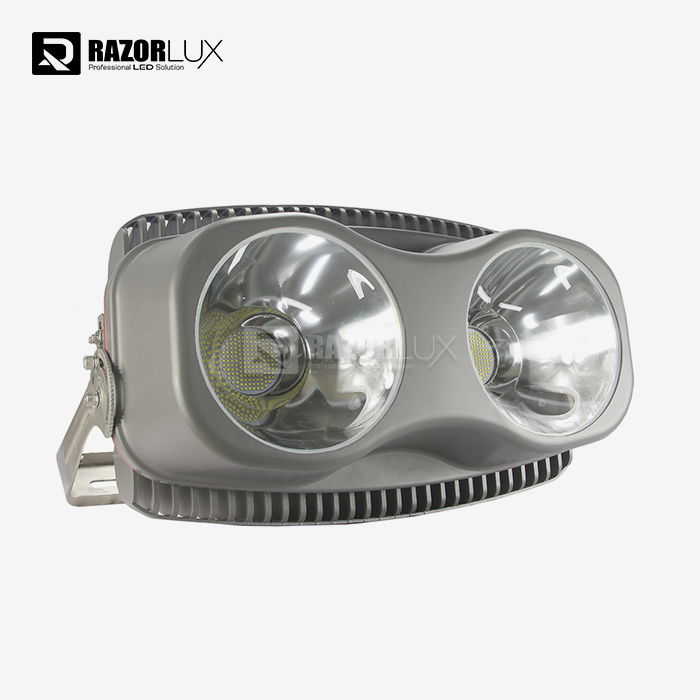
Razorlux RGL-1000A: Professional Stadium Powerhouse
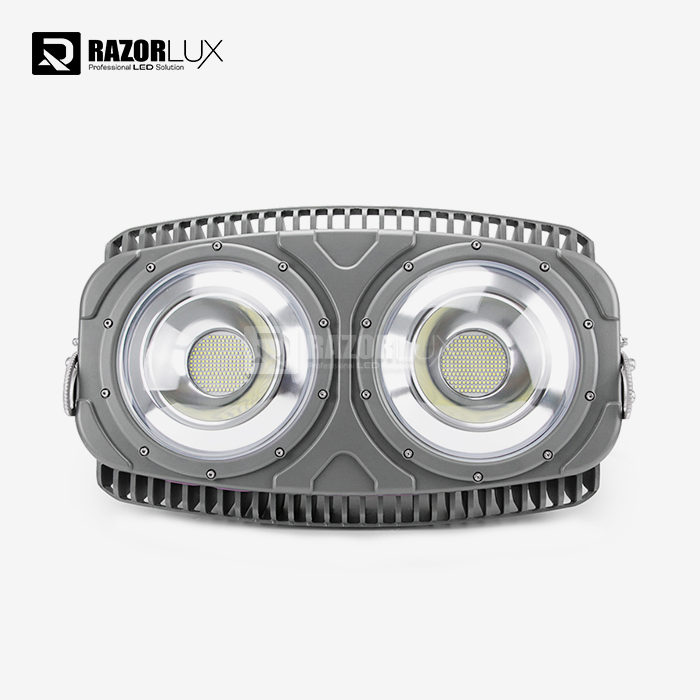
Large sports sites and grounds can use the RGL-1000A to get professional-grade lighting. This bulb replaces 2200–2500W standard lighting systems with better light quality and a 130,000 brightness output from 1000W usage. With beam angles of 40°, 60°, 120°, and 140°, you can precisely control how the light is distributed.
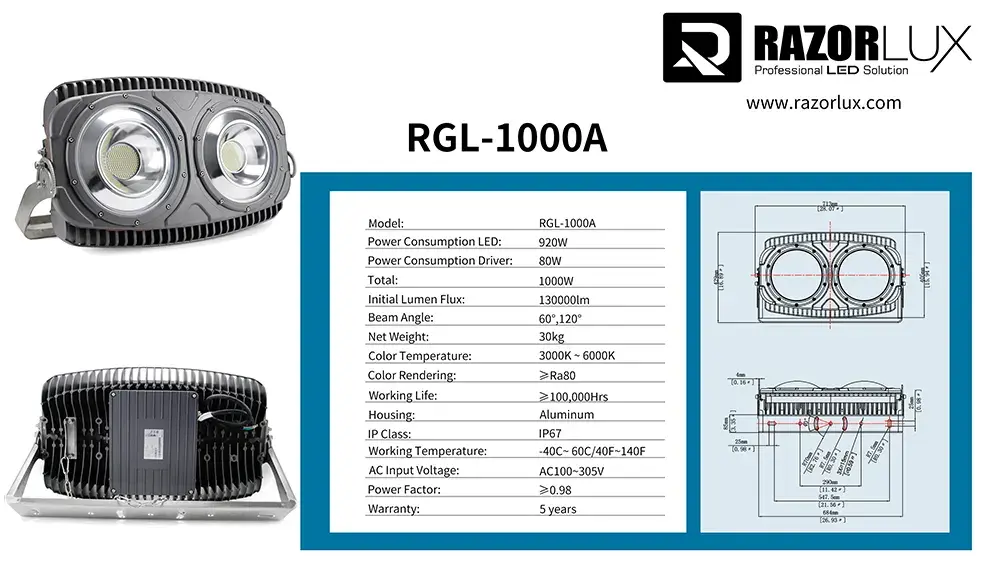
Professional Specifications:
- Total power: 1000W (900W LED + 100W driver system)
- Luminous flux: 130,000 lm stable output
- Beam options: 40°, 60°, 120°, 140° precision optics
- Housing: Premium aluminum with advanced thermal management
- Dimensions: 671×405×379mm for optimal heat dissipation
- Weight: 29kg, robust construction
- Voltage flexibility: AC80-305V, DC100-400V, DC500-800V
The advanced heat management system keeps performance from dropping when it's being used for long periods of time. Meanwell motors fix the power factor (≥0.98) and keep harmonic distortion low (<10%) so they can work with the power grid. The flexible design makes it easier to maintain and change parts.
This device is made for high-mast lighting setups, professional arenas, and large sports centers. It's perfect for broadcast-quality lighting needs because it has a high brightness density and can be controlled very precisely.
High-Performance LED Floodlight Systems for Athletics
Modern sports ground lighting requires energy-efficient, high-quality lights. Modern optics in premium LED sports lighting fixtures avoid hot spots and cover huge playing grounds evenly. These systems optimise light dispersion using Samsung LED chips and precision-engineered reflectors.
Motion-sensor sports lights include clever control to save energy during inactivity. These systems automatically alter brightness depending on occupancy, prolonging fixture life and providing security illumination at night. Smart controls let building managers save energy without sacrificing safety.
Light pollution restrictions and neighborhood effects must be considered while lighting night games. Modern LED retrofits use directed optics to reduce light leakage outside playing areas. The ecologically friendly designs provide outstanding on-field lighting while respecting communities.
Global Market Analysis and Regional Considerations
There are a lot of different rules and performance standards in the global sports lighting market. For markets in Northern Europe, the energy economy and environmental responsibility are very important. In the Middle East, on the other hand, LED sports lighting fixtures need to be able to handle high temperatures and not rust. Southeast Asian sites put a lot of emphasis on keeping humidity levels low and running smoothly in hot conditions.
Maritime and seaside systems need special treatments to keep them from rusting and higher IP ratings. Marine-grade finishes and fastening tools made of stainless steel make fixtures last longer in salt spray settings. These things have a direct effect on the choice of material and finishing requirements for long-term dependability.
Lifecycle cost analysis and environmental metrics are being used more and more in lighting projects for sports complexes. Facility managers look at the total costs of ownership, which include things like energy use, repairs, and dumping. As energy costs rise and environmental rules get stricter, the benefits of LED technology become clearer.
When it comes to color brightness and flicker-free operation, professional setups often have to meet standards set by the television business. For high-definition TV production, colors must be rendered consistently, and any visual flaws that might show up on camera must be removed. These standards affect how LED drivers are made and how heat is managed.
Purchasing Recommendations and Implementation Considerations
A thorough site study and illumination models are the first steps to a successful sports lighting project. Professional photometric studies find the best places to put fixtures and the angles at which to aim them so that the light is spread evenly. These figures take into account the height of the mounting, the distance between the poles, and the needs of the sport.
When making a budget, you should include the costs of buying the equipment, installing it, and saving money over time. Even though LED sports lighting fixtures cost more up front, they usually pay for themselves in three to five years thanks to lower energy costs and repair costs.
The professional help, guarantee coverage, and availability of local service should be emphasized when choosing a vendor. Suppliers with a lot of experience in both naval and industrial settings know how to handle the unique challenges of sports lighting uses. Having a lot of certifications, like CE, RoHS, UL, and DNV/GL, shows that you care about quality and following the rules.
| Consideration | Description | Benefit |
|---|---|---|
| Site Analysis | Photometric studies and fixture placement | Ensures uniform illumination |
| Budget Planning | Initial costs, installation, and savings | Optimizes long-term ROI |
| Vendor Selection | Technical support, warranty, and service | Reliable supplier and ongoing support |
| Certifications | CE, RoHS, UL, DNV/GL | Confirms quality and compliance |
Implementation Best Practices
Professional construction teams who know how to use high masts and precise pointing methods make sure that the system works at its best. When fixtures are aligned and focused correctly, uniformity is maximized, and glare and light pollution are minimized. Maintenance plans that are followed on a regular basis keep fixtures working well for a long time.
Advanced control methods that make the best use of consumption trends are made possible by energy management systems. Dimming features let you change the lighting for different hobbies and parties. Remote tracking systems give information about performance in real time, which helps plan for planned maintenance.
Conclusion
The progress made in LED sports lighting fixtures has opened up new ways to improve facilities and lower operating costs. Premium lighting uses very little energy and gives off better light, which improves both player ability and the fan experience. The best return on investment is achieved by carefully choosing based on application needs, weather factors, and long-term operating goals.
Many modern sports centres gain greatly from LED technology's benefits, such as instant lighting, exact control, and longer operating lifespans. Facility managers are quickly switching away from traditional lighting systems because they save a lot of money on energy costs and don't need as much upkeep. Professional-grade LED systems are reliable and work well enough for hard sports use. They also help with recycling efforts and neighbourhood environmental goals.
FAQ
1. What lumens do I need for different sports applications?
For casual play, professional football and soccer fields need between 200 and 500 lux (20 to 50 foot-candles), while broadcast-quality fields need 1000 lux or more. Depending on the level of play, tennis courts need between 300 and 750 lux. Basketball courts need between 300 and 750 lights, and the regularity ratio should be less than 2:1.
2. How long do LED sports lighting fixtures last compared to traditional systems?
Good LED sports lighting fixtures work regularly for 50,000 to 100,000 hours, which is about 15 to 25 years of normal use. Most metal halide systems last between 10,000 and 15,000 hours before they need to be replaced. Also, LED systems keep giving off the same amount of light over their entire life, while standard lights lose a lot of their value over time.
3. What are the most important licenses that expert sports lights need?
UL listing for electricity safety, DLC approval for energy saving programs, and FCC clearance for electromagnetic interference are some of the most important licenses. For international projects, it may be necessary to get CE marks, RoHS compliance, and other area clearances. DNV/GL or ABS approval helps marine products work reliably in tough environments.
Partner with Razorlux for Professional LED Sports Lighting Solutions
Razorlux stands as your trusted LED sports lighting fixtures manufacturer with over 25 years of engineering excellence and 200+ patents in LED technology. Our comprehensive product portfolio addresses diverse athletics applications from recreational facilities to professional stadiums requiring broadcast-quality illumination. Contact sam@razorlux.com to discuss your specific project requirements and receive customized lighting solutions that deliver exceptional performance, energy efficiency, and long-term reliability for your sports facility investment.
References
1. International Association of Lighting Designers. "Sports Lighting Design Guidelines and Best Practices." 2025 Edition.
2. Institute of Electrical and Electronics Engineers. "LED Sports Lighting Standards and Performance Metrics." IEEE Standards Publication, 2025.
3. Sports Facility Research Institute. "Global Sports Lighting Market Analysis and Technology Trends." Annual Report 2025.
4. International Dark-Sky Association. "Sports Lighting Design Guidelines for Light Pollution Reduction." Technical Manual 2025.
5. Energy Efficiency Council. "LED Lighting Retrofit Benefits in Sports and Recreation Facilities." Research Study 2025.
6. Professional Sports Lighting Association. "Broadcast Quality Illumination Standards for Modern Sports Venues." Technical Specification 2025.
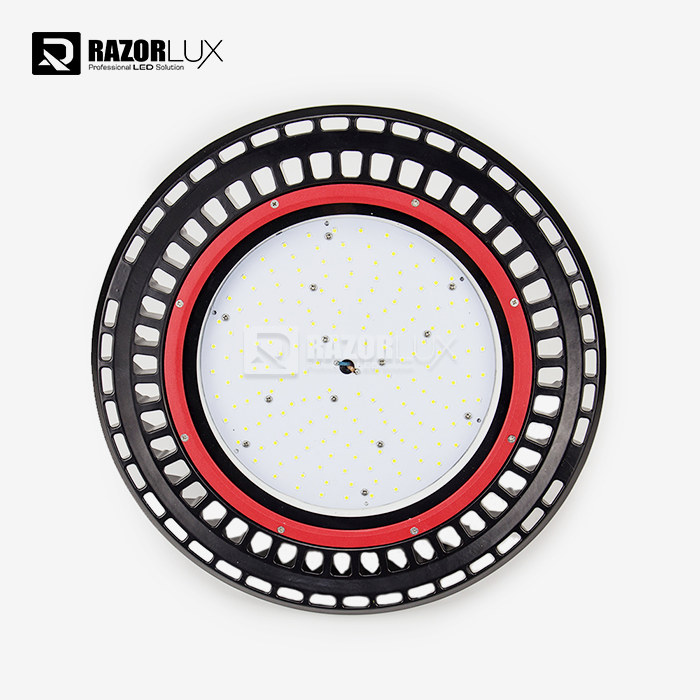 VIEW MOREworkshop light fixtures
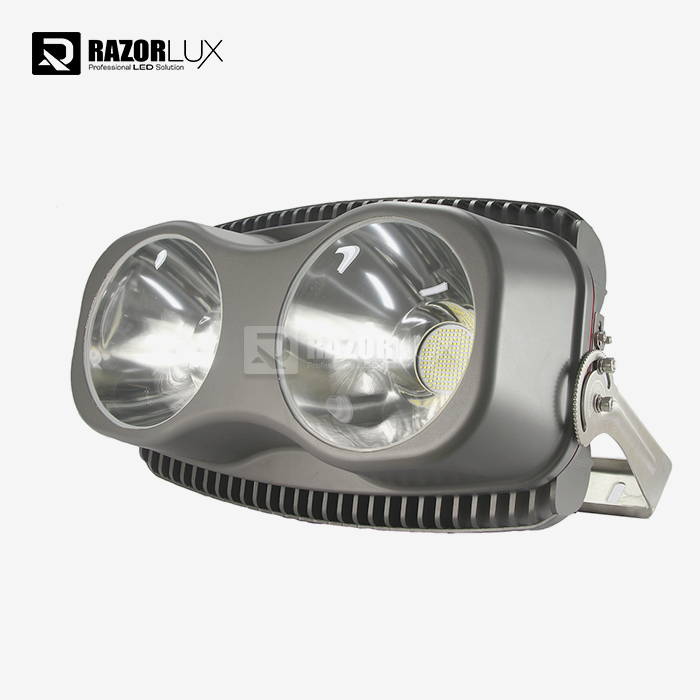 VIEW MOREoutdoor basketball light
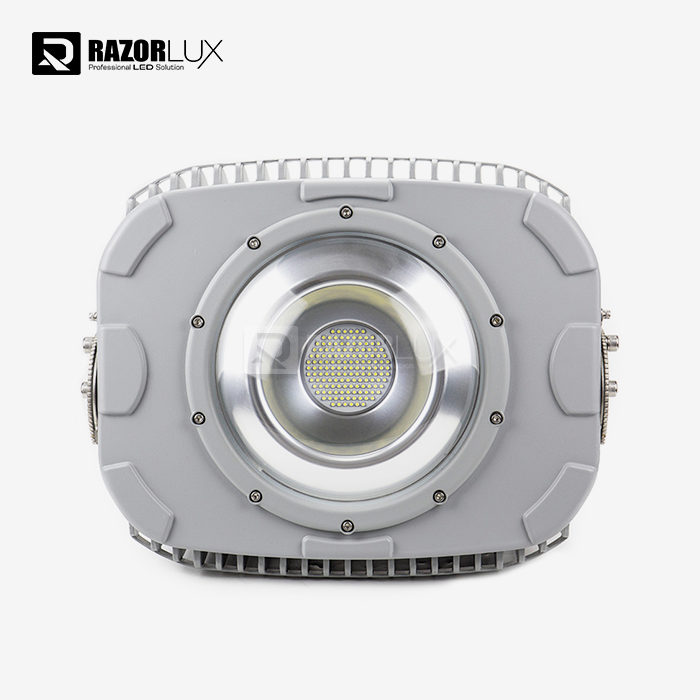 VIEW MOREsports ground lights
 VIEW MOREtennis court flood lights
 VIEW MOREboat deck lights
 VIEW MOREmarine dock lights led
 VIEW MORERound 120w Led Industrial Flood Light 14400lm Anti Glare Led Flood Light
 VIEW MORESports Flood Lights Outdoor