

_1750326878398.png)

1000 Watt Led Sports Light for Tennis Courts and Stadiums
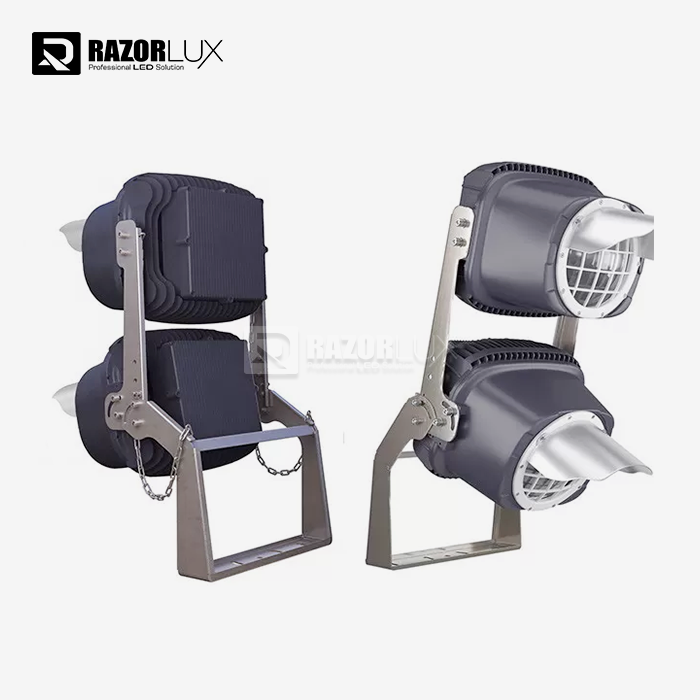
https://www.razorlux.com/led-outdoor-sports-lighting/high-lumen-led-flood-lightThe 1000 Watt Led Sports Light stands out as a potent substitute for conventional 2000–3000W metal halide systems when it comes to high-performance lighting for tennis fields and arenas. These high-tech LED lights give off a lot of light—usually 130,000 lumens or more—while using 50–60% less electricity. Because they were designed to work in tough sports settings, they provide even lighting, turn on instantly, and last longer, which lowers upkeep costs by a huge amount. Because of this, they are perfect for procurement managers who want to make sure that large-scale venue setups are reliable, efficient, and follow all the rules.
Understanding 1000 Watt LED Sports Lights: Technology and Benefits
How LED Technology Transforms Sports Lighting
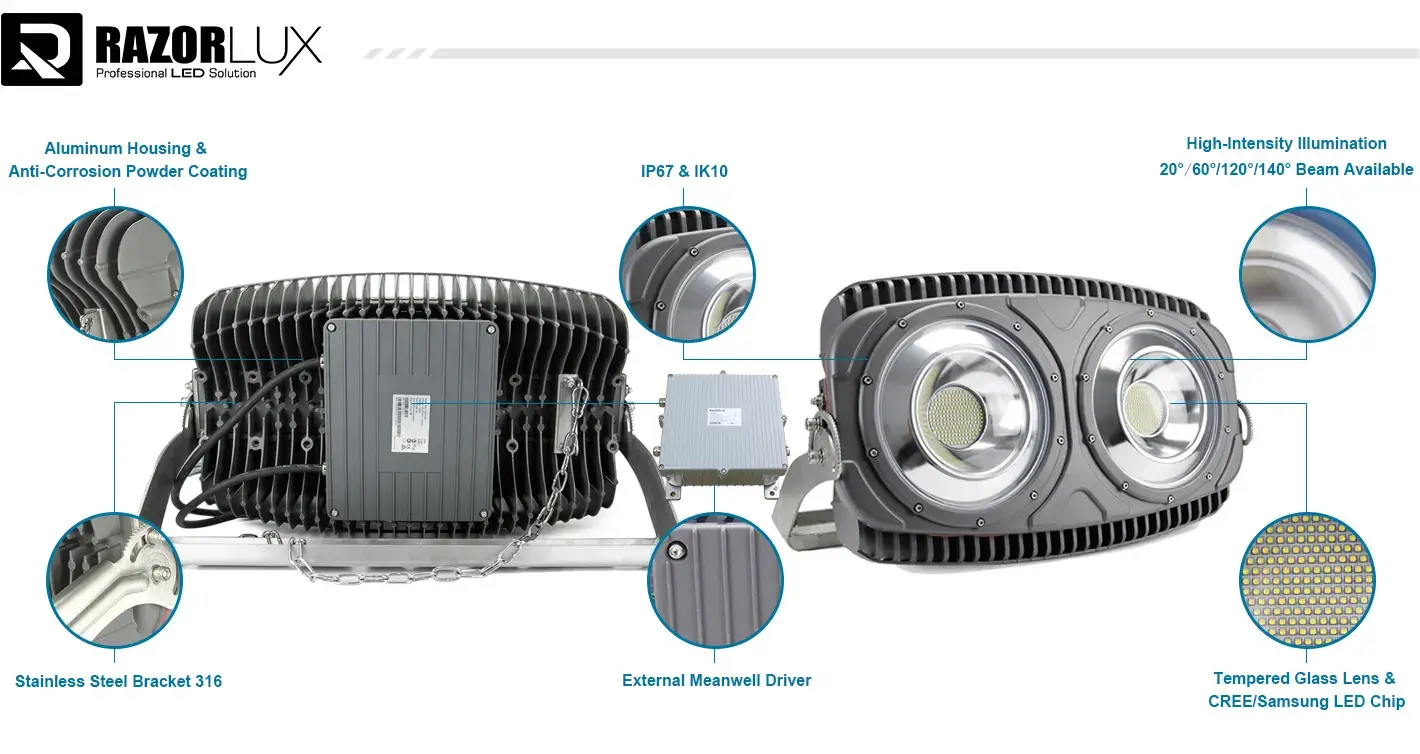
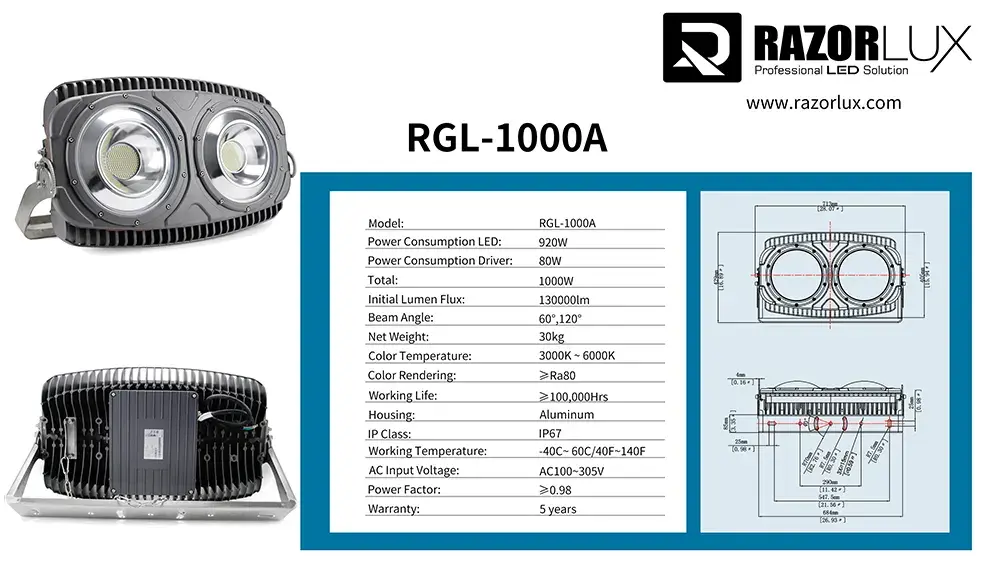
High-intensity discharge systems have been replaced by LED sports lighting, which is a big change. Modern LED fixtures reach full brightness right away, while metal halide lamps need 5 to 15 minutes to warm up. Semiconductor diodes are what make the technology work. They turn electricity straight into light with very little heat loss. Our RGL-1000A type has a Meanwell power source and high-efficiency LED panels that work together to achieve 130 lm/W luminous effectiveness. This is a standard that means the fixture will save a lot of energy over its 50,000+ hour lifetime.
Energy Efficiency That Impacts Your Bottom Line
Making the switch to LED sports lighting clearly saves money. Traditional 2000–3000W HID lamps can be replaced with a single 1000 Watt Led Sports Light, which gives off more light. In a normal stadium installation, this reduction cuts energy use by about 60% over the course of five years of operation. This saves tens of thousands of dollars in utility costs. The fixtures work well with a wide voltage range (AC80-305Vac, DC100-400Vdc), so they will keep working even in places where the power source isn't stable. This is an important thing to think about for foreign projects in Southeast Asia and the Middle East.
Superior Light Quality for Athletes and Spectators
The quality of the lighting has a direct effect on how well athletes do and how much fun fans have watching them. The colour rendering index (CRI Ra>75, which can be raised to Ra>90) makes sure that colours are seen correctly, which is important for telling team clothes apart or following moving objects like tennis balls. Our fixtures have colour temperatures that can be changed from 2700K to 6500K, so venue managers can make the perfect visual environment. The beam angles that are available are 40°, 60°, 120°, and an asymmetric 140°x60°. These angles allow for precise light spread that reduces glare and increases uniformity across playing fields.
Built to Withstand Harsh Environments
Installations for sports lights are always exposed to tough environments. The RGL-1000A has casings that are rated IP65/IP67 and protect the interior parts from water, dust, and direct water jets. The IK10 grade for impact makes sure that the housing can handle hits of up to 20 joules, which is the same as dropping a 5 kg object from 40 cm. These fixtures work effectively in temperatures ranging from -40°C to 60°C. They do the same job whether they are placed in open grounds in the Middle East or in Norway for winter sports. The powder-coated aluminium housing and stainless steel brackets are treated to make them resistant to corrosion. This makes them last longer, even in salty environments like those found near the coast.
Comparing 1000 Watt LED Sports Lights with Alternative Lighting Solutions
LED vs. Metal Halide: A Technical Performance Analysis
When you compare LED technology to metal halide technology, you can see that they work very differently. Within the first 10,000 hours, metal halide lamps lose 30 to 40 percent of their original lumens. After 50,000 hours, LED lights keep working at L70 (70% of their original lumens). At installation heights of 18 to 35 meters, metal halide systems are also hard to maintain because they need special tools and can interrupt service. LED modular designs let you fix individual parts instead of changing whole lights, which cuts down on downtime and labour costs.
| Parameter | 1000W LED | 2500W Metal Halide |
|---|---|---|
| Lumen Output | 130,000 lm | 125,000-140,000 lm |
| Efficacy | 130 lm/W | 50-60 lm/W |
| Lifespan | 50,000+ hours | 10,000-15,000 hours |
| Warm-up Time | Instant | 10-15 minutes |
| Restrike Time | Instant | 15-20 minutes |
| CRI | Ra>75 (up to Ra>90) | Ra 65-70 |
Total Cost of Ownership: A Five-Year Projection
To make good purchasing decisions, you need to know about the costs that go beyond the initial purchase price. Even though LED lights cost more up front, they save a lot of money over the life of the device. Every year, energy costs go down by 60%. Maintenance costs drop by a huge amount. Metal halide lamps need to be replaced every 18 to 24 months, which costs $200 to $500 per fixture and includes labour. However, during the five-year warranty period, LED systems usually don't need any major service work. Companies usually get their money back on an investment (ROI) for a stadium installation of 100 fixtures within 24 to 36 months, and then they save money for years after that.
Wattage Selection: Matching Power to Application Requirements
The fixing height, covering area, and lighting standards all affect the choice of wattage. The 1000 Watt Led Sports Light version works on tennis courts with poles that are 12 to 18 meters high and in stadiums with poles that are 20 to 30 meters high. 500–750W fixtures may work well in smaller venues or lower mounting positions. On the other hand, 1500W models or multiple 1000 Watt Led Sports Light units may be needed in very large stadiums. Our technical team does photometric analysis with DIALux or AGi32 software to model how light is distributed and make sure it meets standards like IESNA RP-6-15 for sports lighting.
Installation and Optimal Placement for Maximum Performance
Pre-Installation Planning and Site Assessment
A thorough site evaluation is the first step to any successful lighting project. For example, engineering teams have to look at where the poles are, how tall they are, how much weight they can hold, and whether there is electricity service. To get the lighting levels suggested by the USTA (50–100 foot-candles for casual play, 125+ for tournament-level play), we suggest installing four- or six-pole systems with uneven beam distributions on tennis courts. Complete photometric modelling is needed for stadium projects to make sure that the horizontal lighting on the playing surfaces is balanced with the vertical lighting needed for fans to see and for broadcasting.
Mounting Configuration and Aiming Protocols
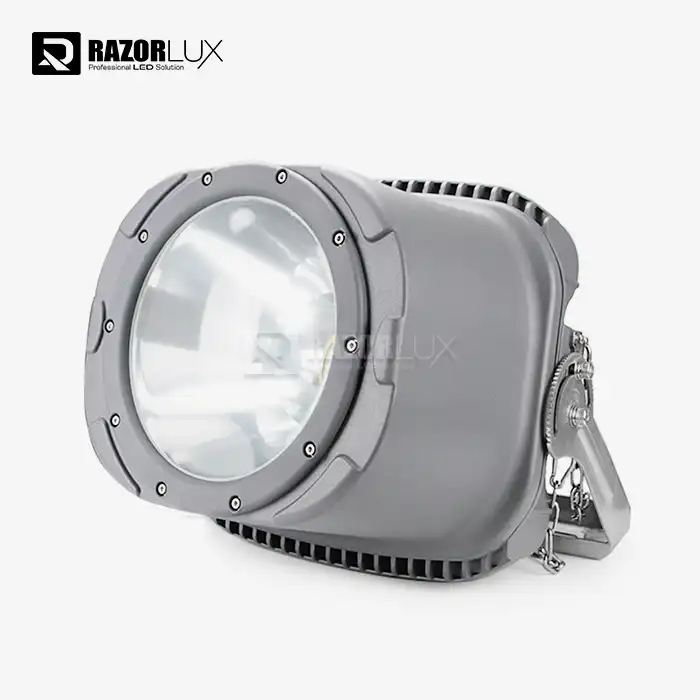
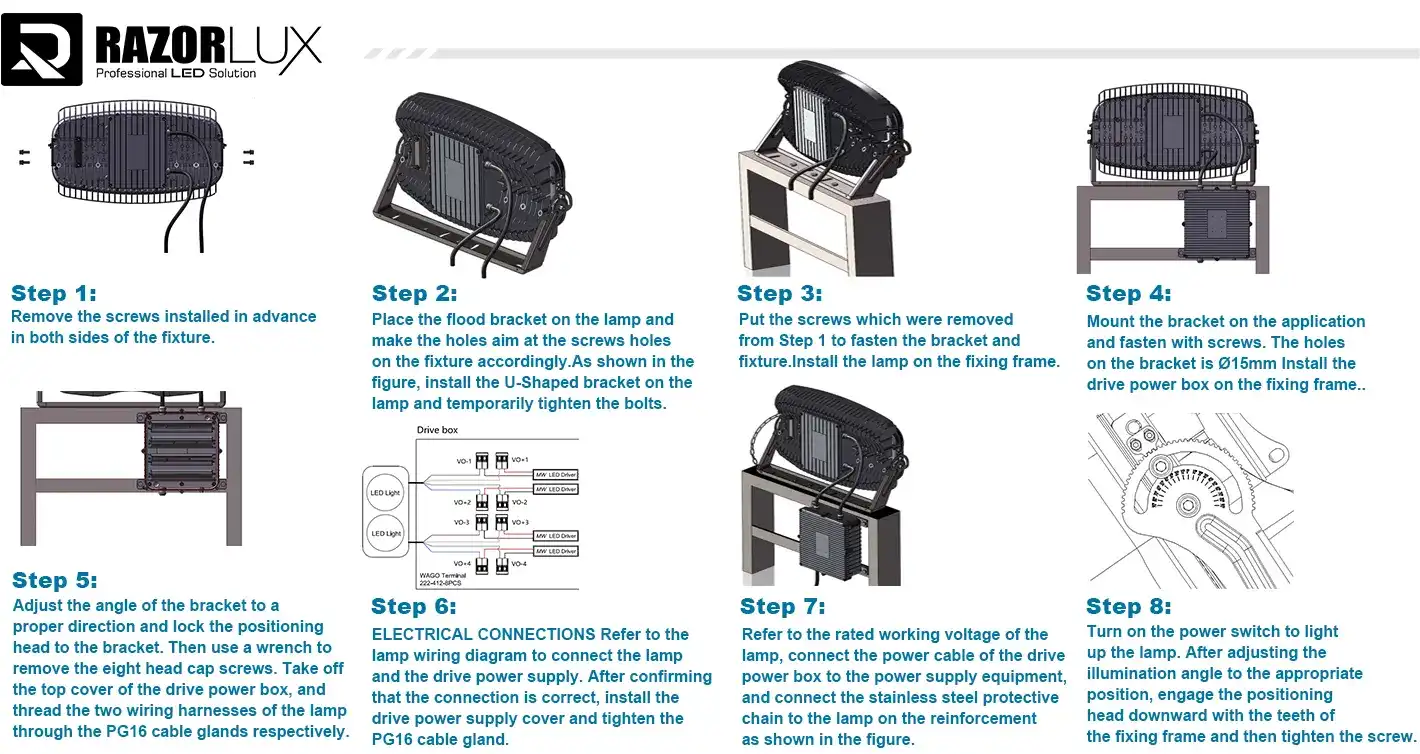
When you aim your fixtures correctly, you can get rid of hot spots and dark areas that make playing conditions worse. The unique multi-function bracket design can be rotated 360 degrees, and the angle can be adjusted precisely, so it can be used in a variety of mounting situations. Fixtures shouldn't just point straight down; they should be aimed at specific places on the playing field. The 29 kg weight needs mounting hardware that is strong and rated for dynamic loads, like wind forces. We give you detailed aiming diagrams and suggest that you use calibrated lux meters to take measurements after installation to make sure that the actual lighting matches the design specifications.
Integration with Control Systems
Smart lighting management is helpful in modern sports venues. The light fixtures work with 0-10V dimming protocols, so they can be connected to building management systems or used as stand-alone controls. With this feature, workers can set up schedule programs that lower output during practice sessions. This makes fixtures last longer and uses less energy. In some installations, wireless mesh networking is used to control and monitor hundreds of fixtures from one place. The low THD (<10%) and high power factor (≥0.98) make it possible to use sensitive control tools and keep the stress on the electrical system to a minimum.
Real-World Case Study: Municipal Stadium Retrofit
In the southeast of the United States, a municipal stadium got rid of 150 old 1500W metal halide fixtures and put in 100 1000 Watt Led Sports Lights instead. The fix cut the associated load by 56%, from 225kW to 100kW. The amount of energy used each year went from 540,000 kWh to 240,000 kWh, which saved $42,000 a year at $0.14/kWh. The consistency of the light increased from 0.6 to 0.8 (min/avg ratio), and the 15-minute warm-up time was no longer needed thanks to the instant-on feature. Even though the project cost more in LEDs at the start, it paid for itself in 2.8 years.
Procurement Best Practices: How to Source High-Quality 1000 Watt LED Sports Lights
Critical Specifications That Define Quality
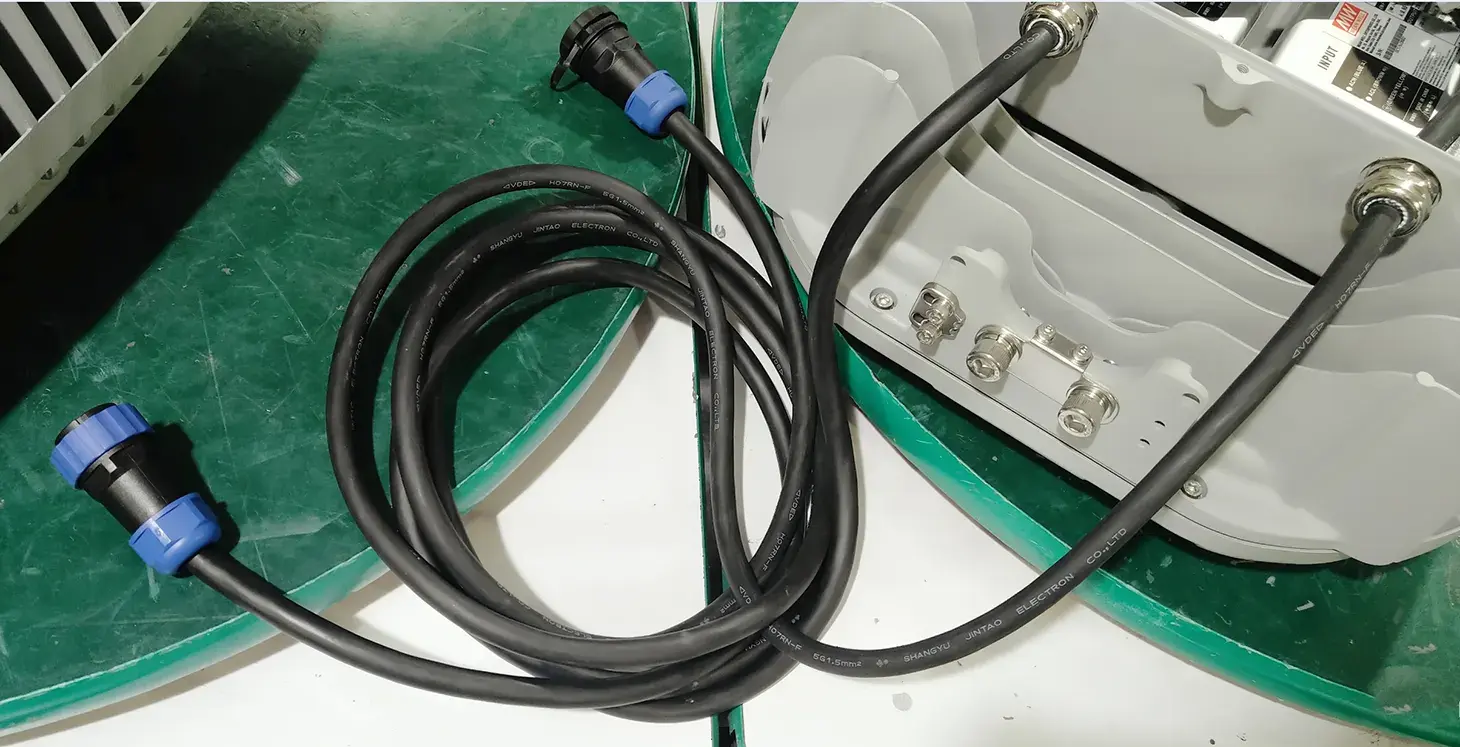
Managers in charge of buying things should check fixtures against certain performance standards. Lumen power claims need to be backed up by LM-79 test results from reputable labs. What is the difference between "initial lumens" and "stable lumens after one hour"? For example, our RGL-1000A says it has a stable output of 130,000 lumens, which is based on real-world conditions and not inflated cold-start measurements. Reliability depends on the quality of the driver. The Meanwell power sources in our fixtures come with their own five-year warranties and can handle the wide ranges of voltage that are typical in naval and industrial settings.
| Certification | Purpose | Required For |
|---|---|---|
| CE | Following European safety rules | The EU market |
| UL/DLC | Standards in North America | US and Canada |
| SAA/C-Tick | Compliance in Australia and New Zealand | Oceania area |
| RoHS | Limits on dangerous substances | Global rules for the environment |
| DNV/GL | Classification of the sea | Installations on ships |
| ISO:9001 | System for managing quality | Checking the trustworthiness of the supplier |
Evaluating Manufacturers and Supply Chain Reliability
Beyond product specs, the choice of supplier affects the success of the project. Xi'an Razorlux Optoelectronic Technology has been making LEDs for more than 20 years and has more than 200 patents covering LED Packaging, heat management, and optical design. Our vertically integrated production facility keeps enough inventory on hand to guarantee delivery times of 4 to 6 weeks, even for large orders. The ISO:9001 quality management system uses testing procedures at the receiving, assembling, and final checking steps. Before shipping, every fixture goes through a 48-hour burn-in test.
Certification Documentation and Compliance Verification
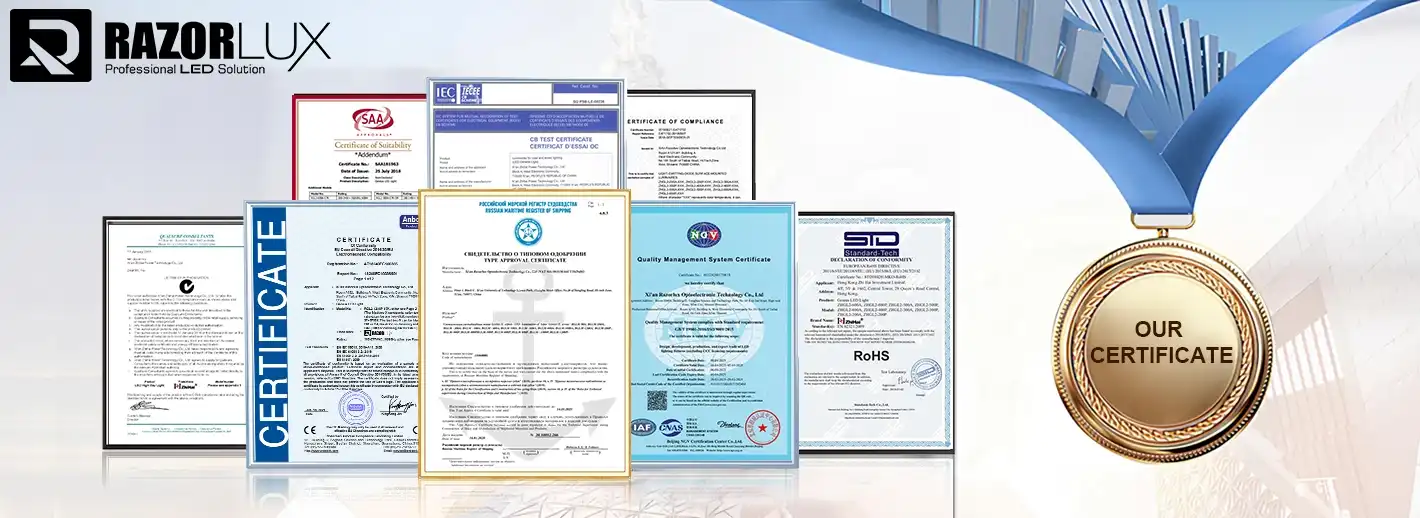
For international projects, you need to include a lot of paperwork. We offer full certification files that include CE, RoHS, SAA, C-Tick, UL, DLC, and CB certificates that cover environmental compliance, electromagnetic compatibility, and electrical safety. For naval uses, DNV/GL and ABS certificates show that the product is safe to use on ships, where vibrations, wetness, and corrosive atmospheres are worse than on land. Not only should procurement teams ask for copies of the certificates, but they should also ask for test reports with the real values that were measured. This paperwork is very important during the approval process for projects and regulatory reviews.
Strategic Considerations for Bulk Orders
Structured relationships with suppliers are helpful for big purchases. Price optimisation is possible with volume commitments. Our sales team works with procurement managers to set up orders that meet both budget and delivery deadlines. Technical teams can try things in the field with sample evaluation programs before committing to full orders. During the whole buying process, we provide engineering support by giving CAD models, IES photometric files, and technical specs that are ready to be added to project paperwork. Payment flexibility lets organisations meet a range of needs, such as those related to T/T wire transfers, letters of credit for large government contracts, and Alibaba platform transactions.
Future Trends and Innovations in 1000 Watt LED Sports Lighting
Advancing Efficiency Through Next-Generation LED Technology
As the process of making semiconductors changes, LEDs keep getting brighter. High-performance lights on the market today get 130–150 lm/W, but lab samples show that they could get 200+ lm/W. These improvements will allow future goods to provide the same amount of light at lower wattages. For example, 750W lamps could replace today's 1000 Watt Led Sports Light models while still producing 130,000 lumens. Better thermal management materials and active cooling technologies may make rated lifespans go beyond 100,000 hours, which would completely change how facility managers plan their replacement cycles.
Smart Lighting and IoT Integration
When LED technology and IoT systems come together, they make it possible to do new things. In the future, sports lighting systems will have occupancy monitors, algorithms that can predict when repairs will need to be done, and ambient light recognition. By reporting driver temperatures, lumen depreciation rates, and component health metrics, fixtures will be able to share their operational status. This will allow condition-based maintenance, which stops failures before they happen. When integrated with stadium management systems, automated scenarios will be possible, such as dimming during pre-game warmups, dynamic lighting effects timed to entertainment shows, and automatic emergency lighting protocols.
Sustainability Imperatives Driving Design Evolution
Environmental laws are having a bigger effect on the requirements for purchases. The European Union's Ecodesign requirements and related standards that are being adopted around the world require better recycling and energy efficiency. In the future, LED lights will have housings made of a higher percentage of recovered aluminium, no more dangerous materials, and modular designs that make it easier to separate parts during recycling at the end of their useful life. Manufacturers who go above and beyond the current regulatory standards put their products in a better position for long-term partnerships in procurement, as environmental factors become more important in scoring evaluations.
Preparing Infrastructure for Technology Transitions
When planning new installations, facility managers should think about ways to make them work in the future. Electrical systems that were made to work with LED lights can support even more energy-efficient ones in the future without having to be rewired, which can be expensive. Hardware for mounting that is designed for 30 kg fittings allows for the possible addition of new technology. Standardised communication methods (like DALI and BACnet) should be included in control system specs to make sure they work with new smart building platforms. Working with suppliers that show they invest in research and development, like Razorlux, with our 200+ patent portfolio, helps make sure you can get the newest products when it's time to upgrade.
Conclusion
When you switch to LED sports lighting, you're not just replacing lamps; you're also getting huge practical benefits like better lighting, lower upkeep costs, and more efficient use of energy. There is a group of 1000 Watt Led Sports Light fixtures that are perfect for tennis courts and medium-sized stadiums. These fixtures replace old 2000–3000W metal halide systems and use 60% less energy. Not only do you have to look at the specifications, but you also have to look at the manufacturer's credentials, the completeness of the certifications, and the reliability of the supply chain. Companies that work with well-known suppliers like Razorlux, which has more than 25 years of experience with LEDs, full certifications, and a track record of completing projects on time, can get the most out of their investments and protect their lighting systems from changes in technology and regulations.
FAQ
What is the actual lifespan of a 1000 Watt LED sports light fixture?
Professional-grade LED sports lights usually last between 50,000 and 70,000 hours of use before they hit L70 depreciation, which means they lose 70% of their original lumen power. Our RGL-1000A model says it can work for more than 50,000 hours, which is about 11 to 15 years if a stadium is used for 8 to 12 hours a day. The five-year guarantee on LED modules and drivers gives you peace of mind during the crucial early working period, which is when manufacturing flaws usually show up.
How does mounting height affect performance and fixture selection?
The mounting height directly affects the beam angle and the power that is needed. To get the 50–100 foot-candle light levels that are suggested, tennis courts with poles that are 12–15 meters high usually use 60° or uneven beam angles. For stadium setups between 25 and 35 meters, 40° beams that aren't as wide are needed to focus light on the playing fields from farther away. Our technical team does photometric analysis based on how your mounting is set up to make sure you choose the best fixture.
Can these fixtures operate in extreme weather conditions?
The RGL-1000A works effectively in temperatures ranging from -40°C to 60°C. It is waterproof to IP67 standards and resistant to impacts to IK10 standards. The sealed case keeps wetness out, and the thermal management system keeps the LED junction temperatures stable even when the temperature outside is high. Stainless steel brackets and coatings that don't rust make sure that the structure will last in coastal areas where salt spray is common.
Partner with a Trusted 1000 Watt Led Sports Light Manufacturer
Razorlux is ready to help you with your sports lighting projects with its proven knowledge and complete solutions. We provide the technical performance, certification trustworthiness, and supply chain dependability that procurement professionals need as a specialised 1000 Watt Led Sports Light maker with over 25 years of experience. Our RGL-1000A lights have Meanwell power sources, high-quality LED arrays that achieve 130 lm/W efficiency, and strong construction that is rated IP67/IK10 and comes with a five-year warranty. In addition to making great products, we also offer full project support, including photometric analysis, technical documentation, sample programs, and quick communication during the procurement process. Email our team at sam@razorlux.com to talk about your specific needs, get technical specs, or set up a sample evaluation. Find out why the world's most important places trust Razorlux to light their most difficult events.
References
International Commission on Illumination. (2021). Guide on the Lighting of Outdoor Sports and Recreational Activities. CIE Technical Report 235:2021.
Illuminating Engineering Society. (2020). Recommended Practice for Sports and Recreational Area Lighting. IESNA RP-6-15.
U.S. Department of Energy. (2022). LED Lighting for Sports and Recreation Facilities: Energy Savings and Performance Benefits. DOE Solid-State Lighting Program Report.
American Society for Testing and Materials. (2019). Standard Test Method for Photometric Testing of LED Sports Lighting Systems. ASTM E2387-19.
International Electrotechnical Commission. (2020). Luminaires – Part 2-5: Particular Requirements for Searchlights and Floodlights. IEC 60598-2-5:2020.
Maritime and Coastguard Agency. (2021). Lighting and Emergency Systems for Marine Applications: Certification Requirements. DNV GL Classification Standards.