


_1750326878398.png)

1000 Watt Led Outdoor Flood Lights for Industrial Applications
https://www.razorlux.com/led-outdoor-flood-light/1000-watt-led-outdoor-flood-lightsWhen industrial facilities require powerful illumination for large-scale operations, 1000 Watt LED Outdoor Flood Lights deliver the brightness, durability, and energy efficiency needed to maintain safe, productive environments. These advanced lighting systems replace traditional metal halide and high-pressure sodium lamps while reducing energy consumption by up to 70%, making them an essential investment for ports, shipyards, offshore platforms, and heavy industrial complexes where reliability isn't negotiable.
Understanding 1000 Watt LED Outdoor Flood Lights
High-wattage LED flood lights made for industrial use are a big change in how large buildings are lit up. Unlike home or business lighting, these fixtures are made to give off strong, even light over large areas while also being able to handle the worst weather.
What Defines Industrial-Grade LED Flood Lighting
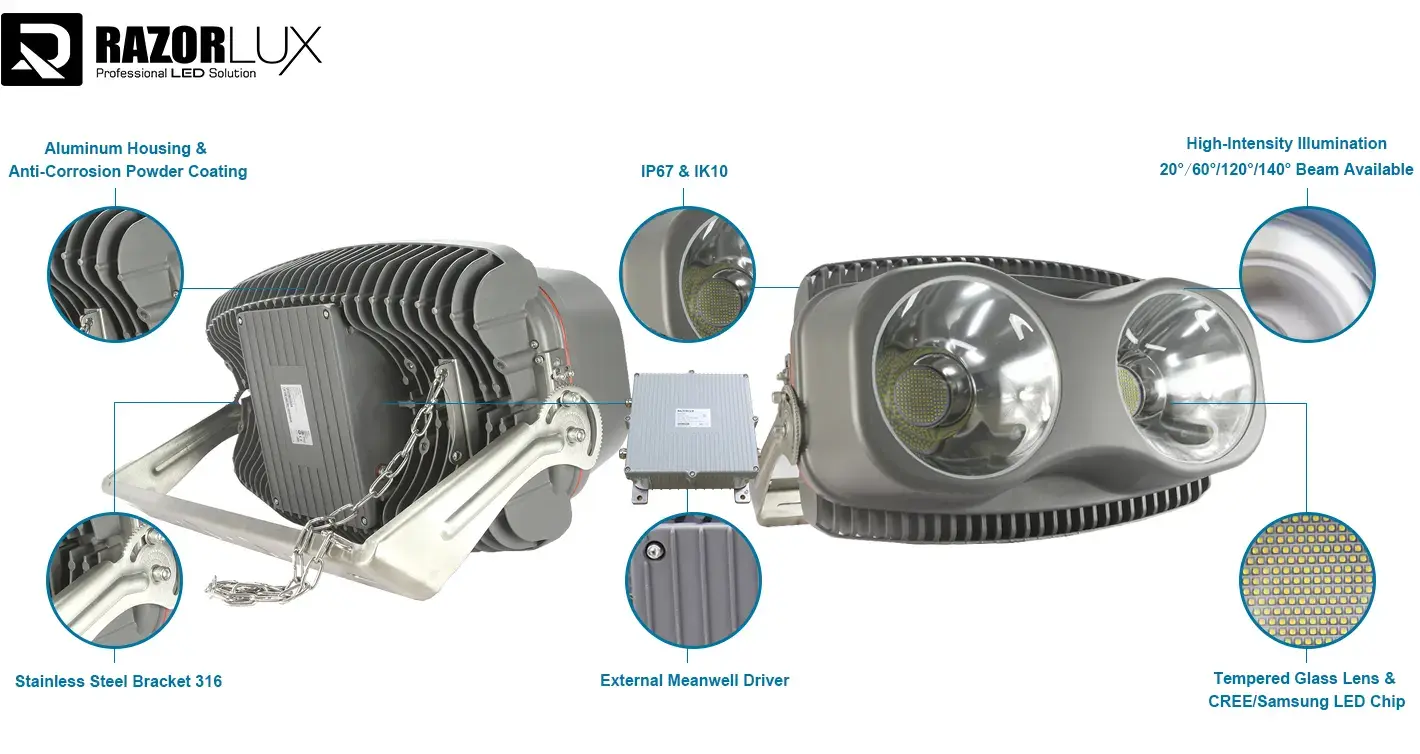
Industrial-grade high-output LED floodlights have a number of important parts that work together. Premium LED chips, which usually come from companies like Samsung or Lumileds, make a very bright light. Our RGL-1000P-L20 type gives off 105,000 lumens at 130 lumens per watt, which is more light per watt than other technologies. The housing is made of 6063-T5 aluminium metal and has improved heat dissipation fins. This makes sure that the LED junction temperature stays within the best operating ranges even when the device is running continuously in temperatures ranging from -40°C to 60°C. The visual system needs just as much care. Secondary filters control how the beam is spread out, which lets you place light precisely without wasting any of it. A 20° beam angle focuses light on specific work areas, cutting down on light pollution and making it easier to see what you're doing. This level of visual accuracy is important for lighting crane paths in container ports or work areas on ship decks, where shadows can be dangerous.
Technical Specifications That Matter to Procurement Teams
When buying LED floodlights, purchasing managers need to look at more than just the wattage number. Our fixtures use MeanWell drivers, which are known for being reliable in the industry. They have a wide input voltage range (AC 80–305V, DC 100–400V, and extended DC 500–800V options). In industrial settings where power quality changes or where DC bus systems are present, this voltage range is very useful. Protection scores show how well something keeps out the weather. If something has an IP67 rating, it means that it can't be damaged by dust or water for 30 minutes at a depth of one metre. This specification isn't too strict; it's necessary for maritime uses where saltwater spray is constant. The IK10 grade for impact strength means that the fixture can handle 20 joules of impact energy, which is the same as dropping a 5 kg object from 40 cm. This keeps machinery or tools from accidentally hitting it.
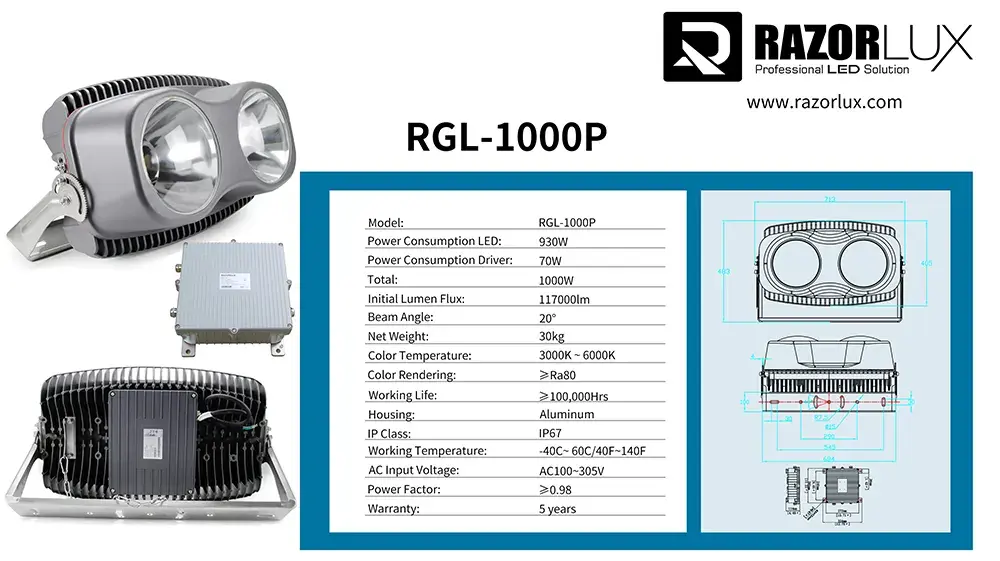
Table 1: Key Technical Parameters for Industrial LED Floodlights
| Parameter | Specification | Industrial Benefit |
|---|---|---|
| Luminous Output | 105,000 lumens | Replaces 2000-3000W HID lamps |
| Efficacy | 130 lm/W | 60-70% energy reduction |
| Color Temperature | 2700K-6500K | Adaptable to different tasks |
| Operating Temperature | -40°C to 60°C | Arctic to desert deployment |
| Lifespan | ≥50,000 hours | 5-7 years of continuous operation |
| Input Voltage Range | AC 80-305V / DC 100-800V | Power stability in variable grids |
| Weight | 29 kg | Durable construction, stable mounting |
These specifications deal with real problems that come up in operations. A buying manager at a shipyard once said that their old lighting failed after 18 months because of corrosion. The process of replacing it involved renting a crane and stopping production, which cost a lot more than the lights themselves. This situation shows why it's more important to look at the building materials and certifications than the initial price.
IP Ratings and Environmental Resilience
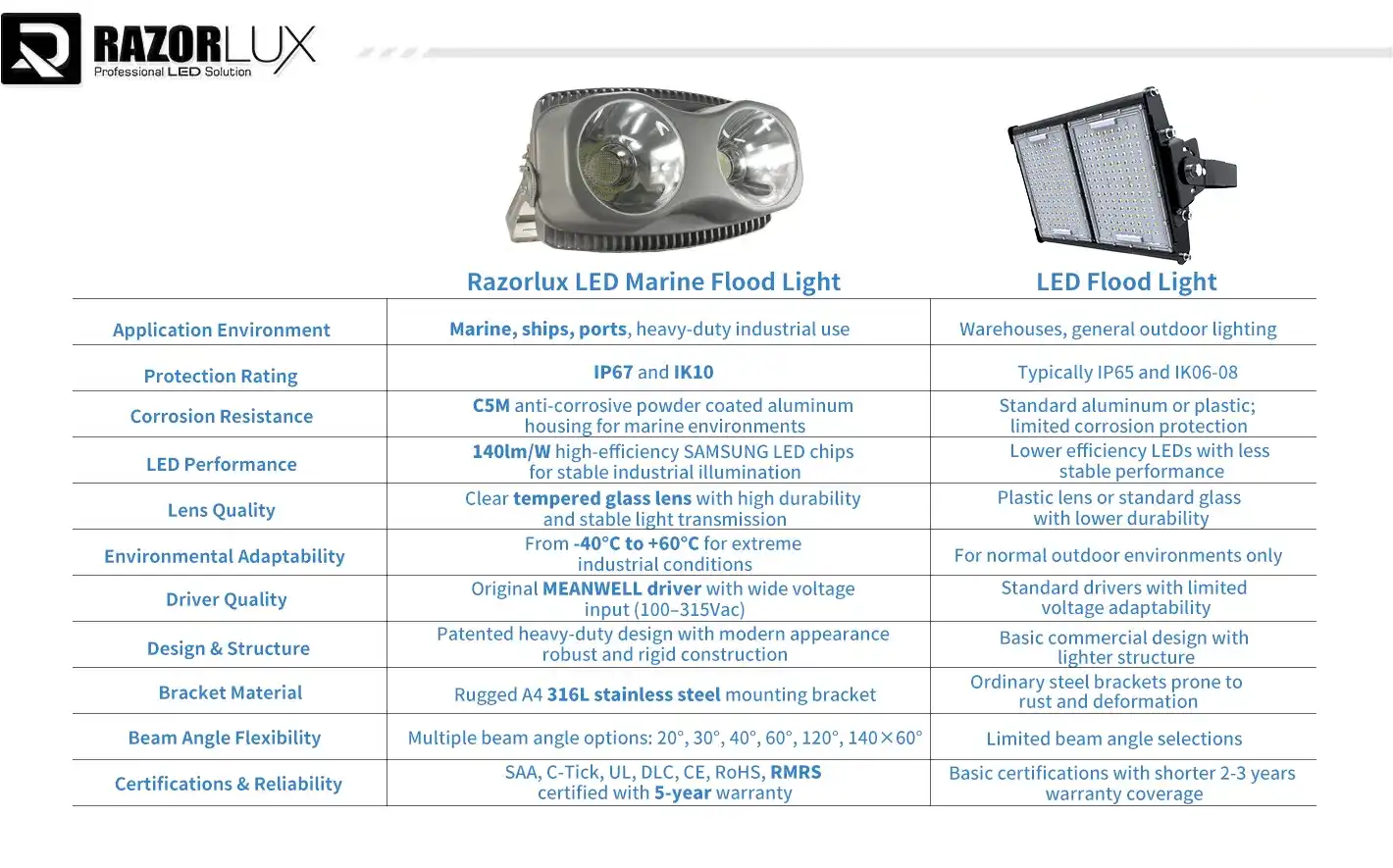
The Ingress Protection rating system gives consistent details about how well an enclosure works. For IP67 certification, fixtures have to go through a lot of tests. They have to be put in dust chambers for eight hours and then submerged in water under controlled conditions. This certification gives buying teams peace of mind when they have to choose lights for areas that get washed down, docks that are left open, or ocean platforms where waves splash around all the time. Resistance to corrosion goes beyond the IP grade. Galvanic rusting can't happen in saltwater because of the marine-grade powder finish, stainless steel brackets, and sealed cable glands. Facilities in the Middle East have to deal with different problems, like high heat and sandstorms, which means they need strong sealing and temperature management. Our fixtures take these regional differences into account by choosing the right materials and making sure the temperature design works. This is proven by testing the fixtures in climate rooms that simulate years of exposure.
Comparing 1000 Watt LED Flood Lights: Making the Right Choice
To choose the right industrial lighting, you need to look at several different methods and know what the total costs will be, in addition to the buying price. When buying something, smart buyers think about how much it will cost to run, how often it needs to be maintained, and how well it will work over time.
LED vs. Traditional High-Intensity Discharge Lighting
Metal halide and high-pressure sodium high-intensity discharge lamps were the most common type of industrial lighting for many years. These technologies use electrical arcs in pressurised gas tubes to make light. It takes 15-20 minutes for them to reach full output, and they need 2000–3000W to get the same brightness as our 1000 Watt LED Outdoor Flood Lights. The difference in energy use directly translates to practical savings: a building with 20 floodlights that are used for 4,000 hours a year would save $48,000 a year at $0.12/kWh power rates by switching to LED. Besides being expensive to run, HID lights break down quickly. Within 10,000 hours, metal halide lights lose 30–40% of their original brightness, so they need to be replaced early to keep providing enough light. After 50,000 hours, LED technology keeps 70% of its original power, so the light quality stays the same over its lifetime. This lumen maintenance feature is very important in places that need to be safe and where poor lighting can be dangerous. Another problem with HID technology is that it takes a long time to restart. When the power goes out, HID lamps need to cool down completely before they can be turned back on. This could mean that work areas are dark for 20 minutes during important operations. LED lights can turn on instantly, keeping things safe and productive even when the power goes out, which can happen in industrial settings with heavy motor loads.
Evaluating Manufacturers and Certifications
Manufacturers in the LED market range from well-known commercial lighting companies to newbies with little experience. Teams in charge of buying things should give more weight to suppliers who have the right certifications. For example, CE marking is important for European markets, UL listing is important for North American installations, and DNV-GL or ABS certifications are important for maritime uses. Razorlux has many certifications, such as CE, RoHS, SAA, C-Tick, UL, DLC, CB, and ISO 9001. This shows that they are dedicated to quality management and following all regulations in all global markets. These certifications are more than just paper; they show that safety, performance, and stability in production have been checked by a third party. A buying manager looking at different providers should ask to see proof of their certifications and make sure they are still valid, because using expired or incorrectly applied certifications can put the company at risk of harm. Transparency in getting components is just as important. Fixtures with MeanWell drivers and Samsung LED chips are more likely to last because these companies are known for making reliable products. When technical teams are looking at quotes, asking for a full bill of materials lets them check the quality of the parts and find places where they might fail. Manufacturers who don't want to say where their parts come from may be using low-quality parts that make the product less reliable.
Real-World Performance Data and Case Studies
Third-party confirmation through detailed installations gives people faith in what manufacturers say. In Singapore, shipping docks are open 24 hours a day, seven days a week, and are subject to high humidity. In Norway, ships work in harsh arctic conditions, and in Australia, steel mills use radiant heat from production processes to test thermal management systems.A ship repair shop in Norway switched out 85 metal halide lamps for our LED floodlights. This cut energy use from 212 kW to 85 kW and made the lighting 35% more even. When energy savings and no longer having to pay for maintenance are taken into account, the project paid for itself in 2.3 years. Including photometric reports and energy tests in the documentation of these kinds of installations helps procurement teams build business cases for LED conversion projects.
How to Select and Procure 1000 Watt LED Outdoor Flood Lights for Your Business
To buy industrial lighting strategically, you need to know what the specific needs of the application are, figure out the total cost of ownership, and build relationships with suppliers that will support your long-term operational needs. A methodical strategy makes sure that the answer chosen provides value over its entire life.
Application-Specific Selection Criteria
Different types of workplace settings have different lighting needs. When fixings are placed on ship masts or dock buildings, they are constantly moving and exposed to saltwater, so corrosion resistance and vibration tolerance are very important. Our marine-grade coatings and stainless steel mounting brackets are made to handle these conditions, and the 29 kg weight of the fixture makes it stable when installed on high masts and exposed to wind. Different optimisations are needed for warehousing and transportation. Fixtures with controlled beam angles are needed at high mounting heights—often 10 to 15 meters—to provide enough light at ground level while wasting as little energy as possible. With a 20° beam angle, light is focused downward, so fewer fittings are needed than with wide-beam options. Before buying fixtures, facilities can use photometric tools to model how light will be distributed and find the best places to put them. Coverage uniformity and colour rendering are important aspects of security surround lights. Good colour rendering (CRI >75) lets security staff and surveillance systems tell the difference between details. If you ask, our fixtures can meet CRI standards up to Ra90, which helps with jobs where being able to tell colours apart is important for quality control or recognition.
Table 2: Application-Specific Lighting Requirements
| Application | Key Requirements | Recommended Specifications |
|---|---|---|
| Maritime/Offshore | Corrosion resistance, vibration tolerance | IP67, 316 stainless hardware, IK10 |
| Logistics/Warehousing | Uniform coverage, mounting height | Controlled beam angle, high efficacy |
| Heavy Manufacturing | Heat resistance, robust construction | Wide temperature range, aluminum housing |
| Security/Perimeter | Color rendering, consistent illumination | CRI >80, maintained lumen output |
| Construction Sites | Portability, temporary mounting | Adjustable brackets, wide voltage input |
These specifications are turned into buying requirements when requests for quotes are made. Including application context helps providers suggest the right settings and find any possible compatibility problems before an order is placed.
Energy Efficiency and Total Cost of Ownership
Advanced buying looks at the costs over a person's lifetime instead of just the price of the item at first. A full analysis looks at how much energy is used, how much it costs to maintain, how much it costs to replace, and how the quality of the lighting affects productivity. LED technology has benefits in every area, but accurate data is needed to do a proper evaluation. To figure out energy costs, you need to know how much power each light uses, how long it runs, and how much electricity costs in your area. At normal industrial electricity rates, our 1000 Watt LED Outdoor Flood Lights uses 85W less than a similar HID system, which saves $102 per fixture per year. If this is applied to a building with fifty outlets, it saves $5,100 a year, or $25,500 over five years, in energy bills. Savings on energy often go beyond savings on maintenance costs. Every 8,000 to 12,000 hours, HID lights need to be replaced. Each service call costs money for labour, equipment rental (for high-bay systems), and time lost from production. These ongoing costs are eliminated by LED lights that last 50,000 hours before they need to be serviced. A port facility found that switching to LED fixtures saved $14,000 a year in maintenance costs. The savings in energy and maintenance costs paid for the fixtures in less than three years, even though they cost more at first. Productivity and safety impacts are hard to measure but have real value. Better lighting cuts down on mistakes in tasks that depend on quality and on accidents happening in places where visibility is an issue. Better lighting may lower insurance rates, and happier workers are happier in well-lit spaces. These are two examples of factors that affect the total cost assessment that aren't directly related to money.
Bulk Purchasing and Supplier Relationships
Strategic engagement with suppliers is good for big industrial lighting projects. When you buy directly from the factory, you don't have to pay the middleman, and you can get expert help and make changes to the product. When choosing sources for big projects, you should think about more than just the product specs. For project-driven procurement, manufacturing capacity and the dependability of lead times are important. Suppliers should show that they can produce enough to meet supply dates without lowering the quality of the goods. Asking for facility certifications (ISO 9001) and learning about how the maker controls quality gives you an idea of what to expect in terms of regularity. Razorlux uses ISO 9001 quality management systems and tests the products at every stage of production to make sure that large orders are always the same from batch to batch. Flexibility in customisation meets the needs of each job. Fixtures can be made better for certain uses by changing the beam angle, setting the colour temperature, putting them in a certain way, or adding controls. If a manufacturer has their own tech staff, it can make these changes without having to wait longer or pay more. Talking about the options for customisation early on in the buying process gives engineers time to look over the plans and make prototypes. Clear agreements are needed for things like payment terms and coordinating logistics. When you buy something from another country, you have to think about shipping, government paperwork, and security. Expert makers offer complete export paperwork and work with dependable goods forwarders to make sure deliveries happen on time. Setting clear expectations about shipping times, packing standards, and the claims process helps avoid misunderstandings that slow down the project.
Installation and Maintenance Best Practices for Industrial LED Flood Lights
Installing and maintaining fixtures correctly will make sure they work well and last a long time, and it will also keep the workplace safe. Industrial settings have their own problems that need to be dealt with in a planned way, both when they are first set up and as time goes on.
Safe Installation Procedures and Mounting Guidelines
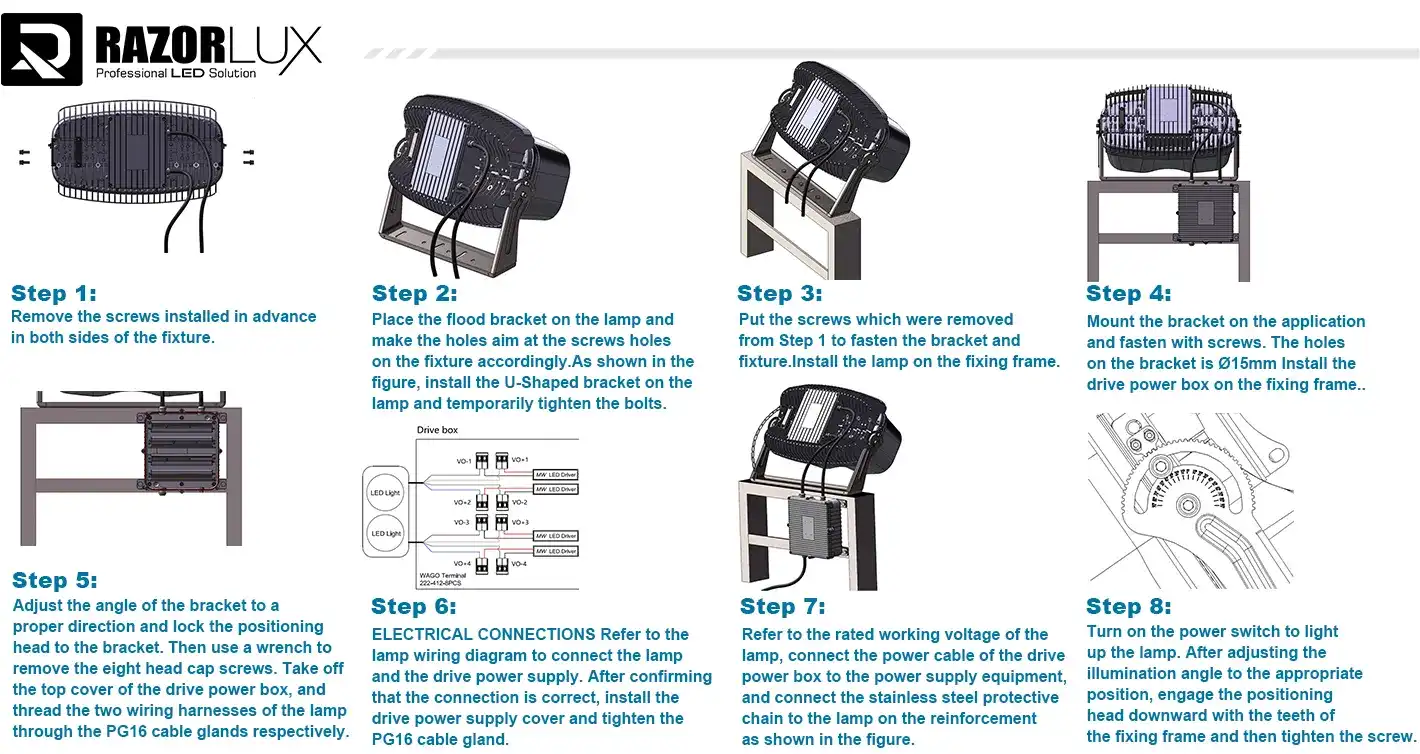
Installing industrial floodlights requires working at heights, making electrical connections, and thinking about the structure. Starting with a detailed construction plan keeps people safe and makes sure the lights work at their best. Site surveys find places to mount things, figure out what kind of electrical infrastructure is needed, and think about how to get to them for future maintenance. The height and angle of the mount have a direct effect on how the light is spread. Photometric formulas find the best place to put each bulb so that it gives off the right amount of light at ground level while minimising glare and light trespass. Fixtures should usually be placed 1.5 to 2 times the length of the area above the target surface, and the angles of aim should be calculated to center the beam pattern correctly. Using mounting hardware that is made for the fixture's weight (29 kg) and the wind load in the area will keep the structure stable. Using clamps that are too small can cause safety issues and vibration problems that shorten the fixture's life. When connecting electrical devices, they must follow local rules and the manufacturer's instructions. Even though our fittings can handle a wide range of input voltages, they still need to be properly grounded and protected from short circuits. Using marine-grade cable glands keeps IP67 integrity; normal compression fittings might not be waterproof in setups that are likely to shake. In corrosive conditions, dielectric grease should be applied to all links to keep the contacts from wearing out. Before finishing installations in hard-to-reach places, testing newly installed fixtures makes sure they work right.
Routine Maintenance and Inspection Protocols
LED lights don't need as much care as older technologies, but they should still be checked regularly to keep small problems from turning into big ones. Setting up a maintenance schedule based on the working hours and the environment helps with reliability. Marine and heavy industrial environments need to be inspected every three months, while controlled environments may only need service once a year. These important points should be covered in inspection processes. An outside look shows any physical damage, the start of rust, or loose hardware that isn't tight. Cleaning off dirt and other debris that has built up helps keep thermal performance high. Dust acts as insulation, raising the temperatures at LED junctions and speeding up degradation. It's important to clean in the right way. For example, high-pressure washing can damage seals, and strong chemicals can damage surfaces. Most cleaning jobs can be done with soft brushes or low-pressure water mixed with mild detergent. Thermal imaging lets you check the performance of something without hurting it. When heat signatures are too high, it means that drivers are failing, LEDs and heatsinks are not making good thermal contact, or airflow is being blocked. Finding temperature problems early lets you fix them before the whole fixture fails. Electrical testing makes sure that the voltage levels are right, that the driver works, and that the circuit is complete. Writing down what was found during a check helps find performance trends and the best repair intervals.
Troubleshooting Common Issues
Knowing the most common types of failure makes it easier to find the problem and fix it quickly. LED lights break down less often than HID systems, but figuring out what's wrong faster speeds up fixes when they do happen. If there is no light output at all, it's probably because of a problem with the driver or the power supply, not the LED itself. First, checking the input voltage and circuit safety lets you know if the issue is with the wires in the building or with the fixture itself. Less light output could be caused by LED degradation (which happens over time), heat problems that make the dimming safety go off, or optical degradation from dirt or dust. By comparing the current output to the readings taken during commissioning, you can tell if the decrease is greater than what would be expected. Cleaning the lenses and heatsinks can often fix dimming that is caused by heat. There may be a problem with the LED connection or the driver if the lights flicker or change colours. Changes in the facility's power voltage can shut down the driver or set off the safety mode. 1000 Watt Led Outdoor Flood Lights. By installing voltage tracking tools, problems with power quality can be found and fixed at the distribution level. Checking the connections might show that the LED board has corrosion or loose terminals that are affecting the connections.
Future Trends and Innovations in 1000 Watt LED Outdoor Flood Lighting
Industrial LED lighting is always changing as new technologies come out that make it work better, be easier to handle, and work with bigger building management systems. Learning about new developments helps buying teams guess what the future will hold and carefully plan investments in lighting infrastructure.
Smart Lighting and IoT Integration
Connected lighting systems make it possible to control, monitor, and improve industrial lighting from one place. Zigbee and LoRaWAN wireless methods let fixtures send practical data to building management platforms, such as how much energy they use, when they're on, and their temperature. This connectivity helps with predictive maintenance by showing which parts are getting close to the end of their useful life before they break. This lets replacements be planned for planned breaks instead of emergency service calls. Integrating occupancy sensors and daylight harvesting systems makes the best use of energy without putting safety at risk. Areas that only get used sometimes can have their lights dimmed or turned off automatically when no one is there. This saves energy and keeps the area available at all times when motion recognition turns on the lights. Photocells change the output based on how much natural light is available. This is especially helpful in places that are partly covered or have skylights. Controlling things with advanced features is more than just turning things on and off. Tunable white technology changes the colour temperature during operational shifts. This may help workers' circadian rhythms work better for their health and alertness. Scene programming lets you set different light levels for different tasks, like full output for operations that need to be done, lower levels for security checks, and maintenance levels for cleaning teams. For these features to work, devices must have the right control ports (0-10V, DALI, DMX) chosen when they are bought.
Material Science and Efficiency Improvements
LED chip development keeps making them more efficient than the current 130–150 lm/W standards. In the lab, research devices have shown that they can produce over 200 lm/W, which means that market goods will likely hit 170-180 lm/W within a few years. These improvements in efficiency directly lead to lower running costs or allow the same amount of light to be produced by lower-wattage fixtures, which means less equipment is needed. New developments in thermal management make it possible to increase power efficiency without lowering reliability. Using phase-change materials or vapour chambers in new heatsink designs makes heat transfer better, keeping LED junction temperatures at the right level in packages that are getting smaller. These improvements make it possible for lights to be lighter and look better without losing the thermal performance that is important for LEDs to last a long time. As optical technology improves, beam control gets more accurate, and costs go down. Target ranges can be reached more quickly and accurately with freeform lens designs that have been optimised through computer modelling. These optics lower the number of fixtures needed to cover an area well, which lowers both the cost of installation and the amount of energy used over time.
Regulatory Drivers and Sustainability Considerations
Environmental laws are having a bigger impact on choices about buying lights. In many places, energy codes set minimum standards for efficiency and control that must be met by new installations and major renovations. Keeping up with the latest standards makes sure that you are following them and avoids having to make expensive changes to meet new requirements. The principles of the circular economy affect how products are made and what people buy. Manufacturers that make products that are easy to take apart and recycle parts are in line with their companies' sustainability goals. Our flexible design lets you change the driver without throwing away the whole fixture, which increases its useful life and decreases trash. End-of-life issues, recycling standards, and manufacturer take-back plans are becoming more common in procurement specifications. Concerns about light pollution are dealt with by dark sky compliance, which sets standards for lighting design and application. Fully shielded fixtures that are properly directed stop light from wasting upward while keeping ground-level lighting. Facilities that are close to residential areas or environmentally sensitive areas are under more and more pressure to reduce the effects of lighting. Choosing fixtures with the right optical control can help with this during the procurement process, rather than having to make costly changes later.
Conclusion
The investment in industrial lighting is a big one that affects safety, efficiency, and the cost of running a business for a long time. The performance needed for demanding uses is provided by 1000 Watt LED Outdoor Flood Lights, which also offer benefits in terms of energy efficiency and dependability over older technologies. To do a good job of procurement, you need to know the technical specs, look at the total cost of ownership, choose qualified manufacturers, and follow the right steps for installation and maintenance. As technology keeps getting smarter and more efficient, businesses that invest in good LED systems set themselves up for long-term practical benefits and the ability to adapt to new standards.
FAQ
How does the brightness of a 1000W LED compare to traditional lighting?
A 1000 Watt LED Outdoor Flood Light that puts out 105,000 lumens is the same amount of light as a 2000–3000W metal halide or high-pressure sodium lamp. There's more to the comparison than just raw lumens. LED technology renders colours better, can reach full output instantly, and keeps its brightness throughout its lifetime, while HID lamps lose a lot of their brightness after the first installation.
Can these fixtures withstand harsh maritime environments?
Fixtures with an IP67 rating and marine-grade materials are designed to withstand saltwater, dampness, and acidic environments. Offshore platforms, docks, and shoreline facilities that use stainless steel brackets, sealed cable glands, and special powder coats keep metal from rusting. When specifications and installations are done correctly, the system will work reliably even in the roughest maritime conditions.
What control options integrate with existing facility systems?
Industrial LED floodlights can be controlled by a number of different protocols, such as 0-10V dimming, DALI addressing, and wireless systems. Compatibility depends on the specifications given for the fixture when it was bought. Talking to manufacturers about control needs makes sure that the chosen fixtures work well with current building management systems or planned automation upgrades, so you don't have to buy expensive adapters or find other ways to get around problems.
Partner with a Trusted 1000 Watt Led Outdoor Flood Lights Manufacturer
Razorlux uses more than 20 years of experience with LED innovation to solve problems in industrial lighting. They combine technical know-how with top-notch manufacturing to create reliable, high-performance lighting solutions. Our all-around method covers every part of a successful lighting project, from helping with the initial design to helping with installation and providing long-term service. Razorlux is ready to meet your industrial lighting needs with full certifications for global markets, high-quality parts like MeanWell drivers, and a 5-year warranty backed by ISO 9001 quality systems. Whether you're updating a shipyard, lighting up a container terminal, or replacing old infrastructure at a manufacturing plant, our team can help you with the technical advice and product customisation that turn lighting from a basic purchase into a strategic operational advantage. Email our engineering experts at sam@razorlux.com to talk about your specific application needs, get detailed photometric data, or set up an evaluation sample. We're dedicated to providing lighting options that work better than expected while still meeting the needs of your project's schedule and budget.
References
1. American Society of Heating, Refrigerating and Air-Conditioning Engineers. (2021). IESNA Lighting Handbook: Reference and Application. Illuminating Engineering Society of North America.
2. Maritime and Coastguard Agency. (2020). Code of Practice for the Safety of Ships: Lighting and Emergency Systems. United Kingdom Maritime Authority Publications.
3. U.S. Department of Energy. (2022). LED Lighting: Energy Efficiency in Industrial Applications. Office of Energy Efficiency and Renewable Energy Technical Report Series.
4. International Commission on Illumination. (2019). CIE 150:2017 - Guide on the Limitation of the Effects of Obtrusive Light from Outdoor Lighting Installations. Commission Internationale de l'Éclairage.
5. National Electrical Manufacturers Association. (2021). ANSI C78.377-2017: Specifications for the Chromaticity of Solid State Lighting Products. NEMA Standards Publication.
6. International Maritime Organization. (2020). Guidelines for the Installation of Shipboard Lighting Systems. IMO Maritime Safety Committee Technical Documentation.
 VIEW MOREathletic field lighting
 VIEW MORELed Outdoor Arena Lights
 VIEW MORE800W Led Flood Light
 VIEW MORE240W Ufo High Bay
 VIEW MOREHot Products Aluminum Alloy floodlight 1000w led flood light for Indoor Outdoor Sports Venue
 VIEW MOREAluminum Alloy IP67 LED Navigation Lights For Marine Boating
 VIEW MOREBest Led Stadium Lights
 VIEW MOREBest Led Floodlights