


_1750326878398.png)

Are Crane Boom Lights Essential for Crane Safety Compliance?
When workers move big loads at heights of more than 100 meters at night, sight is what makes the difference between success and failure. Crane Boom Lights fill in this important gap by shining directed, high-intensity light from the boom frame onto the hook block and load zone below. These special features aren't just extras; they're essential safety parts that let workers keep an eye on the lifting operations, get rid of the shadows cast by the crane's main structure, and lower the risk of accidents that happen when there isn't enough light. More and more, regulatory bodies in North America and Europe see properly lit crane operations as a basic compliance requirement. This means that modern building sites, ships, and ports need these lighting systems.
Understanding Crane Boom Lights and Their Role in Safety Compliance
What Defines a Crane Boom Light System
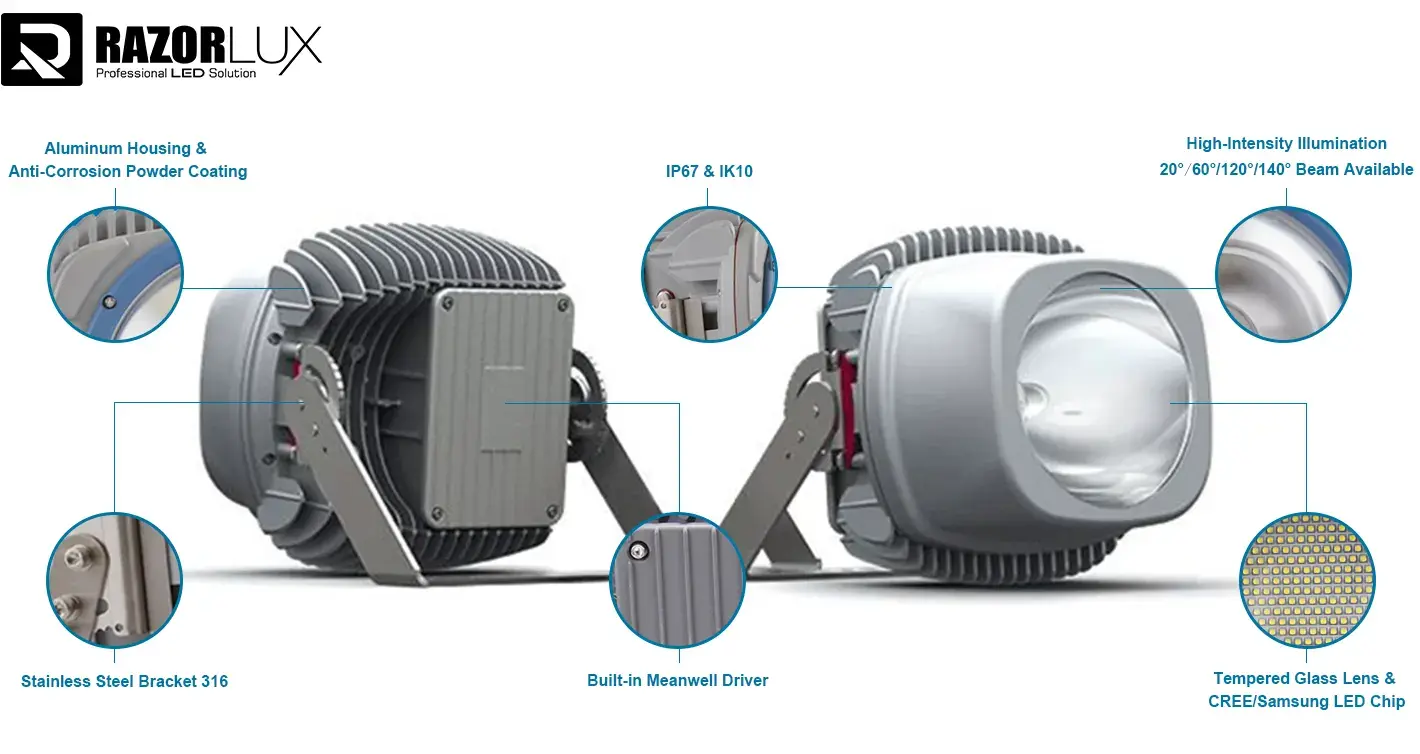
Crane boom lighting is a special kind of industrial lighting that is designed to survive the unique mechanical pressures that come with big moving equipment. Unlike regular floodlights, these units are attached directly to the boom, jib, or trolley assembly, where they are subjected to constant shaking, shock loads from quick stops, and harsh weather conditions that can range from -40°C in the Arctic to +60°C in the desert. Delivering stable, high-lumen power while blocking the harmonic frequencies that cause regular bulbs to burn out too soon is the main design challenge. Modern systems use solid-state LED technology with a stronger internal design. This gets rid of the problems with metal halide solutions in the past, like weak filaments and glass casings. Our RGL-150P model is a great example of this growth. It has a unique multi-function design that works consistently across AC80-315Vac and DC80-400Vdc input ranges without the need for extra adapters. This is a huge benefit for mobile cranes that use different power sources.
How Boom-Mounted Illumination Enhances Operational Safety
The idea behind how it works is to make a vertical "light column" that moves with the hook along the operating radius of the boom. This situation fixes three safety problems that can't be fixed with lights on the ground. When floodlights shine on a building site from the outside, the changing shadows of the crane's structure parts make it hard for the rigger to see the signs and place the load correctly. Boom-mounted lamps get rid of this problem by putting the light source above the interference plane. This way, the view stays clear no matter what the boom angle or slew position is. Our lamps' narrow 20° beam angle focuses 13,200 lumens into a focused cone, keeping the right amount of light strength even at long boom lengths, where light spread is usually a problem. Operators who work at Singapore's port facilities say that this focused beam pattern lets them tell the difference between container twist-lock settings from more than 30 meters away, which is something that can't be done with just natural site lighting.
Regulatory Frameworks Governing Crane Illumination
OSHA Standard 1926.550(a)(6) says that when working with a crane at night or when vision is low, there must be enough lighting to make sure the work is safe, but it doesn't say how many lumens are needed or where the fixtures should be placed. ANSI B30.5 gives more specific instructions. It says that the lighting in the load zone should be just right so that the user can see the load and the area around it clearly. It suggests a minimum of 5 foot-candles (about 54 lux) of light at the working plane. In the same way, European standard EN 13000 says that mobile cranes that work at night or when vision is low must have enough lights for the user to see the load path and any dangers nearby. These rules make it so that boom-mounted lighting is functionally necessary instead of just recommended, especially for operations that put public safety at risk or are considered heavy-lift projects. The problem with practical compliance comes when enforcement agencies try to figure out what "adequate lighting" means during investigations into accidents. When we worked with Norwegian factories, we learned that insurance agents look more closely at lighting specs during accident claims reviews. They want to see proof that workers kept eye contact with each other during the lift process. Proof of due care that can be defended includes documentation that shows lights with IP67 water protection, IK10 impact resistance, and approved optical performance. There are many certifications for the RGL-150P, such as CE, RoHS, SAA, UL, DLC, and CB marks. These certifications meet the paperwork requirements and make sure the product works with buying rules in many places. These certificates also show that the products meet standards for electromagnetic compatibility. This means that lighting systems won't interfere with wireless communication gear or load moment signs.
Evaluating Different Types of Crane Boom Lights for Effective Safety Compliance
LED vs. Traditional Halogen Technology Comparison
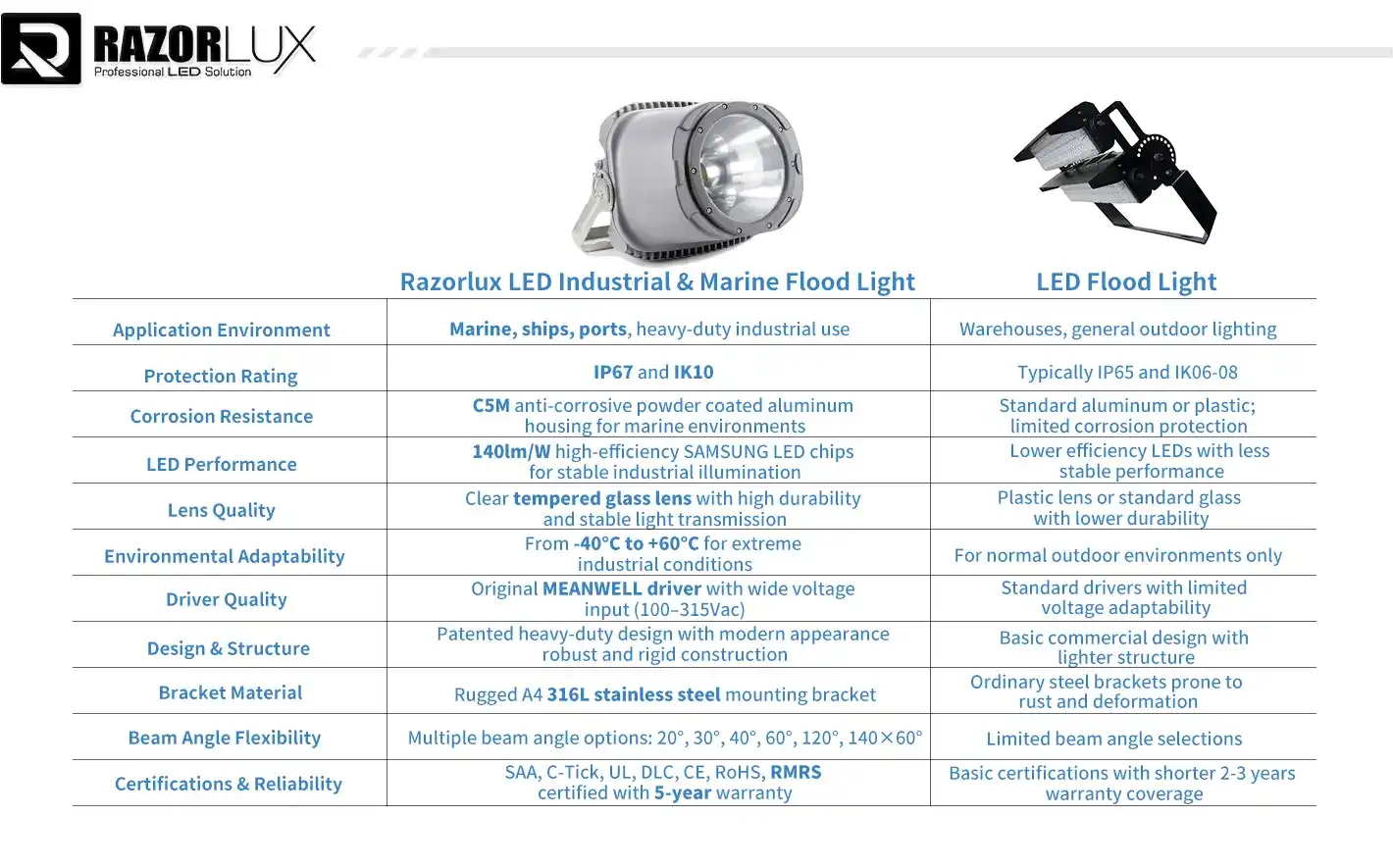
Switching from incandescent to LED lighting is more than just a small step forward; it completely changes how much it costs to run and how reliable the lighting systems are. Traditional 400W metal halide lights use a lot of electricity and make a lot of heat. This puts a lot of stress on the electrical systems in cranes and causes thermal expansion cycles that speed up housing failure. With 130 lm/W luminous efficiency, our 150W LED version gives off the same amount of light as 300–400W incandescent lamps while using about 62% less energy. This difference in efficiency directly leads to longer generator runtimes for mobile cranes and less need for electrical infrastructure for tower crane setups. The differences are even more striking when you look at the lifespans of the two types of equipment. Halogen lights usually last between 2,000 and 3,000 hours of use before they break. This means that they need to be replaced every 4 to 6 months during normal night-shift building plans. Each new cycle needs the boom to be taken down, a safety device to be worn while working at heights, and specialized staff. When downtime and labor are added up, the total cost of each service call often goes over $500. LED lights rated for 50,000 hours or more can run continuously for 8 to 10 years, so changing the bulbs regularly is no longer a care issue. The Mean Well power source that we used in our design adds to its longevity. It has a protective covering that keeps wetness out and thermal control systems that keep junction temperatures in the right ranges. These traits are especially useful in marine settings, where salt spray speeds up rusting, and humidity gets into spaces that aren't properly sealed.
| Technology Type | Power Consumption | Luminous Efficacy | Operational Lifespan | Replacement Frequency | Total Cost of Ownership (10 Years) |
|---|---|---|---|---|---|
| Metal Halide 400W | 400W | 75 lm/W | 2,500 hours | Every 5 months | $18,500 (energy + 24 replacements) |
| LED 150W (Razorlux RGL-150P) | 150W | 130 lm/W | 50,000 hours | Once in 10 years | $6,200 (energy + 1 replacement) |
| Halogen 500W | 500W | 65 lm/W | 2,000 hours | Every 4 months | $22,800 (energy + 30 replacements) |
The total cost analysis incorporates industrial electricity rates of $0.12/kWh, assumes 3,000 annual operating hours typical of double-shift construction schedules, and includes average replacement labor costs of $450 per service call. These figures demonstrate that LED technology reduces ownership costs by approximately 66% compared to metal halide alternatives, even before accounting for productivity losses from unplanned outages.
Specialized Features for Demanding Operational Environments
In addition to basic lighting, more advanced Crane boom light systems have extra useful layers that help with specific industry problems. Motion sensor activation might not make sense for crane apps, but some models have vibration-sensing algorithms that turn on the lights automatically when the boom starts to move. This cuts down on runtime that isn't needed when the crane isn't in use. With wireless control systems, workers can change the amount of light from the car, which can help with fog or make it easier to see when placing things precisely. The RGL-150P's wide input voltage range (AC80-315Vac, DC80-400Vdc) is an example of another important specialty. It means that the same fixture can work with different global voltage standards without any changes, which is very helpful for international contractors moving equipment between regions. Waterproofing specifications should be carefully looked at beyond the standard IP rating nomenclature. IP67 approval means that the product is protected against being submerged in water up to 1 meter deep for 30 minutes. This is enough to cover situations like rain and washing down. On the other hand, offshore platform installations often need IP68 grades for things that will be hit by waves or cleaned with high-pressure water. The IK10 impact grade means that it can withstand 20 joules of impact energy, which is the same as dropping a 5 kg object from 40 cm. This is enough security for most tool drops and debris hits that happen during climbing operations. Our mounting clamps are made of stainless steel, which is resistant to both mechanical stress and galvanic corrosion. This means that they keep their structural integrity in coastal areas where aluminum gear often breaks down when it comes into contact with metals that are not the same.
Performance Benchmarks That Define Quality Fixtures
Without taking into account color temperature, color rendering index, and beam spread traits, lumen output alone doesn't give a full picture of performance. When used in workplace settings, the 5700K sunshine color temperature standard improves eyesight and makes long jobs less tiring than higher 3000K options. Color rendering index (CRI) values above Ra75 make sure that workers can clearly see color-coded lifting equipment, load marks, and danger markers. This is especially important for safety when handling containers, where stacking rules are based on color-based classification systems. Our color temperature range (2700K–6500K) can be changed to accommodate regional tastes and specific application needs. For example, warmer tones are preferred in architectural lighting in Europe, while cooler temperatures are preferred in manufacturing facilities in Asia. Beam angle selection is a strategic tradeoff between coverage area and intensity at a distance. The 20° narrow beam focuses light on a smaller target area, keeping the lux levels high at the long boom lengths that are common for tower crane setups (often 60–80 meters). Wider 40° beams give you better side vision when working close to a mobile crane, but they lose some of their strength when you're farther away. When you put more than one bulb, you can use narrow lamps for the main work area and extra wide-angle units to see what's going on around you. This makes stacked lighting plans that meet the needs of both accuracy and situational awareness. The powder-coated aluminum housing manages heat perfectly, letting convective fins remove heat from the LED junction while keeping IP67 sealing integrity. This is a balance that is hard to achieve with cast housings that trap heat or stamped cases that aren't structurally rigid.
Best Practices for Installation and Maintenance to Maximize Compliance and Performance
Pre-Installation Assessment and Planning
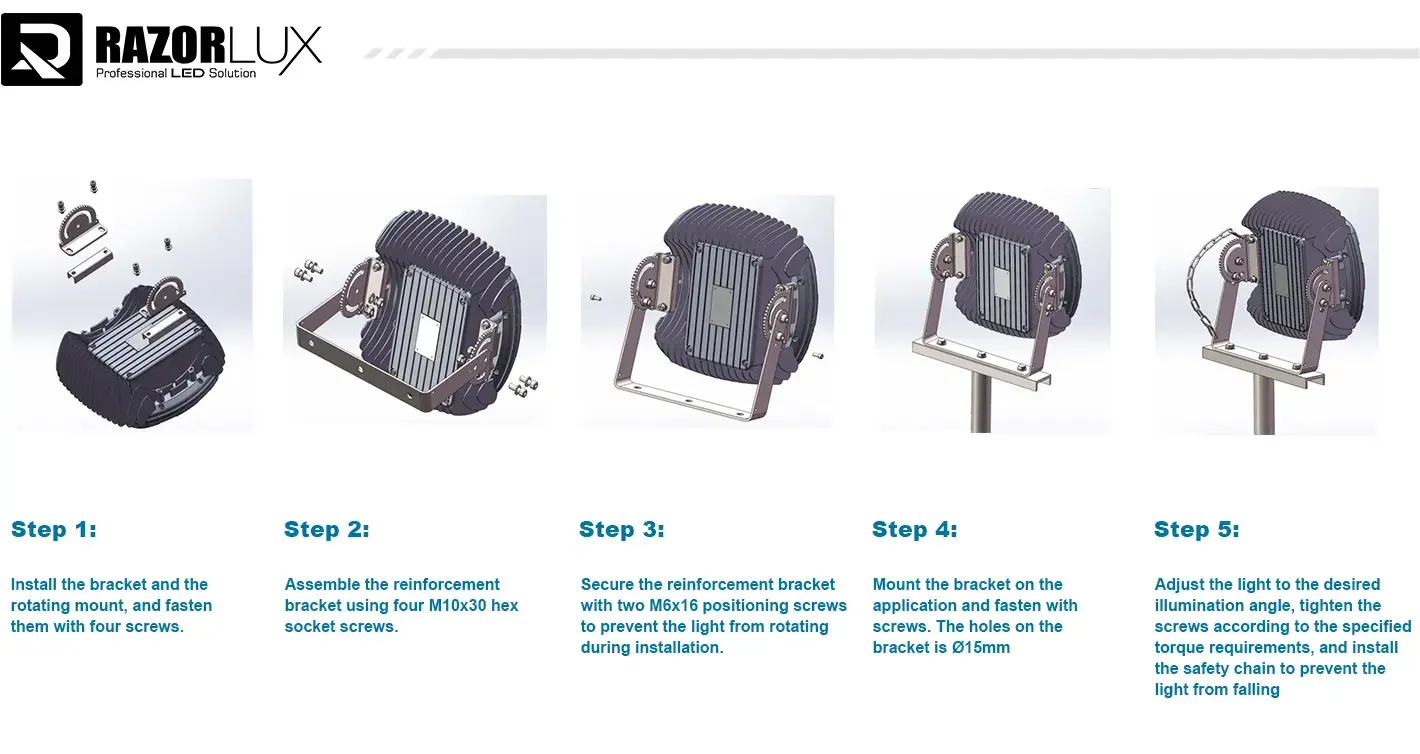
A thorough site study that takes into account both technical needs and practical processes is the first step to a successful boom light rollout. The location of the fixing affects how well the lighting works. Positions close to the boom tip provide the most load zone coverage, but they also make the light more vulnerable to shaking and wind loads. It is important to do structural load calculations to make sure that the crane's boom can safely hold the fixture's 10 kg weight plus the mounting gear at the extended moment arm. This is especially important for older cranes that may need an engineering review for weight adds. Electrical routing is another important part of planning—power cables have to go along the length of the boom and be able to withstand repeated bending during boom extension cycles. This means they need heavy-duty strain relief fittings and cable carriers rated for dynamic applications. The installation process itself requires technicians to follow strict fall protection protocols because they work at high heights and in limited positions. Our fixing bracket design can fit different boom shapes thanks to clamp mechanisms that can be adjusted. This means that no structural changes are needed, which could weaken the crane. The bulb should be set up so that the beam line is aligned to the hook's vertical trip path. This way, the light will stay even throughout the lift cycle and won't create hot spots or dark zones as the loads rise. Pre-commissioning tests make sure that the electrical polarity is correct, that the ground fault protection works, and that standard optical readings are recorded so that future maintenance checks can use them as a guide.
Routine Maintenance Protocols That Extend Service Life
Systematic review plans keep small problems from getting worse and causing operations to stop. Visual checks are done once a month to look for cracks in the case, discolored lenses, loose mounting brackets, and cable scratches at entry points. These are all problems that can be easily fixed during regular maintenance but can be very bad if not fixed until they break. Cleaning the lens every six months gets rid of dust, industrial waste, and salt layers that slowly stop light from passing through. This could lower output by 20 to 30 percent over a few months in places with a lot of contamination. The way you clean is important. Harsh solvents or rough materials can damage polycarbonate lenses and anti-reflective coatings, but mild detergent solutions and soft cloths can protect the optical properties. Every year, thermal imaging surveys find problems that can't be seen with the naked eye. High temperatures inside the housing could mean that the driver isn't working right or that the thermal interface materials are broken, while cool spots could mean that an LED in the array isn't working right. These methods for predictive maintenance let you change parts before they break down completely and stop activities. The RGL-150P's modular design breaks down the LED module, driver assembly, and case into parts that can be easily replaced in the field. This makes repairs easier and lets techs get the device working again without having to replace the whole thing. Our 5-year guarantee on both LED modules and driver parts builds trust in this method by covering production flaws and backing up customers' investments in preventative maintenance. Documentation routines produce important proof of compliance and data on performance trends. For regulatory checks and insurance reviews, keeping maintenance logs with dates of inspections, findings, corrective actions, and lighting readings is the right thing to do. Trending analysis shows patterns like how lenses break down faster in certain environments or how drivers fail early because of power problems. These patterns help with the standards for buying new units. These records also verify guarantee claims when products fail early, which speeds up replies from maker support.
Making an Informed Procurement Decision for Crane Boom Lights
Critical Selection Criteria for Industrial Applications
Instead of improving just one measure at a time, procurement requirements need to balance a number of performance factors. The amount of lumens needed depends on the height of the boom and the amount of light in the area. However, too much brightness can cause glare problems for people on the ground and people living nearby. Our stable flux output of 13,200 lumens is the best level for engineering at normal boom heights of 40 to 80 meters, giving 50 to 100 lux at the load zone without causing disability glare. Because energy use has a direct effect on running costs, light effectiveness (lumens per watt) is a better way to compare lamps than total output. Although the RGL-150P's 130 lm/W performance is above the minimum requirements for maritime applications, it is still 15% below the theoretical limits of LED efficiency. This means that there is room for future improvements without putting too much stress on the components' reliability. Environmental protection ratings should be based on the harshest conditions that fixtures will be used in, not their normal working conditions. Coastal sites need at least IP67 protection, even if the crane works mostly inland, because salt air exposure during transport or short-term tasks can start rusting processes. The IK10 impact grade is very important for building and removal sites where falling debris is a constant danger. In mine operations, this protection is needed along with special dust seals to keep gritty particles from getting into bearing surfaces. Voltage compatibility is very important for foreign builders because the RGL-150P's global input range means they don't have to keep separate stores of fixtures for each region's voltage standards.
| Selection Criteria | Minimum Specification | Razorlux RGL-150P Performance | Why It Matters |
|---|---|---|---|
| Luminous Flux | 10,000 lumens | 13,200 lumens (stable after 1 hour) | Ensures adequate load zone visibility at extended boom lengths |
| Luminous Efficacy | 100 lm/W | 130 lm/W | Reduces operational energy costs by 20-30% vs. minimum standards |
| Ingress Protection | IP65 | IP67 | Protects against pressure washing and temporary immersion scenarios |
| Impact Resistance | IK08 | IK10 | Withstands higher-energy impacts common in heavy industrial settings |
| Operating Temperature | -30°C to +50°C | -40°C to +60°C | Enables operation in Arctic and desert extremes without derating |
| Vibration Resistance | 5g @ 10-200Hz | 10g @ 10-500Hz | Prevents premature failure in high-vibration mobile crane applications |
| Warranty Coverage | 3 years | 5 years (LED module & driver) | Reduces replacement costs and validates long-term reliability claims |
These specifications demonstrate how the RGL-150P exceeds baseline requirements across multiple parameters, providing performance margins that accommodate unexpected conditions and extend service intervals beyond minimum expectations.
Supplier Evaluation Beyond Product Specifications
When choosing a vendor, you have to look at their planning skills, which affect how well the partnership will work in the long run. Manufacturing capacity signs include the amount of goods that can be made, the number of items that can be shipped right away, and the company's ability to meet specific needs without having to wait too long for supplies. Xi'an Razorlux has been making Crane boom lights since 1998, which gives them a level of steadiness that is hard to find among younger LED sources. Additionally, our collection of more than 200 patents shows that we continue to invest in research and development instead of relying on common parts. The combination of Mean Well power supplies, which are known around the world for their industrial-grade dependability, and Samsung LED chips shows that the designers chose to use proven technologies over cheaper alternatives. Certification breadth shows how easy it is to get into new markets and how mature the quality system is. Our wide range of approvals, including CE, RoHS, SAA, C-Tick, UL, DLC, CB, and ISO:9001, allows international projects to buy from a single source instead of needing different specifications for each area. These certificates also show that the manufacturing process is controlled, since groups like UL regularly check factories to make sure they stick to accepted ways of making things. How fast problems are fixed depends on the technical support infrastructure. For example, our engineering team reacts to installation problems, gives mounting advice for non-standard crane setups, and comes up with custom solutions when projects need special changes.
Logistics and Volume Procurement Strategies
When buying a large fleet, it's helpful to use smart purchasing methods that go beyond price per unit. Framework deals set pledges for volume over several years. This secures better pricing and ensures capacity sharing during busy building seasons, when spot market supply is low. Our payment terms are open enough to work with a wide range of financial models, from standard T/T bank transfers to letter of credit agreements for large building projects. Technical teams can use sample evaluation programs to test products in real-world settings before placing large orders. This lowers the risk of not meeting specifications and proves performance claims. Global shipping logistics need to be coordinated across many types of transportation and customs jurisdictions. We work with well-known freight forwarders who know how to handle industrial equipment. They make sure that the right packing keeps the equipment safe during travel and that the paperwork meets the standards for import clearance. When operating cranes break down unexpectedly, air freight choices can be used to get replacements quickly. On the other hand, consolidated sea imports can save money on shipping costs per unit for planned fleet updates. Regional delivery relationships in Northern Europe, Southeast Asia, and the Middle East make it possible for customers who need items right away to get them without having to pay the high costs of keeping their own inventory.
Conclusion
Crane boom lighting is no longer just an extra piece of equipment; it's an important safety system that helps with legal compliance and business risk management. As the rules of OSHA, ANSI, and EN standards come together, lighting standards become a legal duty instead of a matter of choice. As LED technology improves, it offers strong economic benefits through lower energy use, longer service times, and less upkeep work, advantages that grow over longer ownership periods. For deployment to go smoothly, environmental protections, performance standards, and provider skills must be carefully defined. These factors together decide how reliable the system is in harsh industry conditions. Companies that want to meet safety standards while also cutting costs find that properly designed boom lighting systems pay for themselves in the form of fewer accidents, higher regulatory trust, and higher production at night.
FAQ
Are boom-mounted lights legally required for all crane operations?
Regulatory mandates vary by jurisdiction and operational context. OSHA requires adequate illumination during low-visibility operations but does not explicitly mandate boom mounting, while ANSI B30.5 recommends lighting sufficient for operators to clearly see loads and surroundings. Maritime classification societies, including DNV-GL, specify lighting requirements for ship-mounted cranes. The practical answer centers on demonstrating compliance with "adequate illumination" standards—boom-mounted fixtures provide the most defensible solution for documenting this requirement during incident investigations or regulatory audits.
How does LED efficiency compare with traditional lighting in real operating costs?
The RGL-150P's 150W consumption versus 400W metal halide equivalents saves 250W per hour of operation. At typical industrial rates of $0.12/kWh over 3,000 annual operating hours, this represents $90 yearly energy savings per fixture. Combined with elimination of bulb replacements (averaging $500-600 per service call every 5 months for halogens), total 10-year savings exceed $12,000 per fixture. Fleets operating multiple cranes realize proportionally larger cost reductions while gaining operational reliability benefits from reduced maintenance interventions.
What maintenance tasks actually extend fixture service life?
Quarterly lens cleaning prevents light transmission losses from accumulated contamination, maintaining designed lumen output levels. Semi-annual mounting bracket inspections catch loosening hardware before vibration causes structural failures. Annual thermal imaging surveys identify developing driver issues before complete failures. These proactive measures typically extend operational life 20-30% beyond minimal maintenance approaches while reducing unplanned downtime. The RGL-150P's 5-year warranty coverage reinforces these practices by protecting against premature component failures when proper maintenance documentation exists.
Partner with Razorlux for Compliant, High-Performance Crane Boom Lights
Shipyard purchasing managers and industrial equipment integrators require lighting solutions that meet rigorous performance standards while simplifying procurement complexity. Razorlux combines two decades of LED engineering expertise with comprehensive international certifications (CE, RoHS, UL, DLC, DNV/GL) that ensure our crane boom lights satisfy regulatory requirements across global markets. Our RGL-150P model delivers 13,200 lumens through industry-leading 130 lm/W efficiency, IP67/IK10 environmental protection, and universal voltage compatibility—specifications that address the demanding conditions of maritime, port, and heavy industrial applications. As a manufacturer and supplier with over 200 patents and proven case studies across Northern Europe, Southeast Asia, and offshore platforms, we provide not just products but complete technical support including installation guidance, custom specification development, and rapid quotation response. Contact sam@razorlux.com to discuss your project requirements, request technical documentation, or arrange a sample evaluation that demonstrates our commitment to quality and reliability in every fixture we deliver.
References
1. American National Standards Institute. (2021). ANSI B30.5-2021: Mobile and Locomotive Cranes – Safety Standard for Cableways, Cranes, Derricks, Hoists, Hooks, Jacks, and Slings. Washington, DC: ANSI.
2. Occupational Safety and Health Administration. (2020). OSHA Standard 1926.550: Cranes and Derricks in Construction. U.S. Department of Labor.
3. European Committee for Standardization. (2019). EN 13000:2019 Cranes – Mobile Cranes. Brussels: CEN.
4. Det Norske Veritas. (2022). DNV-GL Rules for Classification: Ships Part 4 Chapter 8 – Electrical Installations. Oslo: DNV-GL.
5. Illuminating Engineering Society. (2020). IES RP-7-20: Recommended Practice for Lighting Industrial Facilities. New York: IES.
6. Maritime and Port Authority of Singapore. (2021). Technical Guidelines for Container Terminal Lighting Systems. Singapore: MPA Safety Standards Division.
 VIEW MOREhigh bay lights for warehouse
 VIEW MOREindustrial led shop lights
 VIEW MOREhockey field lights
 VIEW MOREsport court flood lights
 VIEW MOREOutdoor Led Flood Light With Photocell
 VIEW MOREMarine Led Flood Lights
 VIEW MOREEnergy Saving Dimmable LED Flood Light With Stainless Steel Bracket
 VIEW MOREPowerful Led Flood Lights