


_1750326878398.png)

Crane Boom Lights Installation Guide for Construction Equipment
To install industrial lights on heavy-duty machines, you need to know more than just basic electrical skills. You also need to know how to deal with the unique problems that come with working at high altitudes, with constant shocks, and in the toughest environments. Crane boom lighting systems are the only way for workers dozens of meters above the ground to see what's going on below with the precise lifting work. Without the right lighting, building sites are more likely to have accidents, run late, and damage tools. This guide shows procurement managers, shipyard engineers, and industrial lighting contractors the whole installation process, from assessing the site for the first time to testing the lighting's performance. This way, your team can be sure that the lighting solutions they install are safe, legal, and long-lasting enough to withstand the wear and tear of 24/7 operations.
Understanding Crane Boom Lights and Their Critical Role in Heavy Equipment Operations
Boom-mounted LED lights have changed how construction workers do their jobs at night. Ground-based floodlights cast shadows and blind spots around loads that are hung. These special fixtures, on the other hand, send focused beams straight from the crane's jib or trolley and follow the hook block as it moves. The technology solves three main operational problems: getting rid of vertical visual gaps that make it hard to tell how far away something is; protecting against mechanical shocks that destroy regular metal halide lamps; and lowering the frequency of maintenance in places where even changing a lamp is dangerous.
Why LED Technology Dominates Modern Boom Applications
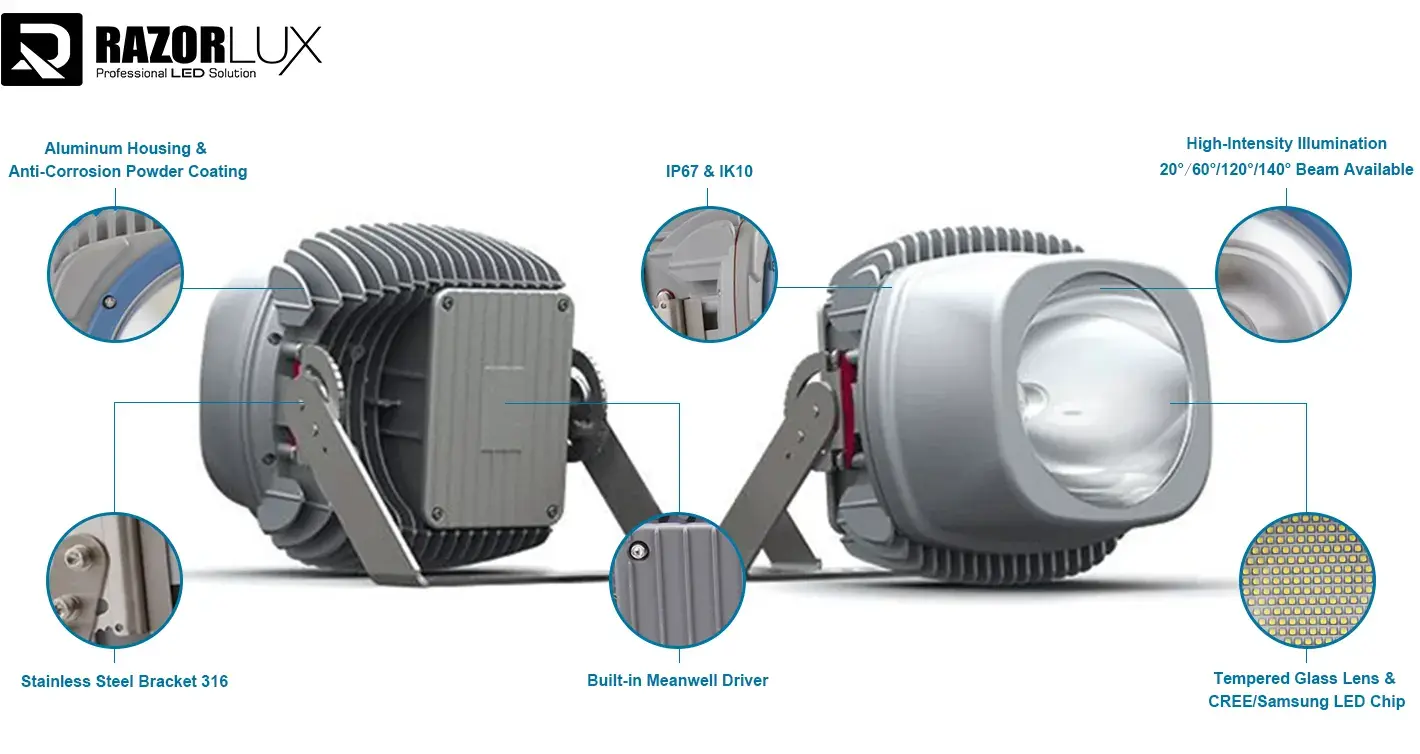
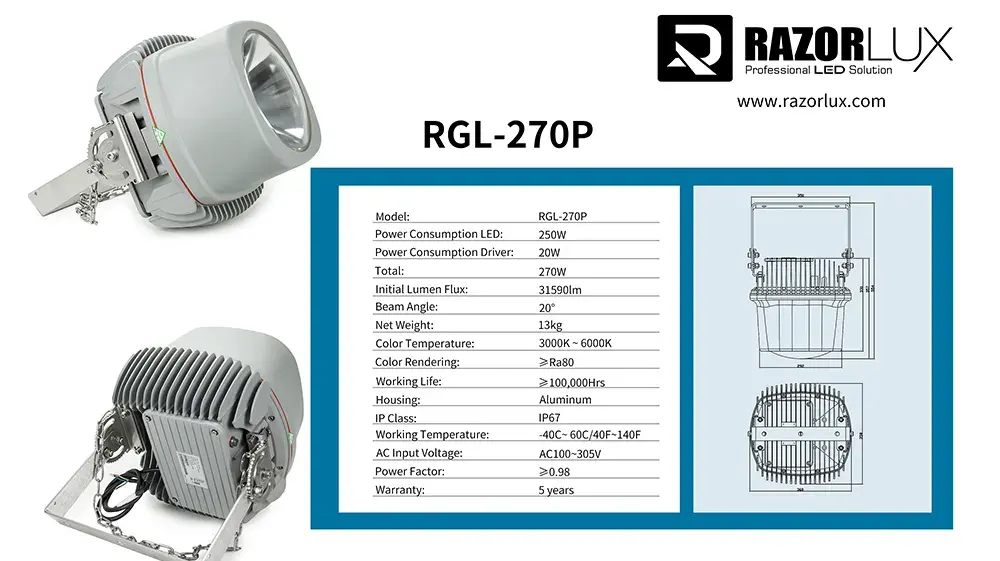
People are switching from gas and HID lights to solid-state lighting because it works better. LED lights give off 130 lumens per watt and color rendering values above Ra75, which means that workers can see clearly on load marks and mounting details. Because these lights don't have weak filaments, they can handle the constant shaking from moving trolleys and sudden stops in the load that used to cause lamps to break every week. This way of building is shown by the Razorlux RGL-150P type, which packs 13,200 lumens into a 10 kg body that is made to last 50,000 hours.
Matching Beam Characteristics to Site Requirements
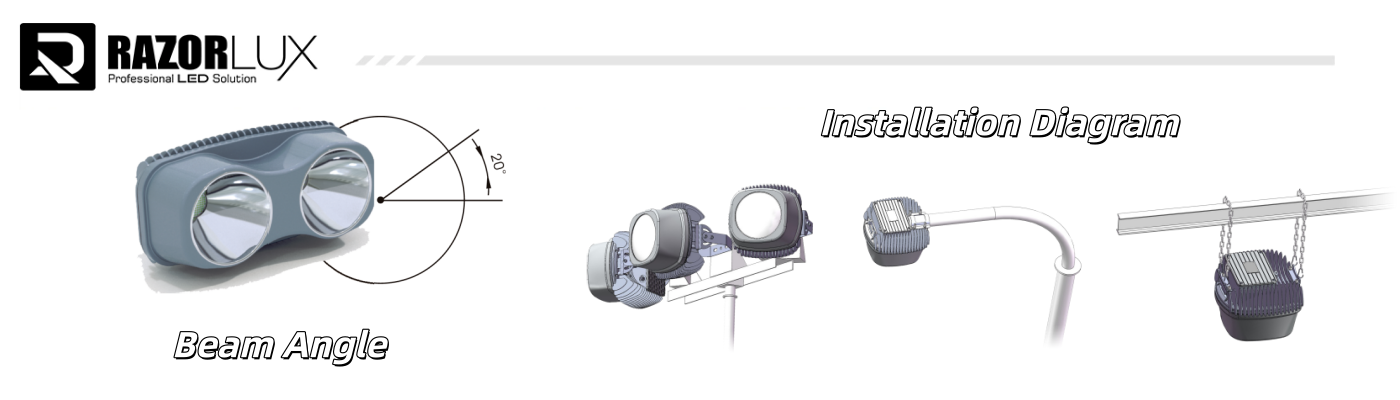
Choosing the right beam angle has a direct effect on how well you can see. A 20-degree narrow beam focuses light over lengths of more than 100 meters, making it perfect for tower cranes used on high-rise projects where the hook works below the tip of the boom. In the port, operations that deal with containers may need bigger dispersion patterns to light up areas where containers are being stacked. In a mine, on the other hand, high color temperatures around 5700K are important to keep operators awake during night shifts. Being able to choose color temperatures between 2700K and 6500K lets you match the lighting to the needs of each job. For example, warmer tones make it easier on the eyes during long tasks, while cooler temperatures make it easier to see in dusty places.
Environmental Protection Ratings Explained
IP67 approval means that the light can't let any dust in and can also withstand being submerged up to one meter for 30 minutes. This is very important when boom lights need to be pressure washed during maintenance or when it starts to rain in the middle of the shift. The IK10 impact grade makes sure that the polycarbonate lens can handle being hit by 5 kg objects dropped from 40 cm. This is important for rigging jobs where shackles and chain pieces may occasionally hit fixtures. These scores aren't just fancy words for marketing; they show the difference between constant running and multiple service calls.
Pre-Installation Assessment and Planning
When you bring tools and wires to a job site without first evaluating them, you're asking for delays and extra work. Documenting the current electrical infrastructure, measuring the mounting area, and making sure that the voltages work together will keep problems from being found after the cranes have been turned off.
Equipment Compatibility Verification
Crane makers list the highest loads that can be put on the boom, and adding 10 kg lighting systems means making sure that the structure can handle it. This is especially important for older equipment that is working close to its maximum listed limits. The fixing bracket's size needs to match the boom section's available bolt patterns. Making adapter plates to order adds cost and schedule risk. It's also important to make sure that the power is available. Most problems can be solved by universal input drivers that accept 80-315VAC or 80-400VDC, but jobsites with non-standard generator systems need to be tested ahead of time.
| Site Factor | Assessment Requirement | Impact on Installation |
|---|---|---|
| Crane Age/Type | Structural load capacity verification | Determines fixture weight limits |
| Ambient Temperature Range | Review -40°C to +60°C operational specs | Affects thermal management design |
| Coastal Proximity | Salt spray exposure assessment | Dictates corrosion protection grade |
| Electrical Infrastructure | Voltage stability measurement | Confirms driver compatibility |
Regulatory Compliance Documentation
Crane Boom Lights: The general industry lighting standard (1926.56) from OSHA sets the minimum lighting levels for building sites at 5 foot-candles for common areas and 10 foot-candles for busy work zones. The European EN 12464 standard has more specific rules. Before work starts, procurement professionals must make sure that the items they've chosen meet these basic standards. Certifications like UL, CE, and DLC aren't just checks; they're proof from a third party that a product won't pose an electrical risk or interact with crane control systems electromagnetically. When marine classification groups (DNV/GL, ABS) are involved in a project, it gets extra attention and needs proof that the materials meet standards for shaking, flame spread, and harmful fumes.
Weather Window Planning and Site Logistics
Putting electricity equipment 60 meters above the ground when it's raining or windy is too dangerous. Schedules for installations should aim for times when winds will stay below 25 km/h, and there won't be any rain. By working together with building schedulers, you can make sure that crane downtime doesn't interfere with important lifts but instead fits in with normal project breaks. Setting up overhead work platforms, tool staging areas, and parts storage ahead of time cuts down on the time workers have to spend at height, which saves money on labor and protects them from harm.
Step-by-Step Installation Procedure
Methodical execution separates successful installations from projects plagued by callbacks and performance complaints. The following sequence reflects lessons learned across shipyards, mining operations, and urban construction sites.
Required Tools and Safety Equipment
Putting together the whole toolkit before going up keeps you from having to make dangerous descents during installation to get things you forgot. In addition to multimeters, voltage monitors, and torque wrenches, which are all common pieces of electrical checking gear, boom setups need special tools. Vibration-resistant thread-locking chemicals keep screws from coming loose while they're being used. Outdoor-rated wire ties that are immune to UV light don't break after years of being in the sun. Personal fall stop systems that meet ANSI Z359 standards must be used at all times, even when working from elevated platforms. To make sure that mounted bolts reach the manufacturer-specified clamping force without overtightening and breaking the metal housings, impact tools with measured torque settings must be used. Standard light leads can be stripped with wire cutters that are made for the 14–18 AWG range. Heat-shrink tubes and marine-grade glue keep connections dry. Documentation cams record every step of the installation process, which is very helpful for future upkeep and guarantee claims.
Mounting the Fixture Assembly
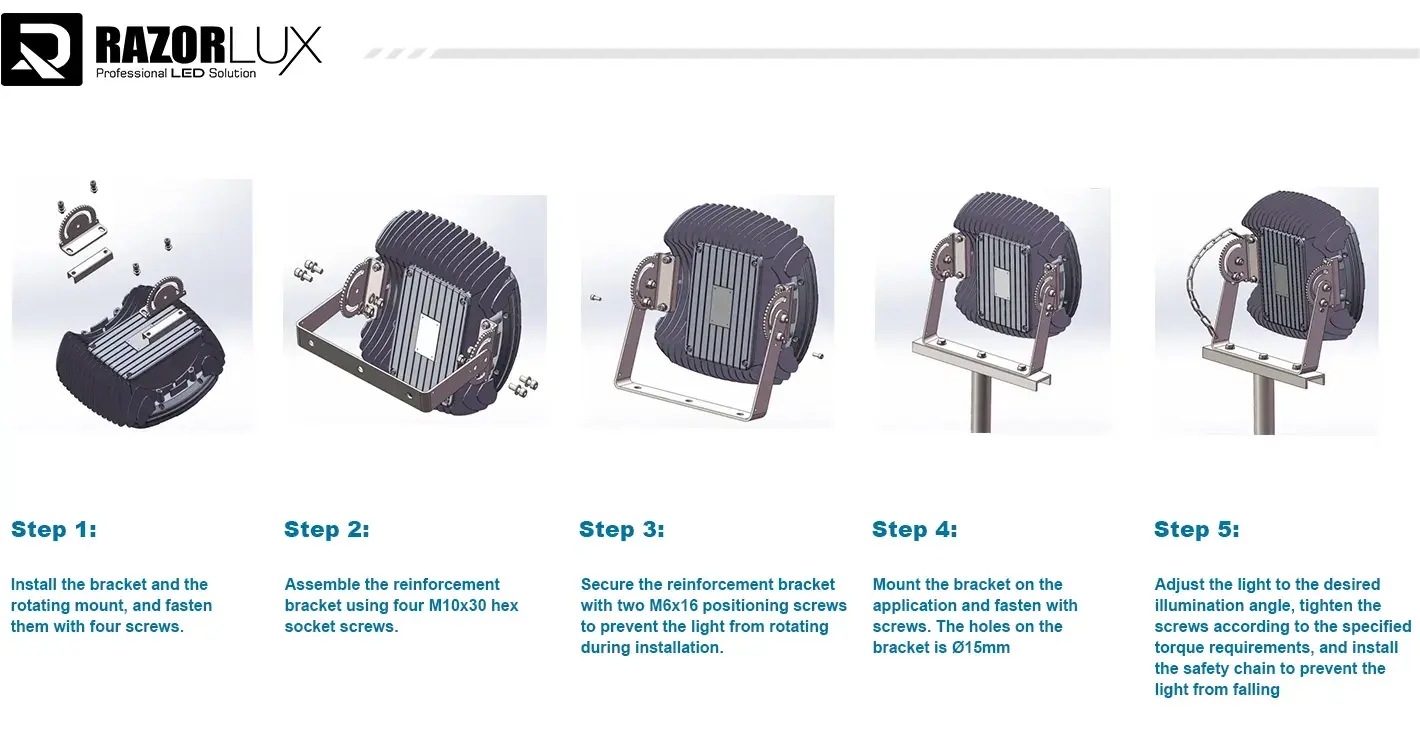
The clamp made of stainless steel is the base for long-term dependability. Putting it on the top of the boom gives it the most downward light while keeping it safe from debris and cable contacts in the air. Using a center punch to mark the location of bolt holes stops the drill bit from walking while making test holes. Using Grade 8 bolts and star washers to secure the bracket and a thin bead of silicone sealant around the edges creates an extra barrier against moisture. Attaching the 10 kg fixture body takes two people working together; one person supports the weight while the other lines up the mounting pins and threads that hold the hardware in place. If you over-torque the connection between the fitting and the bracket, the powder-coated aluminum housing could crack. On the other hand, if you don't use enough torque, the housing can move, which speeds up fatigue cracking. These worries are balanced by the 25–30 Nm power setting that was given.
Electrical Connection Best Practices
When possible, power is routed from the crane's control box to the tip of the boom along existing cable runs. This keeps the design as simple as possible and keeps the wires safe. Industrial-grade SOOW wire that is resistant to oil and rated for constant bending can handle the movement that comes with using a boom. The large input voltage range (80-315VAC or 80-400VDC) allows for voltage drops along long wire runs, but workers should still use true-RMS multimeters to check the real supplied voltage under load conditions. Connection points need to be carefully considered. By removing the insulation from the wire to just the length shown on the ends, you can stop both partial contact and the conductor from being revealed. When it comes to shaking, crimped connections work much better than twist-on wire nuts. When done correctly with ratcheting tools, crimp joints create gas-tight seals that stop rust. Putting links in junction boxes with an IP67 rating adds an extra layer of security, especially for use offshore, where salt spray finds every opening.
Testing and Commissioning
Putting power into the circuit is only half of the starting process. Using a clamp meter to measure current draw proves that the device works within its 150W limit. Readings that are significantly above or below expected values show issues with the connection or the driver. During the first 30 minutes of operation, thermal imaging shows hot spots that suggest the LED array and heatsink are not making good thermal contact. Functional testing goes beyond just making sure the lights work. Operators should make sure that the beam pattern covers the hook block completely throughout its movement range. If shadows show in critical areas, mounting angles should be changed. For vibration testing, the crane is put through normal load cycles while being watched for flickering or broken operation. This proof in the real world finds software mistakes that don't show up in idle bench tests.
Post-Installation Maintenance and Performance Optimization
Even the most robust lighting systems require periodic attention to maintain peak performance. Proactive maintenance catches small issues before they escalate into costly failures that interrupt operations.
Establishing Inspection Schedules
Visual checks should be done every three months as a matter of course. Maintenance workers check to see if the mounting hardware is free, see if the cables are rubbing or getting damaged, and clean the lens surfaces that have become cloudy from dust. If you work in a place that is prone to rust, like a port on the coast or an ocean platform, you should check it every month and pay special attention for signs of galvanic corrosion where two different types of metal meet. Keeping a maintenance log of what was found helps establish performance trends and provides proof for warranties if things break down too soon. Every year, full evaluations are done that include optical testing to compare real given lights to installation values. If the lumen loss is more than 10% in the first 10,000 hours, it could mean that there are problems with the heat management or the driver. Thermal imaging during long operation shows if heatsink surfaces are successfully removing heat—high temperatures shorten the life of LEDs and make them age faster.
Cleaning and Protective Measures
Crane Boom Lights: Even IP67-rated lamps should be cleaned every so often to get rid of dirt and grime that lowers the light output. Using microfiber cloths that have been wet with light soap solutions will protect anti-reflective lens coatings and get rid of salt residue, gas particles, and building dust. If you don't use rough cleaners or high-pressure washers, you won't scratch polycarbonate surfaces or force water past seals. After cleaning, checking the state of the gasket and adding new silicone glue to places where water could get in increases the time between maintenance tasks.
Troubleshooting Common Performance Issues
| Symptom | Probable Cause | Corrective Action |
|---|---|---|
| Intermittent flickering | Loose electrical connection | Re-torque terminals; inspect wire condition |
| Reduced light output | Lens contamination or LED degradation | Clean lens; measure actual lumens |
| Complete failure | Driver malfunction or wiring damage | Test input voltage; inspect cable routing |
| Rapid cycling on/off | Thermal protection activation | Verify heatsink contact; check ambient temperature |
| Discolored light output | Individual LED failures | Document for warranty claim; schedule replacement |
The Mean Well driver design incorporates thermal shutdown protection that temporarily disables output when internal temperatures exceed safe thresholds. If fixtures exhibit this behavior during normal operations, insufficient heatsink contact or blocked ventilation requires immediate correction. Continuing to operate fixtures in thermal protection mode dramatically shortens component lifespans.
Upgrade Opportunities and Technology Evolution
The 5-year guarantee on LED modules and drivers is based on how long the parts are supposed to last, but as technology improves, it may be worth upgrading sooner. Newer versions of LEDs are more efficient than 150 lm/W, which means they use 15% less power while still giving off the same amount of light. Advanced driver designs with power factor correction above 0.98 and total harmonic distortion below 10% reduce stress on the electrical infrastructure. This is especially helpful for buildings that are getting close to their electrical capacity limits. Connecting to remote monitoring systems gives maintenance teams real-time information about performance, letting them know about problems before they become failures. Dynamic dimming based on natural light conditions is possible with wireless control methods. This further cuts down on energy use during dawn and dusk activities. When B2B clients look at the total cost of ownership, they should check every so often to see if fix changes save enough money on operations to support the capital investment.
Procurement Strategies for Industrial Boom Lighting
Selecting the optimal supplier involves evaluating factors extending far beyond initial purchase price. Long-term operational costs, product reliability, and supplier responsiveness during the five-year warranty period dwarf upfront savings from bargain-priced alternatives.
Evaluating Supplier Credentials and Manufacturing Capabilities
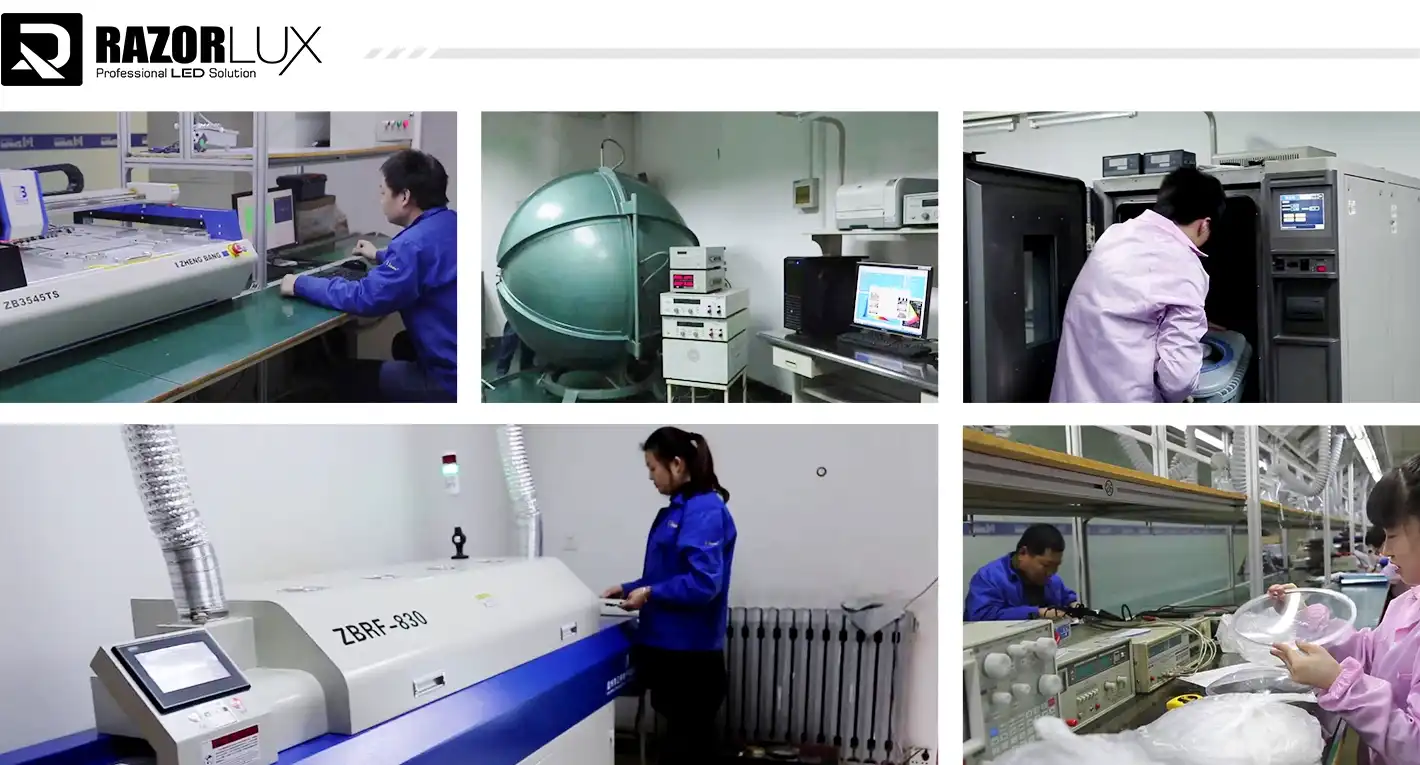
Manufacturers who have a lot of different certifications show that they care about quality and market access. UL listing proves compliance with North American safety standards, while CE marking shows compliance with European market standards. Certifications from companies like DNV/GL and ABS show that a product meets the standards of the marine classification society, which is important for use in shipyards and overseas. Although ISO 9001 certification is a sign of organized quality management, buyers should ask for real audit reports instead of taking certificates at face value. The ability to manufacture directly affects the dependability of delivery. Suppliers who keep a lot of stock on hand can fill pressing repair orders within days, but businesses that build to order may need 6–8 weeks of wait time, which can throw off project plans. You can be sure that the products will last a long time by making sure that the sellers use high-quality parts like Samsung LED chips, Mean Well drivers, and marine-grade stainless steel hardware. Razorlux has been in business for 20 years and has more than 200 patents in its portfolio. This shows that it is constantly coming up with new technologies instead of just reselling common goods.
Balancing Specifications with Budget Constraints
Crane Boom Lights: Even IP67-rated lamps should be cleaned every so often to get rid of dirt and grime that lowers the light output. Using microfiber cloths that have been wet with light soap solutions will protect anti-reflective lens coatings and get rid of salt residue, gas particles, and building dust. If you don't use rough cleaners or high-pressure washers, you won't scratch polycarbonate surfaces or force water past seals. After cleaning, checking the state of the gasket and adding new silicone glue to places where water could get in increases the time between maintenance tasks.
Documentation Requirements and Compliance Verification
Professional providers are different from importers who only offer restricted help because they offer full technical paperwork sets. Full standard sheets with information on optical performance, electrical properties, and environmental grades make it possible for engineers to review the products. Installation guides with sized pictures, wire diagrams, and mounting directions cut down on the time and mistakes needed to install something. Third-party confirmation of claimed performance metrics can be found in test reports from accredited laboratories. Marine and offshore projects need extra paperwork, such as material certifications, country-of-origin declarations, and compliance statements that talk about flame-spread ratings and toxic fume generation. When suppliers can't or won't give these papers, project risks rise above any cost saves. Setting clear paperwork standards during the RFQ phase keeps people from having to rush at the last minute when inspectors ask for proof of compliance.
Conclusion
For crane boom light installation to go well, it needs to be both technically precise and well-planned. In industrial settings, where equipment works nonstop under harsh conditions and breakdowns are more likely to cause safety risks than just be a bother, the steps described here are what really happens. Buying things with approved parts, strong environmental protection, and quick seller support always ends up being more valuable in the long run than the cheapest options. Industrial operations can get reliable lighting that improves safety and productivity throughout the long and difficult service life of heavy equipment by following systematic installation protocols, starting preventative maintenance programs, and working with manufacturers who show real technical expertise.
FAQ
What lumen output do I need for a 40-meter tower crane?
A 40-meter boom height typically requires 12,000-15,000 lumens with a narrow 20-degree beam angle to deliver adequate illumination at the hook block. The 150W LED fixture with 13,200 stable lumens meets this requirement for most construction applications. Wider beam angles reduce effective intensity at distance, necessitating higher initial lumen output or multiple fixtures.
Can installation happen on energized crane systems?
Safety protocols universally prohibit working on energized systems during installation. Lockout/tagout procedures isolating electrical supplies must precede any fixture mounting or wiring work. Testing after installation requires controlled energization with qualified personnel using proper PPE and following established electrical safety procedures.
How often should fixtures undergo professional inspection?
Quarterly visual inspections by maintenance staff identify obvious issues, while annual comprehensive evaluations by qualified technicians assess photometric performance and electrical integrity. Harsh environments like offshore platforms or mining sites warrant monthly inspections focused on corrosion and seal integrity.
What distinguishes marine-grade from standard industrial fixtures?
Marine specifications demand 316 stainless steel fasteners resisting galvanic corrosion, conformal coating on electronic assemblies protecting against salt spray, and gasket materials maintaining flexibility through temperature extremes. Standard industrial fixtures using 304 stainless steel and basic sealing fail rapidly in saltwater environments.
Partner with a Trusted Crane Boom Lights Manufacturer for Uncompromising Quality
Razorlux delivers industrial-grade illumination solutions backed by over two decades of specialized engineering experience. Our RGL-150P boom lighting system combines patented multi-function design with Mean Well drivers and IP67 environmental protection, providing the reliability your critical operations demand. The 130 lm/W efficiency reduces energy costs while 50,000-hour rated lifespans minimize maintenance disruptions across shipyards, mining operations, and construction sites worldwide. Every fixture ships with comprehensive CE, UL, RoHS, and ISO 9001 certification documentation, plus our 5-year warranty covering both LED modules and drivers. Contact our technical team at sam@razorlux.com for application-specific recommendations, custom sampling, and delivered pricing that reflects our commitment to long-term partnership rather than transactional relationships. Visit razorlux.com to explore our complete industrial lighting portfolio engineered for environments where failure isn't an option.
References
1. American Society of Civil Engineers. (2021). "Lighting Standards for Heavy Equipment Operations in Construction Environments." ASCE Manual of Practice, Vol. 142.
2. International Commission on Illumination. (2019). "CIE 227:2017 - Lighting for Industrial Environments and Outdoor Work Areas." Vienna: CIE Central Bureau.
3. Marine Classification Society Standards Board. (2020). "Electrical Installation Requirements for Mobile Offshore Drilling Units." Houston: Offshore Standards Publications.
4. National Electrical Manufacturers Association. (2022). "NEMA Standards Publication 250 - Enclosures for Electrical Equipment (1000 Volts Maximum)." Rosslyn: NEMA.
5. Occupational Safety and Health Administration. (2023). "Construction Industry Lighting Requirements: Compliance Guide for General Industry Standard 1926.56." Washington: U.S. Department of Labor.
6. Society of Maritime Industries Technical Committee. (2021). "Best Practices for LED Lighting Integration on Heavy-Lift Cranes and Offshore Installation Vessels." London: SMI Publications.
 VIEW MOREled loading lights
 VIEW MOREoverhead crane lights
 VIEW MOREhigh wattage flood lights
 VIEW MOREtennis court flood lights
 VIEW MOREmarine flood lights
_1748337998981.webp) VIEW MOREExplosion Proof Led Fixtures
VIEW MOREExplosion Proof Led Fixtures VIEW MORE6000K 270w Dimmable Outdoor Light 60 Degree Flood Light For Basketball Court
 VIEW MOREIP66 Building 500W Dimmable Led Flood Light 10 Degrees Angle Wall Washer Spotlight