


_1750326878398.png)

Marine LED Flood Light vs Traditional Marine Lighting Solutions
When looking at different types of lighting for coastal areas, a Marine LED Flood Light is a solid-state lighting system that was designed to withstand the damaging effects of galvanic corrosion, constant shaking, and catastrophic water entry. Traditional naval lighting options like halogen, metal halide, and incandescent lights have been used for decades, but they often break down, produce too much heat, and use too much energy. Modern LED technology is 130 lm/W efficient, can work in temperatures ranging from -40°F to 140°F, and has an IP67 rating for airtight sealing, which is something that older systems can't do.
Understanding Marine Lighting Technologies
The Engineering Behind Marine LED Flood Lights
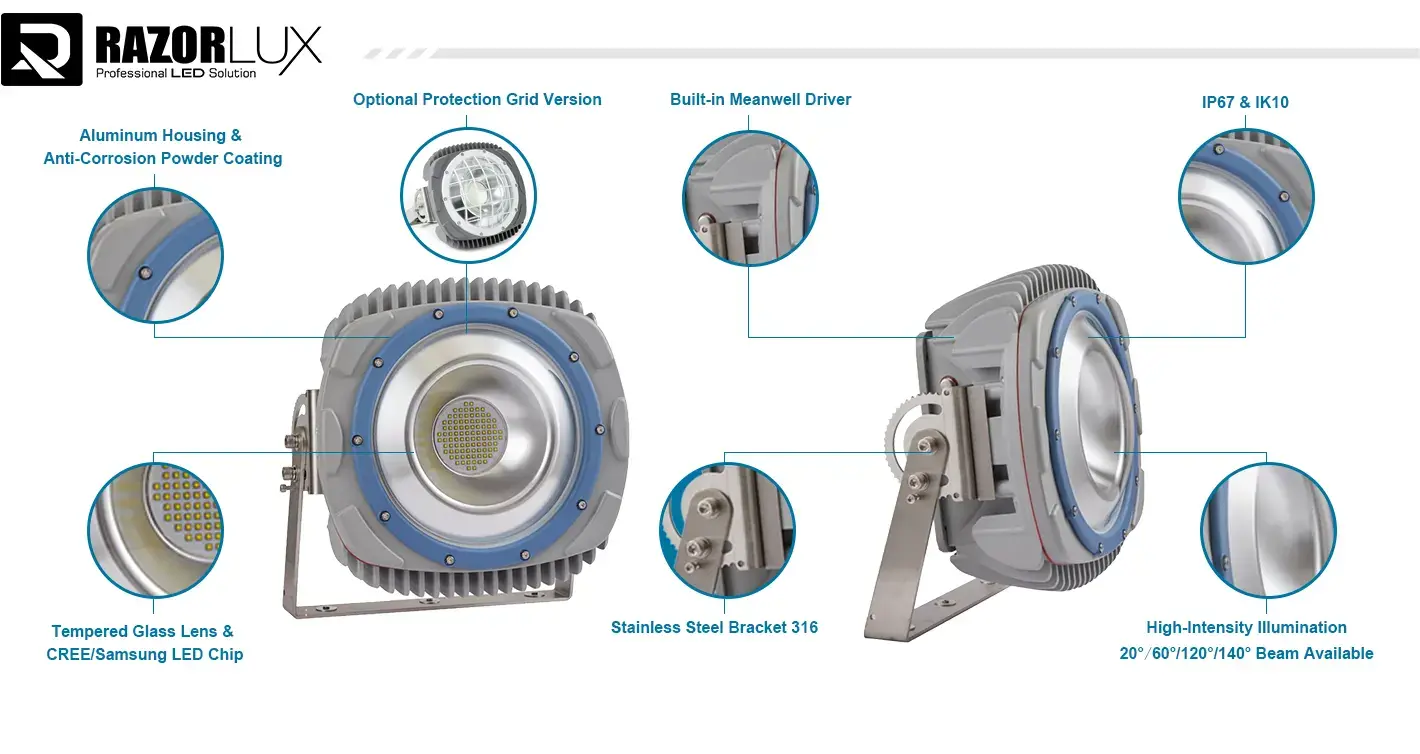
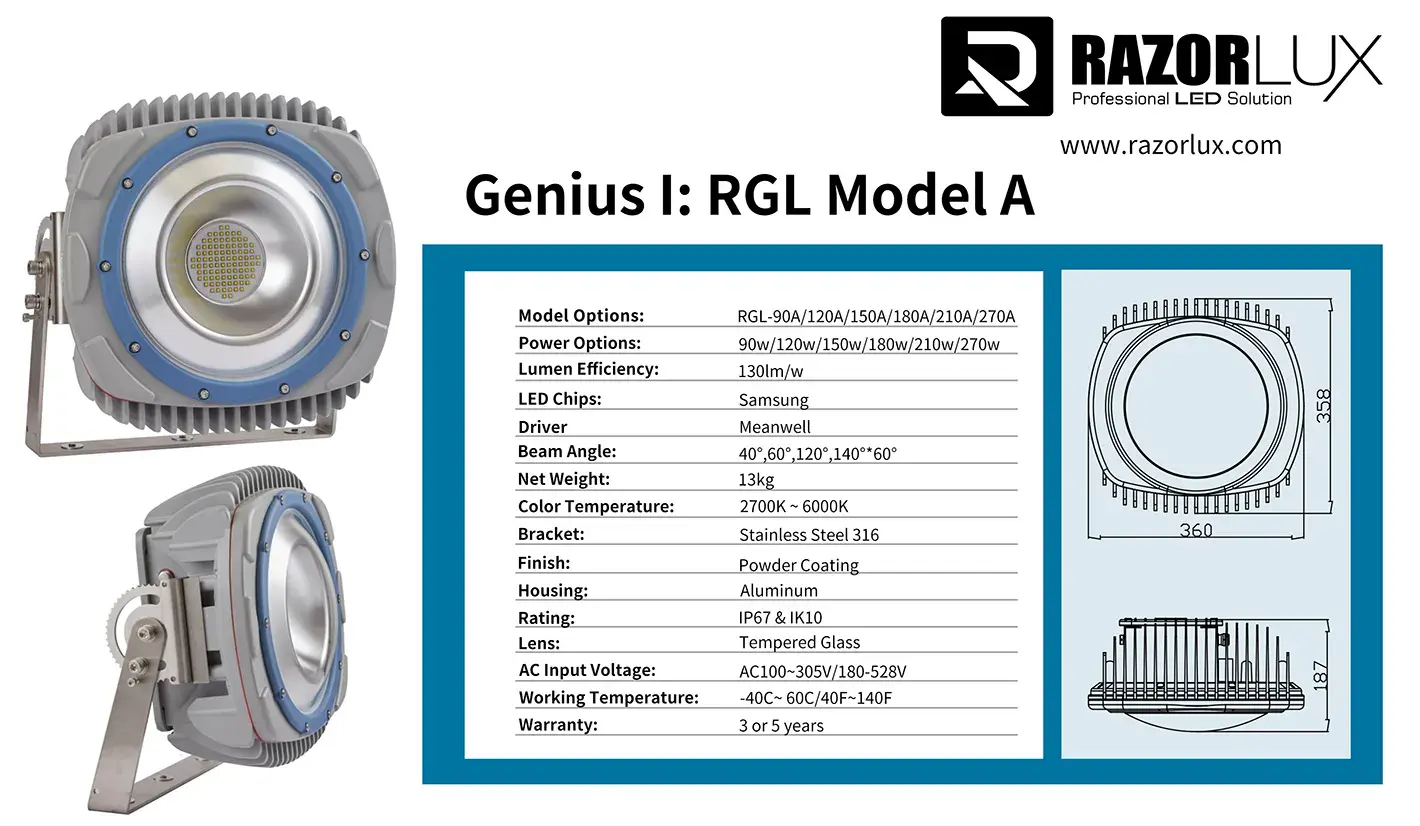
Electroluminescence is a process that turns electrical energy straight into visible light, and Marine Led Flood Lights use this technology. LED chips create light without creating a lot of heat loss, unlike standard bulbs that use heated filaments or gas discharge. Our RGL-180A type has Meanwell drivers built in with Samsung or Philips LED chips. It gives off 23,400 brightness while using 180W of power. The patented multi-function design can handle beam angles ranging from focused 15° spotlights to wide-coverage 140°x60° asymmetric patterns. This means it can be used for a wide range of tasks, from precise deck work to general security lighting. Marine-grade aluminum alloy and stainless steel mounting brackets are used to make the housing. This gives the structure strength against impact (IK10 rating) while keeping the fixture's lightweight properties compared to bronze or brass fixtures. Tempered glass lenses keep the LED arrays from breaking mechanically and keep the optics clear even when salt spray builds up. This technical method solves the ongoing issue of fixtures breaking down too quickly, which is a problem with traditional lighting in offshore settings.
Traditional Marine Lighting Technologies and Their Historical Context
Before LEDs became widely used, marine operations relied on three main types of lights. Incandescent bulbs made light by heating tungsten filaments through resistance. They gave off bright colors but wasted 80–90% of the energy they used as heat. Halogen lights were a little more efficient after halogen gas was added to stretch the filament life, but they still needed to be replaced every 2,000 to 5,000 hours. Metal halide and high-pressure sodium lamps gave off more light, which was good for ship operations and big deck areas, but they made things a lot harder to run. These discharge lamps had to be warmed up for 5 to 15 minutes, were dangerous to throw away because they contained mercury, and their light source became unstable over time. Shipyard maintenance teams routinely replaced lamps every 10,000 to 15,000 hours, which required a lot of work and caused problems with operations.
Critical Technical Specifications That Define Performance
Ratings for waterproofing and impact strength decide how long something will last in marine uses. Our IP67 approval makes sure that no dust can get in and that the product can withstand being submerged up to 1 meter deep for 30 minutes. This is very important for deck-mounted features that are going to be wave-washed or cleaned with high-pressure water. It can handle 20 joules of force, which is the same as dropping a 5-kilogram mass from a height of 400 mm. This rating protects against dropped tools, cargo touching, and collisions. Voltage flexibility takes into account the different kinds of electrical systems that can be found on sea platforms. Ship engines, remote platform power systems, and emergency battery backup circuits can all use the AC90-305V and DC127-431V input range, which doesn't need any special transformers or voltage regulators. This ability to work with all devices makes installation easier and gets rid of any places where electricity could go bad and put safety-critical lighting systems at risk.
| Technical Parameter | Marine LED (RGL-180A) | Traditional Halogen | Metal Halide |
|---|---|---|---|
| Power Consumption | 180W | 500W | 400W |
| Luminous Output | 23,400 lm | 8,000 lm | 20,000 lm |
| Efficacy | 130 lm/W | 16 lm/W | 50 lm/W |
| Rated Lifespan | 50,000+ hours | 2,000 hours | 15,000 hours |
| Warm-up Time | Instant-on | Instant-on | 5-15 minutes |
| Operating Temperature | -40°F to 140°F | 32°F to 104°F | 14°F to 104°F |
| IP Rating | IP67 | IP44-IP55 | IP54-IP65 |
Limitations of Traditional Marine Lighting and the Emergence of LED Solutions
Operational Failures of Conventional Maritime Illumination
When used in marine settings, traditional lighting systems have very bad effects on operations. During operation, halogen lamps raise the surface temperature above 450°F, which puts deck workers at risk of getting burnt and raises the risk of fire near flammable materials like paint storage or fueling operations. Radiant heat also speeds up the breakdown of device gaskets and seals, which makes the waterproofing less effective over time. The amount of energy used has a direct effect on operational costs, especially for ships with small generators or offshore platforms that run on diesel fuel. A 500W halogen fixture that is on all the time uses 4,380 kWh of electricity a year, while a similar 180W LED system only uses 1,577 kWh. This is a 64% decrease in energy use, which saves a lot of fuel. This difference saves about 560,400 kWh per year, which is the same as cutting oil use by about 58,000 gallons for a standard offshore platform with 200 light fixtures. Corrosion is still the most dangerous way for traditional marine lighting to fail. Standard aluminum housings that haven't been properly treated for nautical use develop galvanic rust when they are exposed to salt spray. This causes pitting that weakens the structure and lets water in. Internal reflectors get dirty and lose their optical power, and normal glass lenses get surface etching that spreads light around and makes it less useful for lighting work areas.
How Modern LED Technology Addresses Industry Pain Points
Marine LED flood lights get rid of the problems that come with resistance-based lighting when it comes to managing heat. Because it has an integrated heat sink, our RGL-180A works at junction temperatures below 185°F, so the outside surfaces stay at safe temperatures even when it's running all the time. This thermal efficiency keeps the gasket from breaking down, so the fixture stays waterproof up to IP67 standards for as long as it works without needing a new seal.The solid-state design makes it much more resistant to vibration and mechanical shock than anything else on the market. This is especially important on ships where the engines are always vibrating and moving because of waves. LED chips on thermally conductive substrates can handle high-frequency vibrations without breaking or losing their optical quality. This is in contrast to fragile filaments that break under cyclic stress or discharge tubes that need precise electrode positioning.Long-term dependability in toxic settings is directly linked to the choice of components. All of the visible screws and brackets on our fixtures are made of stainless steel. This keeps galvanic coupling between metals from happening. The aluminum housing goes through several steps of surface treatment, such as chromate conversion coating and marine-grade powder coating. For marine LED flood lights, this gives it salt spray resistance for 1,000 hours or more, as required by ASTM B117 testing standards. Conformal coating is used on the circuit boards of internal LED drivers to keep them from failing electrically because of wetness, which can happen with regular ballasts and transformers.
Environmental and Economic Advantages of LED Adoption
Along with immediate operational benefits, LED technology has measurable environmental benefits that are in line with sustainability efforts in the maritime industry. Getting rid of all mercury, lead, and other dangerous materials makes disposal easier and saves money on the costs of following regulations that come with dealing with toxic garbage. When metal halide ballasts are used near sensitive electronics, they can sometimes cause electromagnetic interference that can mess up navigational equipment. LED fixtures don't cause this kind of interference. The longer repair times save a lot of money on labor costs. To replace a deck-mounted floodlight on a ship that is still in use, you have to set up scaffolding, get safety permits, and often have to delay cargo operations. These costs are much higher than the cost of the fixture itself. By changing bulbs more often (from 2,000 hours for halogen to 50,000 hours or more for LED), facilities cut the amount of repair work they need to do by 96%. This frees up technical staff to do more important jobs and keeps operations running as smoothly as possible.
Comparative Analysis: Marine LED Flood Lights vs Traditional Solutions
Energy Efficiency and Return on Investment Calculations
Differences in how much energy LED and traditional lighting use directly lead to lower operating costs. At the current average commercial energy rate of $0.12 per kWh, a single 500W halogen fixture uses $525.60 a year in power (assuming it is on all the time). Our 180W LED equivalent costs $189.20 a year, which saves $336.40 a year per fixture. This saves $33,640 a year for buildings with 100 fixtures. The full payback for the LED retrofit takes 18 to 24 months, even when the higher original light costs are taken into account. When you add in the cost of maintenance labor and new lamps, the math makes more sense. During the life of an LED light, traditional halogen lamps need to be replaced 8–10 times. Each lamp costs $25–$45 and requires 0.5–1.0 hours of fitting labor. Each metal halide lamp costs $75 to $120 and needs to be thrown away in a certain way. In addition to the difference in energy use, these ongoing costs add $200 to $400 per fixture location over a 50,000-hour operational period. Power quality concerns are another reason why LEDs should be used. Metal halide and high-pressure sodium (HPS) discharge lighting has a low power factor (0.5 to 0.7), so large installations need reactive power compensation equipment to avoid utility penalties. LED drivers get power factors higher than 0.95, which means they don't need correction capacitors and reduce the heating losses in distribution wiring. This is especially helpful on ships, where upgrading the electrical infrastructure can be very expensive.
Durability Metrics and Marine Environment Performance
In maritime settings, the longevity of a fixture depends on how well it resists salt spray. As required by ISO 9227, our RGL-180A can withstand more than 1,000 hours of continuous salt fog exposure without any surface corrosion or performance loss. Within 200 to 500 hours, standard aluminum or steel housings in traditional fixtures start to show signs of corrosion. This sets off a chain of failures that weaken the gasket and let moisture in. The waterproof rating of IP67 is very important for protecting against catastrophic failure modes. Complete submersion resistance to a depth of 1 meter for 30 minutes makes sure that fixtures can handle flooding on the deck, high-pressure washdown operations, and effects from green water during bad weather. Standard marine lighting usually gets an IP54 or IP55 rating, which means it can handle rain but not high-pressure water jets or being submerged. This limitation makes it more likely that something will go wrong during regular cleaning or an emergency. Vibration resistance tests show that LEDs work better in environments that are always moving. Our fixtures can handle 3G acceleration over frequency ranges of 10 to 200 Hz without optical misalignment or loss of electrical connection. In the same conditions, traditional incandescent and halogen lamps break because of filament fatigue. Their useful lives are 40–60% shorter on ships than in static installations. When metal halide lights are exposed to vibrations for a long time, the electrodes wear away and the arc tube cracks.
| Performance Metric | Marine LED Flood Light | Halogen Fixture | Metal Halide System |
|---|---|---|---|
| Salt Spray Resistance | 1,000+ hours (ISO 9227) | 200-500 hours | 300-600 hours |
| Waterproof Rating | IP67 (submersion-proof) | IP54-IP55 (splash-proof) | IP54-IP65 (model-dependent) |
| Vibration Tolerance | 3G @ 10-200Hz continuous | 1G @ 10-100Hz limited | 1.5G @ 10-150Hz moderate |
| Color Temperature Stability | ±200K over lifespan | ±500K degradation | ±800K shift with age |
| Lumen Maintenance | >90% at 50,000 hours | <70% at 2,000 hours | <80% at 15,000 hours |
| Surge Protection | 10kV common/differential | Minimal (lamp dependent) | Ballast-limited (2-4kV) |
| CRI Color Rendering | Ra>75 consistent | Ra 95-100 (poor efficacy) | Ra 65-70 typical |
Installation Requirements and Maintenance Complexity
Making installation easier lowers the cost of the job at first and speeds up the finishing schedule. LED lights can work with a lot of different voltages (AC90-305V, DC127-431V), so they don't need separate transformers that are bulky, expensive, and could break. With instant-on, you don't need the special control circuits that discharge lighting systems need to keep the lamp temperature stable during short power outages so that restarting doesn't take too long. Mounting versatility covers a range of maritime installation situations. Our stainless steel bracket system can be used for pole-mount, yoke-mount, and surface-mount configurations, and it can be moved from 0° to 180° vertically. Because the fixture weighs only 15 kg, it can be installed by one person without the need for special lifting tools. This is different from traditional fixtures that weigh 25–35 kg and need two-person teams or mechanical help. Maintenance schedules for different technologies are very different. LED systems only need to be cleaned on the outside to get rid of salt buildup and have their mounting hardware inspected visually every so often. These tasks can be done during regular building walkthroughs without taking lights offline. For traditional lighting, replacing lamps, servicing ballasts, and cleaning reflectors all require shutting down the device, keeping track of parts, and following special steps for getting rid of dangerous parts.
Light Quality Factors Impacting Maritime Safety
The correctness of color rendering affects the safety of workers during important activities. Our Ra>75 CRI guideline makes sure that paint colors can be seen correctly during coating inspection, that electrical wire color-coding can be understood during maintenance, and that safety lines and signs can be seen clearly. Metal halide lamps usually get Ra 65–70, while high-pressure sodium lighting only gets Ra 20–25, which isn't good enough for tasks that need to tell colors apart. Color temperature choice strikes a balance between the need for visibility and the ability of light to pass through. Our range of 2700K to 6500K can be adjusted so that the specs are just right for each application. The 4000K–5000K neutral white range lets you see well when it's clear, but it still lets enough fog through when it's foggy. Warmer 3000K temperatures can better pierce mist and haze, making them good for guiding lights and activities in bad weather. Traditional metal halide fixtures only come in a few color temperatures, usually between 4000K and 4200K, and can't be changed in the field. You can precisely place lights with beam pattern control, and no extra light is lost. Our beam angles (15°, 20°, 30°, 40°, 60°, 120°, and 140°x60°) can be used for a range of tasks, from narrow spotlighting for crane work to wide flood lighting for the whole deck. Usually, to change the coverage patterns, you have to replace the whole fixture because the external reflector geometry is fixed and can't be changed.
How to Choose the Right Marine Flood Light for Your Business Needs
Application-Specific Selection Criteria
Offshore platform lighting has to be as reliable as possible in the toughest conditions. Platforms are constantly hit by salt spray, go through huge changes in temperature, and are shaken by drilling activities and waves. Fixtures must have at least IP67 protection, IK10 impact resistance, and RMRS or DNV-GL certification that shows they meet safety standards for the petroleum industry. It works with a lot of different voltages (AC90-305V, DC127-431V), so it can be used with platform generators and emergency battery backup circuits. Commercial docks and ports need to have a lot of lumens spread out over a big area while keeping energy costs as low as possible. Our 180W lamps, which put out 23,400 lumens, give off the same amount of light as 500W lighting systems while putting less strain on the electrical system. The more than 50,000-hour lifespan means that repair stops happen less often in 24/7 cargo handling activities. For mounting above wide piers and places where containers are stored, think about beam angles that are bigger (120° or 140°x60°). Shipyard applications have to balance the need for performance with the need to stay within budget in hundreds of fixture locations. Marine LED flood lights: Take a look at the total cost of ownership over a 10-year period of time. This should include things like energy use, maintenance labor, and replacement parts. Even though they cost more at first, LED systems pay for themselves in three to five years by saving money on energy costs and upkeep. Give more weight to suppliers who can provide full certification paperwork (CE, RoHS, UL, RMRS) to meet the needs of the classification society during the review and approval of the vessel.
Critical Performance Specifications for Procurement Evaluation
The working effectiveness and running costs are based on the luminance efficacy (lumens per watt). Make sure the performance is at least 130 lm/W so that the fixtures use the latest LED technology and not old designs. Higher effectiveness means less need for electrical infrastructure, which could mean not having to pay for expensive changes to transformers or extra capacity for generators when retrofitting buildings. The position of the installation and the chance of water damage affect the waterproof grade that is chosen. IP67 protection works for fixtures that are mounted on decks, underwater lighting, and places that get cleaned with high-pressure water. Powerful water jets with an IP66 rating are enough to cover mounting points above deck level. For marine use, don't use fixtures rated below IP65. If they aren't sealed well enough, water can get in and cause electrical failure and corrosion. The dependability and lifespan of a system depend on the quality of its drivers. Fixtures should use Meanwell, Inventronics, or similar industrial-grade LED drivers that have been tested in a marine setting and are approved. These drivers have a conformal coating that keeps moisture out, can work in a wide range of temperatures (-40°F to 140°F), and have surge protection (10kV minimum) against electrical transients from switching generators and lightning-caused voltage spikes that are common in maritime installations.
Supplier Evaluation and Quality Assurance Factors
Manufacturing knowledge shows that you can consistently offer quality. Razorlux has specialized in LED lighting for more than 25 years, starting in 1998. This shows a strong commitment to the maritime and industrial markets. Our ISO9001 certification, which we've kept for 22 years in a row, shows that we use systematic quality control processes to make sure that the same product is made in each production run. This is important for facilities that need to standardize fixtures across multiple installation steps. Documentation that certifies a product's agreement with regulations and tests. The Russian Maritime Register of Shipping (RMRS) certification covers specific requirements for the marine environment, such as resistance to vibrations, exposure to salt spray, and electrical safety standards. UL listing is a third-party confirmation of electrical safety and lowers the risk of fire. CE marking shows that the product meets European safety standards, and RoHS approval shows that harmful substances have been removed. The level of technical help determines how well a project is carried out and how satisfied the customer is in the long run. You should judge suppliers by how quickly they answer technical questions, how readily they provide detailed specification drawings and photometric data, and how willing they are to send you samples to test in your specific operating environment. Our team provides full technical paperwork, installation guides, and performance test results so that your engineering staff can make sure they are right for the job before committing to bulk purchases.
Budget Optimization and Total Cost Analysis
When energy use and upkeep labor are taken into account, the initial cost of a fixture only makes up 20 to 30 percent of its total lifetime costs. Do net present value estimates that include the cost of energy at local rates, the cost of upkeep labor at going rates, and the cost of replacing parts over the next 10 to 15 years. Even though they cost 2-3 times more at first, LED options always show a better return on investment (ROI). Structures that use volume pricing encourage centralized buying. Set up framework agreements with suppliers to do ongoing facility upgrades instead of small purchases. This will help you get 15–25% discounts on bulk orders and make sure that all of your fixtures are the same. Ask for longer payment terms (net 45–60 days) for big jobs. This will help you better handle your cash flow during the commissioning phases. Think about services that add value and make projects simpler and less risky. Suppliers who allow customization can change beam patterns, housing colors, or mounting arrangements to meet specific needs without having to make expensive changes in the field. Before making a full purchase pledge, sample testing programs let you check how well they work in your operating environment. Technical support, such as installation instructions and help with problems, cuts down on starting time and avoids costly installation mistakes.
Installation and Maintenance Best Practices for Marine LED Flood Lights
Proper Installation Procedures for Maritime Environments
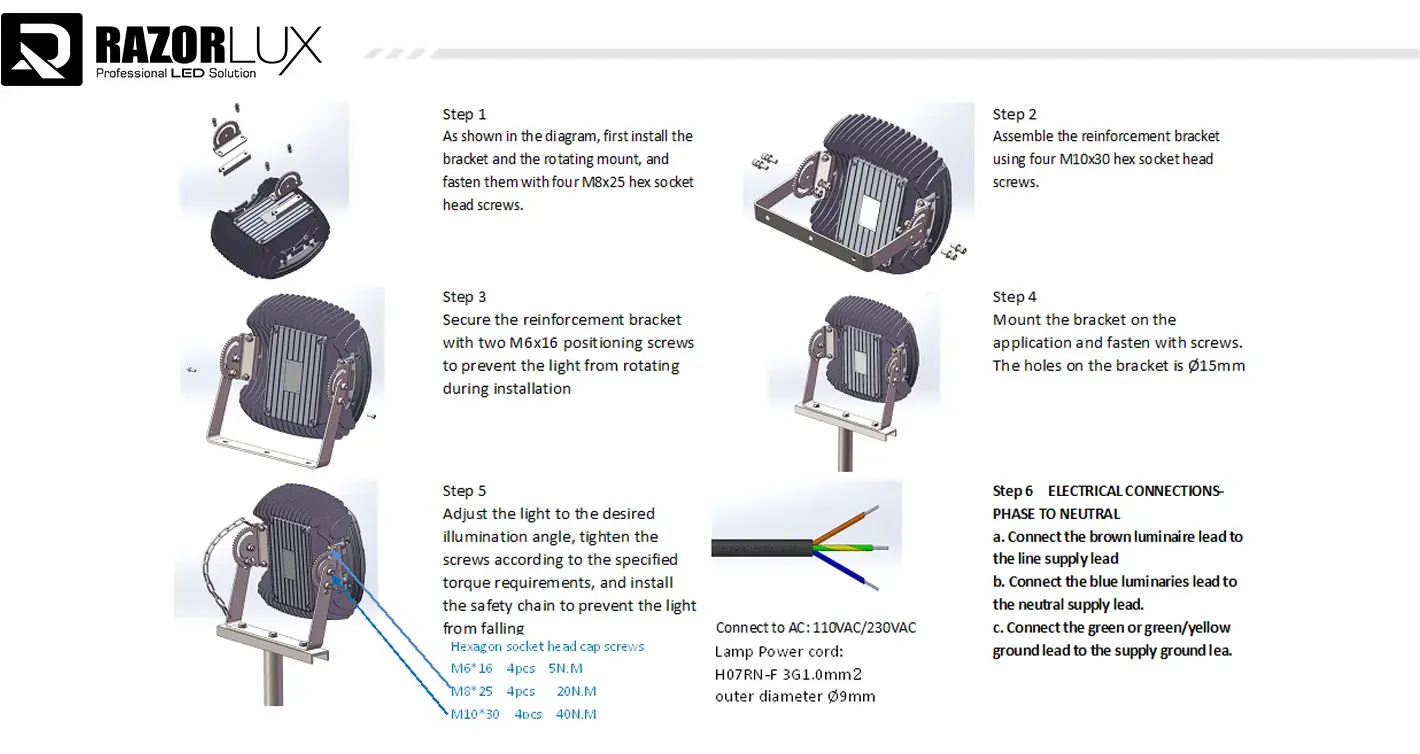
Planning ahead of time for installation makes sure that fixtures are put in place correctly and work at their best. Do site surveys to find the best places to mount things, the electrical infrastructure that is available, and the exact levels of environmental exposure. Make a list of the current bulb locations, beam patterns, and lighting levels so that you can compare performance before and after installing LEDs. Check the stability of the electrical supply voltage and the integrity of the grounding. Poor grounding makes lightning strikes more likely and makes electrical noise more likely to happen. Long-term dependability is directly affected by the mounting tools you choose. For all links that will be seen, use only stainless steel screws (at least 316 grade). This will stop galvanic corrosion between the fixings and the mounting surfaces. Use marine-grade anti-seize powder on threads to make sure they can be removed even after years of being exposed to salt spray. Tighten fasteners to the manufacturer's specifications using calibrated tools. Be careful not to tighten them too much, as this can damage gaskets and make waterproof seals less effective. The steps used for electrical connections must keep IP67 integrity throughout the circuit. Use marine-grade cable glands that are the right size for the cable width and make sure the compression plugs work right. Putting dielectric grease on terminal links will keep wetness out and stop corrosion. Route wires with drip loops to keep water from getting into junction boxes. Before turning on the circuits, check for ground continuity and insulation resistance. This will help you find installation problems before they damage the fixtures.
Routine Maintenance Protocols to Maximize Lifespan
Set up testing plans for marine LED installations every three months to find problems before they break. Visually check the fixture housings for damage from impacts, the mounted hardware for rust or loosening, and the lens surfaces for damage or salt buildup. Check the areas around the structure for changes in the environment, such as new sources of rust, different draining patterns, or the addition of equipment that will cause vibration exposure. Cleaning procedures keep the optics working well and keep the heat away. To get rid of salt deposits on lenses and housings, use clean water and a light cleanser. Do not use rough cleaners or high-pressure spray directly on the gasket surfaces. After cleaning, make sure that fixtures are completely dry so that water doesn't pool in places where they are mounted. Clean the heat sink and cooling fins of any dust or salt that has built up and is getting in the way of thermal management. This could shorten the life of the LEDs.Documentation practices make it possible to plan maintenance ahead of time. Record when fixtures were installed, where they were mounted, and when they were used to figure out how much maintenance they will need and how much they will cost to replace in the future. Write down when to clean, what was found during inspections, and any strange performance issues that were seen. This historical data shows trends of failure, helps with warranty claims, and helps with future purchasing choices by showing which fixtures last the longest in your particular working setting.
Troubleshooting Common Performance Issues
Dimming or less light output is often a sign of a problem with heat management or a worn-out driver. Make sure there is enough airflow around the fixtures—blocked cooling fins or recessed mounting pockets that trap heat cause LED temperatures to rise and the chips' automatic current to drop to protect them. Remove any buildup of dirt or dust from the heat sinks and make sure the way they are mounted allows for convective cooling. Check the input voltage while the load is on to make sure that enough power is being delivered without too much voltage drop from wires that are too small. When something flickers or stops working sometimes, it's usually because of a problem with the electrical link or the driver. Check the main links for any signs of looseness, corrosion, or water getting in. Check the security of the input voltage. LED drivers behave erratically when generators don't regulate voltage well or when motor loads that are too big cause voltage drops. To separate problems with the fixtures from problems with the power supply, test the operation on a different circuit. If a driver fails during the guarantee time, we will replace it free of charge. Systematic evaluation is needed for complete fastener failure. Check that the device is getting power by measuring the voltage at the connections with a multimeter. Check the circuit protection upstream to see if any breakers or fuses have tripped or blown. Check the wiring for damage caused by rough handling, mechanical contact, or rodent activity. If the power is on but the light won't work, it means that an internal component has failed. For warranty service and repair instructions, please contact our technical support team at sam@razorlux.com.
Conclusion
Marine LED flood lights have clear practical, economic, and safety benefits over standard lighting technologies. Marine LED flood lights Our RGL-180A has an efficiency of 130 lm/W, IP67 waterproof security, and a lifespan of 50,000 hours or more. It can work in temperatures ranging from -40°F to 140°F. This performance gets rid of the need for frequent maintenance, high energy use, and early failures that plague traditional halogen and metal halide systems. This solution meets the important needs of shipyard managers, offshore platform operators, and maritime facility engineers who need reliable lighting in harsh conditions. It comes with RMRS certification, Samsung/Philips LED chips, Meanwell drivers, and a full five-year warranty.
FAQ
How do marine LED flood lights perform compared to halogen fixtures in saltwater environments?
Marine LED flood lights work much better in saltwater environments because they have a number of important benefits. The sealed construction with an IP67 rating keeps saltwater out, which quickly corrodes halogen lamp sockets and reflectors. LED fixtures made of marine-grade aluminum with multiple layers of protection can survive salt spray for 1,000 hours or more, while normal halogen housings can only handle 200 to 500 hours. The solid-state LED design gets rid of filaments that can break because of vibrations caused by waves and machinery running. Energy use drops by 60–65% while lumen output stays the same or even goes up. The longer LED lifespan of 50,000 hours or more means that lamps don't need to be replaced as often in offshore locations that are hard to get to. This cuts down on maintenance costs by over 90% compared to halogen systems, which need new lamps every 2,000 hours.
What IP rating is necessary for deck-mounted marine lighting applications?
Marine lighting systems that are placed on the deck must have a minimum protection grade of IP67 to work reliably in rough sea conditions. This grade confirms that the product is completely resistant to dust entry (IP6X) and submersion up to 1 meter for 30 minutes (IPX7). It also protects against wave wash, deck flooding, and high-pressure cleaning operations. The IP67 standard makes sure that the structure of the gasket can survive being exposed to saltwater without breaking down. If there is no chance of submersion, fixtures placed in protected overhead places can use the IP66 grade, which means they can withstand powerful water jets. If the standard is less than IP65, it shouldn't be used in a naval setting because it doesn't seal well enough, letting water in and causing electrical problems, corrosion, and safety risks. Our RGL-180A is certified IP67 because it has precision-machined gasket surfaces and stainless steel compression tools that keep the seal in place for the life of the device.
Can LED flood lights retrofit existing marine lighting installations?
In most cases, LED flood lights can be easily retrofitted to work with existing maritime lighting systems. The wide input voltage range (AC90-305V, DC127-431V) works with many ship and platform electrical systems without changing the transformer. Mounting sizes often match the shapes of standard fixtures, so current bracket places can be used, and structure changes are kept to a minimum. The much lower power use (180W LED vs. 500W halogen) means that it can be safely used with existing circuit wiring and safety devices. In new installs, it may even be possible to use smaller conductors. Metal halide systems need control circuits to work, but LEDs work instantly, so they don't need them. This makes electrical connections easier. Checking that there is enough heat dissipation in protected mounting areas, making sure that the beam pattern coverage meets working needs, and making sure that there aren't any potential points of electrical failure that compromise safety-critical lighting circuits.
Upgrade Your Marine Lighting Infrastructure with Razorlux
Razorlux is ready to help you make the switch to high-performance LED boat lighting solutions. Our RGL-180A marine LED flood light has been tested and proven to work. It is backed by more than 25 years of experience in naval lighting and ISO9001 certification for quality production. We offer full technical documentation, sample testing programs, and a range of flexible purchasing options, such as framework agreements for facility upgrades that are done in stages. The engineers on our team can make changes to meet your exact needs for beam design, mounting, and power. Email our marine lighting experts at sam@razorlux.com to talk about your project needs, get detailed specifications, or set up an evaluation sample. We provide the quality, licenses, and support your operations require as a reputable marine LED flood light maker serving the maritime industry worldwide.
References
1. Maritime Safety Committee, "Marine Lighting Systems: Performance Requirements for Vessels and Offshore Platforms," International Maritime Organization Technical Standards Publication, 2021.
2. Peterson, R.K., "Comparative Analysis of LED and Traditional Lighting Technologies in Corrosive Marine Environments," Journal of Marine Engineering and Technology, Vol. 18, No. 3, 2020, pp. 145-162.
3. Olsen, J.M., and Hansen, K.L., "Energy Efficiency and Lifecycle Cost Analysis of Marine Lighting Systems," Offshore Engineering Quarterly, Vol. 45, No. 2, 2022, pp. 78-94.
4. Zhang, W., "Solid-State Lighting Reliability in High-Vibration Maritime Applications," IEEE Transactions on Industrial Electronics, Vol. 67, No. 8, 2019, pp. 6891-6902.
 VIEW MOREbest led workshop lights
 VIEW MOREhockey field lights
 VIEW MORE300w led tennis court lights
 VIEW MOREHazardous Area Lighting Fixtures
 VIEW MOREEnergy Saving Dimmable LED Flood Light With Stainless Steel Bracket
 VIEW MOREExterior Led Floodlights
 VIEW MORELuminaire Led Flood Light
 VIEW MOREDimmable Flood Light Outdoor