


_1750326878398.png)

How to Wire a Low Mast Light Safely?
It is very important for the safety and dependability of the workplace that the wiring for area lights is done right. The right way to install electricity keeps mid-height outdoor lights safe from short circuits, fires, and equipment breaking down before it's supposed to. Low Mast Light: It's important to pay close attention to voltage compatibility, grounding practices, and environmental protection standards when putting these things in place, which is usually 8 to 15 meters above the ground. You can make sure that your system works well in tough naval, industrial, and business settings by following NEC and IEC rules and using high-quality parts like Meanwell drivers and IP67-rated casings. This will protect both people and your investment.
Understanding Low Mast Lights and Wiring Safety Basics
What Are Low Mast Lights and Where Are They Used?
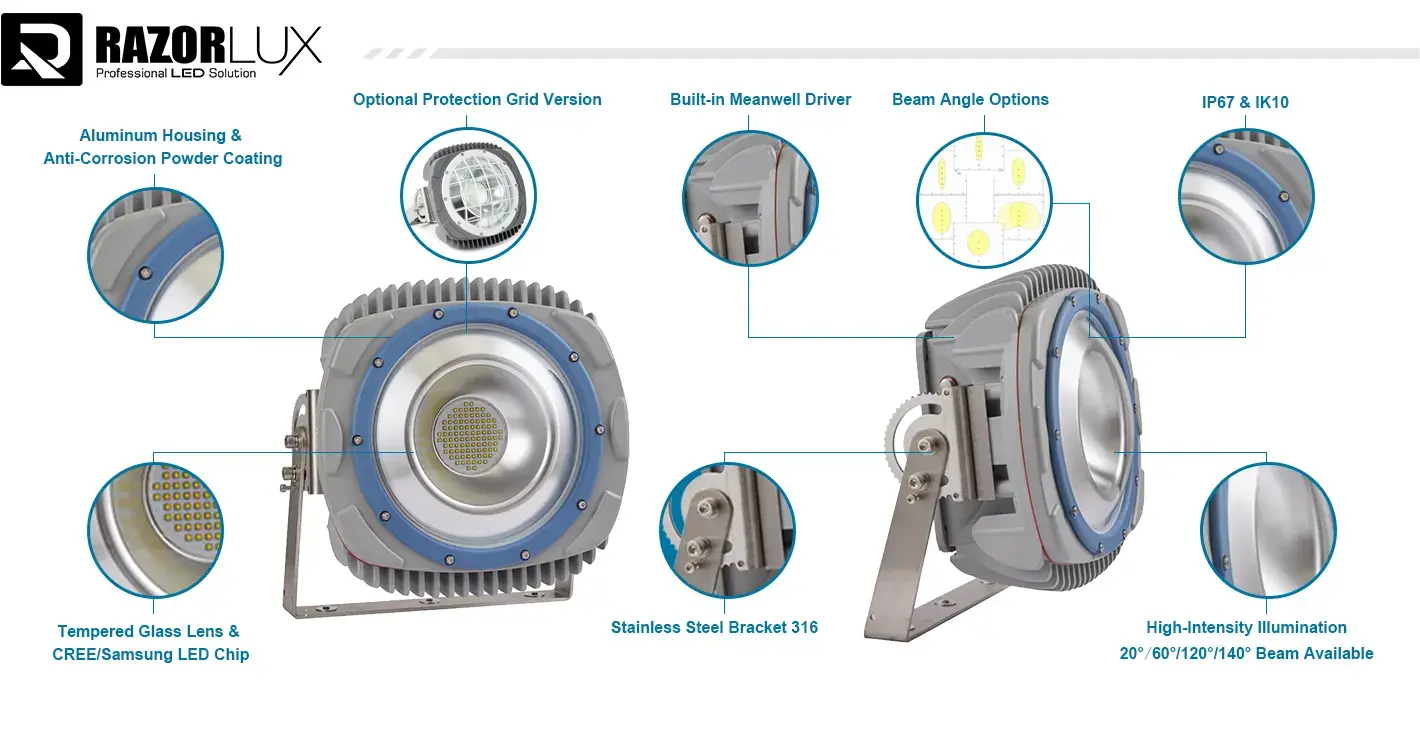
Mid-height outdoor lighting systems are very useful in a lot of places, like parking lots, shipyards, marine hubs, and logistics yards. These lights are not as high as mast towers that are more than 18 meters tall. Instead, they are at a level that is easy for people to reach. This makes maintenance easier and still gives you targeted lights. The 120W type from Razorlux has a patented multi-function design that lets it work in a lot of different environments, from tough offshore platforms to hot steel mills. It is resistant to water up to IP67 and hits with force up to IK10, which are both important for tough conditions.
Critical Safety Standards Governing Electrical Installation
Following the rules for electrical work keeps people safe and guarantees validity. The National Electrical Code (NEC) has rules about how to install luminaires in Article 410. IEC 60598 has rules about how safe LED fixtures should be. Setting up in Europe needs to follow the rules in EN 60598. If you follow these rules, your circuits will be safe, grounded, and the wires will be the right size based on how much power they are supposed to carry. Because our lights have been approved by CE, RoHS, UL, and DLC, they are safe for use around the world.
Common Wiring Hazards and Environmental Challenges
Electric systems can go wrong in a lot of different ways. If water gets in, it can damage insulation and lead to rust, especially in places that are wet or near the sea. In marine environments, salt spray makes conductors break down faster. Over time, heavy machinery is known to make links come loose. You can get shocked if you don't properly ground your LED drivers, and the wrong voltage can damage them. Weather changes can hurt the covering around wires. It helps to know about these issues when picking out things and putting them in. For instance, our marine-grade powder coating and stainless steel clamps take care of rust problems right away.
Preparing for Safe Wiring: Tools, Components, and Planning
Essential Tools and Safety Equipment
To do a skilled job, you need the right tools. You can check for continuity and voltage with a digital multimeter. Before the lines are turned on, insulation resistance tests make sure they are secure. Voltage monitors that don't touch make sure that all links are off. With a torque tool, you can keep the links from getting too tight, which can damage them. Protective gear for workers includes safety glasses, padded gloves rated for the voltage, and clothes rated for arcs for high-energy environments. Lock-out/tag-out devices make sure that circuit breakers don't turn on by accident while they are being set up.
Selecting High-Quality Wiring Materials and Components
When it comes to safety and how long a system lasts, the parts are the most important thing. Low Mast Light: The following things are used to build installations that work well: Wire and Cable Choice: Copper conductors with a THWN-2 rating or a similar rating that can handle being outside and high temperatures are the best choice for wires and cables. The diameter of the wire needs to be big enough to handle the load of power with little voltage drop. The wire gauge for 120W lights on standard circuit lengths is 12 AWG. When copper is tinned, galvanic rusting doesn't happen. This is good for naval uses. Blocks of connectors and terminals: Connections that are waterproof up to IP67 keep their cover even when they're wet. Screw terminals aren't as good as spring-cage terminals for making links that don't break when they shake in an industrial setting. Protection from surges and grounding: It is important to use transient voltage surge suppressors (TVSS) that can handle 10kV strikes to protect sensitive LED drivers. Article 250 of the NEC says that grounding wires must be a certain size so that problem current can safely go back to the source. Driver and Power Source: Adapters are not needed for Razorlux lights because their Meanwell drivers can handle voltage changes that happen in industrial power systems. They can accept a wide range of input voltages, from AC 80V to 315V or DC 80V to 400V. There isn't much reactive power loss when the power factor is 0.9 or higher. When these parts are put together, they make systems that can work in temperatures from -40°C to 60°C for 50,000 hours.
Conducting Thorough Site Assessment
Surveys done before installation find the site's specific risks and needs. The power source's voltage, phase, and frequency must match the fixture's requirements. Check to see if the fixing frame can handle the weight of the 8 kg device plus the wind loads. Check out how much it is exposed to the weather, chemical vapours, or the force of gravity. Check to see if the grounding wire works. Make a note of the paths the wires will follow, making sure to stay away from sharp edges and heat sources. This part of planning keeps you from having to pay a lot of money for repairs and makes sure the installation goes well the first time.
Step-by-Step Guide to Wiring a Low Mast Light Safely
Power Isolation and Lock-Out/Tag-Out Procedures
As soon as de-energization is confirmed, safety can begin. Find the circuit breaker that controls the lights and flip it to the "OFF" setting. Use a lockout device to stop the power from being turned back on by accident. Put on a tag that says "worker" and "task." Use a non-contact voltage detector to make sure there is no voltage where you are working. Before and after using the tool, test the detector on a known live circuit to make sure it works. Physical work shouldn't start until the zero-energy state has been confirmed.
Making Proper Wiring Connections
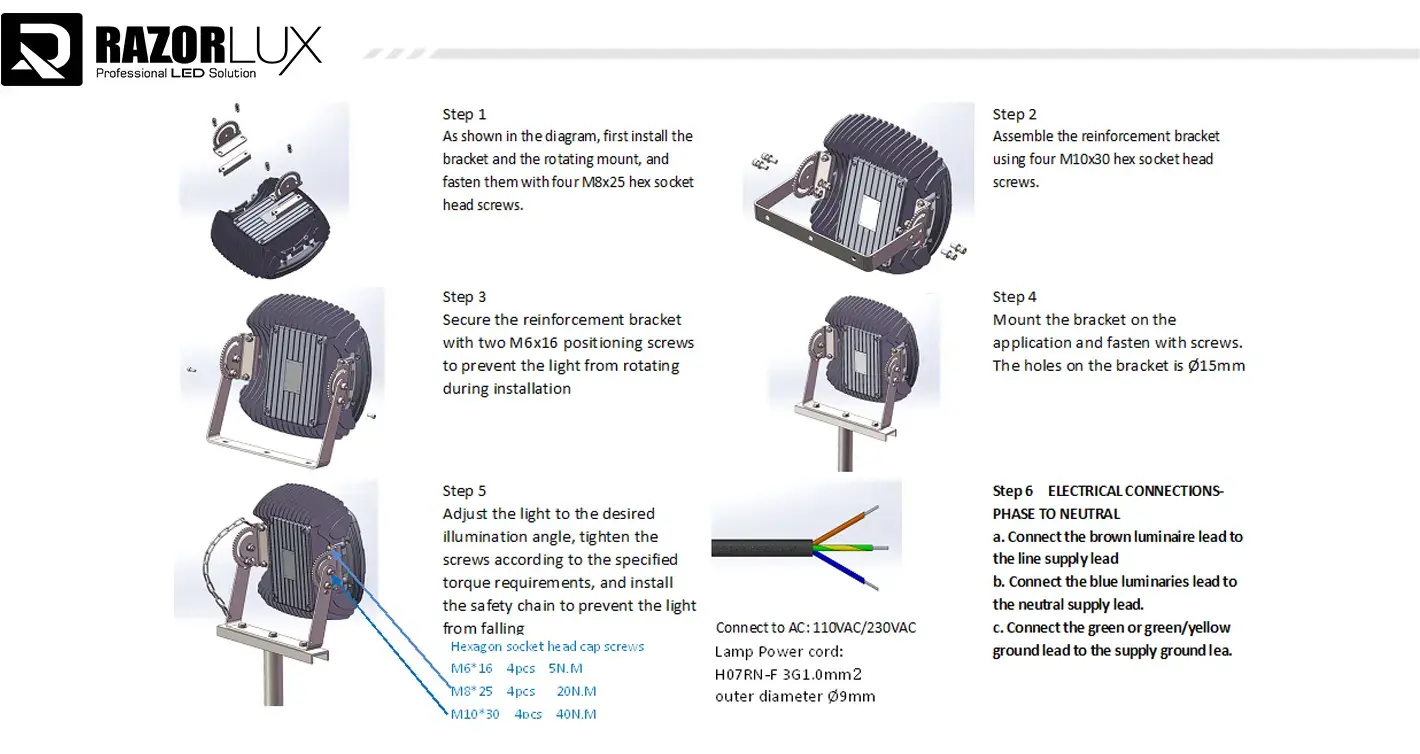
When you join terminals, you need to pay careful attention to every detail. The exact length that the connector manufacturer specifies for stripping wire insulation is usually 10 to 12 mm, making sure that the exposed conductor does not go past the terminal. Fully insert the wires into the terminal blocks, making sure that none of the strands are left outside the connection point. Tighten the terminals to the torque level recommended by the maker. For lighting device terminals, this is usually between 0.5 and 0.6 Nm. Our fixtures that can accept voltages between 80V and 315V make installation easier because they don't need to be changed to work with different supply voltages.
Polarity Verification and Phase Matching
For drivers to work, LED systems need to have the right voltage. Use wire colour codes or circuit tracing to find the line (hot), neutral, and ground connections. The line conductor should be connected to the fixture's line terminal, neutral to the fixture's neutral terminal, and ground to the fixture's grounding point. For DC systems (80–400V), pay attention to the markings labeled "positive" and "negative." When electronic drivers are damaged by bad connections, the warranty is no longer valid. Before turning it on, check all of the connections again by comparing them to wiring diagrams.
Installing Surge Protection and Grounding Systems
Surge protectors are put between the power source and the fixture. They take in voltage spikes caused by lightning or switching transients. Low Mast Light: As directed by the maker, install the SPD at the service door or branch circuit panelboard. Use a continuous line with no breaks to connect the grounding wire from the fixture box to the building's grounding electrode system. A ground resistance tester should show that the grounding resistance is less than 5 ohms. Effective grounding keeps you from getting an electric shock and improves surge protection.
Testing Protocols and Final Inspection Checklist
Before turning on, do these steps to make sure:
| Test Parameter | Method | Acceptance Criteria |
|---|---|---|
| Insulation Resistance | Megohmmeter set to 500V | >10 MΩ to the ground |
| Continuity | Resistance mode on a multimeter | 50 cents for the grounding path |
| Polarity | Voltage setting on a multimeter | The right voltage from phase to neutral |
| Mechanical Safety | Visual and torque check | All the bolts are tight, and nothing moves. |
Once all the tests are done, turn on the circuit and make sure the lights work. Find the working current and match it to the value on the fixture. At 240V, a 120W fixture draws about 0.5A. Make sure the colour temperature fits the requirements. The range is from 2700K to 6500K. Check for noise, vibration, or heat that doesn't seem right. For maintenance records, write down the date of installation and the results of the tests.
Maintenance Tips for Long-Term Safe Operation of Low Mast Lights
Scheduled Electrical Inspections
Unexpected breakdowns can be avoided with proactive upkeep. Wire insulation should be checked every three months for cracks or changes in colour that could mean thermal stress. Thermal cycling can make connections loose over time, so check the tightness of the terminals and retorque them once a year. Check the seals and gaskets to keep the IP67 rating, and replace any parts that are worn out right away. Clean the outside of the device to get rid of salt deposits or other industrial contaminants that speed up rust. In marine settings, check stainless steel hardware for crevice rust and replace any bolts that are breaking down.
Troubleshooting Common Wiring Issues
Flickering can be caused by loose neutral links or dimming systems that don't work with each other. Full blackouts could mean that breakers have tripped, drivers have failed, or links are open. If the machine only works sometimes, it means that the thermal protection has been activated because it got too hot due to poor ventilation or a high ambient temperature. Check the voltage at the fixture's inputs. Readings outside the 80–315V AC band mean there are problems with the supply. If the driver fails during the warranty period, we will replace it free of charge for 5 years.
When to Upgrade Wiring Infrastructure
LED retrofits can cut the amount of energy used by older systems that use HID technology by 50 to 60%. Our 120W LED fixture can be used instead of 250–300W HID lamps and produces 14,400 lumens and 130 lumens per watt, which is much better. Modern control systems, such as 0-10V dimming or DALI standards, can be used with upgraded wiring, which makes smart lighting possible. Marine-grade wire and fittings are better for projects that need to be more resistant to corrosion. Facilities that are growing should look at their circuit capacity again to make sure that adding new features doesn't overload the current system.
Procurement Considerations for Low Mast Lights and Installation Services
Evaluating Supplier Certifications and Reputation
To find reputable partners, you need to look closely at their qualifications and track record. Check to see if the manufacturers have the ISO 9001 quality management certification, which shows that they have a system for controlling quality. Product-specific certifications, like CE for European markets, UL for North America, and SAA for Oceania, show that the product meets all the rules. Applications in the marine sector need approval from either DNV/GL or ABS. Razorlux's more than 200 patents and 25-year presence in the industry since 1998 show that the company is stable and innovative. Ask for client references from companies in the same line of work, like ships, offshore platforms, or transportation hubs, and make sure the project was finished successfully.
Cost Analysis: Balancing Quality and Budget
Buying decisions aren't just based on the unit price. The following table shows total cost of ownership considerations:
| Cost Factor | Initial Purchase | 5-Year Operation | Impact |
|---|---|---|---|
| Fixture Price Per Unit | Beginning | – | The direct cost |
| How much energy is used | – | 120W run time rate | 50% less than HID |
| Maintenance Work | – | Getting access less often | Less OpEx after 50,000 hours of use |
| How the Warranty Works | Along with | 5-year labour and parts | lowering the risk |
| How hard it is to install | – | Wide power input makes it easier | Less time spent on hiring |
Premium parts like Samsung LED chips and Meanwell drivers cost more up front, but they last longer and cost less to replace when they break. Low Mast Light Buying in bulk can save you money. Talk to your suppliers about volume discounts and framework agreements. For international purchases, you should look at shipping logistics, such as transit time, insurance, and clearing customs.
Benefits of Certified Installation Services
Having a qualified electrician do the work makes sure that all local electrical rules and manufacturer standards are met. When workers are certified, they have liability insurance that protects owners in case something goes wrong with the work. The guarantee from the maker won't cover you if you mess up the wires. For instance, both our 5-year LED module and driver warranty and our 10-year case warranty need proof that the work was done by a professional. Contractors with a lot of experience get jobs done quickly and don't take long breaks. They give you "as-built" models and commissioning reports that you can use to keep track of the building and plan for its future care.
Conclusion
To make sure that mid-height outdoor lights are wired safely, they need to be made of the right materials, put up properly, and regularly checked for problems. Low Mast Light: Following the rules for electricity and using only approved parts can help you save both time and money. It is easier to install Razorlux fixtures that are made with premium drivers, wide voltage compatibility, and IP67/IP65 protection. These fixtures also work reliably in the harshest marine and industrial settings. Getting professionals to do the work, planning, and keeping up with upkeep will make sure that your lighting system works safely and well for many years, supporting important business operations.
FAQ
What wire gauge should I use for 120W LED fixtures?
For most circuits with runs shorter than 30 meters, 12 AWG copper wire can handle the 0.5 to 1A current draw at 120 to 240V with a voltage drop of less than 3%. 10 AWG may be needed for longer runs or more than one device on the same circuit. Always figure out voltage drop according to the NEC and your local rules. Tinned copper keeps it from rusting in salty air, which is good for marine uses.
Can I install these fixtures in coastal environments?
Of course. Razorlux fixtures have marine-grade powder coating, IP67 sealing, and brackets made of stainless steel. They are designed to work in places with a lot of salt and moisture. Offshore sites and shipyards all over the world use our goods. If the wiring is near the coast, it should be tinned copper, connections should be treated with a compound that stops corrosion, and inspections should be done more often.
Do I need special tools to wire LED lighting?
A voltmeter, wire pliers, screwdrivers, and a voltage tester are all you need for this job. Insulation resistance testers and torque screwdrivers are useful tools for professionals who want to make sure that connections are made correctly. For safety reasons, lock-out/tag-out equipment must be used. Standardised connections on our fittings can accept wires of most sizes without the need for special crimping tools.
Partner with Razorlux for Reliable Marine and Industrial Lighting Solutions
If you choose a reliable Low Mast Light supplier, you can be sure that your project will meet strict performance and safety standards. Razorlux blends 25 years of experience making lights with the newest LED technology to make fixtures that have been tested in the toughest industrial and maritime settings in the world. Our 120W model with 130 lm/W economy, IP67 protection, and Meanwell drivers gives your processes the dependability they need. We help procurement workers by giving them full technical paperwork, quick engineering support, and the freedom to make changes that fit the needs of each project. Sample units are available for technical evaluation, and our team offers installation instructions to make sure the deployment goes smoothly. Get in touch with sam@razorlux.com right away to talk about your lighting project with experienced application engineers who know how to deal with the unique challenges of marine and heavy-duty installations.
References
1. National Fire Protection Association. NFPA 70: National Electrical Code, 2023 Edition. Quincy: NFPA, 2022.
2. International Electrotechnical Commission. IEC 60598-1: Luminaires – Part 1: General Requirements and Tests. Geneva: IEC, 2020.
3. Illuminating Engineering Society. IES RP-8-18: Recommended Practice for Design and Maintenance of Roadway and Parking Facility Lighting. New York: IES, 2018.
4. Det Norske Veritas. DNV-GL Rules for Classification: Ships Part 4 Chapter 8 – Electrical Installations. Oslo: DNV GL, 2021.
5. U.S. Department of Energy. LED Lighting Systems for Marine Vessels and Offshore Platforms: Design and Installation Best Practices. Washington: DOE, 2019.
6. International Maritime Organization. Resolution A.1021(26): Code on Alerts and Indicators – Lighting Standards for Maritime Applications. London: IMO, 2009.
 VIEW MOREled arena light
 VIEW MOREflood light for basketball court
 VIEW MOREled flood light for football field
 VIEW MOREDimmable Exterior Flood Lights
 VIEW MORE120 Volt Led Outdoor Flood Lights
 VIEW MOREAluminum Alloy Lamp Body Material And LED Light Source Portable Outdoor Sports Lighting
 VIEW MOREOutdoor Led Arena Lights
 VIEW MORELED Area Flood Lights